New Displays for the Bronzes of San Casciano dei Bagni. Reggio Calabria, Berlin and Aquileia
Massimo Osanna, Jacopo Tabolli
in collaboration with Chiara Bonanni and Guglielmo Malizia
Abstract
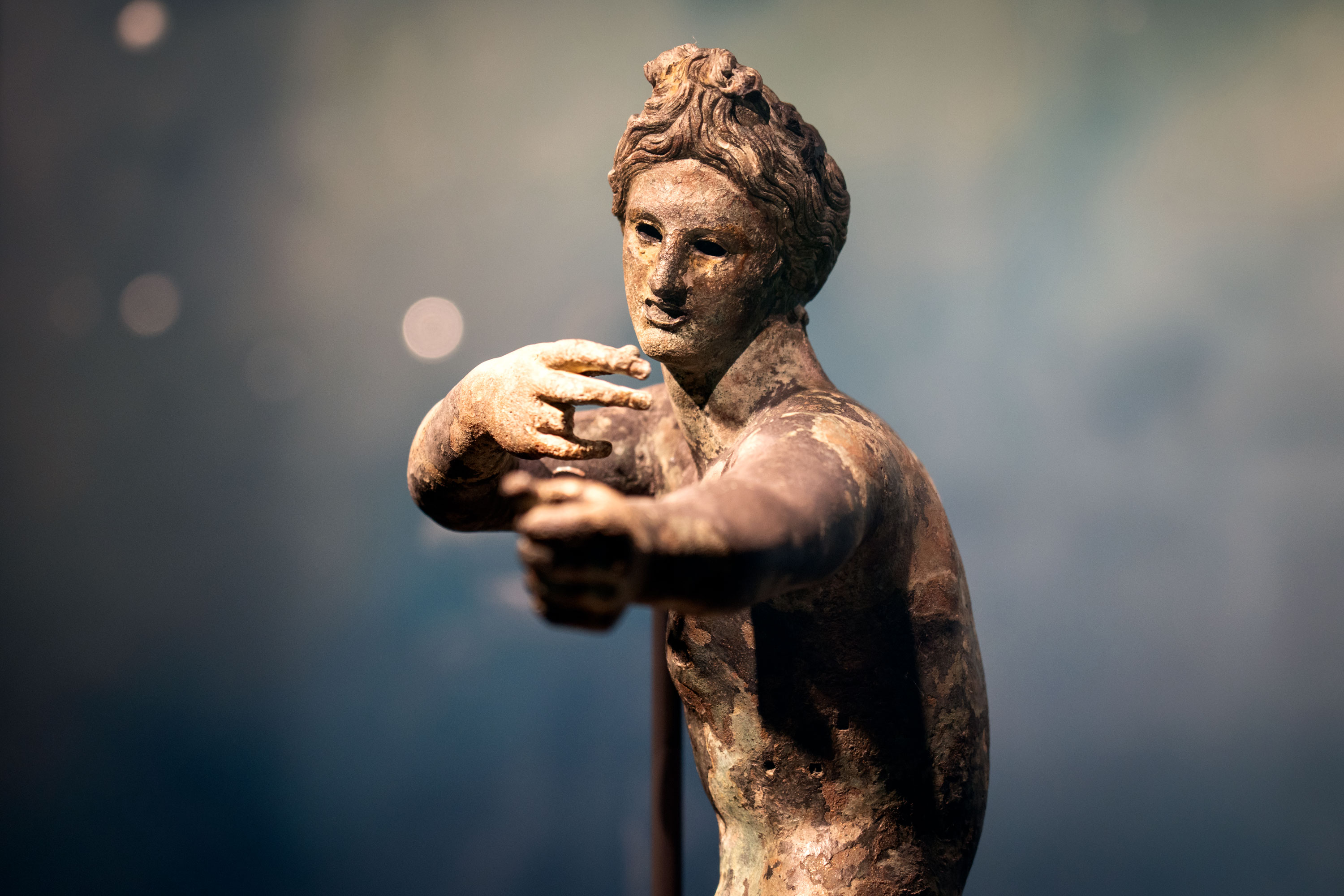
1 | Apollo at Palazzo del Quirinale, photo by Emanuele Antonio Minerva – MIC.
In previous issues of “La Rivista di Engramma” (Tabolli 2023; Osanna, Tabolli 2024b), we have presented the exhibition trajectory of the Bronzes of San Casciano, starting from their display at the Quirinal Palace in Rome (Osanna, Tabolli 2023) and at the National Archaeological Museum of Naples (Osanna, Tabolli 2024a).
As the excavation at the Etruscan and Roman of Bagno Grande at San Casciano dei Bagni continued (Mariotti, Salvi Tabolli 2023; 2025) between August 2024 and March 2025, the exhibition was presented at the National Archaeological Museum of Reggio Calabria (MArRC), within a radically different spatial context (Osanna, Tabolli 2024-2025). The exhibition enters into dialogue both with the identity of the museum itself – as the home of the Bronzes of Riace – and with contemporary approaches to context-oriented archaeological museography. As in the previous displays, the exhibition design was conceived as a temporary intervention capable of constructing a contextual narrative device, rather than a mere display of excavation assemblages. The layout organizes the artefacts along a path that places the thermo-mineral context of the Bagno Grande sanctuary and the processual dimension of archaeological research at its core, guiding visitors “through the landscape of sacred waters” and its historical and cultural stratifications. The exhibition sequence – structured as a spatial-temporal progression, beginning with a section dedicated to the territory and the history of research and followed by a focused exploration of the votive deposits – integrates statues, small bronzes, and anatomical offerings as evidence of ritual and therapeutic practices. This approach reinforces a “choral” reading of dedications and inscriptions – the “voices” of the dedicants – transforming the visit into an interpretative reconstruction of the site.
At the James-Simon-Galerie in Berlin, the exhibition The Bronzes of San Casciano dei Bagni. A Sensation from the Mud (5 July-12 October 2025), conceived together with colleagues Martin Maischberger and Agnes Schwatzmeier (Osanna et al. 2025), proposed an exhibit design that highlights the exceptional nature of the archaeological finds through a carefully calibrated dialogue between ancient art and contemporary museum space. Installed within the large galleries dedicated to temporary exhibitions, the arrangement of the bronzes does not merely replicate the sequence of their discovery, but instead constructs a spatial continuum that invites visitors to traverse a kind of “ritual landscape,” evocative of the ancient Etruscan-Roman sanctuary of San Casciano dei Bagni, while also engaging in dialogue with materials from the territory of the ancient Etruscan city-state of Chiusi preserved in the Berlin collections. The works - from cult statues to small votive bronzes – are presented with rigorous attention to three-dimensional visibility, narrative sequencing, and their relationship with the architectural surfaces of the Galerie. The exhibition design – abandoning the aquatic blue tones that characterized previous installations and recontextualizing the objects within a black spatial environment - exploits overhead light and the open volume of the galleries to create contrasts and perspectives that enhance the material presence of the bronzes and the sense of discovery. Didactic panels, bilingual captions, and neutral chromatic choices support the historical and cultural legibility of the artefacts, here exhibited outside Italy for the first time. The architecture of the James-Simon-Galerie, with its large volumes and modern language, thus becomes not merely a container but an active interpretative device, capable of accompanying the visitor from the formal perception of the sculptures to their ritual and anthropological contextualization.
In its most recent stage at the National Archaeological Museum of Aquileia, from 5 December 2025, the Bronzes of San Casciano dei Bagni are presented within an exhibition layout (Osanna and Tabolli 2025-2026) organized in the new musealized storage areas, redefined as temporary exhibition spaces (in the project by Studio Modland) while remaining fully integrated into the museum’s structure. This setting reflects a curatorial strategy aimed at simultaneously enhancing the material and documentary richness of the largest deposit of Etruscan and Roman bronzes ever discovered in Italy. The exhibition design exploits the vertical and horizontal spatiality of the storage areas – also characterized by rich mosaic pavements – transforming an environment traditionally dedicated to conservation into a narrative device in which more artefacts, including those from the 2024 excavation campaigns presented to the Italian public for the first time, engage in dialogue with one another and with visitors. Statues, votive figurines, anatomical offerings, and coins are arranged in display cases and niches that recall the stratification of the original discovery context, evoking the presence of sacred waters and the centrality of thermal ritual practices within the sanctuary of San Casciano. The exhibition further exploits the darkening of the storage lighting system, deliberately suspending the usual visibility of the deposits to create a sharp contrast between the fully illuminated bronzes of San Casciano and the surrounding display of stored materials, perceived as “ghosts of things.” Far from a merely atmospheric effect, this choice establishes a high-level, intellectual dialogue based on meta-references between presence and absence, visibility and latency. The musealized deposits thus function not as a background, but as a parallel, reflective layer, proposing a kind of second, implicit itinerary that runs alongside the exhibition path – one that invites visitors to reflect on the status of archaeological objects, the conditions of their preservation, and the shifting boundaries between exhibition, storage, and interpretation. The decision to exhibit the bronzes within museum storage spaces is far from neutral: it overturns the traditional hierarchy between spaces of conservation and spaces of display, proposing a process of scientific and museographic legitimization that emphasizes the provenance, chronology, and ritual functions of the objects, enriched by interpretative tools intertwining typological, epigraphic, and contextual perspectives. Beyond offering a rich and layered visitor experience, this exhibition foregrounds the relationship between archaeological heritage and the new museological use of storage spaces, contributing to the contemporary debate on exhibition architecture and the musealization of archaeological materials.
Across its successive displays, the Bronzes of San Casciano dei Bagni emerge not as fixed masterpieces but as a dynamic archaeological corpus whose meaning is continuously rearticulated through exhibition design: in Reggio Calabria, Berlin, and Aquileia, architecture, light, and spatial sequencing become integral to the interpretation of the sanctuary itself, allowing the material evidence of ritual, healing, and deposition to be re-read through a series of site-specific, yet conceptually coherent, museographic translations
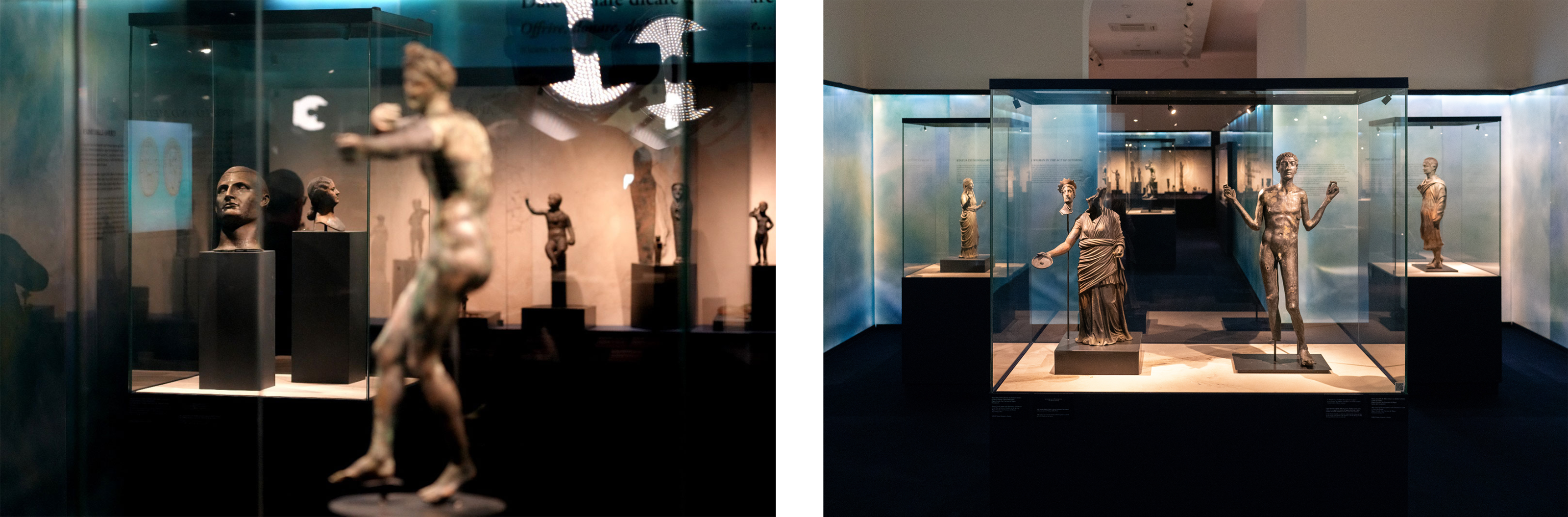
2 | The exhibit at MANN Naples, photo by Emanuele Antonio Minerva – MIC.
3 | Encountering the thermo-mineral spring at MANN, photo by Emanuele Antonio Minerva – MIC.
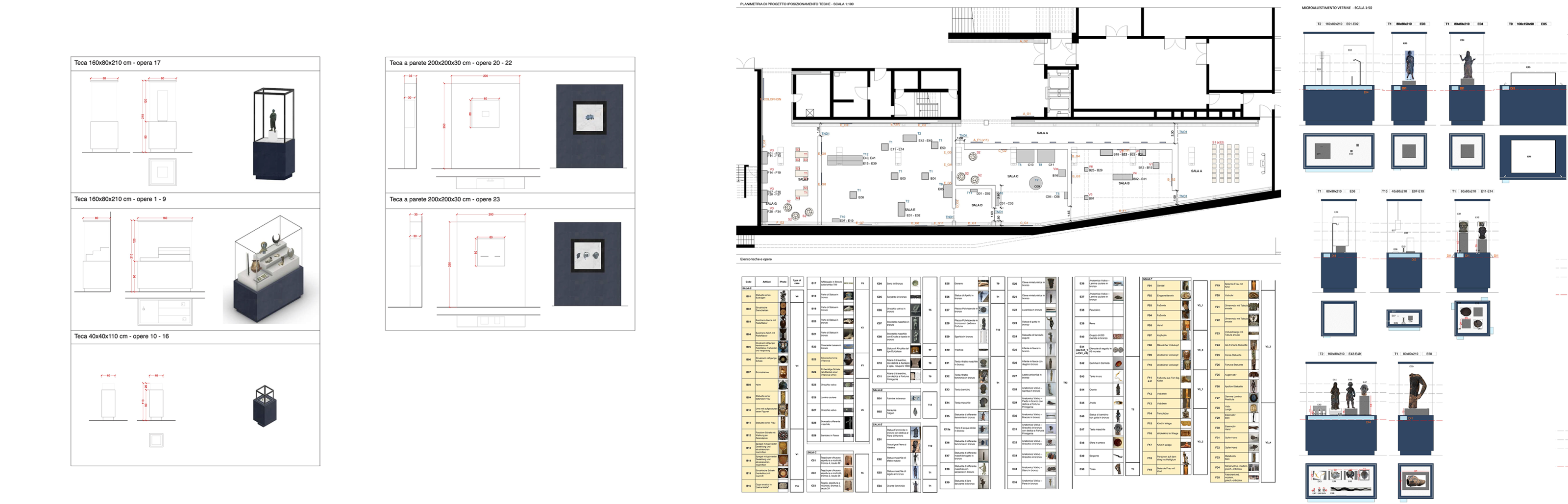
4 | Designing the display at Museo ARcheologico Nazionale in Reggio Calabria (© Decima Casa).
5 | James Simon Galerie in Berlin, General Plan (© Decima Casa).
6 | James Simon Galerie in Berlin, microsetting of the Sacred Pool (© Decima Casa).
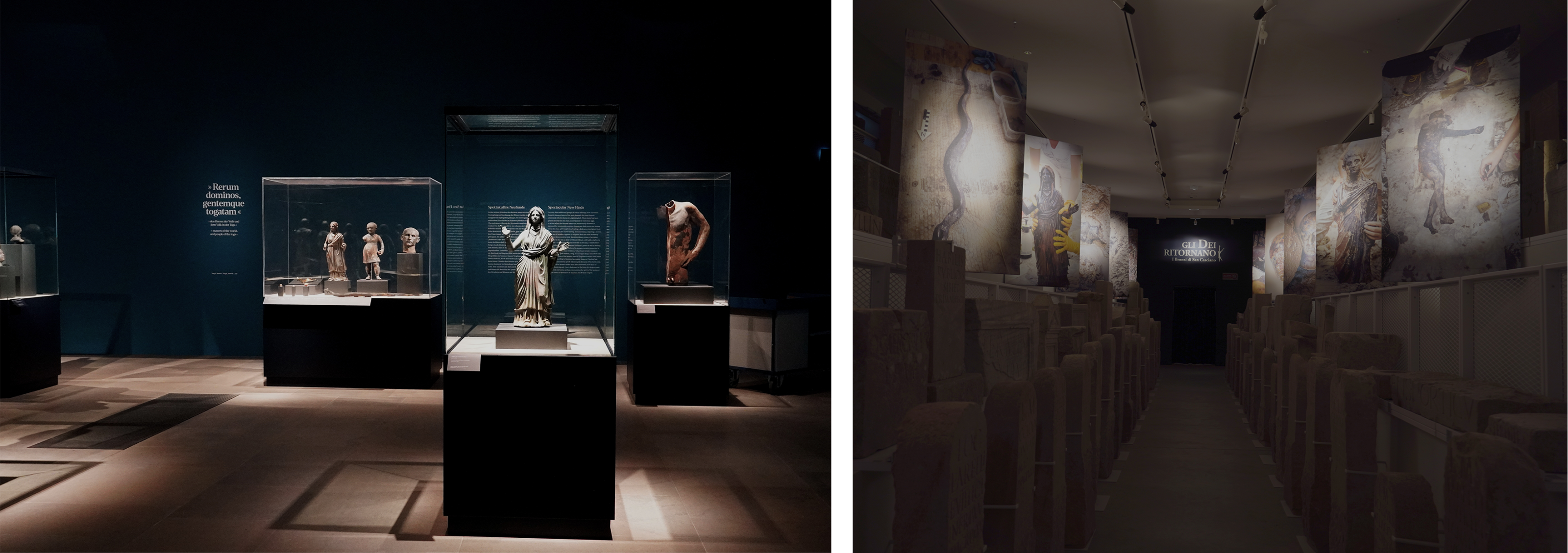
7 | James Simon Galerie in Berlin, discoveries on display, 2024 (© Decima Casa).
8 | Entering the exhibit at MAN Aquileia (© Decima Casa).
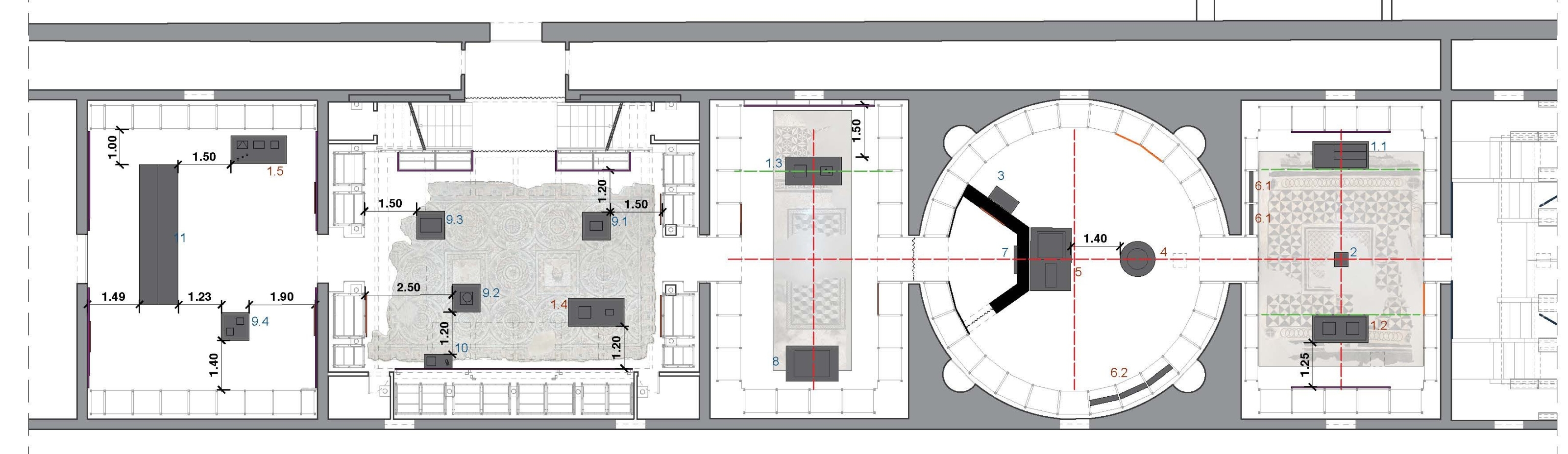
9 | General Plan of the exhibit at MAN Aquileia (© Decima Casa).
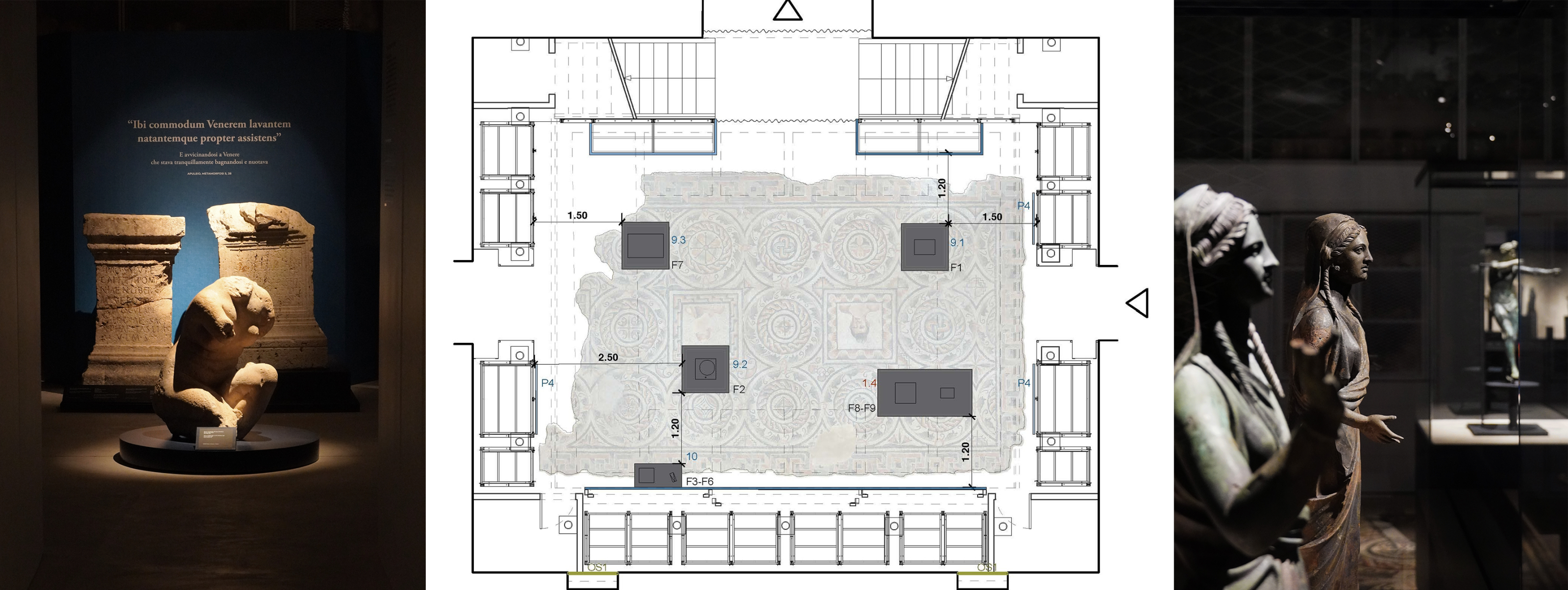
10 | Aphrodite and the altars at MAN Aquileia (© Decima Casa).
11 | The storages on Display at MAN Aquileia (© Decima Casa).
12 | Views on the oranti at MAN Aquileia (© Decima Casa).
Bibliography
- Mariotti, Tabolli, Salvi 2023
E. Mariotti, J. Tabolli, A. Salvi (a cura di), Il Santuario ritrovato 2. Dentro la vasca sacra. Rapporto preliminare di scavo al Bagno Grande di San Casciano dei Bagni, Livorno 2023. - Mariotti, Tabolli, Salvi 2025
E. Mariotti, J. Tabolli, A. Salvi (a cura di), Il Santuario ritrovato 3. Oltre il bronzo. Rapporto preliminare di scavo al Bagno Grande di San Casciano dei Bagni, Livorno 2025. - Osanna, Tabolli 2023
M. Osanna, J. Tabolli (a cura di), Gli dei ritornano. I bronzi di San Casciano, Catalogo della mostra (Roma 2023), Roma 2023. - Osanna, Tabolli 2024a
M. Osanna, J. Tabolli (a cura di), Gli dei ritornano. I bronzi di San Casciano, Catalogo della mostra (Napoli 2024), Roma 2024. - Osanna, Tabolli 2024b
M. Osanna, J. Tabolli, Encountering the thermo-mineral spring of Bagno Grande in the design of the exhibition at the Archaeological National Museum of Naples, “La Rivista di Engramma” 214 (luglio 2024), 219-223. - Osanna, Tabolli 2024-2025
M. Osanna, J. Tabolli (a cura di), Gli dei ritornano. I bronzi di San Casciano, Catalogo della mostra (Reggio Calabria 2024-2025), Roma 2024. - Osanna, Tabolli 2025-2026
M. Osanna, J. Tabolli (a cura di), Gli dei ritornano. I bronzi di San Casciano, Catalogo della mostra (Aquileia 2025-2026), Roma 2025. - Osanna et al. 2025
M. Osanna, J. Tabolli, M. Maischberger, A. Schwarzmaier, Die Bronzen von San Casciano dei Bagni. Eine Sensation aus dem Schlamm, Berlin 2025. - Tabolli 2023
J. Tabolli, Digging into a Display. The ‘Voices’ of the Bronzes from San Casciano dei Bagni, “La Rivista di Engramma” 204 (luglio/agosto 2023), 175-191.
Abstract
This article examines the successive exhibition displays of the Bronzes of San Casciano dei Bagni in Reggio Calabria, Berlin, and Aquileia, focusing on how exhibition design functions as an interpretative and narrative tool rather than a neutral framework. Across these three contexts, the bronzes are presented through site-specific museographic strategies that emphasize ritual practice, sacred waters, and the processual nature of archaeological research. The exhibitions articulate different relationships between objects, space, and architecture: from the context-oriented narrative at the National Archaeological Museum of Reggio Calabria, to the immersive and monumental staging at the James-Simon-Galerie in Berlin, and finally to the reflexive use of musealized storage spaces at the National Archaeological Museum of Aquileia. Together, these displays demonstrate how contemporary archaeological museography can reconfigure the meaning of an archaeological corpus, transforming the bronzes from isolated masterpieces into a dynamic assemblage whose interpretation evolves through spatial sequencing, light, and curatorial design.
keywords | Archaeological museography; San Casciano dei Bagni; Exhibition design; Sacred waters and ritual practice; Musealized storage spaces.
Per citare questo articolo / To cite this article: Massimo Osanna, Jacopo Tabolli, New Displays for the Bronzes of San Casciano dei Bagni: Reggio Calabria, Berlin and Aquileia, “La Rivista di Engramma” n. 231, gennaio/febbraio 2026.