Mnemosyne: “From Word to Image”
On: Maurizio Ghelardi (a cura di), Mnemosyne. L’Atlante delle immagini (Aragno, Torino 2002)
Nicholas Mann
Abstract | Versione italiana originale
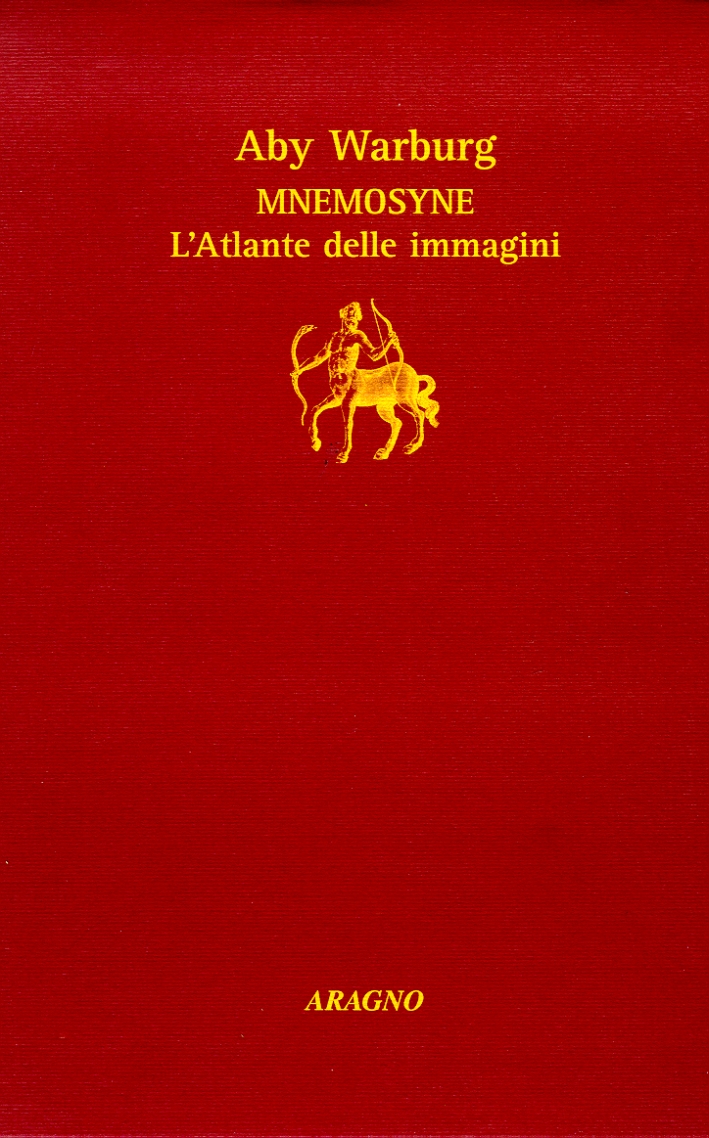
A. Warburg, Mnemosyne. L’Atlante delle immagini, a cura di M. Ghelardi (Aragno, Torino 2002).
Contents
Mnemosyne: “Dalla parola all’immagine”. Prefazione alla edizione italiana di Nicholas Mann
Nota alla edizione italiana
Introduzione di Martin Warnke
MNEMOSYNE. L’Atlante delle immagini
Introduzione
Le tavole dell’Atlante
Appendice
a. Lettera di Fritz Saxl alla casa editrice B.G. Teubner, Lipsia (1930 ca.)
b. Aby Warburg, “Da arsenale a laboratorio. Uno sguardo retrospettivo sulla mia vita”
Indice dei nomi e dei temi
Nino Aragno opened its series of Warburg’s writings in 2002 with Maurizio Ghelardi’s Italian edition of the Atlas. The Turin volume retained the Berlin edition’s facing pages, with the captions opposite the panel photograph, but opened with a new preface by Nicholas Mann, then Director of the Warburg Institute (VII–XI). It precedes both Ghelardi’s note on the Italian edition and Warnke’s preface in translation. Drawing on Warburg’s letters to his brother Max, Mann asks how the search for a vocabulary of gesture led to an atlas of images.
Mnemosyne: ‘From Word to Image’*
“Orientalists, and more recently Romanists […] recognize the general application of the principle that I adopted from the start of my endeavours—“from word to image”—as a heuristic method in itself”. Aby Warburg makes this claim in a long retrospective letter to his brother Max on 13 June 1928 (A. Warburg to M. Warburg, 13 June 1928, WIA FC). At this point, a year before his death, he attempts a summary of the most significant intellectual influences on his development as a scholar, while at the same time justifying the orientation and achievements of the Kulturwissenschaftliche Bibliothek, which Max had been supporting at great expense. But above all Aby seizes the opportunity to explain his vast project, the never to be completed picture-atlas (Bilderatlas), best known under the title of Mnemosyne, on which he had worked unstintingly, particularly in his later years.
This work, which has been abundantly quoted and discussed, but whose genesis and implications have received little real attention, is an opera aperta which defies closure, rather like the skyline of a whole throbbing metropolis of figures, thoughts, intuitions, a metropolis whose heuristic significance it is essential to recognize. Mnemosyne, which is the first of a series of Warburg’s works to be published by Aragno, is here presented to Italian readers on the basis of the edition prepared by Martin Warnke with the collaboration of the Warburg Institute in London.
My aim in introducing this Italian edition is not to supplement the work undertaken by Warnke, nor to attempt any exegesis. I intend instead briefly to survey certain aspects of the form and genesis of this project as an instance of material culture. I shall therefore endeavour to discuss the form and not the content of the work, its genesis and not its meaning, bearing in mind the role that the Atlas played in the dynamic tension between word and image, a dynamic present for Warburg from the outset and enshrined in the structure of his library, to which the two separate floors of its present-day descendant in London devoted to Word (Wort) and Image (Bild) continue to bear concrete witness.
Warburg rarely used the term ‘iconology’, for both he and his devoted assistant Fritz Saxl preferred to use that of ‘iconography’. As to the difference between these two concepts, I have nothing to add to a terminological discussion which has long since been amply documented by Dieter Wuttke. I am tempted instead to compare Warburg to Molière’s Bourgeois Gentilhomme: much like Monsieur Jourdain, who had long been writing prose without realizing it, Warburg only seems to have become aware in the final year of his life that his Ferrara lecture, delivered at the Rome Congress of the History of Art of 1912, was crucial for the overall direction of his research, “thanks to my methodological claim to an ‘iconology’” (GS Tagebuch, 412). It is noteworthy that Warburg places inverted commas around the term. Some two months later, on the occasion of a seminar on the “Iconology of the Interval” (Ikonologie des Zwischenraums), he echoes Tito Vignoli in defining iconology as “the art-historical material for a developmental psychology of the oscillation between the establishment of figurative and symbolic causes” (GS Tagebuch, 434-435). Having noted that, I am happy to leave the explanation of such mysteries of Warburg’s intellectual life to those better qualified than myself, and to move instead to a brief reconstruction of the genesis of Mnemosyne.
As is well-known, the Atlas consisted of a series of panels to which Warburg fixed those images (photographs, newspaper cuttings, prints and in some cases even postage stamps) between which he believed that he could establish a fluid and dynamic relationship. The great advantage of this display system was that it helped the interplay (itself dynamic and fluid) of his ideas. Anyone who has had the opportunity to study, however cursorily, the wealth of material concerning Mnemosyne in the archives of the Warburg Institute will be aware that there are multiple versions of the individual panels, and that they themselves were grouped in a variety of different sequences. One has only to compare Martin Warnke’s edition with the series of images recently exhibited in Rome, Siena and Florence to become aware of the very different exegetical character assumed by Mnemosyne in each of the variant versions of it which have been displayed. One of the great merits of the Warnke edition is not only that it establishes a precise order of sequence for the panels and proposes for each of them an order of reading which seems to correspond to the author’s final intentions, but in addition publishes a number of photographs which show how the panels were arranged in the elliptical reading room of the Kulturwissenschaftliche Bibliothek Warburg. In this way it rightly attempts to resituate in its precise historical context what had until then been in danger of being transformed into something of a cult object.
The original panels no longer exist. Made of black material stretched over wooden frames, they had the advantage of being light in weight and therefore easy to transport; in Rome in 1929 for example they several times travelled from the Hotel Eden, where Warburg was staying, to the Biblioteca Hertziana, where he gave some of his renowned lectures. Today the only material remains of his device for exploring the survival of Antiquity are the photographs of the panels, taken from time to time as his ideas evolved, and a little box of clips with which he attached the images to the screens. Ernst Gombrich has identified Fritz Saxl as the person who suggested the use of screens to Warburg. Immediately after the First World War, this young Austrian had spent some months teaching in an Army education unit for recently demobbed soldiers, where he had discovered both his interest in visual education, and a highly effective means of putting it into practice by using lightweight frames made of wood covered with hessian. Later, in 1924 when Warburg was discharged from the clinic at Kreuzlingen and returned to Hamburg, it was Saxl’s idea to celebrate his return to life by mounting a small display of images fixed to panels illustrating what had been the main themes of Warburg’s research. This was in effect the earliest form of what was to become the Mnemosyne project. It seems that Warburg immediately grasped the advantages of the system, as a means not only of gathering and developing his research material in visual form without having to wrestle with the immense obstacle of the written word, but also, in the years to follow, of promoting the Kulturwissenschaftliche Bibliothek Warburg in its new public role as a promoter of historical or didactic exhibitions. Consequently he adopted Saxl’s technique to display astrological images illustrating his 1925 lecture in commemoration of Franz Boll, and then again for a series of exhibitions, one for the Congress of Orientalists in September 1926, another with images from printed editions of Ovid, others on postage stamps and the Medici festivities. On his last Italian journey, Warburg took more than a dozen panels with him from Hamburg, using them for the exhibition organised to illustrate the lecture he gave at the Biblioteca Hertziana in January 1929. These panels were the very ones that, as already noted, he had with him in his suite at the Hotel Eden, where he was constantly working on the development of his Atlas.
I believe, however, that he had already shown a propensity for this kind of work before Saxl’s intervention. His assistant’s initiative evidently seems to have acted as a kind of catalyst at a particularly critical moment in Warburg’s life, encouraging him to ‘rationalize’ some of his ideas and to rediscover methods that were perhaps buried in his memory, adapting them to the needs of a new and maturer phase of his scholarly activity. But it is equally evident from the account he gives in a letter of 30 November 1900 to Max Warburg that he was already at that stage deriving great pleasure from his efforts to identify the figures in a Ghirlandaio fresco using coins, genealogies, chronicles and tax records. The method he was using was one that he had learned at school to solve chess problems: ‘using a piece of paper while playing to foresee each regular and obvious move’; he was adopting a similar technique to juxtapose varieties of source material and test his hypotheses as to historical identification (A. Warburg to M. Warburg, 30 November 1900, WIA FC).
Twelve years later, in the context of preparations for the Congress of the History of Art in Rome, at which Warburg was to present his groundbreaking interpretation of the frescos in Palazzo Schifanoia, we again meet the use of slips of paper. Writing to his colleague Rudolf Kautzsch on 18 September 1912, he proposes using a similar technique to solve the timetabling problems of the Congress: “I’m enclosing a stock card to show you my very practical system for planning the lecture timetable. In this way one can entrust the whole running to the tableau labil”—employing a French term to designate what might be seen as a forerunner to Saxl’s panels—“without needing any significant apparatus” (A. Warburg to R. Kautzsch, 18 September 1912, WIA GC).
These two needles lurking in the haystack of the Archive do not of course constitute an argument for a radical rethinking of the Atlas, even if from a methodological point of view they bring to bear two new elements which allow us to hypothesize that in Warburg’s intellectual development there was a pre-existing tendency to confront and ‘rationalize’ certain conceptual problems in visual terms by using a particular type of material and manual technique. At least in the two cases just mentioned there is a practical and detailed explanation. Which is more than can be said of the somewhat metaphorical declarations found in a letter of 3 May 1928 to his friend Jacques Mesnil. Speaking of his progress with the Atlas, Warburg writes: “it is an expanding system of coat-hooks”—to date he had in fact already created no fewer than forty panels—“on which I hope to hang all the fabrics, large or small, woven on the loom of Time” (A. Warburg to J. Mesnil, 3 May 1928, WIA GC).
Since this brief introduction, which makes no claim to completeness, is concerned with questions around the genesis of Mnemosyne, I should like now to shift my attention from the fabrics to the coat-hooks in an attempt to shed light on Warburg’s underlying aim in developing the Atlas. In the letter to his brother Max quoted earlier, Aby speaks of the concurrence between Orientalists and Romanists on the eminently heuristic question of the transition “from word to image”. It is interesting in this respect to note the role played in not dissimilar contexts by the ideas of the linguist Hermann Osthoff, professor at the University of Heidelberg, and of the ethnologist Adolf Bastian.
In 1899 Osthoff had published an essay on the suppletive system of Indo-Germanic languages which Warburg appears to have read and admired in 1903, while he was working on his research on Florentine festivities. “Osthoff on The Suppletive system”, he notes, “is illuminating” (Festwesen, WIA III.58.10.2, 138). Warburg had effectively sensed the potential of this linguistic research for visual material. Osthoff had observed that in the Indo-Germanic languages the paradigm of certain words is defective, that is to say that certain words do not have all the forms that usually complete the regular paradigm. An example would be the Latin adjective bonus: whereas the normal comparative paradigm would be altus–altior–altissimus, bonus, precisely because it is defective, has to complete its paradigm by using different etymons, that is melior and optimus. These are the suppletive forms recognized by linguists as characteristic of Indo-Germanic languages, which systematically complete paradigms by drawing on words of different roots.
Warburg applies this idea when comparing Florentine and Flemish art, approaching the relationship between Classical and Renaissance art in Florence along the same lines as the linguistic relationship between positive (the simplest form), comparative and superlative, thus considering the art of Flemish tapestries as a defective form in so far as it is only through intensifying and doubling that it can become superlative. Yet at the same time he sees this Flemish art as a positive form when compared to the superlative of Classical art. In another note dated 6 March 1905, Warburg writes: “I do not want to overrate the formula that I have found for it [explaining the development of the expression of emotions through gesture], but there exists in the field of the visual arts a phenomenon which is the same as the one Osthoff has observed in linguistics—a suppletive system, a switch and supplementation of the roots used in the superlative” (Festwesen, WIA III.58.10.2, 79). In this way, Warburg attempts to establish a parallel between a linguistic atlas and his own project to establish a syntax of human gestures. It is no doubt emblematic that the reference to Osthoff’s linguistic research should resurface in the final version of his introduction to Mnemosyne.
A few pages before the note of 1905 in the Tagebuch just quoted, Warburg drafts a series of possible titles for his embryonic picture-atlas: “The entry of a classicizing Pathos into the (language of artistic forms) world of early Florentine Renaissance art”; “The entry of classical Pathos […] of classical [style into the artistic language] into the artistic style of [Florentine painting] the early Florentine Renaissance”, and so on (Festwesen, WIA III.58.10.2, 72-73).
Further evidence that Warburg never abandoned his fascination with comparative linguistics may be found in the extensive correspondence dating from around 1915 apropos of a project for an atlas of Hispano-Iberian languages launched by a certain Schädel. Warburg repeatedly denounces Schädel’s arrogance in presuming to publish too quickly an atlas of too vast a linguistic area, without any first-hand knowledge of the places and dialects concerned. In this case at least we can be certain that the advocate of “God in the detail” was not inspired by another scholar!
Returning to the various models of an atlas that Warburg had before him, one should also remember—as Gombrich demonstrated—the possible influence of the ethnologist Adolf Bastian. In 1887 Bastian had published a book of images in the form of an atlas under the title of Die Welt in ihren Spiegelungen unter dem Wandel des Völkergedankens (“The World as Reflected in the Changing Thought of the Peoples”), with the subtitle “Prolegomenon to a Statistics of Thoughts”. Bastian’s method, which Gombrich regards as flawed by an extreme methodological inductivism, consisted of gathering random material from which he believed that he could extrapolate the unchanging ideas and laws that characterize the development of different peoples. It may be that it is not entirely appropriate to compare Warburg with Bastian, but it is clear that he frequently fell under the spell of apparently eccentric works, from which he invariably derived some inspiration for his own research (Gombrich 1970, 285-286).
After touching on these questions, however lightly, I should like now briefly to turn my attention to the final phase of the gestation of Mnemosyne which, together with his sudden passion for Giordano Bruno, dominated the final years of Warburg’s thinking.
The most obvious feature of what he saw as the tension between ‘Word’ and ‘Image’ is manifested in his struggle to find a suitable verbal formulation for his ideas. This is evident, not only from his repeated attempts to find a fitting title for his Atlas, but also in general from his handwritten notes, which seem to follow a simultaneously wave-like and circular movement, repetitive, almost obsessive.
On 22 September 1926 Warburg noted in his diary: “I have begun to put the visual material for the Atlas in order” (GS Tagebuch, 12-13). From that moment on, he seems at once anxious and determined about the future of what was to be his magnum opus. In a letter of 22 February of the following year to his brother Max, commenting on the exhibition mounted for the general public of Hamburg in the reading room of his library, Aby refers to his Atlas, possibly for the first time, as a visual project: “I have conceived the project of bringing together in a large typological atlas the results of my research, or at least such of them as concern the influence of Antiquity on European culture. A publication of this kind would provide a stable yet flexible framework for all my material” (A. Warburg to M. Warburg, 22 February 1927, WIA GC).
This is confirmed by another note in the Tagebuch, dated 30 July 1927: “A formulation for the overall framework of the Atlas: ‘(a cultural-scientific consideration) On the surviving shaping forces of Classical expressive values in the intellectual economy (culture) of Europe’” (GS Tagebuch, 126). Shortly after, apropos of Saxl’s efforts to gather visual material for a “history of human orientation in the cosmos”, he writes on 16 August 1927 to his friend Gladys Reichard in the United States: “it is a chapter extracted from the great atlas of the history of the survival of Antiquity in Europe, on which I have been working for almost thirty years” (A. Warburg to G. Reichard, 16 August 1927, WIA GC). As we have seen, it appears likely that the first efforts to resolve the question of the form of Mnemosyne came from Saxl. From a note in the Tagebuch dated 14 September 1927 it emerges that he had suggested that Warburg adopt an initial subdivision of the material according to the model of the Museum of Ethnology: the first section would be given over to material grouped in chronological or topographical order, the second by contrast would be organized “on the basis of systematic synopses: Perseus, Saturn, the variations of man as microcosm, and so forth” (GS Tagebuch, 147).
On 4 October Saxl wrote a long and detailed letter to Warburg in which he declared that he had completed the task of collecting material for the most important themes: Orpheus, Proserpine and Fortuna. He goes on to say that it will always be possible to add something, even though such an undertaking will only fall to whoever might decide to dedicate a separate volume to one or another of these topics: “in the systematic volume which is the first that we must prepare, the key question is not so much the abundance of material as its significance” (F. Saxl to A. Warburg, 4 October 1927, WIA GC). Then Saxl asks Warburg where astrology can be fitted in. From this we may deduce that the part he played was not simply that of a gatherer of visual material, but also of an active participant in the development and shaping of the project as a whole.
The extent of Saxl’s role is clear from the report he sent to Warburg, who was then in Italy, six weeks later (15 November 1927). In it, he confirms that he has been pressing on with the preparation of the Atlas: “I have proceeded with three considerations in mind: 1. to leave the intellectual structure given to it by you absolutely unchanged; 2. to increase the number of examples beyond those already collected; 3. to be cautious in regard to any possible surprises arising from unknown material” (F. Saxl to A. Warburg, 15 November 1927, WIA GC). With this objective, Saxl had sent two of his colleagues to Munich and London to look at mythographical and astrological manuscripts. The material that Meier and Breitenbach unearthed was excellent, but not such as actually to change the main lines of the Atlas, which, as Saxl writes, already contained around 550 images arranged in two sections: 1. The transformation of the images of the Olympian gods into demons in the Middle Ages; 2. the restoration of their classical forms in the Renaissance.
In the final months of 1927, the overall direction of the work was therefore clear. In a letter to Saxl of 22 September, Warburg defines the project as “our gigantic Atlas” (A. Warburg to F. Saxl, 22 September 1927, WIA GC), and on 20 November he writes to Alfred Doren about “an atlas dealing with the migration of astral symbols” (A. Warburg to A. Doren, 20 November 1927, WIA GC), thus replying indirectly to Saxl’s earlier question about the placing and interpretation of astrology. On 22 December Warburg notes in the Tagebuch: “Title of the Atlas: Restitutio (Expressionem) Eloquentiae (expressiva would be better, but it is not Latin). Overall title: Mnemosyne” (GS Tagebuch, 169). A few months later (7 March 1928), Gertrud Bing was to comment:
The ‘book’, which is now on show in the old reading room, is the first volume of the Atlas, a methodological introduction and quasi practical manual for the elaboration of all the visual material relating to the survival of Antiquity that follows in the second volume. If we publish the catalogue of the Bibliothek Warburg as a third volume, the whole thing will be the most marvellous ‘foundation for a science of culture’ (GS Tagebuch, 217-218).
Meanwhile the continuing progress of Saxl’s efforts to expand the Atlas can be gauged from Warburg’s letter to Jacques Mesnil quoted above, where it is described as a series of coat-hooks: in less than six months the initial 400 images had become 700, arranged over 40 panels. On 18 May 1928, barely two weeks after his letter to Mesnil, Warburg writes to Saxl before leaving Frankfurt that “we have arranged our Atlas of images for Mnemosyne over 45 panels, about 700 illustrations which, whether we like it or not, will certainly increase to at least 1000” (A. Warburg to F. Saxl, 18 May 1928, WIA GC). Warburg adds that the publishers Friedrichsen-De Gruyter have sent him the contract for its publication.
From this moment onwards it was Saxl who took on the detailed business of seeing it to press. His reply to Warburg, dated 26 May 1928, not only contains a typically Warburgian characterization of the Atlas, but also proposes a practical solution to the form in which it should be published. He believes that it will be a revelation for Germans: thousands of people will travel round Italy armed with a better understanding because they have studied it, and the impact of Florentine culture on their lives will consequently be more profound. Furthermore, he adds:
This Atlas represents the most important contribution since Burckhardt to research on the early Renaissance and the period following. The work does not need much by way of supporting text, only a couple of pages of introduction to the essential; the comments on the images will arise almost of their own accord! […] The whole point of this Atlas must be to show that it offers the best interpretation of works of art […]. In my opinion we should divide the whole material into two folders so that all the images can be placed alongside each other, and the whole thing doesn’t become too cumbersome […]. [The publication] is not a corpus, but merely enough of a selection to give a sense of direction when contemplating world history. I would like to organize it so that the text relating to each section functions simultaneously as a cover for the illustrations in that group, in such a way that it is immediately perceptible that all the material is interconnected (F. Saxl to A. Warburg, 26 May 1928, WIA GC).
Warburg’s prophecy concerning the number of images had come true by the end of that July. On 31 July 1928 he asks his brother Max for a further tranche of funding for “the no fewer than 1,000 images […] in my Mnemosyne, the basic outline of which is now complete […] this work, if I manage to publish it, will definitely mark a turning-point not only in art-historical thinking, but also in scientific historicism” (A. Warburg to M. Warburg, 31 July 1928, WIA GC).
Despite his best intentions, however, the Atlas was still not ready for publication. A month later, on 24 August, Warburg announces to Edgar Wind’s wife Ruth that the work now comprises 1,200 images arranged over 75 panels. Barely a week later (1 September 1928), he writes to Gladys Reichard that there are about 80 panels and 1,300 images arranged around the reading room of the Kulturwissenschaftliche Bibliothek Warburg. In the same letter Warburg claims that he had reached the target that he had set himself: he had succeeded in sifting all the visual material and therefore felt that the work was ready to go to press. Despite all that, however, he almost immediately set off again on travels to expand it—as he explains in a letter of 25 October from Rimini to his friend Davidsohn—so that it can be published as “a work composed of a series of images illustrating the survival of Antiquity in the Renaissance, accompanied by a text” (A. Warburg to R. Davidsohn, 25 October 1928, WIA GC).
But publication is once more delayed. On 23 January 1929, when Saxl was yet again revising the images which still had to be somewhat reorganized and increased in number, Warburg writes from Rome that “we must find a way of drafting an explanatory description of the tables in good German, so as to promote the text of Mnemosyne, which was, as you know, the ultimate purpose of my journey” (A. Warburg to F. Saxl, 23 January 1929, WIA GC). The use of the first person plural “we” is not surprising, not solely because relations between the scholar and his young assistant Bing had become very close in Rome, but also because Warburg was by then accustomed to referring to “our Atlas”, as a way of acknowledging the help he had received from Saxl and Bing, from Cassirer, colleagues, assistants and even from his wife Mary and their daughter Frede. What he defines in a letter of 13 June 1928 to his brother Max as “the founding act of my scientific career, that is to say my intention to understand the symbolic” has by now explicitly become “my so-called life’s work” (A. Warburg to M. Warburg, 13 June 1928, WIA GC). “If I were to complete my major work”, he writes to Ludwig Curtius on 23 May 1929, “it would be thanks not least to the more than personal style of your kollegiale Hilfsbereitschaft which I have experienced so personally” (A. Warburg to L. Curtius, 23 May 1929, WIA GC), that is to say the collective readiness to help on the part of the citizens of the respublica literarum of the day. He acknowledges his debt to the extensive network of scholars and students gathered around his library in the Heilwigstrasse in Hamburg.
On two occasions in 1929 Warburg again drafts titles for the Atlas in the Tagebuch. On 8 April he writes: “Mnemosyne. The reawakening of the pagan gods at the (time of the) European Renaissance as a form of energetic expressivity. An outline of an art-historical science of culture. Two volumes of text. In addition, an Atlas of some 2,000 images” (GS Tagebuch, 434). Then, on 6 October, “Mnemosyne. Series of images towards research into the function of classically derived expressive values in the representation of life in movement in the art of the European Renaissance” (GS Tagebuch, 543).
Both these solutions correspond quite closely to Warburg’s final assessment of his unfinished project. Six days later, on 12 October 1929, barely two weeks before his death, Warburg wrote a long letter to Karl Vossler, apologising for holding up the publication of a lecture. He explains that for health reasons he had been obliged to collect all his various studies together in a unified work, to show the degree to which his diverse endeavours had in reality a single goal. His travels had enabled him to acquaint himself with important artists and works of art that he wanted to organize as links of proof in the chain of his deductions, aimed at constructing a new science of artistic creation:
With the help of the self-effacing zeal of Dr Bing, I have been able to bring together the material for a picture-atlas. Its series of images will unfold the function of the prefigured classicizing nuances of expression which were used to represent the inner and outward movements of life. [The Atlas] will at the same time also provide the foundations of a new theory of the function of the human memory of images (A. Warburg to K. Vossler, 12 October 1929, WIA GC).
Warburg’s death, at dawn on 26 October 1929, brings my enquiries into Mnemosyne and its author irrevocably to a close. Yet anyone who cares to follow the events surrounding the final phase of this singular scholar’s life as reflected in the Tagebuch of the Kulturwissenschaftliche Bibliothek, in his dialogues with Saxl and in particular with Gertrud Bing, cannot but be struck by how in the last weeks of his life Warburg focused his energies on the heretic Giordano Bruno, and how his final efforts were devoted to preparing a lecture on him for the following year. To sum up, it seems that gradually, and unostentatiously, the Atlas slipped from his mind and ceased to be his principal preoccupation. This is not the only reason for its being unfinished, yet because it is, Mnemosyne remains to this day an opera aperta, both mysterious and challenging for posterity. But it bears repeating that the ‘founding act of [his] scientific career’ is not a monument of iconology, nor even a monument to it. Warburg had in fact dedicated his greatest energy to the attempt to investigate the overarching question of the transition “from word to image”, and was never merely concerned to establish sequences of images, nor to claim that he was laying down thematic chains across time. With a modesty which can sometimes affect the most ambitious and vain of intellects, Warburg has bequeathed to us a work which is also a reflection of his profound psychological insecurity. In a letter from Perugia dated 5 November 1928 and addressed to Ingeborg Georgi he admits that “Dr Bing is helping me to put the final touches to an atlas which I have been working on for thirty years now, and which certainly contains much new material and even some new ideas, but which, once published, is likely to have the typical immortality of paper made of wood pulp: ‘give us this day our daily illusion’” (A. Warburg to I. Georgi, 5 November 1928, WIA GC).
Mnemosyne: dalla parola all’immagine
“Gli orientalisti, e più recentemente i romanisti, accettano che il principio che ho sostenuto fin dall'inizio della mia attività, cioè dalla ‘parola all’immagine’, possa avere una applicazione generale come metodo euristico”.
L’osservazione si trova in una lunga lettera retrospettiva che Aby Warburg scrive al fratello Max il 13 giugno 1928 (A. Warburg a M. Warburg, 13 giugno 1928, WIA FC). Qui, un anno prima della morte, l’autore trova il modo di riassumere le influenze intellettuali più importanti della sua formazione di studioso, giustificando al contempo la direzione e le conquiste della Kulturwissenschaftliche Bibliothek che così tanto era costata a Max Warburg. Ma soprattutto coglie l’occasione per spiegare quel grande progetto, peraltro rimasto incompiuto, quell’atlante d’immagini (Bilderatlas) conosciuto con il titolo di Mnemosyne, a cui il nostro autore aveva lavorato incessantemente soprattutto negli ultimi anni della sua vita.
L’opera, molto discussa e citata, ma poco realmente studiata nella sua genesi e nelle sue implicazioni, è un testo aperto che non ammette chiusure, una sorta di sky-line dietro il quale pulsa una intera metropoli di figure, pensieri, intuizioni, una metropoli della quale va colto appunto il significato euristico. Mnemosyne, che costituisce la testa di ponte di una serie di opere di Warburg che l’editore Aragno pubblicherà, viene qui presentata ai lettori italiani sulla base della edizione che Martin Warnke ha predisposto in accordo con l’Istituto Warburg di Londra.
Il compito che mi sono proposto introducendo questa edizione italiana, non è quello di integrare il lavoro fatto da Martin Warnke, né è di tipo esegetico. Intendo invece accennare brevemente solo ad alcuni aspetti della forma e della genesi di questo progetto, così rappresentativo dal punto di vista della cultura materiale. Cercherò dunque di trattare la forma, non la sostanza dell’opera; la genesi, non il suo significato, nonché la funzione che questo Atlante svolge nel contesto della dinamica tra parola e immagine che è presente fin dagli inizi nella struttura della Biblioteca Warburg, e di cui sono concreta testimonianza proprio quei due piani distinti della Biblioteca consacrati alla ‘parola’ (Wort) e all’‘immagine’ (Bild).
Warburg ha usato raramente il termine “iconologia”. Sia il nostro autore che il suo fedele assistente Fritz Saxl preferivano di solito il termine “iconografia”. A proposito della differenza tra questi due concetti, non intendo entrare qui in una discussione terminologica che è stata ben documentata nove anni fa da Dieter Wuttke. Mi limito invece a paragonare Warburg a Le Bourgeois gentilhomme di Molière: quasi fosse il signor Jourdain, che scriveva prosa senza saperlo, Warburg sembra infatti rendersi conto solo nell’ultimo anno della sua vita che la conferenza su Ferrara tenuta “al Congresso di Roma del 1912 è stata determinante per l’orientamento complessivo della ricerca grazie alla mia pretesa metodologica di una ‘iconologia’”(GS Tagebuch, 412). Si noti bene: Warburg scrive iconologia tra virgolette. In seguito, un paio di mesi dopo, in occasione di un seminario sulla “Iconologia dell’Intervallo” (Ikonologie des Zwischenraums), egli definisce l’iconologia, sulla falsariga di Tito Vignoli, come “il materiale storico artistico per una psicologia dello sviluppo, il quale fissa l’oscillazione tra le cause figurative e quelle simboliche” (GS Tagebuch, 434-435). Premesso ciò, preferisco lasciare l’esegesi di questi misteri della vita intellettuale di Warburg agli specialisti e di passare invece a ricostruire brevemente la genesi di Mnemosyne.
L’Atlante, com’è noto, era costituito da una serie di pannelli sui quali Warburg attaccava quelle immagini (foto, ritagli di giornale, stampe, in alcuni casi perfino francobolli) tra le quali egli riteneva poter stabilire un rapporto fluido e dinamico. Il grande vantaggio di questo sistema di rappresentazione era di agevolare il gioco (anche questo dinamico e labile) del suo pensiero. Chi ha potuto studiare, anche per poco tempo, il ricchissimo fondo dedicato a Mnemosyne conservato nell’archivio dell’Istituto Warburg di Londra, sa che esistono molteplici versioni dei singoli pannelli e diverse sequenze complessive degli stessi.
Basterebbe mettere a confronto questa edizione curata da Martin Warnke con quella serie di immagini che di recente sono state esposte a Roma, Siena e Firenze, per capire il diverso carattere esegetico che Mnemosyne ha assunto in relazione alle diverse versioni che ne sono state proposte. È merito della edizione di Warnke non solo presentare una precisa disposizione seriale dei pannelli e disporre per ognuno di essi di un ordine di lettura che sembra corrispondere alle ultime intenzioni dell'autore, ma anche pubblicare alcune foto che mostrano quale fosse la precisa disposizione dei pannelli nella ellittica sala di consultazione della Kulturwissenschaftliche Bibliothek Warburg. In tal modo, si è cercato giustamente di ricollocare nel suo contesto storico preciso ciò che fino ad oggi ha rischiato di trasformarsi in un culto totemico.
I pannelli originari non esistono più. Fatti di stoffa nera disposta su una struttura di legno, avevano il vantaggio di essere facilmente trasportabili per la loro leggerezza e a Roma fecero, ad esempio, più volte il tragitto tra l’Hotel Eden, dove Warburg risiedeva, e la Biblioteca Hertziana, dove Warburg tenne nel 1929 alcune delle sue famose conferenze. Soltanto le riproduzioni fotografiche, che erano realizzate di volta in volta che Warburg cambiava idea, nonché una piccola scatola di mollette, con le quali il nostro autore attaccava le immagini sui pannelli, restano a tutt’oggi a testimoniare la sua concezione circa la sopravvivenza dell’Antico.
Ernst Gombrich ha indicato in Fritz Saxl colui che suggerì a Warburg l’uso dei pannelli (Gombrich [1970] 1983, 241). Reduce della prima guerra mondiale, il giovane assistente austriaco aveva trascorso alcuni mesi come docente in una scuola per militari dismessi e proprio in questa occasione aveva scoperto la sua passione per l’educazione visiva, ma anche lo strumento più adatto per renderla operativa ed efficace attraverso dei pannelli leggeri fatti di legno e canapa. Quando poi, nel 1924, Warburg fu dimesso da Kreuzlingen e ritornò ad Amburgo, fu Saxl ad avere l’idea di festeggiare la rinascita del maestro con una piccola mostra d’immagini che illustravano i temi principali a cui Warburg aveva dedicato le sue ricerche. Fu in questa occasione che nacque formalmente il primo progetto di Mnemosyne. Sembra che Warburg abbia colto subito i vantaggi di questo sistema, non solo come mezzo per collegare e sviluppare le sue ricerche in ambito visivo senza dover affrontare l’immenso ostacolo della parola scritta, ma anche per promuovere negli anni successivi la Kulturwissenschaftliche Bibliothek Warburg nel suo nuovo ruolo pubblico di organizzatrice di mostre storiche o espositive. Così Warburg finì per adottare la tecnica ideata da Saxl per illustrare con immagini astrologiche la sua conferenza del 1925 in memoria di Franz Boll e per una serie di mostre: ad esempio quella fatta in occasione del Congresso degli Orientalisti nel settembre del 1926, quella con immagini tratte da stampe di Ovidio, infine quelle sui francobolli e le feste medicee. Quando intraprese il suo ultimo viaggio in Italia, Warburg portò con sé da Amburgo più di una decina di pannelli che utilizzò per la mostra realizzata in appoggio alla sua conferenza tenuta alla Biblioteca Hertziana di Roma nel gennaio del 1929. Si trattava degli stessi pannelli che Warburg teneva con sé nell’appartamento dell’Hotel Eden dove lavorava instancabilmente alla elaborazione del famoso Atlante.
Tuttavia, penso che Warburg avesse manifestato, già prima di Saxl, la propensione a lavorare in questo modo. Certo, l’iniziativa del suo assistente sembra aver svolto una funzione catalizzatrice in un momento particolarmente critico della vita dello studioso, contribuendo in modo decisivo a ‘razionalizzare’ alcune sue idee e a riscoprire metodi forse sepolti nella sua memoria adattandoli alle esigenze di una nuova e più matura fase dell'attività scientifica. Ma certo è pure che tra le carte dell’archivio londinese già il 30 luglio del 1900 si trova una lettera al fratello Max dove Aby Warburg racconta quanto piacere gli diano le fatiche per identificare i personaggi di un affresco di Ghirlandaio attraverso monete, genealogie, codici e altre testimonianze. “In questo mio tentativo adopero”, si legge, “lo stesso metodo che avevo imparato a scuola per giocare a scacchi, metodo che consisteva nel trasferire ogni mossa su pezzi di carta. Così ho scoperto come anticipare ogni mossa. Oggi, uso la stessa tecnica per le diverse ipotesi dell’identificazione storica” (A. Warburg a M. Warburg, 30 novembre 1900).
Dodici anni dopo, nel contesto dei preparativi per il Congresso degli storici dell’arte a Roma, durante il quale com’è noto Warburg avrebbe presentato la sua interpretazione degli affreschi di Palazzo Schifanoia, ritroviamo l’uso dei pezzi di carta. Scrivendo al collega Rudolf Kautsch nel settembre del 1912, Warburg propone una tecnica analoga per risolvere i problemi dell'organizzazione dell’orario del Congresso: “Sto adoperando”, scrive, “un tableau labil [designando così con una espressione francese ciò che potrebbe essere inteso come una anticipazione dei pannelli ideati da Saxl] che mi permette, grazie a dei pezzetti di carta, di spostare e sistemare le relazioni dei partecipanti a seconda dell’ora e della sala” (A. Warburg a R. Kautzsch, 18 settembre 1912).
Questi due accenni ritrovati nell’enorme fienile dell’Archivio non giustificano naturalmente un ripensamento radicale dell’Atlante, anche se dal punto di vista metodologico apportano due elementi nuovi che ci permettono di ipotizzare che nella formazione intellettuale di Warburg fosse preesistente una disposizione per fronteggiare e ‘razionalizzare’ visivamente alcune questioni concettuali attraverso un certo tipo di tecnica concreta e manuale. Riguardo ai due casi citati esiste dunque una spiegazione pratica e circostanziata. La stessa cosa non si può certo dire delle affermazioni alquanto metaforiche, fatte nella lettera del 3 maggio 1928 all’amico Jacques Mesnil. Trattando dei progressi dell’Atlante, Warburg scrive: “Si tratta di un sistema estendibile di attaccapanni [in quel periodo aveva infatti realizzato già ben quaranta pannelli] sul quale spero di appendere tutti i panni, piccoli e grandi, prodotti dal telaio del Tempo” (A. Warburg a J. Mesnil, 3 maggio 1928, WIA GC).
Giacché questa mia introduzione – per quanto breve e frammentaria – si preoccupa delle questioni della genesi di Mnemosyne, vorrei adesso provare a spostarmi dai panni all’attaccapanni per cercare di mostrare che cosa Warburg intendesse veramente perseguire con il suo progetto dell’Atlante. Nella lettera citata all’inizio al fratello Max, Aby parla della convergenza tra orientalisti e romanisti a proposito della questione, di sapore eminentemente euristico, del passaggio “dalla parola all’immagine”. In tal senso è interessante osservare il ruolo che in un simile contesto avevano giocato le idee del linguista Hermann Osthoff, professore all’Università di Heidelberg, e dell’etnologo Adolph Bastian.
Nel 1899 Osthoff aveva pubblicato un saggio sul sistema suppletivo delle lingue indogermaniche che Warburg sembra aver letto e apprezzato nel 1903, mentre era occupato nelle sue ricerche sulle feste fiorentine. Lo scritto di “Osthoff sul sistema suppletivo”, scrive in appunto, “mi ha illuminato” (Festwesen, WIA III.58.10.2, 138). In effetti, Warburg aveva intuito la potenzialità delle ricerche linguistiche di Osthoff per il materiale visivo. Difatti, secondo Osthoff, nelle lingue indogermaniche il paradigma di alcune parole è difettivo, cioè ad alcune parole mancano tutte le forme che di solito completano il paradigma regolare. Si pensi ad esempio all’aggettivo latino bonus: mentre la norma sarebbe altus–altior–altissimus, bonus, esso, proprio perché difettivo, è costretto a completare il suo paradigma usando etimi diversi, cioè melior e optimus. Tali sono per lo studioso di linguistica le forme suppletive caratteristiche delle lingue indogermaniche, le quali per completare i loro paradigmi si servono appunto di un sistema di rappresentanza usando parole che hanno tra loro origini diverse.
Warburg applica questa idea nel confronto tra arte fiorentina e arte fiamminga, giacché considera il rapporto tra Antico e arte rinascimentale a Firenze alla stregua del rapporto linguistico tra positivo (forma più semplice) e comparativo, considera cioè l’arte fiamminga degli arazzi come una forma difettiva dal momento che solo attraverso una enfasi e un raddoppiamento essa riesce ad essere un superlativo. A sua volta però quest’arte fiamminga rappresenterebbe una forma positiva rispetto al superlativo dell’arte antica. In un altro appunto datato 6 marzo 1905, Warburg scrive: “Non intendo sopravvalutare le formulazioni che ho trovato [per spiegare lo sviluppo dell’espressione gestuale delle emozioni], ma esse si trovano certamente nell’ambito delle arti visive come risulta dalle ricerche linguistiche di Osthoff a proposito del sistema suppletivo e dello scambio e della sostituzione delle forme superlative” (Festwesen, WIA III.58.10.2, f. 79). In tal modo Warburg cerca di stabilire un parallelismo tra l’Atlante linguistico di Osthoff e il suo progetto d’individuare una sintassi dei gesti umani. D’altronde, è emblematico che il riferimento alle ricerche linguistiche di Osthoff ricompaia anche nella ultima versione della introduzione a Mnemosyne.
Qualche pagina prima dell’appunto prima citato del 1905, Warburg butta giù una serie d’ipotetici titoli per il suo embrionico Atlante di immagini: “L’ingresso del Pathos anticheggiante nel mondo artistico/nel linguaggio delle forme artistiche del primo Rinascimento fiorentino”; “L’ingresso dell’Antico patetico/dello stile antico nello stile artistico/nel linguaggio artistico della pittura fiorentina”, e cosi via (Festwesen, WIA III.58.10.2, ff. 72-73).
Che Warburg non abbia mai abbandonato un forte interesse per la linguistica comparativa lo dimostra un lungo scambio di lettere scritte intorno al 1915 a proposito del progetto di un atlante delle lingue ispano-iberiche avviato da un certo Schädel. Qui Warburg denuncia ripetutamente l’arroganza di Schädel di pretendere in tempi troppo brevi di pubblicare l’atlante di un'area linguistica troppo vasta, senza per questo conoscere direttamente luoghi e dialetti. Almeno in questo caso possiamo essere certi che il protagonista del “buon Dio nel particolare” non sia stato ispirato ad altri studiosi!
Sempre a proposito dei modelli di atlante con i quali Warburg si era confrontato, non bisogna dimenticare – come ha giustamente messo in evidenza Ernst Gombrich – l’influenza che sul nostro autore poteva aver esercitato l’etnologo Adolph Bastian, il quale aveva pubblicato nel 1887 con il titolo di Il mondo riflesso nei mutamenti del pensiero dei diversi popoli (Die Welt in ihren Spiegelungen unter dem Wandel des Völkergedankes) un libro d’immagini in forma di atlante che aveva come sottotitolo “Prolegomeni ad una statistica del pensiero”. Il metodo di Bastian, che Gombrich afferma essere affetto da un induttivismo estremo, consisteva nella raccolta di materiale molto eterogeneo, da cui l’autore riteneva poter ricavare le idee costanti, le leggi che caratterizzavano lo sviluppo dei popoli. Forse l’accostamento di Bastian a Warburg può suonare non troppo appropriato, ma certo è che il nostro autore subiva spesso il fascino di opere apparentemente eccentriche, dalle quali ricavava sempre uno spunto per la sua ricerca (Gombrich [1970] 1983, 242-244).
Dopo aver, seppur rapsodicamente, accennato a questi temi, vorrei adesso soffermarmi brevemente sull’ultima fase della gestazione di Mnemosyne che, assieme all’improvviso ‘amore’ per Giordano Bruno, caratterizza gli ultimi anni della riflessione di Warburg.
L’aspetto più evidente è la tensione posta da Warburg tra ‘parola’ e ‘immagine’. Essa appare come una lotta volta a ricercare una formulazione verbalmente adeguata alle sue idee. Tutto ciò appare chiaro non solo dai suoi reiterati tentativi di trovare, come abbiamo detto in precedenza, un titolo adeguato per il suo Atlante, ma anche in generale, dalla forma stessa dei suoi appunti manoscritti che sembrano seguire un andamento ondulatorio e al tempo stesso circolare, ripetitivo, quasi coatto.
Il 22 settembre 1926 Warburg annota nel suo diario: “Ho iniziato a mettere in ordine il materiale visivo per l’Atlante” (GS Tagebuch, 12-13). Da questo momento in poi, il nostro autore sembra ansioso e allo stesso tempo risoluto riguardo al futuro della sua ultima opera. In una lettera del 2 febbraio 1927, commentando la mostra organizzata per la popolazione di Amburgo allestita nella grande sala della Biblioteca, Aby, forse per la prima volta, riferisce al fratello Max del suo Atlante come progetto visivo: “Ho concepito il progetto di mettere insieme i risultati delle mie ricerche, o almeno quelle che hanno a che fare con l’influenza dell’Antico nella cultura europea, in un grande atlante tipologico. Una pubblicazione di questo genere permetterebbe di fornire una solida cornice, pur sempre elastica, a tutto il mio materiale” (A. Warburg a M. Warburg, 22 febbraio 1927, WIA FC).
Una conferma in tal senso ci viene da un altro appunto di poco posteriore: “La cornice complessiva dell’Atlante potrebbe essere formulata così: una considerazione scientifico-culturale della forza plasmatrice sopravvissuta dei valori espressivi antichi nell'economia spirituale, cioè nell'ambito culturale generale europeo” (GS Tagebuch, 126). Sempre nello stesso anno, in agosto, a proposito del lavoro di Saxl volto a raccogliere materiale visivo per una “storia dell’orientamento umano nel cosmo”, scrive all’amica Gladys Reichard negli Stati Uniti: “Si tratta di un capitolo ricavato dal grande Atlante della storia della sopravvivenza dell’Antico in Europa, a cui mi dedico ormai da quasi trent’anni” (A. Warburg a G. Reichard, 16 agosto 1927, WIA GC).
Come abbiamo visto, non sorprende dunque che i primi sforzi per risolvere la questione della forma di Mnemosyne vengano proprio da Saxl. Da un appunto del diario datato 14 settembre 1927, risulta che Saxl aveva proposto a Warburg una prima suddivisione del materiale secondo il modello del Museo etnografico: la prima sezione doveva essere dedicata al materiale raggruppato in ordine cronologico o topografico, la seconda doveva essere invece sistemata “in base a sinossi: Perseo, Saturno, i mutamenti dell’omino-microcosmo, e cosi via” (GS Tagebuch, 147).
Il 4 ottobre Saxl scrive a Warburg una lunga e dettagliata lettera, nella quale afferma di aver finito il lavoro di collegare il materiale dei temi più significativi: Orfeo, Proserpina e Fortuna. Inoltre, dichiara che comunque sarà possibile sempre aggiungere qualcosa, anche se un compito simile spetterà a chi progetterà di scrivere un volume autonomo su uno di questi argomenti: “Nel volume sistematico, che dobbiamo anzitutto preparare, la questione essenziale riguarda non tanto l’abbondanza del materiale, ma il suo significato” (F. Saxl ad A. Warburg, 4 ottobre 1927, WIA GC). Saxl chiede poi a Warburg dove dovrà essere collocata l’astrologia. Di qui si deduce il ruolo avuto da Saxl non solo come raccoglitore del materiale visivo, ma anche come partecipe allo sviluppo complessivo del progetto.
La natura del ruolo avuto da Saxl si comprende molto bene dalla sua relazione inviata a Warburg (allora in Italia) sei settimane più tardi (15 novembre 1927). In questa occasione Saxl ribadisce la sua intenzione di proseguire il lavoro dell'Atlante: “a fondamento ho seguito tre principi: 1. lasciare assolutamente inalterata la struttura intellettuale data [da Warburg]; 2. accrescere il numero di esempi, rispetto a quelli già raccolti; 3. cautelarsi riguardo a eventuali sorprese provenienti da materiali sconosciuti” (F. Saxl ad A. Warburg, 15 novembre 1927, WIA GC).
A questo scopo Saxl aveva inviato due suoi colleghi a Monaco di Baviera e a Londra per studiare i codici mitografici e astrologici. Il materiale che Meier e Breitenbach avevano trovato era eccellente, ma non al punto da mutare le linee direttrici dell'Atlante che, come scrive Saxl, contiene ormai 400 immagini organizzate in due sezioni: 1. la trasformazione delle immagini degli dèi; 2. la restituzione della loro forma primitiva nel Rinascimento.
Negli ultimi mesi del 1927 l’orientamento appare dunque già chiaro. Warburg, in una lettera a Saxl del 22 settembre, definisce il progetto come “il nostro gigantesco Atlante” (A. Warburg a F. Saxl, 22 settembre 1927, WIA GC) e a Alfred Doren scrive il 20 novembre a proposito di un “Atlante che tratta la migrazione dei simboli astrali” (A. Warburg ad A. Doren, 20 novembre 1927, WIA GC), rispondendo cosi indirettamente alla questione posta da Saxl in precedenza circa la collocazione e l’interpretazione della astrologia.
Il 22 dicembre, Warburg annota nel diario: “Titolo dell’Atlante: Restitutio (Expressionem) Eloquentiae (‘expressiva’ sarebbe comunque meglio, ma non è latino). Titolo generale: Mnemosyne” (GS Tagebuch, 169). In un appunto del 1928 Gertrud Bing commenta:
Il ‘libro’, che adesso è esposto nella vecchia sala, è il primo volume dell’Atlante, introduzione metodologica e ‘quasi’ manuale pratico per l’elaborazione di tutto il materiale visivo relativo alla sopravvivenza dell’Antico che seguirà nel secondo volume. Se pubblichiamo il catalogo della Kulturwissenschaftliche Bibliothek Warburg come terzo volume, sarà un meraviglioso “fondamento per una scienza della cultura (GS Tagebuch, 217-218).
Nel frattempo, in quale misura proseguisse incessantemente l’opera di ampliamento perseguita da Saxi, lo si intuisce nella citata lettera di Warburg a Jacques Mesnil, ove l’Atlante viene descritto come un “attaccapanni”: in meno di sei mesi le iniziali 400 immagini erano infatti diventate 700, disposte su 40 pannelli. Il 18 maggio 1928, appena due settimane dopo la lettera a Mesnil, Warburg scrive a Saxl: prima di venir via da Francoforte “abbiamo sistemato il nostro Atlante di immagini per il libro Mnemosyne su 45 pannelli comprensivi di 700 illustrazioni che sicuramente, lo si voglia o meno, diventeranno almeno 1000” (A. Warburg a F. Saxl, 18 maggio 1928, WIA GC). Warburg aggiunge inoltre che la casa editrice Friedrichsen-De Gruyter gli ha inviato il contratto per la pubblicazione.
Da questo momento in poi è Saxl ad occuparsi dei dettagli. La sua risposta a Warburg, datata 25 maggio 1928, contiene non solo una caratterizzazione tipicamente warburghiana dell'Atlante, ma avanza anche una soluzione pratica dei problemi editoriali. Saxl ritiene che l'Atlante finirà per essere una rivelazione per i tedeschi: migliaia di persone viaggeranno in Italia forti di una maggiore conoscenza perché lo avranno studiato, e gli effetti della cultura fiorentina sulla loro vita finirà per essere più profondo. Oltracciò aggiunge:
Dopo Burckhardt, questo atlante rappresenta il contributo più importante per la ricerca sul primo Rinascimento e sul successivo periodo. L'opera non necessita di un testo ampio, ma solo di una succinta introduzione di un paio di pagine; le osservazioni rispetto alle immagini seguiranno poi da sé! L’ingegnosità di questo atlante consiste nel fatto di essere la migliore interpretazione delle opere d’arte […]. A mio avviso dobbiamo dividere l’intero materiale in due raccoglitori, in modo da poter collocare le immagini l’una accanto all’altra, sicché l’oggetto non risulti troppo ingombrante […]. La pubblicazione] non sarà un corpus, ma solo una selezione capace di fornire una direzione alla Historia. Vorrei trovare una soluzione tale che il testo che accompagna ogni sezione possa fungere al contempo anche da copertina per le tavole relative, dimodoché si possa vedere come tutto il materiale sia esplicitamente collegato (WIA GC, F. Saxl ad A. Warburg, 26 maggio 1928).
La profezia di Warburg riguardo al numero delle immagini si concretizza entro il mese di luglio del 1928. Il 31 luglio Warburg chiede al fratello Max un ulteriore finanziamento per “le non meno 1000 immagini della mia Mnemosyne, che ormai in larga parte è pronta. L’opera, nel caso che venga alla luce, indicherà un punto di svolta non solo per la riflessione storico-artistica, ma soprattutto per l’Historismus scientifico” (A. Warburg a M. Warburg, 31 luglio 1928, WIA FC).
Malgrado le buone intenzioni, l’Atlante non risulta però ancora pronto per la stampa. Un mese più tardi, il 24 agosto, Warburg annuncia a Ruth Wind, moglie di Edgar, che l’opera comprende ormai 1200 immagini collocate su 75 pannelli. Appena una settimana dopo, il primo agosto, scrive a Gladys Reichard che sono circa 80 i pannelli e 1300 le immagini disposte nella sala di consultazione della Kulturwissenschaftliche Bibliothek Warburg. Sempre in questa lettera, Warburg confessa di aver raggiunto ormai la meta che si era proposto: è riuscito a passare al vaglio tutto il materiale visivo e dunque ritiene che l'opera sia ormai pronta per la stampa. Nonostante tutto, il nostro autore ricomincia quasi subito a viaggiare per ampliarla – come spiega in una lettera del 25 ottobre indirizzata all'amico Davidsohn –, sicché essa possa essere resa pubblica come “un’opera composta di una serie d’immagini che illustra la sopravvivenza dell’Antico nel Rinascimento”. Inoltre, aggiunge: “le immagini appariranno assieme a un testo” (A. Warburg a R. Davidsohn, 25 ottobre 1928, WIA GC).
La pubblicazione è però ancora una volta procrastinata. Il 23 gennaio 1929 da Roma Warburg scrive a Saxl, il quale sta rivedendo ancora una volta le immagini che devono essere un po’ riordinate e ampliate. Warburg scrive: “Dobbiamo trovare il modo per stendere in buon tedesco una descrizione motivata delle tavole, al fine di supportare il testo di Mnemosyne. Lei ben sa che era questo lo scopo ultimo del viaggio mio e della Bing” (A. Warburg a F. Saxl, 23 gennaio 1929, WIA GC). L’uso del plurale non deve sorprendere, poiché non solo il rapporto personale tra lo studioso e la giovane assistente era diventato a Roma molto stretto, ma anche perché Aby era solito parlare del “nostro Atlante”, intendendo con ciò l’aiuto che aveva ricevuto non solo da Saxl e dalla Bing, ma da Cassirer, da colleghi, assistenti e perfino dalla moglie Mary e dalla figlia Frede. Ciò che Warburg definisce in una lettera al fratello Max del 13 giugno 1928 come “l’atto fondamentale della mia vocazione scientifica, vale a dire l'intenzione di comprendere il simbolico”, diventa dunque esplicitamente proprio in questi anni “la cosiddetta opera della mia vita” (A. Warburg a M. Warburg, 13 giugno 1928, WIA FC). L’Atlante, scrive a Ernst Robert Curtius il 23 maggio 1929, è il risultato di una kollegiale Hilfsbereitschaft, di una disponibilità collettiva della respublica literarum del tempo, e deve moltissimo a quella ampia rete di studiosi e studenti collegati alla straordinaria Biblioteca della amburghese Heilwigstrasse.
Per due volte nel 1929 Warburg abbozza nel diario i titoli per questo “nostro Atlante”. L’8 aprile scrive: “Mnemosyne. Il risveglio degli dèi pagani nell'epoca del Rinascimento europeo, in quanto forma di valore espressiva energetica. Un tentativo per una scienza della cultura storico-artistica. Due volumi di testo. Inoltre, un Atlante con circa 2000 immagini” (GS Tagebuch, 434). Quindi il 6 ottobre: “Mnemosyne. Serie di immagini per una ricerca della funzione dei valori espressivi improntati all’Antico nella rappresentazione della vita in movimento nel Rinascimento europeo” (GS Tagebuch, 543).
Le due soluzioni corrispondono in gran parte all’ultima valutazione data da Warburg del suo incompiuto progetto. Sei giorni dopo, il 12 ottobre 1929, appena due settimane prima della morte, Warburg scrive una lunga lettera a Karl Vossler per scusarsi del ritardo subito dalla pubblicazione della sua conferenza. Spiega che per ragioni di salute era stato costretto a riunire in un’opera i suoi studi, proprio per mostrare in quale misura i suoi diversi interessi avevano in realtà un unico scopo: i viaggi erano serviti per conoscere opere d’arte che intendeva disporre come anelli nella catena delle sue deduzioni, al fine di costruire una nuova interpretazione dei personaggi più famosi della storia dell’arte:
Grazie all’aiuto altruista della dott.ssa Bing, sono riuscito a riunire il materiale per un Atlante d’immagini, nel quale si può vedere, proprio grazie alle immagini, la diffusione della funzione del valore espressivo improntato all’Antico nella rappresentazione dei movimenti della vita interiore ed esteriore. [L’Atlante] costituirà al contempo il fondamento per lo sviluppo di una nuova teoria della funzione della memoria visiva umana (A. Warburg a K. Vossler, 12 ottobre 1929, WIA GC).
La morte, avvenuta all’alba del 26 ottobre 1929, pone un termine invalicabile alla mia indagine sull’autore di Mnemosyne. Chi è disposto a seguire, attraverso il diario della Kulturwissenschaftliche Bibliothek, le vicende che accompagnano l’ultima fase della vita del grande studioso, i suoi dialoghi con Saxl e soprattutto con Gertrud Bing, resta però colpito alla fine da come, proprio nelle ultime settimane, Warburg concentri le sue energie verso Giordano Bruno, e come i suoi sforzi finali siano volti a preparare per l’anno successivo una conferenza sul grande eretico. In sostanza: sembra che pian piano, e con una certa discrezione, l’Atlante finisca per dileguarsi dalla sua mente e dalle sue occupazioni principali. Dunque, anche per questa ragione, e non solo per la sua incompletezza, Mnemosyne resta a tutt’oggi un’opera aperta, cosi misteriosa e al contempo cosi attraente per i posteri. Anche se occorre comunque ribadire che in ogni caso “l’atto fondamentale della vocazione scientifica” di Warburg non è riconducibile al metodo iconologico, e tanto meno Mnemosyne costituisce un esempio monumentale in tal senso. Warburg aveva dedicato infatti le sue migliori energie al tentativo di indagare la questione del passaggio “dalla parola all’immagine” e non si è mai occupato di stabilire mere successioni d’immagini o affermare che la sua ricerca consisteva nel fissare, attraverso i secoli, delle catene tematiche. Con una modestia che affligge talvolta perfino le menti più ambiziose e vanitose, Warburg ci ha lasciato così in eredità un’opera che è anche un riflesso della sua profonda insicurezza psicologica. In una lettera scritta dall’Italia il 5 febbraio 1928 e indirizzata a G. Wegner, confessa: “La dott.ssa Bing mi aiuta a portare a termine un Atlante, al quale sto lavorando ormai da trent’anni, e che contiene certo molto materiale nuovo e perfino alcune nuove idee, ma che, una volta pubblicato, è destinato ad avere la solita immortalità della carta usuale, fatta di pasta di legno: ‘dacci oggi la nostra illusione quotidiana’” (A. Warburg a I. Georgi, 5 novembre 1928, WIA GC).
*At the insistence of the editors of “La Rivista di Engramma”, I have, at a distance of almost a quarter-century, translated into my native tongue a text I originally wrote in Italian (no doubt with input from Italian colleagues). In so doing I have discovered some minor errors and incongruities in the original, and have silently corrected them; I have also retranslated directly from the German all the sources cited in the text; I am grateful to the Archivist of the Warburg Institute, Dr. Claudia Wedepohl, for her generous assistance in this, and for updating some of the bibliographical references, with additions indicated in square brackets. As a result, this English version should be considered more correct for purposes of reference than the Italian original. N.M.
Bibliography
Abbreviations and Editions Used
- WIA
Warburg Institute Archive, London. - WIA GC
Warburg Institute Archive, General Correspondence. - Festwesen
A. Warburg, Festwesen [WIA III 58.10.2]. - GS Tagebuch
A. Warburg, Tagebuch der Kulturwissenschaftlichen Bibliothek Warburg, hrsg. von K. Michels, C. Schoell-Glass, Berlin 2001.
Bibliographical references
- Bastian 1887
A. Bastian, Die Welt in ihren Spiegelungen unter dem Wandel des Völkergedankens. Prolegomena zu einer Gedankenstatistik, Berlin 1887. - Gombrich 1970
E.H. Gombrich, Aby Warburg: An Intellectual Biography, London 1970. - Gombrich [1970] 1983
E.H. Gombrich, Aby Warburg. Una biografia intellettuale [Aby Warburg: An Intellectual Biography, London 1970], tr. it. A. Dal Lago, P.A. Rovatti, Milano 1983. - Osthoff 1899
H. Osthoff, Vom Suppletivwesen der indogermanischen Sprachen, Heidelberg 1899.
Abstract
This essay presents the English translation of Nicholas Mann’s introduction to the Italian edition of Aby Warburg’s Mnemosyne Atlas, published in 2002 for Aragno, revised for the present publication with corrections and new translations of the German archival sources. Rather than offering an iconographic interpretation of the plates, Mann reconstructs the genesis and material form of the Atlas through Warburg’s correspondence, diaries, and archival materials. Particular attention is devoted to the development of the movable image panels, the contributions of Fritz Saxl and Gertrud Bing, and the intellectual precedents of Warburg’s heuristic transition “from word to image”, including comparative linguistics and ethnology. The essay traces the successive configurations of the Atlas and the evolving plans for its publication, highlighting the relationship between visual arrangement, scholarly research, and the investigation of the afterlife of Antiquity. Warburg’s unfinished project thus emerges as an open-ended experiment in visual thought and cultural memory.
keywords | Fritz Saxl; Gertrud Bing; Ernst Gombrich; Adolf Bastian; Hermann Osthoff; Kulturwissenschaftliche Bibliothek Warburg.
Per citare questo articolo / To cite this article: N. Mann, Mnemosyne: ‘From Word to Image’. On: Maurizio Ghelardi (a cura di), Mnemosyne. L’Atlante delle immagini (Aragno, Torino 2002), “La Rivista di Engramma” n. 239, settembre 2026.
Per citare questo articolo / To cite this article: nome e cognome, titolo dell’articolo, “La Rivista di Engramma” n. 237, luglio 2026, pp. xx-yy | PDF dell’articolo