The Idea of the Artistic Image in Aby Warburg: The Mnemosyne Atlas (1924-1929)
On: Fernando Checa (editado por), Atlas Mnemosyne (Akal, Madrid 2010)
Fernando Checa
Abstract | Versión española original
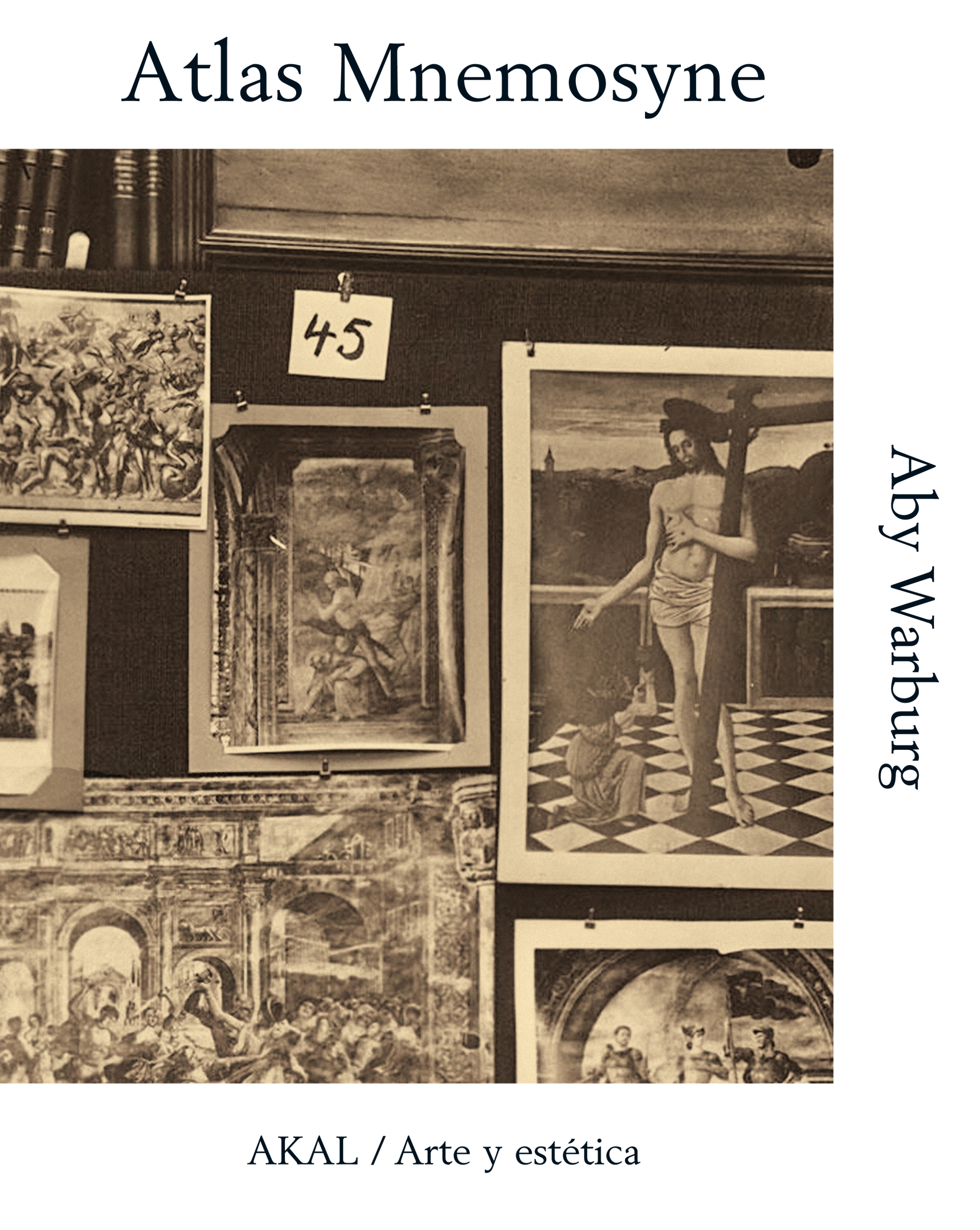
A. Warburg, Atlas Mnemosyne, editado por F. Checa (AKAL, Madrid 2010).
Contenidos
Advertencia editorial
Carta de Fritz Saxl a la editorial B.G. Teubner, Leipzig [hacia 1930]
Atlas MNEMOSYNE
Introducción
Los paneles
La idea de imagen artística en Aby Warburg: el Atlas Mnemosyne (1924-1929), por Fernando Checa
España en el Atlas Mnemosyne, por Karin Hellwig
Apéndices. Warburg y la elaboración de Mnemosyne
Aby Warburg, The Franz Boll Lecture (1925)
Aby Warburg, Conferencia sobre Rembrandt (mayo de 1926)
Aby Warburg, Conferencia en la Hertziana (enero de 1929)
Aby Warburg, Conferencia en la Fiesta de los Doctores (1929)
Índice
Fernando Checa Cremades’s Madrid edition for Akal (2010) followed the Berlin edition in placing Warburg’s Einleitung, here in Spanish translation, before the sixty-three panels. Checa placed his own essay immediately after the last panel (135–154), where readers could reconsider sequences they had already seen. He traces two very different routes by which antiquity reached Renaissance Europe, through astrological figures at Palazzo Schifanoia and through heroes dressed in the fashions of the Burgundian court. Karin Hellwig’s essay on Spain follows his, and an appendix brings together four of Warburg’s lectures. Engramma publishes Checa’s Spanish essay alongside its first English translation.
The Idea of the Artistic Image in Aby Warburg: The Mnemosyne Atlas (1924-1929)
A conventional account of twentieth-century art historiography divides its most substantial currents into two broad tendencies: formalism and iconography. Whereas the former would place the emphasis on stylistic, aesthetic and fundamentally formal aspects—the tradition associated with figures such as Alois Riegl (1858-1905) or Heinrich Wölfflin (1864-1945)—the latter would approach art history from the point of view of the contents and subjects represented. Erwin Panofsky (1892-1968) would be the leading figure of this tendency, with Aby Warburg’s studies as its precedent (Podro 1982). This is, of course, a simplification, since matters developed in a considerably more complex fashion, even in Warburg himself (Agamben [1975] 1999, 89-103). That, however, is not the subject of the present essay. What is important to stress here is that, if Aby Warburg (1866-1929) is reductively regarded as the “father” of iconology and iconography, his importance and significance within the European historiographical debate of the first decades of the twentieth century are substantially diminished. The entirety of his published work, together with the material that has gradually emerged, above all from his archive in London, and particularly his final, unfinished project—the Mnemosyne Atlas, which is the subject of these pages—reveals a much richer and more complex intellectual figure, one who played a decisive role in the development of a cultural theory of the artistic image and of art history during the first three decades of the twentieth century. This explains the steadily growing interest in Warburg’s figure and personality, reflected in an ever-expanding and at times almost unmanageable bibliography (Wuttke 1998; Didi-Huberman 2002). In order to situate the place occupied by Mnemosyne within its author’s intellectual trajectory, it may therefore be useful to begin with a brief biographical outline, since, as we shall see, in few authors are life and intellectual development so closely intertwined (Heise 1947; Gombrich 1970; Forster 1999, 1-75; Didi-Huberman 2002; Michels 2007).
Aby Warburg was born in 1866 into a highly prosperous Jewish banking family in Hamburg (Chernow 1993). This circumstance points to two of the elements that Warburg would later use to characterise himself in a celebrated phrase: “Ebreo di sangue, Amburghese di cuore, d’anima fiorentino” (Bing 1960, 113). It is well known that, at the age of thirteen, the young Warburg reached an agreement with his brother Max, one year his junior, by which he relinquished his birthright in the family bank in return for the financing of his lifelong purchase of books. Indeed, when the already famous Warburg Library—the KBW, Kulturwissenschaftliche Bibliothek Warburg—was transferred to London in 1933, after Aby’s death, most of its approximately sixty thousand volumes had been purchased with family funds (Settis 1985, 5-38).
Warburg began his studies in art history at Bonn in 1886, alongside history and archaeology. His teacher there was Carl Justi (1832-1912), but he also attended the lectures of the historian of religion Hermann Usener (1834-1905) and the historian Karl Lamprecht (1856-1915), both of whom were to shape his methodological orientation to a considerable degree. It was at this time that he also read works by Charles Darwin, including The Expression of the Emotions in Man and Animals (1872), and Tito Vignoli’s Mito e scienza (1879), which were equally decisive for his early development. Given his interest in Renaissance art, and particularly in its earliest Italian manifestations, Warburg was already strongly drawn to Florence. With the financial support of his family, he lived there between 1888 and 1889, assiduously visiting not only its works of art but also its archives and libraries. It was during this period that he began preparing his doctoral dissertation on Botticelli’s two celebrated paintings in the Uffizi, Primavera and The Birth of Venus. His ideas were not accepted by Justi, however, and he therefore continued his studies at the University of Strasbourg under Hubert Janitschek (1846-1893). In 1893 he published his study of the two paintings (Warburg [1893] 1999, 89-156), the first of his major works. Already in its opening paragraphs he set out the basis of many of his subsequent methodological and historical concerns: the relationship between texts and images; the attempt to trace antiquity in the heightened movement of figures, draperies and other accessory forms; and the psychological grounding of his research in the theory of empathy.
Between 1893 and 1895 Warburg’s life was centred on Florence. In the latter year he published his second major essay, devoted to Bernardo Buontalenti’s designs for the festivities celebrating the marriage of Grand Duke Ferdinand I of Tuscany and Christina of Lorraine in 1589. Here he developed another fundamental strand of his research: the relationship between works of art and the drawings and descriptions associated with court festivals and pageantry, pursuing in this respect one of the central insights of another of his great intellectual masters, Jacob Burckhardt (1818-1897) (Warburg [1895] 1999, 349-401). On the occasion of the marriage of his brother Paul to Nina Loeb in New York in 1895, Warburg travelled to the United States, where he remained until 1896, visiting not only New York but also New Mexico, San Francisco and Stanford. This is one of the most fascinating episodes in his intellectual career and one that has generated an especially extensive literature (Saxl [1930] 1980, 317-326; Cestelli Guidi, Mann 1998; Settis 1993, 139-158). With assistance from the Smithsonian Institution, he was able to study in situ the customs and rituals of the Hopi Indians of New Mexico, an experience that proved fundamental to the development of the anthropological dimension of his theory of the image. The notes and photographs he made there would much later provide the basis for his work on the serpent ritual, to which we shall return below. During the closing years of the nineteenth century Warburg travelled for research in France and England but, above all, repeatedly returned to Florence, where he generally spent the winter months with his wife, the painter and sculptor Mary Hertz, whom he had married in 1897. During these years, and particularly in the early twentieth century (1902-1904), he combined his research in the Florentine archives with periods in Hamburg, where he began the systematic development of his library. These investigations provided the foundations for his major studies of Ghirlandaio and other artists of the late fifteenth century, of the role played by the Florentine upper classes as patrons of works of art, and of the exchanges between the Italian Renaissance and Northern Europe—three of the principal focal points of his research. His analysis of the frescoes and paintings in the Sassetti Chapel in Santa Trinità in Florence, likewise pursued under Burckhardt’s intellectual aegis, led him to genuinely innovative conclusions not only concerning the role of patrons and commissioners but also the complexity of artistic relations between the different cultural environments of Northern and Southern Europe (Warburg [1902] 1999a, 185-221; Warburg [1902] 1999b, 281-303; Warburg [1905] 1999a, 275-280; Warburg [1907] 1999a, 223-262). The closing years of the first decade of the twentieth century marked the beginning of Warburg’s systematic interest in mythological and astrological imagery. He was strongly influenced by his reading of scholars such as Franz Cumont (1868-1947) and, above all, by the work of his friend Franz Boll (1867-1924), whose Sphaera, published in 1903, proved decisive for his investigations into the history of astrology and the meaning of ancient and Renaissance representations of the heavens and the stars. Warburg delivered a lecture on the subject as early as 1908 and in 1912 published the short text entitled An Astronomical Map in the Old Sacristy of San Lorenzo in Florence (Warburg [1912] 1999, 269-270). These concerns, undoubtedly stimulated by his contacts with the Austrian art historian Fritz Saxl (1890-1948), who would soon become his principal collaborator at the KBW in Hamburg, found their first spectacular outcome in Warburg’s lecture on Francesco del Cossa’s astrological cycle in the Palazzo Schifanoia in Ferrara, delivered at the International Congress of Art History in Rome in 1912. His identification of the sources of these frescoes in ancient and Arabic manuscript traditions, and his reconstruction of the complex migration of mythological and astrological images from classical antiquity to the East and, ultimately, back to Renaissance Italy, established Warburg among art historians as one of the most audacious thinkers of his generation (Warburg [1922] 1999, 563-591). In 1909 Warburg had acquired a house at 114 Heilwigstrasse in Hamburg. This was to remain his permanent residence until his death in 1929 and became the home of his continually expanding library. Between 1909 and 1911 its holdings increased from 9,000 to 15,000 volumes, and the collection continued to grow throughout the years of the First World War, assisted from 1912 onwards by Fritz Saxl in the capacity of research assistant. At the end of October 1918 the most troubled period of Warburg’s life began. A severe nervous crisis, aggravated by the circumstances of the war, forced him to withdraw from his studies. Amid serious hallucinations and phobic and schizophrenic episodes, he was eventually admitted to the clinic of Ludwig Binswanger (1881-1966) at Kreuzlingen in Switzerland, where his condition was initially diagnosed as irreversible (Stimilli [2005] 2007). Before this he nevertheless completed one of his most complex and problematic essays, in which the onset of this crisis is palpable: Pagan-Antique Prophecy in Words and Images in the Age of Luther of 1920 (Warburg [1920] 1999, 597-697). The essay was dedicated to his “dear wife in memory of the winter of 1888 in Florence”, and Warburg consented to the publication of the fragment “at the instance of his friend Franz Boll”. Meanwhile, the KBW had continued to grow. In 1919, when Warburg’s mental crisis was at its height, his family formally entrusted Fritz Saxl with its direction, thereby initiating its transformation into an institute open to scholars. More pragmatic in temperament than Warburg, Saxl set about this task. A new building was planned beside the Heilwigstrasse residence, to designs by the architect Fritz Schumacher (Schumacher 1949), and two publication series were launched for the work of the group of researchers gathered around Saxl, among whom particular mention should be made of the philosopher Ernst Cassirer (1874-1945) and the art historians Erwin Panofsky and Gustav Pauli (1866-1938). These were the Vorträge der Bibliothek Warburg, of which nine volumes appeared during the Hamburg years, and the Studien der Bibliothek Warburg, which comprised twenty-one published studies.
Although many details of Warburg’s stay at Binswanger’s psychiatric clinic are now known, they cannot be discussed here. One episode, however, must be mentioned: the famous lecture delivered on 21 April 1923 as part of his recovery, under Binswanger’s supervision. With Fritz Saxl’s assistance Warburg reworked the material from his American journey concerning the rituals of the Pueblo Indians. The resulting text, Schlangenritual, today one of his best-known and most widely discussed works among art historians and theorists of the image, was first published in English in 1939 as A Lecture on Serpent Ritual (Warburg [1923] 1939, 277-292). In this text Warburg set out his ideas concerning the anthropological significance of primitive rites, festivals, customs and images; identified profound lines of connection between classical antiquity and the art of so-called primitive peoples, central to his conception of “social memory”; and, in its concluding paragraphs, expressed his distrust of certain aspects of modernity that abolished the distance between the human psyche, nature and symbolic images.
Fortunately, despite the extremely pessimistic initial diagnoses, Warburg was discharged from Kreuzlingen in the spring of 1924. A new period of his life thus began, only to be cut short by his sudden death on 26 October 1929. These were five exceptionally productive years, of which the Gesammelte Schriften prepared by Gertrud Bing in 1932 provide only a partial account. Warburg’s work during this period centred on the further development of his library, by then an established research centre; the preparation and delivery of seminars and major lectures; the organisation of exhibitions using the institution’s increasingly extensive photographic holdings; and the Mnemosyne Atlas.
As Saxl observed in his letter to the publisher Teubner around 1930, with the Atlas—an attempt to unite a philosophical with a historical understanding of the image—Warburg intended to present, in a comprehensive and unified form, the results of his entire scholarly enterprise. Thus E.H. Gombrich (1909-2001), in his fundamental Intellectual Biography of Warburg, writes: “To the reader who has had the patience to follow the development of Warburg’s thought through the four decades of his intellectual development, these juxtapositions of pictures and these fragments of text will be no more enigmatic than they were to Warburg and his immediate environment” (Gombrich 1970, 284).
Since Mnemosyne was unfinished and still in the process of construction at the time of Warburg’s death, many aspects of its final form must be understood in relation to the extraordinary intensity of his post-Kreuzlingen activity, pursued with the constant assistance of Saxl and Bing in both Rome (November 1928-April 1929) and Hamburg. An indispensable source for understanding this period is therefore the Tagebuch recording the daily activities of the KBW, kept by Warburg, Bing and Saxl from the beginning of 1926 until Warburg’s death in 1929 and now published (GS Tagebuch).
Equally decisive for understanding the project are the numerous lectures Warburg delivered during these final years: from the lecture in memory of Franz Boll on 25 April 1925 (Warburg [1925] 2008), to that on Rembrandt in May 1926; the seminars on Jacob Burckhardt at the University of Hamburg in 1926-1927 (Roeck 1991, 86-89), in which, among other subjects, Warburg explored the relationship between Burckhardt and Friedrich Nietzsche (Gombrich 1970, 254-258); the lecture on the Valois tapestries preserved in the Uffizi, delivered at the German Institute for Art History in Florence in the autumn of 1928; the lecture at the Hamburg Chamber of Commerce in the spring of 1928, accompanied by an exhibition on the history of festivals; the crucial lecture at the Bibliotheca Hertziana in Rome in January 1929, effectively the first public presentation of Mnemosyne; the lecture on Manet in 1929; and the so-called Doktorfeier lecture, delivered on 30 July 1929, only a few weeks before his death on 26 October of the same year.
Alongside these activities, the exhibitions of visual material organised at the KBW—initially a suggestion by Saxl that greatly appealed to Warburg, and without whose systematic practice the Mnemosyne project cannot be understood—testify to the feverish activity of Warburg and his circle between 1925 and 1929. These included the exhibition devoted to illustrations of Ovid, held from 29 January to 6 February 1927 (Cieri Via 2004, 305-343); the exhibition on Rembrandt, entitled Italienische Antike im Zeitalter Rembrandts and associated with Warburg’s lecture of 29 May 1926; exhibitions devoted to festivals and postage stamps (McEwan 2004, 345-376); and the exhibition on the history of astrology conceived in honour of Boll, which was realised posthumously in 1930 in the Hamburg water tower (Fleckner et al. 1993). These exhibitions of visual material constitute the clearest precedent for the working and presentational method of Mnemosyne, with its pronounced predominance of images and their carefully considered juxtaposition over words. They may be regarded as preparatory activities for the Atlas, with which they frequently overlap. The relevant volume of Warburg’s collected works is to be devoted precisely to these exhibitions. Something similar can be said of Warburg’s lectures, whose texts will be repeatedly drawn upon in what follows and of which a selection is published in the volume.
Mnemosyne. The “Prologue” and Warburg’s Theory of the Image
The purpose of the Atlas was to explain, through a very extensive repertoire of images and a much smaller body of words, the historical process of artistic creation in what we now call the early modern period, concentrating above all on its beginnings in the Italian Renaissance, and particularly on certain essential aspects of late fifteenth-century Florence, while seeking their foundations in Antiquity. At the centre of Warburg’s concerns stood the figure of the artist, the psychology of creation, and the process through which images and ideas are produced, a process he conceived as essentially mental. Warburg regarded the Renaissance as oscillating between two conceptions of the world: one religious and mythical, inherited from tradition; the other new and mathematical in character.
The creative process is stimulated by a double memory, individual and collective, which constitutes the site in which the space of thought is created. This idea emerges with particular clarity at the beginning of the most important work published in the 1932 Gesammelte Schriften from the period immediately preceding Mnemosyne: the already mentioned essay on Luther (1920). There Warburg explains how logic creates a mental space between man and object by means of conceptual definition, whereas magic destroys that distance by establishing a superstitious association between the two. In astrology these apparently opposing modes still coexist. Astrology should therefore not be understood simply as a phase preceding the scientific development of astronomy. He describes the age in which logic and magic remain joined as “inherently timeless”, and criticises a historiography founded upon “a purely chronological theory of development”. We shall return to these points later.
Warburg’s investigation is centred on memory. It is within memory, Mnemosyne, that the two poles between which he locates artistic creation emerge: on the one hand serene, Apollonian contemplation; on the other, Dionysian, orgiastic abandon. Memory does not operate merely as a protective faculty within the creative process; rather, Warburg is concerned with the capacity of passionate and phobic personalities to generate artistic style, a force manifested above all, in his view, in religious mysteries. In his lecture delivered at the Hamburg Chamber of Commerce in 1928, he formulated the problem as follows:
The creation and the enjoyment of art demand the viable fusion between two psychological attitudes which are normally mutually exclusive. A passionate surrender of the self leading to a complete identification with the present—and a cool and detached serenity which belongs to the categorizing contemplation of things. The destiny of the artist can really be found at an equal distance between the chaos of suffering excitement and the balancing evaluation of the aesthetic attitude (Gombrich 1970, 253).
In the same lecture he explained the question of collective memory in relation to the aims of his library, which were none other than:
To show the function of collective memory as a normative force in the emergence of styles, taking the civilisation of pagan antiquity as a constant. The variations in the manner of rendering, seen in the mirror of the age, reveal the conscious or unconscious selective tendencies of the moment and thus bring to light the collective psyche that creates these desires and postulates these ideals, testifying, in its perpetual movement to and fro from concretion to abstraction and back again, to the struggles that man must wage in order to attain serenity (Gombrich 1970, 270-271).
Warburg believed that the study of this psychological process had failed to take sufficient account of the evidence provided by figurative culture. Such evidence oscillates between the two moments of creation, which he understood not as a linear and chronological succession of events but in bipolar terms: as a tension between imagination, concentrated upon the object, and reason, which seeks to distance itself from it. A conscious distance must be established between the self—subjectivity—and the external world—objectivity. The definition of this intermediate space may be regarded as “the fundamental act of human civilisation”; and if artistic creation can take place within it, it acquires the character of sophrosyne, of balanced self-possession—something that is by no means always achieved.
Hence the disquiet that affects the intellectual or spiritual human being. It is precisely this disquiet that cultural science must investigate. Warburg conceived such a discipline as a psychological history conducted through images, capable of revealing the interval between impulse and action, and as an instrument of “de-demonisation”: a liberation of thought from the conception of the human being as determined by the power of the stars, or, more broadly, the emancipation of the human psyche from phobic impressions.
Warburg exemplified this process in his studies of the development of astronomy out of astrology and in the already cited essay on Luther. There he analysed the struggle that took place in late fifteenth-century Germany between two conceptions of Antiquity. The first, practical and religious in character, prevailed in the North, where ancient astrological images and astral symbols acquired political significance; the second, aesthetic and artistic, prevailed in Italy.
For this reason, his study of the creative process, conceived in these terms, begins chronologically in the fifteenth century, the moment at which this liberation starts to become visible, and culminates in the late sixteenth and seventeenth centuries in figures such as the physicist and mathematician Johannes Kepler (1571-1630), the representative par excellence of scientific rationalism and intellectual distancing. Warburg also conceived this process of “de-demonisation” through images to a considerable extent as a quasi-typological study of the representation of gesture. It was in gesture that he identified the most eloquent symptom of a greater or lesser emancipation from the phobic memory that had held medieval humanity in its grasp. As he writes in the introduction to Mnemosyne, it is in the sphere of collective orgiastic transport that one must seek the imprint left by memory upon the expressive movements associated with the most extreme states of emotion, insofar as these can be translated into gestural language.
For Warburg, the artistic act is a form of tactile manipulation of the object through which it may be reflected in plastic and pictorial form. It therefore stands at an equal distance both from the imaginative mode of thinking objects and from purely conceptual contemplation. Artistic creation thus establishes a duplicity, a polarity: on the one hand, a struggle against chaos, since the artwork tends towards delimitation and objectification; on the other, its transformation into a stimulus inviting the beholder to submit to the cult of the idol placed before him. Once again, this is the opposition between distance and empathy. It is this polarity that produces disquiet in the intellectual human being and that must become the object of cultural science: that is, of a psychological history through images capable of illuminating the distance between impulse and action. Warburg expressed a similar idea in his lecture on Rembrandt, referring to the double movement represented by Helios’s ascent towards the sun and Proserpina’s descent into the depths: “All we can take with us on this journey is the ever fugitive interval between impulse and action; it is left to us how long we can extend this breathing-space with the help of Mnemosyne” (Gombrich 1970, 237-238).
What is at stake here is a process of rationalisation and objectification. These ideas should also be related to Warburg’s conception of memory in the preparatory notes for the Schlangenritual, which were ultimately not used in the lecture (Gombrich 1970, 222-224). Memory does not preserve recollections in a merely successive fashion but rather in stratified form: “With primitive man the memory image results in a religious embodiment of causes, with civilized man in detachment through naming”. And further:
All mankind is eternally and at all times schizophrenic. Ontogenetically, however, we may perhaps describe one type of response to memory images as prior and primitive, though it continues on the sidelines. At the later stage the memory no longer arouses an immediate, purposeful reflex movement—be it one of a combative or a religious nature—but the memory images are now consciously stored in pictures and signs. Between these two stages we find a treatment of the impression that may be described as the symbolic mode of thought (Gombrich 1970, 223).
Mnemosyne, then, was intended as a visual atlas in which, through comparative analysis, Warburg could offer an inventory of antique precedents preserved in memory and subsequently employed by Renaissance culture in its representation of life in motion (see Conclusions for the successive and changing titles with which Warburg described his work).
At this point it is useful to retain a number of key concepts for a clearer understanding of Warburg’s thought. The first is memory, conceived as the mental space between the self and the object: it is here that the creative act takes place. The two poles of memory are the Apollonian-rationalising and the Dionysian-dynamic. Memory, and consequently artistic creation, tends towards the latter. The intermediate space, the domain of sophrosyne, is extremely difficult to achieve, and from this difficulty arises disquiet. Disquiet is, in a certain sense, an indispensable condition of creation. The study of images—art history, or what we might today call visual culture—had not been sufficiently used to understand these processes. This was the task Warburg set himself, and it is in this sense that we regard him as a historian both of art and of culture. The most effective way of understanding this process was, for Warburg, through the study of gesture and expression, because it is here that these mnemonic phobias manifest themselves most clearly. To a considerable extent, Mnemosyne is a repertoire of images of ancient gesture, assembled in order to explain what occurred in the Renaissance and, in its final panels, in certain examples drawn from the Baroque. Warburg conceived art history as a study of images capable of revealing the process through which man and artist free themselves from such phobias: the emancipation from belief in astrology and the movement towards science, a process whose beginnings he located in the pre-Renaissance and whose culmination, as we have said, he associated with Kepler—although Warburg himself was never wholly convinced that this process of emancipation had ever been finally accomplished.
The second decisive step in Mnemosyne concerned the manner in which these values are preserved in memory. Warburg did not believe that recollection operates solely through reminiscence of similar subjects, themes or forms, somewhat in the manner of Platonic ideas. On the contrary, memory and recollection may be intensified—and indeed frequently are intensified—through a peculiar process of transformation entirely foreign, as we shall see, to the laws of internal evolution proposed by the formalist theory and criticism of his time. To explain this, Warburg drew upon a phenomenon found in the Indo-European languages and their use of suppletion. The introduction of a different root—in adjectives when forming degrees of comparison, or in verbal conjugation—could produce an intensification of the original meaning of a word precisely through the replacement of its root (Osthoff 1899).
The same process, Warburg argued, can occur in the gestural language of images. Thus the figure of the “dancing Salome” may be transformed in Renaissance art into a Greek-style maenad. Such a transformation cannot be explained either through historicist evolution or through the simple recollection of something previously seen. It is instead a case of the intensification of an original expressive meaning—in this instance, frenzied movement—through a change in the very root of the image. In a formulation quoted by Gombrich: “In head-hunting: Judith, Salome, the maenad, by way of the Nympha as bearer of fruit, Fortuna, the Hora of Autumn, down to the water-bearer at the well, Rachel at the well, the woman putting out the fire in the Borgo […]” (Gombrich 1970, 287; see also Mnemosyne, Panel 47).
The same triumph of vitality and existence is visible both in Greek sarcophagi with their Dionysian processions and in the triumphal language of the processional reliefs of Roman arches. These are two different images of mass movement organised around a dominant leader, the second of which in particular became the subject of one of the panels of Mnemosyne.
It is therefore clear that such a process could not, in Warburg’s view, be adequately understood by the formalist criticism of art—whose practitioners he disparagingly called “aesthetic hedonists”—nor by an art history derived from Vasari or Winckelmann, with their models of evolution based upon a successive development through different ages: Vasari’s first, second and third maniere, or comparisons with biological development in Winckelmann’s archaic, classical and decadent periods in the art of Antiquity. For Warburg, the transmission of forms was consequently not to be understood as a chronological succession, which he regarded as a merely descriptive evolutionism. One had instead to descend into the depths of instinctual interconnections linking the human psyche to a material sedimented in an achronological manner. In his notes for the Burckhardt seminar he writes:
Our attempt to understand the processes of stylistic evolution in their psychological necessity, by viewing them against the background of antiquity, was bound ultimately to lead to a criticism of the periodizations of history. Can there, for instance, be an exact delimitation between the Renaissance and the Middle Ages in the light of the psychology of style? (Gombrich 1970, 268).
Warburg’s youthful reading of Nietzsche’s The Birth of Tragedy (1872) was as decisive for him as his early journey to the United States. It is therefore significant that, in the introduction to Mnemosyne, he should devote particular attention to Bacchic worship and the thyrsus, fundamental to those aspects of Greek culture grounded in intoxication and madness and originating in Asia Minor: privileged fields for the study of what he understood as the unrestrained unleashing of bodily expressive movement. The next question Warburg asks is how the Italian Renaissance internalised this inheritance of phobic “engrams”. His answer required an investigation of the Renaissance artist’s attitude towards the past, an attitude characterised by a particular ambivalence.
On the one hand, for artists liberated by a worldly and rational mode of existence, this inherited store of forms provided a means of communicating what was otherwise inexpressible to those engaged in the struggle for personal freedom against destiny: in other words, it made possible the communication of the incommunicable. On the other hand, because this stimulus operated mnemonically through forms already coined by artistic creation, it became possible to assign to artistic genius a spiritual position between instinctive abandonment of the ego—Dionysus—and consciously delimited formal creation—Apollo. Within this intermediate zone the artist could impress upon the inherited language of forms a distinctively personal stamp. A peculiar space of artistic agency thus emerged: the space constituted by the artist’s own position in relation to the past. The artist was compelled to confront a world of already formed images, and the decision taken in response to them—the confrontation with a more or less distant past and the stance adopted towards it—became decisive in the affirmation of artistic individuality.
According to Warburg, the study of this phenomenon had yet to be undertaken. It was one of the tasks of Mnemosyne, which from this perspective may be understood as “an inventory of demonstrable precoinages” (Vorprägungen). We have already seen that gestural language is one of the matrices through which expressive forms of the highest degree of inner excitement are imprinted upon memory. These forms, charged with expressive intensity, are what Warburg calls “engrams of emotional experience”; they survive as inherited possessions of memory. Such engrams should not be sought in the graceful and decorative linear development of plants, but rather in the arduous study of life to be found, as Warburg put it, in the tangled subterranean network of their roots. What is at stake is not, as he repeatedly insisted, a superficial formalist study of the aesthetic evolution of forms, but a profound search for the psychological and internal foundations of artistic creation: that “tangled subterranean network of roots” which the historian uncovers in the study of pathetic gesture across Antiquity and the Renaissance, or in the tumultuous imagery of processions led by a dominant and triumphant figure—whether Bacchus surrounded by maenads in ancient reliefs and sarcophagi or the Roman general leading a triumphal procession in which even the severed heads of the vanquished may be displayed. “The cycle of the triumphal arch, the return of Victoria, the substitution of the courtly genre picture; the cycle of images on Burgundian panni dipinti” (Gombrich 1970, 285). The festival, one of Warburg’s favourite subjects and one through which he wished to continue Burckhardt’s researches, is thus transformed from a ludic space into a tragic and violent moment in which the concealed roots constituting the fabric of artistic creation are released. In his seminar on Burckhardt he had written:
He rediscovered the art of festivals, and this compelled him to respond to an aspect of untamed life that had not existed before and that he was truly afraid to present. It is not enough to approach these matters with an ethical yardstick. Burckhardt was a necromancer with his eyes wide open. He thus conjured up spectres that seriously threatened him. He evaded them by building a watchtower. He is a seer like Lynkeus; he sits in his tower and speaks […]. He was and remained an enlightened man, although he never wished to be anything other than a simple teacher (Gombrich 1970, 255).
It is from this perspective that Panels 5, 6 and 7 of Mnemosyne, devoted to different forms of pathos, should be understood. In the first of these, the images centre on the idea of the Magna Mater: from the destroyed mother to the destructive mother and the violated woman, with representations of Cybele, Medea and Pentheus, the death of Orpheus, the abduction of Proserpina and the death of Alcestis. Panel 6 continues the classical iconography of abduction, sacrifice and destruction. Its central column brings together a Pompeian drawing of the Laocoön, the celebrated sculptural group in the Vatican Museums that structures the panel as a whole, and an early fifth-century Virgil manuscript containing the same iconography. Panel 7, in turn, is devoted to the pathos of the victor, dominated by images of the Arch of Constantine and the Gemma Augustea, an iconography that Warburg explains to a considerable extent in the introduction to the Atlas.
Two of the principal axes of Warburg’s investigation into the transformations of Antiquity in the Renaissance converge in what he termed the “double mask of the Renaissance”, another concept of fundamental importance throughout his career as a historian. One side of this double mask was astrology. The other was what he called Antichità alla franzese: an Antiquity presented through forms of peculiar realism, concentrated on facial expression and costume, and finding one of its most effective vehicles in fifteenth-century tapestry.
The characterisation of pagan antiquity as an Olympian world of clear and harmonious forms, as it would later appear in artists such as Raphael and Michelangelo, eventually led to the pervasive dominance of dynamic formulas. Yet this “Olympian” character of the Renaissance was achieved only after a period of resistance on the part of elements and works that, while outwardly displaying a barbarous anti-classicism, were paradoxically among the most authentic heirs of the classical tradition.
Warburg therefore conceived the advent of the Renaissance in fifteenth-century visual culture not primarily as a struggle between forms conventionally described as Gothic and classical—the “Vasarian” explanation that still underlies much historiography—but as the gradual unmasking of two parallel phenomena that took place towards the end of the fifteenth century in culture generally and in visual culture in particular: the fall of the double mask.
By this Warburg meant, first, the end of the astrological interpretation of the universe, or the passage from monsters (monstra), the so-called sphaera barbarica, to the astral sphere: Per monstra ad astra. Secondly, he meant the progressive reintegration of classical forms with classical iconography, which had previously continued to be represented in forms alla franzese, particularly in such media as tapestry and in modes of representation conventionally labelled “Gothic”.
These were, as we shall see, two privileged fields in the “de-demonisation” of the world, whose beginnings Warburg located at the end of the fifteenth century.
Warburg’s conception of cultural history is completed by his constant concern with the migration and circulation of images, whether geographically—from South-Italy to North-Germany—or from East to West. These migrations are essential to understanding his profound critique both of chronology and of formalism, as well as his renewed conception of Renaissance history and culture.
He regarded Renaissance culture as the unified product of the convergence of three elements: an Eastern practical conception; a Northern courtly conception; and an Italian humanistic conception based upon the Antico. Common to all three was what he saw as a longing for a restoration rooted in the primordial realm of pagan religiosity, expressed through the figurative language of gesture and through the Pathosformel characteristic of the European Renaissance.
It was during this period, Warburg concluded, that the “pathetic form” began to be perceived as a canonical “pathos formula”, and that the triumphal gestures of the age of Trajan could be distinguished from the confused mass epic of the Constantinian epigones.
The Panels of Mnemosyne (1924-1929)
As Peter van Huisstede has shown, the Warburg Archive, housed at the institute that bears his name in London, preserves three series of photographs documenting the external development of the project. The first, dating from May 1928, comprises forty-three panels containing photographs of 682 objects; the second, known as the “penultimate” version, consists of seventy-one panels and 1,050 objects; and the third of sixty-three panels and 971 objects. The latter two series date from 1929. The final one, although never definitively completed because of Warburg’s sudden death, is the version we now regard—with the crucial proviso that it remains an unfinished work—as the final state of the Atlas (van Huisstede 1995, 130-171; Forster, Mazzucco 2002; Wuttke 1980, 592; see also Martin Warnke’s introduction).
The Introductory Panels (A, B, C)
The album as it has come down to us opens with three panels that are not numbered but designated by the letters A, B and C. They are clearly introductory in character and focus on several of the key issues necessary for an understanding both of the project as a whole and, to a considerable extent, of Warburg’s ideas and concerns regarding the image.
The first presents the three systems that bind images together across time. The first is cosmic, reflecting Warburg’s concern with astronomy and with the historical development of ideas concerning the influence of the stars upon human history and behaviour. The second is the terrestrial system of the migration of images. The third may be described as social: the way in which images are likewise transmitted through inherited memory. Or, to put it differently, the way in which social organisation operates as one of the most frequent vehicles facilitating their transmission.
Alongside his scholarly interest in the “migration of images” and in the system governing their transmission and afterlife from Antiquity to the modern age—the Nachleben der Antike that formed one of his methodological points of departure—Warburg’s study of astrology focused on the gradual emancipation of humanity from the idea that it was determined by irrational forces such as those of the stars. This is the central concern of the introductory Panels B and C. Panel B centres on the idea of magic understood as applied cosmology, as expressed in the visions of Hildegard of Bingen and in an astrological miniature from the Très Riches Heures du Duc de Berry, as well as on the liberating role played by the Renaissance in relation to such influences, represented by Leonardo da Vinci and Albrecht Dürer. True liberation, however, was to be achieved through scientific practice, personified in Warburg’s historical scheme by Kepler, a figure of fundamental importance and one closely associated with his admiration for the work of his friend, the historian of science Franz Boll. The bipolar figure of the ellipse—the form described by the planets in their revolution around the sun, as Kepler had demonstrated—thus becomes the perfect form, set against the circle and square that frame the Leonardesque and Dürerian images of Panel B. This new image of bipolarity associated with Kepler’s ellipse was even transferred to the ground plan of the KBW reading room. An image of the Graf Zeppelin airship also appears on this panel. Warburg was fascinated by the capacity of such a machine to anticipate storms: that is, to forestall dangerous and unpredictable events. Humanity could thereby foresee danger and thus free itself from irrational fear—one of Aby Warburg’s deepest personal concerns. In another photograph, taken from a Hamburg newspaper of 1929, the airship is associated with the existence of telegraphed images (telegraphierte Bilder). The new means of communication, with their dramatic reduction of spatial and temporal distances, fascinated Warburg, for whom distance and the space of contemplation were, as we have seen, fundamental. At the end of his lecture on the serpent ritual, Warburg included a photograph of an American—“Uncle Sam”—walking through the streets of San Francisco, with the dome of a classically inspired building in the background and electrical wires running above his head:
By means of Edison’s copper serpent he has wrested the thunderbolt from nature […]. Lightning imprisoned in the wire, captive electricity, has created a civilization that does away with paganism. What does it put in its stead? The forces of nature are no longer conceived as anthropomorphic or biomorphic shapes but rather as infinite waves obeying the pressure of the human hand. By this means the civilization of the machine age destroys what science, emerging from myth, had painfully conquered, the zone of contemplation that became the zone of reasoning. The modern Prometheus and the modern Icarus, Franklin and the Wright Brothers who invented the dirigible aircraft, are the fateful destroyers of that sense of distance who threaten to lead the globe back into chaos. Telegram and telephone destroy the cosmos. Mythopoeic and symbolic thought in their struggle to spiritualize man’s relation with his environment have created space as a zone of contemplation or of reasoning, that space which the instantaneous connection of electricity destroys unless a disciplined humanity restores the inhibitions of conscience (Gombrich 1970, 225-226).
This remarkable conclusion presents us with a Warburg apparently resisting the rationalising forces of science and, to a certain degree, nostalgically recalling the lightning-serpent of the Hopi, despite the fact that on so many other occasions he had championed those same rationalising forces. It is yet another indication of the ambiguity and complexity of his thought, to which we shall return in these pages. The three groups of images brought together in Panel C thus offer three distinct but complementary perspectives on the emancipation of humanity from astral determination and from every form of unpredictable force. Nor was this subject in any sense remote from Warburg’s own personality: only a few years earlier, during the period of his mental illness between 1918 and 1924, he had experienced and suffered precisely such forces in his own life. The emancipation from these irrational powers had, in Warburg’s account of European history, begun in the age of Leonardo and Dürer and culminated, following Franz Boll’s interpretation, in Johannes Kepler at the beginning of the seventeenth century. Warburg’s encounter with societies in which mythical thought remained operative in his own time offered an exceptionally productive contrast to the abundance of scientific discoveries made during the nineteenth century, as well as to the possibilities of prediction and the annihilation of distance and space offered by contemporary science. It consequently provided him with an ideal basis for investigating two of his favourite themes: time and distance.
The First Mask of the Renaissance: Aby Warburg and the Science of the Stars
Following a tendency widespread in Central European culture at the end of the nineteenth and beginning of the twentieth century (Settis [1985] 2007, 15-22), Aby Warburg became deeply interested in the science of the stars, drawing above all on the writings of Franz Boll and particularly on his Sphaera, published in 1903. As already noted, Boll died in 1924, shortly before Warburg began to devote himself intensively to Mnemosyne. Boll’s ideas were in fact discussed by Warburg in the commemorative lecture of April 1925, and they underlie a substantial proportion of the studies of astral iconography, images of the stars, and their transmission from Antiquity to the Renaissance carried out by Fritz Saxl and Aby Warburg during the first three decades of the twentieth century.
Thus, after the introductory Panels A, B and C, Panels 1 to 3 focus on the ancient origins of belief in astral influence and on divination through signs found both in nature and in sacrificial ritual. Panel 1, “Divination and Destiny”, consists of examples from Mesopotamian art, including several images of livers examined for omens by means of the practice known as hepatoscopy, together with images of constellations and a photograph showing material from an exhibition at the Warburg Institute devoted to the transmission of ancient astrological symbols into the Italian Renaissance. The theme of the migration and transformation of images across the centuries is thus introduced. Panel 2, devoted to the “Greek Sphere”, centres on Greek images of the cosmos. In this sphaera graeca, special attention is given to the image of the heavens as a globe, regarded as the distinctive contribution of the Greek imagination to celestial representation. Particular prominence is accorded to the celebrated Farnese Atlas in the Museo Archeologico Nazionale in Naples and to the myth of Perseus freeing Andromeda from the monster. Both offered privileged examples for Warburg’s concern with the emancipatory character that the circular image of the Greek celestial sphere exercised upon Eastern astrological conceptions. Panel 3 is devoted to migration and to the transformation undergone by astrological images in their journey eastwards: the “Orientalisation of Ancient Images”. A particularly prominent role is given to the already circular Zodiac of Dendera in the Louvre, which, following Boll’s studies, had become one of the crucial points of reference in the Warburg circle’s interpretation of these questions. Fritz Saxl referred specifically to it in his later 1932 article on Qusayr ‘Amra, discussing the circular representations of the heavens that appear in both East and West from the end of Antiquity onwards. He characterised the development as follows: in ancient Egyptian representations, the stars are arranged in rows, whereas at Dendera they are already arranged in a circle, evidently as a result of Graeco-Roman influence—a development that made it possible to represent the heavens in a scientifically more accurate form (Saxl 1932, 289-294).
After Panels 4 to 7, to which we shall return below, the Atlas moves to Panels 20 to 27. These unfold a history of the representation of the stars, focusing above all on the itinerary followed by astrological images and ideas from Antiquity, through the Arab Middle Ages, to the Renaissance. They are therefore fundamental panels for understanding the central Warburgian theme of the “migration of images” in astrology. In Panel 20 the figure of Abu Ma‘shar appears at the top, as though presiding over the whole. The explanatory text describes him as “the famous Oriental astrologer Abu Ma‘shar enthroned, from a fifteenth-century Arabic manuscript preserved in Oxford”. Almost all the images on the panel derive from this manuscript, and Warburg had discussed them in his commemorative lecture for Boll. In the third volume of his Catalogue of Astrological and Mythological Illuminated Manuscripts of the Latin Middle Ages, devoted to manuscripts in English libraries (Saxl, Meier 1953), Fritz Saxl described Abu Ma‘shar as the astrologer who had attempted to bring together, in synoptic form, the Persian and Indian spheres with the Graeco-Roman one. The illustrations used on Panel 20 derive from Bodleian Library MS 133, extensively studied by Saxl. According to Saxl, Abu Ma‘shar’s illustrations were not based on Eastern models but on European ones:
Whether constellations or planets, they are strictly European in character. In the case of the constellations, their Western character is beyond doubt, since a considerable number of the European figures could never have occurred in an Arabic manuscript, particularly those whose existence results from the translator’s linguistic misunderstandings. Nor are even the planets direct copies of an Eastern model: this is demonstrated above all by the diversity of Oriental representations with the same content, as becomes clear when they are compared with the images in Bodleian Library Oriental MS 133 (Saxl, Meier 1953).
Image 3 on Panel 20 reproduces a manuscript of al-Qazwini’s Wonders of Creation, dating from the fourteenth century although the work itself is considerably earlier. This was another text of fundamental importance to the Warburg circle under the influence of Franz Boll, and Fritz Saxl analysed its images in his study of planetary representations in East and West (Saxl 1912, 151-177). Al-Qazwini represents the planets exclusively as cosmic powers, making it all the more striking that his illustrations are figurative rather than geometrical. “The problem”, Saxl wrote in his 1912 essay, “is therefore this: in what part of East or West did these figures develop, given that they are entirely inexplicable within the Islamic cultural sphere?” For Saxl, the answer had to be sought in ancient Babylonia. If Zimmern was correct and no complete set of Babylonian planetary images survived, then the history of planetary cults had to be reconstructed through literary sources, since it was there that the origins of these figurative types could be discerned most clearly. Saxl summarised the historian’s task and method as follows:
Our task will therefore be to analyse and interpret the literary sources and works of art in order to isolate the original Babylonian nucleus of the later representations and, as far as possible, to trace the genesis of these types, before demonstrating the ways in which they were preserved over the centuries. Nor does our task end there: even if we possessed Babylonian representations of all seven planets, their comparison with Islamic documents would not in itself yield significant iconographic results, since between ancient Babylonia and Islam lies late Antiquity and its mixture of peoples. The ultimate aim of our investigation must therefore be to examine the influence of late Antiquity upon Islamic planetary imagery (Saxl 1912, 151-177).
In the article on images of the stars already mentioned, Saxl again took al-Qazwini as an example, first examining a representation of Perseus in a medieval European manuscript in which the mythological figure holds the image of a demon in his hand. Few passages better express the profound intellectual affinity between Aby Warburg and Fritz Saxl than Saxl’s interpretation of this image:
What interests the medieval viewer is the ancient graphic schema of the astronomical image, or the astronomical wisdom of Antiquity: hence the need faithfully to reproduce the image of the constellation—in star maps, for example—or that of the god with all his attributes, but not the figurative style coined in Antiquity. We must finally free ourselves from Winckelmann’s influence and accustom ourselves to the idea that the medieval European’s relationship to the ancient figurative inheritance is not so very different from that of the Eastern Middle Ages, itself likewise heir to the world of late Antiquity.
“In the fifteenth century”, Saxl continues, “the term classical did not mean ‘noble simplicity and quiet grandeur’”, as Winckelmann had maintained (Winckelmann [1755] 1987, 33). This was an idea Warburg repeated insistently and which Saxl again emphasised in his brief but substantial account of his teacher’s journey to the United States, from which the preceding quotation derives. It is in these terms that the subsequent panels of Mnemosyne should be understood. Panel 21 is devoted to representations of the seven planets according to the conception of the medieval East. It draws extensively upon a fifteenth-century copy of al-Qazwini, together with Abu Ma‘shar and the Picatrix, a work which, Warburg tells us, Saxl believed to be the translation of an Arabic text conceived from the outset as an illustrated book. After studying a Picatrix manuscript in the Kraków Library, Saxl reached the following conclusion:
The history of the illustrations to the Picatrix in the Kraków manuscript is therefore as follows: late antique images were first reconstructed in the East from literary descriptions […] and on the basis of these descriptions were subsequently taken up again in the West in a substantially new form. In the use made of the ancient figurative inheritance, East and West thus proved to be particularly close to one another (Saxl 1912, 151-177).
Panel 22 centres on another crucial stage in Warburg’s conception of the “migration of images”: their passage through medieval Spain and the Toledo school of translators, a point repeatedly emphasised in Saxl’s writings. In his study of Agostino Chigi’s astrological beliefs, Saxl states: “Il fatto è che ormai, nella Spagna di Alfonso il Saggio, in Italia e anche nel Nord, si ricominciava a considerare conciliabili cristianesimo e astrologia pagana, fino allora ritenuti incompatibili” (Saxl 1934). Throughout the Middle Ages, therefore, astrologers took into account not only the Greek sphere but also the so-called sphaera barbarica, which, Warburg emphasised, was independent of any direct observation of the firmament and existed in two distinct versions, one Indian and the other Persian. Panel 22 reproduces an image from a fourteenth-century Spanish manuscript in the Vatican Library showing the sign of Scorpio and thirty fantastic constellations corresponding to the predictions for each of the thirty days of the month. It is the same image Warburg had used in a note to his essay on Luther, where he explains: “An illuminated astrological manuscript from the circle of King Alfonso the Wise […] bridges the gap between late medieval Germany and the scholars of the Toledo court, with their strong leaning towards matters antique and Arabian. Among other things, it contains a divinatory almanac in which each month is shown as a radial arrangement of thirty figures accompanied by divinatory texts. Though well-nigh unrecognizable beneath layers of medieval realist accretions, these figures derive from the Sphaera of Teucer, and thus from authentic, antique astrological or religious polytheism” (Warburg [1920] 1999, 687). He goes on to trace the passage of these images, through Pietro d’Abano and the frescoes of the Palazzo della Ragione in Padua, into the printing presses of Augsburg and Northern Europe at the end of the fifteenth century. The already mentioned importance of Northern Italy as one of the crucial sites in this migration of images is exemplified by the astrological decorations of the great hall of the Palazzo della Ragione in Padua, executed between 1420 and 1425 according to ideas associated with Pietro d’Abano. Panel 23 is devoted to this cycle, together with several images from Michael Scot’s Liber introductorius, a work of fundamental importance to the migration of astrological images as reconstructed by Boll, Warburg and Saxl. According to Saxl, the Liber was a vast astrological-astronomical treatise produced between 1243 and 1250, when its author was working for Emperor Frederick II, and it reveals a representational tradition distinct from that of Antiquity:
For the first time since Antiquity, as far as I am aware, we encounter figurative schemes of a new kind. Saturn is a medieval warrior, Jupiter a judge in legal dress […]. It is not difficult to recognise here the Babylonian astral divinities […]. Once this Babylonian character has been understood, the medieval figures can be explained […]. If the Sun is therefore represented in the Salone at Padua wearing the imperial crown, and, elsewhere in Padua, in the Cappella degli Eremitani, in the vestments of the pope, king of the Church, this should not surprise us (Saxl 1957c, 73-84).
The following panel, Panel 23a, constitutes an interesting interpolation in this sequence of astrological imagery. It introduces a contrast between games of chance and irrational predetermination conceived as a game, on the one hand, and mathematical calculation as a more exact means of thinking about human destiny, on the other: a confrontation between chance and necessity. Warburg develops this contrast through a comparison between images of astrological dice games and Lorenzo Spirito’s Game of Good Fortune (Navarro Durán 1990, 361-367). Mathematics thus appears as one of the highest operations of abstract reasoning, while fear of demons represents one of the most primitive forms of religious causation—one of the central themes of Warburg’s essay on Martin Luther. It is also on Panel 24 that Warburg develops the iconography of the Children of the Planets through images produced by German printing workshops during the second half of the fifteenth century. In the article he devoted to the subject, in which he discusses the Wolfegg and Tübingen manuscripts reproduced on Panel 24, Fritz Saxl summarises the development as follows:
The development is, more or less, as follows: the earliest images of the Children of the Planets reached Europe from the East in a schematically scientific form, in which a fixed number of occupations (seven) corresponded to each planet. The individual images were subsequently Europeanised, a process facilitated by the fact that both lines of development rest upon the same late antique tradition […]. This process may have taken place in the thirteenth or fourteenth century, following a similarly schematic formula to that of the Salone at Padua […] (Saxl [1919] 2007, 274-279).
After Panel 25, devoted to Agostino di Duccio’s reliefs in the Tempio Malatestiano in Rimini—a monument that had attracted Warburg’s attention since his Botticelli study and remained one of his lifelong preoccupations—Panel 26 presents a series of images explaining the system of astral representation employed in the Palazzo Schifanoia. Panel 27 is then devoted to the Renaissance frescoes themselves. As is well known, the discovery of the iconographic sources of the Palazzo Schifanoia cycle was one of Warburg’s great intellectual achievements. He presented his findings at the International Congress of Art History in Rome in 1912, and subsequently published them under the title Italian Art and International Astrology in the Palazzo Schifanoia, Ferrara (Warburg [1922] 1999, 563-591).
Within Mnemosyne, the fresco cycle appears as the culmination of the preceding sequence beginning with Panel 20 and Abu Ma‘shar. It provides a particularly compelling demonstration of the subtlety and complexity not only of the “migration of images” and the transmission of the ancient inheritance to the Renaissance, but also of the need to enlarge the objectives and methods of art history itself: in Warburg’s words, “an extension of the methodological borders of our study of art, in both material and spatial terms” (Warburg [1922] 1999, 584). Through his reconstruction of this complex journey—in which images migrated from West to East, undergoing transformation, before returning once more to the West—Warburg sought to demonstrate the inadequacy of the evolutionary categories customarily employed by art history if the discipline was to contribute to an as yet unwritten “historical psychology of human expression”. What was required was the iconological analysis of a specific obscure point: in the case of Schifanoia, the presence of strange life-size figures in the second register of the painted walls. Such an analysis should do away with the “border guards” policing methodological frontiers that treated Antiquity, the Middle Ages and the modern age as hermetically sealed compartments. Warburg included within the same category of historiographical absurdities the separation of so-called autonomous art from the applied arts. For him, the latter were expressive documents of precisely the same historical significance as “autonomous” works of art (Warburg [1922] 1999, 584-585). Through his knowledge of Abu Ma‘shar’s writings, Warburg demonstrated that the strange figures in the middle register of the Schifanoia frescoes represented the “Children of the Planets”, or rather the “decans”. Their presence in representations of the heavens had been unknown to the Greeks, yet they entered Western visual culture through Eastern influence. The striking point is that in the East these decans were represented with attributes belonging to the classical gods, although not in the forms those gods had acquired in ancient art. This remained the case even in fifteenth-century Ferrara. The subsequent “reunification” of the literary source with the “correct” classical image became one of the defining achievements of the Renaissance.
Long after Warburg’s Roman lecture of 1912, Fritz Saxl and Erwin Panofsky published their celebrated essay Classical Mythology in Mediaeval Art in 1933, bringing together and, to some extent, systematising earlier research, including Warburg’s pioneering investigations into precisely this process of reunification (Panofsky, Saxl 1933, 228-280). The date, 1933, was of course still very close to Warburg’s death in 1929 and hence to the period in which Mnemosyne had been taking shape. The study consists of two parts. The first, explicitly indebted to Aby Warburg’s ideas and library, examines what the authors term the “representational tradition”: that is, the survival of classical subjects and motifs in medieval European art. It considers the process by which a medieval artist beginning a work had before him visual materials that supplied both the iconographic subject and its formal representation. In the second part, devoted to the “literary” or “textual” phase of artistic creation, the artist possessed only a written description of the mythological subject and was therefore compelled to devise new visual forms with which to illustrate it. It is in the first part of the essay, dealing with this “representational tradition”, that many of the issues raised by the astrological panels of Mnemosyne are brought together. Panofsky and Saxl analyse the medieval development of planetary imagery, in which classical contents became separated from their ancient forms. Only at the end of this process was subject matter reunited with classical form, thereby opening the way to the Renaissance. In certain German manuscripts of Michael Scot’s astrological treatises, Panofsky and Saxl observe, the non-classical figures were replaced by others that appear much closer to Greek and Roman representations of the corresponding deities. It was as though, under the influence of fifteenth-century humanists, Northern artists had come to regard it as absurd to represent the gods of classical mythology in forms fundamentally at odds with classical art itself. This conception, subsequently developed by Erwin Panofsky on numerous occasions, was to become one of the leitmotifs of iconographic and iconological studies throughout much of the twentieth century.
Pathosformel and the Nachleben of Antiquity
Let us return to Aby Warburg’s general introduction. There, as we have seen, he states that the visual material assembled in Mnemosyne was intended to constitute an inventory of ancient precedents that converged in the Renaissance in order to create images and representations of life in motion. To this end, it was necessary to adopt a comparative method that, unlike Heinrich Wölfflin’s use of comparative plates in Renaissance and Baroque (1888) or Principles of Art History (1915), was neither formal, stylistic nor aesthetic in character, nor even directly iconographic in the more usual sense of the term.
Comparison had to be understood through a profound socio-psychological study of images, capable of revealing the significance of the expressive values preserved in memory, since these represented the most significant functions of a spiritual technique. In developing this idea, Warburg was stimulated by Hermann Osthoff’s linguistic studies of 1899 on the suppletive character of the Indo-European languages, discussed above. In his lecture on Renaissance festivals, he had expressed similar ideas in more explicit terms:
The true object of their rivalry was the representation of intensified expression in mental or physical states, whether inward religious emotion or the human figure gracefully adorned or gesticulating in a violently expressive manner. I do not wish to overestimate the formula I have found for this; but in the visual arts there exists a phenomenon analogous to that observed by Osthoff in linguistics: the replacement and supplementation of roots used in the superlative. The extremes of physiognomic expression at moments of greatest excitement (pathos) required either intensification or deeper contemplation (ethos).
At other times the transformation was much more radical, as in the case of Dürer’s celebrated engraving Melencolia I, which Saxl analysed in 1927-1928. Earlier planetary images had presented mathematicians and melancholics as separate “children of Saturn”; Dürer instead employed the classical method of personification, uniting mathematics and melancholy within a single monumental figure. Like his Italian contemporaries, he sought both to harmonise the principles of art with the laws of nature and to define beauty in mathematical terms. His representation of cosmic order no longer took the form of a planet surrounded by its children: that typology had become too crude. Melencolia instead becomes a symbol of the individual mind seeking its own image in the mirror of the universe (Saxl 1957a, 69-70). The intensification of meaning is now achieved through a total and radically new iconographic change. The forms Warburg called the engrams of memory—above all those embodied in a gestural language of exceptional intensity—survived within memory in an emotive form, as its inherited patrimony. The appearance of figures in pathetic movement, which he termed Pathosformeln, so characteristic of late fifteenth-century Florentine art, was nothing other than this period’s peculiar way of reviving Antiquity. This revival had to be related to the orgiastic and Dionysian dimensions of the ancient world that Warburg had learnt to value through his reading of Nietzsche’s The Birth of Tragedy.
Panels 4, 5 and 6 of Mnemosyne, already mentioned above, present some of these ancient precedents for figures in violent motion. In Panel 4, the left-hand column contains images of the Abduction of Deianira, the Labours of Hercules and the Judgement of Paris. Particularly expressive is the corresponding left-hand column in Panel 5, with images of Cybele, a Niobid, the so-called Colonna Maiden and several photographs of sculptures of Medea. Panel 6, for its part, centres on the Vatican Laocoön, the paradigmatic classical representation of pain and pathos, and on the relief of a dancing maenad, one of the clearest examples of movement not only in the figure itself but also in its draperies, as in the figures of Ghirlandaio, Botticelli and Lippi that so fascinated Warburg.
Particularly revealing is the comparison between these panels at the beginning of Mnemosyne and Panel 39, centred on Botticelli and the introduction of the ideal style; Panel 40, which traces the emergence of the temperament of Antiquity not only in Baldassarre Peruzzi’s frieze at the Villa Farnesina or in Marcantonio Raimondi’s engraving of the Massacre of the Innocents, but also through seventeenth-century examples by Reni and Poussin and an eighteenth-century engraving by Bernard Picart; and Panels 41 and 41a, in which the pathos of the Laocoön is developed from Pisanello to Giulio Romano and El Greco. One might also mention the panels devoted to the reappearance of what Warburg called the “Nympha”, whether in the Tornabuoni milieu associated with Ghirlandaio (Panel 46) or as the “Nymph as Guardian Angel”, a subject to which we shall return below.
For Warburg, the recovery of Antiquity characteristic of the Renaissance was not so much the result of a rational or historical awareness of the superior value of certain aspects of classicism that appealed to the emerging culture of the modern age. Rather, it arose from a “consciously free artistic empathy” with that earlier period. The transmission of forms was not, therefore, to be understood as a succession of stages of the kind Warburg dismissed as “descriptive evolutionism”. A genuine understanding of the process required descending into the depths of those instinctual interconnections that bind psychic material together and cause it to become stratified in an essentially achronological manner. Only in this way could the expressive matrix of pagan exaltation emerge, identified by Warburg with the “tragic thyrsus”: that is, with Dionysian values and with the creative possibilities of intoxication. It is no coincidence that, in discussing these themes, Warburg invokes Nietzsche, who in one of his final works, Twilight of the Idols (1888), had described intoxication as an indispensable physiological precondition of artistic creation: a state in which the excitation of the whole organism is intensified, whether through sexual desire, strong affects, the festival, rivalry, virtuosity, victory, extreme movement, cruelty or destruction. What is essential to intoxication, in Nietzsche’s account, is the feeling of plenitude and the intensification of force (Nietzsche [1889] 1998, 46-47). This “consciously free artistic empathy” and its relationship to the depths of the human psyche underlie the psycho-historical character of Warburg’s iconography. Already in the third paragraph of his Botticelli dissertation he had written:
It is possible to trace, step by step, how the artists and their advisers recognized “the antique” as a model that demanded an intensification of outward movement, and how they turned to antique sources whenever accessory forms—those of garments and of hair—were to be represented in motion. It may be added that this evidence has its value for psychological aesthetics in that it enables us to observe, within a milieu of working artists, an emerging sense of the aesthetic act of “empathy” as a determinant of style (Warburg [1893] 1999, 89).
At this point Warburg refers to two works that were of great importance to his intellectual formation: Robert Vischer’s Über das optische Formgefühl of 1873 and Das Symbol, written in 1887 by Vischer’s father, Friedrich Theodor Vischer. The former develops at length the concept of empathy, the nature of gesture and mimic expression, and the internal significance acquired by “muscular dynamics” and movement in works of art:
Music and language were originally based upon the imitative expression of an impression; the same is true of mimicry and of its fixed reflection, physiognomy, and, with particular clarity, of our gestures, which are always arbitrary reproductions—that is, reproductions displaced from the corporeal representation itself—of forms of impression. In order to indicate something expansive or magnificent, for example, we extend our arms; to indicate grandeur or sublimity, we raise them upwards […]. Our inner oscillations and movements express themselves outwardly in muscular dynamics analogous to the movements of works of art (Vischer [1873] 1994, 114-115).
A little further on, Robert Vischer formulates an idea that must have made a particular impression on Warburg and that reveals the psychological foundations underlying his conception of the revival, or Nachleben, of one artistic period—Antiquity—within another—the Renaissance:
Yet even this artistic reproduction, however greatly transformed, is originally the appropriate result of an inner dynamic process consisting in a re-living (Nachleben). The activity of the eye has initiated a process within the nervous system and within the soul and the human being taken in all their complexity. To represent this re-living is the purpose, concealed even from itself, of every naïve representation; anyone who thinks it is simply a matter of natural models is mistaken (Vischer [1873] 1994, 115).
As we have seen, Warburg identified dynamic expressions of pathos—so frequent in Renaissance art and particularly in fifteenth-century Florentine art—as the most conspicuous manifestation of the Nachleben of ancient art. His interest in the figure represented in violent motion was linked to the Nietzschean idea of the Dionysian, in which Nietzsche had likewise located one of the clearest origins of tragedy. Warburg’s preference for viewing Antiquity from this perspective constituted an explicit polemic against the eighteenth-century, Winckelmannian and Neoclassical image of the ancient world that had remained dominant throughout the nineteenth century. For this reason, a substantial number of the panels of Mnemosyne, particularly in its central sections, are explicitly devoted to a theme that in reality runs throughout the entire work. Panel 40, already mentioned, dealing with the emergence of the spirit of Antiquity, brings together images under the formula “Excess in the Pathos Formula”. Panel 41 concentrates on what Warburg calls the “pathos of destruction” and centres on one of the images that preoccupied him throughout his life: the Death of Orpheus, as represented by a Ferrarese master in a copper engraving preserved in the Kupferstichkabinett of the Kunsthalle in Hamburg.
As Warburg had shown in his substantial 1905 essay on Albrecht Dürer, this engraving served as a model for Dürer’s own treatment of the same subject. Yet what mattered to Warburg was not simply the relationship of derivation. More important was the need to expose the reductive character of the still influential classical doctrine of “serene grandeur”, which obstructed a deeper analysis of works of this kind. In the Death of Orpheus, Warburg writes, Dürer sought above all “to create an animated image in the antique manner, and thus to follow the Italians in acknowledging the supremacy of the antique in all gestural rendering of emotion”. The conclusion of Warburg’s 1905 essay contains what may be regarded as his first formulation of the concept of the Pathosformel. The images of the Death of Orpheus, he writes, record “some initial excavations along the route of the long migration that brought antique superlatives of gesture from Athens, by way of Rome, Mantua, and Florence, to Nuremberg and into the mind of Albrecht Dürer” (Warburg [1905] 1999b, 558).
Panel 41a centres on the “pathos of suffering”, in which an important role is played by images copied or derived from the Laocoön—by El Greco, Giulio Romano, Jean de Gourmont, Hans Brosamer, Marco Dente and Apollonio di Giovanni, among others. In the following panel, this pathos of suffering is concentrated in religious scenes of mourning, particularly images of the death of Christ by Donatello, Cosimo Tura, Carpaccio and Luca Signorelli. After a further group of panels devoted primarily to gesture, the theme of pathos re-emerges in Panel 49 as the “pathos of the tamed victor”. Here we find images by Mantegna from the Triumphs of Caesar, the Camera degli Sposi and the San Zeno Altarpiece, as well as the engravings Battle of the Sea Gods and Bacchanal. Once again there appears an image of the Death of Orpheus, this time in Francesco Novelli’s copper engraving after a drawing from the circle of Andrea Mantegna. Rarely is the pathos of the ancient image linked as clearly as it is in this panel to a major Renaissance artist whose work embodies a distinctive, archaeologically inflected form of the Nachleben der Antike. It may indeed be said that Panels 37 to 43, with the exception of Panel 38, constitute an extraordinary sequence of predominantly Renaissance images exploring, from a wide variety of perspectives, violence, suffering and grief.
Later, in Panel 57, the question is taken up again in relation to the Northern world and is centred on Dürer, whose position within Mnemosyne will be discussed below. The final panels of the Atlas return to the subject through Baroque painting, whether in Rubens and his circle (Panel 70) or in contrast with Rembrandt (Panels 72 and 73). We shall return later to the relatively late role that the Baroque came to play in Mnemosyne. From the outset of his research, Aby Warburg found in gesture and movement one of his privileged fields for the investigation of images. Indeed, he considered gesture and movement to be two of the principal—perhaps the principal—means by which a Renaissance image established a relationship with Antiquity. Against the Neoclassical conception of Antiquity founded upon stillness and simplicity, Warburg understood the ancient world as characterised by movement and restlessness. Already in the second paragraph of his early Botticelli essay, he had stated that artists and their advisers saw in Antiquity the model for intensified outward movement and turned to antique sources whenever accessory forms—both drapery and hair—had to be represented in motion. And in a fragment of 1889 he drew up a scheme outlining the possibilities for studying “Drapery in Motion in Florentine Quattrocento Art” (Gombrich 1970, 48).
Gesture and intensely, continuously moving drapery thus became permanent Warburgian preoccupations. Nowhere did he see them embodied more vividly than in the female figure who enters rapidly into the otherwise tranquil setting painted by Ghirlandaio in the Birth of St John the Baptist in the Tornabuoni Chapel in the choir of Santa Maria Novella in Florence. Although the cycle is clearly religious in iconography, the treatment given to it by the artist—doubtless at the instigation of his patron Tornabuoni—is markedly secular, celebrating not only the wealth of the family but also alluding unmistakably to the neo-pagan artistic fashions taking hold within the Italian Renaissance. The correspondence between Aby Warburg and his Dutch friend André Jolles reveals their enthusiasm for this figure and the complex range of meanings they attributed to her, not merely as a moving figure but as a nymph and as a classical Victoria: “Who, then, is the ‘Nympha’? As a real being of flesh and blood she may have been a freed slave from Tartary […] but in her true essence she is an elemental sprite, a pagan goddess in exile. If you want to see her ancestors, look at the relief under her feet” (Gombrich 1970, 124). In that relief Ghirlandaio had copied a work of classical triumphal art. A connection was thereby established between the gesture of this figure in motion and the world of festivals and triumphal entries, as well as with the classical visual culture of reliefs, sarcophagi and sculptures on triumphal arches. In the pathetic gesturality of such figures Warburg perceived signs not merely of suffering and pain but also of liberation and emancipation.
This theme of gesture runs through a considerable part of Mnemosyne, from the panels devoted to the “Pathos of the Victor” (Panel 7) to others such as Panel 25, centred on Agostino di Duccio’s reliefs in the Tempio Malatestiano at Rimini, where the question intersects with Warburg’s astrological concerns. That the gestures of these sculptures—in which Warburg recognised one of the clearest manifestations of the Dionysian spirit of Antiquity—interested him specifically from this perspective is made evident by the inclusion of images 12.1 and 12.2: a dancing maenad after Callimachus and a Mary Magdalene, taken from a Crucifixion by Bertoldo di Giovanni in the Bargello in Florence. The already noted interchangeability of forms and meanings thus becomes evident: Maenad, Magdalene, classical figures and signs of the Zodiac can all convey the same pathetic intensity characteristic of Antiquity.
In Mnemosyne, the panels devoted to gesture and to the Nymph are closely related—as the correspondence with Jolles analysed by Gombrich makes clear—to Ghirlandaio’s paintings in the choir of Santa Maria Novella, particularly the Stories of St John the Baptist commissioned by the Tornabuoni family. Panel 45, explicitly devoted to the language of gesture as an exaltation of self-consciousness and of the individual hero, centres on two large reproductions of frescoes from this cycle. Through the Massacre of the Innocents, Warburg sought not merely to display a vast repertoire of violent gestures and forms, formally resolved through recourse to the classical compositional system of the frieze and, for many of the poses, to Hellenistic sculpture. He also sought to set this language in contrast with the Roman triumphal arch that occupies and dominates the centre of the composition. This compositional system, in which architecture plays such a major role, recurs throughout much of the cycle. In the second large reproduction, The Angel’s Announcement to Zacharias, Warburg wished to emphasise the predominant place occupied within the composition by members of the Tornabuoni family, even at the expense of the principal sacred episode. He sought to identify these figures through his archival researches in Florence, and communicated his provisional results to his friend Jolles (Gombrich 1970).
All are signs of the victor, manifestations of the hero, and may be placed in parallel with such images as Ghirlandaio’s Resurrection of Christ, Giovanni Bellini’s Christ the Redeemer, or the Roman heroes Brutus, Mucius Scaevola and Camillus in Ghirlandaio’s frescoes in the Sala dei Gigli of the Palazzo Vecchio in Florence.
This network of relationships culminates in the following panel, whose dominant image is the Birth of St John the Baptist from the same Florentine fresco cycle. It is here that the celebrated young woman bearing a basket of fruit on her head appears, breaking into the stillness, serenity and rigidity of the other figures through the force of her movement.
Once again, the arrangement of the images is eloquent. Along the right-hand margin of the panel, from top to bottom, we encounter successive versions of the theme: a detail of the face of Ghirlandaio’s Nymph, a drawing by Giuliano da Sangallo, one by Raphael and another by Agostino da Sangallo. The sequence concludes, to the left, in characteristically Warburgian fashion, with a photograph taken by Warburg himself of a peasant woman at Settignano.
The polyvalence of the Nymph’s gesture becomes fully explicit in Panel 47, which juxtaposes images of opposing meaning: the protective Nymph, appearing as a guardian angel, and the destructive Nymph, dominated by the iconographies of Salome and Judith, with examples by Donatello, Botticelli and Ghirlandaio.
North and South. The Second Mask of the Renaissance: Antiquity all’italiana and alla franzese
As we have already seen, one of Warburg’s recurrent concerns was the analysis of images in their continual movement through history. Without this “journey”, it would be impossible to understand such important cycles as the paintings in the Palazzo della Ragione in Padua or the frescoes of the Palazzo Schifanoia in Ferrara, whose iconographic sources in Eastern manuscripts Warburg’s research succeeded in identifying. As noted above, these displacements of images constitute one of the principal foundations of his sustained interest in astrological iconography. Warburg applied the same idea to the European dissemination of the Renaissance and to the continual exchanges between the North and South of the continent at the end of the Middle Ages and during the opening decades of the new culture. He regarded this as the second “double mask” of the Renaissance and devoted a substantial portion of the written introduction to the Atlas to it.
After the sequence of panels specifically devoted to the development of astrology, culminating in the already discussed Panel 27 on the Palazzo Schifanoia in Ferrara, Warburg begins another group. Its argument is certainly less compact, but it may to a considerable extent be read as an exploration of relations between North and South at the beginning of the Renaissance. Panel 28-29, dominated by paintings by Paolo Uccello and fifteenth-century Italian cassoni, is iconographically unified by the presence of tournaments, battles, hunting scenes, festivals and religious celebrations. It offers a good example of Warburg’s interest in the ludic and ceremonial aspects of Renaissance culture, a field in which he consciously sought to continue the path opened by Jacob Burckhardt in his studies of the Italian Renaissance and which remained a constant concern throughout Warburg’s work.
The following panel, Panel 30, expresses his interest in the monumentalisation of these same themes and in the sense of distance established towards them. Warburg takes as his example Piero della Francesca’s frescoes at Arezzo (1452-1466), contrasting them with the crowded and still “Gothic” frescoes painted by Benozzo Gozzoli in the Chapel of the Magi in the Palazzo Medici (1459-1461). He also introduces Pisanello’s medal of John VIII Palaiologos (1438), whose relationship to the iconography of the Arezzo frescoes Warburg was the first to demonstrate.
Through this juxtaposition Warburg wished to show one specifically Italian way of representing what he called the “life of the age” in naturalistic terms, and to set it alongside the other, Northern version that was developing elsewhere in Europe and with which it would almost immediately enter into intense relations.
Panel 31 is dominated by three images of Hugo van der Goes’s Portinari Altarpiece (1476-1478), perhaps the most spectacular and ambitious work commissioned from a Flemish painter by an Italian patron of the period. Equally significant is the inclusion of photographs of two paintings by Colantonio, St Vincent Ferrer Preaching (1456-1465) and St Jerome in His Study (1444/1445), as examples of works in a Flemish style produced by an Italian artist. They demonstrate the permeability of European boundaries to the innovations of Renaissance masters north and south of the Alps. Even more significant in this respect is the following panel, Panel 32. Here Warburg turns not to “great art” but, as he had already done with the cassoni of Panel 28-29, to media that did not belong to the canon of the so-called “major arts” and that are described as “utensils”. These include cups, vessels, chess sets, prints, popular sculptures and equally popular decorations on the façades of houses. The panel should be understood in relation to Warburg’s interest in those aspects of visual culture that escape the solemnity of what might be called “great art”. Precisely because they lie outside the rigid controls of high culture, such objects may give freer expression to certain impulses characteristic of a particular period. This applies not only to their material supports but also to their contents. Panel 32 accordingly focuses on the “grotesque”, bringing together works attributed to Bosch, others by Daniel Hopfer, and a number of carnivalesque and comic scenes. To these we may add several images that Warburg himself had already examined in detail in earlier studies. One example is the Battle for the Breeches, represented in several versions on the panel and already studied by Warburg in 1905 in relation to other images included here, among them an enamel cup depicting the Peddler and Monkeys, a fifteenth-century work then in the Pierpont Morgan collection in New York. As Warburg explained: “Just as the farcical humor of the North found its way into Florentine festivities on a functional level, so to speak, as the ornament on an enamel cup, the satirical image of the Hosenkampf became closely associated on a personal and practical level with the courtship pastimes of the Florentines through imprese—those picture puzzles that the women wore embroidered on their sleeves” (Warburg [1905] 1999a, 276). It was in the field of the decorative arts, and through the importance these acquired within goldsmiths’ workshops, that some of the most decisive transfers between Gothic elements and those of the new Renaissance culture took place. From this perspective, Warburg once again assigns a central role to Sandro Botticelli, whose activity ranged from the “autonomous” great art of fresco and panel painting to the “applied” field of the decorative arts. The closing lines of Warburg’s essay on artistic exchanges between North and South once again reveal an author concerned not only with the relationship between historical periods such as the Gothic and the Renaissance, or between different geographical spaces such as the French North and the Italian South, but also with the recovery of consciousness, with the distance between the self and the observed object and, ultimately, with liberation from uncontrolled forces. The excessive accumulation of ornament that prolonged the decorative world of the Middle Ages could, in Warburg’s account, only be overcome by Botticelli:
Florentine goldsmith’s apprentice, he had been made to smother the ideal figures of the Greek pantheon with the inexpressive ornament demanded by late medieval taste; and for that reason he now saw liberation from courtly alla franzese material culture in terms of a rebirth of antiquity. The reason why his mythological figures exude that strange, insinuating, antique sense of mobility is that they are not free but emancipated inventions: emancipated, that is, from the constraints of the fashionable finery that remained de rigueur in the courtly art of gift boxes, planetary manuals, and tournament flags. Botticelli’s Venus Anadyomene emerges from the sea, unclad, as the still-hesitant precursor of those eloquent Olympians who would one day teach the Flemings to make effective use of the language of Roman sublimity (Warburg [1905] 1999a, 279).
It is from this perspective that the following panels of Mnemosyne should be interpreted. Panel 33 is based primarily on illustrations from early books on mythological subjects: from Ovid’s Metamorphoses, naturally, to works by Christine de Pizan and Boccaccio, Albericus’s Libellus de imaginibus deorum (c. 1400), and Guido delle Colonne’s Historia destructionis Troiae. As with the astrological manuscripts that Aby Warburg and Fritz Saxl studied so assiduously under the guidance of the work of Cumont, Boll and other historians of science, medieval illustrations of books such as Ovid’s works, the Homeric poems and other classical sources formed a central field of research at the Kulturwissenschaftliche Bibliothek in Hamburg. Their purpose was to understand the Nachleben der Antike in its fullest extent. In this way Warburg and his circle confronted the immense number of medieval works and illustrations dealing with classical iconographic subjects but rendered, as had also occurred with planetary images, in “Gothic” forms. A particularly striking example is provided by the so-called Arras cloths, the arazzi: one of the forms of “applied” art that most attracted Warburg’s attention, not merely for their artistic importance but also because of their role as vehicles for classical subject matter between Northern and Southern artistic environments throughout the fifteenth century. Panel 34 is devoted to this issue and superimposes several related themes. The first is tapestry as a vehicle for the transmission of forms. This art, predominantly Flemish and Northern European during the period that interested Warburg, was prized not only by the kings of France or the dukes of Burgundy but also by Italian princes and magnates who were simultaneously introducing an all’antica Renaissance into their courts. A second aspect concerns the naturalism developed by some of these tapestries in their iconography. Tapestries depicting peasants at work, fashionable in the late fifteenth century, offered a specifically alla franzese route towards reality, entirely different from the Italian one but no less “naturalistic”. Thirdly, cycles depicting subjects such as the Trojan War or the Stories of Alexander provide some of the clearest examples in late fifteenth-century European art of ancient themes staged in “Gothic” dress, attitudes and style. Warburg expressly addressed these issues in several of his published writings. Already in 1902 he had observed: “This same mood contributed to the fifteenth-century popularity of the arazzo (arras). These Flemish or French tapestries, on which the heroic deeds of biblical or classical antiquity, or of the age of chivalry, were enacted by figures resplendent in Burgundian court dress, were so much in demand, and so expensive, that efforts were made to attract skilled Flemish weavers to settle in Milan, Mantua, Ferrara, Florence, Urbino, Siena, Perugia, and Rome” (Warburg [1902] 1999b, 281). In the same context Warburg posited the existence of a missing link between the Burgundian tapestries at Bern and the monumental genre painting of Northern Italy, represented by Gentile da Fabriano, Pisanello and Domenico Veneziano (Warburg [1902] 1999b, 281-303). It was not until 1907, however, with the publication of his pioneering essay Peasants at Work in Burgundian Tapestries (Warburg [1907] 1999b, 315-323), and 1913, with Airship and Submarine in the Medieval Imagination (Warburg [1913] 1999, 333-337), that he drew some of his most important conclusions on these questions. In the former he concentrated on a naturalistic tapestry depicting peasants at work, formerly belonging to Chancellor Rolin and now in the Musée des Arts Décoratifs in Paris; in the latter, on the Alexandrian tapestries in the Doria collections in Genoa. Panels 35 and 36 offer further examples of this Antiquity alla franzese. Panel 35 includes prints and illustrations from various versions of the Guerre de Troie, from Pierre Bersuire’s Ovide moralisé (1484) and from the edition published in Paris in 1493, as well as from Raoul Lefèvre’s story of the knight Jason (1486-1487).
The following panel, by contrast, provides an example of the use of Antiquity alla franzese in the South. It reproduces miniatures preserved in the Vatican Library, made for Federico da Montefeltro around 1480, illustrating the festive apparatus devised for the wedding of Costanzo Sforza, lord of Pesaro, and Camilla d’Aragona. Gods, planets and triumphal chariots here appear in “French” forms. The medium is no longer tapestry but festival culture, which, as we have already seen, constituted one of Warburg’s favourite fields of research. “Italian festivals, in their higher form, are a genuine transition from life into art”, Burckhardt had written in The Civilisation of the Renaissance in Italy (1860); Warburg had already quoted the sentence in his early essay on Botticelli, and it provides perhaps the clearest expression of this concern.
The following panels, 37 to 40, already discussed from other perspectives, constitute within the particular logic of Mnemosyne under consideration here the Italian pendant to this account of the advent of the Renaissance. The arrival of Antiquity in sculpture, the emergence of motifs of movement in fifteenth-century Italian painting, with examples by Mantegna, Pollaiuolo and others, scenes of warfare, and Pollaiuolo’s projected equestrian monument to Francesco Sforza (c. 1485) precede Panel 38, which contains examples of what Warburg called the “mixed style”. Some of these had already been analysed in earlier writings. More important still is Panel 39, centred on Botticelli’s two great mythological paintings—the works with which Warburg had entered the field of art history—and on the magnificent drawing Allegory of Abundance (c. 1470-1480), likewise by Botticelli: outstanding examples of what is described here as the “ideal style”.
At this point the internal trajectory of Mnemosyne is interrupted, to some extent, by the introduction of another sequence, already discussed above, devoted to the typology of pathos. This sequence is itself interrupted by Panel 43, primarily devoted to Domenico Ghirlandaio’s frescoes in the Sassetti Chapel in Santa Trinità in Florence. These frescoes formed the subject of one of Warburg’s most celebrated studies, published in 1902 as The Art of Portraiture and the Florentine Bourgeoisie: Domenico Ghirlandaio in Santa Trinità: The Portraits of Lorenzo de’ Medici and His Household (Warburg [1902] 1999a, 185-221). The essay was a fundamental contribution to what Burckhardt called a “synthetic history of culture” and a pioneering investigation of the idea that the patron “edges the art of portraiture toward the typical […]”, and that “works of art owed their making to the mutual understanding between patrons and artists” (Warburg [1902] 1999a, 186).
For an understanding of Panel 43, this essay must be read alongside the no less celebrated Francesco Sassetti’s Last Injunctions to His Sons (Warburg [1907] 1999a, 223-262), a document—these “last injunctions”—containing evidence “useful to the art historian […] to cast light on the psychology of an educated layman in early Renaissance Florence” (Warburg [1907] 1999a, 223). The study also enabled Warburg to return to the question of the Flemish and Northern presence in major works of Florentine art, in this case Ghirlandaio’s Adoration of the Shepherds (1485) in the Sassetti Chapel, prominently reproduced on Panel 43. This panel should in turn be considered alongside Panel 44, which we have already discussed in connection with Warburg’s treatment of pathos. The principal image on Panel 44 is Francesco Sassetti’s tomb in the same chapel. Its sarcophagus and surrounding grisaille decoration, in striking contrast with the painting of the altarpiece, are executed in a strongly classical style. Warburg could hardly fail to seize upon this contrast. Here, in the very centre of Florence, and in a chapel whose patrons belonged to circles as powerful as the Medici and the Sassetti themselves, he found a particularly striking confirmation of his conception of the artistic interchange between North and South.
Ascent and Fall
From the earliest panels of Mnemosyne, the theme of ascent and fall—or, in other words, of human salvation and damnation—recurs almost as a basso continuo throughout the project, often combined with the idea of triumph or the pathos of the victor already discussed above. As we have seen, Panel 7 is devoted to this latter theme; among its images is the relief of the Chariot of the Sun from the Arch of Constantine in Rome. The following panel is entirely concerned with ascent towards the sun, whether through the myth of Phaethon, the reliefs from Palmyra or, above all, the numerous images of the god Mithras and of the mithraeum at Ostia, which Warburg had visited with Bing during his final stay in Rome. Here one should also recall Fritz Saxl’s decisive studies of Mithras (Saxl 1957b, 13-44).
Elsewhere in Mnemosyne, references to the iconography of Alexander concentrate above all on the fantastic episode, narrated by Pseudo-Callisthenes, of his ascent into heaven. His image, as represented in the pavement of Otranto Cathedral (1166), appears on Panel 33 and provides the precedent for the following panel, which focuses on the Doria tapestries with episodes from the Alexander legend.
At the bottom of Panel 33, mounted on a single sheet of paper and thus clearly conceived as a group, are two fragments from these tapestries, one representing the hero’s ascent into heaven and the other his descent to the depths of the sea. Between them appears a late antique representation of Malakbel, the solar god, crowned by a Victory (Rome, Capitoline Museums, c. 40-70 AD), while to the left of this quasi-triptych is a medallion with a bust of Apollo taken from the Hypnerotomachia Poliphili (1499). Salvation and fall thus emerge as another of the fundamental polarities of Warburg’s thought.
Panel 50-51, with representations of the Muses and of the virtues and vices, includes among its captions the underlined word “Ascent”. This probably refers to Andrea Mantegna’s Parnassus (c. 1497), its companion Minerva Expelling the Vices from the Garden of Virtue (c. 1499-1502), and the images of dancing Muses from the same period that are closely related to Mantegna’s paintings for Isabella d’Este’s studiolo. Here the theme of ascent is connected with liberation through harmony and with the triumph of virtue, art and music. Ascent now means ascent to Parnassus, whether terrestrial—Raphael’s School of Athens (1510-1511)—or celestial—his Parnassus (c. 1511)—both shown in Panel 53 among the Vatican frescoes. The same idea is reinforced by two ensembles in which the Christianisation of the planets and the Olympianisation of the gods are particularly evident: mosaics executed by Luigi da Pace after Raphael’s designs in the vault of Agostino Chigi’s funerary chapel in Santa Maria del Popolo (1516), and the series of astrological and mythological motifs painted by Baldassarre Peruzzi in the Sala di Galatea of the Villa Farnesina for the same patron (Panel 54). For many reasons this panel represents a point of convergence for several of the principal lines running through the Atlas as a whole.
During his stay in Rome, Gustav Pauli drew Warburg’s attention to the fact that the central group in Manet’s Le Déjeuner sur l’herbe derived from Marcantonio Raimondi’s engraving of the Judgement of Paris. Warburg immediately began working intensively on the subject. The result survives both in the form of a lecture and in Panel 55 of Mnemosyne. For Warburg, the theoretical implications of Manet’s painting centred above all on a further manifestation of the bipolarity already discussed: the opposition between ascent and fall. He therefore devoted Panel 56 to this subject, bringing together examples from Michelangelo and the Last Judgement with the mythological story of the fall of Phaethon. To understand this aspect of Warburg’s thought, beyond relating it to the impressions of his final months in Rome and to his visits to the mithraeum at Ostia, Agostino Chigi’s Farnesina and the works of Raphael and Michelangelo in the Vatican, we must take into account two further historiographical interests that came to the fore at this time: Rembrandt and the already mentioned painting by Manet.
Stimulated, no doubt, by Fritz Saxl’s longstanding interest in Rembrandt, Warburg began to investigate the Dutch artist’s relationship with Antiquity and his confrontation with official art. He concentrated on three works: The Rape of Proserpina, The Conspiracy of Claudius Civilis—the commission for Amsterdam Town Hall that was rejected—and the etching Medea. All of this formed the subject of a long lecture delivered in Hamburg in May 1926 and is reflected in Panels 70 to 75 of the Atlas. Warburg contrasted the superficial image of Baroque pathos in the work of Antonio Tempesta, whose prints Rembrandt collected, with the vital dramatic force of Rembrandt’s interpretations. Warburg interpreted Rembrandt’s Claudius Civilis as the result of a genius’s resistance to the mere rhetoric of official art. His Medea, likewise, overcame the superficial theatricality with which the story was commonly represented. To that emptied theatricalism Warburg devoted Panel 69 [sic!], which leads, through the magnificent panel on the rape of Proserpina and Neptune’s Virgilian Quos ego, to the panels centred on Rembrandt’s profoundly human pathos. Warburg writes: “Those artists who demand of their public that they should respond to a desperate concentration of mental energies in the face of an uncertain, dangerous future, and that they should feel compassion for the eternal problem of Hamlet, the agonies of conscience between reflex-movement and reflective behaviour—whether these are embodied in the moral appeal of Medea or of Claudius Civilis, transformed into ethical cult images—such artists will always have to risk being ousted by the purveyors of a triumphant acceptance of the present day and age. But the day of resurrection in the circle of seekers dawned, as it did for the hesitant Medea thanks to Lessing, so also for Rembrandt’s Claudius Civilis” (Gombrich 1970, 236-237). In Rembrandt, Warburg saw not only a profound interpretation of the Pathosformel as embodied in the Baroque, but equally moving images of the theme of ascent and fall that now preoccupied him. In his lecture on the painter he stated: “The ascent with Helios towards the sun and the descent with Proserpina into the depths symbolize two stages which belong as inseparably to the cycle of life as do the alternations of breathing” (Gombrich 1970, 237-238).
Through his analysis of Manet’s Le Déjeuner sur l’herbe, to which Panel 55 of Mnemosyne is devoted, Warburg began to explore another of the major concepts that concerned him towards the end of his life: that of “energetic inversion”. Following Pauli’s observation, Warburg examined the way in which Manet, in 1863, had made use of Marcantonio Raimondi’s engraving of the Judgement of Paris (c. 1530), in which three river deities appear, when composing his principal group. What particularly struck Warburg was, first, the modern readaptation of the Judgement of Paris stripped of its apotheotic ascent and, secondly, the reclining pose of one of the river gods. That pose, in fact, derived from a figure likewise lying on the ground in Raphael’s Vatican fresco The Expulsion of Heliodorus. The entries in the Roman Tagebuch are exceptionally rich on this subject, although often cryptic. At this point theoretical and reflective passages become relatively frequent: observations on bipolarity, on distance from or involvement with the image, and on the “precoinages” of past art transmitted through social memory. At times these notes assume an unmistakably autobiographical tone while remaining deeply bound up with Warburg’s scholarly work: “Sometimes it looks to me as if, in my role as psycho-historian, I tried to diagnose the schizophrenia of Western civilization from its images in an autobiographical reflex. The ecstatic ‘Nympha’ (manic) on the one side and the mourning river-god (depressive) on the other […]” (Gombrich 1970, 303). The entry goes on to present these figures as the two poles between which the sensitive individual seeks to create style: the old game of contrast between vita activa and vita contemplativa (GS Tagebuch, 429). The contrast between the Nymph—an obsession throughout Warburg’s life—and the new figure that emerged for him through Raphael, Raimondi and Manet, the reclining river god, is one of the most striking in all his work and a key to many aspects of his psycho-historical conception of the image.
It is therefore hardly surprising that Warburg related the reclining man, or river god in the same pose, as an example of vita contemplativa, to Dürer’s Melencolia I. On 16 February 1929 Warburg noted in the Tagebuch that he had brought “Manet into relation with Dürer’s Melencolia”. He continued: “The journey—from the sarcophagus with the Judgement of Paris, through Dürer’s Melencolia and Berchem, to Manet—might have as its common denominator: the cosmos and figurative-anthropomorphic contingency”. Here Warburg was referring to several of the images crucial to his argument, among them a painting by Nicolaes Berchem, seen by him at the Villa d’Este in Tivoli and related to Marcantonio Raimondi, in which the group of river gods no longer contemplates an apotheosis but a herd of cattle. In his lecture on Manet, Warburg returned once more to his longstanding ideas about liberation, now taking one of the most celebrated works of the nineteenth century as his point of reference:
Between the Judgement of Paris as it is represented on the pagan sarcophagus and Manet’s Déjeuner sur l’herbe mankind witnessed the decisive change in the theory of causation relating to the basic phenomena of nature. The idea of an immanent and impersonal law ruling natural events sweeps the whole haggling governing body with its all-too-human foibles from the heavens. It is true that where astrological superstition has remained intact up to the present day the planetary committee of seven has preserved its noxious power over the destiny of man, but the major Olympic divinities have ceased to be the subject of active sacrificial rituals since they have been archaeologically sterilized (Gombrich 1970, 277).
Festivals, Ceremonies and the Image of Power: The Final Panels of Mnemosyne
The final three panels of Mnemosyne (77, 78 and 79) are among the most curious in the Atlas and reflect some of the events that most strongly attracted the attention of Aby Warburg and Gertrud Bing during their stay in Rome. Foremost among these was the signing of the Concordat between the Holy See and Mussolini’s Italian government in 1929, whereby the Pope renounced temporal power and the Vatican City State was created.
The ensuing ceremony in St Peter’s Square made a profound impression on Warburg, who commented on it at length in his diary, where he included some of the photographs of the event that he would later incorporate into the Atlas. The splendour of the ceremony likewise impressed Bing, who believed that it surpassed any ceremony of Imperial Germany or England and described it in terms informed by her anthropological interests: “Its progress […] [that of the procession], conducted slowly, represents in an unexpected way a revival of triumphant paganism […]”. Referring to the monks in the procession, she writes: “There are faces there that seem to have attained the highest degree of expression: ardent passion, devout asceticism, great dignity, laborious energy, superior wisdom and profundity of thought […]”. The climax of the spectacle unfolded in the choir, against the background of Bernini’s window with the dove and rays of the Holy Spirit, an ensemble for which Gertrud felt particular admiration. Aby Warburg himself stood among the crowd—il povero me: “Since the weather was grey but stable, it seemed foolish to me not to experience St Peter’s Square on this day—as a historian and psychologist of the symbol […]” (GS Tagebuch, 408).
Alongside this anthropological and sociological dimension, the final three panels of Mnemosyne are highly revealing of Warburg’s growing interest in the image as such, irrespective of whether or not it qualified as a “work of art”. We have already noted that his concern with the applied arts was one of the most innovative aspects of his status as a historian of “visual culture”.
These three panels are constructed primarily from press photographs, advertisements and other newspaper cuttings. This development culminates in Panel 79, where photographs of St Peter’s, the Chair of St Peter and the ceremony just discussed appear alongside a page from the “Hamburger Fremdenblatt” of 29 July 1929, which Warburg subjected to a detailed and ironic analysis in the talk he gave at the celebration for the newly graduated doctors, included in the present publication. Warburg’s cultural analysis of the photographs on this newspaper page speaks for itself and requires no further commentary on our part as evidence of the point he had reached in his study of the image only a few weeks before his death.
Conclusions
Following the experiments with exhibitions undertaken from 1925 onwards, the lecture delivered at the Bibliotheca Hertziana on 19 January 1929 played a decisive role in the concrete development of Mnemosyne. On 28 January 1929 Bing noted: “Most of the audience followed the lecture enthusiastically, despite the difficulty of the arguments and the poor visibility of the photographs. It was above all the methodological premises, and the fact that they led to a distinctive clarification of the past, that made a great impression”. On the 23rd of the same month, while Warburg was still making minor alterations to the arrangement of several panels, Bing recorded the process in the Tagebuch. On the 28th Warburg observed: “Ferrara should be placed between Pollaiuolo and Ghirlandaio [in the Atlas]; I am not sure where Mantegna should be inserted, since he is in fact the true pivot […]”. On the same day Bing noted that “the text of the Atlas has become possible through the introduction to the lecture; but if it is to become a methodological introduction to the entire work, it will have to be considerably expanded. Thus, for example, with regard to the psychological concept of polarity as a heuristic principle, a discussion will have to be added on the idea of oscillation between distancing and incorporation” (Diario romano, 45-46).
During the following weeks Warburg continued to work on the arrangement of the panels. On the afternoon of 10 February 1929 he wrote that he had arranged Mnemosyne on two cloth-covered supports: “Now one has an overall view of the entire architecture from Babylon to Manet, so that it can be subjected to merciless criticism” (Diario romano, 53).
Gradually, the complex system of continuities and contiguities between images that Mnemosyne in fact constitutes began to take shape: its interwoven yet profoundly coherent trajectories, “from image to word”, are what we have attempted to summarise here. For it is the image, rather than the text, that occupies the central position in the Kunstwissenschaft conceived by Warburg. In an entry in the Tagebuch dated 5 April 1929, during his final stay in Rome, he wrote:
The two poles of character—the expression and the annihilation of the passions—are equally influenced, in the gestural form through which they communicate themselves, by the precoinage of recovered Antiquity [in the age of the European Renaissance]. The oscillation between these two dynamic opposing poles is the fundamental process in the evaluation of energetic expression in the culture of the European Renaissance. The consciousness of having inherited the most intense psychic traces (engrams) acts in such a way that the latter are transmitted without restraint in the direction of emotionality as an experience of energetic tension. An unpolarised contiguity can also function as continuity. Energetically modified interpretation: protective covering (GS Tagebuch, 431; van Huisstede 1995).
Over the years in which he worked on the project, Aby Warburg proposed to himself and to his collaborators, Saxl and Bing, a succession of different titles for the Atlas. These are highly revealing not only of the polyvalent ambition of the undertaking but also of the difficulty of achieving a unitary synthesis of its often labyrinthine ramifications. The principal formulations follow:
30 July 1927 [Observations on the Science of Culture]. On the survival of the formative power (Prägerkraft) of ancient expressive values within the European intellectual sphere [cultural sphere].
22 December 1927. Restitutio Eloquentiae [“expressive” would convey the meaning better, but there is no equivalent in Latin]. General title: Mnemosyne. Restitutio eloquentiae? It would fit very well in a broad sense [for example, Pathos Formula]. But the question of cosmic order, stereology, would not be included. Only by extending it as a chapter heading. Appropriate general title: Mnemosyne.
10 March 1928. Reflections from the perspective of the Science of Culture on stylistic change in the representation of the human figure in the European Renaissance.
12 March 1928. Mnemosyne: series of images towards a reflection, from the perspective of the Science of Culture, on the European Renaissance.
14 March 1928. Mnemosyne: series of images towards reflections, from the perspective of the Science of Culture, on ancient precoinages in representations of cosmic and human movement in Renaissance Europe.
8 April 1929. Mnemosyne: the awakening of the pagan gods in the age of the European Renaissance as an energetic expressive value. An essay towards an art-historical science of civilisation. Two volumes of text. In addition, an atlas containing approximately 2,000 illustrations, edited by Aby Warburg. Indexes by Gertrud Bing.
Written on the 8th: The pre-formative function of pagan elemental divinities in the development of the modern feeling for nature.
On the 11th: Iconology of the interstitial space. Art-historical material towards a psychology of the development of the pendular movement between figurative and symbolic causality.
14 April 1929. Participation in the inheritance of pre-imprinted impressions as a style-forming function [energetic polarity]. An atlas of images [2,000] with text on Renaissance culture. Psychological-epistemological premise. Attempt to reform highly charged expressive values through an energetically polar interpretation. Ambivalence of expressive values of maximum energetic tension through the intense empathetic observation of the cultivated human being of the Renaissance.
29 November 1929 [sic!]. Mnemosyne: series of images for the investigation of the pre-formative function of ancient expressive values in the representation of life in motion in the art of the European Renaissance.
Reading these successive draft titles clarifies the driving ideas behind the project, while also revealing the difficulty of integrating its various concepts into a coherent whole. This is particularly evident in Warburg’s concern with images of life and accessories in motion as privileged manifestations of the presence of Antiquity in the Renaissance, and in the way this concern is linked to the evolution of images of the heavens and the stars, from Babylon to Dürer and Leonardo and thence to Kepler, as one of the most striking historical examples of “de-demonisation” and of liberation from particular phobias of the human psyche.
One must nevertheless ask what Warburg’s ultimate intention was with regard to achieving a unitary and systematic definition of his thought. After all, Winckelmann had stated at the beginning of his History of the Art of Antiquity that his aim had been to construct a system: “The history of the art of antiquity that I offer to the public is no mere narrative of the chronology and changes of art. Rather, I take the word history in the broadest sense it has in the Greek language, and my intention is to achieve a system (Lehrgebäude)”. On Winckelmann’s systematic conception of history, see also Potts 1994 and Didi-Huberman 2002, 11-26; for an analogous consideration of Vasari, Rubin 1995, 148-149. Had Warburg not conceived his own thought in profound opposition to Winckelmann? It is precisely in considering Mnemosyne as a total system that we encounter the most jarring and, at the same time, the most fascinating aspect of the project. The difficulty of discovering such a system within a mode of thought far removed from any linear conception of history or reality constitutes one of its greatest attractions. Mnemosyne is a labyrinth, as Cassirer described the KBW; it is also a series of more or less nebulous constellations, a veritable theatre of memory with its predetermined routes and points of reference (Bologna 2004, 277-304).
Mnemosyne and, more generally, Aby Warburg’s entire oeuvre constituted in their time the most ambitious attempt—and indeed remain so—to propose a “science of the image” resistant to every form of simplification, whether aesthetic-formal, historical-chronological or iconographic. His reflections on the relationship between the image of the Renaissance and that of Antiquity decisively moved beyond the ideas of Vasari and Winckelmann, not only with regard to the conception of Classicism but also to the very idea of History devised by both. His considerations on the relationships between the Middle Ages and the Renaissance, Northern and Southern art, chivalric and classical Antiquity, remain valid today and go decisively beyond those of his beloved Jacob Burckhardt.
Equally decisive is his idea of the “journey of images” and of the transformations to which images are subjected across time and space. His study of the relations between texts and images may be regarded as pioneering, as may his investigations into the relationships between life and art and into the role of patrons and commissioners. His unprejudiced use of every kind of evidence, whether or not it belonged to the realms of “great art”, made him a forerunner of “cultural history” and of the now widespread study of the relations between high and low art. To this must be added his fundamental contributions to our understanding of the complexities of historical time and its achronological manifestations, which he had already perceived clearly through his youthful interest in anthropology. The most memorable aspect of Warburg’s legacy, however, is his conception of collective memory—Mnemosyne—as both the sphere of creation and the site of artistic production, through the intensification of memories and the precoinages of artistic images that, from beyond Antiquity, reach the Renaissance and even our own day.
La idea de imagen artística en Aby Warburg: el Atlas Mnemosyne (1924-1929)
Una interpretación habitual de la historiografía artística del siglo XX divide las partes más sustanciales de esta en dos grandes corrientes: el formalismo y la iconografía. Mientras la primera haría hincapié en los aspectos estilísticos, estéticos y fundamentalmente formales –la tradición de autores como Alois Riegl (1858-1905) o Heinrich Wölfflin (1864-1945)–, la segunda contemplaría la historia del arte desde el punto de vista de los contenidos y los temas representados –el héroe de esta tendencia sería Erwin Panofsky (1892-1968), y tendría su precedente en los estudios de Aby Warburg– (Podro [1982] 2001). Naturalmente, esto es una simplificación, ya que todo se produjo de una manera más compleja, incluso en el propio Warburg (Agamben [1975] 2008, 127-152). Pero este no es el tema de las presentes páginas. Sí que nos interesa resaltar, sin embargo, que la figura de Aby Warburg (1866-1929), si la consideramos, de manera reductiva, como la del “padre” de la iconología y la iconografía, disminuye considerablemente su importancia y significación en el debate historiográfico europeo de las primeras décadas del siglo XX. La totalidad de su obra publicada hasta este momento, la que poco a poco va emergiendo fundamentalmente de su archivo conservado en Londres, y muy en especial su último proyecto, que quedó incompleto e inacabado y que queremos presentar en estas páginas, el álbum de imágenes Mnemosyne, muestra una personalidad mucho más rica, compleja y decisiva en el desarrollo de la teoría cultural de la imagen artística y de la historia del arte en los treinta primeros años del pasado siglo. Esta es la razón por la que cada día que pasa aumenta el interés por la figura y personalidad de Aby Warburg, con una bibliografía creciente y, a ratos, inabarcable (Wuttke 1998; Didi-Huberman 2002). Por ello, y con el fin de centrar el papel que Mnemosyne posee en la trayectoria intelectual de su autor, quizá lo mejor sea trazar una síntesis biográfica de Warburg pues, como veremos, en pocos autores como el que nos ocupa vida y desarrollo intelectual se encuentran tan entremezclados (Heise 1947; Gombrich [1970] 1992; Forster [1999] 2005, 11-56; Didi-Huberman 2002; Michels 2007).
Aby Warburg nació en 1866 en el seno de una más que acomodada familia de banqueros de Hamburgo de origen judío (Chernow 1993). Con ello queremos llamar la atención hacia dos de los hechos que, más adelante, utilizaría el mismo Warburg para autocaracterizarse en una famosa frase: “Ebreo di sangue, Amburghese di cuore, d’anima fiorentino” (Bing 1960, 113). Es cierto que el joven Warburg llegó a los trece años a un acuerdo con su hermano Max, un año menor que él, para transmitirle los derechos de gobierno sobre la banca familiar, a cambio de la financiación de la continua compra de libros: de hecho, cuando en 1933 la por entonces ya famosa Biblioteca Warburg (KBW, Kulturwissenschaftliche Bibliothek Warburg) hubo de ser trasladada a Londres, ya fallecido Aby, la mayor parte de los sesenta mil libros de los que se componía habían sido comprados con los dineros familiares (Settis 1985, 5-38).
Sus primeros estudios de historia del arte los inició en Bonn en 1886, simultaneándolos con los de Historia y Arqueología. Su profesor entonces fue Carl Justi (1832-1912), aunque también siguió los cursos del historiador de las religiones Hermann Usener (1834-1905) y los del historiador Karl Lamprecht (1856-1915), que marcaron en buena medida sus orientaciones metodológicas. Es entonces cuando leyó también ciertas obras de Charles Darwin, como The Expression of the Emotions in Man and Animals (1872), y de Tito Vignoli, como Mito e Scienza (1879), igualmente decisivas en estos primeros momentos. Dado su interés por el arte del Renacimiento, sobre todo en sus primeras expresiones italianas, desde entonces se sintió muy atraído por una ciudad como Florencia, en la que, con la ayuda económica de su familia, vivió entre los años 1888 y 1889, visitando asiduamente no solo sus obras de arte, sino igualmente sus archivos y bibliotecas. Es entonces cuando comienza a preparar su tesis doctoral sobre las dos grandes tablas de Botticelli conservadas en los Uffizi, La primavera y El nacimiento de Venus. Sin embargo, sus ideas al respecto no fueron aceptadas por Justi, de manera que continuó sus estudios en la Universidad de Estrasburgo, bajo la dirección de Hubert Janitschek (1846-1893). Fue en 1893 cuando publicó su estudio sobre estos dos cuadros (Warburg [1893] 2005, 73-121), la primera de sus obras importantes, planteando ya, desde los tres primeros párrafos del escrito, la base de buena parte de sus intereses metodológicos e históricos: la relación entre textos e imágenes, su idea de encontrar la huella de la Antigüedad en el movimiento patético de figuras, ropajes y otros elementos accesorios, y la fundamentación psicológica de sus estudios en la teoría de la empatía.
Entre 1893 y 1895 su vida transcurre en Florencia. Fue en este último año cuando publica su segundo ensayo importante. Se trata del dedicado a los dibujos de Bernardo Buontalenti para las fiestas del gran duque Fernando I de Toscana y Cristina de Lorena en 1589, desarrollando otro de los aspectos fundamentales de sus investigaciones, como es el de la relación entre obras de arte, dibujos y descripciones de fiestas, siguiendo en ello una de las ideas capitales de otro de sus grandes maestros, Jacob Burckhardt (1818-1897) (Warburg [1895] 2005, 291-329). Con motivo de la boda de su hermano Paul con Nina Loeb en 1895 en Nueva York, viajó a los Estados Unidos entre 1895 y 1896, visitando no solo esta ciudad, sino también Nuevo México, San Francisco y Stanford. Es este uno de los episodios más fascinantes de su carrera y de los que más ríos de tinta ha hecho correr (Saxl [1930] 1980, 317-326; Cestelli Guidi, Mann 1998; Settis 1993, 139-158), ya que, con la ayuda de una beca de la Smithsonian Institution, pudo estudiar in situ las costumbres y los rituales de los indios hopi de Nuevo México, fundamentales en el desarrollo de los aspectos antropológicos de su teoría de la imagen. Los apuntes y las fotografías que allí realizó son la base de su trabajo, muy posterior, El ritual de la serpiente, al que más adelante nos referiremos. Los años finales del siglo XIX los empleó en viajes de estudios a Francia e Inglaterra pero, sobre todo, a Florencia, donde pasaba principalmente los meses invernales, en compañía de su mujer, la artista –pintora y escultora– Mary Hertz, con la que había contraído matrimonio en 1897. Fue entonces, y en los primeros años del siglo XX (1902-1904), cuando simultaneó sus estudios de los archivos florentinos con sus estancias en Hamburgo, donde comenzó el desarrollo sistemático de su biblioteca. Estos trabajos sirvieron de base a sus grandes estudios acerca de Ghirlandaio y los artistas de fines del siglo XV, del papel que las altas clases florentinas tuvieron como comitentes de obras de arte, y de los intercambios entre el arte del Renacimiento italiano y el mundo del norte de Europa, tres de sus grandes focos de atención. El análisis de los frescos y pinturas en la Capilla Sassetti de la iglesia de Santa Trinità en Florencia, también colocados bajo el patrocinio intelectual de Burckhardt, le llevaron a conclusiones realmente novedosas no solo sobre el papel de los mecenas y clientes, sino acerca de la complejidad de las relaciones artísticas entre diversos ambientes del norte y el sur de Europa (Warburg [1902] 2005a, 147-175; Warburg [1902] 2005b, 229-244; Warburg [1905] 2005a, 223-227; Warburg [1907] 2005a, 177-205). Los años finales de la primera década del siglo XX señalan el comienzo de sus intereses sistemáticos por el tema de las representaciones mitológicas y astrológicas, muy influidos por las lecturas de las obras de estudiosos como Franz Cumont (1868-1947) y, sobre todo, las de su amigo Franz Boll (1867-1924), cuyo libro Sphaera, publicado en 1903, resultó decisivo en sus investigaciones sobre la historia de la astrología y el sentido de las representaciones antiguas y renacentistas del cielo y los astros. Ya en 1908 pronunció una conferencia sobre el asunto y en 1912 publicó un breve texto con el título Una representación astronómica del firmamento en la antigua sacristía de San Lorenzo en Florencia (Warburg [1912] 2005, 213-215). Estas preocupaciones, sin duda estimuladas por sus contactos con el historiador del arte austríaco Fritz Saxl (1890-1948), que poco después se convertiría en su principal colaborador en la KBW de Hamburgo, tuvieron su primer y espectacular resultado en su conferencia sobre el ciclo astrológico de Francesco del Cossa en el Palazzo Schifanoia de Ferrara, pronunciada en el Congreso de Historia del Arte de Roma de 1912. El descubrimiento de las fuentes de estos frescos en antiguos manuscritos árabes, y el complicado viaje de las imágenes mitológicas y astrológicas desde la Antigüedad clásica a Oriente y, finalmente, a la Italia del Renacimiento, catapultó la fama de Warburg en el mundo de los historiadores del arte como uno de los pensadores más audaces de su momento (Warburg [1922] 2005, 415-438).
En 1909 Aby Warburg había adquirido una casa en la Heilwigstrasse 114 de Hamburgo. Este será el lugar de su residencia estable hasta su muerte en 1929 y el sitio donde instalará, con sucesivas ampliaciones, su cada vez más amplia biblioteca, que desde esta fecha hasta 1911 había pasado de 9.000 a 15.000 volúmenes, pero que se seguirá ampliando en los años de la Primera Guerra Mundial con la ayuda, a partir de 1912, de Fritz Saxl en calidad de ayudante e investigador. A finales de octubre de 1918 se inicia el periodo más problemático de su vida, en el que una profunda crisis nerviosa, agravada por la circunstancia de la guerra, le llevará a apartarse de los estudios, llegando a ser internado, en medio de severas alucinaciones y episodios fóbicos y esquizofrénicos, en la clínica del Dr. Binswanger (1881-1966), en Kreuzlingen (Suiza), donde, en un principio, se diagnosticó su mal como irreversible (Stimilli [2005] 2007). Antes de ello, todavía redactó uno de sus ensayos más complejos y problemáticos, en el que se refleja el inicio de este periodo crítico, su Profecía pagana en palabras e imágenes en la época de Lutero, de 1920 (Warburg [1920] 2005, 445-511), dedicado a su “querida esposa en el recuerdo del invierno de 1888 en Florencia” y del que accedió a publicar “el presente fragmento a instancias de su amigo Franz Boll”. La KBW había continuado creciendo y, en 1919, cuando la crisis mental de Aby Warburg era total, la familia encargó formalmente a Fritz Saxl que se ocupara de su dirección, iniciándose de esta manera su conversión en un instituto abierto a los estudiosos. Saxl, de mentalidad más pragmática que Warburg, inicia la tarea. Se proyecta un nuevo edificio al lado de la mansión de la Heilwigstrasse, con planos del arquitecto Fritz Schumacher (Schumacher 1949), y se inician dos series de publicaciones con los trabajos del equipo de investigadores que allí se reúne en torno a Saxl, entre los que habría que destacar al filósofo Ernst Cassirer (1874-1945) y a los historiadores del arte Erwin Panofsky y Gustav Pauli (1866-1938). Se trata de los Vorträge der Bibliothek Warburg, de los que en los años hamburgueses aparecieron nueve volúmenes, y los Studien der Bibliothek Warburg, con 21 trabajos publicados.
Aunque hoy día nos son ya conocidos varios de los pormenores de la estancia de Warburg en el psiquiátrico de Binswanger, no nos es posible ahora entrar en ellos. Pero sí hay que mencionar el más célebre de todos ellos: la conferencia que el 21 de abril de 1923 pronunció como parte de su tratamiento de recuperación bajo el atento cuidado del médico, reelaborando, con la ayuda de Fritz Saxl, el viejo material de su estancia en los Estados Unidos en torno a los rituales de los indios Pueblo. Se trata del texto Schlangenritual, hoy día uno de los trabajos más famosos y “de culto” entre historiadores del arte y teóricos de la imagen, que no fue publicado por primera vez, en inglés, hasta 1939 (Warburg [1923] 1939, 277-292). En él, Aby manifiesta sus ideas acerca de los valores antropológicos de ritos, fiestas, costumbres e imágenes primitivas, encuentra profundos hilos de conexión entre la Antigüedad clásica y el arte de los pueblos primitivos, básicos para sus ideas acerca de la “memoria social”, y expresa, en sus párrafos finales, su desconfianza ante ciertos aspectos del mundo moderno que anulan el distanciamiento entre la psique humana, la naturaleza y sus imágenes simbólicas.
Felizmente, y a pesar de los muy pesimistas diagnósticos del comienzo, Warburg fue dado de alta de Kreuzlingen en la primavera de 1924, dando así inicio a una nueva vida que se iba a ver truncada, sin embargo, por su temprana y repentina muerte el 26 de octubre de 1929. Cinco años fecundos de los que sus Gesammelte Schriften, preparados por Gertrud Bing en 1932, apenas nos dan noticias y en los que los trabajos warburgianos se centraron en el desarrollo de su biblioteca, convertida ya en centro de estudios; en la preparación e impartición de seminarios e importantes conferencias; en la organización de exposiciones con el cada vez más abundante material gráfico del centro; y en el Atlas Mnemosyne.
Como ya indicó Saxl en su carta al editor Teubner (hacia 1930), con el atlas, tentativa básica de unir una visión filosófica con otra histórica de la imagen, Warburg pretendía mostrar de modo pleno y unitario los resultados completos de todo su trabajo científico. Por ello, afirma E.H. Gombrich (1909-2001) en su fundamental “biografía intelectual” de Aby: “al lector que haya tenido la paciencia de seguir la evolución del pensamiento de Warburg a lo largo de las cuatro décadas de su desarrollo intelectual, estas yuxtaposiciones de fotos y estos fragmentos de textos no le resultarán más enigmáticos de lo que resultaron al propio Warburg y a su entorno inmediato” (Gombrich [1970] 1992, 263).
Sin embargo, al tratarse de una obra inacabada, en proceso de construcción en el momento de su muerte, buena parte de sus características finales han de explicarse al hilo de la intensísima actividad warburgiana, siempre ayudado por Saxl y Bing, post-Kreuzlingen, desarrollada en Roma (noviembre de 1928-abril de 1929) y en Hamburgo. Por ello, complemento imprescindible para su comprensión son los Tagebücher de la actividad cotidiana de la KBW, que comienzan a escribirse por estos tres personajes desde comienzos de 1926 hasta la muerte de Aby en 1929, hoy ya publicados (GS Tagebuch).
Igualmente decisivas para la comprensión del proyecto fueron las numerosas conferencias pronunciadas en estos últimos años: desde la impartida en homenaje a Franz Boll, el 25 de abril de 1925 (Warburg [1925] 2008), a la dedicada a Rembrandt (mayo de 1926); los seminarios sobre Jacob Burckhardt en la Universidad de Hamburgo (1926-1927) (Roeck 1991, 86-89), en los que, entre otros temas, trató de la relación entre este historiador y Friedrich Nietzsche (Gombrich [1970] 1992, 238-242); la conferencia sobre los tapices de los Valois, conservados en los Uffizi, en el Instituto Alemán de Historia del Arte de Florencia, en otoño de 1928; la pronunciada en la Cámara de Comercio de Hamburgo (primavera de 1928), que se acompañó de una exposición sobre la historia de las fiestas; la fundamental conferencia en la Biblioteca Hertziana, ya en Roma (enero de 1929), de hecho la primera presentación pública de Mnemosyne; la impartida sobre Manet (1929); y la llamada Conferencia en honor de los doctores (Doktorfeier), pronunciada el 30 de julio de 1929, semanas antes de su muerte, el 26 de octubre de este mismo año.
Junto a ello, las exposiciones de ilustraciones realizadas en la KBW, una idea de Saxl que fue muy del agrado de Warburg y sin cuya sistemática no se entendería el proyecto Mnemosyne, nos muestran la febril actividad de Warburg y su equipo entre 1925 y 1929. Se trata de la exposición sobre las ilustraciones de la obra de Ovidio, que tuvo lugar entre el 29 de enero y el 6 de febrero de 1927 (Cieri Via 2004, 305-343), y de las realizadas sobre Rembrandt –bajo el título Italienische Antike im Zeitalter Rembrandts–, cuya conferencia fue impartida el 29 de mayo de 1926; las fiestas; los sellos (McEwan 2004, 345-376); o la dedicada a la historia de la astrología, en homenaje a Boll, que se realizaría póstumamente, en 1930, en el depósito de agua de Hamburgo (Fleckner et al. 1993). Las exposiciones con material gráfico son el más claro precedente del método de trabajo y de exposición de Mnemosyne, con el rotundo predominio de las imágenes y su meditada yuxtaposición sobre las palabras, y pueden ser consideradas como actividades preparatorias para el atlas, con el que en muchas ocasiones coinciden. El tomo de las obras completas de Warburg estará dedicado, precisamente, a estas exposiciones. Algo parecido podríamos decir de las conferencias, de cuyos textos haremos amplio uso en las líneas que siguen, y de las que publicamos una selección.
Mnemosyne. El “Prólogo” y la teoría warburgiana de la imagen
La finalidad del atlas fue la de explicar, a través de un repertorio muy amplio de imágenes y otro, mucho menor, de palabras, el proceso histórico de la creación artística en lo que hoy denominamos Edad Moderna, sobre todo en sus momentos iniciales, los comienzos del Renacimiento en Italia, centrándose en algunos aspectos esenciales de finales del siglo XV en Florencia y buscando sus fundamentos en la Antigüedad.
En el centro de las preocupaciones warburgianas se encontraba la figura del artista, la psicología de la creación y el proceso de producción de imágenes e ideas, al que concibe como algo mental. Warburg consideraba que en el Renacimiento todo ello oscilaba entre una concepción del mundo de tipo religioso-mítica, de carácter tradicional, y otra, novedosa, de carácter matemático.
El proceso de creación se estimula por una doble memoria, individual y colectiva, que es el lugar donde se crea el espacio del pensamiento. La idea aparece con gran claridad en el inicio del trabajo más importante entre los publicados en los Gesammelte Schriften de 1932 en la época inmediatamente anterior a Mnemosyne, es decir, el ensayo ya mencionado sobre Lutero (1920). Aquí afirma con claridad cómo la lógica crea un espacio entre el hombre y los objetos, que es un espacio de pensamiento, mientras que la magia destruye este espacio, uniendo al hombre y al objeto con el vínculo de la superstición. Estos dos elementos ya existían en el “pensamiento” de la astrología, que, sin embargo, no debemos interpretar simplemente como un tiempo anterior al desarrollo científico de la astronomía, ya que el tiempo en el que magia y ciencia están unidas refleja más bien “una realidad atemporal”. Warburg se queja de que hoy en día todo ello se ha estudiado por medio de una historiografía “cuyo concepto de evolución es meramente cronológico”. Volveremos sobre estos puntos más adelante.
El interés de la investigación de Warburg se centra en la memoria. Es aquí, en la memoria, Mnemosyne, donde se producen los dos polos en los que el autor sitúa la creación artística: el primero de ellos es el de la contemplación serena, o apolíneo, y el segundo es el del abandono orgiástico, o dionisiaco. La memoria actúa no tanto de una manera protectora sobre el proceso creador, sino que se centra en la fuerza de las personalidades pasionales-fóbicas para crear un estilo artístico, una fuerza que aparece, según nuestro autor, sobre todo, en los misterios religiosos. En la conferencia pronunciada en la Cámara de Comercio de Hamburgo (1928) había afirmado:
La creación y el goce del arte requieren una fusión viable entre dos actitudes psicológicas que, normalmente, se excluyen mutuamente. Una entrega apasionada del yo lleva a una identificación completa con el presente –y a una serenidad fría y distanciada que pertenece a la contemplación categorizadora de las cosas–. El destino del artista se puede encontrar realmente en una distancia igual entre el caos de una excitación dolorosa y la evaluación equilibrada de la actitud estética (Gombrich [1970] 1992, 238).
En esa misma conferencia explicaba el tema de la memoria colectiva en función de las intenciones de su biblioteca, que no eran otras que:
Señalar la función de la memoria colectiva como fuerza normativa del surgimiento de estilos, sirviéndose de la civilización de la Antigüedad pagana como una constante. Las variaciones en la manera de plasmar, vistas en el espejo de la época, ponen de manifiesto las tendencias selectivas conscientes o inconscientes del momento y, de este modo, sacan a la luz la psique colectiva que crea estos deseos y que postula estos ideales, atestiguando, con su perpetuo ir y venir de la concreción a la abstracción y viceversa, las luchas que el hombre tiene que librar para lograr la serenidad (Gombrich [1970] 1992, 252).
Warburg pensaba que en el análisis de este proceso psicológico no se habían tenido en cuenta suficientemente los testimonios de la cultura figurativa, que oscilan entre los dos momentos de la creación, que él interpretaba no como una sucesión cronológica y lineal de hechos, sino de manera bipolar, como una tensión entre imaginación, centrada en el objeto, y razón, que trata de distanciarse de él. Es preciso crear una distancia consciente entre el Yo –la subjetividad– y el mundo externo –la objetividad–. La definición de este espacio intermedio puede designarse “como el acto fundamental de la civilización humana”, y si logramos que sea allí el lugar donde se produce la creación artística, esta tendrá los caracteres de sophrosyne (armonía), cosa que no siempre sucede.
De ahí el malestar que invade al hombre espiritual: es ese malestar el que ha de explorar la ciencia de la cultura que Warburg define como “una historia psicológica a través de imágenes, que sea capaz de ilustrar la distancia que existe entre impulso y acción”, y a la que concibe como un impulso de “desdemonización”, o liberación del pensamiento que concibe al hombre como determinado por la fuerza de los astros, o como apartamiento de la psique humana de las impresiones fóbicas.
Este proceso fue ejemplificado por Warburg en sus estudios acerca de la evolución de la astrología hacia la astronomía y en el ya citado ensayo sobre Lutero. Allí analiza la lucha que se produjo en la Alemania de fines del siglo XV entre dos ideas de la Antigüedad: la primera, de carácter práctico-religioso, que triunfó en estas regiones del norte y dotó a las imágenes astrológicas antiguas y los símbolos astrales de un valor político; y la segunda, de carácter estético-artístico, que se impuso en Italia.
Por todo ello, su estudio del proceso creador concebido desde estos parámetros se inicia cronológicamente en el siglo XV, momento del inicio de la liberación, para culminar a fines del siglo XVI y en el XVII, en figuras como la del físico y matemático Johannes Kepler (1571–1630), representante del racionalismo científico y distanciador.
El estudio de este proceso de “desdemonización” a través de las imágenes lo concibió también, en buena medida, como una consideración casi tipológica de la representación de los gestos. Fue en la gestualidad donde nuestro autor localizó el síntoma más elocuente de una mayor o menor liberación de esta memoria fóbica que atenazaba al hombre medieval. Como señala en esta introducción, “[Es] en la zona de los arrebatos en grupo orgiásticos donde debemos buscar el sello que la memoria imprime a los movimientos expresivos de los arrobos extremos de la emoción, en la medida en que se pueden traducir en lenguaje gestual”.
Para Warburg, el acto artístico no es otra cosa que una manipulación táctil del objeto con el fin de que este pueda reflejarse de modo plástico y pictórico. De esta forma, equidista tanto de la manera de pensar los objetos típica de la imaginación como del modo de contemplación puramente conceptual. Con la creación artística se crea así una duplicidad y una polaridad entre la lucha contra el caos, dado que la obra de arte tiende a delimitarse y a objetivarse, y su conversión en pretexto para que el espectador acepte el culto al ídolo que se le pone enfrente: es, una vez más, la dicotomía entre distanciamiento y empatía. Es esta polaridad la que crea la desazón en el hombre espiritual y la que debe considerarse como el objeto de la ciencia de la cultura, “es decir, una historia psicológica a través de las imágenes, que sea capaz de ilustrar la distancia que existe entre el impulso y la acción”. Similares ideas había expresado en su conferencia sobre Rembrandt, al referirse al doble movimiento, el ascendente de Helios hacia el Sol y el descendente de Proserpina: “Lo único que podemos llevar con nosotros en este viaje es el intervalo siempre fugitivo entre el impulso y la acción; a nosotros nos compete decidir cuánto podemos extender este espacio respiratorio con la ayuda de Mnemosyne” (Gombrich [1970] 1992, 223).
Se refiere con ello al proceso de racionalización y objetivación. Por otra parte, estas ideas se deben relacionar con la concepción de la memoria expresada en las notas preparatorias, luego no utilizadas, de su Schlangenritual (Gombrich [1970] 1992, 206-214). La memoria que conserva los recuerdos no funciona de manera sucesiva sino estratificada: “Con el hombre primitivo […] da como resultado la representación religiosa de las causas; con el hombre civilizado, el desapego mediante el hecho de nombrar”. La humanidad es, eternamente y en todo momento, esquizofrénica. Ontogenéticamente, sin embargo, quizá podamos describir un tipo de respuesta a las imágenes de la memoria como algo anterior y primitivo, aunque continúe en un lugar secundario. En una fase ulterior, la memoria ya no suscita un movimiento reflejo inmediato o deliberado –ya sea de naturaleza combativa o religiosa– sino que las imágenes de la memoria se almacenan ahora conscientemente en representaciones y signos. “Entre estas dos fases, encontramos un tratamiento de la impresión que se puede definir como el modo simbólico del pensamiento” (Gombrich [1970] 1992, 210). Mnemosyne quiere ser, por tanto, un atlas visual en el que, a través de consideraciones comparativas, se muestra un inventario de los precedentes antiguos que, conservados en la memoria, sirvieron para representar en el Renacimiento el tema de la vida en movimiento (véase Conclusiones, para los sucesivos y cambiantes títulos con los que Warburg fue caracterizando su trabajo).
Resulta útil retener en estos momentos una serie de conceptos clave para una mejor comprensión del pensamiento warburgiano. El primero de ellos sería el de memoria, considerado como espacio mental entre el yo y el objeto: es allí donde se produce el momento creador. Los dos polos de la memoria son el apolíneo-racionalizador y el dionisiaco-movimiento. La memoria y, por consiguiente, la creación se inclinan hacia el segundo. El espacio intermedio, lugar de la sophrosyne, es muy difícil de conseguir, y de ahí surge el malestar. El malestar es casi la condición indispensable de la creación. El estudio de las imágenes –la historia del arte o la cultura visual, diríamos nosotros– no se ha utilizado suficientemente para comprender todo esto. Esta es la tarea que se propuso Warburg y por ello le tenemos como un historiador del arte y de la cultura. La mejor comprensión de este proceso resulta del estudio de la gestualidad y la expresividad, ya que es allí donde se manifiestan con mayor claridad estas fobias mnémicas. En buena medida, Mnemosyne es un repertorio de imágenes de la gestualidad antigua para explicar lo que sucede en el Renacimiento y, en sus láminas finales, en algunos ejemplos del Barroco. Warburg concibe la historia del arte como un estudio de las imágenes que nos muestran el proceso de liberación del hombre y del artista de estas fobias, de su liberación de la creencia en la astrología, para llegar a la ciencia, proceso que cree observar que se inicia en el Prerrenacimiento y culmina, como hemos dicho, en Kepler, aunque nuestro autor nunca se muestre muy seguro acerca de su total cumplimiento.
El segundo paso decisivo de Warburg en Mnemosyne fue el del estudio de cómo se conservan estos valores en la memoria. Nuestro autor no pensaba que el recuerdo se produce solo a través de una reminiscencia de asuntos, temas o formas semejantes, un poco a la manera de las ideas platónicas, sino que, al contrario, el recuerdo y la memoria pueden intensificarse, y de hecho sucede así, a través de un peculiar proceso de cambio, en todo ajeno, como veremos, a las leyes de evolución interna que proponían en su tiempo la teoría y crítica formalistas. Para ello Warburg recurrió a la explicación procedente de lo que sucede en el lenguaje de las lenguas indogermánicas y su naturaleza supletiva: la introducción de una raíz diversa –en los adjetivos para las comparaciones, o en la conjugación de los tiempos para los verbos– “producía una intensificación en el significado originario de la palabra, cuya raíz se cambiaba” (Osthoff 1899).
Lo mismo puede suceder en el lenguaje gestual de las imágenes, y señala el ejemplo de cómo el tema de “Salomé danzante” se transforma en el Renacimiento en una ménade a la griega, un proceso que no puede explicarse ni a través de una evolución historicista ni por medio de la reminiscencia de algo previamente visto: se trata de esta mencionada intensificación de su significado originario, en este caso el tema del movimiento frenético, que hace cambiar la raíz de la imagen. En una formulación citada por Gombrich: “En la caza de cabezas: Judith, Salomé, la ménade, pasando por la Ninfa como portadora de fruta, la Fortuna, la Hora del Otoño, hasta la servidora de agua en el pozo, Raquel en el pozo, la extintora del incendio del Borgo […]” (Gombrich [1970] 1992, 266; véase también Mnemosyne, lámina 47).
Este triunfo de la expresión de la vitalidad y la existencia se observa igual en los sarcófagos griegos y su cortejo dionisiaco, y en el lenguaje triunfal de las procesiones de los relieves de los arcos triunfales romanos. Se trata de dos imágenes de movimientos de masas con un director dominante, a los que dedicó, sobre todo al segundo, una de las láminas de Mnemosyne.
Es obvio, por tanto, que este proceso no puede ser entendido por la crítica artística del formalismo, cuya crítica constante –Warburg los llamaba “estetas hedonistas”– es uno de los leitmotiv de nuestro autor, ni por una historia del arte de raíz vasariana o winckelmanniana, con sus ideas de evolución basadas en el desarrollo sucesivo de diversas edades –las maniere primera, segunda y tercera de Vasari– o en las comparaciones con el desarrollo biológico –las edades arcaica, clásica y decadente de Winckelmann aplicadas al arte de la Antigüedad. Por ello resulta claro que la comprensión de este proceso de transmisión de formas no debe pensarse como el de una sucesión cronológica, que Warburg califica de “evolucionismo descriptivo”, sino que hay que descender, sin embargo, a las profundidades de los entrecruzamientos instintivos, que unen la psique humana con una materia que se estratifica –se ordena– de manera acronológica. En las notas del seminario sobre Burckhardt puede leerse:
Nuestro intento por comprender los procesos de evolución estilística en su necesidad psicológica, considerándolos sobre el trasfondo de la Antigüedad, estaba abocado, finalmente, a realizar una crítica de las periodizaciones de la historia. ¿Puede establecerse, por ejemplo, una delimitación exacta entre el Renacimiento y la Edad Media a la luz de la psicología del estilo? (Gombrich [1970] 1992, 249-250).
La lectura juvenil de una obra como El origen de la tragedia (1872) de Nietzsche resultó decisiva para Aby Warburg, tanto como su también temprano viaje a Estados Unidos. Por ello resultan tan expresivas las palabras que en la introducción a Mnemosyne dedicó a un fenómeno como el del culto báquico al tirso, decisivo para tantos aspectos de la cultura griega que se fundamentan en los conceptos de ebriedad y locura en Asia Menor, como campos en los que se puede estudiar muy bien la tipología del “desencadenamiento desenfrenado del movimiento expresivo corpóreo”.
El siguiente paso que da Warburg es el de preguntarse de qué manera el Renacimiento italiano interiorizó esta herencia de “engrammas” fóbicos. Para ello estudia la postura que el artista del Renacimiento asume frente al pasado, con una ambivalencia muy particular.
Por una parte, a los artistas liberados por el modo de ser mundano y racional, esta herencia les permitió comunicar a los que luchaban por su libertad personal contra el destino aquello que resultaba indecible, es decir, la posibilidad de comunicar lo incomunicable. Por otra, ya que esta incitación se desarrollaba como una función mnémica a través de formas acuñadas gracias a la creación artística, resultó la posibilidad de prescribir al genio artístico un lugar espiritual situado entre la renuncia instintiva al Ego (Dionisos) y una creación formal conscientemente delimitada (Apolo), un lugar donde este genio pudo otorgar una impronta propia a su lenguaje formal más personal. Se creaba un espacio peculiar del artista, que no era otro que el de su posición personal frente al pasado. El artista se veía obligado a confrontarse, pues, con un mundo de formas ya acuñadas, y la decisión que tomara al respecto, su enfrentamiento con un pasado más o menos lejano y la postura que tomara ante él se convertía en el momento decisivo a la hora de afirmar su personalidad.
Según Aby Warburg, el estudio de este fenómeno todavía está por hacer y constituye una de las tareas de Mnemosyne, que, desde este punto de vista, es “un inventario de preacuñaciones documentables”. Ya sabemos que el lenguaje gestual es otra de las matrices que imprimen en la memoria las formas expresivas de la máxima exaltación interior. Son estas formas cargadas de expresividad, a las que Warburg denomina “engrammas de la experiencia emotiva”, las que sobreviven como patrimonios hereditarios de la memoria. Estos no han de buscarse en los bellos desarrollos de las líneas decorativas y graciosas de las plantas, sino que se manifiestan en el arduo estudio de la vida que se encuentra, decía, en el intrincado subterráneo de sus raíces. No estamos, como repetidamente proclamaba Warburg, ante el estudio superficialmente formalista de la evolución estética de las formas, sino ante la búsqueda profunda de los fundamentos psicológicos e internos de la creación artística, ese “intrincado subterráneo de raíces” que el historiador encuentra en el estudio del gesto patético a través de la Antigüedad y el Renacimiento, o en las imágenes tumultuosas de los cortejos conducidos por un líder dominador y triunfante, ya sea Baco y el cortejo de bacantes de los antiguos relieves y sarcófagos, ya el general romano que conduce su procesión, en la que pueden aparecer las cabezas cortadas de los vencidos. “El ciclo del arco del triunfo, el retorno de la Victoria, la sustitución del cuadro de género cortesano; el ciclo de imágenes en los panni dipinti borgoñones” (Gombrich [1970] 1992, 265). La fiesta, uno de los temas favoritos con los que Warburg quería continuar los estudios de Burckhardt, se transforma así de espacio lúdico en momento trágico y violento de liberación de esas raíces ocultas que constituyen la trama de la creación artística. En su seminario sobre Burckhardt había escrito:
Redescubrió el arte de las fiestas y ello le obligó a responder a un aspecto de la vida indómita que no había existido antes y que él tenía verdadero miedo de presentar. No basta con acercarse a estas materias con un patrón ético. Burckhardt fue un nigromante con los ojos bien abiertos. Así pues, conjuró a los espectros que le amenazaron peligrosamente. Los esquivó levantando una torre de observación. Es un vidente como Linkeus; se sienta en su torre y habla […]. Fue y sigue siendo un ilustrado, aunque no deseó nunca ser otra cosa que un simple profesor (Gombrich [1970] 1992, 239).
Es desde este punto como hemos de comprender las láminas 5, 6 y 7 de Mnemosyne, dedicadas a estas distintas maneras de pathos. Mientras en la primera de las citadas las imágenes se centran en la idea de “Magna mater”, desde la madre destruida a la madre destructiva y a la mujer ofendida, con ilustraciones de Cibeles, Medea, Penteo, la muerte de Orfeo, el rapto de Proserpina o la muerte de Alcestes, en la número 6 se continúa la iconografía clásica del rapto, el sacrificio y la destrucción, agrupándose en la columna central de imágenes en la que vemos un dibujo pompeyano con la escena de Laocoonte, el célebre grupo de los Museos Vaticanos, que articula toda la lámina, y un manuscrito virgiliano del comienzo del siglo V con esta iconografía. Por su parte, la número 7 se dedica al pathos del vencedor, con las imágenes dominantes del Arco de Constantino y la Gemma Augustea, en una iconografía que, en buena medida, Warburg explica en esta introducción al atlas.
Dos de los ejes capitales de la investigación de Warburg en torno a la búsqueda de las transformaciones de la Antigüedad en la época del Renacimiento se encuentran en lo que el autor denomina “la doble máscara del Renacimiento”, que constituyó otro de sus conceptos esenciales en su carrera como historiador. Esta doble máscara es la que proporciona, por una parte, la astrología y, por otra, la que él llamaba Antichità alla franzese, con sus formas de extraño realismo, que se centraba en las expresiones del rostro y en las de los vestidos, y que encontró en los tapices del siglo XV uno de sus mejores lugares de expresión.
La caracterización del paganismo como un mundo olímpico de formas claras, tal como aparecía en artistas como Rafael o Miguel Ángel, condujo a un dominio muy invasivo de las fórmulas dinámicas. A esta caracterización “olímpica” del Renacimiento se llegó solo después de un periodo de resistencia por parte de aquellos elementos y obras de arte que, aunque en su aspecto exterior muestran una anticlasicidad bárbara, son, paradójicamente, los herederos auténticos de la herencia clásica. La llegada del Renacimiento a la cultura visual del siglo XV se concibe por Warburg no tanto como una lucha de formas, que convencionalmente hemos denominado góticas y clásicas –esta sería la explicación “vasariana” que todavía hoy constituye el fundamento de nuestra historiografía al respecto– sino como el desenmascaramiento de dos fenómenos que se produjeron de manera paralela a finales del siglo XV en el mundo de la cultura en general y de la visual en particular: la caída de la ya mencionada doble máscara.
Se refiere Warburg con ello: 1) al fin de la interpretación astrológica del universo, o el paso de los monstruos (monstra) o “esfera barbárica” a la esfera astral (Per monstra ad astra); y 2) a la progresiva integración de las formas clásicas en la iconografía, también clásica, pero de formas todavía “a la francesa”, que aparecía en géneros como el tapiz o en ciertas figuraciones que la historiografía denomina “góticas”. Se trata, como veremos más adelante, de dos de los campos privilegiados en esa “desdemonización” del mundo de la que Warburg señalaba el comienzo de su existencia a fines del siglo XV. La concepción de la historia de la cultura de Aby Warburg se completa con su preocupación constante por el tema de la migración y circulación de las imágenes, ya sea en sus desplazamientos geográficos de sur –Italia– a norte –Alemania– o los de Oriente a Occidente. Se trata de unas migraciones que resultan decisivas para entender la profunda crítica a la cronología y al formalismo que imbuye la obra de nuestro autor, y que contribuye a su renovada idea de la historia del Renacimiento y su cultura, a la que considera de una manera unitaria como el resultado de la mezcla de: 1) una concepción práctica oriental; 2) otra nórdica-cortesana; y 3) otra italiana humanística, basada en el antico, con un elemento común a estos tres aspectos que no es otro que “una nostalgia por una restauración radicada en el reino primordial de la religiosidad pagana”, basada en el lenguaje figurativo de la gestualidad y en la Pathosformel típica del Renacimiento europeo. Fue en esta época, concluye Warburg, cuando esta “forma patética” comenzó a ser percibida como “fórmula de pathos canónica” y a ser distinguida, en los gestos triunfales de la época trajanea, de la “confusa épica de masa de los epígonos de Constantino”.
Las láminas de Mnemosyne (1924-1929)
Como ha estudiado Peter van Huisstede, en el Archivo Warburg, depositado en el instituto de este mismo nombre en Londres, se conservan tres series de fotografías que explican el desarrollo externo de este proyecto. La primera de ellas es de mayo de 1928, con 43 láminas en las que están fotografiados 682 objetos; la segunda, conocida como “la penúltima”, consta de 71 láminas y 1.050 objetos; la tercera, de 63 láminas y 971 objetos. Estas dos deben datarse en 1929, y la última, sin estar concluida definitivamente a causa de la repentina muerte de Warburg, es la que hoy día consideramos, con esta importante salvedad que la convierte directamente en una obra incompleta, versión final (van Huisstede 1995, 130-171; Forster, Mazzucco 2002; Wuttke 1980, 592; véase también la introducción de Martin Warnke en Warburg 2010).
Las láminas de introducción (A, B, C)
El álbum, tal como ha llegado hasta nosotros, se inicia con tres láminas que no aparecen numeradas, sino sigladas con tres letras: A, B y C. Estas poseen un claro carácter introductorio y se centran en varios de los aspectos clave necesarios para la comprensión total del proyecto y, en buena medida, para entender las ideas y preocupaciones de Warburg acerca de la imagen. La primera de ellas nos muestra los tres sistemas que, a través del tiempo, ligan entre sí las imágenes: en primer lugar, los cósmicos, que traslucen la preocupación de Warburg por la astronomía y la evolución de las ideas acerca de su influjo en la historia y los comportamientos humanos; en segundo lugar, el sistema terrestre de viaje de las imágenes; y, en tercer lugar, el sistema que podemos llamar social, es decir, cómo las imágenes se transmiten igualmente a través de una memoria hereditaria. O, dicho de otra manera, cómo el ordenamiento social actúa como uno de los medios más frecuentes para facilitar su transmisión.
Junto al interés erudito por el tema del “viaje de las imágenes” y el sistema de transmisión y vida posterior de estas desde la Antigüedad a la Edad Moderna –el Nachleben der Antike, que era uno de sus puntos de partida metodológicos–, el estudio warburgiano del tema astrológico se centraba en la explicación del progresivo liberarse del hombre de la idea de su determinación por fuerzas irracionales, como eran las de los astros. A ello responden, fundamentalmente, las láminas introductorias B y C: la primera de ellas centrada en la idea de la magia entendida como cosmología aplicada, tal como se manifiesta en la imagen con las visiones de Hildegarda von Bingen y en la miniatura astrológica del libro de Las muy ricas horas del duque de Berry, y en el papel liberador de este tipo de influjos que jugó el Renacimiento en las figuras de Leonardo da Vinci y Alberto Durero. Sin embargo, la auténtica liberación se ha de producir a través de la práctica de la ciencia, que Warburg personificó en la figura de Kepler, esencial en su sistema explicativo de la historia, muy basado en su admiración por los escritos de su amigo, el estudioso de historia de la ciencia Franz Boll: la figura bipolar de la elipse, que es la que recorren los astros en su giro alrededor del Sol, tal como había descubierto Kepler, se convierte en la forma perfecta, opuesta al círculo y al cuadrado en los que se enmarcaban las imágenes leonardescas y durerianas de la lámina B. Esta nueva imagen de la bipolaridad asociada a la elipse de Kepler se transmitió incluso a la forma de la planta de la sala de lectura de la KBW. Una imagen del dirigible Graf Zeppelin acompaña esta lámina. Warburg se había sentido fascinado por la capacidad de este aparato de prevenir las tormentas, es decir, de anticiparse a cualquier acontecimiento peligroso e imprevisible. De esta manera, el hombre podía prevenir los problemas y, así, liberarse de cualquier miedo irracional, una de las grandes preocupaciones vitales de Aby Warburg. En otra de estas fotografías, procedente de un periódico de Hamburgo de 1929, la imagen del dirigible se relaciona con la existencia de imágenes telegrafiadas (Telegraphierte Bilder). Los nuevos medios de comunicación, con su reducción dramática de las distancias espaciales y temporales, fascinaban a Warburg, para el que la distancia y el espacio de la contemplación eran, como hemos visto, capitales. Al final de su conferencia El ritual de la serpiente, Warburg incluyó la fotografía de un americano (“el tío Sam”) paseando por las calles de San Francisco, con el fondo de la cúpula de un edificio inspirado en la arquitectura clásica y, por encima de su cabeza, los cables de la electricidad:
Mediante esta serpiente de cobre (el cable eléctrico), Edison ha despojado del rayo a la naturaleza […]. El rayo apresado dentro del cable y la electricidad encadenada han creado una cultura que aniquila al paganismo. Pero ¿qué es lo que se ofrece a cambio? Las potencias naturales ya no son vistas como elementos antropomorfos o biomorfos, sino como una red de ondas infinitas que obedecen dócilmente a los mandatos del hombre. De esta manera, la cultura de la máquina destruye aquello que el conocimiento de la naturaleza, derivado del mito, había conquistado con grandes esfuerzos: el espacio de contemplación, que deviene ahora espacio de pensamiento. Como un Prometeo o un Ícaro moderno, Franklin y los hermanos Wright, que han inventado la aeronave dirigible, son los fatídicos destructores de la noción de distancia que amenaza con reconducir este mundo al caos. El telégrafo y el teléfono destruyen el cosmos. El pensamiento mítico y simbólico, en su esfuerzo por espiritualizar la conexión entre el ser humano y el mundo circundante, hace del espacio una zona de contemplación o de pensamiento que la electricidad hace desaparecer mediante una conexión fugaz (Warburg [1923] 2004, 65-66).
Esta sorprendente conclusión nos presenta a un Warburg en oposición a las fuerzas racionalizadoras de la ciencia, añorante en cierta medida del rayo-serpiente de los hopis, allí donde en tantas otras ocasiones se mostraba partidario de ellas. Es una muestra más de la ambigüedad y complejidad de su pensamiento, que tendremos ocasión de glosar en estas páginas. Los tres conjuntos de imágenes que concurren en esta lámina C constituyen, pues, tres puntos de vista distintos, aunque complementarios, acerca del tema de la liberación del hombre de las determinaciones de los astros y de todo tipo de fuerza imprevisible. Un asunto al que no era ajena en absoluto la propia personalidad de Warburg, que lo había experimentado y sufrido en sus propias carnes, pocos años antes, en la época (1918-1924) de su enfermedad mental. La liberación de estas fuerzas irracionales había comenzado a experimentarse en la historia europea en la época de Leonardo y Durero, y había culminado, según las ideas de Franz Boll, en la figura de Johannes Kepler a comienzos del siglo XVII. La constatación y el estudio por parte de Warburg de la existencia de pueblos para los que el pensamiento mítico continuaba siendo operativo en su propia época constituyó un excelente contraste con el tema de los descubrimientos científicos tan abundantes en el siglo XIX, así como con las posibilidades de predicción y de destrucción de distancias y espacios que ofrecía la ciencia de su tiempo, y le facilitó una base inmejorable para el estudio de dos de sus temas favoritos, como fueron los del tiempo y la distancia.
La primera máscara del Renacimiento: Aby Warburg y la ciencia de los astros
Siguiendo una tendencia muy en boga en la cultura centroeuropea de finales del siglo XIX y principios del XX (Settis [1985] 2007, 15-22), Aby Warburg se interesó por el tema de la ciencia de los astros, basándose esencialmente en los escritos del ya mencionado Franz Boll, sobre todo en su libro Sphaera, publicado en 1903. Como acabamos de decir, Franz Boll falleció en 1924, es decir, poco tiempo antes del momento en que Warburg comenzaba a dedicarse a Mnemosyne. De hecho, las ideas de Boll fueron glosadas por el historiador en la conferencia ya mencionada de abril de 1925, pronunciada en su honor, y están en la base de buena parte de los estudios que, acerca de la iconografía astral, las imágenes de los astros y su transmisión desde la Antigüedad al Renacimiento, realizaron Fritz Saxl y Aby Warburg durante los treinta primeros años del siglo XX. De esta manera, tras las láminas de introducción A, B y C, las numeradas del 1 al 3 se centran en los orígenes, en la Antigüedad, de la idea del influjo de los astros y de la adivinación a través de diversos signos en la naturaleza y en los ritos de sacrificio.
La primera de ellas, “Adivinación y destino”, se compone de ejemplos sacados del arte mesopotámico, con diversas imágenes de hígados que eran observados como signos de augurios a través de la denominada hepatoscopia; otros de constelaciones; y una fotografía con ejemplos procedentes de una exposición celebrada en el Instituto Warburg sobre la transmisión de los símbolos astrológicos antiguos en el Renacimiento italiano. Se introduce de esta manera el tema del viaje y transformación de las imágenes a lo largo de los siglos. La lámina 2, dedicada a la “Esfera griega”, se centra en las imágenes helénicas del cosmos. En esta sphaera greca se presta una atención especial a la imagen del cielo en forma de globo, considerada como la aportación específica de la imaginación griega a la representación celeste, destacando la importancia del famoso Atlante Farnese del Museo Arqueológico de Nápoles y la del mito de Perseo que libera a Andrómeda del monstruo. Son dos ejemplos privilegiados de su preocupación por el carácter liberador que esta imagen circular de la esfera griega tuvo sobre las concepciones astrológicas orientales. La lámina 3 se dedica al tema del viaje y al de la transformación experimentada por imágenes astrológicas en su desplazamiento hacia Oriente. Es la “Orientalización de las imágenes antiguas”. Gran protagonismo adquiere la imagen del Zodíaco, ya circular, de Dendera (Louvre), el cual, tras los escritos de Boll, se había convertido en uno de los puntos clave en la interpretación de estos temas por parte del círculo de Warburg. Fritz Saxl lo mencionó especialmente en su posterior artículo de 1932 sobre Qusayr ‘Amra, a propósito de las representaciones circulares del cielo que aparecen desde el fin de la Antigüedad tanto en Oriente como en Occidente, y lo caracteriza de la siguiente manera: “En el periodo egipcio antiguo las representaciones (de los astros) se disponen en fila, mientras que en la de Dendera se disponen ya en círculo, evidentemente a causa de la influencia greco-romana”, lo que supone una posibilidad de representar el cielo de modo científicamente más correcto (Saxl 1932, 289-294). Tras las láminas 4 a 7, a las que nos referiremos más adelante, el atlas pasa a las numeradas con las cifras 20 a 27, en donde se desarrolla una historia de la representación de los astros, refiriéndose sobre todo al camino de las imágenes y las ideas astrológicas desde la Antigüedad, pasando por la Edad Media árabe, hasta la llegada del Renacimiento. Son, pues, láminas fundamentales para comprender el tema capital del “viaje de las imágenes” astrológicas. En la lámina 20 la figura de Abu Ma‘shar aparece en la parte superior, como presidiendo el conjunto. Se trata, dice el texto explicativo, de “el famoso astrólogo oriental Abu Ma‘shar en el trono, de un manuscrito árabe del siglo XV conservado en Oxford”. La lámina se compone de imágenes procedentes, en su casi totalidad, de este manuscrito, y fueron estudiadas por Warburg en la conferencia de homenaje a Boll. Fritz Saxl, en el tomo III de su Verzeichnis astrologischer und mythologischer illustrierter Handschriften des lateinischen Mittelalters, dedicado a los manuscritos conservados en las bibliotecas inglesas, estudiaba a Abu Ma‘shar como el astrólogo que había realizado la tentativa “de reunir en forma sinóptica la esfera persa e india con la grecorromana […]” (Saxl, Meier 1953). Las ilustraciones utilizadas en la lámina 20 proceden del ms. 133 de la Bodleian de Oxford, ampliamente estudiado por Saxl. Las ilustraciones de Abu Ma‘shar, dice este último, no se basan en modelos orientales, sino europeos:
Ya fueran las constelaciones, ya lo fueran los planetas, tienen un carácter estrictamente europeo […]. En lo que se refiere a las constelaciones, su carácter occidental es indudable, ya que una buena parte de sus figuraciones europeas no hubieran podido encontrarse en un manuscrito árabe, precisamente aquellas que deben su existencia a la ignorancia lingüística del traductor. Y que ni siquiera los planetas son copias directas de un modelo oriental lo demuestran, en primer lugar, la diversidad de las figuraciones orientales con su mismo contenido, como resulta de la confrontación con las imágenes del manuscrito oriental 133 de la Bodleian Library de Oxford (Saxl, Meier 1953).
La imagen número 3 de esta lámina 20 nos muestra el manuscrito Maravillas de la creación de Al-Qazwini, del siglo XIV, aunque su origen sea muy anterior. Se trata de otra de las obras que resultaron clave en estos estudios del círculo de Warburg, influido por Franz Boll, y Fritz Saxl las analizó en su trabajo acerca de las representaciones de los planetas en Oriente y Occidente (Saxl 1912, 151-177). Al-Qazwini representa los planetas solo como potencias cósmicas, por lo que es singular que las ilustraciones no sean geométricas sino figurativas. El problema –dice Saxl en este escrito de 1912– es, pues: “¿en qué lugar de Oriente o de Occidente se desarrollaron estas figuraciones, que dentro del ámbito cultural islámico son totalmente inexplicables?”. La respuesta hay que buscarla en la antigua Babilonia, ya que, si Zimmern tiene razón y no poseemos ni siquiera una representación completa de los planetas de la época babilónica, habría que buscar la historia del culto de los planetas a través de las fuentes literarias, pues es allí donde con la mayor claridad encontraremos el origen de estos tipos figurativos. Saxl resume de esta manera la tarea y la metodología que debe seguir el historiador interesado en el tema:
Nuestra tarea será, por tanto, la de analizar e interpretar las fuentes literarias y los objetos artísticos para individualizar el núcleo babilónico originario de las figuraciones más tardías, y recorrer en la medida de lo posible la génesis de estos tipos, para demostrar después de qué manera se han conservado a través de los siglos. Nuestra tarea no se agota ahí, ya que, aunque poseamos representaciones babilónicas de los siete planetas, su comparación con los documentos islámicos no llevaría a resultados iconográficos significativos, ya que entre la antigua Babilonia y el islam transcurre la baja Antigüedad y su mezcla de pueblos. Como objetivo último de nuestra investigación, debemos, pues, examinar el influjo tardoantiguo sobre las imágenes islámicas de los planetas (Saxl 1912, 151-177).
El mismo Saxl, en su artículo Imágenes de los astros, ya citado, antes de referirse como ejemplo otra vez a Al-Qazwini, estudia la representación de Perseo de un manuscrito medieval europeo en el que la figura mitológica aparece con la imagen de un demonio en la mano. Pocas veces se expresará mejor la profunda relación intelectual que unía a eruditos como Aby Warburg y Fritz Saxl que en la interpretación de esta imagen:
Lo que interesa al hombre medieval es el antiguo esquema gráfico de la imagen astronómica o la sabiduría astronómica de la Antigüedad: de aquí la necesidad de reproducir fielmente la imagen de la constelación, por ejemplo, en las cartas estrelladas o del dios con todos sus atributos, pero no el estilo figurativo acuñado en la Antigüedad. Convendrá liberarse de una vez del influjo de Winckelmann y acostumbrarse a la idea de que la relación del europeo medieval hacia el patrimonio figurativo antiguo no es muy distinta de la que realiza el Medioevo oriental, heredero también él del mundo tardoantiguo.
“En el siglo XV, el término clásico no significaba ‘la noble simplicidad y la serena grandeza’”, tal como sostenía Winckelmann (Winckelmann [1755] 2008, 92). Era esta una idea que fue repetida machaconamente por Warburg y que Saxl vuelve a recoger en su breve pero sustanciosa glosa del viaje de su maestro a Estados Unidos, de donde procede la cita anterior. De esta manera es como se deben entender las siguientes láminas de Mnemosyne. La número 21 se dedica a las representaciones de los siete planetas según la concepción del Oriente medieval, utilizando ampliamente a Al-Qazwini en un ejemplar del siglo XV, así como a Abu Ma‘shar y el Picatrix, un libro que, según nos explica Warburg, Saxl pensaba que era la traducción de una obra árabe concebida desde un principio como un texto ilustrado. Tras analizar un Picatrix de la Biblioteca de Cracovia, Saxl llegó a la siguiente conclusión:
La historia de las ilustraciones de Picatrix en el manuscrito de Cracovia es, pues, la siguiente: las imágenes tardoantiguas fueron primeramente reconstruidas en tierras orientales a partir de descripciones literarias […] y, sobre la base de estas descripciones, fueron retomadas en Occidente en forma sustancialmente nueva. En la utilización del patrimonio figurativo antiguo, Oriente y Occidente resultaron así particularmente próximos (Saxl 1912, 151-177).
La lámina 22 se centra en otro de los momentos esenciales del pensamiento de Warburg acerca del “viaje de las imágenes”, el de su paso por la España medieval de la Escuela de Traductores de Toledo, una referencia que fue continua en los escritos de Fritz Saxl. En su trabajo sobre las creencias astrológicas de Agostino Chigi, este afirma: “Il fatto è che ormai, nella Spagna di Alfonso il Saggio, in Italia e anche nel Nord, si ricominciava a considerare conciliabili cristianesimo e astrologia pagana, fino allora ritenuti incompatibili” (Saxl 1934), de manera que, a lo largo de la Edad Media, junto a la esfera griega, los astrólogos tenían en cuenta igualmente la llamada “esfera barbárica”, independiente, como afirmaba Warburg, de cualquier observación directa del firmamento, y que podía tener dos versiones diferentes, una de procedencia india y otra de origen persa. En esta lámina 22 se recoge la imagen de un manuscrito español del siglo XIV conservado en la Biblioteca Vaticana, con la representación del signo de Escorpio y treinta constelaciones fantásticas correspondientes a las predicciones de cada uno de los treinta días del mes. Se trata de la misma imagen que Warburg había utilizado en una de las notas de su texto sobre Lutero y que explica así: “Dicho manuscrito constituye el puente de unión entre las ideas tardomedievales alemanas y el círculo de eruditos antiguos y arabizantes de Toledo. En este manuscrito se conserva, entre otras cosas, un calendario adivinatorio de los meses que tiene forma circular y está dividido radialmente en treinta grados; en él aparecen figuras con sentencias adivinatorias que, a pesar de mostrar un carácter realista y medieval que las hace casi irreconocibles, constituyen estribaciones de la Sphaera de Teucro; es decir, proceden de una genuina adoración de carácter astral o religioso […]” (Warburg [1920] 2005, 507), y continúa estudiando cómo, a través de Pietro d’Abano y los frescos del Palazzo della Ragione de Padua, entran en las imprentas de Augsburgo y del norte de Europa a fines del siglo XV.
La referencia, ya mencionada, a la Italia del Norte como uno de los lugares esenciales en este viaje de las imágenes tiene uno de sus puntos capitales en las decoraciones astrológicas del salón del Palazzo della Ragione de Padua, realizadas entre 1420 y 1425 según las ideas de Pietro d’Abano, a las que se dedica la lámina 23, junto a varias imágenes del Liber introductorius de Michel Scoto, cuya figura resulta fundamental en el tema del viaje de las imágenes astrológicas, tal como lo explicaron Boll, Warburg y Saxl. Según este último, el Liber es un gran tratado astrológico-astronómico realizado entre 1243 y 1250, cuando su autor trabajaba para el emperador Federico II, en el que aflora una tradición representativa distinta a la de la Antigüedad:
Por primera vez desde la Antigüedad –dice– por lo que se me alcanza, nos enfrentamos a esquemas figurativos de tipo nuevo. Saturno es un guerrero medieval, Júpiter un juez en hábito forense […]. No es difícil reconocer aquí las divinidades astrales babilónicas […]. Una vez comprendido este carácter babilónico, es posible explicar las figuraciones medievales […]. Si de esta manera el Sol se representa en el Salón de Padua con la corona imperial y, siempre en Padua, en la Capilla degli Eremitani, con los vestidos del papa, rey de la Iglesia, no nos debe extrañar (Saxl [1957] 2007, 162-174).
La siguiente lámina, la número 23a, es una interpolación interesante en esta serie de imágenes de astrología, ya que introduce el contraste entre los juegos de azar y la idea de la predeterminación irracional como juego, y la idea del cálculo matemático como un aspecto más preciso a la hora de pensar en nuestro destino, es decir, una confrontación entre los conceptos de azar y necesidad, para lo que utiliza la comparación entre imágenes de juegos de dados astrológicos y el Juego de la Buena Ventura de Lorenzo Spirito (Navarro Durán 1990, 361-367). La matemática aparece, pues, como una de las fuerzas superiores del razonamiento abstracto, y el miedo a los demonios como una de las formas más primitivas de la causalidad religiosa, uno de los temas centrales del ensayo de Warburg sobre Martín Lutero. Es en la lámina 24 donde Warburg desarrolla también el tema de la iconografía de los hijos de los planetas, con las imágenes de este asunto utilizadas en las imprentas alemanas de la segunda mitad del siglo XV. En el artículo que dedicó a ello, donde menciona los manuscritos de Wolfegg y Tübingen que aparecen en esta lámina 24, Fritz Saxl lo resume así:
El desarrollo es, más o menos, como sigue: las primeras imágenes de los hijos de los planetas llegaron a Europa desde Oriente, disponibles en forma esquemáticamente científica, en la que a cada uno de los planetas correspondía un cierto número de oficios (siete). Las imágenes individuales fueron posteriormente europeizadas, y el proceso fue facilitado por el hecho de que ambas líneas evolutivas se apoyan en la misma tradición tardoantigua […]. Este proceso pudo haber sucedido en el siglo XIII o en el XIV, y según una fórmula análogamente esquemática como en el Salón de Padua […] (Saxl [1919] 2007, 274-279).
Tras la lámina 25, dedicada a los relieves de Agostino di Duccio en el Templo Malatestiano de Rímini, un conjunto que ya le había llamado la atención desde el trabajo sobre Botticelli y una de las obsesiones de Warburg a lo largo de toda su vida, la 26 se dedica a diversas imágenes que explican el sistema de representación astral del Palazzo Schifanoia, y la siguiente, la 27, a los frescos renacentistas de este lugar en Ferrara. Como es sabido, el descubrimiento de las fuentes iconográficas del Palazzo Schifanoia fue uno de los grandes triunfos intelectuales de Warburg, presentado en el Congreso Internacional de Historia del Arte de 1912 en Roma y publicado bajo el título Arte italiano y astrología internacional en el Palazzo Schifanoia de Ferrara (Warburg [1922] 2005, 415-438).
En Mnemosyne el ciclo de frescos se presenta como la culminación de las láminas anteriores, desde la número 20 dedicada a Abu Ma‘shar, y como la demostración perfecta de lo sutil y complejo que es no solo el estudio del “viaje de las imágenes” y el de la herencia de la Antigüedad hasta llegar al Renacimiento, sino también como muestra de la necesidad de una ampliación de los objetivos y la metodología de la historia del arte, de “una ampliación metodológica –dice– de las fronteras de nuestra historia del arte, tanto por lo que se refiere a su ámbito material como al espacial” (Warburg [1922] 2005, 434).
Con el estudio de este complicado viaje, por el que las imágenes se trasladaban, transformándose, de Occidente a Oriente, con retorno otra vez a Occidente, Warburg pretendía demostrar lo insuficiente de las categorías evolutivas habitualmente usadas en la historia del arte para conseguir una “psicología histórica de la expresión humana”. Para ello, lo que debía utilizarse era el análisis iconológico de un punto oscuro concreto –en el caso de Schifanoia, la presencia de unas extrañas figuras de tamaño natural en el segundo de los registros de las paredes pintadas–, que sirviese para destruir lo que el historiador alemán calificaba de “control policial” ejercido en unas fronteras metodológicas que contemplan Antigüedad, Medievo y Edad Moderna como compartimentos estancos. En este mismo saco de actitudes historiográficas absurdas incluía la separación, en el estudio, del arte autónomo de las llamadas artes aplicadas, a las que Warburg consideraba como documentos expresivos de idéntica relevancia a la que poseía este arte “autónomo” (Warburg [1922] 2005, 434). A través de su conocimiento de los escritos de Abu Ma‘shar, Warburg demostró que aquellas extrañas figuras no representaban otra cosa que los “hijos de los planetas” o los “decanos”, cuya presencia en la representación de los cielos había sido ignorada por los griegos y que, sin embargo, se introdujeron en Occidente a través del influjo oriental. Lo curioso del tema es que estos decanos se representaron en Oriente con atributos de los dioses clásicos, aunque no con las formas que habían adquirido en el arte de la Antigüedad, lo que todavía sucede en Ferrara en el siglo XV. El proceso de “reunificación” entre fuente literaria e imagen clásica “correcta” fue una de las características del Renacimiento.
Mucho después de la conferencia de Warburg en Roma en 1912, Fritz Saxl y Erwin Panofsky publicaron en 1933 su famoso ensayo Classical Mythology in Mediaeval Art, en el que se recogían y, en cierta manera, se sistematizaban trabajos anteriores, incluidas las investigaciones pioneras de Warburg en este sentido reunificador al que venimos refiriéndonos (Panofsky, Saxl 1933, 228-280). Es una fecha, esta de 1933, todavía, sin embargo, no muy lejana a la muerte del historiador en 1929 y, por tanto, a los años de elaboración de Mnemosyne. El trabajo consta de dos partes: en la primera de ellas, explícitamente deudora de las ideas y de la biblioteca de Aby Warburg, se estudia lo que los autores denominan la “tradición de representación”, referida a las pervivencias de temas y motivos clásicos en el arte medieval europeo. Es decir, se analiza el proceso de la imagen cuando el artista medieval tenía a la vista, en el momento del inicio de su creación, una serie de materiales que le proporcionaban, a la vez, tanto el tema iconográfico como su representación formal. En la segunda parte del estudio, en la que consideraban la fase “literaria” o “textual” de la creación, el artista no tenía delante otra cosa que el texto que describía el tema mitológico, por lo que, para ilustrarlo, debía recurrir a nuevas formas. Es en la primera parte del ensayo, donde se analiza esta llamada “tradición de representación”, en la que se sintetizan bastantes de los aspectos que habían aparecido en las láminas “astrológicas” de Mnemosyne, y se estudia la evolución medieval de la representación de los planetas, en la que los contenidos clásicos se separaron de sus formas antiguas. Solo al final del proceso se logró la reunificación de tema y contenido, dando paso al Renacimiento: “En ciertos manuscritos alemanes de tratados astrológicos de Michel Scoto, las figuras no clásicas se reemplazaron por otras que nos hacen el efecto de estar más próximas a las representaciones griegas y romanas de las divinidades correspondientes”, como si, dicen Saxl y Panofsky, gracias a los humanistas del siglo XV, algunos artistas del norte concluyeran que era absurda la representación de los dioses de la mitología de manera contraria a como lo hacía el clasicismo. La idea, que será utilizada en multitud de ocasiones por Erwin Panofsky, se convertirá en uno de los leitmotiv de los estudios iconográficos e iconológicos a lo largo de buena parte del siglo XX.
Pathosformel y Nachleben de la Antigüedad
Volvamos a la introducción general de Aby Warburg. En ella se nos dice, recordémoslo, que el autor pretendía que el material visual de Mnemosyne constituyera un inventario de los precedentes antiguos que concurrieron en el Renacimiento con el fin de crear la imagen y representación de la vida en movimiento. Para ello había que recurrir a una técnica comparativa que, a diferencia de cómo había sido utilizada por Heinrich Wölfflin en las láminas de sus libros Renacimiento y Barroco (1888) o Principios fundamentales de la Historia del arte (1915), no era de tipo formal, estilístico o estético y que ni siquiera había de ser de carácter directamente iconográfico en el sentido más habitual del término.
La comparación debía ser comprendida “por medio de un estudio sociopsicológico profundo [de las imágenes], que debía manifestar el sentido de los valores expresivos conservados en la memoria, ya que estos eran los que representaban las funciones más significativas de una técnica espiritual”. Para ello Warburg se sintió estimulado por los estudios lingüísticos de Osthoff acerca del carácter supletivo de las lenguas indogermánicas, que ya hemos mencionado. En su conferencia acerca de las fiestas del Renacimiento había expresado ideas parecidas de manera más explícita:
El objeto auténtico de su rivalidad era la representación de la expresión intensificada de los estados mentales o físicos, ya fuese la de la emoción religiosa interior, ya la de la figura humana graciosamente adornada o gesticulando de manera cruda. No quiero sobrestimar la fórmula que he encontrado para esto; pero en el terreno de las artes visuales existe un fenómeno igual al observado por Osthoff en lingüística: un cambiar y complementar las raíces usadas en el superlativo. Los extremos de la expresión fisionómica en el momento de mayor excitación (pathos) necesitados de intensificación o de contemplación más profunda (ethos).
Otras veces la transformación era mucho más radical, como sucedió con la célebre estampa dureriana Melancolía I, que es analizada así por Saxl en 1927-1928:
Sabemos que el grabado de Durero. Melancolía I representa a Saturno. Sin embargo, marca una ruptura definitiva con la interpretación realista de los cuadros anteriores que representaban a matemáticos y melancólicos, ambos hijos de Saturno. Durero eligió un método clásico –el de la personificación– para representar a las matemáticas y la melancolía juntas en una figura poderosa […]. Como sus contemporáneos italianos, había intentado tanto armonizar los principios de su arte con las leyes de la naturaleza como definir la belleza en términos matemáticos.
Su intento de describir el orden del macrocosmos “significativamente no lo hace describiendo al planeta y a sus hijos; era esta una tipología que se había convertido en algo demasiado crudo para él. Su Melancolía es un símbolo de la mente individual que busca su imagen en el espejo del universo” (Saxl 1957a, 69-70). La intensificación de significado se realiza ahora mediante un cambio iconográfico total y radicalmente novedoso. Los que Warburg llamaba engrammas de la memoria, sobre todo los de un lenguaje gestual de enorme intensidad, sobrevivían en la misma de una manera emotiva “como patrimonio hereditario” de esta facultad. La aparición de figuras en movimiento patético, a las que llamaba Pathosformel, tan características del fin del siglo XV florentino, no eran otra cosa que la peculiar manera de revivir la Antigüedad por parte de este periodo artístico, que debía relacionarse con sus aspectos orgiásticos y dionisiacos, que Warburg había aprendido a apreciar tras sus lecturas de Nietzsche, en El origen de la tragedia.
En las ya mencionadas láminas 4, 5 y 6 de Mnemosyne se observan algunos de estos precedentes antiguos de figuras en movimiento violento. En la primera de ellas, en la columna de la izquierda, se disponen imágenes del Rapto de Deyanira, los Trabajos de Hércules o del Juicio de Paris. Particularmente expresiva es la similar columna de la izquierda de la lámina 5, con las imágenes de Cibeles, una Niobida, la llamada Muchacha Colonna y varias fotografías de esculturas de Medea. Por su parte, la lámina 6 se centra en la representación del Laocoonte del Vaticano, paradigma de la figuración clásica del dolor y el patetismo, y el relieve de una ménade danzante, uno de los casos más claros de movimiento no solo de la figura, sino de su vestido, tal como sucedía en las figuras de Ghirlandaio, Botticelli o Lippi que obsesionaban a Warburg. Particularmente elocuente sería la comparación de estas láminas situadas al comienzo de Mnemosyne con la número 39, centrada en Botticelli y la introducción del estilo ideal; la 40, que despliega el surgimiento del temperamento de la Antigüedad no solo en el friso de Baldassarre Peruzzi en la Villa Farnesina o en la estampa de Marcantonio Raimondi con el tema de La matanza de los inocentes, sino incluso con ejemplos del siglo XVII, de Reni y Poussin, y del XVIII, con un grabado de Bernard Picart; la 41 o la 41a, en la que, sobre todo, se desarrolla el tema del pathos del Laocoonte desde Pisanello a Giulio Romano o El Greco. Por no mencionar las láminas dedicadas a la reaparición de la que Warburg llamó “Ninfa”, ya sea en el ambiente Tornabuoni ligado a Ghirlandaio (lámina 46), o la “ninfa como ángel custodio”, en un tema sobre el que volveremos más adelante.
Para Warburg, la recuperación de la Antigüedad que caracteriza al Renacimiento no era tanto el resultado de la conciencia racional o histórica del mayor valor de ciertos aspectos del clasicismo que interesaban a la nueva cultura de la Edad Moderna, sino que más bien procedía de una “empatía artística conscientemente libre” hacia aquella época del pasado. La comprensión de este proceso de transmisión de formas no debe hacerse según este tipo de sucesión, al que califica de “evolucionismo descriptivo”. Para un verdadero conocimiento del mismo hay que descender a las profundidades de los entrecruzamientos instintivos que se unen con la materia en la psique humana y que se estratifican de manera esencialmente acronológica. Solo de esta manera es posible hacer surgir la matriz expresiva de la exaltación pagana que nuestro autor identifica en el “tirso trágico”, es decir, en los valores dionisiacos y en las posibilidades creadoras de la ebriedad. No en vano, Warburg menciona al tratar estos temas a Nietzsche, quien años más tarde, en una de sus obras finales, El crepúsculo de los ídolos (1888), había escrito:
Para que haya arte, para que haya algún hacer y contemplar estéticos, resulta indispensable una condición fisiológica previa: la embriaguez. La embriaguez tiene que haber intensificado la excitabilidad de la máquina entera; antes de eso, no se da arte ninguno […]. Asimismo la embriaguez de que van seguidos los apetitos grandes, todos los afectos fuertes; la embriaguez de la fiesta, de la rivalidad, de la pieza de virtuosismo, de la victoria, de todo movimiento extremado; la embriaguez de la crueldad; la embriaguez de la destrucción […]. Lo esencial en la embriaguez es el sentimiento de plenitud y de intensificación en las fuerzas (Nietzsche [1889] 1973, 90-91).
Esa “empatía artística conscientemente libre” a la que nos acabamos de referir, y su relación con las profundidades de la psique humana, fundamenta el carácter psicohistórico de la iconografía de Warburg. Ya en el párrafo tercero de su tesis sobre Botticelli había escrito:
Al mismo tiempo, esta constatación [la de que los artistas del Renacimiento veían en la Antigüedad el modelo de los movimientos externos intensificados y se apoyaban en ella para representar los motivos accesorios en movimiento en el ropaje y en los cabellos] tendrá consecuencias en el ámbito de la estética psicológica, ya que allí, en el entorno de los artistas y de sus creaciones, se hace posible estudiar el sentido que el proceso de la empatía estética desempeña en la conformación de los estilos (Warburg [1893] 2005, 73).
En este momento Warburg cita dos obras muy importantes en su formación, como son Über das optische Formgefühl, de Robert Vischer, de 1873, y Das Symbol, escrita en 1887 por su padre F. Theodor Vischer. En la primera de ellas se teoriza ampliamente sobre el concepto de empatía, el carácter del gesto, de la mímica, del sentido interno que adquieren las “dinámicas musculares” o el movimiento en las obras artísticas:
La música y el lenguaje se fundaban originalmente sobre la expresión imitativa de una impresión; esta constituye también la base de la mímica y su rígido reflejo, la fisiognomía y, también de manera particularmente evidente, de nuestros gestos, los cuales son siempre una reproducción arbitraria, es decir, una reproducción apartada de la misma representación corpórea, de formas de la impresión. Para indicar algo desplegado o magnífico, por ejemplo, alargamos nuestros brazos; para indicar grandiosidad o sublimidad los alzamos hacia lo alto […]. Nuestras oscilaciones y nuestros movimientos interiores se expresan exteriormente en dinámicas musculares análogas a los movimientos de las obras de arte (Vischer [1873] 2003, 91).
Poco más adelante, Robert Vischer introduce una frase que debió causar particular impresión en Warburg y que pone de manifiesto los fundamentos de psicología artística que estaban en la base de su idea de reviviscencia (Nachleben) de un periodo artístico, la Antigüedad, en otro, el Renacimiento:
Pero aun esta reproducción artística, no importa en qué grado transformada, es originalmente el resultado adecuado de un proceso dinámico interior consistente en un revivir (Nachleben). La actividad del ojo ha suscitado un proceso en el sistema nervioso y en el alma y el ser humano tomados en toda su complejidad. Representar este revivir es la finalidad oculta a sí misma a cualquier figuración ingenua, y se engaña quien piense que se trata de modelos naturales (Vischer [1873] 2003, 91-92).
Warburg, como hemos dicho, encontró en la expresión dinámica del patetismo, tan frecuente en el arte del Renacimiento y especialmente en el arte florentino del siglo XV, la manifestación más conspicua del revivir (Nachleben) del arte de la Antigüedad. Este interés por la figura representada en movimiento violento se ligaba a la idea nietzscheana de lo dionisiaco, donde el filósofo encontró igualmente uno de los orígenes más claros del género literario de la tragedia. El que la Antigüedad fuera vista preferentemente desde este punto de vista constituía en Warburg una polémica explícita contra la imagen dieciochesca, winckelmanniana y neoclásica de la misma, predominante durante el siglo XIX.
Por ello, buena parte de las láminas de Mnemosyne, sobre todo en sus partes centrales, se dedican explícitamente a un tema que, en realidad, recorre toda la obra. La ya mencionada lámina 40, que plantea el asunto del surgimiento del espíritu de la Antigüedad, propone imágenes que pretende resumir con la frase “Exceso en la fórmula del pathos”. La 41 se concentra en el que denomina “pathos de la destrucción” y se centra en una de las imágenes que más obsesionaron a Warburg a lo largo de su vida: La muerte de Orfeo, tal como la imagina un maestro ferrarés en un grabado sobre cobre conservado en el Kupferstichkabinett de la Kunsthalle de Hamburgo que, como señaló en un enjundioso ensayo sobre Alberto Durero de 1905, sirvió a este maestro de inspiración para su dibujo del mismo tema. No era esto, sin embargo, lo que interesaba específicamente a Warburg, sino poner de manifiesto lo reduccionista de la todavía influyente doctrina clásica de la “serena grandeza”, que impedía un análisis en profundidad de este tipo de obras de arte, ya que, con La muerte de Orfeo, “lo que Durero pretendía realizar era una imagen temperamentalmente antigua y, en consonancia con los artistas italianos, otorgar a la Antigüedad el privilegio estilístico de la representación gestual de las emociones”. “En definitiva –dice en la conclusión de este ensayo de 1905, que podemos considerar como la primera definición warburgiana del concepto de Pathosformel–, las “imágenes de la muerte de Orfeo” son como un anticipo de las primeras estaciones desenterradas en ese itinerario de superlativos nómadas de la gestualidad que salieron de Atenas, pasaron por Roma, Mantua y Florencia y llegaron finalmente a Núremberg, donde alcanzaron el espíritu de Durero” (Warburg [1905] 2005b, 407).
La lámina 41a se centra en el “pathos del sufrimiento”, en donde juegan un especial papel imágenes copiadas o derivadas del Laocoonte –El Greco, Giulio Romano, Jean de Gourmont, Hans Brosamer, Marco Dente, Apollonio da Giovanni. En la siguiente, este pathos del sufrimiento se centra en lamentos fúnebres religiosos, sobre todo imágenes de la muerte de Cristo –Donatello, Cosme Tura, Carpaccio, Luca Signorelli. El tema del pathos, tras otro grupo de láminas más bien centradas en el asunto del gesto, se recupera en la lámina 49, con el “pathos del vencedor domado”, en la que aparecen imágenes de Mantegna, ya sea de su Triunfo de César, ya de la Cámara de los esposos, del Políptico de San Zenón o de sus grabados Lucha de dioses marinos y Bacanal y, una vez más, otra imagen de la Muerte de Orfeo, ahora en la estampa de cobre de Francesco Novelli, basada en un dibujo del entorno de Andrea Mantegna. Es claro que pocas veces como en esta lámina el pathos propio de la imagen del mundo antiguo se liga a un artista capital del Renacimiento, protagonista de una peculiar y arqueológica imagen del Nachleben der Antike. Bien puede decirse que estas láminas, que van desde el número 37 al 43 –con la excepción de la 38–, son una impresionante sucesión de imágenes, fundamentalmente renacentistas, que exploran desde las más variadas perspectivas el tema de la violencia, el del sufrimiento y el de la pena. Láminas más adelante, ya en la número 57, se recupera el asunto en lo que se refiere al mundo nórdico, centrado en Durero, un artista de cuya posición en Mnemosyne nos ocuparemos más adelante. Las últimas láminas del álbum recogen el tema en la pintura barroca, ya sea en Rubens y su círculo (lámina 70), ya en contraste con Rembrandt (láminas 72 y 73), aunque también del tardío papel que el Barroco comenzó a jugar en Mnemosyne nos ocuparemos más tarde.
Desde el inicio de su investigación Aby Warburg encontró en el estudio de la gestualidad y del movimiento uno de sus campos favoritos de exploración de la imagen. De hecho, consideraba que gesto y movimiento eran dos de los aspectos principales, si no los principales, en los que una imagen renacentista se relacionaba con la Antigüedad. Opuesto al concepto neoclásico de esta época histórica basado en las ideas de quietud y simplicidad, el periodo antiguo se caracterizaba, sin embargo, por el movimiento y la inquietud. De hecho, en el segundo de los párrafos de su temprano ensayo sobre Botticelli, se afirmaba ya que: “En este contexto –el del estudio de la significación de obras como El nacimiento de Venus y La primavera– es posible seguir paso a paso cómo los artistas y sus mentores veían en la Antigüedad el modelo de un movimiento externo intensificado y cómo se apoyaban en los modelos antiguos siempre que se trataba de representar motivos accesorios en movimiento –tanto en el ropaje como en los cabellos”. Y en un fragmento de 1889 elabora un esquema en el que apunta las posibilidades de estudio del tema de la “Vestimenta en movimiento en el arte del Quattrocento florentino” (Gombrich [1970] 1992, 57-58).
El gesto, la vestimenta en movimiento intenso y continuo, constituyen una de las obsesiones perennes de Warburg, que las vio reflejadas, como en ningún otro lugar, en la figura femenina que entra con rapidez en el sosegado ambiente pintado por Ghirlandaio en el fresco que representa el Nacimiento de san Juan Bautista en la Capilla Tornabuoni del coro de la iglesia de Santa Maria Novella en Florencia. A pesar de tratarse de un conjunto de clara iconografía religiosa, el tratamiento que el artista le otorgó, sin duda a instancias de su comitente Tornabuoni, fue claramente de carácter profano, exaltador no solo de la riqueza de la familia en cuestión, sino claramente alusivo a las modas artísticas neopaganas que se estaban imponiendo en el Renacimiento italiano. En la correspondencia entre Aby Warburg y su amigo holandés André Jolles se manifiesta el entusiasmo de los amigos por esta figura y el significado complejo y cargado de sentidos que le atribuían, no solo como figura en movimiento, sino como ninfa, como Victoria clásica: “¿Quién es la ‘Ninfa’, pues? Como cualquier ser real de carne y hueso, pudo haber sido una esclava liberada de Tartaria […]; pero en su verdadera esencia, es un espíritu elemental, una diosa pagana en el exilio. Si quieres conocer a sus antepasados, mira el relieve que hay bajo sus pies” (Gombrich [1970] 1992, 126). En este, Ghirlandaio había pintado una obra de arte triunfal clásico, estableciendo, por tanto, una relación entre el gesto de esta figura en movimiento y el mundo de las fiestas y entradas triunfales, así como con la cultura visual clásica de relieves, sarcófagos y esculturas en arcos del triunfo, con sus figuras en movimiento, en cuya gestualidad patética Warburg observaba signos no solo de sufrimiento y dolor, sino de liberación y emancipación.
Este tema de la gestualidad recorre buena parte de las láminas de Mnemosyne, desde las dedicadas al “Pathos del vencedor” (n. 7) a otras, como la n. 25, referida a los relieves de Agostino di Duccio en el Templo Malatestiano de Rímini, en la que el tema se entremezcla con el de las ya comentadas preocupaciones astrológicas. Pero que la gestualidad de estas esculturas, en la que Warburg veía una de las mejores manifestaciones del espíritu dionisiaco de la Antigüedad, interesaba a nuestro autor desde este punto de vista, queda patente a través de la inserción de las imágenes 12.1 y 12.2, en las que aparecen una ménade danzante, según el modelo de Calímaco, y una María Magdalena, detalle extraído de una Crucifixión de Bertoldo di Giovanni conservada en el Museo del Bargello de Florencia. Aparece, por tanto, claro el ya señalado tema de lo intercambiable de las formas y los sentidos –Ménade, Magdalena, personajes clásicos y signos del Zodíaco–, aunque todas vengan a expresar ese sentido patético típico de la Antigüedad.
En Mnemosyne las láminas dedicadas al tema del gesto y de la ninfa se encuentran muy ligadas, como se explica en la ya mencionada correspondencia con Jolles estudiada por Gombrich, a las pinturas de Ghirlandaio en el coro de Santa Maria Novella con las Historias de san Juan Bautista encargadas por la familia Tornabuoni. La lámina 45, dedicada explícitamente al lenguaje de los gestos como exaltación de la conciencia de sí mismo y al héroe individual, se centra en dos grandes reproducciones de los frescos de este lugar.
Con la de La matanza de los inocentes Warburg buscaría no solo mostrar un amplísimo repertorio de gestos y formas violentas que se solucionan formalmente recurriendo al sistema compositivo clásico del friso y a la inspiración, para muchas de las posturas, en la escultura helenística, sino también a través de su contraste con el arco del triunfo romano que centra y domina la composición. Este sistema compositivo, en el que la arquitectura juega un papel tan grande, se repite en buena parte de los frescos de este lugar. Con la segunda gran reproducción, La anunciación del ángel a Zacarías de su paternidad, Warburg pretendía resaltar el papel predominante en la composición de los miembros de la familia Tornabuoni, aun por encima de la escena principal, unos miembros que intentó identificar a través de sus estudios eruditos en los archivos florentinos y cuyos resultados provisionales enviaría a su amigo Jolles (Gombrich [1970] 1992, 107 ss.). Son todos ellos signos del vencedor, manifestaciones del héroe, que pueden ponerse en paralelo con escenas de la Resurrección de Cristo en un cuadro de Ghirlandaio, la imagen de Cristo redentor de Giovanni Bellini, la de los héroes romanos Bruto, Mucio Escévola y Camilo, en el fresco de Ghirlandaio en la Sala dei Gigli del Palazzo Vecchio de Florencia, etcétera. Un sistema de relaciones que culmina en la siguiente lámina, en la que la imagen protagonista es la de El nacimiento de san Juan Bautista en los mencionados frescos florentinos. Es en este en el que precisamente aparece la famosa muchacha con el cesto de frutas a la cabeza, irrumpiendo con su movimiento en la quietud, la serenidad y la rigidez del resto de las figuras. Una vez más el orden dispositivo de las imágenes es elocuente, y en el margen derecho de la lámina, de arriba abajo, podemos ver distintas versiones del tema: desde un detalle del rostro de la ninfa de Ghirlandaio a un dibujo de Giuliano da Sangallo, otro de Rafael y otro de Agostino da Sangallo, terminando, a la izquierda de esta, de una manera típicamente warburgiana, con una fotografía, original suya, de una campesina en Settignano. La polivalencia del gesto de la ninfa se aclara definitivamente en la lámina 47, con las imágenes, de sentido opuesto, de la ninfa protectora, en forma de ángel custodio, y de la ninfa destructora, en la que predominan la iconografía de Salomé y la de Judith, con ejemplos de Donatello, Botticelli y Ghirlandaio.
El norte y el sur. La segunda máscara del Renacimiento: Antigüedad a la italiana y a la francesa
Ya sabemos que uno de los temas recurrentes de Warburg fue el del análisis de las imágenes en su continuo movimiento a lo largo de la historia. Sin este “viaje” no entenderíamos conjuntos tan importantes como las pinturas del Palazzo della Ragione de Padua, los frescos del Palazzo Schifanoia en Ferrara, cuyo descubrimiento de la fuente iconográfica en manuscritos orientales fue uno de los grandes triunfos eruditos de nuestro autor. De hecho, y como ya hemos indicado, estos desplazamientos de las imágenes constituyen uno de los pilares sobre los que basó su constante interés en la iconografía astrológica.
La misma idea fue aplicada al tema de la difusión europea del Renacimiento y a los continuos intercambios entre el norte y el sur del continente a finales de la Edad Media y las décadas iniciales de la nueva cultura, un asunto que Warburg consideraba como la segunda “doble máscara” del Renacimiento y al que consagró buena parte de la introducción escrita del atlas. Tras la serie de láminas dedicadas de manera muy específica al desarrollo de la astrología, que culminan en la ya comentada dedicada al Palazzo Schifanoia de Ferrara (n. 27), Warburg comienza otro conjunto, de discurso ciertamente menos compacto, pero que, en buena medida, podríamos unificar como un recorrido en torno a las relaciones entre el norte y el sur a comienzos del Renacimiento. La numerada como 28-29, en la que predominan tablas de Paolo Uccello y cassoni italianos del siglo XV, posee como elemento iconográfico unificante la presencia de torneos, batallas, escenas de caza, fiestas y celebraciones religiosas. Es una buena muestra del gusto de Warburg por el estudio de los aspectos lúdicos y ceremoniales del Renacimiento, un tema en el que se había propuesto seguir los pasos emprendidos por Jacob Burckhardt en sus estudios sobre el Renacimiento italiano y que estaría presente de manera continua en su bibliografía. La siguiente lámina (n. 30) expresa su interés por la monumentalización y el sentido de la distancia acerca de estos mismos temas, tomando como ejemplo los frescos de Piero della Francesca en Arezzo (1452-1466), que contrasta con los abigarrados y aún “góticos” de Benozzo Gozzoli en la Capilla de los Reyes Magos del Palazzo Medici (1459-1461), introduciendo la medalla de Pisanello de Juan VIII Paleólogo (1438), cuya relación con la iconografía de los frescos aretinos fue el primero en demostrar. Con todo ello, Warburg quería mostrarnos una versión, la italiana, de cómo era posible representar de una manera naturalista lo que denominaba “vida de la época”, y su paralelismo con la otra versión, la nórdica, que se estaba produciendo en otra área de Europa y cuyas relaciones no dejarían de ser muy intensas de inmediato. La lámina 31 se encuentra dominada por las tres imágenes del Tríptico Portinari de Hugo van der Goes (1476-1478), quizá la obra más espectacular y de mayor ambición que un italiano de la época encargara a un pintor flamenco.
Igualmente es muy significativa la inserción de dos fotografías con obras de Colantonio, La predicación de san Vicente Ferrer (1456-1465) y San Jerónimo en su estudio (1444/1445), para ilustrar obras de estilo flamenco realizadas por italianos y demostrar así lo permeables que eran las fronteras europeas a las novedades de los maestros renacentistas del norte y el sur de los Alpes. Todavía más significativa a este respecto es la lámina siguiente (32), en la que Warburg recurre no al gran arte, sino, como había hecho en la n. 28-29 con los cassoni, a otros soportes no consagrados dentro de las llamadas “artes mayores” –que son denominados “utensilios”–. Se trata de copas, tinajas, juegos de ajedrez, grabados y esculturas populares o decoraciones, también populares, de fachadas de casas. La lámina debe ser interpretada a la luz del interés del autor por aquellos aspectos de la cultura visual que se sustraen a la solemnidad de aquello que bien pudiéramos denominar “gran arte”, pero que, al escapar a la rigidez de los controles de la alta cultura, expresan de una manera más libre determinadas pulsiones de una época. Y ello no solo desde el punto de vista del soporte en que se muestran, sino también del contenido: por ello esta lámina 32 que comentamos se centra en el tema de lo “grotesco”, con obras atribuidas al Bosco, otras de Daniel Hopfer y otras con escenas carnavalescas y cómicas, a las que podríamos añadir diversas imágenes que el propio autor había analizado con detenimiento en alguno de sus trabajos anteriores. Es el caso de La lucha por los calzones, que aparece en esta lámina en varias versiones y que, ya en 1905, había sido estudiada en relación con otras imágenes de esta misma lámina y relacionada con obras como un vaso de esmalte con el tema de El buhonero y los monos (siglo XV), de la Pierpont Morgan Library de Nueva York. Como explicaba Warburg: “Del mismo modo que la comicidad nórdica se introdujo en la vida festiva de los florentinos en la forma de un utensilio práctico –la decoración de una copa de esmalte–, la imagen satírica de la ‘pelea por el calzón’ fue asociada en un nivel práctico con los pasatiempos cortesanos de los florentinos a través de las imprese, emblemas iconográficos que las mujeres llevaban bordados en las mangas” (Warburg [1905] 2005a, 226). Fue en el campo de las artes decorativas y en la importancia que estas adquirieron en los talleres de los orfebres donde se produjeron algunos de los casos más determinantes de trasvases de elementos góticos con los de la nueva cultura renacentista. Desde este punto de vista, Warburg vuelve a otorgar una importancia decisiva a la figura de Sandro Botticelli, que se ocupó tanto del gran arte “autónomo” de la pintura al fresco y de caballete como del “aplicado” de las artes decorativas. Las últimas frases de este ensayo sobre los intercambios artísticos entre el norte y el sur nos vuelven a mostrar al Warburg interesado no solo por el asunto de las relaciones entre épocas como el Gótico y el Renacimiento y entre espacios geográficos diversos, como el norte francés y el sur italiano, sino por el tema de la recuperación de la conciencia, de la distancia entre el yo y lo observado y, en suma, por la liberación de las fuerzas no controladas. La acumulación barroca de elementos ornamentales que prolongaba sin excesivo sentido el mundo decorativo medieval solo pudo ser superada por Botticelli:
Porque en su aprendizaje como ayudante en el taller de orfebrería florentino él mismo tuvo que vestir el universo ideal de las divinidades griegas con los adornos inexpresivos de la Edad Media tardía; por esta razón, experimentaría más tarde la liberación de la mundanidad cortesana alla franzese en el renacimiento de la Antigüedad. Sus figuras mitológicas exhalan ese raro y sugestivo sentido antiguo del movimiento porque son criaturas fantásticas, no libres, sino liberadas; liberadas del hechizo del atavío suntuoso de los regalos galantes cortesanos, de los libros planetarios y de los estandartes de torneo; su Venus anadyomene emerge desnuda de las aguas como la titubeante predecesora de aquellos dramáticos habitantes del Olimpo que, más tarde, enseñarían a los fiamminghi a utilizar el lenguaje elevado de los modelos romanos (Warburg [1905] 2005a, 227).
Es desde este punto de vista desde el que hemos de interpretar las siguientes láminas de Mnemosyne. La n. 33 se basa fundamentalmente en la consideración de las ilustraciones de antiguos libros con temas mitológicos, desde, naturalmente, Las metamorfosis de Ovidio, a obras de Christine de Pizan, de Boccaccio, o el Libellus de imaginibus deorum (h. 1400) de Alberico, para llegar a la Historia destructionis Troiae de Guido delle Colonne (siglo XV). Al igual que sucedía con los manuscritos astrológicos, que Aby Warburg y Fritz Saxl estudiaban con denuedo guiados por los estudios de Cumont, Boll y otros historiadores de la ciencia, las ilustraciones medievales de libros como los de Ovidio, los poemas de Homero y otras fuentes clásicas constituían un campo esencial de los trabajos de la Kulturwissenschaftliche Bibliothek de Hamburgo, con el fin de comprender en toda su amplitud el tema del Nachleben der Antike. De esta manera se encontraron con esa inmensa cantidad de obras y de ilustraciones medievales con temas de iconografía clásica pero resueltos, como había sucedido con las imágenes de los planetas, con formas “góticas”.
Este fenómeno tiene un ejemplo clamoroso en el caso de los paños “de Arras”, los arazzi, uno de los géneros artísticos “aplicados” que más llamó la atención de Warburg, no solo por su importancia artística, sino en su calidad de vehículo de contenidos clásicos entre los ambientes artísticos del norte y del sur de Europa a lo largo del siglo XV. A este asunto dedicó la siguiente lámina (n. 34), en la que se superponen los siguientes temas. En primer lugar, el del tapiz como vehículo de transmisión de formas, ya que este arte, de procedencia flamenca y norteuropea en la época que interesa a Warburg, era apreciado no solo por los reyes de Francia o los duques de Borgoña, sino por los príncipes y poderosos italianos que estaban introduciendo el Renacimiento all’antica en sus cortes. Un segundo aspecto es el del interés por el naturalismo que algunos de estos tapices desarrollan en su iconografía. En efecto, los tapices, de moda a fines del siglo XV, con el tema del trabajo de campesinos, representan una vía de acceso a la realidad específicamente alla franzese, en todo diversa a la italiana, pero no por ello menos “naturalista”. Y, en tercer lugar, conjuntos como los que representan una iconografía como la de la “Guerra de Troya” o la de las “Historias de Alejandro” están entre los ejemplos más claros de temas antiguos escenificados con vestidos, actitudes y estilo a la “gótica” que podemos encontrar en el arte europeo de fines del siglo XV. Aby Warburg se ocupó expresamente de estos temas en varios de sus trabajos publicados. Ya en 1902 alude explícitamente al tema y señala que “esta misma actitud explica que en la primera mitad del siglo XV fuera sobre todo el arazzo, el tapiz flamenco o francés, el medio elegido para la representación de las efemérides narradas en la Biblia, en la historia antigua o en la época feudal, puestas en escena con suntuosos ropajes cortesanos borgoñones, llegando a convertirse en un objeto tan buscado y costoso que se intentó atraer a los tejedores flamencos para que se instalaran en Milán, Mantua, Ferrara, Florencia, Urbino, Siena, Perugia y Roma” (Warburg [1902] 2005b, 229). En este mismo contexto considera la existencia de un missing link entre los tapices borgoñones de Berna y la pintura de género monumental del norte de Italia, la de Gentile da Fabriano, Pisanello o Domenico Veneziano (Warburg [1902] 2005b, 229-244). Pero no es hasta 1907, cuando publica su pionero ensayo El trabajo campesino en los tapices flamencos (Warburg [1907] 2005b, 257-263), y 1913, con Aeronaves y sumergibles en la imaginación medieval (Warburg [1913] 2005, 275-279), cuando extrae sus mejores conclusiones sobre estos temas, centrándose, en el primero de los trabajos, en el estudio de un tapiz naturalista con el tema de los trabajos de campesinos, perteneciente al canciller Rolin, hoy en el Museo de Artes Decorativas de París, y, en el segundo, en su estudio de los tapices de tema alejandrino en posesión de las colecciones Doria en Génova.
Las láminas 35 y 36 proporcionan nuevos ejemplos en el desarrollo de esta Antigüedad “a la francesa”, con grabados y estampas de diversas versiones de la Guerre de Troie, ilustraciones del Ovide moralisé de Pierre Bersuire (1484) o del publicado en París en 1493, o de la historia del caballero Jasón de Raoul Lefèvre (1486/1487), todas ellas en la n. 35, mientras que la siguiente despliega, como ejemplo de la utilización de la Antigüedad a la francesa en el sur, las miniaturas conservadas en la Biblioteca Vaticana que, realizadas para Federico de Montefeltro hacia 1480, ilustran los aparatos festivos realizados en la boda de Costanzo Sforza, señor de Pesaro, con Camilla d’Aragona, en las que, con modos “franceses”, aparecen dioses, planetas y carros triunfales. No se trata ahora del género de los arazzi, sino del de las fiestas, que, como ya sabemos, constituía para Warburg uno de sus campos de estudio favoritos. “Las fiestas italianas, en la más elevada de sus formas, suponen un auténtico tránsito de la vida al arte”, había dicho Burckhardt en su Cultura del Renacimiento en Italia de 1860, y esta frase, recogida por Warburg ya en su ensayo primerizo sobre Botticelli, es el mejor testimonio de esta preocupación.
Las siguientes láminas, de la n. 37 a la 40, que ya hemos comentado desde otros puntos de vista, se constituyen, en la lógica de Mnemosyne que ahora estamos estudiando, como el pendant italiano del tema de la entrada del Renacimiento, ahora en Italia. La llegada de la Antigüedad a la escultura, la aparición de los temas de movimiento en la pintura del siglo XV italiano, con ejemplos de Mantegna, Pollaiuolo y otros, las escenas de guerra o el monumento ecuestre a Francesco Sforza (h. 1485) del mencionado Pollaiuolo, preceden a la siguiente lámina (n. 38), con ejemplos de lo que denomina “estilo mixto”, algunos de los cuales había ya estudiado en algún escrito anterior y, sobre todo, a la n. 39, que se centra en las dos grandes pinturas mitológicas de Botticelli, que habían constituido su trabajo de entrada en la historiografía artística, y el magnífico dibujo de la Alegoría de la abundancia (h. 1470-1480) del mismo autor, ejemplos señeros de lo que se califica de “estilo ideal”. Es en esta lámina donde, en cierta medida, se interrumpe este recorrido interno de Mnemosyne para dar entrada a otro, del que ya hemos hablado, dedicado a la tipología de lo patético que, sin embargo, se ve, a su vez, interrumpido por la lámina 43, dedicada fundamentalmente a los frescos de la Capilla Sassetti, obra de Domenico Ghirlandaio, existentes en la iglesia florentina de Santa Trinità. Son estos objeto de uno de sus mejores y más celebrados trabajos, publicado en 1902, El arte del retrato y la burguesía florentina. Domenico Ghirlandaio en Santa Trinità. Los retratos de Lorenzo de Medici y su familia (Warburg [1902] 2005a, 147-175), una aportación fundamental a lo que Burckhardt llamaba “historia sintética de la cultura” y un estudio pionero en la idea de que “el comitente puede determinar la evolución del arte del retrato en dirección a lo típico […] [y de que] las obras de arte nacen de la responsabilidad compartida entre comitente y artista”. Para la comprensión de esta lámina 43, este ensayo ha de completarse con el no menos famoso acerca de La última voluntad de Francesco Sassetti (Warburg [1907] 2005a, 177-205), un documento –esta “última voluntad”– de gran “valor histórico-artístico para esclarecer la psicología de la sociedad laica educada del primer Renacimiento florentino”, y que sirvió a Warburg, además, para estudiar de nuevo el tema de la presencia de lo flamenco y nórdico en obras importantes del arte de Florencia, en este caso la pintura de Ghirlandaio con el tema de La adoración de los pastores (1485), existente en la Capilla Sassetti y que se recoge de manera destacada en esta lámina 43, la cual ha de completarse con la 44, que ya hemos considerado dentro del discurso warburgiano de lo patético. Protagonista de esta última es el sepulcro de Francesco Sassetti, en la capilla ya mencionada, cuya urna y grisallas que la rodean son, en agudo contraste con la pintura de la pala del altar, de un estilo fuertemente clásico. Un aspecto que no podía ser pasado por alto por Warburg, que veía así demostrada, de forma clamorosa, su idea de los intercambios artísticos entre el norte y el sur en pleno centro de Florencia, en una capilla en la que campeaban comitentes tan poderosos como los Medici y la misma familia Sassetti.
Ascensión y caída
Desde las primeras láminas de Mnemosyne el tema de la ascensión y caída, o lo que es lo mismo, el de la salvación o condenación del hombre, aparece de manera recurrente, casi como un bajo continuo de todo el proyecto, combinado en muchas ocasiones con la idea de triunfo o pathos del vencedor que ya hemos mencionado. A este último tema se dedica, como ya sabemos, la lámina 7, en una de cuyas ilustraciones aparece el relieve del “Carro del Sol” del Arco de Constantino en Roma; la siguiente lámina se dedica en su integridad a estos temas de la subida al Sol, ya sea a través del mito de Faetonte, ya por medio de los relieves de Palmira y, sobre todo, por la inclusión de numerosas imágenes del dios Mitra y del mitreo de Ostia que Warburg había visitado con Bing en su última estancia romana. Todo ello sin que olvidemos los decisivos estudios de Fritz Saxl sobre el tema de Mitra (Saxl [1957] 1989, 21-47). Por otra parte, las alusiones de Mnemosyne a la iconografía de Alejandro se centran, sobre todo, en el episodio fantástico narrado por el pseudo-Calístenes de su subida al cielo. Así recoge su imagen tal como puede verse en el pavimento de la catedral de Otranto (1166) en la lámina 33, que sirve de precedente a la siguiente, en la que se detiene en los tapices Doria de tema alejandrino. En la parte inferior de esta lámina 33, sobre una misma hoja de papel, revelando así que se consideraban un conjunto, aparecen dos fragmentos de estos tapices, el que representa la subida al cielo del héroe y el de su descenso al fondo del mar, flanqueando una figuración tardoantigua de Malacbel, dios del Sol, coronado por una Victoria (Roma, Museos Capitolinos, h. 40-70 d.C.) y, a la izquierda de esta especie de tríptico, un medallón con el busto de Apolo, sacado de la Hypnerotomachia Poliphili (1499). Salvación y caída se configuran de esta manera como otra de las polaridades esenciales del pensamiento de Warburg.
La lámina 50-51, con representaciones de las musas y de las virtudes y vicios, señala en sus didascalias la palabra, subrayada, “Ascensión”, posiblemente referida a la imagen de la tabla El Parnaso de Andrea Mantegna (h. 1497), su compañera Minerva expulsando los vicios del jardín de la Virtud (h. 1499-1502), y a las imágenes de musas danzantes de esta época muy cercanas a la pintura de Mantegna para el studiolo de Isabella d’Este. El tema de la ascensión se relaciona con el de la liberación a través de la armonía y con el del triunfo de las virtudes, el arte y la música, ya que la subida es ahora la ascensión al Parnaso, ya sea terrestre, Escuela de Atenas (1510-1511), ya celeste, El Parnaso (h. 1511), ambos frescos de Rafael en el Vaticano, como se muestra en la lámina 53. La idea se refuerza en esta última lámina con dos de los conjuntos en los que mejor se observa la cristianización de los planetas y la olimpización de los dioses, como son los mosaicos ejecutados por Luigi da Pace sobre diseños de Rafael en la bóveda de la capilla funeraria para Chigi en la iglesia de Santa Maria del Popolo (1516) y la serie de motivos astrológicos y mitológicos que Baldassarre Peruzzi pintó en la Sala de la Galatea de la Villa Farnesina, para el mismo comitente (lámina 54). Una lámina que, por muchas razones, es uno de los puntos de llegada de varias de las líneas de fuerza de todo el conjunto del atlas. Durante la estancia en Roma, y tras la indicación por parte de Gustav Pauli de que el grupo central de Le Déjeuner sur l’herbe de Manet procedía de un grabado de Marcantonio Raimondi con el tema del Juicio de Paris, Warburg comenzó frenéticamente a trabajar sobre el tema. El resultado nos ha llegado en forma de conferencia y a través de la lámina 55 de Mnemosyne. Las implicaciones teóricas de esta pintura fueron para Warburg, fundamentalmente, las de una nueva manifestación de la bipolaridad que es, como decimos, la referida a los polos de ascensión y de caída. Por ello dedicó al tema la lámina 56, con ejemplos de Miguel Ángel y el Juicio Final, y la historia mitológica de la caída de Faetonte. Para entender este aspecto del pensamiento de Warburg, además de relacionarlo con las impresiones de sus últimos meses romanos y sus visitas al mitreo de Ostia, la Farnesina de Agostino Chigi o los conjuntos de Rafael y Miguel Ángel en el Vaticano, hemos de tener en cuenta dos nuevos intereses historiográficos despertados en estos momentos: el primero es por la figura de Rembrandt y el segundo por el ya mencionado cuadro de Manet.
Estimulado, sin duda, por el interés que Fritz Saxl había manifestado siempre por Rembrandt, Warburg se puso a trabajar sobre el tema de las relaciones entre el artista holandés y la Antigüedad y en el de su confrontación con el arte oficial, centrándose en tres obras del maestro: El rapto de Proserpina, la Conjura de Claudius Civilis, el encargo para el ayuntamiento de Ámsterdam que fue rechazado, y el aguafuerte Medea. Todo ello fue objeto de una larga conferencia en Hamburgo en mayo de 1926, y se ve reflejado en las láminas 70 a 75 del álbum. Warburg contrapuso la superficial imagen del pathos barroco del grabador Tempesta, cuyas láminas fueron coleccionadas por Rembrandt, con el dramatismo vital de las interpretaciones del maestro. Su Claudio Civilis fue interpretado como el resultado de la resistencia de un genio por descender a la mera retórica del arte oficial, al igual que su interpretación de Medea, que supone la superación del teatralismo superficial con el que la historia se veía a menudo representada. A este teatralismo más vacío Warburg dedicó la lámina 69 [sic!], que da paso, a través de la espléndida dedicada al rapto de Proserpina y al Quos ego virgiliano de Neptuno, a las centradas en el patetismo humano rembrandtiano. “Los artistas –dice– que piden al público que respondan a una concentración desesperada de energías mentales ante un futuro incierto y peligroso, y que sientan compasión por el eterno problema de Hamlet, por los sufrimientos de la consciencia entre el movimiento reflejo y el comportamiento reflexivo –ya estén encarnados en el atractivo moral de Medea o en el de Claudio Civilis–, convertidos en imágenes de culto éticas, tales artistas siempre correrán el riesgo de verse sustituidos por los proveedores de una aceptación triunfante del momento presente. Pero llegó el día de la resurrección en el círculo de los buscadores, así como para la vacilante Medea, gracias a Lessing, y para el Claudio Civilis de Rembrandt” (Gombrich [1970] 1992, 222). En Rembrandt, Warburg no solo vio una profunda interpretación de la Pathosformel encarnada en el Barroco, sino imágenes, igualmente conmovedoras, del tema de la ascensión y caída que entonces le ocupaba: “El ascenso con Helios hacia el Sol y el descenso con Proserpina a las profundidades simbolizan dos estados que pertenecen tan insensiblemente al ciclo vital como la alternancia de la respiración” (Gombrich [1970] 1992, 223), había dicho en su conferencia sobre el pintor.
A través de su análisis de Le Déjeuner sur l’herbe de Manet, al que dedicó la lámina 55 de Mnemosyne, Warburg comenzó a profundizar en otro de los grandes conceptos que le preocuparon hacia el final de su vida: el de la “inversión energética”. A causa de, como decimos, una indicación de su amigo Gustav Pauli, Warburg comenzó a estudiar el hecho de que el pintor francés se había servido en 1863 de un grabado de Marcantonio Raimondi que representaba tres divinidades fluviales como parte de un Juicio de Paris (h. 1530), para componer el grupo principal. Lo que llamó la atención de Warburg fue, por un lado, la readaptación moderna del tema del juicio de Paris desprovisto de la ascensión apoteósica y, por otro, la postura yacente de uno de los dioses río, que, en realidad, provenía de una figura, también caída por el suelo, del fresco de Rafael La expulsión de Heliodoro en el Vaticano. Las anotaciones del Tagebuch romano son muy ricas, aunque a menudo también crípticas, al respecto. En estos momentos los párrafos de carácter teórico y reflexivo se hacen relativamente abundantes: se trata de observaciones sobre el tema de la bipolaridad, el de la distancia o la implicación con respecto a la imagen o el de las “preacuñaciones” del arte del pasado que se transmiten a través de la memoria social. En algunos momentos adquieren un clarísimo tono autobiográfico, a la vez que están profundamente implicadas en sus trabajos eruditos: “Tal vez, al adoptar mi aspecto de historiador de la psique, me parece, con un reflejo autobiográfico, querer manifestar en el mundo figurativo la esquizofrenia de Occidente: por un lado la ninfa extática (maníaca) y por el otro la divinidad fluvial en forma de luto (deprimido) como dos polos entre los cuales la persona sensible busca la creación del estilo. El viejo juego del contraste: vita activa y vita contemplativa” (GS Tagebuch, 429). La contraposición entre la ninfa, una obsesión de toda su vida, y la nueva figura que se le aparece en la mente a través de Rafael, Raimondi y Manet, el dios fluvial reclinado, es una de las más hermosas en todo Warburg y clave para interpretar tantos aspectos de su concepción psicohistórica de la imagen. No nos debe extrañar, por tanto, que la idea del hombre recostado o la del dios fluvial en la misma postura, como ejemplos de “vida contemplativa”, fueran relacionadas por Warburg con Melancolía I de Alberto Durero. El 16 de febrero de 1929 anotaba en el Tagebuch que había puesto en relación “Manet con la Melancolía de Dürer […]. El viaje –del sarcófago con el Juicio de Paris, a través de la Melancolía de Dürer y Berchem hasta Manet– podría tener como denominador: el cosmos y la casualidad figurativa-antropomorfa”. Warburg se refería aquí a varias de las imágenes clave de su razonamiento, entre ellas un cuadro de Nicolaes Berchem que vio en la Villa d’Este en Tívoli, relacionado con Marcantonio Raimondi, y en el que el grupo de los dioses fluviales ya no contempla una apoteosis, sino una manada de vacas. En su conferencia sobre Manet, Warburg volvía a sus viejas ideas acerca de la liberación, tomando ahora como referencia una obra famosa del siglo XIX:
Entre el Juicio de Paris, tal como aparece representado en el sarcófago pagano, y el Déjeuner sur l’herbe de Manet, la humanidad fue testigo del cambio decisivo en la teoría de la causalidad relativa a los fenómenos básicos de la naturaleza. La idea de una ley inmanente e impersonal, que rige los acontecimientos naturales, da al traste con todo el cuerpo rector en disputa, con sus manías humanas traídas de los cielos. Es cierto que allí donde la superstición astrológica se ha mantenido intacta hasta el presente, el colegio planetario de los siete ha conservado su poder nocivo sobre el destino del hombre, si bien las principales divinidades olímpicas han dejado de ser el tema de los rituales sacrificiales activos al haber sido arqueológicamente esterilizados (Gombrich [1970] 1992, 257).
Fiestas, ceremonias y la imagen del poder. Las últimas láminas de Mnemosyne
Las tres últimas láminas de Mnemosyne (nn. 77, 78 y 79) están entre las más curiosas del atlas y reflejan algunos de los acontecimientos que más llamaron la atención de Aby Warburg y Gertrud Bing en su estancia en Roma. El principal de ellos fue el de la firma del Concordato entre la Santa Sede y el Gobierno italiano de Mussolini de 1929, por el que el papa renunciaba a todo poder temporal y se creaba el Estado Vaticano. La consiguiente ceremonia en la Plaza de San Pedro conmovió a nuestro historiador, que la glosó ampliamente en su diario, en el que incluyó algunas de las fotografías del acontecimiento que luego insertó en el atlas. El fasto de la ceremonia impresionó también a Bing, quien pensaba que superaba cualquier ceremonia de la Alemania imperial o de Inglaterra y cuya descripción aplicó sus intereses antropológicos: “Su recorrido […] [el de la procesión] hecho lentamente representa de modo insospechado un renacimiento del paganismo triunfante […]”. Cuando se refiere a los monjes del cortejo afirma que “allí hay fisonomías que parecen haber logrado la máxima expresión: ardiente pasionalidad, ascetismo devoto, gran dignidad, energía trabajosa, superior sabiduría y profundidad de pensamiento […]”.
El momento culminante del espectáculo se desarrolla en el coro, con el fondo de la ventana de Bernini y la paloma y los rayos del Espíritu Santo, un conjunto por el que Gertrud mostraba especial predilección. Aby Warburg se encontraba entre esta multitud, il povero me. “Visto que el tiempo era gris pero estable me parecía estúpido no conocer –como historiador y psicólogo del símbolo– la Plaza de San Pedro en este día […]” (GS Tagebuch, 408).
Junto a este aspecto antropológico y sociológico, las tres últimas láminas de Mnemosyne son muy elocuentes del progresivo interesarse de Warburg por la imagen en cuanto tal, con independencia de que se tratara o no de una “obra de arte”. Ya hemos comentado más arriba que su interés por las artes aplicadas constituía uno de los puntos más novedosos en lo que se refiere a su estatus de “historiador de la cultura visual”. Estas tres láminas, fotos de prensa, anuncios y otros recortes de periódicos, constituyen la base de su construcción, que culmina en la lámina 79, en la que, junto a fotografías de San Pedro del Vaticano, de la cátedra de San Pedro y de la ceremonia ya referida, se incluye una hoja del “Hamburger Fremdenblatt” del 29 de julio de 1929, cuyo irónico análisis pormenorizado desarrolló en su charla en la fiesta de los doctores, que incluimos en esta publicación.
El análisis cultural de las fotos de esta página realizado por Warburg habla por sí solo y nos exime de cualquier comentario adicional a lo que el historiador había llegado en el estudio de la imagen pocas semanas antes de su muerte.
Conclusiones
Tras los experimentos de las exposiciones realizadas a partir de 1925, la conferencia del 19 de enero de 1929 en la Biblioteca Hertziana sirvió de manera decisiva en los progresos concretos de Mnemosyne. El 28 de enero de 1929 Bing anotaba: “La mayor parte de los espectadores han seguido de modo entusiasta la conferencia, no obstante los razonamientos difíciles y la escasa visibilidad de las fotografías. Han sido, sobre todo, las premisas metodológicas y el hecho de que ellas hayan conducido a una singular clarificación del pasado las que han provocado una gran impresión”. El día 23 de este mes, Bing lo anotaba en el Tagebuch, mientras que Warburg todavía hacía pequeñas variaciones en la disposición de algunas láminas. “Entre Pollaiuolo y Ghirlandaio [para el atlas] se debería colocar Ferrara; no estoy seguro de dónde insertar Mantegna, que constituye en el fondo el auténtico punto de rotación […]”, decía el día 28, el mismo día en el que Bing anotaba que “el texto del atlas ha sido posible gracias a la introducción de la conferencia, pero si se quiere que este se convierta en una introducción metodológica a toda la obra, deberá ser ampliado notablemente. Así, por ejemplo, en lo que respecta al concepto psicológico de la polaridad como principio heurístico, será necesario añadir una discusión sobre la idea de cambio entre toma de distancia e incorporación” (Diario romano, 45-46).
En las semanas siguientes Warburg trabajaba en la disposición de las láminas. En la tarde del 10 de febrero de 1929 escribe que ha dispuesto Mnemosyne sobre dos soportes de tela: “Ahora –dice– se posee una visión de conjunto de toda la arquitectura desde Babilonia hasta Manet, de manera que se puede someter a una crítica despiadada” (Diario romano, 53). Poco a poco se iba organizando el complicado sistema de continuidades y de contigüidades de la imagen que Mnemosyne es en realidad y cuyos recorridos entremezclados, pero profundamente coherentes, “desde la imagen a la palabra” hemos tratado de resumir. Pues es la imagen, y no tanto el texto, el centro capital de la Kunstwissenschaft tal como la concebía Warburg. En una de las entradas del Tagebuch, fechada el 5 de abril de 1929, es decir, en la época de su última estancia en Roma, Aby Warburg escribía:
Los dos polos del carácter: la expresión y la aniquilación de las pasiones están influidos de igual manera en su forma de comunicación gestual por la preacuñación de la Antigüedad recuperada [en la época del Renacimiento europeo]. La oscilación entre estos dos dinámicos polos opuestos es el proceso de base en la valorización de la expresión energética de la cultura del Renacimiento europeo. La consciencia de haber heredado máximas huellas psíquicas (engrammas) actúa de manera que estas últimas sean transmitidas sin cuidado en la dirección de la emotividad en cuanto experiencia de la tensión energética. Una contigüidad no polarizada puede funcionar también como continuidad. La interpretación energéticamente modificada: revestimiento protector (GS Tagebuch, 431; van Huisstede 1995).
A lo largo de los años de ejecución del proyecto, Aby Warburg proponía, para sí mismo y para sus colaboradores Saxl y Bing, diferentes títulos que explicaran el atlas, muy significativos no solo de la ambición polivalente del mismo, sino también de la dificultad de lograr una síntesis unitaria de sus tan a menudo laberínticas ramificaciones. He aquí la sucesión de las ideas principales al respecto:
30 de julio de 1927 [observaciones acerca de la Ciencia de la Cultura]. Acerca de la supervivencia de la fuerza de influir (Prägerkraft) de los antiguos valores de impresión en el ámbito espiritual europeo [Círculo de cultura].
22 de diciembre de 1927. Restitutio Eloquentiae [se entendería mejor “expresiva”, pero no existe en latín]. Título general: Mnemosyne. Restitutio eloquentiae? Convendría muy bien en un sentido amplio [por ejemplo, Forma Patética]. Pero el hecho del orden cósmico, la esterología, no estaría aquí. Solamente alargando como reescritura de capítulo. Título general adecuado: Mnemosyne.
10 de marzo de 1928. Reflexiones de la Ciencia de la Cultura acerca del cambio de estilos en la representación del hombre del Renacimiento europeo.
12 de marzo de 1928. Mnemosyne: series de imágenes acerca de una reflexión de la Ciencia de la Cultura del Renacimiento europeo.
14 de marzo de 1928. Mnemosyne: series de imágenes acerca de las reflexiones de la Ciencia de la Cultura de las antiguas preacuñaciones en las representaciones de los movimientos cósmicos y del hombre en la Europa del Renacimiento.
8 de abril de 1929. Mnemosyne: el despertar de los dioses paganos en la época del Renacimiento europeo como valor expresivo energético. Ensayo de una ciencia histórico-artística de la civilización. Dos volúmenes de texto. Además, un atlas con alrededor de 2.000 ilustraciones al cuidado de Aby Warburg. Índices de Gertrud Bing.
Escrito el día 8: La función preacuñante de las divinidades elementales paganas en el desarrollo del moderno sentimiento de la naturaleza.
El día 11: Iconología del espacio intersticial. Material histórico-artístico para una psicología del desarrollo del movimiento pendular entre causalidad figurativa y simbólica.
14 de abril de 1929. La participación en la herencia de las impresiones preacuñadas como función que forma el estilo [polaridad energética]. Un atlas de imágenes [2.000] con texto para la cultura del Renacimiento. Premisa psicológico-gnoseológica. Tentativa de reformar los valores expresivos de alta tensión a través de una interpretación energéticamente polar. Ambivalencia de los valores expresivos energéticos de máxima tensión a través de una intensa observación empática del hombre culto del Renacimiento.
29 de noviembre de 1929 [sic]. Mnemosyne: series de imágenes acerca de la investigación de la función preacuñadora de los antiguos valores de expresión en la representación de la vida en movimiento en el arte del Renacimiento europeo.
La lectura sucesiva de estos distintos proyectos de título clarifica las ideas fuerza del proyecto, pero también pone de manifiesto la dificultad de engarzar en un todo lógico el conjunto de conceptos. Ello resulta claro en lo que respecta a la preocupación por las imágenes de la vida y los accesorios en movimiento como manifestación privilegiada de la presencia de la Antigüedad en el Renacimiento y su unión con el tema de la evolución de las imágenes del cielo y los astros desde Babilonia a Durero y Leonardo y, de ahí, a Kepler, como uno de los mejores ejemplos de “desdemonización” y liberación de determinadas fobias de la psique humana de toda la historia.
Sin embargo, hay que preguntarse por la intención última de Warburg en lo que se refiere a alcanzar una definición unitaria y sistemática de su pensamiento. Al fin y al cabo, Winckelmann había enunciado al comienzo de su Historia del arte en la Antigüedad que su deseo había sido el de elaborar un sistema: “La historia del arte de la Antigüedad que doy al público no es una mera narración de la cronología y los cambios del arte. Antes bien, entiendo la palabra historia en el más amplio sentido que posee en la lengua griega, y mi intención es conseguir un sistema (Lehrgebäude)”. Sobre esta concepción sistemática de la historia de Winckelmann, véanse también Potts 1994 y Didi-Huberman 2002, 11-26; para una consideración análoga de Vasari, Rubin 1995, 148-149.
¿Y Warburg no había concebido su pensamiento como una profunda oposición a Winckelmann? Es en la consideración de Mnemosyne como sistema total donde podemos encontrar el aspecto más chirriante y, a la vez, el más fascinante del proyecto. La dificultad de encontrar este sistema en un pensamiento alejado de cualquier concepción lineal de la historia y de la realidad constituye uno de sus mayores atractivos. Mnemosyne es un laberinto, como Cassirer calificó a la KBW; es también una serie de constelaciones más o menos nebulosas; un auténtico teatro de la memoria con sus recorridos predeterminados y sus puntos de referencia (Bologna 2004, 277-304).
Mnemosyne y, en general, la obra total de Aby Warburg constituyeron en su tiempo el intento más ambicioso y, en realidad, continúan siéndolo, de proponer una “ciencia de la imagen” ajena a cualquier simplificación, ya sea estético-formal, histórico-cronológica o iconográfica. Sus reflexiones acerca de las relaciones entre la imagen del Renacimiento y la de la Antigüedad, superando de manera definitiva las ideas de Vasari o Winckelmann no solo en lo que se refiere a la idea del Clasicismo, sino a la misma idea de historia inventada por ambos; sus consideraciones acerca de las relaciones entre Edad Media y Renacimiento, arte del norte y del sur, antigüedad caballeresca y clásica, son todavía hoy válidas y sobrepasan definitivamente las de su querido Jacob Burckhardt. También es decisiva su idea del “viaje de las imágenes” y las transformaciones a las que estas se someten a través de tiempos y espacios; su estudio acerca de las relaciones entre textos e imágenes puede considerarse pionero, así como los referidos a las relaciones entre la vida y el arte y al papel de mecenas y comitentes. La utilización desprejuiciada de cualquier testimonio, estuviera o no en las regiones del “gran arte”, lo hace precursor de la “historia cultural” y de los estudios, hoy tan en boga, de las relaciones entre high y low art. Todo ello por no hablar de las fundamentales aportaciones acerca de las complejidades del tiempo histórico y su manifestación acronológica, que ya vio con claridad desde sus juveniles intereses por la antropología. Lo más memorable, sin embargo, del legado de Warburg es su idea de la memoria colectiva, Mnemosyne, como ámbito de la creación y lugar de producción artística a través de la intensificación de recuerdos y preacuñaciones de las imágenes artísticas que, desde más allá de la Antigüedad, llegan al Renacimiento e, incluso, a nuestros días.
Bibliography
Abbreviations and Editions Used
- Diario romano
A. Warburg, G. Bing, Diario romano (1928-1929), a cura di M. Ghelardi, Torino 2005. - GS Tagebuch
A. Warburg, Tagebuch der Kulturwissenschaftlichen Bibliothek Warburg mit Einträgen von Gertrud Bing und Fritz Saxl, hrsg. von K. Michels, C. Schoell-Glass, Berlin 2001. - Renacimiento
A. Warburg, El renacimiento del paganismo, edición de F. Pereda, tr. esp. E. Sánchez Vigil et al., Madrid 2005. - Renewal
A. Warburg, The Renewal of Pagan Antiquity, edited by K.W. Forster, Eng. trans. D. Britt, Los Angeles 1999.
Writings by Aby Warburg
- Warburg [1893] 1999
A. Warburg, Sandro Botticelli’s Birth of Venus and Spring: An Examination of Concepts of Antiquity in the Italian Early Renaissance [Sandro Botticellis “Geburt der Venus” und “Frühling”. Eine Untersuchung über die Vorstellungen von der Antike in der italienischen Frührenaissance, Hamburg/Leipzig 1893], in Renewal, 89-156. - Warburg [1893] 2005
A. Warburg, El nacimiento de Venus y La primavera de Sandro Botticelli. Una investigación sobre las representaciones de la Antigüedad en el primer Renacimiento italiano [Sandro Botticellis “Geburt der Venus” und “Frühling”. Eine Untersuchung über die Vorstellungen von der Antike in der italienischen Frührenaissance, Hamburg/Leipzig 1893], en Renacimiento, 73-121. - Warburg [1895] 1999
A. Warburg, The Theatrical Costumes for the Intermedi of 1589: Bernardo Buontalenti’s Designs and the Ledger of Emilio de’ Cavalieri [I costumi teatrali per gli Intermezzi del 1589: i disegni di Bernardo Buontalenti e il “Libro di conti” di Emilio de’ Cavalieri, “Atti dell’Accademia del R. Istituto Musicale di Firenze” XXXIII, 1895], in Id., The Renewal of Pagan Antiquity, edited by K.W. Forster, tr. D. Britt, Los Angeles 1999, 349-401. - Warburg [1895] 2005
A. Warburg, El vestuario de los intermezzi de 1589. Los diseños de Bernardo Buontalenti y el Libro de Cuentas de Emilio de’ Cavalieri [I costumi teatrali per gli Intermezzi del 1589: i disegni di Bernardo Buontalenti e il ‘Libro di conti’ di Emilio de’ Cavalieri, “Atti dell’Accademia del R. Istituto Musicale di Firenze” XXXIII, 1895, tr. A. Giorgetti, 133-146], en Renacimiento, 291-329. - Warburg [1902] 1999a
A. Warburg, The Art of Portraiture and the Florentine Bourgeoisie. Domenico Ghirlandaio in Santa Trinita: The Portraits of Lorenzo de’ Medici and His Household [Bildniskunst und florentinisches Bürgertum. Domenico Ghirlandaio in Santa Trinita: die Bildnisse des Lorenzo de’ Medici und seiner Angehörigen, Leipzig 1902], in Id., The Renewal of Pagan Antiquity, edited by K.W. Forster, tr. D. Britt, Los Angeles 1999, 185-221. - Warburg [1902] 2005a
A. Warburg, El arte del retrato y la burguesía florentina. Domenico Ghirlandaio en Santa Trinità. Los retratos de Lorenzo de Medici y su familia [Bildniskunst und florentinisches Bürgertum. Domenico Ghirlandaio in Santa Trinita: die Bildnisse des Lorenzo de’ Medici und seiner Angehörigen, Leipzig 1902], en Renacimiento, 147-175. - Warburg [1902] 1999b
A. Warburg, Flemish Art and the Florentine Early Renaissance [Flandrische Kunst und florentinische Frührenaissance. Studien, “Jahrbuch der Königlich Preussischen Kunstsammlungen” XXIII (1902), 247-266], in Id., The Renewal of Pagan Antiquity, edited by K.W. Forster, tr. D. Britt, Los Angeles 1999, 281-303. - Warburg [1902] 2005b
A. Warburg, Arte flamenco y primer Renacimiento florentino. Estudios [Flandrische Kunst und florentinische Frührenaissance. Studien, “Jahrbuch der Königlich Preussischen Kunstsammlungen” XXIII (1902), 247-266], en Renacimiento, 229-244. - Warburg [1905] 1999a
A. Warburg, Artistic Exchanges between North and South in the Fifteenth Century [Austausch künstlerischer Kultur zwischen Norden und Süden im 15. Jahrhundert, “Sitzungsberichte der Kunstgeschichtlichen Gesellschaft zu Berlin”, 17 Februar 1905, 7-12], in Id., The Renewal of Pagan Antiquity, edited by K.W. Forster, tr. D. Britt, Los Angeles 1999, 275-280. - Warburg [1905] 2005a
A. Warburg, Intercambios artísticos entre el norte y el sur en el siglo XV [Austausch künstlerischer Kultur zwischen Norden und Süden im 15. Jahrhundert, “Sitzungsberichte der Kunstgeschichtlichen Gesellschaft zu Berlin” 17 Februar 1905, 7-12], en Renacimiento, 223-227. - Warburg [1905] 2005b
A. Warburg, Durero y la Antigüedad italiana [Dürer und die italienische Antike, “Verhandlungen der achtundvierzigsten Versammlung deutscher Philologen und Schulmänner in Hamburg vom 3. bis 6. Oktober 1905”, Leipzig 1906, 55-60], en Renacimiento, 401-407. - Warburg [1905] 1999b
A. Warburg, Dürer and Italian Antiquity [Dürer und die italienische Antike, “Verhandlungen der achtundvierzigsten Versammlung deutscher Philologen und Schulmänner in Hamburg vom 3. bis 6. Oktober 1905”, Leipzig 1906, 55-60], in Id., The Renewal of Pagan Antiquity, edited by K.W. Forster, tr. D. Britt, Los Angeles 1999, 553-558. - Warburg [1907] 1999a
A. Warburg, Francesco Sassetti’s Last Injunctions to His Sons [Francesco Sassettis letztwillige Verfügung, in H. Weizsäcker et al., Kunstwissenschaftliche Beiträge August Schmarsow gewidmet, Leipzig 1907, 129-152], in Id., The Renewal of Pagan Antiquity, edited by K.W. Forster, tr. D. Britt, Los Angeles 1999, 223-262. - Warburg [1907] 2005a
A. Warburg, La última voluntad de Francesco Sassetti [Francesco Sassettis letzwillige Verfügung, in H. Weizsäcker et. al, Kunstwissenschaftliche Beiträge August Schmarsow gewidmet, Leipzig 1907, 129-152], en Renacimiento, 177-205. - Warburg [1907] 1999b
A. Warburg, Peasants at Work in Burgundian Tapestries [Arbeitende Bauern auf burgundischen Teppichen, “Zeitschrift für bildende Kunst” XVIII (1907), 41-47], in Id., The Renewal of Pagan Antiquity, edited by K.W. Forster, tr. D. Britt, Los Angeles 1999, 315-323. - Warburg [1907] 2005b
A. Warburg, El trabajo campesino en los tapices flamencos [Arbeitende Bauern auf burgundischen Teppichen, “Zeitschrift für bildende Kunst” XVIII (1907) 41-47], en Renacimiento, 257-263. - Warburg [1912] 1999
A. Warburg, An Astronomical Map in the Old Sacristy of San Lorenzo in Florence [Eine astronomische Himmelsdarstellung in der alten Sakristei von San Lorenzo in Florenz, “Mitteilungen des Kunsthistorischen Institutes in Florenz” 2/1 (1912), 34-36], in Id., The Renewal of Pagan Antiquity, edited by K.W. Forster, tr. D. Britt, Los Angeles 1999, 269-270. - Warburg [1912] 2005
A. Warburg, Una representación astronómica del firmamento en la antigua sacristía de San Lorenzo en Florencia [Eine astronomische Himmelsdarstellung in der alten Sakristei von San Lorenzo in Florenz, “Mitteilungen des Kunsthistorischen Institutes in Florenz” 2/1 (1912), 34-36], en Renacimiento, 213-215. - Warburg [1913] 1999
A. Warburg, Airship and Submarine in the Medieval Imagination [Luftschiff und Tauchboot in der mittelalterlichen Vorstellungswelt, “Illustrierte Rundschau”, 2 März 1913], in Id., The Renewal of Pagan Antiquity, edited by K.W. Forster, tr. D. Britt, Los Angeles 1999, 333-337. - Warburg [1913] 2005
A. Warburg, Aeronaves y sumergibles en la imaginación medieval [Luftschiff und Tauchboot in der mittelalterlichen Vorstellungswelt, “Illustrierte Rundschau” 2 (März 1913)], en Renacimiento, 275-279. - Warburg [1920] 1999
A. Warburg, Pagan-Antique Prophecy in Words and Images in the Age of Luther [Heidnisch-antike Weissagung in Wort und Bild zu Luthers Zeiten, “Sitzungsberichte der Heidelberger Akademie der Wissenschaften”, Philosophisch-historische Klasse, XXVI, 1919, Heidelberg 1920], in Id., The Renewal of Pagan Antiquity, edited by K.W. Forster, tr. D. Britt, Los Angeles 1999, 597-697. - Warburg [1920] 2005
A. Warburg, Profecía pagana en palabras e imágenes en la época de Lutero [Heidnisch-antike Weissagung in Wort und Bild zu Luthers Zeiten, “Sitzungsberichte der Heidelberg Akademie der Wissenschaften”, Philosophisch-historische Klasse, XXVI, 1919, Heidelberg 1920], en Renacimiento, 445-511. - Warburg [1922] 1999
A. Warburg, Italian Art and International Astrology in the Palazzo Schifanoia, Ferrara [Italienische Kunst und internationale Astrologie im Palazzo Schifanoia zu Ferrara, “L’Italia e l’Arte straniera. Atti del X Congresso Internazionale di Storia dell’Arte, 1912”, Roma 1922, 179-193], in Id., The Renewal of Pagan Antiquity, edited by K.W. Forster, tr. D. Britt, Los Angeles 1999, 563-591. - Warburg [1922] 2005
A. Warburg, Arte italiano y astrología internacional en el Palazzo Schifanoia de Ferrara [Italienische Kunst und internationale Astrologie im Palazzo Schifanoia zu Ferrara, “L’Italia e l’Arte straniera. Atti del X Congresso Internazionale di Storia dell’Arte, 1912”, Roma 1922, 179-193], en Renacimiento, 415-438. - Warburg [1923] 1939
A. Warburg, A Lecture on Serpent Ritual, Eng. trans. W.F. Mainland, “Journal of the Warburg Institute” II/4 (1939), 277-292. - Warburg [1923] 2004
A. Warburg, El ritual de la serpiente, tr. esp. J. Etorena Homaeche, México 2004. - Warburg [1925] 2008
A. Warburg, Per monstra ad sphaeram, in Id., Sternglauben und Bilddeutung. Vortrag in Gedenken an Franz Boll und andere Schriften 1923 bis 1925, Hrsg. D. Stimilli, mit C. Wedepohl, München/Hamburg 2008.
Bibliographical references
- Agamben [1975] 1999
G. Agamben, Aby Warburg and the Nameless Science [Aby Warburg e la scienza senza nome, “Settanta” I, 2 (luglio-settembre 1975), 9-25], Eng. trans. D. Heller-Roazen, in Id., Potentialities. Collected Essays in Philosophy, Stanford 1999, 89-103. - Agamben [1975] 2008
G. Agamben, Aby Warburg y la ciencia sin nombre [Aby Warburg e la scienza senza nome, “Prospettive Settanta” (luglio-settembre 1975), 70-85; nuova ed. “aut aut” 199-200 (gennaio-aprile 1984), 51-66], en Id., La potencia del pensamiento. Ensayos y conferencias, Barcelona 2008, 127-152. - Bing 1960
G. Bing, Aby M. Warburg, “Rivista Storica Italiana” LXXII (1960), 100-113 [ora in “La Rivista di Engramma” 27 (settembre-ottobre 2003), 251-264]. - Bologna 2004
C. Bologna, Mnemosyne. Il “teatro della memoria” di Aby Warburg, in Cieri Via, Montani 2004, 277-304. - Cestelli Guidi, Mann 1998
B. Cestelli Guidi, N. Mann (eds.), Photographs at the Frontier. Aby Warburg in America 1895-1896, London 1998. - Chernow 1993
R. Chernow, The Warburgs, New York 1993. - Cieri Via 2004
C. Cieri Via, Un’idea per le Metamorfosi di Ovidio, in Cieri Via, Montani 2004, 305-343. - Cieri Via, Montani 2004
C. Cieri Via, P. Montani (a cura di), Lo sguardo di Giano. Aby Warburg fra tempo e memoria, Torino 2004. - Didi-Huberman 2002
G. Didi-Huberman, L’image survivante. Histoire de l’art et temps de fantômes selon Aby Warburg, Paris 2002. - Fleckner et al. 1993
U. Fleckner, R. Galitz, C. Naber, H. Nöldeke (Hrsg.), Aby M. Warburg. Bildersammlung zur Geschichte von Sternglaube und Sternkunde im Hamburger Planetarium, Hamburg 1993. - Forster 1999
K.W. Forster, Introduction, in A. Warburg, The Renewal of Pagan Antiquity. Contributions to the Cultural History of the European Renaissance, edited by K.W. Forster, tr. D. Britt, Los Angeles 1999, 1-75. - Forster [1999] 2005
K.W. Forster, Introducción [Introduction, in The Renewal of Pagan Antiquity, edited by K.W. Forster, trans. D. Britt, Los Angeles 1999], en A. Warburg, El renacimiento del paganismo. Aportaciones a la historia cultural del Renacimiento europeo, Madrid 2005, 11-56. - Forster, Mazzucco 2002
K.W. Forster, K. Mazzucco, Introduzione ad Aby Warburg e all’Atlante della Memoria, a cura di M. Centanni, Milano 2002. - Gombrich 1970
E.H. Gombrich, Aby Warburg. An Intellectual Biography, London 1970. - Gombrich [1970] 1992
E.H. Gombrich, Aby Warburg. Una biografía intelectual [Aby Warburg. An Intellectual Biography, London 1970], tr. B.M. Carrillo, Madrid 1992. - Heise 1947
C.G. Heise, Persönliche Erinnerungen an Aby Warburg, New York 1947. - van Huisstede 1995
P. van Huisstede, Der Mnemosyne-Atlas. Ein Laboratorium der Bildgeschichte, in R. Galitz, B. Reimers (Hrsg.), Aby M. Warburg. “Ekstatische Nymphe… trauernder Flußgott”. Portrait eines Gelehrten, Hamburg 1995, 130-171. - McEwan 2004
D. McEwan, “Idea Vincit”, la volante e vittoriosa Idea. Una commissione artistica di Aby Warburg, in Cieri Via, Montani 2004, 345-376. - Michels 2007
K. Michels, Aby Warburg. Im Bannkreis der Ideen, München 2007. - Navarro Durán 1990
R. Navarro Durán, La edición de los Libros de suertes, en D. Noguera Guirao, P. Jauralde Pou, A. Rey (eds.), La edición de textos. Actas del I Congreso Internacional de Hispanistas del Siglo de Oro, London 1990, 361-367. - Nietzsche [1889] 1973
F. Nietzsche, El crepúsculo de los ídolos o Cómo se filosofa con el martillo [Götzen-Dämmerung oder Wie man mit dem Hammer philosophirt, Leipzig 1889], tr. A. Sánchez Pascual, Madrid 1973, 90-91. - Nietzsche [1889] 1998
F. Nietzsche, Twilight of the Idols, or How to Philosophize with a Hammer [Götzen-Dämmerung oder Wie man mit dem Hammer philosophirt, Leipzig 1889], tr. D. Large, Oxford, Oxford University Press, 1998. - Osthoff 1899
H. Osthoff, Vom Suppletivwesen der indogermanischen Sprachen, Akademische Rede zur Feier des Geburtsfestes des höchstseligen Grossherzogs Karl Friedrich am 22. November 1899 bei dem Vortrag des Jahresberichts und der Verkündung der akademischen Preise, Heidelberg 1899. - Panofsky, Saxl 1933
E. Panofsky, F. Saxl, Classical Mythology in Mediaeval Art, “Metropolitan Museum Studies” 4/2 (March 1933), 228-280. - Podro 1982
M. Podro, The Critical Historians of Art, New Haven/London, Yale University Press, 1982. - Podro [1982] 2001
M. Podro, Los historiadores del arte críticos [The Critical Historians of Art, 1982], tr. R. Guardiola, Madrid 2001. - Potts 1994
A. Potts, Flesh and the Ideal. Winckelmann and the Origins of Art History, New Haven/London 1994. - Roeck 1991
B. Roeck, Aby Warburgs Seminarübungen über Jacob Burckhardt im Sommersemester 1927, “Idea. Jahrbuch der Hamburger Kunsthalle” X (1991), 86-89. - Rubin 1995
P.L. Rubin, Giorgio Vasari. Art and History, New Haven/London 1995. - Saxl 1912
F. Saxl, Beiträge zu einer Geschichte der Planetendarstellungen im Orient und im Okzident, “Der Islam” 3/1 (1912), 151-177. - Saxl [1919] 2007
F. Saxl, I figli dei pianeti [Probleme der Planetenkinderbilder, “Kunstchronik und Kunstmarkt” 30 (1919), 1013-1021], in Id., La fede negli astri. Dall’Antichità al Rinascimento, a cura di S. Settis, Torino 2007, 274-279. - Saxl [1930] 1980
F. Saxl, Warburgs Besuch in Neu-Mexico [1929-1930], in D. Wuttke (Hrsg.), Aby M. Warburg. Ausgewählte Schriften und Würdigungen, Baden-Baden 1980, 317-326. - Saxl 1932
F. Saxl, The Zodiac of Quṣayr ‘Amra, in K.A.C. Creswell (ed.), Early Muslim Architecture, I, Oxford 1932, 289-294. - Saxl 1934
F. Saxl, La fede astrologica di Agostino Chigi. Interpretazione dei dipinti di Baldassarre Peruzzi nella Sala di Galatea della Farnesina, Roma 1934. - Saxl 1957a
F. Saxl, Macrocosm and Microcosm in Mediaeval Pictures, in Id., Lectures, vol. I, London 1957, 58-72. - Saxl 1957b
F. Saxl, Mithras: The History of an Indo-European Divinity I; Mithras: The History of an Indo-European Divinity II, in Id., Lectures, vol. I, London 1957, 13-44. - Saxl 1957c
F. Saxl, The Revival of Late Antique Astrology, in Id., Lectures, vol. I, London 1957, 73-84. - Saxl [1957] 1989
F. Saxl, Mitra. Historia de una divinidad indoeuropea I; Mitra. Historia de una divinidad indoeuropea II [Mithras: The History of an Indo-European Divinity I; Mithras: The History of an Indo-European Divinity II, in Id., Lectures, vol. I, London 1957, 13-44], en Id., La vida de las imágenes. Estudios iconográficos sobre el arte occidental, tr. esp. F. Zaragoza, Madrid 1989, 21-47. - Saxl [1957] 2007
F. Saxl, La rinascita dell’astrologia tardoantica [The Revival of Late Antique Astrology, in Lectures, vol. I, London 1957, 73-84], in Id., La fede negli astri. Dall’Antichità al Rinascimento, a cura di S. Settis, Torino 2007, 162-174. - Saxl, Meier 1953
F. Saxl, H. Meier, Catalogue of Astrological and Mythological Illuminated Manuscripts of the Latin Middle Ages. III: Manuscripts in English Libraries, ed. H. Bober, 2 vols., London 1953. - Schumacher 1949
F. Schumacher, Aby Warburg und seine Bibliothek, en Id., Selbstgespräche. Erinnerungen und Betrachtungen, Hamburg 1949. - Settis 1985
S. Settis, Warburg continuatus. Descrizione di una biblioteca, “Quaderni Storici” 58/a, XX, 1 (aprile 1985), 5-38. - Settis [1985] 2007
S. Settis, Introduzione, in F. Saxl, La fede negli astri. Dall’antichità al Rinascimento, Torino 2007, 15-22. - Settis 1993
S. Settis, Kunstgeschichte als vergleichende Kulturwissenschaft: Aby Warburg, die Pueblo-Indianer und das Nachleben der Antike, en T.W. Gaehtgens (Hrsg.), Künstlerischer Austausch – Artistic Exchange. Akten des XXVIII. Internationalen Kongresses für Kunstgeschichte, Berlin 1993, 139-158. - Stimilli [2005] 2007
D. Stimilli (ed.), L. Binswanger, A. Warburg, La curación infinita. Historia clínica de Aby Warburg, tr. N. Gelormini, M.T. D’Meza, Buenos Aires 2007. - Vischer [1873] 1994
R. Vischer, On the Optical Sense of Form: A Contribution to Aesthetics [Über das optische Formgefühl. Ein Beitrag zur Ästhetik, 1873], Eng. trans. H.F. Mallgrave, E. Ikonomou, in H.F. Mallgrave, E. Ikonomou (eds.), Empathy, Form, and Space: Problems in German Aesthetics, 1873-1893, Santa Monica 1994, 89-123. - Vischer [1873] 2003
R. Vischer, Sul sentimento ottico della forma. Un contributo all’estetica [Über das optische Formgefühl. Ein Beitrag zur Ästhetik, 1873], in R. Vischer, F.Th. Vischer, Simbolo e forma, a cura di A. Pinotti, Torino 2003, 91-92. - Winckelmann [1755] 1987
J.J. Winckelmann, Reflections on the Imitation of Greek Works in Painting and Sculpture [Gedancken über die Nachahmung der Griechischen Wercke in der Mahlerey und Bildhauer-Kunst, Dresden 1755], Eng. trans. E. Heyer, R.C. Norton, La Salle 1987. - Winckelmann [1755] 2008
J.J. Winckelmann, Reflexiones sobre la imitación de las obras griegas en la pintura y la escultura [Gedancken über die Nachahmung der Griechischen Wercke in der Mahlerey und Bildhauer-Kunst, Dresden 1755], tr. esp. S. Mas, Madrid 2008, 92. - Wuttke 1980
D. Wuttke (Hrsg.), Aby M. Warburg. Ausgewählte Schriften und Würdigungen, Baden-Baden 1980. - Wuttke 1998
D. Wuttke, Aby M. Warburg Bibliographie 1866 bis 1995. Werk und Wirkung. Mit Annotationen, Baden-Baden 1998.
Abstract
Originally published in Fernando Checa’s 2010 Spanish edition of Aby Warburg’s Atlas Mnemosyne, this essay offers a broad historical and theoretical reading of Warburg’s final project. Moving beyond the conventional identification of Warburg as a precursor of iconology, Checa reconstructs the intellectual trajectory that culminated in the Bilderatlas and examines its principal conceptual constellations: memory and the psychology of image-making, Pathosformel and the Nachleben der Antike, the migration of images between East and West and between Northern and Southern Europe, the history of astrology and processes of “de-demonisation”, and the polarities of ascent and descent, distance and empathy, Apollonian restraint and Dionysian pathos. Mnemosyne thus emerges as the unfinished synthesis of Warburg’s Kulturwissenschaft: a non-linear history of images grounded in montage, transmission, transformation, and collective memory.
keywords | Friedrich Nietzsche; Heinrich Wölfflin; Johann Joachim Winckelmann; Fritz Saxl; Gertrud Bing; E.H. Gombrich; Jacob Burckhardt; Robert Vischer; F. Theodor Vischer.
Per citare questo articolo / To cite this article: F. Checa, The Idea of the Artistic Image in Aby Warburg: The Mnemosyne Atlas (1924-1929). On: Fernando Checa (editado por), Atlas Mnemosyne (Akal, Madrid 2010), “La Rivista di Engramma” n. 239, settembre 2026.
Per citare questo articolo / To cite this article: nome e cognome, titolo dell’articolo, “La Rivista di Engramma” n. 237, luglio 2026, pp. xx-yy | PDF dell’articolo