A Journey to the Sources
On: Linda Báez Rubí (editado por), El Atlas de imágenes Mnemosine, (Instituto de Investigaciones Estéticas. Universidad Nacional Autónoma de México, Ciudad de México 2012)
Linda Báez Rubí
Abstract | Versión española original
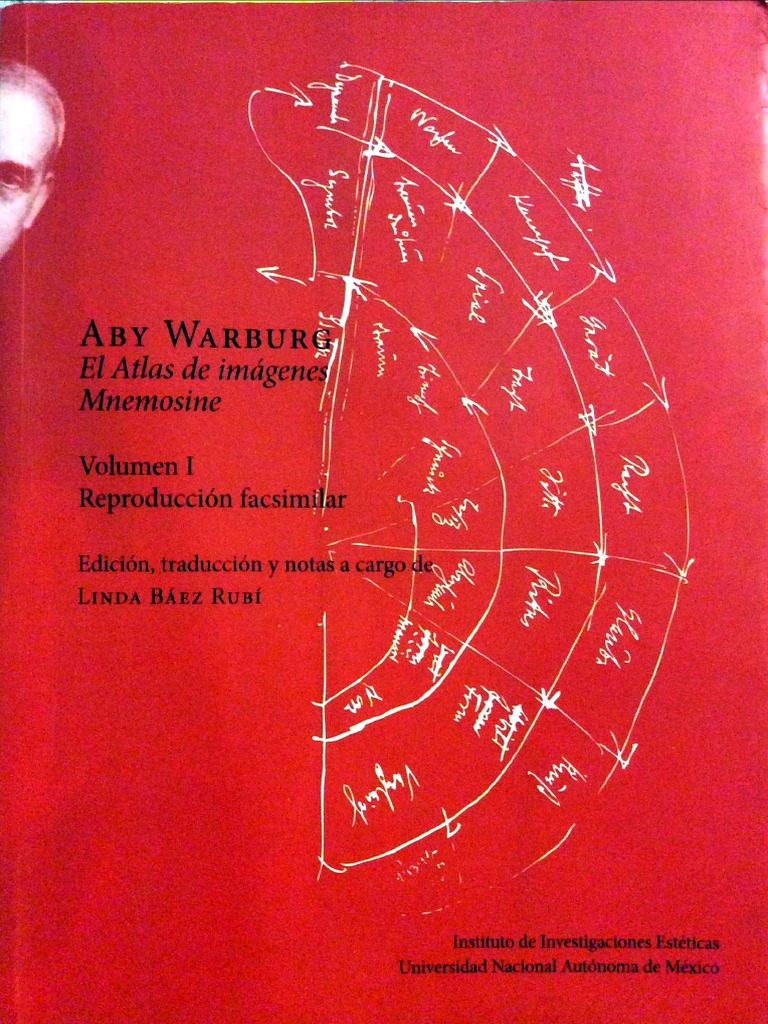
A. Warburg, El Atlas de imágenes Mnemosine, editado por L. Báez Rubí (Instituto de Investigaciones Estéticas, Universidad Nacional Autónoma de México, Ciudad de México 2012).
Índice
VOLUMEN I
Abreviaturas
MNEMOSINE
Los tableros del Atlas
VOLUMEN II
UN VIAJE A LAS FUENTES
Hacia la luz
Forja del lenguaje para una teoría simbólica
Hacia una ciencia de la expresión a través de la Mnemosine
Gestación de la Mnemosine (1924-1929)
UNA LECTURA DE LOS TABLEROS
EPÍLOGO
CRONOLOGÍA: ABY WARBURG
LIST DE ILUSTRACIONES
Linda Báez Rubí wrote two opening texts for her two-volume Mexican edition of 2012. A short introduction to the first volume (I, 15-16) precedes the facsimile and Spanish translation of Warburg’s Einleitung. The panels themselves face diagrams in which brief descriptions identify each image in its place. Un viaje a las fuentes, the essay published here, opens the second volume (II, 11-49) and prepares the reader for the panel commentaries that follow. Báez Rubí turns to the sources from which Warburg drew his account of expressive form, among them Goethe’s morphology and Richard Semon’s theory of the memory trace. The Spanish essay appears here with its first English translation.
A Journey to the Sources
Einen Gedanken zu finden ist Spiel, ihn ausdrücken Arbeit
Finding an idea is play; expressing it is work
Hermann Usener
(Epigraph by Aby Warburg in Grundlegende Bruchstücke)
Towards the Light
Shedding light on darkness was the act that brought the world into being and, like every act of creation, bears within it a quiet resemblance to every creative process: selecting, delineating, ordering and articulating, through the clarity bestowed by the illuminating power of comprehension and understanding, the undifferentiated yet rich and vibrant store of emotional and psychic experience that will nourish the formal world of images with its substance. This beautiful analogy reveals the arduous task of the creative individual. Yet we must understand that anyone endowed with a creative spirit seeks to ascend to the regions of clarity, to see and delineate the horizon from there, only to discover that the human condition makes it impossible to master and apprehend everything at a single stroke: expression, then, is work.
It is to this task that patient study is devoted: speaking of Aby Warburg’s personality and legacy is no easy undertaking. The complexity of his reflections on images demands an effort of understanding to shed light on the obscure and, in certain respects, indefinable mechanisms of the human psyche that generate them. His published essays, collected posthumously by Gertrud Bing, represent only part of a legacy that also includes notebooks, lectures and theoretical fragments (GS; Biester, Wuttke 2007).
This bold aspiration—to try to understand his endeavours—arises from a personal interest: to draw attention to someone who devoted all his intellectual and psychic energy to solving a single problem, the legacy of Antiquity in European Renaissance culture. Yet this research, like everything concerning Warburg, involves establishing connections with dimensions beyond those initially envisaged. Explaining why the culture of classical Greek and Roman Antiquity decisively influenced Western European thought meant delving into the sphere of human social, religious and economic organisation. Studying images that had been inherited, transmitted, transformed and recreated meant addressing their inherent dynamic force and human responses to them, a question that reveals, according to Warburg, the psychological and mental disposition of a particular culture. Artistic creation was thus, in this sense, a cultural process in which aesthetics could not be dissociated from socioeconomic and psychoreligious aspects. Some art historians in the second half of the nineteenth century had already begun to pursue a path opposed to conventional aesthetic appraisals, which disregarded such questions. Warburg likewise opposed judgements that isolated style from its historical context and thereby obscured the genesis and expressive force of images.
Hence Warburg’s profound inspiration from Jakob Burckhardt’s The Civilization of the Renaissance in Italy (Burckhardt 1860), devoted to studying everyday life as the foundation for understanding cultural production (Villhauer 2002, 31-38). A teacher from his university years, Karl Lamprecht (1856-1915), followed the same approach, conceiving cultural history as a science (Wissenschaft) devoted to studying human psychic life in order to explain systematically how individuals behaved in particular periods of German history. Through a psychology of historical phenomena, Lamprecht sought both to understand individual mentalities and to systematise the psychic transition from one state to another through clearly delineated, periodic stages. He thus developed an evolutionary model of cultural history that proceeded from symbolism to typism, then to conventionalism and subsequently to individualism, finally reaching the phase of subjectivism (Lamprecht in Schönebaum 1974, 633-662; Gombrich 1970, 30-42; Villhauer 2002, 25-27; Brush 2001, 65-92). By “typism” (Typismus), Lamprecht meant the stage in which individuals recognised a shared national character through attitudes perceived as distinctively Germanic (Lamprecht 1905, 31-34; Oesterdiekhoff 2001, 372-373).
Closely associated with these themes and new psychological approaches was the comparative history of religions as conceived and taught by Hermann Usener (1834-1905) at the University of Bonn when Warburg was an undergraduate (Villhauer 2002, 28-31). Through a philological analysis of various mythological repertoires, Usener recognised that religious practices were profoundly connected with the primitive origins of cultural phenomena. For Usener, myth was the oldest form of human thought, and its formation made it possible to trace and delineate a particular psychological problem (Bader 2003, 148-158; Wesseling 1997, coll. 965-979; Arrighetti et al. 1982). Likewise, discussions and commentaries on the model of the associative psychology of myth proposed by Tito Vignoli in Mito e scienza (Vignoli 1879) would influence Warburg’s conception of mythological images as processes of symbolisation reflecting the determining forces of nature (Villhauer 2002, 17-19). The projection and personification of phobias in symbols, and in abstract signs belonging to science, are forms of human expressivity that manifest the individual’s relationship with the world. Drawing on what he had learnt during his university studies, Warburg proposed a new methodological approach that would regard the work of art as a complex product of the psychic and social factors acting in “life”, thereby contributing to the formation of the phenomenon of expression, in which the configuration of style had to be understood and explained beyond mere aesthetic appreciation.
Warburg’s task, then, was to create an apparatus capable of identifying, observing, measuring and analysing the factors that determine psychological changes, and thus of resolving the problem of artistic expression. The Hamburg scholar’s practical response was directed towards acquiring instruments capable of detecting the pulsations that constituted life’s dynamic pulse: books and images available in a study room, within reach of anyone interested in understanding the manifestations of cultural life (WIA III.1.10.1, 29 December 1927, f. 12).
This attitude was motivated by a powerful impulse to go beyond boundaries: the so-called Grenzerweiterung, as an ethic of life and work, characterised a personality that would change the way humanity’s cultural manifestations were seen, examined and understood. An ethic of work, because it brings out the most precious value of research: tirelessly and constantly opening new horizons. An ethic of life, because opening boundaries for others is a Promethean undertaking in the fullest sense of the word. In a letter to Johannes Geffcken of 16 January 1926, Warburg described this undertaking as a struggle against ignorance that required making the instruments of research available to young scholars and helping lay readers find their way to books (Wanderstrassen der Kultur, 158-160). The audacity of stealing fire from the gods aims to bequeath to human beings and future generations the tools of knowledge acquired through great effort, so that others may continue and develop what has been achieved thus far. In Warburg’s words:
For the treasures of books, both in the seminars and in the great state library, were available to students in the most liberal manner. Without this glorious Strasbourg humanity I could never have developed further […] there I successfully discovered Poliziano, the learned poet, as an intermediary of Ovid […] also as a transmitter of antiquising mobility in dramatic representation (WIA III.1.10.1, 29 December 1927, f. 5).
In that “glorious Strasbourg humanity”, Warburg discerned better than anyone the importance of access to books. Hence, in building a library, he sought to place within researchers' reach the instruments that would allow them to examine the problem in question from several perspectives and, by constantly recombining the material assembled, arrive at the most adequate interpretation of humanity’s cultural symptoms. In this sense, Warburg’s material legacy to the humanities should be measured not only by his scholarly writings but also by his immense library: a laboratory where word and image meet, complement one another and, in doing so, speak to one another and to us (Settis [1985] 1996, 122-165; Jesinghausen-Lauster 1985, 151-224; von Stockhausen 1992; Schäfer 2003). The library is thus conceived as a receiving apparatus (Auffangsapparat) that captures data, a laboratory where they are processed, and a seismograph (Seismograph) that detects, preserves and accumulates the subtle changes of life in motion from which a need for cultural manifestation arises.
It was no accident that Warburg spoke of constantly tracing migratory routes, the arteries running through the corporeal substance of memory, because memory as substance ultimately becomes present—that is, takes form—in the mental and material images and written documents that human beings conceive, perceive, apprehend and create. The library and the Mnemosyne image atlas would share a common purpose, each pursuing it in its own way: to “map” the paths of cultural inheritance from East to West, in its interchange between North and South (Wuttke [1979] 1992, 307). Indeed, Warburg opened new possibilities for approaching the production of images by revealing the traces of an itinerary of transmission and selection across time and space, and also that through which images became present and circulated: their vehicle, that is, the body of images. Panel A, which opens Mnemosyne, gives this ambition a visual form by tracing relationships across geographical, historical and genealogical space (Mnemosyne Atlas México 2012, I, Panel A).
Forging a language for a symbolic theory
Before discussing Mnemosyne, a brief introduction to Warburg’s use of language is necessary, since language, together with images, is his medium of expression. His style might be said to articulate and condense two aspects: the metaphorical and the scientific. Thus the construction of his sentences and his use of neologisms follow a logic involving two aspects that seem difficult to bring together at first sight, yet ultimately share the same essence: that of being “poles”. Although Warburg does not formulate aphorisms as brilliant as those of his contemporary Walter Benjamin, he does articulate sentences resembling formulations of scientific laws, while aptly interweaving terms with figurative roots. The relationship between the two thinkers has been explored by Rampley and Zumbusch (Rampley 2001; Zumbusch 2004). Two highly complex factors thus come together in his texts. On one side is the analytical and scientific impulse that closely observes every detail, aspect and behaviour in an attempt to explain its causes and effects through the constructive logic of the sentence, often arriving at schematic formulations; on the other, the tendency to synthesise a large body of material at a single stroke through metaphorical turns of phrase. His recollection of dissecting and drawing plants at school, with the feeling that he was tracing a law of nature, offers an early example of this analytical impulse (WIA III.1.10.1, 29 December 1927, f. 2). He was also conscious of the density of his writing, describing his own compressed manner as an “eel-soup style” (Aalsuppenstyl) in a diary entry of 20 March 1927 (GS Tagebuch, 70).
Thus Warburg creates neologisms and weaves together wordplay densely charged with meaning, which can be fully understood only through associations involving further reflection, indispensable to grasping the complete sense. The term Eilsiegebringitte, for example, condenses the transformation of the Roman thiasos—the ecstatic retinue of Dionysus or Bacchus—into its restrained Florentine manifestation (Tod 1906-1907, 328-338; GS Tagebuch, 468). This transformation is articulated in the following sequence:
From the swift victor
to the swift serving woman
and back to Lady “Abonde”
[Von der Eilsieglinde
zur Eilbringitte
und zurück zur Dame Abonde] (WIA III.102.4.2, 4 July 1929, f. 13).
The first noun refers to the conception of movement (Eile, “haste”), joined to victory (Sieg), plus the ending of a personal name derived from the lime tree (Linde); in the second, Warburg continues with wordplay linking a personal name to a concept: the female figure (Brigitte, “Bridget”) in her task of service (bringen, “to bring”). This pair of nominal forms is condensed in Eil siege bringitte, revealing the stages of a process of metamorphosis carried out through history. Thus, in a single noun, Warburg succeeds in condensing the tension of polarity underlying the symbol of the nymph. On one side stand the ecstatically liberating movement and sublimation in victory that characterise the nymph in Greek and Roman culture; on the other, the frenetic movement, already domesticated and attenuated by the subjection of passionate values brought about by the Christian religion (GS Tagebuch, 219-220): the winged Roman goddess of victory who, in the Florentine Quattrocento, does not ultimately become subdued, reduced to a serving woman. Carrying a basket filled with fruit and offerings, she can become the lady of abundance (Abonde). Warburg traced this energetic inversion not only in painting but also in sculpture and architecture (WIA III.102.4.2, 20 June 1929, f. 14; Gombrich 1970, 249-301). Ghirlandaio’s style will occupy an important place in the course of the Atlas, since its figurative forms, which interpret Antiquity, will respond to the “domestication” of the thiasotic maenad, transformed into a submissive nymph serving the court of the Florentine merchant bourgeoisie. Panels 45, 46 and 47 explore this theme through Ghirlandaio’s works and those of his contemporaries (Mnemosyne Atlas México 2012, I, Panels 45-47).
Various examples parade—or, rather, are interwoven—in one of the most substantial and interesting, yet also most difficult to understand, of the texts Warburg wrote between 1896 and 1901, after returning to Europe from his journey to the United States. I refer to “symbolism as the determination of Form”, written in an almost telegraphic manner, although its sentences follow a logic reminiscent of mathematical equations and the formulae of certain laws, through which the author wishes to give his ideas a truly scientific character. Although he did not yet regard the manuscript as a book, Warburg hoped that binding it would help him anticipate—or even force—clarity and completion (WIA III.45.1, 27 March 1896, 2). This search for scientific grounding belongs to the attempt to replace an aesthetics “from above” with one “from below”, informed by theories of empathy and psychophysiology (Zumbusch 2004, 232). Parameter A is to be understood as follows:
A Preliminary dialectical question
Distinguish between two forces:
The differentiated sign = S.
The absorbing fertile ground = N.
Apperceiving mass = M.
The latter [becomes] the “symbol”.
[A Dialectische Vorfrage
Nach zwei Kräften zu scheiden:
Das differenzierte Zeichen = Z.
Der absorbierende Nährboden = N.
appercipierende Masse = M.
das letztere das “Symbol”] (WIA III.45.1, 27 March 1896, 5).
Concerning this distribution in the form of a formula, Warburg writes that symbolism should be understood as the “function of gravitational force in psychic life” (WIA III.45.1, 3), thus defining it as a physical aspect while also relating it to the psychic world. Two forces therefore participate in its nature, positioned in hierarchical opposition on the visual and metaphorical planes in a dialectical tension: the upper corresponds to the differentiated sign (S), while the lower is the “apperceptive” mass (M). The sign (S) is what has been refined, since it is reached—or, rather, ascended to—through differentiation. Differentiation of what? Precisely of the mass, understood as a conglomeration of impressions elicited in the act of perception in a very physical and bodily way. Perception, moreover, should be conceived not simply as a passive act taking place in physical matter, but as an immediate transition to an activity undertaken psychically by becoming conscious of what has been perceived. In Wundt’s experimental psychology, apperception designates the active apprehension of a perceptual content; this framework helps clarify the passage from sensory reception to conscious activity at issue here (Wundt [1896] 1907, 246-271). This explains why S (sign) and M (mass) are considered relative values: the element that truly defines their conversion into one or the other is individual experience (N), that soil which absorbs lived experiences in order to process them (WIA III.45.1, 27 March 1896, 5). The “refined” sign, which Warburg describes as a product of progressive, purposive selection (WIA III.45.1, 7), must therefore be understood as the result of a process of purification of the mass of impressions still carried by the symbol: sensory impression—the lower, material world—can become a spiritual sign—the upper, abstract world—through a physical, physiological and psychological process condensed in a formula of “expression”. In this way, Warburg articulates a central law of his conception of the symbol, whose application will form the axis around which the Mnemosyne image atlas revolves. To understand the introductory panels (Mnemosyne Atlas México 2012, I, Panels A, B, C), we must consider the result of applying parameter A:
B. The symbol in space and time
In the different phases of corporeality.
In the conventional division of human functions into religion, law, art, physiognomy and science lies the decisive latent characteristic of the different degrees of symbolism.
[B. Das Symbol in Raum und Zeit
In den verschiedenen Phasen der Körperlichkeit.
In der konventionellen Einteilung der menschlichen Funktionen in Religion, Recht, Kunst, Physiognomik und Wissenschaft ist latent das entscheidende Charakteristikum für die verschiedenen Stufen des Symbolismus enthalten] (WIA III.45.1, 27 March 1896, 11).
The different phases of corporeality reveal symbolic symptoms through which it is possible to identify the degree of distance that individual consciousness establishes from the world. Symptomatic behaviour manifests itself in the various fields of individual cultural activity: religion, law, art, science and so forth. The symbol becomes a visual articulation—a response—bearing within itself a potential energy which, in contact with a particular reality situated in time and space, tends towards abstraction or concretion. This intermediate position of the symbol and its tendency towards either an abstract or a concrete pole had been synthesised by Warburg in the same manuscript through visual diagrams systematising cultural functions. In one of them, the process of symbolisation occupies an intermediate position in three concentric circles with five segments or cultural fields in which it takes place (WIA III.45.1, 31).
The diagrammatic operation thus offers us the possibility of understanding the different kinds of symbolisation: clothing (II), law (III), religion (IV), art (V) and language (VI), to which play is subsequently added as a point of departure (I), in accordance with a “differential dynamic” (Differenzierende Dynamik) established among these forces of cultural expression. For example, the symbolic process expressed in clothing opens up a broad spectrum: at one end, a practical and concrete understanding of clothing as an “implement” (Gerät), which therefore elicits a dynamic energy of manipulation in the individual; at the other, a conceptual and abstract understanding, as suggested by ornament, which demands a static energy of contemplation. Carlyle’s Sartor Resartus, a recurring point of reference for Warburg, treats clothing as part of a symbolic system through which human beings establish relationships with themselves and the world (Carlyle in Hudson 1973, 2; Villhauer 2002, 39-44; Gombrich 1970, 75). For Warburg, clothing as a “cultural product” likewise entails the intervention of human will in an act of selection. In other words, a psychic and emotional intention is involved, through which human beings construct their individuality in relation to others within the social and political world to which they belong. This reveals the human being as an acting animal who, as such, uses both bodily expression and instruments as means of expression. Here we discern the profound anthropological meaning that Warburg would attribute to the phenomenon of human expression in different periods and cultural fields. He would subsequently modify the circular diagram described above by integrating the cultural segment of the symbolisation of play and adding that of dream interpretation. This produces a semicircle in which symbolic behaviour is defined as an intermediate state (Zwischenzustand) between differentiation (Differenzierung) and static behaviour (statisches Verhalten), thus once again emphasising the gradual character of symbolic intensity (WIA III.45.1, 8 December 1899, 30). Here it should be understood that the cultural expression of symbolic behaviour—divination, play, clothing, tradition, ritual, form and comparison—tends towards two kinds of energy: on one side, a dynamic, centrifugal energy manifest in language (Sprache); on the other, a static, centripetal energy realised in the word (Wort) through the exercise of comparison (Vergleich). The process of symbolisation thus always moves along two polar directions in constant tension: from language → to word, from art → to mannerism, from faith → to superstition, from law → to possession, from implement → to ornament, from struggle → to triumph, from development → to dream. Ultimately, Warburg would consider the circular form inadequate for communicating his symbolic theory visually, since in many of the cultural segments it would be impossible to establish clearly what the concepts would come to mean and, consequently, how they could be woven into a solid system capable of explaining symbolising dynamics definitively. Warburg therefore ultimately proposed a small drawing reduced simply to two basic factors used to determine the degree of symbolic behaviour: dynamics and statics, with the symbol as a unity containing the possibility of activating both (WIA III.45.1, 9 December 1899, 30). Human cultural behaviour thus becomes the outcome of the interaction of these forces. The drawing could be seen as a phytomorphic schematic representation, confined to indicating the branch conducting the dynamic sap, on one side, and, on the other, the branch carrying the static sap. Both emerge from the same trunk—that of personal mobilisation—from which a crown, life, develops upwards. A pendular movement is clearly attributed to it, running, in Warburg’s understanding, from the magical pole of concretion to the scientific pole of abstraction.
Towards a science of expression through Mnemosyne. From Optical Feeling to Symbolisation
Explaining the dynamic processes of symbolisation generated by images in different cultural fields was a fundamental objective for Warburg, since this would subsequently make it possible to understand artistic creation as a product of style (Stilprodukt) arising from an interrelation with the dynamics of life in its fullest extent (WIA III.1.10.1, 29 December 1927, ff. 5-7). In recalling his encounter with Hopi masked dances in 1895-1896, Warburg explained that such experiences had enabled him to understand the dynamics of the work of art as necessary processes within human life. Yet the Hamburg historian went further: he explained the function of movement in human cultural and artistic life and also applied it pedagogically in his method of presentation. Thus he planned and mounted various exhibitions in which viewers underwent a dynamic experience at the very moment of perceiving the images on display. Moving through the various “sites of the image” where photographs were displayed in the rooms was intended to make visitors aware of the different psychic states they experienced when looking at and perceiving the images as such. Space and mobility thus acquired an unusual importance, since they were factors that gave the meaning of the image a distinctly personal dynamic by appealing to a store of individual experiences (Fleckner et al. 1993, 36-114). This pedagogical purpose would likewise be reflected in the Mnemosyne image atlas: a book open to constant combinatorial experimentation with its constituent panels, as though the reader-viewer were visiting exhibition rooms and deciding the route as associations of motifs, details and images arose in the mind in response to what was contemplated. Warburg fully understood the importance of the movement generated by images in the viewer’s affective and mnemonic world. This concern belongs to the broader field of psychological aesthetics, represented by the work of Theodor Lipps (Lipps 1903-1906; Allesch 2006).
We should remember that Warburg’s fascination with the dynamic belongs to the context of the nineteenth century, when society’s technological development accelerated considerably through discoveries in electrodynamics: electrical generators, transformers, the telegraph and so forth. Energy consequently carried both conceptual and metaphorical weight in Warburg’s thought (Raulff 2003; Michaud 1998). The parallels proposed between his work and Jules Marey’s experiments nevertheless remain contested (Métraux 2005, 21-43). Now, the sensation of dynamism—or, let us say, of the dynamic—involves a sense that is itself dynamic: sight. Its organ, the eye, makes rapid, almost imperceptible movements as it sees, looks and contemplates. These movements of the ocular muscles are connected with the nervous system and have repercussions in the psychic and emotional world, so that the act of looking belongs within a bodily psychophysiological system. Warburg thus considered that movement affected not only the displacement of external material objects but also psychic and spiritual developments in the observer, produced by contemplating moving objects or dynamic forms. In this regard, he drew inspiration from the theoretical propositions of Robert and Friedrich Theodor Vischer (Vischer R. [1873] 1927, 1-44; Vischer F.Th. 1887, 153-193), who used the concept of Einfühlung (empathy) and its different stages—such as Zufühlung (incorporation of sensation) and Nachfühlung (reproduction of sensation)—in studying physiological and psychological bodily processes as the basis of the perception and production of works of art, thereby establishing scientific causes for aesthetic experience. The subsequent psychological development of Einfühlung can be followed in the work of Lipps and Dilthey, the latter also an important source for Warburg (Lipps 1903-1906, II; Dilthey 1894).
What, then, did this empathic and optical consideration mean within the theoretical framework of Mnemosyne?
According to Vischer, when individuals contemplate a form, a personal feeling arises within them and is in turn transmitted to the form, even unconsciously, endowing it with a “spiritual” content (seelenvoller Inhalt: Vischer R. [1873] 1927, 1). In other words, human emotions and feelings—the psychic state—are projected onto external appearances through the perception of their form (Vischer R. [1873] 1927, 24-25). Vischer explains the act of optical perception physiologically: in every act of mental reflection (geistiger Akt), certain oscillations (Schwingungen) produce nervous modifications from which an image arises. Every symbolic figuration (symbolisches Abbilden) is thus understood to take place within the organism (Vischer R. [1873] 1927, 2, 21).
He ultimately calls this entire process symbolism of form (Formsymbolik) (Vischer R. [1873] 1927, 2), by which he understands an intimate amalgam of image and content. The degree of identification between image and content that human beings recognise in their reflective processes will determine differences in the development of civilisation. In religions that worship nature directly, image and content become confused, even reaching complete identification. Friedrich Theodor Vischer distinguished this intuitive symbolism, which animates the appearances of things, from a consciously conceived symbolism in which image and meaning remain distinguishable (Vischer F.Th. [1866-1873] 1922, 257 ff.). Robert Vischer characterises this kind of bond as obscure and confounding (dunkel-verwechselnde), since image and its meaning or content are perceived as an inseparable, undifferentiated unity (Vischer R. [1873] 1927, 26-31). Warburg illustrated this magical and associative bond (magisch-verknüpfende) through his study of the Hopi snake dance (Warburg [1923] [1988] 1996). The snake becomes a symbol of lightning because of its formal resemblance to it and the threatening character both exhibit. To summon rain, the Hopi therefore performed a ritual dance in which the dancer held a snake in his mouth, intending to produce rain through this demonstration of mastery. Something different occurred when Phantasie played a determining role in the process of symbolisation. The German term is retained here to preserve Warburg’s usage, without assuming a fixed equivalence with either English “fantasy” or “imagination” (Rosenmeyer 1986, 197-248; Pimpinella 1988, 379-414; Küster 1988, 447-462). In this case, a reflective exercise (Einsicht) allows the relationship between image and content to be understood as a comparison. Friedrich Theodor Vischer’s account of “poetic belief” makes this distinction particularly clear: the artist enters imaginatively into myth while retaining the awareness that its figures are creations of Phantasie, rather than real entities (Vischer F.Th. [1866-1873] 1922, 324; Vischer F.Th. 1887, 161 ff.; Vischer R. [1873] 1927, 2). Thus it can be said that the same process of anthropomorphism involved several levels, which Warburg identified as follows:
Anthropomorphism that submits, as an additional vital form, through naming—religion
Anthropomorphism that equilibrates, as an additional vital form, through periphrastic description—art
Anthropomorphism that subordinates, as an additional vital form, through designation—science.
[Überordnender Anthropomorphismus als vitale Zusatzform durch Benennung -Religion
Gleichordnender Anthropomorphismus vitale Zusatzform durch Umschreibung -Kunst
Unterordnender Anthropomorphismus als vitale Zusatzform durch Bezeichnung -Wissenschaft] (WIA III.43.1.2, 29 March 1891, frag. 164, f. 69).
In the anthropomorphic relationship that someone establishes with an image in a religious context, psychic life becomes dependent on a natural force that has acquired a figurative form. Naming evokes the force to which the individual submits and which must therefore be appeased through sacrificial worship. At the other extreme stands an anthropomorphism that masters and subordinates natural forces and ultimately regards the figures of images simply as signs: here individuals establish their psychic independence from the power of the image. Between these forms stands an equilibrating anthropomorphism which, although it establishes an affective relationship with the image, can create distance in the act of recreating it: recreation delineates the image, and delineation is already a way of bringing its inherent energy under control. The cultural process and degree of civilisation thus depend on degrees of symbolisation that bear witness to the individual’s anthropomorphic behaviour. Warburg would go further by questioning the internal processes of the act of symbolising and attempting to explain them theoretically.
“The mnemonic function as a primordial act of orientation” (WIA III.102.5.3, June 1929, f. 10). The store of memory and the factory of fantasy
Events perceived as stimuli leave a trace in the organic substance of memory, which Warburg called an engram, following the theory of Richard Semon (1859-1918) (Schacter 2001; Rieger 1998, 245-263). “I call this effect of stimuli their engraphic effect, since it inscribes or engraves itself in organic substance. I call the transformation effected in organic substance the engram of the stimulus concerned, and the sum of the engrams that an organism inherits or acquires during its individual existence its mneme” (Semon 1904, 20).
Engrams can fix or transport primordial human experience in symbols, and the store of engrams constitutes mneme, memory. Yet it is essential to understand that Warburg, unlike Richard Semon and Ewald Hering (1834-1918) (Hering 1905; Gombrich 1970, 242; Pinotti 2001, 149-162)—whose concepts belong, respectively, to a neurological biologism and a social theory—situates these concepts in the field of creation and therefore of human expression and its various cultural manifestations. In these, engrams transcend their character as scars imprinted on psychic tissue: they represent a reaction or first expressive response that becomes images. These images, operating on a mental and psychic level and bearing witness to a process of symbolisation (Tavani 2004, 185; Schoell-Glass 2002, 39), then become physically visible in bodily expression and in the extensions the body uses to express itself. Warburg does not explicitly or consistently distinguish engrams from dynamograms. In the texts considered here, however, “dynamogram” appears to emphasise the engram’s dynamic aspect: mnemonic energy set in motion and manifested in bodily or sculptural forms. This reading accounts for the shift from a physiological term to a theory of artistic expression. Hence Warburg considers the “store of engrams” (Engrammschatz) constituted by memory to be a store of human suffering (Leidschatz der Menschheit) (WIA III.111.2, 10 April 1928, frag. 6, 19), and the functional equivalent of the engram to be the symbol viewed from an anthropological perspective (Pochat 1983, 76-87). The symbol stores the traces of mnemonic energy that once served to stamp primitive human experiences onto both body and psyche, and that would find expression in figurative and visual forms—images—which would in turn migrate through different periods along the paths of cultural transmission. Any creative act, any cultural manifestation, is therefore impossible without memory, precisely the mother of the muses. On this basis, Warburg considers the following:
The artist as
receiver and shaper
of ancient, dynamophoric
mneme.
[Der Künstler als
Auffanger und Former
der antiken dynamophorischen
Mneme] (WIA III.102.2.1, 23 and 24 May 1928, f. 7).
What does Warburg mean by this? In remembering what has been received and imagining—forming something new—two movements take place: one regressive, the other comparative, corresponding to two temporal operations, retention and reproduction. What is retained and transmitted is carried by memory, hence its character as dinamo-ferens (“carrying”). Moreover, the function of memory, consisting in recovering or restoring what has been forgotten, puts into practice an entire process of self-knowledge in which the self is led to reflect on the stored experiences that constitute its particular experience of the world. From these, fantasy is the organ capable of initiating the process of symbolisation and finding a new image for what seeks expression. In the creative act, the artist employs symbolic forms: images that bear witness to the process of reflection undertaken in the “factory of fantasy”, where an entire affective and emotional charge brought into play is given form and expression. Warburg would adopt the psychological ideas of Wilhelm Dilthey (1833-1911) (Schindler 2000, 96-122), according to whom creative capacity consisted of two psychic facts: memories and the creativity inherent in fantasy. When perception occurs, images exhibiting similarities or differences in relation to that perception are evoked. From the relationship between present perception and the set of images brought to mind by the capacity to remember, a new image emerges, enriched with present feelings and emotions (Dilthey 1878, 60-61). Fantasy can thus transform remembered images: it incorporates an affective charge generated in the present and endows them with new forms, clearly revealing its creative procedure. These are mental and psychological processes through which the forms of images produced by fantasy arise in consciousness. Yet they do not remain at a mental level: Warburg characterises fantasy as both “thinking in images” (bildhaftes Denken) and “acting in images” (bildhaftes Handeln) (WIA III.102.3.3, May 1929, f. 41). The images are experienced or, to use his expression, lived again (nachgelebt) through personal affects. In Dilthey’s account, this reciprocity between inward experience and outward images allows artistic illusion to be felt as if it were reality (Dilthey 1978, 97, 100). Thus,
The logic of fantasy creates a space for reflection
a creative organ [from which] arises
a kind of ganglion or dynamic switch
from the state of commotion to accumulation
surrender
passivity
fatal and human energy
monstrous
passivity
ephemeral
return to oneself
contemplation
in doubt.
[Die Logik der Phantasie erschafft einen Denkraum
schöpfendes Organ hervor eine
Art Ganglion-dynamischer Umschalter
von Ergriffensein
Lagern
Hingabe
Passivität
fatalische wie humane Energetik
monströser
Passivität
lebensflüchtiger
Zurückverseelung
zweifelnde
Contemplation] (WIA III.102.5.3, 9 June 1929, f. 17).
Umfangsbestimmung: Awareness of Distance
It should be noted that Warburg characterises fantasy as a ganglion or dynamic switch, thereby referring to the physiological and energetic aspect of an organ which, until the nineteenth century, the humanities regarded as belonging to metaphysics. Warburg likewise directs his attention and efforts towards understanding what artists create consciously, in accordance with their will or independently of it. Hence its character as a “switch”, since it can redirect and reconvert—that is, order—the energy inherent in symbolic forms according to expressive needs: surrender, passivity, contemplation and so forth. Warburg thus seeks to discern the mechanisms and elements through which the creative individual carries out a process of symbolisation grounded in a personal affective world (Geisteshaushalt): an economy of memories, sensations and feelings that supplies the resources of aesthetic experience (Dilthey 1978, 265-266). This ordering function is explicit in his definition: “Symbolisation consists in naming through an image. Naming is purposeful in overcoming chaotic confusion by permanently associating a product of reflex movement with a bearer” (Grundlegende Bruchstücke, 26 March 1891, frag. 141b, f. 70).
Warburg explicitly indicates here that reflective movement is delimited, or “given form”, through the image—naming implies an effort of delimitation—which is actualised in the “body of the image”. The symbolic image can then become a sign-image, which happens when it signifies comparatively and is thus situated at a level of abstraction, making it possible to imagine several objects at once (Grundlegende Bruchstücke, 26 March 1891, frag. 141b, f. 70). For Warburg, therefore, symbolism is understood in terms of the gravitational force of individual spiritual concerns, or as a primary determination (primäre Umfangsbestimmung) of a figure’s contour (WIA III.45.1, 27 March 1896, 3).
Finding an adequate translation for the concept of Umfangsbestimmung is difficult; literally, it would be “determination of the perimeter or contour”. Zumbusch relates the concept to Kant, showing how it allows Warburg to connect Vischer’s physiologically grounded Einfühlung with the mental and cognitive dimensions of experience (Zumbusch 2004, 239-240; see also Schindler 2000, 85). Here it denotes an activity performed by the creative individual upon the perceived object, the mental image formed of it in correspondence with the individual’s inner affective world, and the subsequent transformation of that image into an external material object. A comparison with Alberti’s circumscription, the delineation of a figure’s contours, helps clarify this concern with the determination of form, although it does not in itself establish a direct derivation (De pictura, II, 31, 33; Solís Rebolledo 2008).
The “determination of the contour” would refer to the creative possibilities that imagination unfolds by giving form to desires, ideas and memories previously experienced in perceiving the external object. Fantasy—what would correspond to imagination in contemporary understanding—plays a fundamental role, since it endows those affective evocations with contours and seeks to delimit them; in other words, it determines their perimeter, in the fullest sense of the word, and gives them form. The tension generated in the bond between object and individual would arouse particular interest in Warburg, since it defines the degree of empathy and thus the way the subject is bound to the external object. This relationship will reveal the mode of orientation towards which human consciousness is directed, introducing us to Mnemosyne:
The conscious creation of a distance between oneself and the external world may well be considered a founding act of human civilisation: if that intermediate space becomes the substratum of artistic creation, the preconditions are fulfilled for this awareness of distance to become a lasting social function […] Its adequacy or failure as an instrument of spiritual orientation then constitutes the destiny of human culture (Mnemosyne Atlas México 2012, I, 27).
Warburg would recognise here the importance of the human act that would become one of the central aspects of his cultural theory: “creating distance” (Distanzschaffen), decisive for humanity’s civilising process and its ensuing liberation from magical and religious domination, which the Hamburg scholar identified with the psychic conception of the “monster” and its corresponding figurative visualisation as the outcome of that psychic state. Hence the substratum—that intermediate space which allows reflection and whose primary role is to serve as an instrument of spiritual orientation—constitutes the necessary condition for artistic creation. Thus, as early as his experience in the United States, Warburg had theoretically formulated the artist’s activity as follows:
The artist who feels out
between the two
|
I |
II |
III |
|
grasping |
repelling |
comparing |
|
cancellation of |
distance |
distance |
[Der abtastende Künstler
zwischen beiden
|
I |
II |
III |
|
greifend |
abstoßende |
Vergleichend |
|
Aufhebung der |
Entfernung in |
Entfernung] |
(WIA III.45.1, 11 de marzo de 1901, 39).
In the first mode, in which Umfangsbestimmung acquires an assimilative character because it incorporates, awareness of distance is cancelled, and subject and object are thereby confused in an undifferentiated spiritual unity: total empathy. Warburg had already described an “assimilative determination of form” (angleichende Umfangsbestimmung) in 1900, distinguishing bodily assimilation through ornament or instruments from assimilation at a distance through possession (WIA III.45.1, 4 May 1900, 33). Its function is clearly to grasp and appropriate (greifend-aneignend) (WIA III.45.1, 11 March 1901, 41), both materially and psychically, the external object. In the second, a certain distance “at hand” is established between subject and object, and individuals judge themselves independent of the latter in the act of sensory perception, thereby constructing a conscious distance. Here, the sensory data from the perception of the object are confronted, contrasted and associated with the images of memories, producing a new configuration of the image and establishing awareness of an inner reality to some extent distinct from the external object. Artists “feel out” and “give form” to these new images formed in their subjective inner reality, subsequently expressing them in material objects—cultural products—that other individuals can perceive. In the introduction to Mnemosyne, he would place this act of feeling out the object between imaginary grasping and conceptual contemplation (Mnemosyne Atlas México 2012, I, 31). The action of Umfangsbestimmung performed by fantasy is thus characterised as tactile and formative (abtastend-bildend) (WIA III.45.1, 11 March 1901, 41). In the third mode, comparison establishes a fully conscious distance between individual and object, and the image thereby becomes a sign. Its function is thus understood as a naming and descriptive task: the verbal and descriptive (sprechend-beschreibend) is a manifestation of the rational spirit, through which things are mastered by being described (WIA III.45.1, 11 March 1901, 41).
The process of symbolisation reveals a vital dynamic that determines the development of human civilisation, while also explaining the problem individuals face in the act of creation. In feeling out, determining and specifying the contour of an entire affective world stimulated by the perception of external forms, the artist stands between the first and second modes. These expose the critical phases that human beings undergo psychically, which Warburg would later condense in the beautiful image of a “pendular movement between the image-based and sign-based positing of causes, from the image-like to the sign-like” (WIA III.102.3.3, 2 April 1929, f. 76), since the creative individual oscillates between two poles: image and sign. Because imagination has been stimulated by perceived sensory data confronted with the images of memories, individuals can enter into resonance (ein-schwingen) with the materiality of the perceived object (adhering—haften, Mnemosyne Atlas México 2012, I, 27, 31) and, from there, order the affective charges aroused and give form to a new, individual mental image by establishing its contours. Becoming conscious of this inner process, which entails reflective mental activity—measuring (messen)—allows human beings to move away from the object (aus-schwingen) (Mnemosyne Atlas México 2012, I, 27, 31; Schindler 2000, 161). The final step would be the materialisation of this new mental image. The creative process thus constitutes a cycle (Kreislauf), understood organically and physically through psychophysiological processes, that bears witness to the manifestation of inner life in motion: a constant oscillation between assimilation and distance.
Gesture and Pathos Formula
For Warburg, the Mnemosyne image atlas summarises his earlier research (GS Tagebuch, 220-221; 10 March 1928, notebook 4, 121): it proposes to delineate a theory of the artistic process from the stylistic changes observed in works of art. Its principal objective would be to show viewers the preformative function of antiquising expressive values visualised in life, both in their inner psychic dynamics and in their resulting outward expression (letter to Karl Vossler, 12 October 1929, cited in Schoell-Glass 2002, 38, n. 13). Warburg’s interest is clear: inner life set in motion by external stimuli cannot be perceived visually without its outward expressive manifestation, constituted not only through a vehicle in which the image materialises but, in the first instance, through gesture. Gesture, understood as the first symbolic cultural form, is recognised as an image: an image reflecting inner psychic life expressed through a whole physiological activity with psychic antecedents and repercussions (Mnemosyne Atlas México 2012, I, 33; Sierek 2007, 81). Gesture is thus deeply anchored in what must be understood as bodily memory. Since memory is considered an organic substance by virtue of its material qualities, it can be modelled through impressions and traces; it therefore remains in a constant process of metamorphosis rather than unchanged, becoming, in Warburg’s words, “the guardian of the antiquising dynamo-engrams of gestural language” (GS Tagebuch, 120; 17 July 1927, notebook 3, 29). It thus demonstrates its capacity to endure, survive and change within society and artistic expression alike. In the latter, on coming into contact with historical and material reality, dynamo-engrams acquire the character of pathos formulae in their visual and plastic manifestation. Already in his dissertation on Botticelli, Warburg had examined movement in forms as an expression of inner life; the moving accessories (bewegtes Beiwerk) would subsequently become a symptom of the Pathosformel, a term introduced in his 1905 essay on Dürer and Italian Antiquity (Renacimiento, 404). But how does Warburg know that this bodily memory functions? “To understand human expression in the image as the matrix of expression belonging to practical life set in motion—whether religious cult, the drama of courtly celebration or the stage—was a substantial idea I had reached long before, thanks to two books […] in 1888 I read Darwin’s The Expression of the Emotions in Man and Animals and Piderit’s Mimik und Physiognomik” (WIA III.1.10.1, 29 December 1927, f. 7).
Warburg here opens a new field within human cultural production—religious cult, drama, celebration—by drawing on Darwin’s evolutionary biological propositions (Gombrich 1970, 72, 76) and Theodor Piderit’s (1826-1912) medical and physiological account of mimetic movement as a reflection of an inward psychic state (Piderit [1867] 1919, 35). Warburg’s self-description as a “psychohistorian” connects this inquiry into images with reflection on his own experience (GS Tagebuch, 429). The “psychohistorian” is guided by Darwin’s proposition that gesture constitutes a reflex response which, although constant, continues to lose the intensity of the original reaction. For Warburg, this process of “becoming civilised” implies that gesture, in expressing reflection rather than reaction, denotes an exercise of orientation. Orientation is a characteristically human psychic process, as distinct from that of animals, in which will, the affective world and personal expressive desires act as structuring elements. Gesture, conceived as the manifestation of a particular will towards genuine expression, becomes a physical and dynamic image filled with meaning. This must be understood phenomenologically, since the image reveals itself, manifests itself from an experience stored deep in memory; yet this experience also discloses its affective enrichment, forged in the historical and geographical context in which it materialises. Warburg accordingly recognised that a science of expression required the geographical and national scope of observation to be widened (WIA III.1.10.1, 29 December 1927, ff. 7-8). Fantasy plays a determining role in the process of gestural expression. Far from understanding it as a merely “psychic” activity, we must relate it to the bodily world: passive or active reactions, through the experience of mental and affective identification that a subject experiences with the external object, are the product of the bonds that the organ of fantasy establishes with the external world. Warburg is right to characterise the latter explicitly as an organ, since this situates it within the somatic sphere. Its metaphysical activity is thus joined to a physiological activity, because it involves the human body in its entirety. As Robert Vischer had argued, the effects of contemplating an external form resonate throughout the organism: perception engages the whole body, not sight alone (Vischer R. [1873] 1927, 13). Warburg thus speaks, in an anthropological sense, of a “science of expression” that cannot be understood without considering the psychophysiological processes involved in symbolisation and the formulation of human gestural language. The task now is to determine the kind of expression involved: does it proceed from a direct reaction to a stimulus, as in the primitive mentality, or does it involve a conscious selection of particular reactions in order to express something specific? “A distinction must be made between sensation (Empfindung) as a designation for a change in facial or bodily expression, brought about despite ourselves by some overwhelming power […] and sensation as the expression of our awareness that our body’s expressive capacity is inadequate to what we wish or ought to express” (Grundlegende Bruchstücke, 1 October 1898, frag. 13, f. 7).
Warburg draws a clear distinction between certain reactions to external stimuli. According to him, the immediate instinctive reaction “transmits contact with life directly”, whereas the reaction produced through the artistic process transmits contact with life “indirectly”; his example of the latter is “modern art in the manner of Raphael” (Grundlegende Bruchstücke, 1 October 1898, frag. 13, f. 7). Here Warburg argues that the creative individual’s will has the freedom to transform these gestural forms of heightened expression through a creative process, thanks to fantasy as a switching organ and an assimilation of the forms inherited through collective memory (Mnemosyne Atlas México 2012, I, 31). This is precisely a desired mechanism of “de-demonising that inheritance of phobic impressions encompassing the full range of emotions on the gestural plane, from abandoned meditation to murderous cannibalism” (Warburg [1929] [2009] 2017, § A4). Emotions are channelled bodily in such a way that a broad affective spectrum becomes available, including “all the stages situated between the two limiting poles of the orgiastic, such as fighting, walking, running, dancing and grasping” (Warburg [1929] [2009] 2017, § A4). Phobic impressions are actually lived and carry a powerful, dynamic human affective charge; yet the creative individual’s will determines whether to succumb to them completely or transform them by taking an objective distance from them. This means assimilating them and, from that assimilation, creating gestural forms that answer to the expression of a particular inner will. Such forms are thus conceived from an individual consciousness that allows people to perceive themselves as autonomous in relation to the phobic forces projected into the external world. From the foregoing, it follows that gesture consolidated in an image should be seen not as a static product of human expression, but as the result of a sequence of movements—that is, processes or actions which, captured in a suspended instant, reveal both their inner and their outward dynamics. This anthropological theory of expression had a profoundly innovative spirit within the aesthetics of Warburg’s time, since it rejects the idea that the creative act originates in a pure originality concentrated in the figure of genius. At the same time, perceiving the created work is an act that ultimately constitutes it in its creation: it recreates the work and thereby completes its meaning. “The artistic product, by always offering itself to the viewer—contrary to the rule of life—as a fixed copy of a truly fleeting moment, allows viewers also to attempt to test its capacity for life in the work of art, since they can draw conclusions about its inherent qualities from this or that characteristic of its surface” (Grundlegende Bruchstücke, 22 June 1888, frag. 3, f. 2).
Warburg understands the creative act as imitation, since memory and imagination enter into dialectical interplay within it, thereby making room for a phenomenology of the will. This passage suggests that, far from being understood as static (Pfisterer 2003, 21-47), pathos formulae should be seen as expressive values revealing a psychic and existential tension (Mnemosyne Atlas México 2012, I, 33, 35). The interpretation of the Pathosformel as a symptom also places this tension within the history of psychology (Didi-Huberman 2004, 203-233). Although coined in Antiquity, they retain the tremendous dynamic force of the organic energy they preserve, as is evident in their role in shaping Renaissance representations of life in motion (Warburg [1929] [2009] 2017, § B1). Hence pathos formulae cannot be considered universal: they involve a transformative energy through which an individual experience of considerable magnitude, occurring in a particular historical time and space, takes objective and enduring bodily form (Krois 2002, 295). As Krois argues, pathos formulae do not constitute a language in themselves: their capacity to make passion visible depends on a recognised narrative context or on the stories their gestural force prompts the viewer to formulate (Krois 2002, 307). Only when the “dynamo-engram”, materialised through a pathos formula, comes into contact with a particular historical time does it become polarised. In that act it reflects the individual’s psychic orientation, in which a change in the direction of energy—even one contrary to its original direction—becomes possible: contact with time brings about polarisation (WIA III.102.1.4.1, 1 June 1927, f. 12). “The Darwinian theory of remembering a state occasioned by a sensory stimulus should ultimately be understood not as something simple, but as a polarising process, in the sense that stylistic change is conceived not as a simple dynamic reaction, but as an opposing reaction against the imposed burden” (WIA III.1.10.1, 29 December 1927, f. 8).
Warburg proposes a process of polarising energy through which stylistic change is understood both as a dynamic reaction and, beyond this, as a counterreaction opposed to the imposition of particular cultural expressive values. The Florentine Quattrocento’s encounter with Burgundian tapestry and Netherlandish painting offered him a concrete instance of this confrontation with inherited and foreign forms (WIA III.1.10.1, 29 December 1927, f. 8). This aims to show that ordering and controlling the irrational and intuitive elements within pathos formulae, which preserve the primordial magical and primitive experience, makes it possible to move towards the development of an ethical sense (Settis 1997, 31-73) through conscious reflection. This allows a transition from “the object of the thiasotic dynamism of the masses” to the “self-awareness of a personal energy” as the result of mimetic individuation (WIA III.102.3.3, April 1929, f. 69). Thus the same gesture can be revalued and acquire a meaning contrary to its original one in the process of artistic creation: the ancient pathos of triumph, for example, can be transformed into the Christian ethical value of piety (Mnemosyne Atlas México 2012, I, 51).
For Warburg, the body functions as a field of resonance between the internal and the external, and thus constitutes a site of impression and expression in which the capacity and will for expression ultimately manifest themselves: the nucleus around which the theory of the image is woven throughout the Atlas’s visual itinerary. Here the image does not behave as the mere representation of something specific; rather, it has the capacity to “show” and thus to summon, through its own appearance, the other that is evoked and not represented. In this sense, the task is not simply to link formal motifs, but to awaken a visual awareness of them that reveals the enormous energetic potential to which images appeal when related to one another. The image’s complete act of reference does not imply the direct objective presentation of the referent. In Mnemosyne, the time of Antiquity is not simply represented: it is not reduced to the object of representation, since the image shows the fabric in which the object is evoked, the fabric in which the image has been able to become a “figure”, a visual form with contours. This bodily dimension of Warburg’s approach has also informed later studies of performance, theatre and dance (Brandstetter 1995; Port 2001a, 14-39; Port 2001b, 226-251; Streisand 2005, 153-179).
The Genesis of Mnemosyne (1924-1929). Projects Parallel to Mnemosyne
Mnemosyne begins to emerge as a project in 1924, the year Warburg returned from his convalescence at the Bellevue psychiatric clinic in Kreuzlingen, under the care of Ludwig Binswanger (1881-1966). Their relationship was important to both his clinical and intellectual history, and their exchanges also illuminate his reflections on image and sign (Stimilli [2005] 2007, 7-25; Warburg [1921-1924] [2005] 2007, 106-107). Warburg drew inspiration from the method of comparative visualisation based on photographs that Saxl had used during his years of service in the Austrian army (GS Tagebuch, 7). Comparative presentation itself had precedents in art history, including Wölfflin’s simultaneous projection of slides. On large black-backed panels displayed along the elliptical reading room of the Hamburg library, Warburg accumulated, ordered and reorganised photographs that he continually commissioned (Mnemosyne Atlas Berlin 2000, 51). The juxtaposition of images and their combinatorial possibilities provided a dynamic way of perceiving and apprehending them, a process in which the spoken word was assisted by the image. Sierek interprets the cinematic dimension of this procedure as a dispositio mentalis, a mode of organising thought rather than simply a property of the projection apparatus (Sierek 2007, 33).
From his return to Hamburg until his death, Warburg would deliver lectures in this format. His studies proceeded alongside the organisation of the material intended for the Atlas. Through both their experimental, combinatorial character and their visual content, these activities were closely connected with the panels of Mnemosyne. Peter van Huisstede’s reconstruction of the surviving lecture materials makes these connections visible; their uneven textual preservation also reflects Warburg’s practice of writing out introductions and conclusions while presenting the intervening argument orally (van Huisstede 1992). The lecture on Manet, for example, is available in published German and Italian versions (Warburg [1929] 1989, 257-272; Warburg [1929] 1984, 40-45). These complementary activities shed light on the selection and organisation of the material found in the final, unfinished series. The extensive image files documenting the exhibitions and lectures are preserved as “Warburgs Working Copies: Exhibitions (‘Bilderreihen’) Mnemosyne” (WIA III.108.7). The research comprised the two great fields to which Warburg would devote all his intellectual and psychic effort: astrology and the inheritance of antiquising pathos formulae down to the modern era.
Astrology
The lecture delivered in memory of Franz Boll (1925) represented, for Warburg, a recapitulation of the ideas and theoretical formulations he had developed in earlier years concerning astrology. His intellectual exchange with Boll, and his engagement with Usener’s studies of religion, formed part of this inquiry (Ghelardi 2002, 141-152; Usener 1896; Sassi 1982, 65-91). He addressed the development of the barbaric sphere in terms of humanity’s attempts at cosmic orientation, while emphasising the importance of the restoration of classical Antiquity in the Renaissance to the attempt to free the modern mentality from Hellenistic magical practices (Warburg [1925] 20088, 68). Warburg thus connected two themes that many would judge unrelated or even opposed at first sight: Italian Renaissance art and the “dark regions of late-antique superstition”. Their apparent opposition, he argued, was only superficial (Warburg [1925] 2008, 68).
The following year, during the Fourth Congress of Orientalists held at the KBW in Hamburg, Warburg delivered the lecture later published as “Astrología orientalizante (1926)” (Renacimiento, 513-516). He used six large panels placed on the walls of the reading room, together with further images tracing the history of the psychology of the sphaera barbarica (Renacimiento, 514). As reconstructed by van Huisstede, their sequence moved from figurative cosmic orientation and the sphaera barbarica to its legacy in Italy and Germany, the recovery of Antiquity, and the passage per monstra ad sphaeram (van Huisstede 1992, 153). This astrological material was already emerging as a fundamental component of the future Atlas. The lecturer drew attention to the laws of circulation (Kreislaufgesetze) interacting in two processes decisive for cultural development: submission to the laws of natural forces and the creation of distance from them. Through the latter, human beings move towards emancipation through mathematical abstraction. In this presentation, it is therefore important to emphasise the mythological hero Perseus, who appeared to the observer as an emblematic figure of these arduous processes of orientation. In his geographical and temporal itinerary, he had been clothed in magical beliefs deriving from Arabic astrology, before being stripped of his “barbaric garb” and restored to his primordial meaning, as he finally appears in the Loggia of the Villa Farnesina (Mnemosyne Atlas México 2012, I, Panel 54). The mythological hero thus recovered his “ancient status as liberator from the monster”.
To demonstrate this process of human civilisation practically and pedagogically through astrology and the restoration of ancient forms in the Renaissance, Warburg planned an exhibition at the German Museum in 1927, drawing on his lecture material (GS Tagebuch, 68-70). He envisaged twenty panels tracing the history of the cosmological Weltanschauung, from the devotion to the stars of the primitive mentality to the calculations of the modern astronomer: visual demonstrations of the human mind’s development in the “business of orientation” (Warburg, “Cosmología: Museo Alemán”, in van Huisstede 1992, 162). Related material was subsequently presented at the Hamburg Planetarium in the posthumous exhibition “Bildersammlung zur Geschichte von Sternglaube und Sternkunde”, which opened on 15 April 1930 and was reconstructed there in 1993 (Fleckner et al. 1993).
The Legacy of Antiquity
Warburg documented the legacy of Antiquity in culture both in the Renaissance and in later periods. In March 1926, for example, he devoted a lecture to seventeenth-century Dutch art (Gombrich 1970, 229-238). His primary interest was in elucidating the contexts and forms in which mythological figures such as Proserpina and Medea reappeared, and determining Tacitus’s influence on the formation of patriotic feeling through the narration of Roman deeds. The artist’s personality was crucial to understanding all this, since the way the legacy of Antiquity was restored depended on the artist’s choices in forging expressive values of his own or values subject to external demands. Hence, according to Warburg, the representatives of official Dutch art chose a monumental style answering the demands of triumphal festive art. Allegorical images serving official values were characterised by their grandiloquence, whereas figures such as Rembrandt would disdain those “monstrous grimaces” and adopt their own expressive means. Such a choice was a commitment not to succumb to a somewhat “hollow” dramatic representation, since it did not correspond to personal expressive demands. According to Warburg, Rembrandt succeeded in distancing himself from Romanising eloquence and theatrical poses without losing the mythological force that would endow his style with genuine expressive value. Here Warburg highlights precisely the importance of the moment between reflex, as an immediate reactive movement, and reflection, the intermediate space (Zwischenraum) whose opening in consciousness makes the passage towards civilisation possible.
The interest in Rembrandt and the Baroque culture of his time would continue and develop, both conceptually and visually, in the exhibition organised by the KBW in 1927 with engravings made for various editions of Ovid’s Metamorphoses. First envisaged in December 1926, the exhibition is documented in Warburg’s correspondence with Leo Ulrich and in the archival files on the Ovid image series (Aby Warburg to Leo Ulrich, December 1926, WIA GC; WIA III.97). The prints were displayed on the lower parts of the panels along the library’s elliptical room. Through this visual strategy, which gave viewers the opportunity to compare the motifs constituting the images, Warburg highlighted the different ways of interpreting the gestures of the ancient style: those “primordial words” articulating the tragic drama of the soul in its different practices of visualisation. Each of the six panels exhibited had as its main theme a particular pathos formula situated in different contexts of reception, such as musical performance—opera—and theatrical performance—intermezzi. Together, they revealed the cultural transmigration of motifs and themes through images from particular periods and cultural settings, maintaining a closer or more distant relationship with the original value Antiquity had assigned to them:
1) Pursuit (Daphne)—metamorphosis (Actaeon)
2) Abduction (Proserpina) running—grasping—death
3) Death as sacrifice (Orpheus)
4) Human sacrifice (Medea—Polyxena)
5) Sacrificial dance—funerary lament seduction—lament—triumph
6) Triumph (This order is based on the reconstruction in Cieri Via 2004, 305-343).
The sequence of visual documents reveals a structuring axis: the “words of primordial gestural language”—running, grasping and so forth—around which the following reflections revolve: the manifestation of a tension between poles of gestural expression and the actions recounted in myths. These reflections bring to light a dialectic between the triumphal rhetoric characteristic of Roman culture and the submission of the vanquished through an intensification of pathos (Cieri Via 2004, 343). The astrological theme joins this nucleus; in subsequent years the connection between them, already announced earlier, would become firmer, especially in the attempts to organise the Atlas’s material.
Organisation of the Material. The Urworte as Structuring Principles
The theoretical framework conceived for the Atlas in the summer of 1927 was formulated around the surviving formative force of Antiquity’s expressive values within the spiritual “economy” of European culture (GS Tagebuch, 126-127). It was to include a doctrine of gestural language and a repertoire of forms whose relations could be examined through an analogy with verbal expression. This analogy drew on Hermann Osthoff’s study of suppletion in the Indo-European languages, which Warburg discussed in the introduction to Mnemosyne. In certain comparative paradigms, intensified meaning is expressed through a change of root; Warburg related this linguistic phenomenon to the heightened expressive force that Renaissance artists found in ancient visual formulae (Osthoff 1899; Mnemosyne Atlas México 2012, I). He called the elementary forms of gestural expression “primordial words” (Urworte).
To forge this concept, Warburg drew on linguistic, philosophical, literary and scientific studies that shaped nineteenth-century German thought. One relevant linguistic parallel is Carl Abel’s (1837-1906) theory of “primordial words”, characterised in their primitive state by two mutually contradictory meanings (Abel 1885, 313-367). Zumbusch also relates Warburg’s use of the term to Herder’s anthropology of expression, in which perception and reflection meet in the formation of the Urworte (Zumbusch 2004, 176; Herder [1772] 1957, II, 17). According to Abel, the intellect could distinguish the opposing senses gradually and progressively, since rationality could compare them. There were also Urworte composed of words with opposite meanings, producing a compositum in which only the meaning of one constituent member ultimately predominated (Abel 1885, 320). The aim was not to create a third concept, but to express through the compositum what one of its contradictory members expressed by itself. Abel emphasised that this is not something illogical, but a process of language at the moment of its unfolding to grasp and give expressive form to phenomena occurring in reality, since concepts are forged only through comparison between opposites, the sole means of bringing out and identifying their differences (Abel 1885, 323). This contrasting process is the potential inherent in every Urwort, and its development depends on the individual’s relationship with the world in attempting to name it at the moment of perception. Thus, in Abel’s account, the meaning of a Urwort will always be relative—depending on subject, time and space (Abel 1885, 324)—and, at the same time, would tend to “invert itself” (Inversion):
Words with opposite meanings reveal the genesis of concept and language in primitive times. Since the presence of two opposing ideas in the mind was originally necessary to understand each one, both were referred to equally in certain words belonging to the oldest surviving language, whose nature and scope we must delineate more precisely below. Since the concept of “strength” could not be conceived without its opposite, “weakness”, the word meaning “strong” acquired a mnemonic bond with “weak”.
[Die Worte mit entgegengesetzten Bedeutungen erläutern das Werden von Begriff und Sprache in primitiver Zeit. Da die Gegenwart zweier entgegengesetzter Ideen im Geiste ursprünglich notwendig war, um die eine fassen zu lernen, so kamen beide gleichmässig zur Geltung in gewissen Worten des ältesten erhaltenen Idioms, deren Natur und Umfang wir weiterhin genauer erörtern werden. Da man den Begriff der Stärke nicht concipieren konnte, ausser im Gegensatz zur Schwäche, so enthielt das Wort, welches “stark” besagte, eine gleichzeitige Erinnerung an “schwach”] (Abel 1885, 325).
For Warburg, this idea of the Urwort and its inherent potential for an inversion of meaning, dependent on the individual’s relationship with the world when perceiving and expressing it, offered an attractive parallel explanation of how the image functions as the repository of a psychic archaism projected by human beings and its resulting tendency towards an inversion of meaning through “contrasting reflection”. Warburg’s important leap, however, lies in moving from a linguistic to a visual—or, more precisely, iconic—plane. The Urworte become Urbilder when Warburg conceives gesture, the first form of human expression, as an image. Gesture would be the smallest unit of visual meaning from which an entire sequence of bodily images can be generated, eventually constituting a more complex meaning in visual expression. Bodily expression, as the result of behaviours learnt and shaped by particular primitive reactions to specific threatening situations, becomes an image charged with psychic and emotional meanings. And, let us not forget, as the smallest unit of meaning it can tend to invert its sense depending on whether it is conceived as reflex or reflection. Thus “the primordial words of a dynamic of passionate gestural language”, such as struggle, staged combat, abduction, pursuit, killing, the pain of death, lamentation, victory, triumph and resurrection (WIA III.102.2.1, 3 February 1928, f. 15), are ordering principles which, far from being static, possess an enormous dynamic potential that responds to human perception and expression within a phenomenological world constituted by changing relationships.
There is also a parallel between the concept of Urwort and that of the “primordial phenomenon” (Urphänomen), so frequently used by Johann Wolfgang von Goethe to establish a doctrine explaining the development of living organisms in nature (Jesinghausen-Lauster 1985, 331; Pallotto 2007, 109-111; Zumbusch 2004, 306-332). In attempting to create a Wissenschaft—a science—Warburg draws inspiration from Goethe’s model of natural science, according to which an emerging phenomenon must be understood through its genesis: “retracing the course as far as I can follow it, I become aware of a series of stages that I cannot see side by side, but must bring before myself in memory as a certain ideal whole” (Goethe in Kuhn 1964, 131).
Thus, in morphology as Goethe conceives it, questions about causes arise from observation, immediately requiring meticulous documentation of the observed process, ultimately ordered into a sequence of steps allowing an understanding of the metamorphoses of natural phenomena. Morphology thus informs us about the genetic process, whose very character as process is expressed in the constant generation of formations: forms arising from one another, among which a permanent “relational state” prevails. It is essential to stress here that, for Goethe, all forms (Gestalten), especially organic ones, were not passive or static but, on the contrary, in permanent motion (Goethe [1817-1824] 1891, 9). Within this sense of metamorphosis characteristic of living beings, every organic form should be understood as manifesting itself as a visible figure constituting a unity, even though that unity is the product of the “budding and proliferation” of its constituent elements or parts. Goethe therefore indicates that the organic being can be conceived within a “natural dualism”, at once complementary and contradictory, comprising an atomistic and a dynamic dimension (Goethe in Kuhn 1964, 132). The metamorphosis of organic form thus reveals a physiology showing the laws by which plants are generated and develop, disclosing a twofold law: that of the inner nature by which plants constitute themselves, and that of the external conditions according to which they change (Goethe in Kuhn 1964, 135). Thus, for Goethe, “botanical science acquaints us, on the one hand, with the manifold formation of the plant and its parts and, on the other, seeks the laws of this connection” (Goethe in Kuhn 1964, 135) (Bindung).
What Warburg transfers to the structuring matrix of Mnemosyne are precisely the principles governing the transition from simple organic forms to more complex ones and the “relational state” joining them, delineated in series illustrating that process ad oculos. Within this matrix, the Urworte of gestural language can therefore be understood as a polarising expressive and meaningful structure, dual in essence, corresponding to a dialectical character in continuous tension. Using the Urworte as constructive principles within a doctrine of visual and iconic language, through which individuals can articulate expressive constructions, generates pathos formulae (GS Tagebuch, 126-127; 30 July 1927, notebook 3, 47 and 49). These pathos formulae make visible a morphological maxim: cult experience—Greek, mythological and religious, or Roman, historical and political—acts as a matrix imprinting the expressive forms of tragic emotion (GS Tagebuch, 126-127). Pathos formulae are, so to speak, a more complex visual structure, since they are formed through the process of cultural symbolisation. Yet within what structure could the sequence of primordial words be ordered so as to make them comprehensible in the visual articulation of pathos formulae?
The Atlas as Structure
The information available from 1927 onwards reveals Warburg’s difficulties both in assigning an adequate title to the Atlas project and in organising its material on a visual and combinatorial level. Forster compares this apparatus to the montage of Schwitters or Lissitzky; in Warburg, the combination of fragments also generates relations of meaning through particular details and motifs (Forster 1991, 11-37; Reck 1991, 214-225). A morphology of the image, understood through Goethe’s study of “the form, formation and transformation of organic bodies” (Goethe in Kuhn 1964, 140), offered a way of presenting series of images whose constellations could be ordered on panels. Warburg thus expressed his intention to guide readers through a reflective procedure allowing them to understand the problem of humanity’s cultural and psychic development, which determines the formal iconic outcome. This required setting in motion an affective, psychic and mnemonic movement within viewers, capable of turning their gaze into an open dynamic visual apparatus that would combine images and thereby relate previously seen details and motifs within a new context. Thus the images on the panels do not recur simply and mechanically; they follow morphological principles and can therefore symbolise processes unfolding in the psyche that vary according to the historical, social and cultural contexts in which they function.
Material traces of this process of understanding and reconstructing the image’s phenomenological and organic character appear in Mnemosyne: images are framed in black and beige mounts, indicating their use in earlier exhibitions or lectures. The intention is not to evoke the same repetitive process in different presentations, but to document a precise moment within the same organic procedure in which an experience of the image occurs. The parallel is with Goethe’s understanding of Gestalt as something held in experience only for a moment (Goethe [1817-1824] 1891, 9-10). Images thus reappear on different panels, forming different “relational states”. The precise moment captured in a constellation is one possibility among many, since the organic and iconic process exercises its most precious right: its freedom to reconfigure itself.
Considering this dynamic life of images, Warburg endeavoured to find a common denominator joining, explaining and accounting for the two great themes of Mnemosyne: figurative and astrological manifestations and pathos formulae. In September 1927, he hoped to find a title encompassing the “primordial forms of gestural language”; in December, he considered Restitutio Eloquentiae appropriate to the pathos formula, but insufficient to include the ordering of the cosmos and the study of the spheres (GS Tagebuch, 147, 170). How could either theme be understood except through the organic mnemonic substance in which images form, the medium carrying them through generations and constituting humanity’s inheritance? Hence “Mnemosyne” as the general title, alongside successive formulations of a descriptive subtitle (GS Tagebuch, 169, 223). Memory, personified as the mother of the Muses, is thus understood culturally as the source of artistic production.
In this sense, Warburg considered organising his material as an atlas the most appropriate course (GS Tagebuch, 147; 14 September 1927, notebook 3, 101). This decision confirmed that he conceived the Atlas as a compilation of the mnemonic inheritance of knowledge, indicating the geographical and genetic-temporal routes of morphological processes. A comparison with the cosmographic ambition of Mercator’s Atlas brings together the description of the heavens, the earth, genealogy and chronology (Mercator 1595; Stockhammer 2005, 341-361). These fields also meet in the introductory panels of Mnemosyne, which juxtapose celestial representation, migratory routes and genealogy. The Atlas would thus present a cosmographic vision: a system of relationships between maps encompassing both spatial and temporal dimensions and requiring graphic inscription—text—for their proper registration. In September 1927, Warburg distinguished two complementary arrangements: a collection ordered in chronological and topographical groups, and a systematic synopsis tracing such themes as Perseus, Saturn and the transformations of the microcosmic figure (GS Tagebuch, 147). The inscription of figurative symbols and abstract signs in the firmament thus becomes the apparatus measuring human emotional oscillations before the forces constituting the cosmos. Mnemosyne, daughter of Uranus—the firmament—and Gaia—the earth (Hes. Th. 133-138)—is thus conceived between cosmos and nature, between two poles where Warburg’s thought would fight its most arduous battles to formulate a cultural theory of the image. Mnemosyne and Atlas thus unite their reason and meaning for being.
Series
The surviving series must be distinguished from the later attempts to reconstruct and publish them. Gombrich prepared a selection of twenty-four panels for Max Warburg’s seventieth birthday on 5 June 1937, intended for the family and preserved as the Geburtsatlas (WIA III.109.5). The Daedalus group subsequently reconstructed the final series for exhibition in 1993, followed by publications and further exhibitions (Mnemosyne Atlas Hamburg 1994; Mnemosyne Atlas Roma 1998; Mnemosyne Atlas Venezia 2004). The edition in the Gesammelte Schriften, prepared by Martin Warnke and Claudia Brink, appeared as Der Bilderatlas Mnemosyne in 2000; Maurizio Ghelardi edited the corresponding Italian edition (Mnemosyne Atlas Berlin 2000; Mnemosyne Atlas Torino 2002).
Between March and June 1928, after several rearrangements documented in the library diary, Warburg assembled a set of panels catalogued as A/V and known as series 1-43, containing 679 elements (GS Tagebuch, 243, 249-254). The letters A/V probably refer to Atlas and the month of May. The diary entry for 2 May records approximately 670 illustrations on about forty stands, rising to around 750 when the Perseus images are included; the varying totals reflect the continuing work of assembly (GS Tagebuch, 252-254). Photographs are preserved in the folder marked “Atlas 15.V.[1]928 and later” (WIA III.108.7.1.1928). The series acquired the provisional title “Mnemosyne. Image Series for the Cultural-Scientific Study of Antiquity’s Formative Expression in the Representation of Processes of Cosmic and Human Movement in Renaissance Europe” (van Huisstede 1992, 67-69). In a letter to Saxl of 18 May, Warburg described forty-five panels with approximately 700 images, potentially increasing to 1,000 (Wanderstrassen der Kultur, 193).
It should be stressed that, without Warburg’s close collaborators, including Fritz Saxl, Gertrud Bing and Lothar Freund, it would have been difficult to refine the title and subtitle and organise the images so as to make their relationships visible. The diaries show this process at work. In March 1928, Bing objected that “representation of the human being” was too narrow to encompass the psychological and historical dimensions of the project; she subsequently questioned whether “Renaissance” adequately conveyed its concern with the legacy of Antiquity. Their discussions led to “Mnemosyne. Image Series for a Cultural-Scientific Study of Antiquising Expressive Imprinting” (GS Tagebuch, 220-223). The practical work of arranging the material, including Freund’s assistance, is likewise recorded in the diary (GS Tagebuch, 237, 253).
As can be deduced from the title of series 1-43, whose schematic drawings indicate the position of the photographs with their corresponding titles for each panel (WIA III.108.7.1.1928), Warburg brings together astrology-astronomy and pathos formulae as expressions of the dynamic processes unleashed in response to ancient forms rich in expressive content. To offer a visual associative reading of this idea, the material was organised into the following areas. The term “cheirocratic” used in this outline recalls Polybius’s account of the degeneration of democracy into rule by force (Polyb. VI, 9, 7-9):
Decisive regrouping Dürer after Perseus
I Substratum of the antiquising transformation: realism in the clothing of the Burgundian court. ▼
Positive self-perception▲
II Primordial words of gestural language in the antiquising style of +-▼: fortune▲, commotion, abduction, pursuit, ▼homicide (infants), funerary lament, anguish before death (Laocoön)—negative self-perception: Trajan’s justice. Scipio, continence▲
Defeat (head-hunter), triumph (with negative features: Petrarchan dance of death)▼
Tribute “nymph”▲ Roman heroic. ▼
Negation of the heightened cheirocratic individual will.
5/VI/928▲
III Restoration of antiquising psychic dynamics and bodily energy brought together at the focal point of Mantegna
IV Oriental demonic Antiquity as the substratum of transformation towards Olympian classicism. Perseus in his disenchantment from Egyptian priest with double axe to redeemer. Barbaric sphere.
The transformation of Antiquity concentrated at Dürer’s focal point
The restoration of the demonic in Luther
V Triumphant and serving Antiquity in celebration as the substratum of transformation towards musical spiritual drama (opera) or the aircraft
Continence as active restraint: Hamlet’s tension in Rembrandt
▼Cheirocratic obstacle▲
VI Dynamics of life in antiquising imprinting as the fundamental cause of the energetic symbolism of political power (postage stamp).
[Entscheidenste Neugruppierung: Dürer nach ‘Perseus.’
I Substrat der antikisierenden Umformung: der ‘burgundische’ höfisch realistische Trachtenrealismus ▼positive Selbstempfindung ▲
II Urworte der Gebärdensprache im Stile antikischer +-▼ Fortuna▲ Ergriffenheit Raub, Verfolgung, ▼Mord (Kinder-) Totenklage Todesnot (Laokoon)- Negative Selbstempfindung: Trajans Gerechtigkeit. Scipio Continentia ▲
Besiegung (Kopfjäger) Triumph (mit negativen Vorzeichen: Petrarcas (Totentanz)
▼Tribut ‘Nympha’▲ Römisch heldisch. ▲Negation des cheirokratisch angeregten Individualwillens.
5/VI/1928 ▲
III Die Restitution der antikischen seelischen Dynamik und körperliche Energetik im Brennpunkt Mantegna gesammelt.
IV Die orientalisch daemonische Antike als substrat der Umformung in der Richtung Olympischer Klassicität. ‘Perseus’ in seiner Entzauberung vom aegyptischen Priester mit doppelbeil zum Erlöser. Sphaera barbarica.
Die Transformation der antike im Brennpunkt Dürer gesammelt
Die Restitutio des Daemonischen bei Luther
V Die festlich servierende triumphierende Antike als substrat der Umformung zum musikalischen Seelendrama (Oper) oder zum Flugmaschinenstück
Die ‘Continentia’ als aktive Verhaltenheit: die Hamlet-Spannung bei Rembrandt ▼cheirokratische Hemmung ▲
VI Lebensdynamik in antikischer Prägung als Quellurgrund für moderne energetische politische Machtsymbolik (Briefmarke)] (GS Tagebuch, 253; 3 May and 5 June 1928, notebook 5, 33 and 35).
The material is thus linked by a clear dynamic thread, in an arrangement that Huisstede relates to the research collected in The Renewal of Pagan Antiquity (van Huisstede 1992, 177-178): the transmigration of images along geographical routes—interchange between North and South—and, more specifically, the formal realism characteristic of Flemish culture, manifest in Burgundian clothing as it entered Florentine taste (I), or the moresca, subsequently situated in a particular time and space: Florentine culture. Here the highly charged expressive dynamograms (Pathosformel) inherited from Antiquity are actualised, as Antiquity is thereby freed from its “Burgundian larva” (II). Their most eloquent gestural example is Mantegna’s artistic production (III). The same figurative and visual legacy of Antiquity would be observed in its passage from earth to heaven; in that movement it would be clothed in magical and astrological beliefs, from which it would later be liberated precisely through its figurative restoration in “humanising forms” (IV). Perseus serves as the paradigm of this problem, appearing visually as a symbol in tension between two poles: from magical cult practice—as an Egyptian priest with a double axe—to his “disenchantment” from astral influences through the mastery achieved by a conscious, rational distancing from them, thus becoming a liberator and redeemer.
This battle is paradoxically fought in the human psyche, as Warburg illustrates in the territory where German culture developed, a space in which the gods act sometimes as astrological forces, sometimes as human beings. For this, Warburg chose Dürer’s graphic production, which could overcome that cosmic demonism only through a personal effort opposed to planetary influences: a self-conscious struggle to recover human freedom, crystallising in the “humanising forms” of the Olympian gods (GS Tagebuch, 239). Panels 31-33 of series 1-43 are devoted to Dürer (WIA III.108.7.1.1928). An analogous process of emancipation occurred within the dialectical relationship between astrology and astronomy. Here the transition could be seen from the demonic symbol—under whose influence Luther fell—to the symbolism of abstract law used by Kepler to overcome such astrological phobias (GS Tagebuch, 240). Panels 34-35 juxtapose material on divinatory practices, magical and astrological tables attributed to Tycho Brahe, and Kepler (WIA III.108.7.1.1928).
The inclusion of celebratory ritual is one of the elements that give an organic bond of comparative value to the organisation of the material, since it allows the image’s potential “kinetic” value to manifest itself in all its richness. The image’s dynamic power is evident in festive life, which, through its performative characteristics and relationship with other arts, becomes a political apparatus of persuasion and wonder aimed at deeply moving individuals' affective world (V). In this context, triumphant Antiquity serves political interests and power, constituting the substratum of musical drama—opera—and the conquest of celestial space, symbolised by the aircraft. In this sense, the intermezzi risked becoming instruments serving political interests, since in their cheirocratic exercise they postulate empty forms of magnificence that had to be opposed. This would be Rembrandt’s case: his style entails a reception and transformation of pathos formulae and, for Warburg, represents precisely the renunciation of the political values of empty rhetoric and the restoration of Antiquity in its original dramatic energy. Moreover, according to Warburg, the dynamic energy of antiquising formative forms could be actualised in the contemporary age, whose speed was manifest in media such as the postage stamp (VI).
Certain themes from series 1-43, such as Panel 9, devoted to prophets and sibyls—from medieval miniatures to works by Michelangelo, Giusto da Padova, Castegna, Peruzzi, Raphael, Belcani and Martin Schongauer—Panel 28, concerning Andromeda’s liberation by Perseus, with examples from the Villa Farnesina, Panel 30, devoted to sphinxes and sirens by Pollaiuolo, Raphael, Rubens and Heemskerck, and Panel 38, devoted to the French Valois tapestries in the Uffizi Palace (1562-1572), together with Buontalenti’s sketches for the intermezzi performed in 1589 to honour the marriage of Grand Duke Ferdinand I of Florence, do not appear in the final series (WIA III.108.7.1.1928; van Huisstede 1992, 184). Warburg may have intended to develop them over several panels, and it is conceivable that these would have filled its gaps.
Perseus remained central to this projected work. In one of his final notes, dated 26 October 1929, Warburg linked a panel tracing the development of the Perseus type to his proposed study of energetic aesthetics and orientation in Giordano Bruno (GS Tagebuch, 555). His exchanges with Bing show that the question concerned not only artistic form but also the ethical implications of submission to, or emancipation from, the power of astrological images (GS Tagebuch, 550; Mann 2003, 25-37).
The diaries from mid-1928 record discussions about devoting specific panels to themes such as representations of “primitive man” and “sorceresses” (GS Tagebuch, 260). They also reveal the continuing search for material that could exemplify or extend the proposed categories: from astrological and astronomical elements to the primordial words of gestural language in their energetic transformation, as well as new proposals that would emerge later. Michelangelo’s drawings of Phaethon, for instance, offered Warburg a way of tracing the persistence of an ancient expressive pattern and its inversion in the Last Judgement, a problem addressed in Panel 56 (GS Tagebuch, 414). Every mutation thus responded to new combinatorial solutions in that immense universe of figurative forms, where it was necessary—as Warburg knew—to refine the point of transformation between the monstrous Orientalising appearance into which the Olympian gods had fallen and the restoration of their human aspect. This required highlighting mneme in its polarising function, since it transforms both the monstrous visual and figurative element and its implicit psychic values. The individual experience of pathos could thereby become a means of asserting a subjectivity distinct from the forces of the cosmos (GS Tagebuch, 303, 321).
The valuable function of polarity, crucial to the life of images, would find new fields of application at the beginning of 1929, when Warburg undertook the configurational development of the Atlas with great intensity (GS Tagebuch, 394-401). The lecture delivered at the Bibliotheca Hertziana in Rome on 19 January 1929 was based on nineteen panels that opened a space for visual associations, acting as an experimental “workshop” (Werkstatt) (van Huisstede 1992, 186-190). The photographic documentation includes nineteen panels marked “HE”, alongside four marked “Ro/A” (WIA III.108.7.2.1927-1929). With these panels, Warburg undertook an “iconological attempt” (Schmidt 1989; Ginzburg 1966, 1015-1065), examining the transition from life into art. He maintained that human life consists of forces in constant interaction between individuals and the world, whose dynamics have important implications for artists: they determine the style in which figurative art develops by disclosing humanity’s civilising attempt to win a freedom contested between two poles, the magical and religious pole of appropriation and the mathematical and scientific pole of distancing (van Huisstede 1992, 186-187). On the importance this would have for the Atlas, Bing commented in the diary entry of 23 January: “The Atlas text benefited from the lecture’s introduction, which, however, if it is to serve as a methodological introduction to the entire work, must still undergo significant expansion; thus, for example, when mentioning the psychological concept of polarity as a heuristic principle, a discussion must be added concerning the idea of alternation between the establishment of distance and incorporation” (GS Tagebuch, 399).
Although astrology had been excluded from the Bibliotheca Hertziana lecture, this was not the case in the subsequent series of Mnemosyne, where, on the contrary, it would visually introduce that “psychological concept of polarity as a heuristic principle”. The individual psychic action that creates distance from the energetic forces radiated by the image, or incorporates itself into them, constitutes the governing principle of Mnemosyne, since it must manifest “energetic inversion insofar as the formal instrument, the sphere, becomes an instrument of appropriation: from atmospheric distance to magical appropriation” (GS Tagebuch, 439). More specifically, the material expression of this human civilising attempt is exemplified by the transition from image as symbol in astrology to image as sign in astronomy. As repeatedly mentioned, this is not static, since it is subject to the dynamic forces of tension between the inheritance of the past, the self and the external world. Hence dynamograms can change their value when actualised in the present, exhibiting a change of value which Warburg would call “energetic inversion” (energetische Inversion) (van Huisstede 1992, 189).
Warburg would find one of the most beautiful examples of this in the visual evidence of Édouard Manet (1832-1883), whose painting and relationship with the mythological gods would be the object of intense study from February 1929 until Warburg’s death. In this artist he would see “the inversion of fear of earthbound idols into an affirming mirror receiving nature” (GS Tagebuch, 413); in other words, the change of direction effected by the artist in transforming the energy contained in the symbol of passive fatalism—the river gods in Le Déjeuner sur l’herbe—into an optimistic energy affirming the individual in relation to nature (GS Tagebuch, 430). For the next rearrangement of the visual material, energetic inversion acts as the mechanism redefining and refunctionalising individuals’ relationships with the active forces of the cosmos through the image. Warburg therefore considers the iconology created according to this criterion to correspond to the intermediate space (Ikonologie des Zwischenraums). This emerges only when the tension established by an energetic polarity is taken into account. This understanding of iconology thus considers artistic material according to a psychology of the pendular movement within the individual between the determination of causes of a visual and figurative character—one pole—and those of a sign character—the other. Warburg made this programme explicit in April 1929, describing Mnemosyne as a study of the awakening of the pagan gods in the European Renaissance through the energetic formation of expressive values (GS Tagebuch, 434-435). Through the process of artistic creation, related to life in motion generated by the formative function of ancient expressive values, the individual’s spiritual and psychic orientation towards the cosmos thus manifests itself (GS Tagebuch, 436).
The library diaries reveal that, from late April 1929, Warburg’s on-site visits in Italy allowed him to assemble extensive material concerning the astrological problem of rituals performed around Mithras, the solar god of Antiquity. This acquired great significance because it enabled him to give concrete form to his operative idea of energetic inversion in ascending (raptus in coelum) and descending (ad inferos) astral symbolism, detectable in the astrological programmes of the Chigi Chapel and the iconographic programme at Rimini (GS Tagebuch, 436, 440-441, 447, 456). Astrological material would acquire greater importance as an introductory component of the first panels in the subsequent Mnemosyne series, compared with series 1-43. Perhaps owing above all to these reflective travel experiences, it is no coincidence that, during this same period, Warburg dictated a general outline of the Atlas's introductory text—which we present here—to his secretary Franz Alber in Naples in May (GS Tagebuch, 447; 29 April 1929, [Roma] notebook 8, 7; GS Tagebuch, 448; 1 May 1929, [Roma] notebook 8, 9; GS Tagebuch, 454; 14 May 1929, notebook 8, 35; GS Tagebuch, 461; 27 May 1929, [Nápoles] notebook 8, 64).
We might suppose that, between late June and his death, Warburg used the photographic material assembled during his “Antaean journey of discovery towards the sources of European enthusiasm” to compose, after returning to Germany, the series known as the antepenultimate and penultimate (GS Tagebuch, 467; WIA III.107). The adjective “Antaean” evokes Antaeus, whose strength was renewed by contact with the earth, and suggests the restorative value Warburg attached to the journey. The envelope containing the antepenultimate version comprises sixty-nine panels, numbered from 1 to 68, plus another numbered 77 (WIA III.107.3). These bear pencil annotations reorganising the material into the order found in the so-called penultimate series (WIA III.107.1.1). It was important to Warburg that Mnemosyne should manifest psychic tension, through a comprehensive visual exegesis of considerable scope, in the formal changes observed in the artistic productions of Mediterranean cultures, where Rome had been caught “between the barbarism of Hellenistic magical practices (Alexandria) and the barbarism of chivalric adventure narrative (Paris-Bruges)” (GS Tagebuch, 467).
The intense work of the following months on energetic polarity and the possibility of inverting it led Warburg to establish Mnemosyne's guiding energetic thread and to formulate visually a theory of the symbol valid for every age. Its reach into the present is evident in the contemporary newspaper cuttings assembled in Panels 77-79. It was no accident that Warburg had envisaged the following as an “esoteric title” for both his Atlas and his library: “Energetic transformation [as] the object of research and the distinctive function of a library in its comparative and historiographical study of the symbol: [the symbol as a catalysing quintessence]” (GS Tagebuch, 505). Mnemosyne thus aimed to give an account of human attempts at orientation, whose dynamic logic ran from subjection to the “monster”—the forces of nature—to independence achieved through the liberating experience that the perception and recreation of the pathos formula could provide:
Mnemosyne
Dynamo-logic
of visual and figurative orientation
– – –
determination of form bound to cosmic location through the monster
– – –
determination of human and individual direction through the pathos formula
[Mnemosyne
Dynamologik
der bildhaften Orientierung
– – –
kosmische Ortsanordende Umfangsbestimmung durch das Monstrum
– – –
humane individuelle Richtungsbestimmung durch die Pathosformel] (WIA III.102.5.3, 15 June 1929, f. 10).
The clarity of the Olympian gods' human forms had been buried by magical and Oriental practices beneath grotesque hieroglyphs whose forms revealed evident processes of anthropomorphisation. Warburg describes a double mask: that of astrology and that of the bizarre realism of forms alla franzese (Mnemosyne Atlas México 2012, I, 65). Pathos formulae acted as indicators of experience and reflection through which individuals could restore the Olympian divinities to their original human form. The formation of style should therefore be seen as a problem of interchange among such expressive values and, consequently, of what made that process’s dynamics possible: the media and techniques that would transport images through time and space.
To explore and reveal the image’s energetic dimensions and the complex world of affective values to which it gives rise, Warburg attends to the image’s transmitting body (Bildträger), since it preserves traces of the instruments and economic and ideological conditions acting in its material production and enabling every image’s materialisation (GS Tagebuch, 309-310; 20 July 1928, notebook 6, 17, 19): from tapestries to sculpture, through architecture, numismatics and postage stamps, all media conditioning the perception of the image. This attention to material form qualifies any account of Warburg’s method as exclusively concerned with iconographic content (Didi-Huberman 1999, 3-29). Warburg would therefore find a great difference between the image materialised in wax votive offerings, tending towards hyperrealism, and that materialised in grisaille, tending towards a “cooling” of the image’s power. The same applied to postage stamps, whose “winged dynamism” made them the ideal medium for propaganda (McEwan 2005, 121-151). Such differences would certainly account for the psychological tension experienced by individuals in particular cultural times and spaces, to which Mnemosyne sought to sensitise its reader-viewer.
The Final Months
From August 1929, Warburg reordered the entire world of the gods of Antiquity, arranging them to follow the logic of a historical and chronological phenomenon and making it possible to discern the guiding thread from the cosmological and monstrous to the tragic and heroic in Greek and Roman culture (GS Tagebuch, 510; 27 August 1929, 251, notebook 8; GS Tagebuch, 513; 31 August 1929, notebook 8, 259; GS Tagebuch, 515-516; 1 September 1929, 265, notebook 8; GS Tagebuch, 521; 7 September 1929, notebook 8, 291; GS Tagebuch, 522; 9 September 1929, notebook 8, 297). The consequence of this reasoning would be reflected in the organisation of the material dated 4 September 1929:
I. Sphaera graeca and Sphaera barbarica in pagan Antiquity
II. Sphaera barbarica in the Oriental Middle Ages
The emancipation of the monster and the Minerva schema as “corruption”
III. Between Bruges—and Baghdad!
(Paris) Padua (spring 1930!)
IV. The restoration of passionate gestural language all’antica
Sculptors: Donatello, Agostino
Painters: […] Pollaiuolo, Botticelli, Ghirlandaio
Primitive thiasotic ecstasy in cosmic rapture towards heaven or earthly passion.
[I. Sphaera graeca und Sphaera barbarica im heidnischen Alterthum
II. Sphaera barbarica im orientalischen Mittelalter
Die Emancipation des Monstrums und des Minerva Schemas als ‘Verfall’
III. Zwischen Brügge — und Bagdad!
(Paris) Padua (Frühjahr 1930!)
IV. Die Restitutio der pathetischen Gebärdensprache all’antica
Plastiker: Donatello, Agostino
Maler: […] Pollajuolo Botticelli Ghirlandajo
Thiasische Urekstase in Raptus cosmicus in coelum oder Passio terrestris]
(GS Tagebuch, 519; 4 September 1929, notebook 8, 281).
It is clear that Warburg is concerned to take as his point of departure the corruption of the cosmological process of orientation evident in the barbaric sphere (GS Tagebuch, 523). Thus humanity’s problem concerning astrology referred to a problem of reformation marking the transition from “fantastic concretion” to “mathematical abstraction”. Yet this path could lead to either pole, and measuring instruments, and thus the development of technological media, would play an important role in “taming” the monster. In a panel devoted to Luther, Warburg envisaged a movement “from Reymann to Eckener”, or from “Charles the Bold with the cannon to Hugo the Bold with the barometer”: the measuring instrument offered a means of overcoming the phobias embodied by the monster (GS Tagebuch, 523).
Warburg thus formulates the dynamo-logic in which emancipation from the domination of natural forces must be seen as a cultural process. Although the term ‘culture’ is closely related to agriculture, it must also be understood metaphysically (Wirth 2008). Through instruments, human beings learn to domesticate natural forces and use them to their advantage. This process is cultural in nature, insofar as human beings employ technology and thereby redefine their relationship with the surrounding world. This should be understood not only materially and practically but also in relation to spiritual life, that is, the psychological dimension. In Warburg’s thought, the process of controlling natural forces through instruments is to be understood as a process of applied abstraction through which human beings free themselves from submission to divinised telluric forces. A zeppelin’s detour near Madeira supplied a concrete example: informed by wireless of a low-pressure system, its captain avoided the danger instead of confronting it directly, making calculation and adjustment the means of overcoming the elements (GS Tagebuch, 521, 529). The instrument thus becomes a cultural symbol, understood as a true “weapon of science: ‘with compass and straightedge’ (the science of the effect of the smallest invisible part, as opposed to the pseudoscience of the infinitely great, conceived as a cause whose extent can be bodily grasped)” (GS Tagebuch, 529).
This idea of technology manifests itself in the interest in measuring devices, especially those related to meteorology. It involves both maritime and aerial navigation, activities to which Warburg devoted considerable attention, since both entailed two psychological aspects of human beings: descent and ascent. Panel 34, with its material on Alexander the Great and Phaethon, and the essay on airships and submarines in the medieval imagination provide examples of this continuing concern (Renacimiento, 275-279). Both would be studied from Antiquity to the Modern Age, in which Alexander the Great’s chariot drawn by winged dragons, the merchant ship, the aeroplane and the zeppelin would constitute cultural symbols of the conquest of the forces of water and air active on earth (GS Tagebuch, 543).
At the beginning of October, Warburg assigns to the material organised thus far the title “Mnemosyne. Image Series Investigating the Function of Pre-formed Ancient Expressive Values in the Representation of Life in Motion in the Art of the European Renaissance” (GS Tagebuch, 543). At that moment, he planned to organise the Atlas material into “around 200 panels (two folders; approximately 500 to 600 images), and two volumes of text”. The first of these volumes would comprise an explanation of the panels and other documents, while the second would present the barbaric sphere—the topology of the firmament—the heroic gesture, the ascent to Olympus, the survival of demons, Rembrandt’s Holland and Italian Antiquity, and energy in its manipulative and formal manifestation (Barbados—reins) (GS Tagebuch, 543; 6 October 1929, notebook 9, 57). Around the same time, Warburg determined that the ancient engrams would be organised on seven panels and function as formative or “imprinting perimeters” (Prägeränder), thus offering a systematisation of the material as a whole (GS Tagebuch, 543; 6 October 1929, notebook 9, 57). These are very probably the first eight panels of the final series, although an eighth is not mentioned.
The surviving photographic record of the final series comprises sixty-three panels, including the introductory Panels A, B and C. Its numbering is discontinuous, with gaps at 9-19 and 65-69, two pairs of Panels (23, 23a and 41, 41a), and panels combining several numbers (28/29, 50/51 and 61/62/63/64). This arrangement must be distinguished from Warburg’s plans as recorded on 20 October 1929: he then counted approximately eighty frames containing some 1,160 images and envisaged around six introductory panels, designated “A, B, C, D…”, on the theory of knowledge and practice of symbol formation (GS Tagebuch, 551; WIA III.107.4). These plans reflect the thematic lines of research pursued by Warburg and the way he explored and related images to reveal their extraordinary and inexhaustible dynamic and creative potential. The introductory panels will lead us into a visual combinatorial space in which we shall attempt to answer one of the last questions Warburg formulated: “[let us ask with] Kant: what does it mean to orient oneself in space?” (GS Tagebuch, 555).
Un viaje a las fuentes
Einen Gedanken zu finden ist Spiel, ihn ausdrücken Arbeit
Encontrar una idea es juego; expresarla, trabajo
Hermann Usener
(epígrafe de Aby Warburg en Grundlegende Bruchstücke)
Hacia la luz
Arrojar luz en la oscuridad fue el acto que dio origen al mundo y, como todo acto de creación, envuelve en sí una callada similitud con todo proceso creativo: seleccionar, delinear, poner orden y articular, a través de la claridad que dispensa la fuerza lumínica de la comprensión y del entendimiento, el acervo emotivo-anímico indiferenciado, aunque rico y pulsante, que nutrirá con su sustancia el mundo formal de las imágenes. Esta hermosa analogía nos revela la ardua tarea del individuo creador. Mas es preciso entender que toda persona dotada de espíritu creador intenta ascender a las regiones de la claridad para desde allí ver el horizonte y delinearlo, pero ha de descubrir entonces que no es capaz de dominar y aprehenderlo todo de un solo golpe, en vista de su condición humana: trabajo es, pues, el expresar.
Y a ello se consagra el paciente estudio: hablar sobre la personalidad y el legado de Aby Warburg no es empresa fácil. La complejidad de sus reflexiones sobre las imágenes implica esfuerzos del entendimiento para arrojar luz sobre los mecanismos psíquicos humanos, oscuros y en cierta forma indefinibles que las generan. Sus ensayos publicados, reunidos póstumamente por Gertrud Bing, representan sólo una parte de un legado que incluye también cuadernos, conferencias y fragmentos teóricos (GS; Biester, Wuttke 2007).
Tal deseo atrevido –tratar de entender sus esfuerzos– obedece a un interés personal: dirigir la atención sobre alguien que dedicó toda su energía intelectual y anímica a solucionar un solo problema: el legado de la Antigüedad en la cultura europea del Renacimiento. Mas esta tarea de investigación, como en todo lo tocante a Warburg, implica establecer relaciones con dimensiones más allá de lo previsto. Explicar por qué la cultura de la Antigüedad clásica grecolatina influyó de manera decisiva en el pensamiento europeo occidental obligaba a profundizar en la esfera de la organización social, religiosa y económica del ser humano. Estudiar las imágenes heredadas, transmitidas, transformadas y recreadas equivalía a hablar de la fuerza dinámica inherente a las imágenes y del comportamiento humano ante ellas, cuestión que revela, según Warburg, la actitud psicológica-mental de una cultura determinada. La creación artística era pues, en este sentido, un proceso cultural donde la estética no podía verse desvinculada de aspectos socioeconómicos y psicorreligiosos. Ya algunos historiadores del arte de la segunda mitad del siglo XIX habían iniciado un camino opuesto al de las apreciaciones estéticas convencionales, que soslayaban tales cuestiones. Warburg también se opuso a los juicios que aislaban el estilo de su contexto histórico y, por ello, oscurecían la gestación y la fuerza expresiva de las imágenes.
De ahí que Warburg se inspirase hondamente en la obra de Jakob Burckhardt La cultura del Renacimiento en Italia (Burckhardt 1860), dedicada al estudio de la vida cotidiana como fundamento para entender la producción cultural (Villhauer 2002, 31-38). La misma línea seguía un maestro de su época universitaria, Karl Lamprecht (1856-1915), que concebía la historia cultural como una ciencia (Wissenschaft) dedicada a estudiar la vida psíquica del ser humano con el fin de explicar metódicamente el comportamiento de los individuos en determinadas épocas de la historia alemana. Mediante una psicología de los fenómenos históricos, Lamprecht buscaba no sólo entender la mentalidad de los individuos sino también sistematizar la transición psíquica de un estado a otro a través de etapas claramente delineadas y periódicas. Así conformó un modelo evolutivo de la historia cultural que iba desde la etapa del simbolismo hasta el tipismo, pasando luego al convencionalismo y en seguida al individualismo, para desembocar por último en la fase del subjetivismo (Lamprecht in Schönebaum 1974, 633-662; Gombrich [1970] 1992, 41-47; Villhauer 2002, 25-27; Brush 2001, 65-92). Por “tipismo” (Typismus), Lamprecht entendía la etapa en que los individuos reconocían un carácter nacional compartido a través de actitudes percibidas como distintivamente germánicas (Lamprecht 1905, 31-34; Oesterdiekhoff 2001, 372-373).
Fuertemente ligada con estos temas y nuevos tratamientos psicológicos se hallaba la historia comparada de las religiones tal como la concebía y enseñaba Hermann Usener (1834-1905) en la Universidad de Bonn cuando Warburg cursaba sus estudios de licenciatura (Villhauer 2002, 28-31). Mediante un análisis filológico de diversos repertorios mitológicos, Usener advirtió que las prácticas religiosas se encontraban profundamente vinculadas con los orígenes primitivos de los fenómenos culturales. Para Usener el mito era la forma más antigua del pensamiento humano y en la conformación de éste se podía seguir y delinear una determinada problemática psicológica (Bader 2003, 148-158; Wesseling 1997, coll. 965-979; Arrighetti et al. 1982). Asimismo, las disertaciones y comentarios sobre el modelo de la psicología asociativa del mito propuesto por Tito Vignoli en Mito e scienza (Vignoli 1879) influirían en la concepción warburguiana de las imágenes mitológicas al tomarlas como procesos de simbolización en los que se reflejaban las fuerzas determinantes de la naturaleza (Villhauer 2002, 17-19). La proyección y la personificación de fobias en símbolos, así como en signos abstractos pertenecientes a la ciencia, son formas de expresividad humana que manifiestan la relación del individuo con el mundo. Basado en este aprendizaje adquirido durante sus estudios universitarios, Warburg proponía un nuevo acercamiento metodológico que consideraría a la obra de arte como un complejo producto de los factores psíquicos y sociales que actuaban en la “vida”, contribuyendo así a forjar el fenómeno de la expresión donde la configuración del estilo debía de entenderse y explicarse más allá de una simple apreciación estética.
Así, la tarea que se le presentaba a Warburg consistía en crear un aparato capaz de identificar, observar, medir y analizar los factores que determinan los cambios psicológicos y, así, de resolver el problema de la expresión artística. La respuesta práctica del erudito hamburgués se orientó a la adquisición de instrumentos capaces de detectar las pulsaciones que tejían el pulso dinámico de la vida: los libros y las imágenes disponibles en una sala de estudio, al alcance de cualquiera que se interesara por comprender las manifestaciones de la vida cultural (WIA III 1.10.1, 29 de diciembre de 1927, f. 12).
Esta actitud era motivada por el fuerte impulso de ir más allá de los límites: la así llamada Grenzerweiterung, como una ética de vida y de trabajo, es lo que caracterizó el temperamento de una personalidad que cambiaría la manera de ver, examinar y comprender las manifestaciones culturales de la humanidad. Ética de trabajo porque pone de relieve el valor más preciado del oficio de investigar: abre incansable y constantemente nuevos horizontes. Ética de vida porque abrir las fronteras para otros es una empresa prometeica en todo el sentido de la palabra. En una carta a Johannes Geffcken del 16 de enero de 1926, Warburg describió esta empresa como una lucha contra la ignorancia que exigía poner los instrumentos de investigación a disposición de los jóvenes estudiosos y ayudar a los lectores no especializados a encontrar el camino hacia los libros (Wanderstrassen der Kultur, 158-160). El atrevimiento de robar el fuego a los dioses tiene como fin legar al ser humano y a las futuras generaciones las herramientas del conocimiento adquiridas con mucho esfuerzo, para que otros continúen y desarrollen a su vez lo hasta entonces alcanzado. En palabras de Warburg:
Puesto que los tesoros de los libros, tanto en los seminarios como en la gran biblioteca estatal, estaban a disposición de los estudiantes de la manera más liberal. Sin esta gloriosa humanidad estrasburguesa nunca hubiese podido alcanzar un desarrollo mayor […] allí logré con éxito descubrir a Poliziano, el erudito poeta, como intermediario de Ovidio […] también como transmisor de la movilidad antiquizante en la representación dramática… (WIA III.1.10.1, 29 de diciembre de 1927, f. 5).
En aquella “gloriosa humanidad estrasburguesa”, Warburg supo vislumbrar mejor que nadie la importancia del acceso a los libros. Por eso, al conformar una biblioteca, se propuso poner al alcance del investigador los instrumentos que le permitirían examinar la problemática en cuestión desde varios puntos de vista y, mediante la constante recombinación del material reunido, lograr la más adecuada interpretación de los síntomas culturales de la humanidad. En este sentido, el legado material de Warburg al mundo de las humanidades no debe cifrarse sólo en sus eruditos escritos, sino también en su inmensa biblioteca, laboratorio donde la palabra y la imagen se encuentran, se complementan y, al hacerlo, se dicen y nos dicen (Settis [1985] 1996, 122-165; Jesinghausen-Lauster 1985, 151-224; von Stockhausen 1992; Schäfer 2003). La biblioteca se concibe así como un aparato de recepción (Auffangsapparat) que capta datos, como laboratorio donde éstos se procesan, como sismógrafo (Seismograph) que detecta, conserva y acumula los sutiles cambios de la vida en movimiento, a partir de los cuales se genera una necesidad de manifestación cultural.
No en vano, Warburg hablaba de un constante delinear las rutas migratorias, las arterias que corren por la sustancia corporal de la memoria, porque, al fin y al cabo, la memoria como sustancia se hace presente, es decir cobra forma, en las imágenes mentales y materiales, así como en los documentos escritos, que concibe, percibe, aprehende y crea el ser humano. La biblioteca y el Atlas de imágenes Mnemosine tendrían el propósito común –que cada uno perseguiría a su manera– de “cartografiar” los senderos de la herencia cultural: de Oriente a Occidente, en su intercambio entre el Norte y el Sur (Wuttke [1979] 1992, 307). Sí, Warburg propició nuevas posibilidades de acercarse a la producción de imágenes al revelar las huellas de un itinerario de transmisión y selección recorrido a través del tiempo y del espacio, y a la vez aquello gracias a lo cual se hacían presentes y circulaban las imágenes: su vehículo, es decir, el cuerpo de las imágenes. El Tablero A, que abre la Mnemosine, da forma visual a este afán al trazar relaciones a través del espacio geográfico, histórico y genealógico (Mnemosyne Atlas México 2012, I, panel A).
Forja del lenguaje para una teoría simbólica
Antes de hablar de la Mnemosine, es necesaria una breve introducción al empleo warburguiano del lenguaje, puesto que el lenguaje y las imágenes son sus medios expresivos. Podría decirse que su estilo se orienta a articular y condensar dos aspectos: el metafórico y el científico. Es por ello que la construcción de sus frases y su empleo de neologismos obedecen a una lógica que envuelve dos aspectos a primera vista difíciles de conjuntar que, sin embargo, al fin y al cabo, comparten una misma esencia: la de ser “polos”. Si bien es cierto que Warburg no llega a formular aforismos tan brillantes como los de su coetáneo Walter Benjamin, en cambio articula oraciones semejantes a fórmulas de leyes científicas, aunque en ellas se entretejen a la vez, acertadamente, términos de raigambre figurativa. Rampley y Zumbusch han estudiado la relación entre ambos pensadores (Rampley 2001, 121-150; Zumbusch 2004). Se conjuntan así dos factores de gran complejidad en sus textos. Por un lado, el impulso analítico-científico que observa con detenimiento cada detalle, aspecto y comportamiento para intentar exponer sus causas y efectos mediante la lógica constructiva de la frase, debido a lo cual desemboca muchas veces en formulaciones esquemáticas, y, por otro, la tendencia a sintetizar de un solo golpe una gran cantidad de material mediante giros metafóricos. Su recuerdo de haber diseccionado y dibujado plantas en la escuela, con la sensación de seguir las huellas de una ley de la naturaleza, ofrece un ejemplo temprano de este impulso analítico (WIA III.1.10.1, 29 de diciembre de 1927, f. 2). También era consciente de la densidad de su escritura: en una entrada del diario del 20 de marzo de 1927, describió su propio estilo condensado como un “estilo de sopa de anguilas” (Aalsuppenstyl) (GS Tagebuch, 70).
Así, Warburg crea neologismos e hilvana juegos de palabras provistas de una densa carga de significado que sólo es posible comprender a cabalidad mediante asociaciones que implican nuevas reflexiones, indispensables para reconocer el sentido entero. El término Eilsiegebringitte, por ejemplo, condensa la transformación del tíaso romano –la comitiva extática de Dionisios o Baco– en su manifestación florentina contenida (Tod 1906-1907, 328-338; GS Tagebuch, 468). Esta transformación se articula en la siguiente secuencia:
desde la triunfadora veloz
a la servidora veloz
y de regreso a la dama “Abonde”
[Von der Eilsieglinde
zur Eilbringitte
und zurück zur Dame Abonde] (WIA III.102.4.2, 4 de julio de 1929, f. 13).
El primer sustantivo remite a la concepción del movimiento (Eile, premura), unida a la victoria (Sieg), más la terminación de un nombre personal que proviene del árbol tilo (Linde); en el segundo, Warburg continúa con un juego de palabras que liga un nombre personal con un concepto: la figura femenina (Brigitte, Brígida) en su tarea de servidumbre (bringen, traer). Este par de sustantivos nominales se resume en Eil siege bringitte, que pone de manifiesto las etapas de un proceso de metamorfosis realizado a través de la historia. Así, en un solo sustantivo, Warburg logra condensar la tensión de polaridad que subyace en el símbolo de la ninfa. Por un lado, el movimiento libertador extático y la sublimación en la victoria que caracteriza a la ninfa en la cultura grecolatina; por el otro, el movimiento frenético ya domesticado y atenuado por la sujeción de los valores pasionales que trajo consigo la religión cristiana (GS Tagebuch, 219-220): la alada diosa romana de la victoria que en el Quattrocento florentino no acaba por ser mitigada, reducida a una dama de servidumbre. Ésta, al portar un cesto lleno de frutos y ofrendas, puede volverse la dama de la abundancia (Abonde). Warburg siguió esta inversión energética no sólo en la pintura, sino también en la escultura y la arquitectura (WIA III.102.4.2, 20 de junio de 1929, f. 14; Gombrich [1970] 1992, 275-276). El estilo de Ghirlandaio ocupará un lugar importante en el recorrido del Atlas, puesto que sus formas figurativas, que interpretan a la Antigüedad, responderán a “la domesticación” de la Ménade tiasótica, convertida en una ninfa sumisa al servicio de la corte de los burgueses comerciantes florentinos. Los Tableros 45, 46 y 47 exploran este tema a través de las obras de Ghirlandaio y de sus contemporáneos (Mnemosyne Atlas México 2012, I, Tableros 45-47).
Varios ejemplos desfilan o se tejen, más bien, en uno de los escritos más sustanciales e interesantes, y a la vez más difíciles de comprender, que Warburg redactó entre 1896 y 1901, al regresar a Europa de su viaje a Estados Unidos. Me refiero al “Simbolismo como determinación de la forma”, texto redactado en forma casi telegráfica aunque sus oraciones siguen una lógica que recuerda las ecuaciones matemáticas y las fórmulas de ciertas leyes, pues con ellas el autor desea imprimir a sus ideas un carácter realmente científico. Aunque todavía no consideraba el manuscrito un libro, Warburg esperaba que la encuadernación le permitiera anticipar –o incluso forzar– la claridad y la conclusión (WIA III.45.1, 27 de marzo de 1896, 2). Esta búsqueda de un fundamento científico forma parte del intento de sustituir una estética “de arriba” por una “de abajo”, nutrida por las teorías de la empatía y la psicofisiología (Zumbusch 2004, 232). En el parámetro A se ha de entender una:
A Pregunta dialéctica antecedente
Diferenciar entre dos fuerzas:
El signo diferenciado = S.
El suelo de cultivo absorbente = N.
Masa que apercibe = M.
lo último [viene a ser] el “símbolo”.
[A Dialectische Vorfrage
Nach zwei Kräften zu scheiden:
Das differenzierte Zeichen = Z.
Der absorbierende Nährboden = N.
appercipierende Masse = M.
das letztere das “Symbol”] (WIA III 45.1, 27 de marzo de 1896, 5).
Sobre dicha distribución en términos de fórmula, Warburg escribe que el simbolismo ha de entenderse como la “función de la fuerza de gravedad en la vida anímica” (WIA III.45.1, 3), definiéndolo así como un aspecto físico y, a la vez, relacionándolo con el mundo anímico. Por lo tanto, participan de su naturaleza dos fuerzas que, en los planos visual y metafórico, se colocan jerárquicamente opuestas en una tensión dialéctica: la de arriba equivale al signo diferenciado (S) y la de abajo viene a ser la masa “apercitiva” (M). El signo (S) es lo depurado, puesto que se llega a él, o más bien se asciende a él, al diferenciar. ¿Diferenciar qué? Precisamente la masa que ha de entenderse como un conglomerado de impresiones suscitadas en el acto de la percepción de manera muy física y corporal. Más allá, la percepción ha de concebirse no simplemente como un acto de pasividad que sucede en la masa física, sino en el inmediato proceder a una actividad, que se practica anímicamente al crear conciencia sobre lo percibido. En la psicología experimental de Wundt, la apercepción designa la aprehensión activa de un contenido perceptivo; este marco ayuda a aclarar el paso de la recepción sensorial a la actividad consciente que aquí se plantea (Wundt [1896] 1907, 246-271). Se explica así que S (signo) y M (masa) se consideren valores relativos, es decir, que el elemento que realmente define su proceso de conversión en uno u otro es la experiencia individual (N), ese suelo que absorbe vivencias para procesarlas (WIA III.45.1, 27 de marzo de 1896, 5). Hay que entender así al signo “depurado”, que Warburg describe como producto de una selección progresiva y orientada a un fin (WIA III.45.1, 7), como resultado de un proceso de purificación de la masa de impresiones que carga consigo aún el símbolo: la impresión sensitiva (mundo de abajo, material) es capaz de convertirse en signo espiritual (mundo abstracto, de arriba), y todo ello en un proceso físico-fisio-psicológico resumido en una fórmula de la “expresión”. Con ello Warburg articula una ley medular en su concepción del símbolo, cuya aplicación será el eje alrededor del cual girará el Atlas de imágenes Mnemosine, en cuyos tableros introductorios será necesario entender (Mnemosyne Atlas México 2012, I, panels A, B, C) el consiguiente resultado de la aplicación del parámetro A:
B. El símbolo en el espacio y el tiempo
En las diversas fases de la corporalidad.
En la división convencional de las funciones humanas de la religión, el derecho, el arte, la fisiognomía y la ciencia, se halla latente la característica decisiva de los distintos grados del simbolismo.
[B. Das Symbol in Raum und Zeit
In den verschiedenen Phasen der Körperlichkeit.
In der konventionellen Einteilung der menschlichen Funktionen in Religion, Recht, Kunst, Physiognomik und Wissenschaft ist latent das entscheidende Charakteristikum für die verschiedenen Stufen des Symbolismus enthalten] (WIA III.45.1, 27 de marzo de 1896, 11).
Las diversas fases de corporalidad dan cuenta de síntomas simbólicos a través de los cuales es posible identificar el grado de distanciamiento que la conciencia del individuo crea ante el mundo. El comportamiento sintomático se revela en los distintos campos de la actividad cultural del individuo: la religión, el derecho, el arte, la ciencia, etc. El símbolo viene a ser la articulación visual (respuesta) portadora en sí de una energía potencial que, en contacto con una realidad determinada en las coordenadas del tiempo y del espacio, tiende a la abstracción o a la concreción. Esta posición media del símbolo y su tendencia ya a un polo abstracto, ya a otro concreto, la había sintetizado Warburg en el mismo manuscrito, mediante esquemas visuales con que sistematiza las funciones culturales. En uno de ellos, el proceso de la simbolización ocupa un lugar intermedio en tres círculos concéntricos con cinco segmentos o campos culturales donde se lleva a cabo (WIA III.45.1, 31).
De esa manera, la operación diagramática nos ofrece la posibilidad de comprender los distintos tipos de simbolización, a saber, de la vestimenta (II), del derecho (III), de la religión (IV), del arte (V) y del lenguaje (VI), a lo cual se agrega posteriormente el juego como punto de partida (I), conforme a una “dinámica diferencial” (Differenzierende Dynamik) que se establece entre dichas fuerzas de expresión culturales. Por ejemplo, el proceso simbólico expresado en la vestimenta abre un amplio espectro que va desde entenderla con un sentido práctico-concreto al considerarse como “artefacto” (Gerät) y por lo tanto provocadora de una energía dinámica manipulativa en el individuo, hasta con un sentido conceptual-abstracto como lo sugiere el ornamento que demanda una energía estática contemplativa del mismo. El Sartor Resartus de Carlyle, referencia recurrente para Warburg, considera la vestimenta parte de un sistema simbólico a través del cual el ser humano establece relaciones consigo mismo y con el mundo (Carlyle in Hudson 1973, 2; Villhauer 2002, 39-44; Gombrich [1970] 1992, 81-82). Para Warburg, la vestimenta como “producto cultural” también implica la intervención de la voluntad humana en un acto de selección. En otras palabras, concurre una intención psíquico-emotiva a través de la cual el ser humano construye su individualidad ante los demás en el mundo político-social de que forma parte. Esto revela al ser humano como un animal actuante que, por serlo, se vale tanto de su expresión corporal como de instrumentos para expresarse. Así, se advierte el profundo sentido antropológico que Warburg atribuiría al fenómeno de la expresión humana en diferentes épocas y campos culturales. Posteriormente, este pensador modificaría el diagrama circular descrito al integrarle el segmento cultural de la simbolización del juego y añadirle el de la interpretación onírica. De ello resulta un semicírculo donde el comportamiento simbólico se define como un estado intermedio (Zwischenzustand) entre la diferenciación (Differenzierung) y el comportamiento estático (statisches Verhalten), y se hace hincapié así, una vez más, en el carácter gradual de la intensidad simbólica (WIA III.45.1, 8 de diciembre de 1899, 30). Aquí ha de entenderse que la expresión cultural del comportamiento simbólico –a saber, la mántica, el juego, la vestimenta, la tradición, el ritual, la forma y la comparación– tiende hacia dos tipos de energía. Por un lado, hacia una energía dinámica (centrífuga) que se manifiesta con el lenguaje (Sprache) y, por el otro, hacia una energía estática (centrípeta) que se concreta en la palabra (Wort) en el ejercicio de la comparación (Vergleich). Tenemos así que el proceso de simbolización se moviliza siempre a lo largo de dos direcciones polares en constante tensión: del lenguaje → a la palabra, del arte → al manierismo, de la fe → a la superstición, del derecho → a la posesión, del artefacto → al ornamento, de la lucha → al triunfo, del desarrollo → al sueño. Al final, Warburg consideraría que la forma circular no era la más adecuada para comunicar visualmente su teoría simbólica, pues en muchos de los segmentos culturales no podría establecerse con claridad lo que los conceptos llegarían a significar y, por tanto, cómo a través de ellos se tejería una sistematización sólida capaz de explicar la dinámica simbolizante de manera definitiva. Así, Warburg acabó por proponer un pequeño dibujo reducido simplemente a dos factores básicos empleados para determinar el grado del comportamiento simbólico: la dinámica y la estática, y el símbolo como unidad en sí que encierra la posibilidad de activar ambas (WIA III.45.1, 9 de diciembre de 1899, 30). El comportamiento cultural humano deviene así resultado de esas fuerzas en interacción. El dibujo podría verse como una esquematización fitomórfica y se concretaría a señalar la rama que conduce la savia dinámica, por un lado, y, por otro, la rama que transporta la savia estática; ambas parten de un mismo tronco (el de la movilización personal), a partir de él se desarrolla hacia arriba una copa (la vida) a la que claramente se atribuye un movimiento pendular que iría, según el entender de Warburg, del polo mágico (concreción) al de la ciencia (abstracción).
Hacia una ciencia de la expresión a través de la Mnemosine. Del sentimiento óptico a la simbolización
Explicar los procesos dinámicos de simbolización generados por las imágenes en distintos campos culturales fue para Warburg un objetivo capital, pues así podría entenderse posteriormente la creación artística como un producto del estilo (Stilprodukt) surgido de una interrelación con la dinámica de la vida en toda su extensión (WIA III.1.10.1, 29 de diciembre de 1927, ff. 5-7). Al recordar su encuentro con las danzas de máscaras de los hopi en 1895-1896, Warburg explicó que estas experiencias le habían permitido entender los dinamismos de la obra de arte como procesos necesarios de la vida humana. Ahora bien, más allá aún, el historiador hamburgués no sólo explicó la función del movimiento en la vida cultural y artística del ser humano: la aplicó también en su método expositivo con un sentido pedagógico. Así, planeó y montó diversas exposiciones en que sujetaba al espectador a una experiencia dinámica en el momento mismo en que percibía las imágenes expuestas. El recorrido a través de los diversos “lugares de la imagen” donde se exponían las fotografías en las salas pretendía generar en el visitante una conciencia de los diversos estados psíquicos que experimentaba al mirar y percibir las imágenes como tales. El espacio y la movilidad cobraron así una importancia inusual, pues eran factores que dinamizaban la significación de la imagen de manera muy personal al apelar a un bagaje de experiencias individuales (Fleckner et al. 1993, 36-114). Tal sentido pedagógico se reflejaría asimismo en el Atlas de imágenes Mnemosine: libro abierto a la constante experimentación combinatoria de sus tableros constituyentes, como si el lector-espectador visitara las salas de una exposición decidiendo él mismo el rumbo del recorrido a medida que surgieran en su mente asociaciones de motivos, detalles e imágenes ante lo contemplado. Warburg sabría entender cabalmente la importancia del movimiento generado por las imágenes en el mundo afectivo-mnémico del espectador. Esta preocupación se inscribe en el campo más amplio de la estética psicológica, representado por la obra de Theodor Lipps (Lipps 1903-1906; Allesch 2006).
No olvidemos que la fascinación de Warburg por lo dinámico se ubica en el contexto del siglo XIX, cuando el desarrollo tecnológico de la sociedad se acelera en gran medida gracias a los descubrimientos realizados en el campo de la electrodinámica (generadores eléctricos, transformadores, telégrafo, etc.). La energía adquirió, por tanto, un peso conceptual y metafórico en el pensamiento de Warburg (Raulff 2003; Michaud 1998). Sin embargo, los paralelismos propuestos entre su obra y los experimentos de Jules Marey siguen siendo objeto de discusión (Métraux 2005, 21-43). Ahora bien, en la sensación del dinamismo o, digámoslo así, de lo dinámico, interviene uno de los sentidos en sí mismo dinámicos: la vista. El órgano en que reside, el ojo, realiza rápidos y casi imperceptibles movimientos cuando ve, mira y contempla. Estos movimientos óptico-musculares se vinculan con el sistema nervioso y repercuten en el mundo anímico-emocional, por lo que el acto de la mirada se inscribe dentro de un sistema corporal psicofisiológico. Por lo tanto, Warburg consideraba que el movimiento no sólo afectaba el desplazamiento de los objetos materiales exteriores, sino que a la vez implicaba en el observador evoluciones anímico-espirituales producidas al contemplar objetos en movimiento o formas dinámicas. Al respecto, se inspiró en los postulados teóricos de Robert y Friedrich Theodor Vischer (Vischer R. [1873] 1927, 1-44; Vischer F.Th. 1887, 153-193), quienes recurrieron al concepto de Einfühlung (empatía) y sus diferentes estadios –como Zufühlung (incorporación de la sensación) y Nachfühlung (reproducción de la sensación)– al estudiar los procesos corporales fisiológicos y psicológicos como base de la percepción y producción de obras de arte, y establecer así, para la experiencia estética, causas científicas. El desarrollo psicológico posterior de la Einfühlung puede seguirse en la obra de Lipps y Dilthey, este último también una fuente importante para Warburg (Lipps 1903-1906, II; Dilthey 1894).
Ahora bien, ¿qué significaba esta consideración empático-óptica en el interior teórico de la Mnemosine?
Según Vischer, cuando el individuo contempla una forma se genera en él un sentimiento personal que se transmite a su vez, aun inconscientemente, a la forma, dotándola así de un contenido “espiritual” (seelenvoller Inhalt: Vischer R. [1873] 1927, 1). En otras palabras, se trata de una proyección de las emociones y los sentimientos del ser humano (estado anímico) hacia las apariciones exteriores a partir de la percepción de su forma (Vischer R. [1873] 1927, 24-25). Vischer explica el acto de percepción óptica de manera fisiológica: en todo acto de reflexión mental (geistiger Akt), ante determinadas ondas (Schwingungen), se experimentan modificaciones nerviosas a partir de las cuales se genera una imagen, entendiéndose de esta manera que toda figuración simbólica (symbolisches Abbilden) se lleva a cabo en el interior del organismo (Vischer R. [1873] 1927, 2, 21).
A todo este proceso en su conjunto, acaba por llamarle simbolismo de la forma (Formsymbolik) (Vischer R. [1873] 1927, 2), y por él entiende una amalgama íntima entre la imagen y el contenido. Ahora bien, el nivel de identificación que el ser humano advierta, durante sus procesos reflexivos, entre imagen y contenido determinará las diferencias en el desarrollo de la civilización. En las religiones donde se venera a la naturaleza de manera directa, sucede que la imagen y el contenido llegan a ser confundidos, hasta alcanzar una completa identificación. Friedrich Theodor Vischer distinguía este simbolismo intuitivo, que anima las apariencias de las cosas, de un simbolismo concebido conscientemente, en el que imagen y significado permanecen diferenciados (Vischer F.Th. [1866-1873] 1922, 257 ff.). A este tipo de vínculo lo caracteriza R. Vischer como obscuro-confuso (dunkel-verwechselnde), puesto que la imagen y su significado-contenido se perciben como una unidad inseparable sin diferenciación (Vischer R. [1873] 1927, 26-31). Warburg ejemplificaba este nexo mágico-asociativo (magisch-verknüpfende) mediante su estudio de la danza de la serpiente de los hopi (Warburg [1923] [1988] 1996). La serpiente se convierte en símbolo del rayo debido a su semejanza formal con él y al carácter amenazante que ambos manifiestan, por lo que, para conjurar a la lluvia, los indios ejecutaban un baile ritual donde el danzante tomaba una serpiente con la boca, con la intención de generar la lluvia mediante esa prueba de dominio. Algo distinto ocurría cuando en el proceso de simbolización intervenía de manera determinante la Phantasie. Se conserva aquí el término alemán para respetar el uso de Warburg, sin presuponer una equivalencia fija con “fantasía” o “imaginación” (Rosenmeyer 1986, 197-248; Pimpinella 1988, 379-414; Küster 1988, 447-462). En este caso, un ejercicio reflexivo (Einsicht) permite entender la relación imagen-contenido como una comparación. La explicación de Friedrich Theodor Vischer sobre la “creencia poética” aclara particularmente esta distinción: el artista se adentra imaginativamente en el mito, manteniendo la conciencia de que sus figuras son creaciones de la Phantasie y no entes reales (Vischer F.Th. [1866-1873] 1922, 324; Vischer F.Th. 1887, 161 ff.; Vischer R. [1873] 1927, 2). De tal manera, se puede decir que al mismo proceso de antropomorfismo correspondían varios niveles, que Warburg identificaba así:
Antropomorfismo que se supedita, como forma vital adicional, a través del nombrar-religión
Antropomorfismo que equilibra, como forma vital adicional, a través de la descripción perifrástica-arte
Antropomorfismo que subordina, como una forma vital adicional, a través de la designación-ciencia.
[Überordnender Anthropomorphismus als vitale Zusatzform durch Benennung -Religion
Gleichordnender Anthropomorphismus vitale Zusatzform durch Umschreibung -Kunst
Unterordnender Anthropomorphismus als vitale Zusatzform durch Bezeichnung -Wissenschaft] (WIA III.43.1.2, 29 de marzo de 1891, frag. 164, f. 69).
En la relación antropomórfica que alguien establece con la imagen en un contexto religioso, se produce una dependencia de su vida anímica respecto a la fuerza natural que ha adquirido una forma figurativa. En el acto del nombrar se evoca la fuerza a la que el individuo se subordina y a la que por tanto, tiene que complacer mediante el culto sacrificial. En el otro extremo se halla el antropomorfismo que domina, subordina a las fuerzas naturales y llega finalmente a considerar las figuras de las imágenes simplemente como signos: el individuo determina aquí su independencia anímica respecto al poder de la imagen. Entre ambas formas se halla el antropomorfismo equilibrante que, si bien entabla una relación afectiva con la imagen, es capaz de establecer una distancia en el acto de recrearla, puesto que, al recrearla, la delinea y el acto mismo de delinear es ya una forma de sujetar la energía que en ella misma se halla. El proceso cultural y el grado de civilización dependen entonces de los grados de simbolización que dan cuenta del comportamiento antropomórfico del individuo. Warburg iría más allá al cuestionarse respecto a los procesos internos del acto de simbolizar y tratar de explicarlos teóricamente.
“La función mnémica como acto primigenio de la orientación” (WIA III.102.5.3, junio de 1929, f. 10). El acervo mnémico y la fábrica de la fantasía
Los acontecimientos percibidos como estímulos trazan en la sustancia orgánica de la memoria una huella a la que Warburg denominó engrama, de acuerdo con la teoría de Richard Semon (1859-1918) (Schacter 2001; Rieger 1998, 245-263). “A este efecto de los estímulos lo llamo efecto engráfico, puesto que se inscribe o se graba en la sustancia orgánica. A la transformación efectuada en la sustancia orgánica, la denomino engrama del estímulo afectado y a la suma de los engramas que hereda un organismo o adquiere durante su existencia individual, la denomino mneme” (Semon 1904, 20).
Los engramas son capaces de fijar o transportar la experiencia originaria del hombre en símbolos y el acervo de engramas constituye la mneme, la memoria. Pero resulta indispensable entender que Warburg, a diferencia de Richard Semon y Ewald Hering (1834-1918) (Hering 1905; Gombrich [1970] 1992, 211; Pinotti 2001, 149-162) –cuyos conceptos se inscriben, respectivamente, en un biologismo-neurológico y en una teoría social–, asienta dichos conceptos en el campo de la creación y, por tanto, en la expresión humana y en las diversas manifestaciones culturales. En éstas, los engramas superan su índole de cicatriz impresa en el tejido psíquico: representan una reacción o primera respuesta expresiva que se convierte en imágenes. Y entonces tales imágenes, que operan en un nivel mental-psíquico y dan cuenta de un proceso de simbolización (Tavani 2004, 185; Schoell-Glass 2002, 39), se tornan físicamente visibles en la expresión corporal y en las extensiones que el cuerpo emplea para expresarse. Warburg no señala de manera explícita o sistemática una diferencia entre engramas y dinamogramas. En los textos aquí considerados, sin embargo, “dinamograma” parece acentuar el aspecto dinámico del engrama: la energía mnémica puesta en movimiento, que se manifiesta en las formas plásticas y corporales. Esta lectura explica el paso de un término fisiológico a una teoría de la expresión artística. Por tal motivo, Warburg considera que el “acervo de engramas” (Engrammschatz) constituido por la memoria es un acervo del padecer humano (Leidschatz der Menschheit) (WIA III.111.2, 10 de abril de 1928, frag. 6, 19) y que la equivalencia funcional del engrama es el símbolo visto desde una perspectiva antropológica (Pochat 1983; Pochat 1983, 76-87). El símbolo almacena las huellas de la energía mnémica, que en un tiempo sirvieron para acuñar las vivencias del hombre primitivo, tanto en su cuerpo como en su psique, y que hallarían su expresión en las formas figurativas y visuales (imágenes) que, a su vez, emigrarían a través de las distintas épocas gracias a los senderos de la transmisión cultural. Cualquier acto creativo, cualquier manifestación cultural, no es entonces posible sin la memoria, precisamente la madre de las musas. A partir de ello, Warburg considera esto:
El artista como
receptor y formador
de la antigua y dinamofórica
mneme.
[Der Künstler als
Auffanger und Former
der antiken dynamophorischen
Mneme] (WIA III.102.2.1, 23 y 24 de mayo de 1928, f. 7).
¿Qué quiere dar a entender Warburg con ello? En el rememorar (lo recibido) y en el imaginar (formar lo nuevo) acaecen dos movimientos: uno regresivo y otro comparativo, correspondientes a dos marchas temporales: la retención y la reproducción. Lo retenido y transmitido es transportado por la memoria, de ahí su calidad de dinamo-ferens (transportar). Más allá aún, la función de la memoria, consistente en recuperar o restituir lo olvidado, pone en práctica todo un proceso de autoconocimiento donde el yo es inducido a reflexionar acerca de las vivencias almacenadas que conforman su experiencia particular en el mundo. A partir de ellas, la fantasía es el órgano capaz de iniciar el proceso de simbolización y de hallar una nueva imagen para lo que se desea expresar. El artista, en el acto creativo, emplea formas simbólicas, es decir, imágenes que dan cuenta del proceso de reflexión practicado en la “fábrica de la fantasía”, donde se trata de dar forma y expresión a toda una carga afectivo-emocional puesta en juego. Warburg adoptaría las ideas psicológicas de Wilhelm Dilthey (1833-1911) (Schindler 2000, 96-122), según el cual la capacidad creativa se componía de dos hechos psíquicos, a saber, los recuerdos y la creatividad inherente a la fantasía. Cuando se suscita la percepción, se evocan las imágenes que presentan similitudes o diferencias de acuerdo con la percepción acaecida. Producto de la relación entre la percepción actual y el conjunto de imágenes traído a cuenta por la capacidad de recordar, surge una nueva imagen enriquecida con los sentimientos y emociones actuales (Dilthey 1878, 60-61). Es así como la fantasía resulta capaz de transformar las imágenes recordadas: les incorpora una carga afectiva, generada en un momento actual, y las dota de nuevas formas, revelando claramente su procedimiento creativo. Se habla aquí de procesos mentales y psicológicos según los cuales las formas de las imágenes producidas por la fantasía surgen en la conciencia de alguien. Mas no se detienen en un nivel mental: Warburg caracteriza la fantasía como “pensar en imágenes” (bildhaftes Denken) y “actuar en imágenes” (bildhaftes Handeln) (WIA III.102.3.3, mayo de 1929, f. 41). Las imágenes se experimentan, se viven o, para decirlo con Warburg, se re-viven (nachgelebt) mediante las afecciones personales. Según Dilthey, esta reciprocidad entre la experiencia interior y las imágenes exteriores permite que la ilusión artística se sienta como si fuese realidad (Dilthey 1978, 97, 100). De esta manera,
La lógica de la fantasía crea un espacio de reflexión
órgano creador [a partir del cual se] genera
una especie de ganglio-interruptor dinámico
del estado de conmoción a la acumulación
entrega
pasividad
energía fatal y humana
monstruosa
pasividad
efímero
regreso a sí mismo
contemplación
dubitativa.
[Die Logik der Phantasie erschafft einen Denkraum
schöpfendes Organ hervor eine
Art Ganglion-dynamischer Umschalter
von Ergriffensein
Lagern
Hingabe
Passivität
fatalische wie humane Energetik
monströser
Passivität
lebensflüchtiger
Zurückverseelung
zweifelnde
Contemplation] (WIA III.102.5.3, 9 de junio de 1929, f. 17).
Umfangsbestimmung: conciencia de la distancia
Conviene hacer notar que Warburg caracteriza la fantasía como un ganglio o interruptor dinámico, haciendo referencia así al aspecto fisiológico y energético de un órgano que, hasta el siglo XIX en las humanidades, se consideraba propio del campo de la metafísica. Asimismo, Warburg dirige su atención y sus esfuerzos a entender lo que el artista crea de manera consciente, de acuerdo con su voluntad o sin ella. De ahí su calidad de “interruptor”, puesto que es capaz de re-dirigir y re-convertir, es decir de ordenar, la energía inherente a las formas simbólicas, según sus necesidades expresivas (entrega, pasividad, contemplación, etc.). Es decir que Warburg trata de vislumbrar los mecanismos y los elementos a través de los cuales el individuo creador lleva a cabo un proceso de simbolización basado en su mundo afectivo personal (Geisteshaushalt): una economía de recuerdos, sensaciones y sentimientos que proporciona los recursos de la experiencia estética (Dilthey 1978, 265-266). Esta función ordenadora es explícita en su definición: “La simbolización consiste en denominar a través de una imagen. La denominación es útil para superar el desorden caótico al vincular permanentemente un producto de un movimiento reflejo con un soporte” (Grundlegende Bruchstücke, 26 de marzo de 1891, frag. 141b, f. 70).
Warburg señala aquí de modo explícito que el movimiento reflexivo es acotado, o bien “metido en forma”, mediante la imagen (la denominación implica un esfuerzo de acotamiento) que se actualiza en el “cuerpo de la imagen”. Entonces la imagen simbólica puede convertirse en imagen sígnica, lo cual sucede cuando se significa de manera comparativa y se sitúa entonces en un nivel de abstracción, por lo que es posible imaginar entonces varios objetos a la vez (Grundlegende Bruchstücke, 26 de marzo de 1891, frag. 141b, f. 70). Por tanto, para Warburg, el simbolismo es entendido en función de la fuerza de gravedad de las cuestiones espirituales individuales, o bien como una determinación primaria (primäre Umfangsbestimmung) del contorno de una figura (WIA III.45.1, 27 de marzo de 1896, 3).
Encontrar una traducción adecuada para el concepto de Umfangsbestimmung es difícil; literalmente sería “determinación del perímetro o contorno”. Zumbusch relaciona el concepto con Kant y muestra cómo permite a Warburg unir la Einfühlung, de corte fisiológico vischeriano, con las dimensiones mentales y cognoscitivas de la experiencia (Zumbusch 2004, 239-240; véase también Schindler 2000, 85). Aquí habría que entender una actividad realizada por el individuo creador en el objeto que percibe, la imagen mental que de él se forma en correspondencia con su mundo afectivo interior y la transformación posterior de dicha imagen en un objeto material exterior. La comparación con la circunscripción de Alberti, la delimitación de los contornos de una figura, permite aclarar esta preocupación por la determinación de la forma, aunque no demuestra por sí misma una derivación directa (De pictura, II, 31, 33; Solís Rebolledo 2008).
La “determinación del contorno” remitiría a las posibilidades creativas que la imaginación despliega al imprimir forma a los deseos, ideas y recuerdos previamente experimentados al percibir el objeto exterior. La fantasía (lo que equivaldría a imaginación según el entender actual) tiene un papel fundamental, pues dota a esas evocaciones afectivas de contornos, trata de delimitarlas; en otras palabras, determina su perímetro, en todo el sentido de la palabra, y las forma. La tensión generada en la liga entre objeto e individuo despertaría un interés particular en Warburg, ya que a partir de ella se define el grado de empatía y con ello el modo de sujeción del sujeto al objeto exterior, relación que expondrá el modo de orientación al que se dirigirá la conciencia humana y con la cual se nos introduce a la Mnemosine:
La creación consciente de una distancia entre sí misma y el mundo exterior bien puede considerarse un acto fundador de civilización humana: si ese espacio intermedio deviene el sustrato de la creación artística, entonces se cumplen las condiciones previas para que esta conciencia sobre la distancia se convierta en una función social perdurable […] La adecuación o fracaso como instrumento de orientación espiritual constituye entonces el destino de la cultura humana (Mnemosyne Atlas México 2012, I, 27).
Warburg habría de ver aquí la importancia del acto humano, que sería uno de los aspectos medulares de su teoría cultural: la “toma de distancia” (Distanzschaffen), determinante para el proceso civilizatorio de la humanidad y para la consiguiente liberación del dominio mágico-religioso que el erudito hamburgués identificaba con la concepción psíquica del “monstruo” y su respectiva visualización figurativa como resultado de dicho estado anímico. De ahí que el sustrato, ese espacio intermedio que permite reflexionar y cuyo papel primordial consiste en servir como instrumento de orientación espiritual, constituya la condición necesaria para que se lleve a cabo la creación artística. Por eso, ya desde los años de su experiencia en Estados Unidos, Warburg había formulado teóricamente la actividad del artista de la siguiente manera:
El artista que palpa
entre ambos
|
I |
II |
III |
|
asiendo |
apartando |
comparando |
|
cancelación de la |
distancia a |
distancia |
[Der abtastende Künstler
zwischen beiden
|
I |
II |
III |
|
greifend |
abstoßende |
Vergleichend |
|
Aufhebung der |
Entfernung in |
Entfernung] |
(WIA III.45.1, 11 March 1901, 39).
En el primer modo, donde la Umfangsbestimmung adquiere un carácter asimilativo, pues incorpora, se cancela una conciencia de distancia, confundiéndose así el sujeto y el objeto en una unidad espiritual indiferenciada (empatía total). Warburg la había concebido ya en 1900 como una “determinación de la forma asimilativa” (angleichende Umfangsbestimmung), distinguiendo la asimilación corporal mediante el ornamento o el instrumento de la asimilación con distancia mediante la posesión (WIA III.45.1, 4 de mayo de 1900, 33). Su función es claramente la de asir-asimilar (greifend-aneignend) (WIA III.45.1, 11 de marzo de 1901, 41), tanto material como anímicamente, el objeto exterior. En el segundo, al establecer en cierta medida una distancia “a la mano” entre el sujeto y el objeto, donde el individuo se juzga a sí mismo independiente del segundo en el acto de su percepción sensitiva, se logra construir una distancia consciente. Aquí, los datos sensitivos de la percepción que se hizo del objeto se confrontan, contraponen y asocian con las imágenes de los recuerdos y, de ese modo, resulta una nueva configuración de la imagen y se instituye la conciencia de una realidad interior hasta cierto punto distinta del objeto exterior. El artista “palpa” y “da forma” a estas nuevas imágenes formadas en su realidad interior subjetiva para, en un segundo momento, expresarlas en objetos materiales (productos culturales) capaces de ser percibidos por otros individuos. En la introducción a la Mnemosine, situaría esta acción de palpar el objeto entre el asir imaginario y la contemplación conceptual (Mnemosyne Atlas México 2012, I, 31). La acción de la Umfangsbestimmung realizada por la fantasía es calificada entonces de palpante-formativa (abtastend-bildend) (WIA III.45.1, 11 de marzo de 1901, 41). En el tercer modo, a través del acto de la comparación, se logra establecer una distancia completamente consciente entre el individuo y el objeto y con ello la imagen deviene signo. De tal manera, su función se entiende como una tarea denominativa-descriptiva: lo verbal-descriptivo (sprechend-beschreibend) es una manifestación del espíritu racional a través de la cual las cosas se dominan al ser descritas (WIA III.45.1, 11 de marzo de 1901, 41).
El proceso de simbolización revela una dinámica vital y determinante en el desarrollo de la civilización humana, a la vez que explica la problemática a la que se enfrenta el individuo en el acto de creación. El artista, al palpar, determinar y precisar el contorno de todo un mundo afectivo estimulado por la percepción de las formas exteriores, se encuentra entre el primero y el segundo modos. Éstos exponen las fases críticas que padece el ser humano psíquicamente y que más tarde Warburg resumiría en la bella imagen de un “movimiento oscilatorio entre la determinación figurativa o sígnica de las causas, de lo figurativo a lo sígnico” (WIA III.102.3.3, 2 de abril de 1929, f. 76), puesto que el individuo creador oscila entre dos polos: la imagen y el signo. Debido a que su imaginación ha sido estimulada por los datos sensoriales percibidos y confrontados con las imágenes de los recuerdos en la memoria, es capaz de compenetrarse (ein-schwingen) en la materialidad del objeto percibido (adherirse-haften, Mnemosyne Atlas México 2012, I, 27, 31) y, a partir de allí, ordenar las cargas afectivas suscitadas y dar forma a una nueva imagen mental individual estableciendo sus contornos. La toma de conciencia de este proceso interior, que implica el ejercicio de una actividad mental reflexiva (medir-messen), es lo que permite al ser humano alejarse del objeto (aus-schwingen) (Mnemosyne Atlas México 2012, I, 27, 31; Schindler 2000, 161). Como paso último, vendría a ser la materialización de esta nueva imagen mental. El proceso creativo constituye de esta manera, pues, un ciclo (Kreislauf) entendido de manera orgánica y física (procesos psicofisiológicos) que da cuenta de la manifestación de la vida interior en movimiento: ésta sucede en un constante oscilar entre la asimilación y la distancia.
Gesto y fórmula pathos
Para Warburg, el Atlas de las imágenes Mnemosine es el resumen de sus anteriores trabajos de investigación (GS Tagebuch, 220-221; 10 de marzo de 1928, cuaderno 4, 121), es decir, una propuesta para delinear una teoría del proceso artístico a partir de los cambios de estilo observados en las obras. Su principal objetivo consistiría en mostrar al espectador la función preacuñadora de los valores expresivos antiquizantes visualizados en la vida, tanto en su dinámica psíquica interior como en su consiguiente expresión exterior (carta a Karl Vossler, 12 de octubre de 1929, citada en Schoell-Glass 2002, 38, n. 13). El interés en Warburg es claro: la vida interior en movimiento impulsado por estímulos exteriores no puede percibirse visualmente sin su manifestación expresiva exterior, que se constituye no sólo a través de un vehículo en el que se materializa la imagen, sino en primera instancia en el gesto. Y es que el gesto, al entenderse como la primera forma cultural simbólica, se sabe imagen: una imagen que refleja la vida psíquica interior expresada a través de toda una actividad fisiológica con antecedentes y repercusiones anímicas (Mnemosyne Atlas México 2012, I, 33; Sierek 2007, 81). El gesto se ancla, así, profundamente, en lo que ha de entenderse como una memoria corporal. Al considerar la memoria una sustancia orgánica, debido a sus cualidades materiales, resulta posible modelarla a través de impresiones y huellas; así, no se mantiene inalterable, sino en constante proceso de metamorfosis, y por ello se convierte, según palabras de Warburg, en “la resguardadora de los dinamo-engramas antiquizantes del lenguaje gestual” (GS Tagebuch, 120; 17 de julio de 1927, cuaderno 3, 29). Demuestra así su capacidad de perdurar, sobrevivir y cambiar no sólo en la sociedad, sino también en la expresión artística, donde, al entrar en contacto con la realidad histórico-material, los dinamo-engramas adquieren el carácter de fórmulas pathos en su manifestación visual plástica. Ya en su tesis doctoral sobre Botticelli, Warburg había estudiado el movimiento de las formas como expresión de la vida interior; los accesorios en movimiento (bewegtes Beiwerk) se convertirían posteriormente en síntoma de la Pathosformel, término introducido en su ensayo de 1905 sobre Durero y la Antigüedad italiana (Renacimiento, 404). Mas ¿cómo sabe Warburg que esta memoria corporal funciona? “Comprender la expresión humana en la imagen como el elemento matriz de expresión perteneciente a la vida práctica puesta en movimiento –ya fuese del culto religioso o del drama de la celebración cortesana o del escenario– fue una idea sustancial a la que había llegado desde tiempo atrás, gracias a dos libros […] en 1888 leí La expresión de las emociones en el hombre y en los animales, de Darwin, y Mimik und Physiognomik, de Piderit” (WIA III.1.10.1, 29 de diciembre de 1927, f. 7).
Warburg abre aquí un nuevo campo a la producción cultural humana (culto religioso, drama, celebración), al recurrir a las propuestas biológicas evolucionistas darwinianas (Gombrich [1970] 1992, 228, 266) y a la explicación médico-fisiológica de Theodor Piderit (1826-1912) del movimiento mimético como reflejo del estado anímico interior (Piderit [1867] 1919, 35). La caracterización que Warburg hace de sí mismo como “psicohistoriador” vincula esta investigación de las imágenes con la reflexión sobre su propia experiencia (GS Tagebuch, 429). El “psicohistoriador” se guía por la propuesta darwiniana de que el gesto constituye una respuesta-reflejo que, pese a ser constante, no deja de perder la intensidad de la reacción originaria. Para Warburg, ese proceso de “ser civilizada” implica que el gesto, al expresar una reflexión y no una reacción, denota un ejercicio de orientación. La orientación es un proceso psíquico característicamente humano (contrario a los animales), donde la voluntad, el mundo afectivo y los deseos expresivos personales actúan como elementos vertebradores. El gesto, concebido como la manifestación de una determinada voluntad de expresión genuina, se convierte en una imagen física y dinámica llena de significado. Ésta ha de entenderse de manera fenomenológica, puesto que la imagen se revela, se muestra a partir de una experiencia guardada profundamente en la memoria, mas es una experiencia que pone al descubierto también su enriquecimiento afectivo, forjado en el contexto histórico y geográfico en que se materializa. Warburg reconocía, por ello, que una ciencia de la expresión requería ampliar el campo de observación en términos geográficos y nacionales (WIA III.1.10.1, 29 de diciembre de 1927, ff. 7-8). El papel que desempeña la fantasía en el proceso de expresión gestual es determinante. Lejos de entenderla como una actividad meramente “anímica”, hay que relacionarla con el mundo de lo corporal: las reacciones pasivas o activas –a través de la experiencia de la identificación mental y afectiva que un sujeto experimenta con el objeto exterior– son producto de los vínculos que el órgano de la fantasía establece con el mundo exterior. Razón tiene Warburg para calificar a esta última explícitamente como un órgano, puesto que así la inscribe en la esfera de lo somático. Su actividad metafísica se halla unida así a una actividad fisiológica, porque implica la participación del cuerpo humano en su totalidad. Una de las conclusiones de Robert Vischer era que los efectos de contemplar una forma exterior tienen resonancia en todo el organismo: en la percepción participa todo el cuerpo, no sólo la vista (Vischer R. [1873] 1927, 13). Warburg habla así, en un sentido antropológico, de una “ciencia de la expresión” que no se puede entender si no se consideran los procesos psico-fisiológicos llevados a cabo durante la simbolización y la formulación del lenguaje gestual humano. Ahora se trata de determinar de qué tipo es la expresión: ¿procede de una reacción directa ante un estímulo, como sucede en la mentalidad primitiva, o en ella se opera una selección consciente de determinadas reacciones con el fin de expresar algo concreto?: “Es preciso diferenciar entre la sensación (Empfindung) como denominación de un cambio de la expresión facial o corporal, ocasionado a pesar nuestro por alguna fuerza que nos sobrepasa, […] y la sensación como expresión de nuestra conciencia de que la capacidad expresiva de nuestro cuerpo es insuficiente para aquello que queremos o debemos expresar” (Grundlegende Bruchstücke, 1 de octubre de 1898, frag. 13, f. 7).
Warburg establece un claro distingo entre ciertas reacciones ante los estímulos del exterior. Según él, en la reacción instintiva inmediata se “transmite el contacto con la vida de manera directa”, mientras que en la producida en virtud del proceso artístico se transmite el contacto con la vida “de manera indirecta”; su ejemplo de este último caso es el “arte moderno según el estilo de Rafael” (Grundlegende Bruchstücke, 1 de octubre de 1898, frag. 13, f. 7). Aquí, Warburg plantea que la voluntad del individuo creador tiene la libertad de transformar, gracias a la fantasía-órgano interruptor y a partir de una asimilación de las formas heredadas por la memoria colectiva, dichas formas gestuales de expresión exaltada a la luz de un proceso creativo (Mnemosyne Atlas México 2012, I, 31). Éste es precisamente un mecanismo anhelado de “desdemonización de aquella herencia de impresiones fóbicas que abarca la escala completa de las emociones en el plano gestual, desde la meditación abandonada hasta el canibalismo homicida” (Warburg [1929] [2009] 2017, § A4). Las emociones se canalizan de tal manera corporal, que se cuenta con un amplio espectro afectivo donde se incluyen “todos los estadios situados entre los dos polos-límite de lo orgiástico, como el combatir, caminar, correr, danzar y asir” (Warburg [1929] [2009] 2017, § A4). Las impresiones fóbicas se viven realmente y en ellas concurre una fuerte y dinámica carga afectiva humana, mas en la voluntad del individuo creador está el sucumbir plenamente a ellas o transformarlas al tomar una distancia objetiva de ellas. Esto es, asimilarlas y crear a partir de dicha asimilación formas gestuales que obedezcan a la expresión de una determinada voluntad interior y que, por lo tanto, sean concebidas a partir de una conciencia del individuo que le permite percibirse a sí mismo con autonomía respecto a las fuerzas fóbicas proyectadas en el mundo exterior. Por lo antes dicho, se entiende que el gesto consolidado en una imagen debe verse no como un producto estático de expresión humana, sino como resultado de una secuencia de movimientos, es decir, de procesos o acciones que, al ser captados en un instante en suspensión, revelan su dinámica tanto interior como exterior. Esta teoría antropológica de la expresión reviste para la estética de la época de Warburg un profundo espíritu innovador, pues rechaza que el acto creativo parta de una originalidad pura reunida en la figura del genio. A la vez, la percepción de la obra creada es un acto que acaba por constituirla en su creación, es decir que la recrea y completa así su sentido: “El producto artístico, al ponerse siempre a disposición del espectador (contrario a la regla de la vida) como una copia fija de un momento verdaderamente efímero, le permite al espectador intentar comprobar también su capacidad de vida en la obra de arte, ya que puede formular conclusiones respecto a las cualidades inherentes, a partir de ésta o de aquellas características de la superficie” (Grundlegende Bruchstücke, 22 de junio de 1888, frag. 3, f. 2).
Warburg entiende el acto creativo como imitación –pues en él entran en juego dialéctico la memoria y la imaginación–, y da cabida así a una fenomenología de la voluntad. De este pasaje se desprende que, lejos de comprender las fórmulas pathos como algo estático (Pfisterer 2003, 21-47), hay que verlas como valores de expresión que ponen al descubierto una tensión anímico-existencial (Mnemosyne Atlas México 2012, I, 33, 35). La interpretación de la Pathosformel como síntoma sitúa asimismo esta tensión dentro de la historia de la psicología (Didi-Huberman 2004, 203-233). Si bien se acuñaron en la época antigua, no renuncian a la enorme dinámica de energía orgánica que resguardan, como se aprecia en su contribución a las representaciones renacentistas de la vida en movimiento (Warburg [1929] [2009] 2017, § B1). De ahí que las fórmulas pathos no puedan considerarse universales: implican una energía transformadora por virtud de la cual una experiencia individual de amplia magnitud acaecida en determinado tiempo y espacio históricos toma forma corporal objetiva y perdurable (Krois 2002, 295). Como señala Krois, las fórmulas pathos no configuran un lenguaje por sí mismas: su capacidad de hacer visible la pasión depende de un contexto narrativo reconocido o de las historias que su fuerza gestual induce al espectador a formular (Krois 2002, 307). Sólo cuando el “dinamo-engrama”, materializado a través de una fórmula pathos, entra en contacto con un tiempo histórico determinado, se polariza y, en tal acto, refleja la orientación anímica del individuo, en donde es posible llevar a cabo un cambio de sentido energético, incluso contrario al original: el contacto con el tiempo ocasiona la polarización (WIA III.102.1.4.1, 1 de junio de 1927, f. 12). “La teoría darwiniana del recuerdo de un estado ocasionado por un estímulo sensible debería entenderse finalmente no como algo sencillo, sino como un proceso polarizante, en el sentido de que el cambio de estilo no se concibe como una reacción dinámica sencilla, sino como una reacción opuesta contra la carga impositiva” (WIA III.1.10.1, 29 de diciembre de 1927, f. 8).
Warburg plantea un proceso de energía polarizante con el que se entiende no sólo el cambio de estilo como una reacción dinámica, sino, más allá aún, como una contrarreacción opuesta a la imposición de determinados valores de expresión culturales. El encuentro del Quattrocento florentino con la tapicería borgoñona y la pintura de los Países Bajos le ofreció un ejemplo concreto de esta confrontación con formas heredadas y extranjeras (WIA III.1.10.1, 29 de diciembre de 1927, f. 8). Lo que se quiere hacer evidente con ello es que, al ordenar y sujetar lo que hay de irracional e intuitivo en las fórmulas pathos, que guardan en sí la experiencia originaria mágico-primitiva, es posible orientarse al desarrollo de un sentido ético (Settis 1997, 31-73) por medio de la reflexión consciente, que permite pasar “del objeto del dinamismo tiasótico de la masa” a la “conciencia propia de una energía personal” como resultado de una individuación mimética (WIA III.102.3.3, abril de 1929, f. 69). Es así como un mismo gesto puede ser revalorizado y adquirir un significado opuesto al original en el proceso de creación artística: el pathos antiguo del triunfo, por ejemplo, puede transformarse en el valor ético-cristiano de la piedad (Mnemosyne Atlas México 2012, I, 51).
Para Warburg, el cuerpo funciona como un campo de resonancia entre lo interno y lo externo, y constituye así un lugar de impresión y expresión donde finalmente se manifiestan la capacidad y la voluntad de expresión: núcleo alrededor del cual se teje la teoría de la imagen a lo largo del recorrido visual del Atlas. En éste, la imagen no se comporta como la mera representación de algo específico; antes bien, la imagen tiene la capacidad de “mostrar” y, por tanto, de convocar a través de su propia apariencia lo otro que se evoca y no se representa. En este sentido, no se trata simplemente de hilar motivos formales, sino de despertar una conciencia visual de ellos que nos revele el enorme potencial energético al que las imágenes apelan cuando se relacionan entre sí. El acto de referencia completo de la imagen no implica la presentación objetiva directa del referente. Es decir, en la Mnemosine, el tiempo de la Antigüedad no se representa simplemente, a saber no se reduce al objeto de la representación, ya que la imagen muestra el tejido en que el objeto es evocado, ese tejido en que la imagen ha podido devenir “figura”, es decir forma visual con contornos. Esta dimensión corporal del planteamiento de Warburg también ha servido de referencia para estudios posteriores sobre el performance, el teatro y la danza (Brandstetter 1995; Port 2001a, 14-39; Port 2001b, 226-251; Streisand 2005, 153-179).
Gestación de la Mnemosine (1924-1929). Proyectos paralelos a la Mnemosine
La Mnemosine se perfila como proyecto a partir de 1924, año en que Warburg regresó de su convalecencia en la clínica psiquiátrica de Bellevue (Kreuzlingen), a cargo de Ludwig Binswanger (1881-1966). Su relación reviste suma importancia en la historia clínica e intelectual de Warburg, y sus intercambios también iluminan sus reflexiones sobre imagen y signo (Stimilli [2005] 2007, 7-25; Warburg [1921-1924] [2005] 2007, 106-107). Warburg se había inspirado, en esa época, en el método de visualización comparativa que, con base en fotografías, Saxl empleó durante sus años de militancia en las filas del ejército austriaco (GS Tagebuch, 7). La presentación comparativa tenía precedentes en la historia del arte, como la proyección simultánea de diapositivas de Wölfflin. Sobre grandes tableros de fondo negro, expuestos a lo largo de la elíptica sala de lectura de la biblioteca de Hamburgo, Warburg acumulaba, ordenaba y reorganizaba fotografías que continuamente mandaba hacer (Mnemosyne Atlas Berlin 2000, 51). El uso de imágenes yuxtapuestas y su posibilidad combinatoria brindaban una manera dinámica de percibir y aprehender las imágenes, proceso en donde la palabra oral era asistida por la imagen. Sierek interpreta la dimensión cinematográfica de este procedimiento como una dispositio mentalis, una forma de organizar el pensamiento y no simplemente una propiedad del dispositivo de proyección (Sierek 2007, 33).
Desde su regreso a Hamburgo y hasta la fecha de su defunción, Warburg dictaría conferencias con ese formato. Sus actividades de estudio corrieron paralelas a la organización del material destinado para el Atlas. Éstas, tanto por su carácter experimental combinatorio como por su contenido visual, se vincularon de modo estrecho con los tableros de la Mnemosine. La reconstrucción de Huisstede del material conservado de las conferencias permite apreciar estas relaciones; su desigual conservación textual también refleja la práctica de Warburg de redactar la introducción y el final de sus conferencias, mientras exponía oralmente la argumentación intermedia (van Huisstede 1992). La conferencia sobre Manet, por ejemplo, se puede consultar en versiones publicadas en alemán e italiano (Warburg [1929] 1989, 257-272; Warburg [1929] 1984, 40-45). Al ser complementarias en su proceso de gestación, arrojan luz sobre la selección y organización del material hallado en la última serie inconclusa. El copioso material iconográfico que documenta las exposiciones y conferencias se conserva como “Warburgs Working Copies: Exhibitions (‘Bilderreihen’) Mnemosyne” (WIA III.108.7). Los temas de investigación tratados en ella comprendían los dos grandes campos a que Warburg dedicaría todo su esfuerzo intelectual y anímico: la astrología y la herencia de las fórmulas pathos antiquizantes hasta la época moderna.
La conferencia dictada en memoria de Franz Boll (1925) representó para Warburg una recapitulación de las ideas y formulaciones teóricas que había desarrollado en años anteriores respecto a la astrología. Su relación intelectual con Boll y su lectura de los estudios de Usener sobre la religión formaban parte de esta investigación (Ghelardi 2002, 141-152; Usener 1896; Sassi 1982, 65-91). En esa alocución, abordó el desarrollo de la esfera barbárica en función de los intentos de orientación cósmica del ser humano, al tiempo que subrayaba la importancia de la restitución de la Antigüedad clásica en el Renacimiento para el intento de liberar la mentalidad moderna de las prácticas mágicas helenísticas (Warburg [1925] 2008, 68). Warburg vislumbraba ya entonces una clara línea de estudio donde se relacionarían estrechamente dos temas que muchos, a primera vista, juzgarían desvinculados, y aun contrarios: el arte del Renacimiento italiano y las “oscuras regiones de la superstición tardo-antigua”. Su aparente oposición, sostenía, era sólo superficial (Warburg [1925] 2008, 68).
Al año siguiente, en el marco del IV Congreso de Orientalistas celebrado en la KBW de Hamburgo, Warburg dictó la conferencia que se publicó después con el título de “Astrología orientalizante (1926)” (Renacimiento, 513-516). Se sirvió de seis grandes tableros colocados en las paredes de la sala de consulta, junto con otras imágenes que esbozaban la historia de la psicología de la sphaera barbarica (Renacimiento, 514). Según la reconstrucción de Huisstede, la secuencia pasaba de la orientación cósmica figurativa y la sphaera barbarica a su legado en Italia y Alemania, la recuperación de la Antigüedad y el paso per monstra ad sphaeram (van Huisstede 1992, 153). Este material astrológico se anunciaba ya como un componente fundamental del futuro Atlas. El conferenciante despertaba interés por las leyes de circulación (Kreislaufgesetze) que interactúan en dos procesos determinantes del desarrollo cultural: el sometimiento a las leyes de las fuerzas naturales y el distanciamiento de ellas. Mediante el ejercicio de este último, el ser humano se encamina hacia su emancipación gracias a la abstracción matemática. Así, en esta exposición es importante resaltar al héroe mitológico, Perseo, que se presentaba al observador como una figura emblemática de los arduos procesos de orientación. En su itinerario geográfico-temporal, había sido revestido con creencias mágicas provenientes de la astrología árabe, hasta que luego se lo despojó de su “vestimenta barbárica” y, así, se restituyó su significado primigenio, tal como aparece finalmente en la Loggia de la Villa Farnesina (Mnemosyne Atlas México 2012, I, Tablero 54). El héroe mitológico recuperaba, así, su categoría “antigua de libertador del monstruo”.
Con objeto de mostrar de manera práctico-didáctica el proceso de civilización humana, ejemplificado mediante la astrología y la restitución de las formas antiguas en el contexto cultural renacentista, Warburg planearía, basado en el material de su conferencia, una exposición en el Museo Alemán en 1927 (GS Tagebuch, 68-70). Proyectaba hacer desfilar una gran cantidad de ese material en veinte tableros que explicarían la historia de la Weltanschauung cosmológica, desde la devoción rendida a los astros en la mentalidad primitiva hasta el cálculo astronómico moderno: demostraciones visuales del desarrollo del espíritu humano en el “negocio de la orientación” (Warburg, “Cosmología: Museo Alemán”, en van Huisstede 1992, 162). Material relacionado se presentó posteriormente en el Planetario de Hamburgo, en la exposición póstuma “Bildersammlung zur Geschichte von Sternglaube und Sternkunde”, inaugurada el 15 de abril de 1930 y reconstruida allí en 1993 (Fleckner et al. 1993).
Legado de la Antigüedad
Ahora bien, el legado de la Antigüedad en la cultura lo documentó Warburg no sólo en el Renacimiento, sino también en periodos posteriores. Así en marzo de 1926, dedicó una conferencia al arte holandés del siglo XVII (Gombrich [1970] 1992, 216-223). Se interesó ante todo por dilucidar en qué contextos y en qué formas resurgieron figuras mitológicas como Proserpina y Medea, y en determinar la influencia de Tácito en la formación de un sentido patriótico, a través de la narración de las gestas romanas. Para comprender todo ello, resultaba capital la personalidad del artista, pues de sus elecciones para forjar valores de expresión propios o sujetos a exigencias exteriores dependía la forma en que restituía la herencia de la Antigüedad. Por eso, según Warburg, los representantes del arte oficial holandés escogieron un estilo monumental que respondía a las exigencias del arte festivo triunfal. Las imágenes alegóricas al servicio de valores oficiales se caracterizaron por su grandilocuencia, mientras que personalidades como Rembrandt desdeñarían esas “muecas monstruosas” y adoptarían medios expresivos propios. Tal elección apostaba por no sucumbir ante una representación dramática en cierta medida “hueca”, puesto que no correspondía a las exigencias personales de expresión. Según Warburg, Rembrandt lograba distanciarse de la elocuencia romanizante y de la pose teatral, sin perder la fuerza mitológica que dotaría a su estilo de un valor expresivo genuino. Precisamente aquí Warburg pone de manifiesto la importancia del momento que transcurre entre el reflejo como movimiento de reacción inmediata y la reflexión, el espacio intermedio (Zwischenraum) cuya apertura en la conciencia permite dar el paso hacia la civilización.
El interés por Rembrandt y la cultura barroca de su época hallaría su continuación y desarrollo, tanto conceptual como visual, en la exposición que la KBW organizó en 1927 con grabados realizados para diversas ediciones de las Metamorfosis de Ovidio. La idea de la exposición surgió en diciembre de 1926 y está documentada en la correspondencia de Warburg con Leo Ulrich y en los expedientes del archivo sobre las series de imágenes de Ovidio (Aby Warburg a Leo Ulrich, diciembre de 1926, WIA GC; WIA III.97). Los grabados se exhibieron en las partes inferiores de los tableros a lo largo de la sala elíptica de la biblioteca. Mediante esta estrategia visual, gracias a la cual el espectador tenía la oportunidad de comparar visualmente los motivos que conformaban las imágenes, Warburg puso de relieve las diferentes formas de interpretar la gestualidad del estilo antiguo, es decir aquellas “palabras originarias” que articulan el drama trágico del alma en sus diferentes prácticas de visualización. Cada uno de los seis tableros expuestos tenía como tema principal una determinada fórmula pathos situada en diferentes contextos de recepción, tales como el espectáculo musical (ópera) y el teatral (intermezzi). En conjunto, pusieron de manifiesto la transmigración cultural de motivos y de temas, a través de las imágenes de determinadas épocas y ambientes culturales, que conservan una relación más o menos estrecha con el valor original que la Antigüedad les había asignado:
1) Persecución (Dafne)–metamorfosis (Acteón)
2) Rapto (Proserpina) correr–asir–muerte
3) Muerte como sacrificio (Orfeo)
4) Sacrificio humano (Medea–Polixena)
5) Danza sacrificial–lamento fúnebre seducción–lamento–triunfo
6) Triunfo (Este orden se basa en la reconstrucción de Cieri Via 2004, 305-343).
La secuencia de los documentos visuales revela un eje vertebrador: las “palabras del lenguaje primigenio gestual” (correr, asir, etc.), alrededor del cual giran las siguientes reflexiones: la manifestación de una tirantez entre polos de la expresión gestual y de las acciones referidas en los mitos. Tales reflexiones sacan a la luz una dialéctica entre la retórica triunfal propia de la cultura romana y la sumisión de los vencidos a través de una intensificación patética (Cieri Via 2004, 343). A este núcleo se aúna la temática astrológica y es en los años subsiguientes cuando el vínculo entre ambos, ya anunciado desde antes, alcanzará mayor solidez, sobre todo en los intentos de organización del material del Atlas.
Organización del material. Las Urworte como principios estructuradores
El marco teórico concebido para el Atlas en el verano de 1927 se formularía con base en la fuerza sobreviviente de acuñación de los valores de expresión de la Antigüedad y en la “economía” espiritual de la cultura europea (GS Tagebuch, 126-127). En él debería incluirse una doctrina del lenguaje gestual y un acervo de formas cuyas relaciones pudiesen examinarse mediante una analogía con la expresión verbal. Esta analogía surgía de la lectura del estudio de Hermann Osthoff sobre el supletismo en las lenguas indoeuropeas, que Warburg comenta en la introducción a la Mnemosine. En ciertos paradigmas comparativos, la intensificación del significado se expresa mediante un cambio de raíz; Warburg relacionaba este fenómeno lingüístico con la mayor fuerza expresiva que los artistas del Renacimiento encontraban en las fórmulas visuales de la Antigüedad (Osthoff 1899; Mnemosyne Atlas México 2012, I). A las formas elementales de la expresión gestual se refería como “palabras originarias” (Urworte).
Para forjar dicho concepto, Warburg tomó como referencia tanto estudios lingüísticos como filosófico-literarios y científicos que marcaron el pensamiento del siglo XIX alemán. Un paralelismo lingüístico relevante es la teoría de Carl Abel (1837-1906) sobre lo que él denominaba precisamente “palabras originarias” (Urworte), que en su estado primitivo se caracterizaban por poseer dos significados contradictorios entre sí (Abel 1885, 313-367). Zumbusch también relaciona el uso del término por Warburg con la antropología de la expresión de Herder, en la que se conjugan el acto de percibir y el de razonar en la formación de las Urworte (Zumbusch 2004, 176; Herder [1772] 1957, II, 17). Según Abel, ambos sentidos podían llegar a distinguirse gradual y progresivamente gracias al intelecto, pues la racionalidad sería capaz de hacer una comparación entre ellos. Asimismo, había Urworte compuestas por palabras de significados opuestos que daban lugar a un compositum, donde terminaba por destacar sólo el significado de uno de sus miembros constitutivos (Abel 1885, 320). No se pretendía así crear un tercer concepto, sino expresar lo que, vía el compositum, uno de sus miembros contradictorios expresaba por sí mismo. Abel hizo hincapié en que no estamos frente a algo ilógico, sino ante un proceso del lenguaje en el instante en que se desenvuelve para captar y dar forma expresiva a los fenómenos acaecidos en la realidad, puesto que los conceptos se forjan sólo a partir de la comparación entre opuestos, la única manera de resaltar e identificar sus diferencias (Abel 1885, 323). El proceso contrastante es el potencial inherente a toda Urwort y su desarrollo depende de la relación que el individuo establece con el mundo al tratar de nombrarlo en el momento en que lo percibe. Así, según Abel, el significado de una Urwort será siempre relativo –depende del sujeto, el tiempo y el espacio (Abel 1885, 324)– y, a la vez, tendería a “invertirse” (Inversion):
Las palabras con significados opuestos revelan la gestación del concepto y del lenguaje en la época primitiva. Como la presencia de dos ideas opuestas era originalmente necesaria en el espíritu para poder comprender cada una, ambas se referían por igual en ciertas palabras pertenecientes al lenguaje más antiguo que se conserva, cuya naturaleza y alcance debemos delinear en adelante con mayor precisión. Como no se podía concebir el concepto de “fuerza” sin su contrario, “debilidad”, la palabra que significaba “fuerte” adquirió un vínculo recordatorio con lo “débil”.
[Die Worte mit entgegengesetzten Bedeutungen erläutern das Werden von Begriff und Sprache in primitiver Zeit. Da die Gegenwart zweier entgegengesetzter Ideen im Geiste ursprünglich notwendig war, um die eine fassen zu lernen, so kamen beide gleichmässig zur Geltung in gewissen Worten des ältesten erhaltenen Idioms, deren Natur und Umfang wir weiterhin genauer erörtern werden. Da man den Begriff der Stärke nicht concipieren konnte, ausser im Gegensatz zur Schwäche, so enthielt das Wort, welches “stark” besagte, eine gleichzeitige Erinnerung an “schwach”] (Abel 1885, 325).
Para Warburg, esta idea de Urwort y de su inherente potencial hacia la inversión de significado, el cual depende de la relación del individuo con el mundo cuando lo percibe y expresa, resultaba atractiva para explicar de manera paralela el funcionamiento de la imagen como depositaria de un arcaísmo psíquico proyectado por el ser humano y su consiguiente tendencia a la inversión de sentido mediante una “reflexión contrastante”. Ahora bien, el salto importante de Warburg radica en el paso de un plano lingüístico a otro visual, más exactamente icónico. Las Urworte se convierten en Urbilder en el momento en que Warburg concibe el gesto, primera forma de expresión humana, como imagen. El gesto vendría a ser la mínima unidad de sentido visual a partir de la cual se puede generar toda una secuencia de imágenes corporales que llegan a conformar un sentido más complejo en la expresión visual. La expresión corporal, al ser resultado de comportamientos aprendidos y forjados por determinadas reacciones primitivas surgidas en respuesta a específicas situaciones amenazantes, se convierte en imagen cargada de significados psíquico-emotivos. Y –no lo olvidemos– como mínima unidad de sentido puede tender a invertir su sentido según se conciba como reflejo o reflexión. Es así como “las palabras originarias de una dinámica del lenguaje gestual patético”, como la lucha, el combate escenificado, el rapto, la persecución, la matanza, el dolor de la muerte, el lamento, la victoria, el triunfo y la resurrección (WIA III.102.2.1, 3 de febrero de 1928, f. 15), son principios de orden que, lejos de resultar estáticos, poseen un enorme potencial dinámico que obedece a la percepción y la expresión humanas en un mundo fenomenológico constituido por relaciones cambiantes.
También conviene hacer notar el paralelismo que el concepto de Urwort guarda con el de “fenómeno primigenio” (Urphänomen), tan empleado por Johann Wolfgang von Goethe con el objetivo de fundar con él una doctrina que explicara el desarrollo de los organismos vivos en la naturaleza (Jesinghausen-Lauster 1985, 331; Pallotto 2007, 109-111; Zumbusch 2004, 306-332). Warburg, en su intento de crear una Wissenschaft (ciencia), se inspira en el modelo de las ciencias naturales goethiano, según el cual un fenómeno surgido debe comprenderse a partir de su gestación: “al remontar el curso hasta donde puedo seguirlo, advierto una serie de etapas que no puedo ver unas junto a otras, sino que debo hacer presentes en la memoria como un cierto todo ideal” (Goethe in Kuhn 1964, 131).
Es así como en cuanto a la morfología, tal como la concibe Goethe, se plantean preguntas sobre las causas a partir de la observación, lo que exige de inmediato una consiguiente labor de documentación meticulosa del proceso observado para finalmente ordenarlo en una serie de pasos que permiten comprender las metamorfosis de los fenómenos del mundo natural. La morfología informa así del proceso genético y precisamente tal carácter de proceso se expresa en la constante generación de formaciones, es decir en un surgir de formas generadas unas a partir de otras entre las que se impone un permanente “estado relacional”. Resulta muy importante resaltar aquí que para Goethe todas las formas (Gestalten), en especial las orgánicas, no eran pasivas, es decir, no se encontraban en un estado estático, sino todo lo contrario: se hallaban en permanente movimiento (Goethe [1817-1824] 1891, 9). En el sentido de la metamorfosis característica de los seres vivos aquí expresada, ha de entenderse que toda forma orgánica se manifiesta como una figura visible que constituye una unidad, aunque ésta sea producto de la “gemación y proliferación” de los elementos o partes que la conforman. Por ello, Goethe señala que el ser orgánico puede concebirse en el marco de un “dualismo natural” de carácter a la vez complementario y contradictorio, que consta de un sentido atomístico y otro dinámico (Goethe in Kuhn 1964, 132). La metamorfosis de la forma orgánica revela así una fisiología que nos muestra las leyes según las cuales las plantas se generan y desarrollan poniéndonos al descubierto una doble ley: la de la naturaleza interior en virtud de la cual las plantas se constituyen y la de las condiciones externas, según la cual las plantas se modifican (Goethe in Kuhn 1964, 135). Es así como, para Goethe, “la ciencia botánica nos hace conscientes de la formación múltiple de la planta y sus partes, por un lado, mientras que, por el otro, busca las leyes de este vínculo” (Bindung) (Goethe in Kuhn 1964, 135).
Precisamente lo que Warburg transfiere a la matriz estructuradora de la Mnemosine son los principios del paso de formas orgánicas simples a otras más complejas y del “estado relacional” que las une, delineado en series que ilustran ad oculos dicho proceso. En dicha matriz, entonces, las Urworte del lenguaje gestual pueden entenderse como una estructura expresiva y significativa polarizante, es decir de esencia doble, a la que corresponde un carácter dialéctico en continua tensión. Ahora bien, al emplear las Urworte como principios constructores en una doctrina del lenguaje icónico-visual, mediante el cual el individuo es capaz de articular construcciones expresivas, se generan las fórmulas pathos (GS Tagebuch, 126-127; 30 de julio de 1927, cuaderno 3, 47 y 49). En dichas fórmulas pathos se hace visible una máxima morfológica: la vivencia del culto –griega, mitológica y religiosa, o bien romana, histórica y política– actúa como matriz que acuña las formas expresivas de la conmoción trágica (GS Tagebuch, 126-127). Las fórmulas pathos son –digámoslo así– una estructura visual más compleja, pues se forman mediante el proceso de simbolización cultural. Mas ¿en qué estructura era posible ordenar la secuencia de las palabras originarias para hacerlas comprensibles en la articulación visual de las fórmulas pathos?
El Atlas como estructura
Las noticias que tenemos a partir de 1927 revelan las dificultades de Warburg no sólo para asignar un título adecuado al proyecto del Atlas, sino también para organizar óptimamente el material que se componía en un nivel combinatorio-visual. Forster juzga este aparato combinatorio un montaje a la Schwitters o Lissitzky; en Warburg, la combinación de fragmentos también construye relaciones de sentido a través de determinados detalles y motivos (Forster 1991, 11-37; Reck 1991, 214-225). Una morfología de la imagen, entendida a partir del estudio goethiano de “la forma, la formación y la transformación de los cuerpos orgánicos” (Goethe in Kuhn 1964, 140), sería la vía para exponer series de imágenes cuyas constelaciones se verían ordenadas en tableros. Warburg manifestaba así su intención de conducir al lector a través de un procedimiento reflexivo que le permitiría comprender la problemática del desarrollo cultural y psíquico de la humanidad, determinante en el resultado formal icónico. Esto obligaba a poner en práctica un movimiento anímico-afectivo y mnémico en el espectador, capaz de convertir la mirada de éste en un aparato visual dinámico abierto que combinaría imágenes y con ello relacionaría detalles y motivos vistos previamente, aunque en un contexto nuevo. Por eso las imágenes de los tableros no se repiten simple y mecánicamente; obedecen a los principios morfológicos y son capaces así de simbolizar procesos que se desenvuelven en la psique y que varían según el contexto histórico sociocultural donde se funcionalizan.
Huellas materiales de este proceso de comprensión y reconstrucción del carácter fenomenológico y orgánico de la imagen aparecen en la Mnemosine: hay imágenes enmarcadas en marialuisas de color negro y beige que indican que aquéllas se usaron en exposiciones o conferencias anteriores. Con ello no se pretende evocar un mismo proceso repetitivo en sus distintas exposiciones, sino documentar un momento preciso del mismo proceder orgánico donde acaece una experiencia de la imagen. El paralelismo se establece con la concepción goethiana de la Gestalt como algo retenido en la experiencia sólo por un instante (Goethe [1817-1824] 1891, 9-10). Las imágenes, así, reaparecen en tableros distintos donde conforman diferentes “estados relacionales”. Esto quiere decir que el momento preciso captado en una constelación es una posibilidad de tantas, puesto que el proceso orgánico-icónico ejerce su más preciado derecho: su libertad de reconformación.
Considerando esta vida dinámica de las imágenes, Warburg se esforzaba por encontrar un denominador común que uniera, explicara y diera razón de ser a los dos grandes temas de la Mnemosine: las manifestaciones figurativo-astrológicas y las fórmulas pathos. En septiembre de 1927, esperaba encontrar un título que abarcara las “formas originarias del lenguaje gestual”; en diciembre, consideraba Restitutio Eloquentiae adecuado para la fórmula pathos, pero insuficiente para incluir el ordenamiento del cosmos y el estudio de las esferas (GS Tagebuch, 147, 170). ¿Cómo entender unas y otras, si no con base en la sustancia orgánica mnémica donde se forman las imágenes, ese medio que las transporta a través de las generaciones y que constituye la herencia de la humanidad? De ahí “Mnemosyne” como título general, junto con sucesivas formulaciones de un subtítulo descriptivo (GS Tagebuch, 169, 223). La memoria, personificada como madre de las musas, se entiende así culturalmente como gestadora de toda producción artística.
En ese sentido, Warburg consideró que organizar su material en forma de atlas resultaba lo más adecuado (GS Tagebuch, 147; 14 de septiembre de 1927, cuaderno 3, 101). Tal decisión confirmó que este pensador concebía el Atlas como una compilación de la herencia mnémica de conocimientos, donde se señalaban las rutas geográficas y genético-temporales de los procesos morfológicos. Una comparación con la ambición cosmográfica del Atlas de Mercator reúne la descripción del cielo, de la tierra, la genealogía y la cronología (Mercator 1595; Stockhammer 2005, 341-361). Estos campos también confluyen en los tableros iniciales de la Mnemosine, que yuxtaponen la representación celeste, las rutas migratorias y la genealogía. El Atlas presentaría así una visión cosmográfica, es decir, un sistema de relaciones entre mapas que abarcasen tanto la dimensión espacial como temporal y requirieran de la grafía (texto) para su correcta inscripción. En septiembre de 1927, Warburg distinguía dos disposiciones complementarias: una colección ordenada según grupos cronológicos y topográficos, y una sinopsis sistemática que siguiera temas como Perseo, Saturno y las metamorfosis del hombre-microcosmos (GS Tagebuch, 147). La inscripción (grafía) de símbolos figurativos y signos abstractos en el firmamento se convierte pues en el aparato que mide las oscilaciones emotivas del ser humano ante las fuerzas que componen el cosmos. De tal forma, Mnemosine, hija de Urano (el firmamento) y de Gea (la tierra) (Hes. Th. 133-138), se concibe entre el cosmos y la naturaleza, entre dos polos donde el pensamiento warburguiano libraría sus más arduas batallas para formular una teoría cultural de la imagen. Mnemosine y Atlas unen, así, su razón y sentido de ser.
Series
Las series conservadas deben distinguirse de los posteriores intentos de reconstruirlas y publicarlas. Con motivo de la celebración del septuagésimo aniversario de Max Warburg, Gombrich le hizo entrega de una selección de veinticuatro tableros el 5 de junio de 1937, pensada para la familia y conservada como Geburtsatlas (WIA III.109.5). En 1993, el grupo Daedalus reconstruyó la última serie para una exposición, a la que siguieron publicaciones y otras muestras (Mnemosyne Atlas Hamburg 1994; Mnemosyne Atlas Roma 1998; Mnemosyne Atlas Venezia 2004). En los Gesammelte Schriften de las obras completas de Warburg, la edición a cargo de Martin Warnke y Claudia Brink se publicó como Der Bilderatlas Mnemosyne en 2000; la correspondiente versión en italiano fue editada por Maurizio Ghelardi (Mnemosyne Atlas Berlin 2000; Mnemosyne Atlas Torino 2002).
Durante el periodo que corrió de marzo a junio de 1928, Warburg logró –después de varios reacomodos documentados en el diario de la biblioteca– un conjunto de tableros catalogados con la clave A/V y conocidos como la serie 1-43, con 679 elementos (GS Tagebuch, 243, 249-254). Las abreviaturas corresponden probablemente a Atlas y al mes de mayo. La entrada del 2 de mayo registra aproximadamente 670 ilustraciones en unos cuarenta soportes, cifra que asciende a alrededor de 750 al incluir las imágenes de Perseo; la variación de los totales refleja el continuo trabajo de organización (GS Tagebuch, 252-254). Las fotografías se conservan en la carpeta titulada “Atlas 15.V.[1]928 y posterior” (WIA III.108.7.1.1928). La serie adquirió el título tentativo de “Mnemosine. Serie de imágenes para la contemplación científico-cultural de la expresión antigua preacuñadora en la representación de los procesos de movimiento cósmico y humano en la Europa del Renacimiento” (van Huisstede 1992, 67-69). En una carta a Saxl del 18 de mayo, Warburg habla de una versión de cuarenta y cinco tableros con aproximadamente 700 imágenes que podían ascender a 1.000 (Wanderstrassen der Kultur, 193).
Cabe destacar que sin los colaboradores cercanos con que contó Warburg, como Fritz Saxl, Gertrud Bing y Lothar Freund, el refinamiento del título y del subtítulo, así como la adecuada organización visual de las imágenes para hacer evidentes sus relaciones, habrían sido difíciles. Los diarios muestran este proceso en marcha. En marzo de 1928, a Bing “representación del ser humano” le parecía demasiado estrecho, puesto que no abarcaba los aspectos de tipo psicológico o histórico del proyecto; después cuestionaría si “Renacimiento” podía expresar adecuadamente su interés por el legado de la Antigüedad. Sus discusiones condujeron al título “Mnemosine. Serie de imágenes para una contemplación científico-cultural de la impresión expresiva antiquizante” (GS Tagebuch, 220-223). El trabajo práctico de organizar el material, incluida la asistencia de Freund, también se documenta en el diario (GS Tagebuch, 237, 253).
Como se deduce del título de la serie 1-43, cuyos dibujos esquemáticos indican el lugar de las fotografías con su título correspondiente a cada uno de los tableros (WIA III.108.7.1.1928), Warburg une la astrología-astronomía y las fórmulas pathos como expresiones de los procesos dinámicos que se desencadenan ante formas antiguas de rico contenido expresivo. Para ofrecer visualmente una lectura asociativa de esta idea, se organizó el material en las siguientes áreas. El término “querocrático” utilizado en este esquema remite a la descripción de Polibio de la degeneración de la democracia en un gobierno de la fuerza (Polyb. VI, 9, 7-9):
Reagrupación decisiva: Durero después de Perseo
I Sustrato de la transformación antiquizante: el realismo en la vestimenta de la corte borgoñona. ▼Percepción personal positiva▲
II Palabras originarias del lenguaje gestual en el estilo antiquizante de +-▼: fortuna▲, conmoción, rapto, persecución, ▼homicidio (infantes), lamentación fúnebre, angustia ante la muerte (Laocoonte)- percepción personal negativa: la justicia de Trajano. Escipión, continencia ▲
Vencimiento (cazador de cabezas), triunfo (con rasgos negativos: danza de la muerte petrarquesca)
▼Tributo “ninfa” ▲ heroico romano. ▼Negación de la voluntad individual querocrática exaltada.
5/VI/1928 ▲
III La restitución de la dinámica anímica antiquizante y la energía corporal reunidas en el punto de atención de Mantegna
IV La Antigüedad oriental demónica como sustrato de la transformación hacia el clasicismo olímpico. Perseo en su desencantamiento del sacerdote egipcio con doble hacha hacia redentor. Esfera barbárica.
La transformación de la Antigüedad resumida en el centro de atención de Durero
La restitución de lo demoniaco en Lutero
V La Antigüedad triunfante y servil en la celebración como sustrato de la transformación hacia el drama espiritual musical (ópera) o hacia la aeronave
La continencia como sujeción activa: la tensión de Hamlet en Rembrandt
▼Obstáculo querocrático ▲
VI Dinámica de la vida en la acuñación antiquizante como causa fundamental del simbolismo energético del poder político (estampilla postal).
[Entscheidenste Neugruppierung: Dürer nach ‘Perseus.’
I Substrat der antikisierenden Umformung: der ‘burgundische’ höfisch realistische Trachtenrealismus ▼positive Selbstempfindung ▲
II Urworte der Gebärdensprache im Stile antikischer +-▼ Fortuna▲ Ergriffenheit Raub, Verfolgung, ▼Mord (Kinder-) Totenklage Todesnot (Laokoon)- Negative Selbstempfindung: Trajans Gerechtigkeit. Scipio Continentia ▲
Besiegung (Kopfjäger) Triumph (mit negativen Vorzeichen: Petrarcas (Totentanz)
▼Tribut ‘Nympha’▲ Römisch heldisch. ▲Negation des cheirokratisch angeregten Individualwillens.
5/VI/1928 ▲
III Die Restitution der antikischen seelischen Dynamik und körperliche Energetik im Brennpunkt Mantegna gesammelt.
IV Die orientalisch daemonische Antike als substrat der Umformung in der Richtung Olympischer Klassicität. ‘Perseus’ in seiner Entzauberung vom aegyptischen Priester mit doppelbeil zum Erlöser. Sphaera barbarica.
Die Transformation der antike im Brennpunkt Dürer gesammelt
Die Restitutio des Daemonischen bei Luther
V Die festlich servierende triumphierende Antike als substrat der Umformung zum musikalischen Seelendrama (Oper) oder zum Flugmaschinenstück
Die ‘Continentia’ als aktive Verhaltenheit: die Hamlet-Spannung bei Rembrandt ▼cheirokratische Hemmung ▲
VI Lebensdynamik in antikischer Prägung als Quellurgrund für moderne energetische politische Machtsymbolik (Briefmarke)]
(GS Tagebuch, 253; 3 de mayo y 5 de junio de 1928, cuaderno 5, 33 y 35).
El material se hilvana así mediante un claro hilo dinámico, en un orden que Huisstede relaciona con las investigaciones de Warburg publicadas en El renacimiento del paganismo (van Huisstede 1992, 177-178): la transmigración de las imágenes por rutas geográficas (intercambio entre norte y sur) y, más específicamente, el realismo formal característico de la cultura flamenca manifestado en la vestimenta borgoñona que incursionaba en el gusto florentino (I), o bien la moresca, centrada después en un determinado tiempo y espacio, a saber la cultura florentina, donde se actualizan los dinamogramas de alta carga expresiva (Pathosformel) procedentes de la Antigüedad, que se liberaba así de la “larva borgoñona” (II), y cuyo ejemplo más elocuente en el plano gestual lo constituye la producción plástica de Mantegna (III). Ese mismo legado figurativo-visual de la Antigüedad sería observado en su paso de la tierra al cielo y en dicho movimiento traslatorio estaría recubierto de una vestimenta de creencias mágico-astrológicas de las que se liberará más tarde, precisamente gracias a su restitución figurativa en “formas humanizantes” (IV). La figura de Perseo sirve como paradigma de esta problemática al presentarse visualmente como un símbolo en tensión entre los dos polos, de su práctica culto-mágica (en calidad de sacerdote egipcio con doble hacha) hacia su “desencantamiento” de los influjos astrales a través de su dominio ejercido gracias a un distanciamiento consciente-racional de ellos, tornándose así en liberador y redentor.
Este campo de batalla se libra de manera paradójica en la psique humana, como lo ejemplifica Warburg en el territorio donde se gestó la cultura alemana, espacio donde los dioses actúan unas veces como fuerzas astrológicas y otras como seres humanos. Warburg eligió para ello la producción gráfica de Durero, que sólo podía superar aquel demonismo cósmico a través de un esfuerzo personal opuesto a las influencias planetarias, lucha autoconsciente por rescatar la libertad humana que se cristalizaba en las “formas humanizantes” de los dioses olímpicos (GS Tagebuch, 239). Los Tableros 31-33 de la serie 1-43 están dedicados a Durero (WIA III.108.7.1.1928). Un proceso análogo de emancipación acaecía dentro de la relación dialéctica astrología-astronomía. En ésta podía hacerse evidente el paso del símbolo demoniaco (bajo cuya influencia cayó Lutero) a la simbología de la ley abstracta empleada por Kepler para vencer tales fobias astrológicas (GS Tagebuch, 240). Los Tableros 34-35 yuxtaponen material sobre las prácticas de adivinación y las tablas mágico-astrológicas atribuidas a Tycho Brahe, junto con material sobre Kepler (WIA III.108.7.1.1928).
La inclusión del ritual celebratorio es uno de los elementos que imprimen un vínculo orgánico de valor comparativo a la organización del material, pues gracias a ella se manifiesta el potencial valor “cinético” de la imagen en toda su riqueza. La potencia dinámica de la imagen se evidencia en la vida festiva que, en virtud de sus características performativas y su relación con otras artes, se convierte en un aparato político de persuasión y asombro que apunta a mover íntimamente el mundo afectivo de los individuos (V). En este contexto, la Antigüedad triunfante cumple una función favorable a los intereses políticos y al poder, y constituye el sustrato del drama musical (ópera) y la conquista del espacio celestial (cuyo símbolo es la aeronave). En este sentido, los intermezzi corrían el peligro de convertirse en instrumentos al servicio de intereses políticos, ya que, en su ejercicio querocrático, postulan formas de magnificencia vacías a las que era preciso oponerse. Tal será el caso de Rembrandt, cuyo estilo implica una recepción y transformación de las fórmulas pathos, y, para Warburg, representa precisamente la renuncia a los valores políticos de retórica vacua y la restitución de la Antigüedad en su energía dramática originaria. Más allá aún, según Warburg, la energía dinámica de las formas antiquizantes de acuñación era capaz de actualizarse en la época contemporánea, cuya celeridad se manifestaba en medios como la estampilla postal (VI).
Determinados temas de la serie 1-43, como el Tablero 9, dedicado a los profetas y las sibilas (desde miniaturas medievales hasta obra de Miguel Ángel, Giusto da Padova, Castegna, Peruzzi, Rafael, Belcani y Martin Schongauer); el 28, relativo a la liberación de Andrómeda por Perseo (ejemplos de la Villa Farnesina); el 30, consagrado a las esfinges y sirenas (de Pollaiuolo, Rafael, Rubens y Heemskerck), y el 38, dedicado a los tapices franceses de los Valois en el Palacio de los Uffizi (1562-1572), junto con los bocetos de Buontalenti para los intermezzi celebrados en 1589 para honrar las nupcias del gran duque Fernando I de Florencia, no aparecen en la última serie (WIA III.108.7.1.1928; van Huisstede 1992, 184). Quizá Warburg pensaba desarrollarlos en varios tableros, y cabe pensar en la posibilidad de que esto hubiese ocupado los huecos que hay en ella.
Perseo mantuvo un papel central en este proyecto. En uno de sus últimos apuntes, fechado el 26 de octubre de 1929, Warburg relacionó un tablero con el desarrollo del tipo de Perseo con su proyectado estudio sobre la estética de la energía y la orientación en Giordano Bruno (GS Tagebuch, 555). Sus intercambios con Bing muestran que la cuestión no sólo concernía a la forma artística, sino también a las implicaciones éticas del sometimiento o la liberación del poder de las imágenes astrológicas (GS Tagebuch, 550; Mann 2003, 25-37).
Los diarios de mediados de 1928 registran discusiones sobre la dedicación de tableros específicos a temas como las representaciones del “hombre primitivo” y “las hechiceras” (GS Tagebuch, 260). Revelan también la búsqueda continua de material capaz de brindar ejemplos de las categorías propuestas e incluso ampliarlas: desde elementos astrológico-astronómicos hasta las palabras originarias del lenguaje gestual en su transformación energética, así como nuevas propuestas que irían surgiendo en el futuro. Los dibujos de Faetón de Miguel Ángel, por ejemplo, ofrecieron a Warburg una manera de seguir la persistencia de un patrón expresivo antiguo y su inversión en el Juicio Final, problema abordado en el Tablero 56 (GS Tagebuch, 414). Cualquier mutación respondía, de esta manera, a nuevas soluciones combinatorias en ese inmenso universo de formas figurativas donde era necesario afinar –Warburg era consciente de ello– el punto de transformación entre la monstruosa apariencia orientalizante en que habían caído los dioses olímpicos y la restitución de su aspecto humano. Para ello había que poner de relieve la mneme en su funcionamiento polarizante, puesto que mediante ésta se transforma el elemento visual-figurativo monstruoso y los valores psíquicos que lleva implícitos. La experiencia individual del pathos podía convertirse así en un medio de afirmar una subjetividad independiente de las fuerzas del cosmos (GS Tagebuch, 303, 321).
La valiosa función de la polaridad, clave en la vida de las imágenes, encontraría nuevos campos de aplicación a comienzos de 1929, cuando Warburg acometió con gran intensidad el desarrollo configurativo del Atlas (GS Tagebuch, 394-401). La conferencia efectuada en la Biblioteca Hertziana de Roma el 19 de enero de 1929 se basó en diecinueve tableros que abrían un espacio para las asociaciones visuales, pues actuaban como un “taller” (Werkstatt) de experimentación (van Huisstede 1992, 186-190). La documentación fotográfica incluye diecinueve tableros con la inscripción “HE”, junto a otros cuatro clasificados como “Ro/A” (WIA III.108.7.2.1927-1929). Con estos tableros, Warburg emprendió un “intento iconológico” (Schmidt 1989; Ginzburg 1966, 1015-1065), pues se dedicó a examinar la transición de la vida en el arte. Warburg sostenía que la vida del ser humano se compone de fuerzas en constante interacción (entre él y el mundo) cuya dinámica reviste importante significado para el artista: ella determina el estilo en que se desenvuelve el arte figurativo, al poner al descubierto el intento civilizatorio del ser humano por conquistar una libertad debatida entre dos polos: el mágico-religioso (apropiación) y el matemático-científico (distanciamiento) (van Huisstede 1992, 186-187). Sobre la importancia que esto tendría para el Atlas, Bing comentaba en la entrada del diario del 23 de enero: “El texto del Atlas resultó beneficiado por la introducción de la conferencia, la cual, sin embargo, si pretende ser una introducción metodológica de la obra completa, debe experimentar aún significativas ampliaciones; así, por ejemplo, al mencionarse el concepto psicológico de polaridad como principio heurístico debe plantearse una discusión sobre la idea de la alternancia entre el establecimiento de la distancia y la incorporación” (GS Tagebuch, 399).
Si bien la astrología había quedado fuera de la conferencia de la Biblioteca Hertziana, no ocurría lo mismo en las siguientes series de la Mnemosine, donde, por el contrario, sería la introductora visual de ese “concepto psicológico de la polaridad como principio heurístico”. La acción individual psíquica que pone distancia ante las fuerzas energéticas que la imagen irradia o se incorpora a ellas constituye el principio regidor de la Mnemosine, puesto que en ella ha de manifestarse “la inversión energética en tanto que el instrumento formal, la esfera, se convierte en un instrumento de apropiación: de la distancia atmosférica a la apropiación mágica” (GS Tagebuch, 439). Más puntualmente, ha de entenderse que la expresión material de ese intento civilizatorio del ser humano se ejemplifica con el paso de la imagen como símbolo en la astrología a la imagen como signo en la astronomía, y, como se ha mencionado en repetidas ocasiones, éste no es estático, ya que se somete a las fuerzas dinámicas de tensión entre la herencia del pasado, el yo y el mundo exterior. De ahí que los dinamogramas puedan cambiar su valor al ser actualizados en el presente y lleguen a mostrar un cambio en su valor, fenómeno al que Warburg llamaría “inversión energética” (energetische Inversion) (van Huisstede 1992, 189).
Uno de los más bellos ejemplos de esto último lo hallará Warburg en la evidencia visual de Édouard Manet (1832-1883), cuya producción pictórica y cuya relación con los dioses mitológicos serían objeto de un intenso trabajo de Warburg desde febrero de 1929 hasta su fallecimiento. En ese artista vería “la inversión del temor a los ídolos de carácter telúrico al espejo-receptor de una naturaleza con carácter afirmativo” (GS Tagebuch, 413); en otras palabras, el cambio de sentido que el artista lleva a cabo al transformar la energía contenida en el símbolo del fatalismo pasivo (los dioses fluviales en el Desayuno sobre la hierba) en una energía optimista con carácter individual afirmativo sobre la naturaleza (GS Tagebuch, 430). La inversión energética es, para el siguiente reacomodo del material visual, como aquel mecanismo que redefine y refuncionaliza las relaciones del individuo con las fuerzas actuantes del cosmos a través de la imagen, y por ello Warburg considera que la iconología creada de acuerdo con ese criterio corresponde al espacio intermedio (Ikonologie des Zwischenraums). Éste surge sólo cuando se toma en cuenta la tensión establecida por una polaridad energética. Por tanto, esta forma de entender la iconología contempla el material artístico conforme a una psicología del movimiento pendular entre la determinación de las causas de carácter visual figurativo (un polo) y la de las de carácter sígnico (el otro polo) en el individuo. Warburg explicitó este programa en abril de 1929, al describir la Mnemosine como un estudio del despertar de los dioses paganos en el Renacimiento europeo a través de la conformación energética de los valores de expresión (GS Tagebuch, 434-435). Es así como, a través del proceso de la creación artística, que se relaciona con la vida en movimiento generada gracias a la función acuñante de los valores de expresión antiguos, se manifiesta la orientación espiritual-psíquica del individuo ante el cosmos (GS Tagebuch, 436).
Los diarios de la biblioteca nos revelan que, desde fines de abril de 1929, Warburg tuvo oportunidad de reunir, en sus visitas in situ a Italia, un copioso material relacionado con el problema astrológico de los rituales celebrados en torno al dios solar de la Antigüedad Mitra, lo cual adquiere un gran significado puesto que a través de él logra concretar su idea operante de la inversión energética en la simbología astral ascendente (raptus in coelum) y descendente (ad inferos), que se dejará detectar en los programas astrológicos de la Capilla Chigi y el programa iconográfico de Rímini (GS Tagebuch, 436, 440-441, 447, 456). El material astrológico cobrará mayor importancia como parte introductoria en los primeros tableros dentro de las siguientes series de la Mnemosine (en comparación con la serie 1-43) y, quizá debido sobre todo a esas experiencias de viaje reflexivas, no sea casualidad que también durante estas fechas Warburg haya dictado un esquema general del texto introductorio del Atlas (que damos a conocer aquí) a su secretario Franz Alber durante el mes de mayo en Nápoles (GS Tagebuch, 447; 29 de abril de 1929, [Roma] cuaderno 8, 7; GS Tagebuch, 448; 1 de mayo de 1929, [Roma] cuaderno 8, 9; GS Tagebuch, 454; 14 de mayo de 1929, cuaderno 8, 35; GS Tagebuch, 461; 27 de mayo de 1929, [Nápoles] cuaderno 8, 64).
Podríamos suponer que, en el periodo que va de fines de junio a la fecha de su fallecimiento, Warburg compuso, con el material fotográfico reunido durante su “viaje anteico del descubrimiento hacia las fuentes del entusiasmo europeo”, las series conocidas como antepenúltima y penúltima a su regreso a Alemania (GS Tagebuch, 467; WIA III.107). El adjetivo “anteico” evoca a Anteo, cuya fuerza se renovaba por el contacto con la tierra, y sugiere el valor reparador que Warburg atribuía al viaje. El sobre que contiene la antepenúltima versión cuenta con sesenta y nueve tableros: los numerados del 1 al 68 y otro numerado como 77 (WIA III.107.3). En los tableros de esta serie hay anotaciones a lápiz que reorganizan el material para asignarle el orden que se aprecia en la así denominada penúltima serie (WIA III.107.1.1). Para Warburg era importante que la Mnemosine manifestara, con toda una exégesis visual y una considerable extensión, la tensión psíquica a través de los cambios formales observados en las producciones artísticas de las culturas mediterráneas, donde Roma había quedado presa “entre la barbarie de las prácticas mágicas helenísticas (Alejandría) y la barbarie de la narración caballeresca de aventuras (París-Brujas)” (GS Tagebuch, 467).
El intenso trabajo de los siguientes meses sobre la polaridad energética y la posibilidad de invertirla llevó a Warburg a establecer el hilo conductor energético de la Mnemosine y a formular visualmente una teoría del símbolo válida en toda época. Su alcance en el presente se evidencia en los recortes de periódicos de la época reunidos en los Tableros 77-79. No en vano, a manera de “título esotérico”, Warburg había previsto, para su Atlas, tanto como para su biblioteca, éste: “La transformación energética [como] objeto de investigación y función particular de una biblioteca en su proceso comparativo-historiográfico del símbolo: [el símbolo como quintaesencia catalizadora]” (GS Tagebuch, 505). La Mnemosine apuntaba, así, a informar de los intentos de orientación del ser humano, cuya lógica dinámica iba de su sujeción al “monstruo”, es decir, las fuerzas de la naturaleza, hasta su independencia conseguida mediante la experiencia libertadora que era capaz de proporcionar la percepción y recreación de la fórmula pathos:
Mnemosine
Dinamo-lógica
de la orientación visual-figurativa
- - -
determinación de la forma sujeta al lugar cósmico a través del monstruo
- - -
determinación de la tendencia humana e individual a través de la fórmula pathos
[Mnemosyne
Dynamologik
der bildhaften Orientierung
– – –
kosmische Ortsanordende Umfangsbestimmung durch das Monstrum
– – –
humane individuelle Richtungsbestimmung durch die Pathosformel] (WIA III.102.5.3, 15 de junio de 1929, f. 10).
La claridad de las formas humanas de los dioses olímpicos había sido sepultada por las prácticas mágico-orientales bajo jeroglíficos grotescos cuyas formas revelaban procesos de antropomorfización evidentes. Warburg describe una máscara doble: la de la astrología y la del realismo bizarro de las formas alla franzese (Mnemosyne Atlas México 2012, I, 65). Las fórmulas pathos actuaban como indicadores de experiencia y reflexión con que el individuo sería capaz de restituir a las divinidades olímpicas su original forma humana. La formación del estilo habría que verla entonces como un problema del intercambio entre tales valores de expresión y, así, de lo que hizo posible la dinámica de dicho proceso: los medios y las técnicas que transportarían las imágenes a través del tiempo y el espacio.
Para explorar y poner de manifiesto las dimensiones energéticas de la imagen y con ello el complejo mundo de valores afectivos al que da lugar, Warburg brinda atención al cuerpo transmisor de la imagen (Bildträger), puesto que éste guarda las huellas de los instrumentos y las condiciones (económicas e ideológicas) que actúan en su producción material y que hacen posible la materialización de toda imagen (GS Tagebuch, 309-310; 20 de julio de 1928, cuaderno 6, 17, 19): desde los tapices hasta la plástica (escultura), pasando por arquitectura, numismática y sellos postales, todo ello medios que condicionan la percepción de la imagen. Esta atención a la forma material matiza cualquier explicación del método de Warburg como exclusivamente interesado en el contenido iconográfico (Didi-Huberman 1999, 3-29). Por este motivo, Warburg hallaría una gran diferencia entre la imagen materializada en los exvotos de cera, que apunta a un hiperrealismo, y la imagen materializada en la grisalla, que se dirige a un “enfriamiento” del poder de la imagen. Lo mismo sucedía con las estampillas postales, cuyo carácter de “alado dinamismo” era el medio ideal para los fines propagandísticos (McEwan 2005, 121-151). Tales diferencias darán cuenta ciertamente de la tensión psicológica que experimenta el individuo en determinados tiempos y espacios culturales, respecto a los cuales quería sensibilizar la Mnemosine a su lector-observador.
Últimos meses
A partir de agosto de 1929, Warburg reordenó todo el mundo de los dioses de la Antigüedad al colocar a éstos de tal manera que siguieran la lógica de un fenómeno histórico-cronológico y resultara posible advertir el hilo conductor que va de lo cosmológico-monstruoso a lo trágico grecorromano heroico (GS Tagebuch, 510; 27 de agosto de 1929, 251, cuaderno 8; GS Tagebuch, 513; 31 de agosto de 1929, cuaderno 8, 259; GS Tagebuch, 515-516; 1 de septiembre de 1929, 265, cuaderno 8; GS Tagebuch, 521; 7 de septiembre de 1929, cuaderno 8, 291; GS Tagebuch, 522; 9 de septiembre de 1929, cuaderno 8, 297). La consecuencia de dicho razonamiento se reflejaría en la organización del material datada el 4 de septiembre de 1929:
I Esfera griega y esfera barbárica en la Antigüedad pagana
II Esfera barbárica en el medievo oriental
La emancipación del monstruo y el esquema de Minerva como “corrupción”
III ¡Entre Brujas –y Bagdad!
(París) Padua (¡primavera de 1930!)
IV La restitución del lenguaje gestual patético all’antica
Escultores: Donatello, Agostino
Pintores: […] Pollaiuolo, Botticelli, Ghirlandaio
El éxtasis tiasótico primitivo en el rapto cósmico hacia el cielo o pasión terrestre.
[I. Sphaera graeca und Sphaera barbarica im heidnischen Alterthum
II. Sphaera barbarica im orientalischen Mittelalter
Die Emancipation des Monstrums und des Minerva Schemas als ‘Verfall’
III. Zwischen Brügge – und Bagdad!
(Paris) Padua (Frühjahr 1930!)
IV. Die Restitutio der pathetischen Gebärdensprache all’antica
Plastiker: Donatello, Agostino
Maler: […] Pollajuolo Botticelli Ghirlandajo
Thiasische Urekstase in Raptus cosmicus in coelum oder Passio terrestris]
(GS Tagebuch, 519; 4 de septiembre de 1929, cuaderno 8, 281).
Es notorio que Warburg se preocupa por plantear como punto de partida la corrupción del proceso cosmológico de orientación que se hacía evidente en la esfera barbárica (GS Tagebuch, 523). Así, la problemática humana respecto a la astrología remitía al problema de reformación que marcaba el cambio de la “concreción fantástica” a la “abstracción matemática”. Sin embargo, éste era un camino que podía conducir a un polo o al otro, y donde los instrumentos de medida y, así, el desarrollo de los medios tecnológicos desempeñarían un papel importante como “domadores” del monstruo. En un tablero sobre Lutero, Warburg planteó un movimiento “desde Reymann hasta Eckener”, o bien desde “Carlos el Temerario con el cañón hasta Hugo el Temerario con el barómetro”: el instrumento de medición ofrecía un medio para combatir las fobias personificadas en la figura del monstruo (GS Tagebuch, 523).
De ese modo Warburg formula la dinamo-lógica en que ha de verse la emancipación del dominio de las fuerzas de la naturaleza como un proceso cultural. Si bien el término guarda una estrecha relación con el aspecto agrícola, hay que entenderlo en un sentido también metafísico (Wirth 2008). Con los instrumentos, el ser humano aprende a domesticar las fuerzas de la naturaleza y a utilizarlas en su provecho. Tal proceso es de índole cultural, en cuanto que el ser humano se vale de una tecnología y mediante ella redefine su relación con el mundo que lo rodea. Y vale decir que esto no solamente se ha de comprender en el puro aspecto material y práctico, sino también en lo relativo a la vida espiritual, es decir, el aspecto psicológico. El proceso mediante el cual se controlan las fuerzas de la naturaleza con ayuda de los instrumentos se ha de entender en el pensamiento warburguiano como un proceso de abstracción aplicada en virtud del cual el ser humano se libera del sometimiento a las fuerzas telúricas divinizadas. El desvío de un zepelín cerca de Madeira proporcionó un ejemplo concreto: informado por radio de una zona de bajas presiones, su capitán evitó el peligro en vez de afrontarlo directamente, haciendo del cálculo y la adaptación los medios para vencer los elementos (GS Tagebuch, 521, 529). Es así como el instrumento deviene un símbolo cultural, entendido como una verdadera “arma de la ciencia: ‘con compás y regla’ (la ciencia del efecto de la más pequeña e invisible parte en contraposición a la pseudociencia de lo infinitamente grande, concebido como una causa cuya extensión puede aprehenderse corporalmente)” (GS Tagebuch, 529).
Esta idea de la tecnología se manifiesta en el interés por los aparatos de medición, y en especial por los que se relacionan con la meteorología. Ella implica la navegación, tanto marina como aérea, actividades a las que Warburg dedicó no despreciable atención, puesto que ambas implicaban dos aspectos psicológicos del ser humano: el descenso y el ascenso. El Tablero 34, con su material sobre Alejandro Magno y Faetón, y el ensayo sobre aeronaves y sumergibles en la imaginación medieval ofrecen ejemplos de este interés continuo (Renacimiento, 275-279). Uno y otro serían estudiados desde la Antigüedad hasta la Era Moderna, donde el carro tirado por dragones alados de Alejandro Magno, el buque mercante, el aeroplano y el zepelín constituirían símbolos culturales de la conquista de las fuerzas del agua y del aire desplegadas en la tierra (GS Tagebuch, 543).
A principios de octubre, Warburg asigna al material hasta entonces organizado el título “Mnemosine. Serie de imágenes para investigar la función de los valores expresivos de la Antigüedad preacuñados en la representación de la vida en movimiento dentro del arte del Renacimiento europeo” (GS Tagebuch, 543). En ese momento, Warburg planeaba que el material del Atlas se organizara en “alrededor de 200 tableros (dos carpetas; aproximadamente de 500 a 600 imágenes), y dos volúmenes de texto”. El primero de estos volúmenes comprendería una explicación de los tableros y otros documentos, mientras que el segundo representaría la esfera barbárica (topología del firmamento), el gesto heroico, la ascensión al Olimpo, la sobrevivencia de los demonios, la Holanda de Rembrandt y la Antigüedad italiana, y la energía en su manifestación manipulativo-formal (Barbados-riendas) (GS Tagebuch, 543; 6 de octubre de 1929, cuaderno 9, 57). Por las mismas fechas, Warburg definiría que los engramas antiguos se organizarían en siete tableros y actuarían como “perímetros acuñantes” (Prägeränder) o formativos, ofreciendo así una sistematización del conjunto del material (GS Tagebuch, 543; 6 de octubre de 1929, cuaderno 9, 57). Los tableros referidos son muy probablemente los primeros ocho de la última serie, aunque falte la mención de un octavo.
El registro fotográfico conservado de la última serie comprende sesenta y tres tableros, incluidos los introductorios A, B y C. Su numeración es discontinua, con faltantes del 9 al 19 y del 65 al 69, dos pares de tableros (23, 23a y 41, 41a) y tableros que combinan varios números (28/29, 50/51 y 61/62/63/64). Esta disposición debe distinguirse de los planes de Warburg registrados el 20 de octubre de 1929: entonces contó alrededor de ochenta soportes con unas 1.160 imágenes y proyectó unos seis tableros introductorios, denominados “A, B, C, D…”, sobre la teoría del conocimiento y la praxis en el proceso de conformación del símbolo (GS Tagebuch, 551; WIA III.107.4). Estos planes reflejan las líneas de investigación (temática) recorridas por Warburg, y el modo en que exploraba y relacionaba las imágenes para revelar su increíble e interminable potencial dinámico y creativo. Los tableros introductorios nos introducirán en un espacio combinatorio visual donde intentaremos dar respuesta a una de las últimas cuestiones que Warburg formuló: “[preguntemos junto con] Kant: ¿qué significa orientarse en el espacio?” (GS Tagebuch, 555).
Bibliography
Abbreviations and Editions Used
- De pictura
L.B. Alberti, De pictura, in Id., Opere volgari, a cura di C. Grayson, III, Bari 1973. - Grundlegende Bruchstücke
A. Warburg, Grundlegende Bruchstücke zu einer pragmatischen Ausdruckskunde, Notizen seit 1888; Niederschrift: 1901, mit späteren Anmerkungen u. Titelvariationen Warburgs, 1904/5, 1912. WIA III.43. - GS
A. Warburg, Gesammelte Schriften, Die Erneuerung der heidnischen Antike. Kulturwissenschaftliche Beiträge zur Geschichte der europäischen Renaissance, Hrsg. von der Bibliothek Warburg, unter Mitarbeit von F. Rougemont, Hrsg. von G. Bing, Leipzig/Berlin 1932. - GS Tagebuch
A. Warburg, Tagebuch der Kulturwissenschaftlichen Bibliothek Warburg mit Einträgen von Gertrud Bing und Fritz Saxl, hrsg. von K. Michels, C. Schoell-Glass, Berlin 2001. - Mnemosyne Atlas Hamburg 1994
A. Warburg, Mnemosyne-Bilderatlas. Zur Ausstellung im Kunsthaus Hamburg, hrsg. von M. Koos, W. Pichler, W. Rappl, G. Swoboda, Hamburg 1994. - Mnemosyne Atlas Roma 1998
A. Warburg, Mnemosyne. L’Atlante della memoria, a cura di I. Spinelli, R. Venuti, tr. it. A. Landolfi, G. Sampaolo, M.P. Scialdone, R. Venuti, Roma 1998. - Mnemosyne Atlas Berlin 2000
A. Warburg, Der Bilderatlas Mnemosyne, hrsg. von M. Warnke, unter Mitarbeit von C. Brink, Berlin 2000. - Mnemosyne Atlas Torino 2002
A. Warburg, Mnemosyne. L’Atlante delle immagini, a cura di M. Ghelardi, Torino 2002. - Mnemosyne Atlas Venezia 2004
Seminario di Engramma (a cura di), MNEMOSYNE. L’Atlante di Aby Warburg, catalogo della mostra (Venezia, Fondazione Ugo e Olga Levi, 2004), “Quaderni Iuav”, Venezia 2004. - Mnemosyne Atlas México 2012
A. Warburg, El Atlas de imágenes Mnemosine, edición, traducción y notas de L. Báez Rubí, México 2012. - Renacimiento
A. Warburg, El renacimiento del paganismo. Aportaciones a la historia cultural del Renacimiento europeo, editado por F. Pereda, esp. tr. E. Sánchez, F. Pereda, Madrid 2005. - Renewal
A. Warburg, The Renewal of Pagan Antiquity. Contributions to the Cultural History of the European Renaissance, edited by K.W. Forster, Eng. trans. D. Britt, Los Angeles 1999. - Wanderstrassen der Kultur
D. McEwan (Hrsg.), Wanderstrassen der Kultur. Die Aby Warburg-Fritz Saxl Korrespondenz 1920 bis 1929, München/Hamburg 2004. - WIA
Warburg Institute Archive, London. - WIA GC
Warburg Institute Archive, London. General Correspondence.
Writings by Aby Warburg
- Warburg [1921-1924] [2005] 2007
A. Warburg, Briefe und Aufzeichnungen. 1921-1924, in L. Binswanger, A. Warburg, Die unendliche Heilung. Aby Warburgs Krankengeschichte [La guarigione infinita, Vicenza 2005], hrsg. von C. Marazia, D. Stimilli, dt. Übers. S. Schulz, Zürich/Berlin 2007, 93-117. - Warburg [1923] [1988] 1996
A. Warburg, Schlangenritual. Ein Reisebericht [Bilder aus dem Gebiet der Pueblo-Indianer in Nord-Amerika, Kreuzlingen, 21 April 1923, WIA III.93], hrsg. von U. Raulff, Berlin 1996. - Warburg [1925] 2008
A. Warburg, “Per monstra ad sphaeram”. Sternglaube und Bilddeutung. Vortrag in Gedenken an Franz Boll und andere Schriften 1923 bis 1925 [Die Einwirkung der Sphaera Barbarica auf die kosmischen Orientierungsversuche: Franz Boll zum Gedächtnis, Vortrag in Gedenken an Franz Boll, April 1925, WIA III. 94.2.1], hrsg. von D. Stimilli, in Zusammenarbeit mit C. Wedepohl, München/Hamburg 2008. - Warburg [1929] 1984
A. Warburg, Il “Déjeuner sur l’herbe” di Manet. La funzione prefigurante delle divinità pagane elementari per l’evoluzione del sentimento moderno della natura [Manet’s “Déjeuner sur l’herbe”. Die vorprägende Funktion heidnischer Elementargottheiten für die Entwicklung modernen Naturgefühls, Entwurf, 1928-1929, WIA III.116], tr. it. G. Carchia, “aut aut” 199-200 (1984), 40-45. - Warburg [1929] 1989
A. Warburg, Manet’s “Déjeuner sur l’herbe”. Die vorprägende Funktion heidnischer Elementargottheiten für die Entwicklung modernen Naturgefühls, in D. Wuttke (Hrsg.), Kosmopolis der Wissenschaft. E.R. Curtius und das Warburg Institute. Briefe und andere Dokumente, Baden-Baden 1989, 257-272. - Warburg [1929] [2009] 2017
A. Warburg, Mnemosyne Atlas. Introduction [Einleitung, einleitende Worte zum Bilderatlas Mnemosyne, Juni 1929, WIA III.102.3-4], Eng. trans. M. Rampley, “La Rivista di Engramma” 142 (febbraio).
Bibliographical References
- Abel 1885
C. Abel, Sprachwissenschaftliche Abhandlungen, Leipzig 1885. - Allesch 2006
C.G. Allesch, Einführung in die psychologische Ästhetik, Wien 2006. - Arrighetti et al. 1982
G. Arrighetti et al. (a cura di), Aspetti di Hermann Usener filologo della religione, Pisa 1982. - Bader 2003
G. Bader, Hermann Usener (1834-1905), in R. Schmidt-Rost, S. Bitter, M. Dutzmann (Hrsg.), Theologie als Vermittlung. Bonner evangelische Theologen des 19. Jahrhunderts im Portrait, Rheinbach 2003, 148-158. - Biester, Wuttke 2007
B. Biester, D. Wuttke, Aby M. Warburg. Bibliographie 1866 bis 2005, Baden-Baden 2007. - Brandstetter 1995
G. Brandstetter, Tanz-Lektüren. Körperbilder und Raumfiguren der Avantgarde, Frankfurt am Main 1995. - Brush 2001
K. Brush, Aby Warburg and the Cultural Historian Karl Lamprecht, in R. Woodfield (ed.), Art History as Cultural History. Warburg’s Projects, Amsterdam 2001, 65-92. - Burckhardt 1860
J. Burckhardt, Die Kultur der Renaissance in Italien. Ein Versuch, Basel 1860. - Cieri Via 2004
C. Cieri Via, Un’idea per le Metamorfosi di Ovidio, in C. Cieri Via, P. Montani (a cura di), Lo sguardo di Giano. Aby Warburg fra tempo e memoria, Torino 2004, 305-343. - Didi-Huberman 1999
G. Didi-Huberman, Die Ordnung des Materials. Plastizität, Unbehagen, Nachleben, in Vorträge aus dem Warburg-Haus, 3, Berlin 1999, 3-29. - Didi-Huberman 2004
G. Didi-Huberman, Dialektik des Monstrums. Aby Warburg und das Paradigma des Symptomalen, übers. von E. Torra, in B. Naumann, E. Pankow (Hrsg.), Bilder-Denken. Bildlichkeit und Argumentation, München 2004, 203-233. - Dilthey 1878
W. Dilthey, Ueber die Einbildungskraft der Dichter. Mit Rücksicht auf: Herman Grimm, Goethe, Vorlesungen. 2 Bände. Berlin, W. Hertz. 1877, “Zeitschrift für Völkerpsychologie und Sprachwissenschaft” 10 (1878), 42-104. - Dilthey 1894
W. Dilthey, Ideen über eine beschreibende und zergliedernde Psychologie, Berlin 1894. - Dilthey 1978
W. Dilthey, Die geistige Welt. Einleitung in die Philosophie des Lebens, zweite Hälfte: Abhandlungen zur Poetik, Ethik und Pädagogik, hrsg. von G. Misch, Gesammelte Schriften, VI, 6., unveränderte Auflage, Stuttgart/Göttingen 1978. - Fleckner et al. 1993
U. Fleckner, R. Galitz, C. Naber, H. Nöldeke (Hrsg.), A. Warburg, Bildersammlung zur Geschichte von Sternglaube und Sternkunde im Hamburger Planetarium, Hamburg 1993. - Forster 1991
K.W. Forster, Die Hamburg-Amerika-Linie, oder: Warburgs Kulturwissenschaft zwischen den Kontinenten, in H. Bredekamp, M. Diers, C. Schoell-Glass (Hrsg.), Aby Warburg. Akten des internationalen Symposiums Hamburg 1990, Weinheim 1991, 11-37. - Ghelardi 2002
M. Ghelardi, Una amicizia stellare: Aby Warburg e Franz Boll, in M. Bertozzi (a cura di), Aby Warburg e le metamorfosi degli antichi dei, Modena 2002, 141-152. - Ginzburg 1966
C. Ginzburg, Da A.M. Warburg a E.H. Gombrich. Note su un problema di metodo, “Studi medievali”, s. III, VII (1966), 1015-1065. - Goethe [1817-1824] 1891
J.W. Goethe, Zur Morphologie, I, in Goethes Werke, II. Abteilung, VI, Weimar 1891. - Gombrich 1970
E.H. Gombrich, Aby Warburg: An Intellectual Biography, London 1970. - Gombrich [1970] 1992
E.H. Gombrich, Aby Warburg. Una biografía intelectual [Aby Warburg: An Intellectual Biography, 1970], Madrid 1992. - Herder [1772] 1957
J. G. Herder, Über den Ursprung der Sprache, in Herders Werke in fünf Bänden, hrsg. von W. Dobbek, II, Weimar 1957, 77-190. - Hering 1905
E. Hering, Über das Gedächtnis als eine allgemeine Funktion der organisierten Materie. Vortrag gehalten in der feierlichen Sitzung der Kaiserlichen Akademie der Wissenschaften in Wien am 30. Mai 1870, Leipzig 1905. - Hudson 1973
W. H. Hudson (ed.), Sartor Resartus; On Heroes and Hero Worship di T. Carlyle, London 1973. - van Huisstede 1992
P. van Huisstede, De Mnemosyne Beeldatlas van Aby M. Warburg – een laboratorium voor beeldgeschiedenis, Proefschrift ter verkrijging van de graad van Doctor aan de Rijksuniversiteit te Leiden, 3 december 1992. - Jesinghausen-Lauster 1985
M. Jesinghausen-Lauster, Die Suche nach der symbolischen Form. Der Kreis um die Kulturwissenschaftliche Bibliothek Warburg, Baden-Baden 1985. - Katritzky 2001
M.A. Katritzky, Aby Warburg and the Florentine intermedi of 1589: extending the boundaries of art history, in R. Woodfield (ed.), Art History as Cultural History. Warburg’s Projects, Amsterdam 2001, 209-258. - Krois 2002
J.M. Krois, Die Universalität der Pathosformeln. Der Leib als Symbolmedium, in H. Belting, D. Kamper, M. Schulz (Hrsg.), Quel Corps? Eine Frage der Repräsentation, München 2002, 295-307. - Kuhn 1964
D. Kuhn (Hrsg.), Aufsätze, Fragmente, Studien zur Morphologie, in J. W. von Goethe, Die Schriften zur Naturwissenschaft, I. Abteilung: Texte, X, Weimar 1964. - Küster 1988
B. Küster, Einbildungskraft und Phantasie im deutschen Idealismus, in M. Fattori, M.L. Bianchi (a cura di), Phantasia-Imaginatio. V Colloquio Internazionale del Lessico Intellettuale Europeo (Roma, 9-11 gennaio 1986), Roma 1988, 447-462. - Lamprecht 1905
K. Lamprecht, Moderne Geschichtswissenschaft. Fünf Vorträge, Freiburg im Breisgau 1905. - Lipps 1903-1906
Th. Lipps, Ästhetik. Psychologie des Schönen und der Kunst, 2 Bd., Hamburg/Leipzig 1903-1906. - Mann 2003
N. Mann, “Denkenergetische Inversion”: Aby Warburg and Giordano Bruno, “Publications of the English Goethe Society” 72 (2003), 25-37. - McEwan 2005
D. McEwan, “IDEA VINCIT – Die siegende, fliegende ‘Idea’”. Ein künstlerischer Auftrag von Aby Warburg, in S. Flach, I. Münz-Koenen, M. Streisand (Hrsg.), Der Bilderatlas im Wechsel der Künste und Medien, München 2005, 121-151. - Mercator 1595
G. Mercator, Atlas sive Cosmographicae meditationes de fabrica mundi et fabricati figura, Duisburg 1595. - Métraux 2005
A. Métraux, Aporien der Bewegungsdarstellung. Zur Genealogie der Bildprogramme von Aby Warburg und Étienne-Jules Marey im Vergleich, in S. Flach, I. Münz-Koenen, M. Streisand (Hrsg.), Der Bilderatlas im Wechsel der Künste und Medien, München 2005, 21-43. - Michaud 1998
Ph.-A. Michaud, Aby Warburg et l’image en mouvement, préface de G. Didi-Huberman, Paris 1998. - Oesterdiekhoff 2001
G.W. Oesterdiekhoff (Hrsg.), Lexikon der soziologischen Werke, Wiesbaden 2001. - Osthoff 1899
H. Osthoff, Vom Suppletivwesen der indogermanischen Sprachen, Heidelberg 1899. - Pallotto 2007
M. Pallotto, Vedere il tempo. La storia warburghiana oltre il racconto, Roma 2007. - Pfisterer 2003
U. Pfisterer, “Die Bilderwissenschaft ist mühelos”. Topos, Typus und Pathosformel als methodische Herausforderung der Kunstgeschichte, in U. Pfisterer, M. Seidel (Hrsg.), Visuelle Topoi. Erfindung und tradiertes Wissen in den Künsten der italienischen Renaissance, München/Berlin 2003, 21-47. - Piderit [1867] 1919
Th. Piderit, Mimik und Physiognomik, Detmold 1919. - Pimpinella 1988
P. Pimpinella, Imaginatio, phantasia e facultas fingendi in Ch. Wolff e A. G. Baumgarten, in M. Fattori, M.L. Bianchi (a cura di), Phantasia-Imaginatio. V Colloquio Internazionale del Lessico Intellettuale Europeo (Roma, 9-11 gennaio 1986), Roma 1988, 379-414. - Pinotti 2001
A. Pinotti, Memorie del neutro. Morfologia dell’immagine in Aby Warburg, Milano 2001. - Pochat 1983
G. Pochat, Der Symbolbegriff in der Ästhetik und Kunstwissenschaft, aus dem Schwedischen von M. Pochat, Köln 1983. - Port 2001a
U. Port, “die neue geste” & “das neue Pathos”. Über einen Gemeinplatz der Klassischen Moderne, in I. Schiffermüller (Hrsg.), Geste und Gebärde. Beiträge zu Text und Kultur der Klassischen Moderne, Bozen 2001, 14-39. - Port 2001b
U. Port, “Pathosformeln” 1906-1933: Zur Theatralität starker Affekte nach Aby Warburg, in E. Fischer-Lichte (Hrsg.), Theatralität und die Krisen der Repräsentation, Stuttgart/Weimar 2001, 226-251. - Rampley 2001
M. Rampley, Mimesis and Allegory. On Aby Warburg and Walter Benjamin, in R. Woodfield (ed.), Art History as Cultural History. Warburg’s Projects, Amsterdam 2001, 121-149. - Raulff 2003
U. Raulff, Wilde Energien. Vier Versuche zu Aby Warburg, “Göttinger Gespräche zur Geschichtswissenschaft” 19, 2003. - Reck 1991
H.-U. Reck, Pathosformeln, Schwingungsgrade, energetische Messungen: Aby Warburg als Anreger für Motivmontagen, “Kunstforum International” 114 (1991), 214-225. - Rieger 1998
S. Rieger, Richard Semon und/oder Aby Warburg. Mneme und/oder Mnemosyne, “Deutsche Vierteljahrsschrift für Literaturwissenschaft und Geistesgeschichte” 72, supplement (1998), 245-263. - Rosenmeyer 1986
Th.G. Rosenmeyer, φαντασία und Einbildungskraft. Zur Vorgeschichte eines Leitbegriffs der europäischen Ästhetik, “Poetica” 18 (1986), 197-248. - Sassi 1982
M.M. Sassi, Dalla scienza delle religioni di Usener ad Aby Warburg, in G. Arrighetti et al. (a cura di), Aspetti di Hermann Usener filologo della religione, Pisa 1982, 65-91. - Schacter 2001
D.L. Schacter, Forgotten Ideas, Neglected Pioneers. Richard Semon and the Story of Memory, Philadelphia 2001. - Schäfer 2003
H.M. Schäfer, Die Kulturwissenschaftliche Bibliothek Warburg. Geschichte und Persönlichkeiten der Bibliothek Warburg mit Berücksichtigung der Bibliothekslandschaft und der Stadtsituation der Freien und Hansestadt Hamburg zu Beginn des 20. Jahrhunderts, Berlin 2003. - Schindler 2000
T. Schindler, Zwischen Empfinden und Denken. Aspekte zur Kulturpsychologie von Aby Warburg, Münster/Hamburg/London 2000. - Schmidt 1989
P. Schmidt, Aby M. Warburg und die Ikonologie. Mit einem Anhang unbekannter Quellen zur Geschichte der Internationalen Gesellschaft für Ikonographische Studien von Dieter Wuttke, Bamberg 1989. - Schoell-Glass 2002
C. Schoell-Glass, La teoria dell’immagine proposta da Aby Warburg: le testimonianze visive del Bilderatlas, in M. Bertozzi (a cura di), Aby Warburg e le metamorfosi degli antichi dei, Modena 2002, 36-49. - Schönebaum 1974
H. Schönebaum (Hrsg.), K. Lamprecht, Ausgewählte Schriften zur Wirtschafts- und Kulturgeschichte und zur Theorie der Geschichtswissenschaft, Aalen 1974. - Semon 1904
R. Semon, Die Mneme als erhaltendes Prinzip im Wechsel des organischen Geschehens, Leipzig 1904. - Settis [1985] 1996
S. Settis, Warburg continuatus. Description d’une bibliothèque [Warburg continuatus. Descrizione di una biblioteca, “Quaderni storici” XX, 58 (aprile 1985), 5-38], in M. Baratin, C. Jacob (éds.), Le pouvoir des bibliothèques. La mémoire des livres en Occident, Paris 1996, 122-173. - Settis 1997
S. Settis, Pathos und Ethos, Morphologie und Funktion, “Vorträge aus dem Warburg-Haus” 1 (1997), 31-73. - Sierek 2007
K. Sierek, Foto, Kino und Computer. Aby Warburg als Medientheoretiker, Hamburg 2007. - Solís Rebolledo 2008
P. Solís Rebolledo, Alberti y la arquitectura a través del tratado De re aedificatoria: la composición, lineamenta y el proyecto en el siglo XV, tesis de maestría en Historia del Arte, México 2008. - Stimilli [2005] 2007
D. Stimilli, Tinctura Warburgii [La tintura di Warburg, in Id. (a cura di), A. Warburg, L. Binswanger, La guarigione infinita, Vicenza 2005, 9-38], dt. Übers. S. Schulz, in L. Binswanger, A. Warburg, Die unendliche Heilung. Aby Warburgs Krankengeschichte, hrsg. von C. Marazia, D. Stimilli, Zürich/Berlin 2007, 7-25. - Stockhammer 2005
R. Stockhammer, Bilder im Atlas. Zum Verhältnis von piktorialer und kartographischer Darstellung, in S. Flach, I. Münz-Koenen, M. Streisand (Hrsg.), Der Bilderatlas im Wechsel der Künste und Medien, München 2005, 341-361. - Streisand 2005
M. Streisand, Pathosformeln: Das Leiden im Rücken des Darstellers, in S. Flach, I. Münz-Koenen, M. Streisand (Hrsg.), Der Bilderatlas im Wechsel der Künste und Medien, München 2005, 153-180. - Tavani 2004
E. Tavani, Profilo di un Atlante: il cerchio e l’ellissi. Note sul Bilderatlas di Aby Warburg, in C. Cieri Via, P. Montani (a cura di), Lo sguardo di Giano. Aby Warburg fra tempo e memoria, Torino 2004, 147-200. - Tod 1906-1907
M.N. Tod, A Statute of an Attic Thiasos, “The Annual of the British School at Athens” 13 (1906-1907), 328-338. - Usener 1896
H. Usener, Götternamen. Versuch einer Lehre von der religiösen Begriffsbildung, Bonn 1896. - Vignoli 1879
T. Vignoli, Mito e scienza, Milano 1879. - Villhauer 2002
B. Villhauer, Aby Warburgs Theorie der Kultur. Detail und Sinnhorizont, Berlin 2002. - Vischer F.Th. 1887
F.Th. Vischer, Das Symbol, in Philosophische Aufsätze. Eduard Zeller zu seinem fünfzigjährigen Doctor-Jubiläum gewidmet, Leipzig 1887, 153-193. - Vischer F.Th. [1866-1873] 1922
F.Th. Vischer, Kritik meiner Ästhetik, in Id., Kritische Gänge, hrsg. von R. Vischer, zweite vermehrte Auflage, IV, München 1922, 222-419. - Vischer R. [1873] 1927
R. Vischer, Über das optische Formgefühl. Ein Beitrag zur Ästhetik, in Id., Drei Schriften zum ästhetischen Formproblem, Halle 1927, 1-44. - von Stockhausen 1992
T. von Stockhausen, Die Kulturwissenschaftliche Bibliothek Warburg. Architektur, Einrichtung und Organisation, Hamburg 1992. - Wesseling 1997
K.-G. Wesseling, Usener, Hermann Carl, in T. Bautz (Hrsg.), Biographisch-Bibliographisches Kirchenlexikon, XII, Herzberg 1997, coll. 965-979. - Wirth 2008
U. Wirth (Hrsg.), Kulturwissenschaft. Eine Auswahl grundlegender Texte, Frankfurt am Main 2008. - Wundt [1896] 1907
W. Wundt, Grundriss der Psychologie, Leipzig 1907. - Wuttke [1979] 1992
D. Wuttke (Hrsg.) in Verbindung mit C.G. Heise, A. Warburg, Ausgewählte Schriften und Würdigungen, Baden-Baden 1992. - Zampino 1977
M.D. Zampino, Gli studi astrali e il “Journal of the Warburg and Courtauld Institute”, “Biblioteca Teatrale” 18 (1977), 1-44. - Zumbusch 2004
C. Zumbusch, Wissenschaft in Bildern. Symbol und dialektisches Bild in Aby Warburgs Mnemosyne-Atlas und Walter Benjamins Passagen-Werk, Berlin 2004.
Abstract
This essay examines the intellectual foundations and successive configurations of Aby Warburg’s Mnemosyne Atlas, interpreting it as an experimental instrument for investigating the formation and transformation of symbolic images. Drawing on Warburg’s manuscripts, correspondence and library diaries, it traces the connections between his science of expression and theories of empathy, memory, imagination and organic form, particularly those of Robert and Friedrich Theodor Vischer, Richard Semon, Wilhelm Dilthey and Goethe. The concepts of engram, Pathosformel, polarity and energetic inversion illuminate how inherited expressive forms acquire new meanings through artistic creation and historical transmission. The study then reconstructs the lectures, exhibitions and changing panel arrangements through which Mnemosyne developed between 1924 and 1929. Astrology and the afterlife of Antiquity emerge as interconnected fields of inquiry, linked by the oscillation between magical identification and reflective distance. The Atlas is thus understood as a dynamic structure in which images, their material supports and their combinations make visible human attempts at orientation in the world.
keywords | Pathosformel; Einfühlung; Umfangsbestimmung; Cultural memory; Energetic inversion; Astrology; Richard Semon; Goethean morphology.
Per citare questo articolo / To cite this article: L. Báez Rubí, A Journey to the Sources. On: Linda Báez Rubí (editado por), El Atlas de imágenes Mnemosine (Instituto de Investigaciones Estéticas. Universidad Nacional Autónoma de México 2012, Ciudad de México 2012), “La Rivista di Engramma” n. 239, settembre 2026.