Aby Warburg and the Mnemosyne Atlas
On: Hiroaki Ito, Tetsuhiro Kato, Jun Tanaka, Munemoshune Atorasu ムネモシュネ・アトラス (Arina Shobō, Tokyo 2012)
Hiroaki Ito
Abstract | 日本語原版
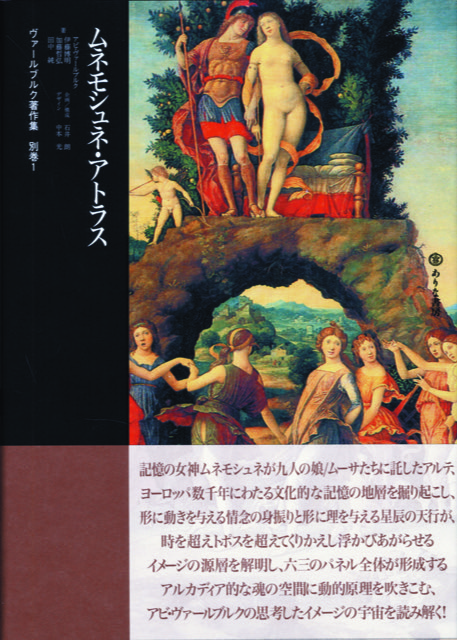
A. Warburg, Munemoshune Atorasu ムネモシュネ・アトラス, edited by H. Ito, T. Kato, J. Tanaka (Arina shobō, Tokyo 2012).
内容
序 アビ・ヴァールブルクと『ムネモシュネ・アトラス』 伊藤博明
パネルA 人間が位置づけられる宇宙的、地上的、系譜学的関係性のさまざまなシステム。……
パネルB 宇宙的体系の人間への投射のさまざまな段階。……
パネルC 火星の表象の発展。擬人的解釈に基づくイメージからの離脱……
パネル1 予言を目的とする、身体の一部分の上に投影された宇宙。……
パネル2 ギリシアの宇宙の表象。天における神話的形象。……
パネル3 古代の図像の東方化。怪物としての神。……
パネル4 パネル4から8。古代における原型の形成。闘い。(巨人たちによる)略奪。……
パネル5 大地母神、キュベレ。子を奪われる母。……
パネル6 略奪(プロセルピナ、冥界[パネル5])。犠牲(ポリュクセネ)。……
パネル7 勝者の情念。古代ローマの勝利感。凱旋門。……
パネル8 太陽への上昇。
パネル20 ギリシア的宇宙論のアラビア的実践への発展。……
パネル21 東方的な古代。東方的な枠組における古代の神々……
パネル22 スペイン的 = アラビア的実践(アルフォンソ)。……
パネル23 南イタリア = アラビア的古代。……
パネル23a 運命の賽子のための、小宇宙としての規則的な立体。……
パネル24 惑星の子どもたちについての教説。(北方?)。実践の理論的基礎。
パネル25 リミニ――呪物的天球表象と対置されるプネウマ的天球表象。古代的形態。
パネル26 リミニからスキファノイア宮への移行としての総合的で体系的な宇宙論的暦。……
パネル27 スキファノイア宮。
パネル28-29 同時代の動的な生(移行――スキファノイア宮の第三層)。……
パネル30 ピエロ・デッラ・フランチ[ェスカ]。……
パネル31 前パネルに続く――北方人の場合。祈念像。……
パネル32 グロテスク。中央の女性を囲んでの踊り。……
パネル33 神話のテクストにおける図解。……
パネル34 運搬車としてのタピスリー。主題――狩猟と行楽。……
パネル35 「フランス風」の古代。ヘラクレス、パリス(略奪)、パリス(審判)、オルペウス。……
パネル36 ペーザロ = 南における「フランス風」古代。
パネル37 彫刻の形態での古代世界の浸透。……
パネル38 古代との関連における混合様式。宮廷生活。愛の象徴的表現。……
パネル39 ボッティチェッリ。理想的様式。バルディーニ――古代化する愛1と2。……
パネル40 古代的気質の発露。連続する描写……
パネル41 殲滅への情念[パネル5参照]。犠牲。魔女としてのニンフ。情念の解放。
パネル41a 苦痛の情念。神官の死[パネル6 参照]。
パネル42 エネルギーを逆転させた苦痛の情念(十字架のもとのペンテウスとマイナス)。……
パネル43 市民文化の代表者としてのサッセッティ――ギルランダイオ 肖像画の侵入……
パネル44 ギルランダイオにおける勝者の情念。入場許可の第一段階としてのグリザイユ。……
パネル45 身振り言語の最上級。自意識の逸脱。類型化されたグリザイユから抜け出た……
パネル46 ニンフ。トルナブオーニ・サークルにおける「足早に運ぶ女性」。……
パネル47 守護天使と女首狩り族としてのニンフ。……
パネル48 フォルトゥーナ。みずからを解放する人間(商人)の対決のシンボル。
パネル49 抑制された勝者の情念(マンテーニャ)。「隠喩のようなもの」としてのグリザイユ。……
パネル50-51 分割と手で扱いうること。ムーサたち。徳と悪徳。調和的体系。……
パネル52 トラヤヌスの正義 = 馬で蹂躙する者のエネルギーの逆転。……
パネル53 ムーサたち。天と地のパルナッソス。(ラファエッロ)マンテーニャ……
パネル54 同時にホロスコープ‐実践をともなったオリュンポス化、および神‐父による……
パネル55 上昇なきパリスの審判。石棺に倣って、ペルッツィとマルカントニオ。……
パネル56 上昇と墜落(ミケランジェロ)。磔刑の神格化。……
パネル57 デューラーにおける情念定型。マンテーニャ。模写。オルペウス。……
パネル58 デューラーにおける宇宙論。
パネル59 北への惑星の移住。
パネル60 北方の宮廷の祝祭行事。海洋の支配――地理上の発見の時代。……
パネル61-62-63-64 「従う神」としてのネプトゥヌス。クォス・エゴ・タンデム。……
パネル70 略奪の描写におけるバロック期の情念表現。演劇。
パネル71 演じられる、誓約と盾の持ち上げ。「公式芸術」。
パネル72 公式芸術とは対照的なレンブラント。聖餐――クラウディウス・キウィリス……
パネル73 演劇のメデイアとレンブラントのメデイア――熟慮のための思考空間。……
パネル74 熟慮。マザッチョ、ラファエッロ、レンブラントにおける聖ペトロ。……
パネル75 魔術的解剖。内臓占い――魂の場所の探索。……
パネル76 危険にさらされた幼児の保護――トビウッツォロ[小さなトビアス]……
パネル77 ドラクロワ/メデイアと嬰児虐殺。切手/バルバドス――クォス・エゴ・タンデム……
パネル78 教会と国家。世俗的権力の放棄の下での宗教的権力。
パネル79 ミサ。神を食べること。ボルセーナ、ボッティチェッリ。……
『ムネモシュネ・アトラス』序論 アビ・ヴァールブルク著/加藤哲弘訳
『ムネモシュネ・アトラス』序論 解説 田中純
解 題 ヴァールブルクの天球へ(AD SPHAERAM WARBURGIANAM) ──『ムネモシュネ・アトラス』の多層的分析 田中純
解 題 不在のペルセウス(Perseo inesistente) ――『ムネモシュネ・アトラス』と占星術 伊藤博明
文献一覧
あとがき
人名/神名/作品名・事項 索引
The Japanese Atlas published by Arina Shobō in 2012 appeared in the same year as Jun Tanaka’s exhibition at the University of Tokyo (“MNEMOSYNE ATLAS. Aby Warburg’s Cosmos of Images”, University of Tokyo, 15–22 December 2012). Hiroaki Ito’s introduction (7–13) opens a volume of 720 pages. It explains how Ito, Tetsuhiro Kato and Tanaka consulted the Hamburg and Berlin editions to identify the images, devised their own numbering and drew provisional panel headings from Gertrud Bing’s notes. Enlarged details accompany the commentaries, allowing a reader to follow an observation back to a particular figure. Warburg’s own Einleitung comes after the sixty-three panels, in Kato’s translation and with a commentary by Tanaka. It is Hiroaki Ito’s opening essay that appears here in Japanese and English.
Introduction. Aby Warburg and the Mnemosyne Atlas
The German art historian and cultural historian Aby Warburg died suddenly of a heart attack on 26 October 1929, at the age of sixty-three. In the last years of his life, he had devoted his energies to assembling a series of image panels collectively entitled “Mnemosyne”. The present volume, the Mnemosyne Atlas, reproduces the sixty-three image panels that Warburg left at his death and provides an original commentary on each of them. Before turning to the individual panels, I should like to offer a brief account of Warburg’s life and research and outline the genesis of the Mnemosyne Atlas.
Aby Warburg was born in Hamburg on 13 June 1866. His father, Moritz Warburg, was a Jewish banker; his mother, Charlotte, belonged to the Oppenheim family. He was the eldest of seven children. The famous “agreement” with his next younger brother, Max, was made when Aby was thirteen. According to Max’s memorial address of 5 December 1929, Aby relinquished his birthright as the eldest son of this distinguished banking family in return for Max’s promise to pay for whatever books his brother might wish to acquire in the future. The promise was faithfully kept: this was the arrangement under which the vast collection of books that would eventually form the Warburg Library was purchased.
In 1886, at the age of twenty, Warburg entered the University of Bonn. His teachers included the art historians Carl Justi and Henry Thode, the scholar of mythology Hermann Karl Usener, and the cultural historian Karl Lamprecht. Lamprecht’s interest in psychology, his broad historical perspective and his understanding of artistic production within the wider field of cultural phenomena were particularly influential. In 1888–1889 Warburg attended a seminar held in Florence by August Schmarsow, Professor of Art History at Breslau. The autumn term in Florence proved highly productive. Schmarsow’s account of the relationship between primitive states of mind and intense bodily expression offered Warburg important insights; it was here, too, that he found the subject of his doctoral dissertation. During this period he also met the painter Mary Hertz, whom he would later marry.
After returning from Italy, Warburg chose Strasbourg as the next place to pursue his studies. His supervisor was Hubert Janitschek, a scholar with a pronounced sociological orientation. Submitted in December 1891 and published in 1893, the dissertation was entitled Sandro Botticelli’s Birth of Venus and Spring (Warburg [1893] 2003). It traced the sources of Botticelli’s mythological paintings in ancient and contemporary literature, while showing that “accessories in motion”, such as flowing hair and fluttering drapery, were characteristic expressions of the influence of Antiquity.
After submitting his dissertation, Warburg moved to Berlin. In 1892–1893 he studied psychology under Hermann Ebbinghaus and Darwin’s theory of evolution, while also immersing himself in Friedrich Theodor Vischer’s theory of symbolism. The theoretical foundations of his work gradually took shape. After a year of military service, he returned to Florence. Until his departure for the American Southwest in 1895, his research ranged across art, music, theatre and costume. Its results appeared that year in The Theatrical Costumes for the Intermedi of 1589: Bernardo Buontalenti’s Drawings and the Account Book of Emilio de’ Cavalieri (Warburg [1895] 2006).
Warburg stayed in the United States in 1895–1896. The immediate reason for his journey was the wedding of his younger brother Paul, the third son, held outside New York in October 1895. After making repeated visits to the Smithsonian, he planned a journey through the western regions. In April of the following year, he visited Tewa and Walpi on First Mesa, and then Oraibi on Third Mesa, also known as West Mesa, the westernmost of the mesas. At Oraibi he witnessed the Humiskachina dance on 1 May. He returned to Hamburg on 5 June. In 1897 he married Mary Hertz and settled in Florence. Until his return to Hamburg in 1904, Warburg pursued research in the Florentine State Archives, concentrating on the art of the early Renaissance and its social context. This work bore fruit in The Illustrated Chronicle of a Florentine Goldsmith of 1899 (Warburg [1899] 2004) and The Art of Portraiture and the Florentine Bourgeoisie: Domenico Ghirlandaio in Santa Trinita; Portraits of Lorenzo de’ Medici and His Family (Warburg [1902] 2004). He also examined exchanges between Florentine and Flemish art in Flemish Art and Florentine Art in the Circle of Lorenzo de’ Medici around 1480, of 1901 (Warburg [1901] 2005), and Flemish Art and the Florentine Early Renaissance, of 1902 (Warburg [1902] 2005).
On the Imprese amorose in the Earliest Florentine Engravings, published in 1905 (Warburg [1905] 2004), Dürer and Italian Antiquity, of 1906 (Warburg [1906] 2003), and Francesco Sassetti’s Last Dispositions, of 1907 (Warburg [1907] 2004), likewise emerged from his Florentine research. Dürer and Italian Antiquity introduced the celebrated concept of the Pathosformel: the expression of intense gestures originating in Antiquity was understood as a constant that repeatedly reappeared in history. Meanwhile, Warburg continued to acquire research materials. In 1909 he purchased a house and the adjoining plot in Hamburg’s Heilwigstraße to provide space for his books. This marked the beginning of what would later be called the Kulturwissenschaftliche Bibliothek Warburg. The premises were purchased by the City of Hamburg in 1993 and now house the University of Hamburg’s centre for art history and political iconography, the Warburg-Haus.
Throughout this period Warburg continued to publish research on a wide variety of subjects. In Working Peasants in Burgundian Tapestries, published in 1907 (Warburg [1907] 2005), he examined the medium of tapestry through examples in the Uffizi. He also developed an interest in astrological imagery in the Renaissance, as shown by On Images of the Planetary Deities in a Low German Calendar of 1519, dated 1908 (Warburg [1908] 2003), and Ecclesiastical and Courtly Art in Landshut, published in 1909 (Warburg [1909] 2003). At the International Congress of Art History in Rome in 1912, he delivered his lecture on Italian Art and International Astrology in the Palazzo Schifanoia, Ferrara (Warburg [1912] [1922] 2003). Here he described his method in the following terms, using the expression “iconological analysis”:
Through the method by which I have sought to elucidate the frescoes of the Palazzo Schifanoia in Ferrara, I believe I have shown that iconological analysis, undeterred by the prejudices of those who police disciplinary boundaries, can regard Antiquity, the Middle Ages and the early modern period as interconnected epochs, ands crutinise works of the freest as well as the most applied art as records with equal expressive standing. By illuminating individual obscurities, such a method can bring to light a vast and universal process of development in its interconnections (Warburg [1912] [1922] 2003, 93).
Looking back on this lecture in his Tagebuch on 26 February 1929, towards the end of his life, Warburg wrote that it had “decisively directed my research towards a combination of approaches through my methodological claim of ‘iconology’” (GS Tagebuch, 412).
With the outbreak of the First World War, Warburg lived in a state of persistent anxiety and was often beset by obsessive thoughts. In 1918, when Germany’s defeat became apparent, he finally suffered a mental breakdown. While he was showing symptoms of schizophrenia, his substantial study Pagan-Antique Prophecy in Words and Images in the Age of Luther appeared in 1920 (Warburg [1920] 2006). Its publication would have been impossible without the assistance of Fritz Saxl, who had taken over as acting director of the library in 1919 at the request of Warburg’s brothers.
Warburg moved repeatedly between clinics, but his condition showed little improvement. In April 1921 he entered Ludwig Binswanger’s Bellevue clinic in Kreuzlingen. Two years later he planned a scholarly lecture to demonstrate his recovery and make the case that he could return to his everyday life as a researcher. The lecture took place within the clinic on 21 April 1923. It was accompanied by slides made from photographs that he had taken or purchased during his American journey. The draft of this lecture was published posthumously as The Serpent Ritual (Warburg [1923] 2003). Warburg was thus, almost miraculously, able to leave the clinic and return to Hamburg. From 1925 he gave lectures at the Kulturwissenschaftliche Bibliothek Warburg for the Department of Art History at the University of Hamburg, which had been established during his absence.
It seems to have been Saxl who, after Warburg’s return to Hamburg, suggested arranging reproductions with pins or clips on black cloth stretched over wooden frames. One of the earliest displays to use such image panels accompanied the memorial lecture for Boll on 25 April 1925. The fifty-nine reproductions used on that occasion survive, together with several plans for the panels. This arrangement was expanded for a lecture to the Oriental Society in September 1926, when some 130 reproductions were mounted on six large panels.
Warburg had already begun work on the series of image panels in 1926. The Tagebuch entry for 22 September of that year records: “I have begun to arrange the visual materials for the ‘Atlas’” (GS Tagebuch, 12-13). Thereafter the creation of the Atlas became both his principal undertaking and, in a sense, the culmination of his research. In a letter to his brother Max dated 2 February 1927, he referred to the exhibitions at the Kulturwissenschaftliche Bibliothek Warburg and described the Atlas as a visual project: “I am considering a plan to bring together the results of my research, or at least of my research into the influence of ‘Antiquity’ on European culture, within a large classificatory atlas”. The Tagebuch and other records make clear that Warburg envisaged the Atlas as an achievement to be realised through collaboration with Gertrud Bing and Saxl, rather than as the work of one individual.
From September 1928 to June 1929 Warburg undertook an extended journey through Italy with Bing. Staying at the Hotel Eden in Rome, he prepared his lecture at the Bibliotheca Hertziana by attaching reproductions to panels brought from Hamburg. After the lecture, on 23 January, Bing wrote in the Tagebuch that “the Atlas has made great progress”. Warburg’s subsequent words, however, show that it was still taking shape: “The arrangement is not yet right. After Donatello, the influence of the Pollaiuolo brothers is missing: the goldsmith as dramatist of the soul, and the monsters of the Illustrated Chronicle. Between Pollaiuolo and Ghirlandaio, Ferrara should be placed (for the Atlas). I am not sure where Mantegna should be inserted. That is indeed the real turning point” (GS Tagebuch, 399).
The image panels themselves have all been lost. Three versions, documented in photographs, are preserved at the Warburg Institute; the panels are estimated to have measured 170 cm in height and 140 cm in width. The first version is dated 15 May 1928 and consists of forty-three panels. It includes subjects absent from the final version: the Sibyls, Andromeda, the Valois tapestries in the Uffizi, and Buontalenti’s drawings for the intermedi of 1589. The next version dates from 1929 and contains some 1,000 reproductions on sixty-nine panels. Subjects omitted from the final version include witches, the Sphinx and Sirens, Signorelli, and Raphael’s Parnassus. Lastly, there is the version on which the present Mnemosyne Atlas is based: sixty-three panels containing 971 reproductions in all. Although the last panel bears the number 79, the sequence begins with the three panels A, B and C; there are numerous gaps in the subsequent Arabic numbering, and in some cases several numbers are assigned to a single panel. The total therefore remains sixty-three. On 24 August 1928 Warburg himself spoke of seventy-five panels with more than 1,200 reproductions, and a week later, on 1 September, of eighty panels with more than 1,300. The surviving final version is clearly unfinished.
In a letter of August 1927 to his American friend Gladys Reichard, Warburg referred to “a large atlas on the history of the survival of ‘Antiquity’ in Europe”, a history to which, he wrote, “I have devoted myself for almost thirty years”. The Atlas may thus be regarded as the summation of his scholarly enquiries, with each panel drawing deeply on his earlier research. Two central themes can nevertheless be distinguished: the astrological tradition inherited from Antiquity and the representations of Pathosformeln originating in the ancient world. Warburg therefore remained uncertain about a title that could encompass the whole, devising several formulations, among them: “Mnemosyne. A series of images for the cultural-scientific study of expressive imprints oriented towards Antiquity, as seen in representations of the dynamic sense of inner and outer life in the European Renaissance”; “Mnemosyne. The awakening of the pagan gods as the formation of energetic expressive values in the European Renaissance. An essay in art-historical cultural science”; and “The creation of a space for thought as a cultural function. An attempt at a psychology of human orientation founded on a universal history of images”. For the present volume we have adopted the straightforward title Mnemosyne Atlas.
When Warburg died in October 1929, plans were made under Saxl’s direction to publish his collected writings (Gesammelte Schriften), including studies, unfinished lecture manuscripts and essays. The first two volumes appeared in Leipzig in early 1932 under the title Die Erneuerung der heidnischen Antike. Kulturwissenschaftliche Beiträge zur Geschichte der europäischen Renaissance [“The Renewal of Pagan Antiquity: Contributions to the Cultural History of the European Renaissance”] (GS). They brought together almost all his previously published papers and abstracts, with supplementary notes by Warburg himself and additional philological annotations edited by Bing. Five further sections were envisaged: the extensive collection of reproductions entitled Mnemosyne; unfinished lectures and shorter essays; fragments of a “theory of expression on an anthropological basis”; letters, aphorisms and autobiographical records; and a catalogue of the Warburg Library.
As the Nazis rose to power, the library bearing the name of the “Jew” Warburg came under increasing pressure. In 1933 the entire library moved to London, and in 1944 it was formally incorporated into the University of London as the Warburg Institute. The work associated with the Institute, from Erwin Panofsky, Rudolf Wittkower and Edgar Wind to Ernst Gombrich, D.P. Walker and Frances Yates, produced a wealth of scholarship in art history, cultural history and intellectual history, firmly establishing its reputation. Warburg’s own texts, however, had largely fallen into oblivion. In an effort to remedy this, an Italian collection of his principal writings appeared in 1966 with a preface by Bing. She observed that “Warburg’s posthumous reputation rests on hearsay rather than on knowledge of his writings; […] he is praised far more enthusiastically than he is actually read” (RPA).
A reprint of Die Erneuerung der heidnischen Antike appeared in the same year as the Italian collection. It was followed in 1970 by Gombrich’s substantial Aby Warburg: An Intellectual Biography, which effectively announced the beginning of a Warburg renaissance (Gombrich 1970). Drawing on a vast body of unpublished material, the book showed Warburg to be an intellectual giant whose significance extended beyond his pioneering role in iconology, and revealed the rich possibilities of a “science of culture” implicit in his writings, reaching far beyond the confines of art history.
Interest in Warburg subsequently grew rapidly. Especially after the fiftieth anniversary of his death in 1979, conference proceedings and scholarly studies appeared in increasing numbers. A new edition of his collected writings was also planned: since 1998, Die Erneuerung der heidnischen Antike, the Mnemosyne Atlas and the Tagebuch have been published. A French selection appeared in 1990 (EF), followed in 1999 by a complete English translation of Die Erneuerung der heidnischen Antike (Renewal). In Italy, a collected edition organised on independent editorial principles, including translations of unpublished studies, is in progress, with two volumes available to date. The seven-volume Japanese Collected Works of Aby Warburg was likewise completed in 2006.
This is a remarkable state of affairs for a scholar active almost a century ago. “Warburg Redux”: this was how Warburg described himself after returning to Hamburg from Kreuzlingen. At the end of the twentieth century, he did indeed “return” to the humanities, undergoing a “rebirth”. Yet since “rebirth” is an “afterlife” (Nachleben), we must ask: “Why does Warburg not die?” The present Japanese edition of the Mnemosyne Atlas offers one answer.
The surviving photographs contain no indications other than panel numbers. Bing left notes describing the contents of each panel; we have provisionally placed these at the beginning of the panels as substitutes for titles. In identifying and commenting on the reproductions, we consulted the edition in the collected writings published by Akademie Verlag and the edition commonly known as “Daedalus” (Mnemosyne Atlas Hamburg 1994; Mnemosyne Atlas Berlin 2000). We have assigned the numbers of the individual reproductions within each panel independently.
References to Warburg’s writings and to secondary studies are abbreviated in the panel commentaries and elsewhere; readers should consult the bibliography at the end of the volume. The commentaries were prepared through discussion among the three contributors, with the name of the person ultimately responsible given at the end of each.
序 アビ・ヴァールブルクと『ムネモシュネ・アトラス』
ドイツの美術史家・文化史家アビ・ヴァールブルクが心臓発作に襲われて急逝したのは、1929年10月26日のことだった。享年六三歳。死の数年前から彼が精神を傾注していた仕事が、全体で「ムネモシュネ」(Mnemosyne)と名づけられた、図像パネル集の作成であった。本書『ムネモシュネ・アトラス』は、ヴァールブルクが生前に残した、計六三枚の図像パネルを複製し、そのすべてについてオリジナルな解説を施す試みである。各パネルの説明をおこなうまえに、ヴァールブルクの生涯と研究について簡単に紹介し、『ムネモシュネ・アトラス』の成立について概略を述べておきたい。
アビ・ヴァールブルクは、1866年6月13日にハンブルクで生まれた。父はユダヤ系銀行家のモーリッツ・ヴァールブルク、母はオッペンハイム家出身のシャルロッテで、彼は七人兄弟の長男であった。すぐ下の弟マックスとの有名な「契約」は、アビが一三歳の時に結ばれた。マックスが1929年12月5日の追悼演説の中で述べているところによれば、アビは弟にこの有名な銀行家一族の「長子相続権」を譲り、その代償としてマックスは、将来兄が欲しいと思う書籍の代金を支払うことを約束させられた。この約束は忠実に守られ、のちにヴァールブルク文庫を形成することになる膨大な書物は、こうした背景のもとに購入されていったのである。
ヴァールブルクは、1886年、二〇歳でボン大学に入学した。美術史家のカール・ユスティやヘンリー・トーデ、神話学者のヘルマン・カール・ウーゼナー、文化史家のカール・ランプレヒトたちから学んだ。とりわけランプレヒトが抱いていた心理学への関心、広い歴史的視野の設定、芸術的所産の文化的現象への位置づけは彼に影響を及ぼした。1888年から89年にかけては、ブレスラウの美術史教授アウグスト・シュマルゾウがフィレンツェで開いたセミナーに参加する。このフィレンツェでの秋学期は彼にとって実り多いものとなった。師シュマルゾウが語る原始的精神状態と激しい身体表現との関係は、ヴァールブルクに大きな示唆を与えたし、ここで博士論文のテーマを発見したのである。また、将来、妻となる画家マリー・ヘルツと出会ったのもこの期間である。
イタリアから帰国後、彼が次の研究先として選んだのはシュトラスブルクであった。担当の教授はフーベルト・ヤニチェックで、社会学的な傾向の強い研究者であった。博士論文が提出されたのは1891年の12月であり、タイトルは「サンドロ・ボッティチェリの《ウェヌスの誕生》と《春》」(Warburg [1893] 2003)で1893年に刊行された。ボッティチェッリの神話画の典拠を古代および同時代の文学作品の中に探り、あわせて、波打つ髪や翻る衣服といった「動く付帯物」が古代の影響を典型的に表わしていることを指摘している。
博士論文を提出した後のヴァールブルクはベルリンに転居して、1892年から93年までヘルマン・エビングハウスのもとで心理学を、そしてダーウィンの進化論を学ぶ一方で、フリードリヒ・テオドル・フィッシャーの象徴理論に傾倒し、次第にヴァールブルクの理論的な基盤が整備されていく。その後、一年間の兵役を務めて、ヴァールブルクはフィレンツェに戻った。そして、1895年にアメリカ南西部への旅行に出かけるまで、美術、音楽、演劇、服飾などの諸分野にかかわる研究に手を染め、その成果は、同年に「一五八九年の幕間劇のための舞台衣裳——ベルナルド・ブオンタレンティの素描とエミリオ・デ・カヴァリエーリの出納簿」(Warburg [1895] 2006)として発表された。
ヴァールブルクは1895年から96年までアメリカに滞在する。彼がアメリカに渡った直接の理由は、1895年10月にニューヨーク郊外で挙行された弟(三男)パウルの結婚式に参列するためであった。彼は、スミソニアン博物館に通ったのち、西部地方の旅行を企てる。翌年の4月に、ファーストメサにあるテワやワルピ、さらには、最も西側に位置するサードメサ(ウェストメサ)のオライビを訪れた。オライビでは、5月1日に「フミスカチーナ」舞踊を見学した。ハンブルクに帰国したのは6月5日のことである。1897年に入って、彼はマリー・ヘルツと結婚し、フィレンツェに居を構えた。そして、1904年にハンブルクに戻るまで、ヴァールブルクはフィレンツェの国立公文書館で、初期ルネサンスの芸術とその社会的背景を中心に考究を進めた。その成果は、1899年の「フィレンツェのある金細工師の図解年代記」(Warburg [1899] 2004)、および「肖像芸術とフィレンツェの市民階級——サンタ・トリニタ聖堂のドメニコ・ギルランダイオ、ロレンツォ・デ・メディチとその一族の肖像」(Warburg [1902] 2004)に結実した。また、1901年の「一四八〇年頃のロレンツォ・デ・メディチのサークルにおけるフランドル美術とフィレンツェ美術」(Warburg [1901] 2005)と1902年の「フランドル美術とフィレンツェの初期ルネサンス」(Warburg [1902] 2005)で、フィレンツェ美術とフランドル美術の交流についても論じている。
1905年に発表の「フィレンツェの最初期の銅版画における〈愛のインプレーサ〉について」(Warburg [1905] 2004)、1906年の「デューラーとイタリア的古代」(Warburg [1906] 2003)、1907年の「フランチェスコ・サッセッティの終意処分」(Warburg [1907] 2004)もフィレンツェ時代の研究成果である。とくに「デューラーとイタリア的古代」では、有名な「情念定型(パトスフォルメル)」(Pathosformel)という概念が提示され、古代に端を発する激しい身振りの表現が、くりかえし歴史上に現われる常数として理解されている。一方で、ヴァールブルクは着々と資料を購入しており、1909年には蔵書を置くスペースを確保するために、ハンブルクのハイルヴィヒ通りに住宅と隣接地を購入している。のちに「ヴァールブルク文化科学図書館」と名づけられる図書館の始まりであり、同施設は1993年にハンブルク市が買いあげ、現在はハンブルク大学美術史政治図像学講座「ヴァールブルク・ハウス」となっている。
ヴァールブルクは、この期間にも多様なテーマを扱って次々と研究成果を生みだした。1907年発表の「ブルゴーニュのタピスリーに見られる働く農民」(Warburg [1907] 2005)においては、ウフィツィ美術館所蔵のタピスリーというメディアを考察の対象とした。またルネサンスにおける占星術的な表象について関心を抱き、その成果は1908年の「一五一九年の低地ドイツの暦における惑星神の図像について」(Warburg [1908] 2003)と1909年の「ランツフートにおける教会の美術と宮廷の美術」(Warburg [1909] 2003)において発表された。そして、1912年のローマでの国際美術史学会において、講演「フェッラーラのスキファノイア宮におけるイタリア美術と国際的占星術」(Warburg [1912] [1922] 2003)がおこなわれる。この講演では「イコノロジー的分析」という言葉を用いて、自らの方法論が次のように語られている。
私は、フェッラーラのスキファノイア宮のフレスコ画について解明しようとした方法を通して、境界監視人の偏見にひるむことなく、古代、中世、近世を互いに関連しあう時代と考え、最も自在で、最も応用的な芸術作品を、表現上は同等の権利を有する記録として精査するイコノロジー的分析という方法が、個々の暗闇に光を当てながら、巨大にして普遍的な発展過程をその相互連関において照らしだすということを示すことができたと思います(Warburg [1912] [1922] 2003, 93)。
ヴァールブルクは晩年(1929年2月26日)の『日誌』において、この講演に言及して、「『イコノロジー』という私の方法論的主張による、探求の複合的な方向性へと決定づけるものだった」(GS Tagebuch, 412)と述懐している。
第一次世界大戦が始まると、ヴァールブルクは常に不安感を抱き、強迫観念に襲われることもまれではなかったが、ドイツの敗戦が明らかになった1918年に、ついに精神に異常をきたすことになる。統合失調症(分裂症)の症状を示す中で、1920年に「ルターの時代の言葉と図像における異教的=古代的な予言」(Warburg [1920] 2006)という重厚な研究が刊行されるが、それはフリッツ・ザクスルの援助なくしては不可能だった。ザクスルはその前年の1919年に、ヴァールブルクの弟たちの要請により、図書館の館長代理を引き受けていた。
ヴァールブルクは転院をくりかえすが、病状はなかなか快方に向かわず、1921年4月に、クロイツリンゲンにある、ルートヴィヒ・ビンスヴァンガーの診療所「ベルヴュ」に入院する。その二年後、ヴァールブルクは自らの回復を証明するための学術講演を企画し、研究者としての日常生活に戻れることを訴えようと考えた。そして、1923年4月21日に講演会が病院内で開催されたのである。この講演は、かつてアメリカに旅行したさいに撮影したり購入したりした写真をスライドで映写しながらおこなわれた。死後に発表された論考「蛇儀礼」はこの講演草稿である(Warburg [1923] 2003)。その結果、ヴァールブルクは奇跡的に退院し、ハンブルクへの帰還を果たすことができた。ヴァールブルクは、自ら不在の間に設立されたハンブルク大学美術史学科のために、1925年からヴァールブルク文化科学図書館で講義をおこなった。
ハンブルクに戻ったヴァールブルクに対して、木枠に張った黒色の布地にピンやクリップで図版を配列するという図像パネルのアイディアを示したのはザクスルだったらしい。図像パネルを利用した最初期の展示は、1925年4月25日のボル追悼講演で、そのときに使用した五九枚の図版とパネルのプランが数枚残されている。これを増補して、1926年9月には東方学会で講演したさいには、六枚の大きなパネルに約一三〇枚の図版が貼られた。
ヴァールブルクは、図像パネル集の制作をすでに1926年から開始していた。同年9月22日の『日誌』には、「私は『アトラス』のための視覚的資料を整理し始めた」(GS Tagebuch, 12‑13)と記されている。これ以降、「アトラス」の作成がヴァールブルクにとって最も大きな課題であるばかりか、いわば彼の研究の集大成として位置づけられた。1927年2月2日付の弟マックス宛の書簡では、文化科学図書館での展示について言及しながら、視覚的企図としての「アトラス」についてこう述べている。「私は、私の探究の、あるいは少なくとも、ヨーロッパ文化における『古代』の影響に関する探究の諸成果を、大きな分類的アトラスの中でともにとりあつかうという計画を考えています」。そして、『日誌』などから明らかになるのは、この「アトラス」をヴァールブルクが個人の成果ではなく、ゲルトルート・ビングやザクスルとの共同作業の中で実現すべきものと考えていた点である。
ヴァールブルクは、1928年9月から1929年6月まで、ビングを伴って長期のイタリア旅行をおこなった。彼はローマのホテル・エデンに宿泊し、ハンブルクから持参したパネルに図版を貼りつけて、ヘルツィアーナ図書館での講演を準備した。この講演のあと(1月23日)、ビングは「アトラスは大きな進歩を遂げた」と『日誌』に記しているが、それに続くヴァールブルクの以下の言葉は、「アトラス」がいまだ形成途上であることを物語っている。「配置はまだ正しいものではない。ドナテッロの後には、ポッライウォーロ兄弟の影響が欠けている。すなわち、金工細工師=魂の演劇家と『図解年代記』の怪物。ポッライウォーロとギルランダイオの間には(アトラスのために)、フェッラーラを置くべきだろう。そこには、たしかにマンテーニャを挿入すべきである。それが実際、真の転換点を形成する」(GS Tagebuch, 399)。
現在、図像パネル自体はすべて失われており、写真によって確認されるヴァージョンが三種類、ヴァールブルク(ウォーバーグ)研究所に保存されている(パネルの大きさは縦一七〇センチ×横一四〇センチと推定される)。最初のものは1928年5月15日の日付があり、四三枚のパネルから成っている。そこには最終ヴァージョンに含まれていないテーマも見いだされ、たとえば、シビュラ、アンドロメダ、ウフィツィ美術館所蔵のヴァロワ・タピスリー、1589年の幕間劇のためにブオンタレンティが描いた素描である。次のヴァージョンは1929年のもので、六九枚のパネルに約一〇〇〇枚の図版が収められている。最終ヴァージョンに見いだされないテーマとしては、魔女、スフィンクスとセイレン、シニョレッリ、ラファエッロの《パルナッソス》などがある。そして、最後に本書『ムネモシュネ・アトラス』が底本とした、パネル六三枚、全体で九七一枚の図版から成るヴァージョンが存在する。この版の最後のパネル番号は79であるが、冒頭にA、B、Cの三枚のパネルが置かれ、続く算用数字によるパネルには欠番が多数あり、また複数の番号がひとつのパネルに付されている場合もあり、パネルの総数は六三にとどまる。ヴァールブルク自身は、1928年8月24日に、七五パネルで一二〇〇点以上の図版と、また一週間後の9月1日に、八〇パネルで一三〇〇点以上の図版と語っており、現存する最終ヴァージョンは明らかに未完成の状態にある。
1927年8月に、ヴァールブルクはアメリカの友人グラディス・レイチャート宛ての書簡の中で、「ヨーロッパにおける『古代』の残存の歴史についての大きなアトラス」に触れて、この歴史について「私はほぼ三〇年前から専心してきました」と述べている。いわば「アトラス」はヴァールブルクの学問的探究の総決算と言うべきもので、各パネルには、これまでの研究が深く反映している。他方、「アトラス」の中心的なテーマとして、古代からの占星術的伝統と古代に端を発する情念定型の諸表象という二つが挙げられる。それゆえ、全体をひとつにまとめるタイトルについて、ヴァールブルク自身が絶えず迷っており、たとえば以下のような、いくつもの表現が案出されている。「ムネモシュネ。ヨーロッパのルネサンス時代の躍動する内的・外的生命感の描写に見られる、古代を志向する表現上の刻印を文化科学的に考察するための図版シリーズ」。「ムネモシュネ。ヨーロッパのルネサンス時代におけるエネルギー学的表現価値の形成としての、異教神の覚醒。美術史的文化科学の試み」。「文化機能としての思考のための空間を創出すること。図像の普遍的な歴史を土台にして試みられる、人間的な方位測定の心理学」。本書では、端的に『ムネモシュネ・アトラス』というタイトルを採用した。
ヴァールブルクが1929年10月に没したとき、彼の論考、未完の講義原稿、エッセイなどを含む著作集(Gesammelte Schriften)の刊行が、ザクスルのもとで計画された。その最初の二巻は1932年初頭にライプツィヒで、『異教的古代の再生——ヨーロッパ・ルネサンス史への文化科学的寄与』(Die Erneuerung der heidnischen Antike. Kulturwissenschaftliche Beiträge zur Geschichte der europäischen Renaissance)というタイトルで刊行された(GS)。ここに既出の論文と発表要旨のほとんどすべてが収録され、補遺として、ヴァールブルク自身の覚書と、それを補完する文献学的註がビングの編集によって付加されていた。また、当時の計画としては、この二巻に続いて五つの部門が、すなわち「ムネモシュネ」と題される図版の大規模な蒐集、未完の講義録と小論、「人類学的基礎にもとづく表現理論」の断片、書簡・警句・自伝的記録、ヴァールブルク図書館の目録が刊行される予定であった。
他方、ナチスの台頭によって、「ユダヤ人」ヴァールブルクの名を冠した図書館は次第に圧迫されたために、1933年に図書館全体がロンドンに移住し、1944年になって正式にロンドン大学に「ウォーバーグ研究所」として移管された。この研究所からは、エルヴィン・パノフスキー、ルドルフ・ウィトカウアー、エトガー・ヴィントから、エルンスト・ゴンブリッチ、D・P・ウォーカー、フランセス・イエイツまで美術史・文化史・思想史を中心に多様な成果が生みだされ、研究所の名声は確固たるものとなった。しかし、ヴァールブルク自身のテクストはほとんど忘却されていた。この事態を打開すべく、1966年に主著を網羅したイタリア語版著作集がビングの序文を付して刊行された。その中で彼女は、「ヴァールブルクの死後の名声は彼の著作を知ることよりも伝聞に基づいており、……実際に読まれるよりもはるかに熱心に讃美されている」と述べている(RPA)。
このイタリア語版著作集刊行と同年に『異教的古代の再生』のリプリント版が刊行されたのに続き、1970年に発表された、ゴンブリッチの労作『アビ・ヴァールブルク——知的伝記』は、いわば、ヴァールブルク・ルネサンスの開始を告げるものだった(Gombrich 1970)。この研究書は、未発表の膨大な資料を駆使しながら、ヴァールブルクが単にイコノロジーの先駆者にとどまらない知的巨人であることを明らかにし、彼の著作群が孕んでいる、美術史の枠をはるかに超えた「文化科学」の豊饒な可能性について指摘したのである。
その後、ヴァールブルクへの関心は急速に高まり、1979年の没後五〇周年を境にシンポジウムの報告集や研究書が陸続と刊行されてきた。ヴァールブルク自身の著作についても、あらたに「全集」が企画され、1998年以来『異教的古代の再生』、『ムネモシュネ・アトラス』、『日誌』が刊行されている。また1990年にはフランス語版選集(EF)が、1999年には『異教的古代の再生』の完全な英訳が刊行された(Renewal)。イタリアでは、独自の編集のもとに、未発表の論考の伊訳をも収めた「全集」が刊行されている(現在第二巻まで)。邦語版「ヴァールブルク著作集」全七巻も2006年に完結した。
このような事態は、ヴァールブルクがほぼ一世紀前に活動した人物であることを考えるならば、きわめて稀有なことであると言えよう。「帰還したヴァールブルク」(Warburg Redux)。クロイツリンゲンからハンブルクに戻ったヴァールブルクは自身のことをこう呼んだ。そしてたしかに、二〇世紀末の人文科学の世界にヴァールブルクは「帰還」を、すなわち「再生」を果たした。しかし、「再生」とは「死後の生」(Nachleben)の謂であるのだから、われわれは「なぜヴァールブルクは死なないのか」と問わねばならない。それに対するひとつの回答が、本書『ムネモシュネ・アトラス』邦語版なのである。
われわれに残された写真には、パネル番号以外にはなんの指示も記されていない。ビングは各パネルの内容を示すメモを残しており、われわれも暫定的に各パネルの冒頭に記して、タイトルに代替させた。各パネルの図版の同定と解説にあたっては、アカデミー出版「全集」版と通称「ダイダロス」版を参照した(Mnemosyne Atlas Hamburg 1994; Mnemosyne Atlas Berlin 2000)。なおパネル内の図版番号は独自に決定した。
各パネルの解説等において、ヴァールブルクの著作および研究書については簡略化して表記してあるので、巻末の文献一覧を参照されたい。各パネルの解説は、三名による検討を経て作成されたが、最終的な責任者名を末尾に記した。
Bibliography
Abbreviations and Editions Used
- CW 1
A. Warburg, ヴァールブルク著作集, 1, Jap. trans. Y. Tomimatsu, supervised by H. Ito. - CW 2
A. Warburg, ヴァールブルク著作集, 2, Jap. trans. K. Uemura, A. Okada, supervised by H. Ito. - CW 3
A. Warburg, ヴァールブルク著作集, 3, Jap. trans. H. Ito, A. Okada, T. Kato, Tokyo 2005. - CW 4
A. Warburg, ヴァールブルク著作集, 4, Jap. trans. H. Ito, A. Okada, T. Kato, Tokyo 2006. - CW 5
A. Warburg, ヴァールブルク著作集, 5, Jap. trans. T. Kato, supervised by H. Ito, Tokyo 2003. - CW 6
A. Warburg, ヴァールブルク著作集, 6, Jap. trans. Y. Tomimatsu, supervised by H. Ito, Tokyo 2006. - CW 7
A. Warburg, ヴァールブルク著作集, 7, Jap. trans. T. Kato, Tokyo 2003. - EF
A. Warburg, Essais florentins, édité par E. Pinto, tr. fr. S. Muller, Paris 1990. - GS
A. Warburg, Gesammelte Schriften, Die Erneuerung der heidnischen Antike. Kulturwissenschaftliche Beiträge zur Geschichte der europäischen Renaissance, Hrsg. von der Bibliothek Warburg, unter Mitarbeit von F. Rougemont, Hrsg. von G. Bing, Leipzig/Berlin 1932. - GS Tagebuch
A. Warburg, Tagebuch der Kulturwissenschaftlichen Bibliothek Warburg, hrsg. von K. Michels, C. Schoell-Glass, Berlin 2001. - Mnemosyne Atlas Hamburg 1994
A. Warburg, Mnemosyne-Bilderatlas. Zur Ausstellung im Kunsthaus Hamburg, hrsg. von M. Koos, W. Pichler, W. Rappl, G. Swoboda, Hamburg 1994; 2., erweiterte Aufl. Hamburg 2006. - Mnemosyne Atlas Berlin 2000
A. Warburg, Der Bilderatlas Mnemosyne, hrsg. von M. Warnke unter Mitarbeit von C. Brink, Berlin 2000; 3. Aufl., Berlin 2008. - Renewal
A. Warburg, The Renewal of Pagan Antiquity. Contributions to the Cultural History of the European Renaissance, edited by K.W. Forster, Eng. trans. D. Britt, Los Angeles 1999. - RPA
A. Warburg, La rinascita del paganesimo antico, a cura di G. Bing, tr. it. E. Cantimori, Firenze 1966.
Texts by Aby Warburg
- Warburg [1893] 2003
A. Warburg, サンドロ・ボッティチェッリの《ウェヌスの誕生》と《春》:イタリア初期ルネサンスにおける古代表象に関する研究 [Sandro Botticellis “Geburt der Venus” und “Frühling”. Eine Untersuchung über die Vorstellungen von der Antike in der Italienischen Frührenaissance, Hamburg/Leipzig 1893], in CW 1. - Warburg [1895] 2006
A. Warburg, 一五八九年の幕間劇のための舞台衣裳——ベルナルド・ブオンタレンティの素描とエミリオ・デ・カヴァリエーリの出納簿 [I costumi teatrali per gli Intermezzi del 1589: i disegni di Bernardo Buontalenti e il ‘Libro di conti’ di Emilio de’ Cavalieri, “Atti dell’Accademia del R. Istituto Musicale di Firenze: Commemorazione della Riforma Melodrammatica” XXXIII, 1895, tr. it. A. Giorgetti, 133-146], in CW 4, 71-150. - Warburg [1899] 2004
A. Warburg, フィレンツェの金工師の図解年代記 [Die “Bilderchronik” eines florentinischen Goldschmiedes, “Beilage zur Allgemeinen Zeitung” 2 (1899), 4-6], in CW 2, 7-36. - Warburg [1901] 2005
A. Warburg, 一四八〇年頃のロレンツォ・デ・メディチのサークルにおけるフランドル美術とフィレンツェ美術 [Flandrische und florentinische Kunst im Kreise des Lorenzo Medici um 1480, “Sitzungsberichte der Kunstgeschichtlichen Gesellschaft” VIII, 9 November 1901, 43-46], in CW 3, 83-94. - Warburg [1902] 2004
A. Warburg, 肖像芸術とフィレンツェの市民階級——サンタ・トリニタ聖堂のドメニコ・ギルランダイオ、ロレンツォ・デ・メディチとその一族の肖像 [Bildniskunst und florentinisches Bürgertum. Domenico Ghirlandaio in Santa Trinita: die Bildnisse des Lorenzo de’ Medici und seiner Angehörigen, Leipzig 1902], in CW 2, 65-116. - Warburg [1902] 2005
A. Warburg, フランドル美術とフィレンツェの初期ルネサンス [Flandrische Kunst und florentinische Frührenaissance. Studien, “Jahrbuch der Königlich Preussischen Kunstsammlungen” XXIII (1902), 247-266], in CW 3, 35-82. - Warburg [1905] 2004
A. Warburg, フィレンツェの最初期の銅版画における「愛のインプレーサ」について [Delle “imprese amorose” nelle più antiche incisioni fiorentine, “Rivista d’Arte” III, 1905, tr. it. G. Poggi, 1-15], in CW 2, 37-64, 185-196. - Warburg [1906] 2003
A. Warburg, デューラーとイタリア的古代 [Dürer und die italienische Antike, in Verhandlungen der achtundvierzigsten Versammlung deutscher Philologen und Schulmänner in Hamburg vom 3. bis 6. Oktober 1905, Leipzig 1906, 55-60], in CW 5, 7-34. - Warburg [1907] 2004
A. Warburg, フランチェスコ・サッセッティの終意処分 [Francesco Sassettis letztwillige Verfügung, in H. Weizsäcker et al., Kunstwissenschaftliche Beiträge August Schmarsow gewidmet, Leipzig 1907, 129-152], in CW 2, 117-164. - Warburg [1907] 2005
A. Warburg, ブルゴーニュのタピスリーに見られる働く農民 [Arbeitende Bauern auf burgundischen Teppichen, “Zeitschrift für bildende Kunst” XVIII (1907) 41-47], in CW 3, 109-125. - Warburg [1908] 2003
A. Warburg, 一五一九年の低地ドイツの暦における惑星神の図像について [Über Planetengötterbilder im niederdeutschen Kalender von 1519, “Jahresbericht der Gesellschaft der Bücherfreunde zu Hamburg 1908-1909” (1910), 45-57], in CW 5, 99-106. - Warburg [1909] 2003
A. Warburg, ランツフートにおける教会の美術と宮廷の美術 [Kirchliche und höfische Kunst in Landshut, “Münchner Neueste Nachrichten” 441, 21 September 1909], in CW 5, 41-44. - Warburg [1912] [1922] 2003
A. Warburg, フェッラーラのスキファノイア宮におけるイタリア美術と国際的占星術 [Italienische Kunst und internationale Astrologie im Palazzo Schifanoja zu Ferrara, Roma 1912; in L’Italia e l’arte straniera. Atti del X Congresso Internazionale di Storia dell’Arte in Roma, Roma 1922, 179-193], in CW 5, 45-98. - Warburg [1920] 2006
A. Warburg, ルターの時代の言葉と図像における異教的=古代的予言 [Heidnisch-antike Weissagung in Wort und Bild zu Luthers Zeiten, “Sitzungsberichte der Heidelberger Akademieder Wissenschaften”, Philosophisch-historische Klasse, XXVI (1919), Heidelberg 1920], in CW 6, 7-115. - Warburg [1923] 2003
A. Warburg, 蛇儀礼:北アメリカ、プエブロ・インディアン居住地域からのイメージ [Bilder aus dem Gebiet der Pueblo-Indianer in Nord-Amerika, Kreuzlingen, 21 Avril 1923, WIA III.93], in CW 7.
Bibliographical references
- Gombrich 1970
E.H. Gombrich, Aby Warburg: An Intellectual Biography, London 1970.
Abstract
This introduction to the Japanese edition of Aby Warburg’s Munemoshune Atorasu ムネモシュネ・アトラス (Tokyo 2012) traces the relationship between his intellectual development and the formation of the Atlas. It follows his investigations of Renaissance art, expressive gesture and astrological imagery, identifying the afterlife of Antiquity as their central concern. The essay reconstructs the lectures, collaborative work and successive arrangements of images through which Mnemosyne took shape, highlighting the contributions of Fritz Saxl and Gertrud Bing. It also examines the posthumous publication and reception of Warburg’s writings. The concluding section explains the Japanese edition’s approach to panel headings, image identification, numbering and commentary, situating its editorial choices within the continuing interpretation of Warburg’s unfinished project.
keywords | Hiroaki Ito; Arina Shobō; Fritz Saxl; Gertrud Bing; Ernst Gombrich; Pathosformel; Nachleben; Astrology.
Per citare questo articolo / To cite this article: H. Ito, Aby Warburg and the Mnemosyne Atlas. On: Hiroaki Ito, Tetsuhiro Kato, Jun Tanaka, Munemoshune Atorasu ムネモシュネ・アトラス (Arina Shobō, Tokyo 2012), “La Rivista di Engramma” n. 239, settembre 2026.