Aby Warburg’s Mnemosyne Atlas: An Exhibition History
A Presentation of: Giulia Zanon, Exhibit Mnemosyne | Display Mnemosyne (Antiga, Treviso 2025)
edited by Redazione di Engramma
Abstract
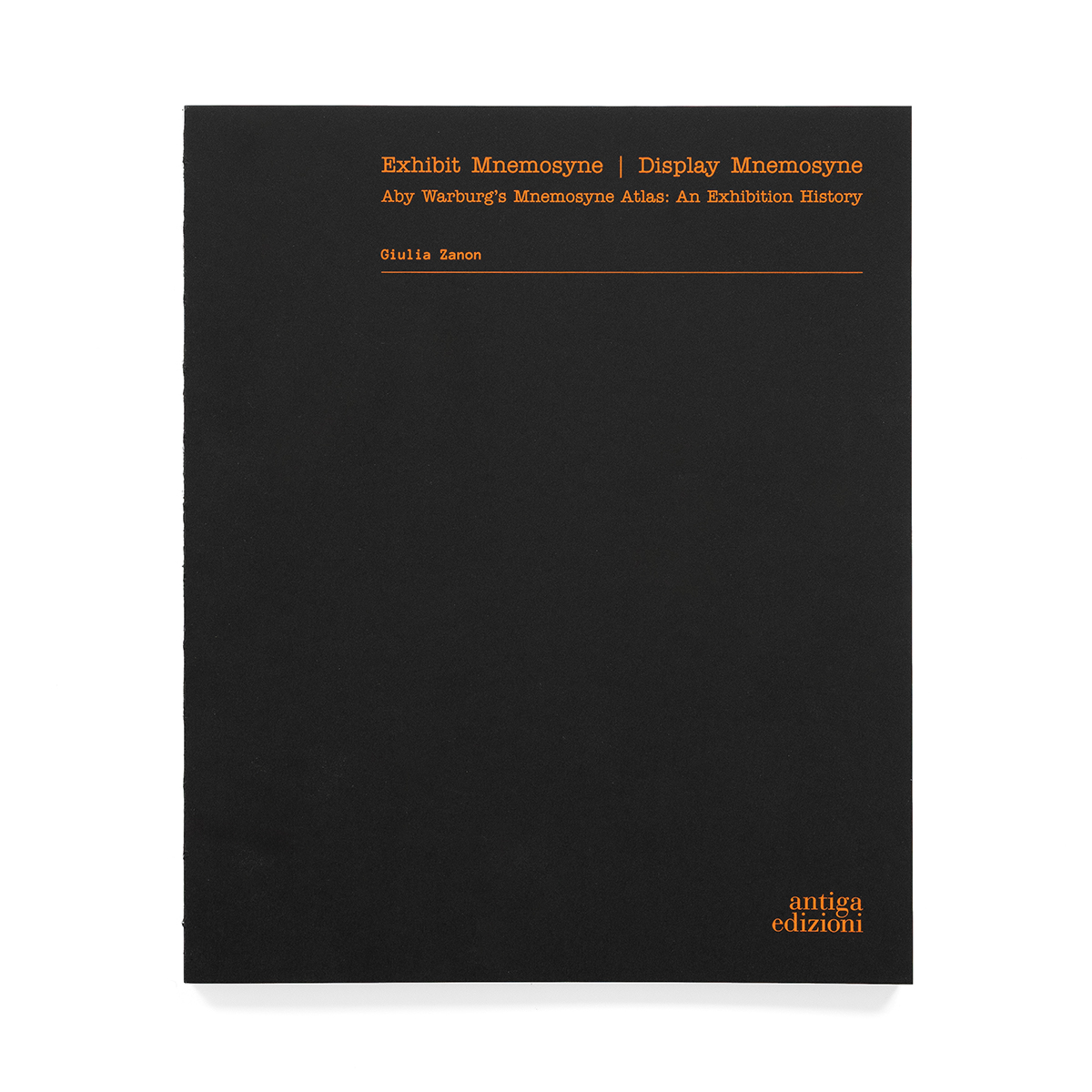
Table of Contents
Preface, Bill Sherman
Introduction
The Exhibitions
Other Exhibitions
Appendix | The Editions
Bibliography
This volume traces the exhibition and publishing history of Aby Warburg’s Mnemosyne Atlas, conceived as a book on the afterlife of antiquity in Western culture and left unfinished at his death. Through a systematic, though necessarily selective, survey of more than thirty exhibitions and thirteen editions from the late 1970s onwards, it examines how the Atlas has been reconstructed, displayed and interpreted. Individual entries explore curatorial methods, the presentation of materials, the relationship with exhibition spaces, accompanying texts and critical reception. Together, they chart the changing reception of Warburg’s thought, examining the tensions between documentary fidelity and curatorial interpretation and asking how the Atlas might be exhibited while preserving its capacity to generate thought.
The Exhibitions
1. “Aby Warburg – Mnemosyne”, Vienna, Akademie der bildenden Künste, 1993
2. “Aby M. Warburg. Mnemosyne”, Hamburg, Kunsthaus Hamburg, 1994
3. “L’Atlante della memoria di Aby Warburg”, Siena, Santa Maria della Scala, 1998
4. “L’Atlante della memoria di Aby Warburg”, Firenze, Gallerie degli Uffizi, 1998-1999
5. “MNEMOΣYNE. L’Atlante di Aby Warburg”, Venezia, Fondazione Ugo e Olga Levi, 2004
6. “Der Bilderatlas Mnemosyne”, Vienna, Albertina, 2007
7. “Aby Warburg. Der Bilderatlas Mnemosyne”, Budapest, OSA Archivum, 2008
8. “Mnemosyne Atlas. Aby Warburg’s Cosmos of Images”, Tokyo, University of Tokyo, Komaba Campus, 2012
9. “Aby Warburg. Mnemosyne Bilderatlas. Reconstruction – Commentary – Revision”, Karlsruhe, ZKM – Zentrum für Kunst und Medien, 2016
10. “Aby Warburg: Bilderatlas Mnemosyne – The Original”, Berlin, Haus der Kulturen der Welt, 2020
11. “Aby Warburg: Bilderatlas Mnemosyne – The Original”, Bonn, Bundeskunsthalle, 2021
12. “Aby Warburg: Bilderatlas Mnemosyne – The Original”, Hamburg, Sammlung Falckenberg, 2021
Other Exhibitions
1. “Die Menschenrechte des Auges”, Hamburg, Kunsthalle, 1979-1980
2. “L’Atlante della memoria di Aby Warburg”, Roma, Bibliotheca Hertziana, 1999
3. “Mnemosyne. Aby Warburg’s Atlas of Memory”, Tel Aviv, Genia Schreiber University Art Gallery, 1999-2000
4. “Mnemosyne. Image World of Aby Warburg. Sources of the Images and Bibliography”, Tokyo, Wako University, 2001
5. “Aby Warburg. Der Bilderatlas Mnemosyne”, Heiligenkreuz-Gutenbrunn, Castle Museum, 2008
6. “ATLAS. How to Carry the World on One’s Back?”, Madrid, Museo Nacional Centro de Arte Reina Sofía, 2010–2011
7. “ATLAS. How to Carry the World on One’s Back?”, Karlsruhe, ZKM – Zentrum für Kunst und Medien, 2011
8. “ATLAS. How to Carry the World on One’s Back?”, Hamburg, Deichtorhallen, 2011
9. “Histoires de fantômes pour grandes personnes”, Tourcoing, Le Fresnoy – Studio national des arts contemporains, 2012
10. “Atlas, Suite”, Rio de Janeiro, Museu de Arte do Rio, 2013
11. “Afteratlas”, Beirut, Beirut Art Center, 2014
12. “Nouvelles histoires de fantômes”, Paris, Palais de Tokyo, 2014
13. “Aby Warburg Mnemosyne Bildertafeln Atlas”, St Gallen, Kulturraum am Klosterplatz, 2013
14. “Aby Warburg Mnemosyne Bildertafeln Atlas”, Urnäsch, Brauchtumsmuseum, 2014
15. “Instrument Erinnerung. Der Mnemosyne Bilderatlas von Aby Warburg. Eine Kooperation mit dem Hamburger 8. Salon”, Munich, Kunstraum, 2014
16. “Aby M. Warburg’s Mnemosyne Picture Atlas”, Firenze, Villa Romana, 2015
17, “Aby Warburg Mnemosyne Bildertafeln Atlas”, St Gallen, Kulturraum, 2016
18. “Figli di Marte. Warburg, Jünger, Brecht”, Venezia, Università Iuav di Venezia, 2015
19. “Between Cosmos and Pathos. Berlin Works from Warburg’s Atlas”, Berlin, Gemäldegalerie, 2020
20. “Warburg Manebit! Dürer, Rembrandt, Manet”, Venezia, Università Iuav di Venezia, 2023
21. “Camere con vista. Aby Warburg, Firenze e il laboratorio delle immagini”, Firenze, Gallerie degli Uffizi, 2023
Introduction
Giulia Zanon

Pages reproduced from G.Zanon, Exhibit Mnemosyne | Display Mnemosyne. Aby Warburg’s Mnemosyne Atlas: An Exhibition History (Antiga, Treviso 2025).
Mnemosyne is the Atlas dedicated by Aby Warburg to the study of the survival of Antiquity within Western culture. Mnemosyne is the magnum opus of a great scholar who devoted his intellectual life to the pioneering endeavour to restore “the word to the image”, devising a new method of research dissemination by which the visual element is emancipated from its ancillary role in relation to language and acquires a new semantic autonomy. Mnemosyne is a conceptual object—a machine à penser, borrowing Carlo Ginzburg’s apt definition—that has profoundly influenced the cultural landscape of the past 50 years, inspiring countless artists, intellectuals, and scholars across various disciplines.
However, when discussing the Mnemosyne Atlas, one must begin with a premise that is as banal as it is problematic: the Mnemosyne Atlas does not exist. Or, more precisely, the Mnemosyne Atlas as we know it does not physically exist. The material substance of the Bilderatlas consists of images—a series of photographs taken following the 1929 death of its creator, Aby Warburg, that capture a provisional mock-up of 63 large panels, each composed of a montage of photographic reproductions, drawings, book pages, maps, postage stamps, newspaper clippings, and advertising inserts.
The Atlas is forever crystallised in its in fieri state, perpetually in the making. The photographic documentation of the panels constitutes the only surviving trace of the Atlas today and offers an evocative and enigmatic image reminiscent of an exhibition display. When viewed superficially, without engaging with its compositional logic, Mnemosyne risks appearing as an impressionistic, suggestive, and brilliant—yet arbitrary—enterprise.
With the Mnemosyne Atlas, Warburg sought to develop a new format to present his research. It is the blueprint for a system of collective memory organisation that reveals—through a refined process of photographic montage—the mechanisms underlying the transmission and tradition of themes and figures from Antiquity as well as their enduring effects throughout the long history of images. Mnemosyne is not an archive; it does not entail an indiscriminate or thematically ordered accumulation of images. Instead, it consistently privileges conceptual selection. Mnemosyne is neither an imaginary museum nor the sticker album of an eccentric connoisseur nor a work of art devoted to a mysterious unintelligibility intended merely to be exhibited and contemplated. Rather, it was conceived as a publishing project—a book-atlas—intended for imminent publication. Between 1928 and 1929, Warburg entered into negotiations with two publishing houses: Teubner, based in Leipzig (see, among others, the Diary of the KBW, entry of 11 June 1928: GS Tagebuch, 275), and Friederichsen, de Gruyter & Co., based in Hamburg (see Aby Warburg’s letter to Fritz Saxl of 18 May 1928: McEwan 2004, 193-194).
Mnemosyne also stands as a remarkable methodological endeavour. In fact, many of those who were close to Warburg during his final, extraordinary years—those who had witnessed the project gradually take shape—were highly aware of its profound epistemic significance. In December 1929, during a commemorative address made in honour of his mentor Aby Warburg, Fritz Saxl outlined Warburg’s intellectual profile by retracing the key themes of his research before a large audience; behind him, several panels of the Atlas were displayed, serving as tangible condensations of those same inquiries. In a similar vein, Edgar Wind, speaking at the 1930 Congress of Aesthetics with a backdrop of a selection of Atlas panels, offered what remains perhaps the most incisive philosophical framing of the Hamburg scholar’s thought.
Following Warburg’s death in 1929, the unfinished state of the work combined with the adverse historical context—the collapse of the international stock market and the rise of National Socialism in Germany—rendered the prospect of publishing the Atlas an unattainable chimaera. A first edition ultimately materialised only in 1937 and in a ‘private’ form, edited by Ernst Gombrich in what became known as the Geburtstagsatlas (“Birthday Atlas”). This edition, marked by a visual and conceptual simplification, significantly distorts Warburg’s original project. In doing so, it played a decisive role in the definitive abandonment of the endeavour to publish Mnemosyne despite the project being ardently advocated by Warburg’s closest collaborators—first and foremost, the philosopher Gertrud Bing—in the immediate aftermath of his death.
After this early attempt, it would not be until the 1990s that a new edition of the Atlas panels emerged, marking the beginning of a renewed phase of interest characterised by a series of publishing initiatives and exhibition projects.
The aim of this volume is to document the most significant milestones in the exhibition history of the Mnemosyne Atlas in the form of catalogue entries, tracing a trajectory spanning approximately 30 years. This attempt to reconstruct the exhibition projects—over 30 exhibitions and 13 editions can be counted—represents a first step towards the composition of a history of the Atlas’s reception: a multifaceted history shaped by the diverse intellectual approaches through which curators, scholars, and thinkers have engaged with the 63 panels tracing the resurgence of Antiquity within Western cultural memory.
This volume’s thematic scope is unavoidably broad, oscillating between aesthetic and epistemic concerns (and often moving fluidly between the two). In this regard, particular significance lies in the accompanying texts provided in the different exhibitions; these paratexts serve not only as interpretative frameworks but also as valuable indicators in reconstructing the historiography of Warburgian studies and the evolving accessibility of sources. The history of the Atlas exhibitions may be viewed, at once, as a litmus test and a parallel discourse in relation to the development of Warburg’s thought and method, mirroring its transformations, continuities, and reinterpretations—a visual echo, as it were, of an unsettled quest for meaning.
Equally telling is the choice of how to display the panels: photographic reproductions faithful to the original negatives taken prior to the Library’s transfer to London; black-and-white reconstructions; colour reconstructions; or even reconstructions that employ the very same ‘original’ materials used by Warburg in the late 1920s. Each of these compositional and curatorial choices is the outcome of a distinct research process—the fruit of years of study, or even of a lifelong intellectual journey. Each reflects the particular path through which a curator encountered Warburg—the particular mode through which a scholar experienced and activated the Mnemosyne device.
At a historical moment in which Aby Warburg and his Bilderatlas occupy a central place in international cultural discourse, fuelled by numerous editorial and exhibition initiatives—one may well speak of a pervasive, almost auratic fascination with Mnemosyne and of a veritable Warburgian wave—and nearly a century after the Atlas’s conception, it becomes ever more pressing to investigate how the intellectual and artistic world has engaged with this work and to attempt to define the varying degrees of proximity to Mnemosyne that frame such encounters. Ultimately, however, it may simply not be possible to speak of Mnemosyne without somehow betraying its complexity. The most arduous challenge facing scholars—and the very question that this book seeks to place at the forefront—is the search for the most appropriate means of articulating the Atlas: to convey its functional value and to render intelligible its structure as a genuine machine for thinking.
Note on the selection criteria
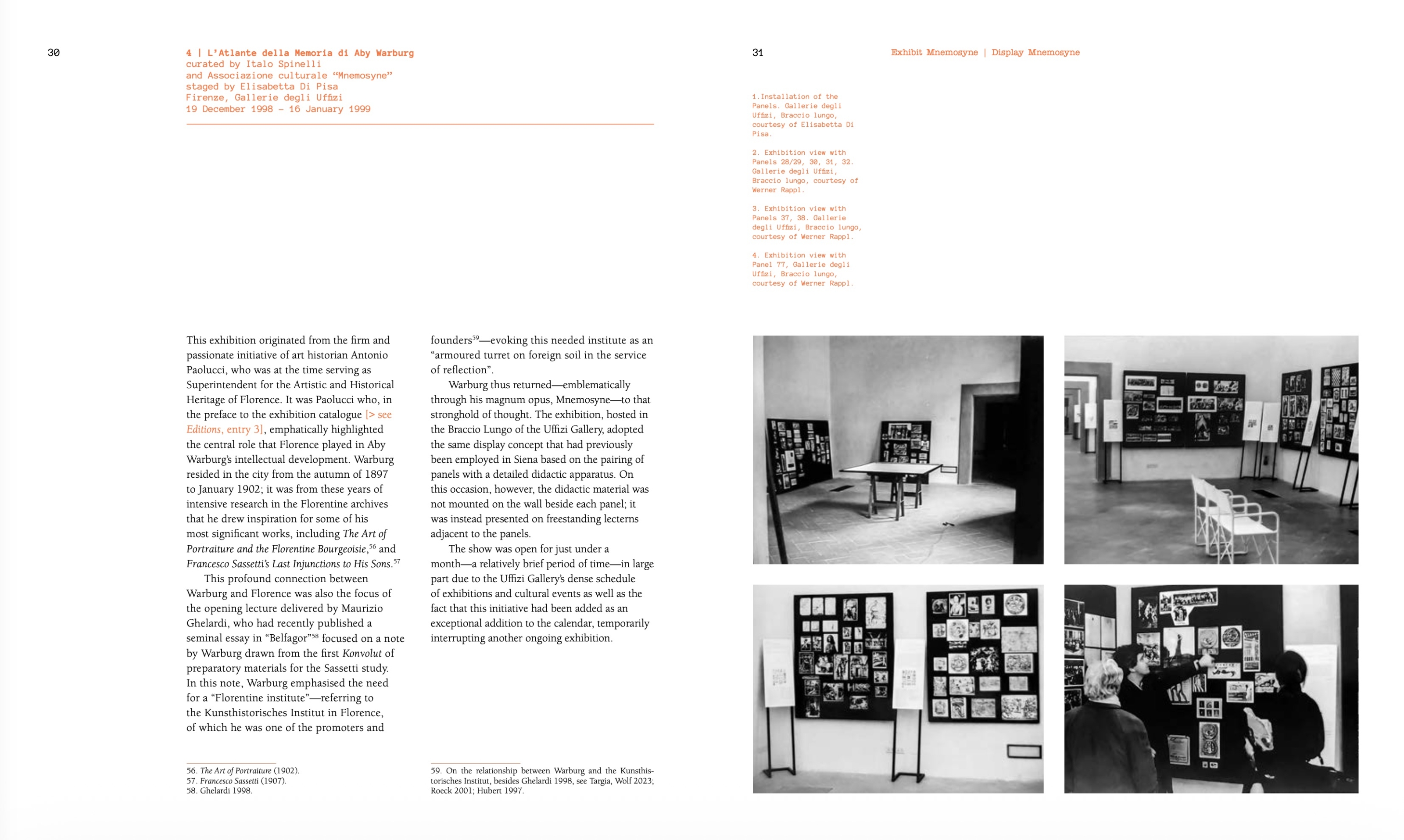
Pages reproduced from G.Zanon, Exhibit Mnemosyne | Display Mnemosyne. Aby Warburg’s Mnemosyne Atlas: An Exhibition History (Antiga, Treviso 2025).
In light of the remarkable breadth and richness of the responses provoked by Aby Warburg’s Mnemosyne Atlas in recent decades among intellectuals, artists, and curators alike, it would be neither practical nor particularly fruitful to examine every single exhibition project inspired by the Bilderatlas in detail or to attempt to construct a comprehensive inventory of all those that have incorporated its panels in one form or another.
Accordingly, this volume adopts a simple and clear organising principle, structuring its contents into two main sections. The first, Exhibitions, is devoted to exhibition endeavours that have presented the Mnemosyne Atlas in its entirety—all 63 panels. These particularly significant instances are explored comprehensively through extensive and in-depth analyses. The second section, Other Exhibitions, is a collection of more concise entries devoted to exhibitions that—while no less meaningful—featured only a selection of panels from the Atlas. The appendix that follows is dedicated to Editions, meaning a diverse array of editorial undertakings that have sought—in what may often have been described as a near-Gulliverian fashion—to adapt the Atlas to different forms of dissemination: from boxed loose-leaf reproductions to portable miniature editions and, conversely, to large-scale formats.
Naturally, an enterprise of this kind cannot in earnest claim absolute objectivity. Each entry here inevitably reflects the nature and availability of the sources it is based on, which shape its perspective, depth, and points of emphasis. Some entries adopt a more theoretical approach, while others dwell on technical or curatorial aspects; others still assume a more descriptive or documentary tone.
Given the scale and complexity of the exhibition practices that have, in various ways, engaged with Warburg’s thought and his Atlas, it is inevitable that this volume will have gaps and omissions. Thus, it should be regarded as a provisional cartography—a working tool that lays the groundwork for expanded and revised editions in the future.
Towards the Re-emergence of Mnemosyne
Our reconstruction begins with the early stages of the rediscovery of Mnemosyne, the Atlas conceived by Warburg as a summa of his research on the afterlife (Nachleben) of Antiquity. The relocation of the Kulturwissenschaftliche Bibliothek Warburg from Hamburg to London in the 1930s (Diers 1993; Sears 2013; Fleckner 2015; Woldt 2015)—a consequence of the diaspora of German intellectuals following the rise of National Socialism—alongside the more general upheavals brought about by the Second World War radically transformed the intellectual and institutional landscape of the continent. By the start of the second half of the twentieth century, the traces of this picture atlas on the transmission of classical culture—a project that, on the eve of Warburg’s death, appeared sharp, articulated, and nearly ready for publication—had all but dissolved.
Echoes of this project may be discerned in the collection of essays—the first to appear after the Warburg Library’s exile from Germany and the publication of the ill-fated German edition of his Gesammelte Schriften (GS)—that Gertrud Bing, together with Emma and Delio Cantimori, curated and published under the title La rinascita del paganesimo antico in 1966 through La Nuova Italia (RPA). In the introduction to this collection, Bing—who had been the most dedicated advocate for the publication of the Atlas—offers a passionate intellectual portrait of Warburg, explaining that he “conceived a pictorial atlas that would illustrate the history of visual expression in the Mediterranean area; it was to bear the title Mnemosyne […]. Yet, this work exists only in its fundamental outlines” (Bing 1966, XVII). In the original Italian: “Progettò un atlante figurativo che illustrasse la storia dell’espressione visiva nell’area del Mediterraneo; doveva avere il titolo di Mnemosyne, nome che aveva scelto anche come motto della sua biblioteca. Anche quest’opera esiste solo nelle linee fondamentali” (Bing 1966, XVII). That same year, Carlo Ginzburg also referenced Mnemosyne in his essay From Aby Warburg to E.H. Gombrich: A Problem of Method, alluding to the project as “an atlas of symbols diffused in the Mediterranean world that would have been entitled Mnemosyne” (Ginzburg [1966] [1986] 1990, 173).
In 1970, Ernst Gombrich’s Aby Warburg. An Intellectual Biography reintroduced the Mnemosyne project (Gombrich 1970, 283-306) into scholarly discourse—but did so through an extremely misleading lens. While the volume undoubtedly bolstered the accessibility of Warburg’s unpublished notes, drawing on the extensive biographical research undertaken by Gertrud Bing since the 1940s (Centanni 2024; Gelhard 2024; Centanni 2022; Centanni 2020; Despoix, Treml 2019, 23-41), it simultaneously distorted the meaning of the Bilderatlas. Gombrich, who had arrived at the Warburg Institute in 1936 with the specific aim of assisting Bing in the editing and publication of the Atlas, offered an interpretation that was heavily conditioned by a reading of Warburg’s work through the lens of his mental illness; Mnemosyne was reduced to a mere therapeutic tool, stripped of its epistemological and methodological coherence and ultimately rendered unintelligible as a scholarly endeavour. Gombrich wrote: “Thus I became aware of the intrinsic difficulties which stood in the way of the original project. […] The problem of how to edit papers of this kind seemed to me formidable. Yet without their edition the collection of photographs which form the ‘Atlas’ would also remain unintelligible to the uninitiated” (Gombrich 1970, 3). Moreover, in his Intellectual Biography, Gombrich published two panels of the Atlas for the very first time—Panel B, dedicated to the representation of Macrocosm and Microcosm, and Panel 46, centred on the figure of the Nymph—though only as greatly reduced reproductions, relegating the images of the panels to the iconographic section (Gombrich 1970, plates 56-57). The unfavourable light in which Gombrich cast the Atlas did not, fortunately, deter the growing interest of many intellectuals, who had by this point come to regard Warburg’s work as an extraordinary methodological endeavour. One particularly notable example is Omar Calabrese, who—in the now-legendary issue of “aut aut” dedicated to Warburg—described the Atlas as an undertaking grounded in a clear theoretical premise: the application of a comparative approach to the history of images, in deliberate opposition to any unilinear conception of historical development, despite only having encountered the work through Gombrich’s account (Calabrese 1984, 116-117).
Still today (and since its inception), anyone who visits the Warburg Institute in London must undergo a symbolic initiation under the sign of Mnemosyne. The epigraph ΜΝΗΜΟΣΥΝΗ carved in stone—designed in 1925 at the request of Warburg himself, who entrusted its implementation to the architect Fritz Schumacher—rests atop the architrave of the vestibule of the Library’s Elliptical Hall (Calandra di Roccolino 2023). Gertrud Bing later ensured that the very same inscription was carved and gilded on the wooden lintel of the Warburg Institute’s new building at Woburn Square, completed in the late 1950s. As Tim Anstey and Mari Lending note: “Deliberations about the construction of the Mnemosyne inscription occupied letters between Gertrud Bing and Kenneth Urquhart during December 1957” (Anstey, Lending 2023, 85). It was Giorgio Agamben in his 1975 essay Aby Warburg and the Nameless Science who first brought back into focus, after decades of obscurity, the link between the Library’s vestibule and the Bilderatlas (Agamben [1975] 2022, 94). In this way, Mnemosyne—the mythical personification of memory, to whom Warburg dedicated his two great intellectual imprese—stands as the guardian of the two gateways into Warburg’s universe.
The first ‘material’ return of Mnemosyne occurred with the first display of photographic reproductions of some panels from the Atlas. The exhibition “Die Menschenrechte des Auges”, curated by Martin Warnke in collaboration with Georg Syamken and Werner Hofmann, was held in the foyer of the Hamburger Kunsthalle in 1979. It is particularly significant that the first tangible reappearance of Mnemosyne took place within an exhibition space, transforming Warburg’s project into a visual dispositif.
In the years that followed, the Mnemosyne Atlas became the subject of academic research aimed at systematically analysing its materials. A pivotal moment in this trajectory occurred in 1980, when Dorothée Bauerle devoted her doctoral dissertation to Aby Warburg’s Mnemosyne Atlas, providing for the first time a comprehensive commentary on all 63 panels. The thesis was published in book form almost ten years later, under the title Gespenstergeschichten für ganz Erwachsene. Ein Kommentar zu Aby Warburgs Bilderatlas Mnemosyne (Bauerle 1988). Her research employed a variety of sources, including photographic reproductions of the panels, Warburg’s draft of a planned introduction (Einleitung), fragments of Warburg’s lecture at the Bibliotheca Hertziana, the Überschriften—extended editorial titles corresponding to each panel of the Atlas (WIA III 108.1.1)—and the body of notes in Allgemeine Ideen, handwritten by Warburg on individual loose sheets in 1927 (WIA III 102.1.4), and Grundbegriffe I & II, handwritten on individual loose sheets in 1928 and 1929 (WIA III 102.3.2; WIA III 102.4), which Bauerle described as “a kind of theoretical framework expressed in aphoristic form” (Bauerle 1988, 3). A further step was taken in 1992, when Peter van Huisstede defended his doctoral dissertation at the Rijksuniversiteit in Leiden, entitled De Mnemosyne Beeldatlas van Aby M. Warburg. Een laboratorium voor beeldgeschiedenis (van Huisstede 1992). Van Huisstede’s work gathered and organised archival materials related to the Atlas panels, establishing connections with Warburg’s writings and offering a structured approach to the study of the Mnemosyne Atlas and its intellectual framework.
Bibliography
Abbreviations and Editions Used
- GS
A. Warburg, Gesammelte Schriften. Die Erneuerung der heidnischen Antike. Kulturwissenschaftliche Beiträge zur Geschichte der europäischen Renaissance, hrsg. von G. Bing unter Mitarbeit von F. Rougemont, Leipzig/Berlin 1932. - GS Tagebuch
A. Warburg, Tagebuch der Kulturwissenschaftlichen Bibliothek Warburg, hrsg. von K. Michels und C. Schoell-Glass, Berlin 2001. - RPA
A. Warburg, La rinascita del paganesimo antico, a cura di G. Bing, tr. it. E. Cantimori, Firenze 1966. - WIA
Warburg Institute Archive, London.
Bibliographical References
- Agamben [1975] 2022
G. Agamben, Aby Warburg and the Nameless Science [Aby Warburg e la scienza senza nome, “Settanta” I, 2 (luglio-settembre 1975), 9-25]; in Centanni 2022, 83-105. - Anstey, Lending 2023
T. Anstey, M. Lending (eds.), Warburg Models. Buildings as Bilderfahrzeuge, Berlin 2023. - Bauerle 1988
D. Bauerle, Gespenstergeschichten für ganz Erwachsene. Ein Kommentar zu Aby Warburgs Bilderatlas Mnemosyne, Münster 1988. - Bing 1966
G. Bing, Introduzione, in RPA, VII-XXXI. - Calabrese 1984
O. Calabrese, La geografia di Warburg. Note su linguistica e iconologia, “aut aut” 199-200 (gennaio-aprile 1984), 109-120. - Calandra di Roccolino 2023
G. Calandra di Roccolino, L’epigrafe ΜΝΗΜΟΣΥΝΗ di Fritz Schumacher per la KBW, “La Rivista di Engramma” 206 (ottobre-novembre 2023), 37-40. - Centanni 2020
M. Centanni, “Purtroppo non abbiamo trovato molto tra le carte della nostra cara amica Gertrud Bing che si potrebbe salvare”. Testo e contesto di Ernst Gombrich, Lettera a Delio Cantimori, 29 ottobre 1964, “La Rivista di Engramma” 171 (gennaio-febbraio 2020), 127-153. - Centanni 2022
M. Centanni (a cura di), Aby Warburg and Living Thought, Eng. trans. E. Thomson, Dueville 2022. - Centanni 2024
M. Centanni, “[…] to bury Warburg, not to praise him.” The Role of Ernst Gombrich in the Tradition of the Warburgian Methodology and Thought, in D. Padularosa (ed.), Pathographies of Modernity with Aby Warburg and Beyond. An Astral Map of Warburgian Constellations, Newcastle upon Tyne 2024, 104-129. - Despoix, Treml 2019
P. Despoix, M. Treml (éds.), Gertrud Bing, Fragments sur Aby Warburg, Paris 2019. - Diers 1993
M. Diers (ed.), Porträt aus Büchern. Bibliothek Warburg und Warburg Institute, Hamburg – 1933 – London, Hamburg 1993. - Fleckner 2015
U. Fleckner, Hermia’s Voyage. A Preface, in U. Fleckner, P. Mack (eds.), The Afterlife of the Kulturwissenschaftliche Bibliothek Warburg. The Emigration and the Early Years of the Warburg Institute in London, Berlin/Boston 2015, 11-13. - Gelhard 2024
D. Gelhard, Gertrud Bing im Warburg-Cassirer-Kreis, in D. Gelhard, T. Roider (Hrsg.), Gertrud Bing im Warburg-Cassirer-Kreis. Mit dem Text ihrer Dissertation von 1921, Göttingen 2024, 12-112. - Ginzburg [1966] [1986] 1990
C. Ginzburg, From Aby Warburg to E.H. Gombrich: A Problem of Method [Da A. Warburg a E.H. Gombrich. Note su un problema di metodo, “Studi medievali” III/7/2 (1966), 1015-1065; poi in Miti, emblemi, spie, Torino 1986], in Id., Myths, Emblems, Clues, Eng. trans. J. and A.C. Tedeschi, London 1990, 17-59. - Gombrich 1970
E.H. Gombrich, Aby Warburg. An Intellectual Biography, London 1970. - van Huisstede 1992
P. van Huisstede, De Mnemosyne Beeldatlas van Aby M. Warburg – een laboratorium voor beeldgeschiedenis, Proefschrift ter verkrijging van de graad van Doctor aan de Rijksuniversiteit te Leiden, 3 december 1992. - McEwan 2004
D. McEwan (ed.), “Wanderstrassen der Kultur”. Die Aby Warburg–Fritz Saxl Korrespondenz 1920 bis 1929, Hamburg-München 2004. - Sears 2013
E. Sears, The Warburg Institute, 1933-1944. A Precarious Experiment in International Collaboration, “Art Libraries Journal” 38/4 (2013), 7-15. - Woldt 2015
I. Woldt, Family Matters. The Great Depression of 1929 and its Consequences for the Warburg Library, in U. Fleckner, P. Mack (eds.), The Afterlife of the Kulturwissenschaftliche Bibliothek Warburg. The Emigration and the Early Years of the Warburg Institute in London, Berlin/Boston 2015, 15-22.
Abstract
This contribution presents Giulia Zanon’s Exhibit Mnemosyne | Display Mnemosyne. Aby Warburg’s Mnemosyne Atlas: An Exhibition History (Antiga Edizioni, 2025), alongside an excerpt from its introduction. Conceived as a book-atlas and left unfinished at Warburg’s death, Mnemosyne has subsequently taken shape through successive editorial and curatorial interpretations. The volume surveys more than thirty exhibitions and thirteen editions, tracing the transformation of an unrealised publishing project into an object of exhibition. The introductory text considers the Atlas’s material status, its critical reception and its re-emergence from the late 1970s onwards. It explores the methodological questions underlying its reconstruction and display, examining the relationship between documentary fidelity and curatorial interpretation and asking how an exhibition might convey the dynamic character of Warburg’s thought.
keywords | Geburtstagsatlas; Akademie der bildenden Künste; Santa Maria della Scala; Haus der Kulturen der Welt; Gallerie degli Uffizi; Fondazione Ugo e Olga Levi; Albertina; OSA Archivum; University of Tokyo; ZKM – Zentrum für Kunst und Medien.
Per citare questo articolo / To cite this article: Redazione di Engramma (edited by), Aby Warburg’s Mnemosyne Atlas: An Exhibition History. A Presentation of: G. Zanon, Exhibit Mnemosyne | Display Mnemosyne (Antiga, Treviso 2025), “La Rivista di Engramma” n. 239, settembre 2026.