Archaeology of Thermalism. Living and Working with Mineral Waters
Editorial of Engramma no. 231
Maddalena Bassani and Jacopo Tabolli
Abstract
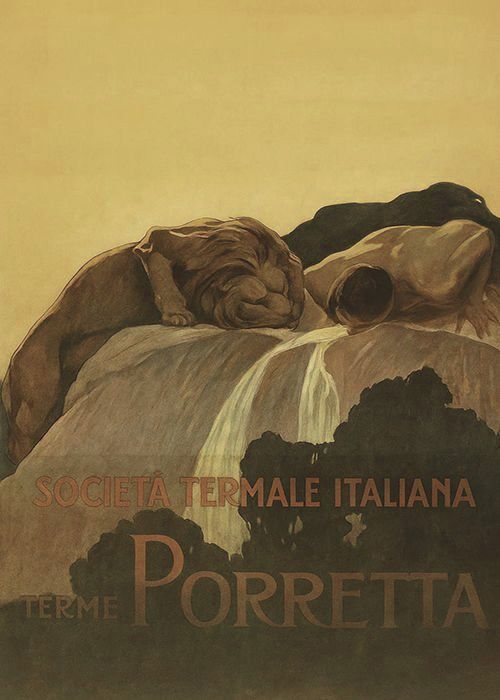
This issue of Engramma takes water – and especially thermo-mineral water – seriously. Water is not as background scenery to “great” monuments, but as a material, sensory, and political infrastructure through which societies organise bodies, beliefs, labour, and power. Across different chronologies and geographies, from Antiquity to contemporary contexts, the contributions gathered here show how thermalism, springs, rivers, and maritime installations generate forms of knowledge that are never neutral: they are always situated, contested, and historically layered.
Maddalena Bassani’s reading of Seneca’s Epistulae is exemplary in this respect. It refuses to treat moral discourse as a transparent window onto practice and instead extracts from the text a dense micro-archive of technical and architectural cues – especially around the material presence of glass (and possible lapis specularis) in early Imperial bathing environments. The result is a methodological provocation: to move from rhetorical topoi to testable questions and targeted archaeometric enquiry. From Sicily, Sofia Bulgarini and Andrea Luvaro present a protome of Achelous found near Monte Raffe, and – crucially – place the object back into a damaged and only partially explored landscape, shaped by illicit excavations. Here the river god is not merely iconography: he becomes a reminder that water-cults are also territorial histories, and that heritage protection is inseparable from how we reconstruct (or erase) the conditions of discovery. The sea, too, becomes an archive. Enrico Maria Giuffrè and Jacopo Tabolli reconstruct the long biography of the submerged Fishpond of Bagno del Saraceno (Isola del Giglio), tracing transformations from landing installation to Neronian peschiera and later restorations – while the finding of tubuli and heated rooms nearby makes the hypothesis of a villa balneum newly plausible. The site’s later afterlives – marked by modern lead objects recalling Venetian gondolas – underline a central theme of the issue: aquatic places do not simply “survive”; they are continuously re-used, re-signified, and remembered. Ameur Younès shifts the frame southwards to Ancient Tunisia, mapping sixteen hot springs and associated installations and insisting on their centrality within local water management, precisely because they have too often been sidelined in favour of monumental urban baths. This becomes where a decolonial reflex is not an external slogan but a scholarly necessity: to undo habitual hierarchies of evidence and attention, and to treat the Mediterranean as a field of multiple centres rather than a single imperial viewpoint. Mila Cvetkovic extends the conversation from Water to Earth, following the Medicinal and Ritual Uses of Clays and “Earths” through classical sources and foregrounding their frequent origin in hydrothermal environments. The body here is a site of exchange between mineral resources, medical theories, and ritual practices – another reminder that “therapy” is never just a technique but also a cultural grammar.
Chronology expands further in Edoardo Vanni’s study of the Medieval Thermal Site of the Caldanelle di Petriolo, interpreted as a hybrid space where architecture, hydrothermal technology, hospitality, and productive routines co-evolve between the fourteenth and seventeenth centuries. And in Paola Zanovello’s “Unusual” yet revealing case, Thermal-Mineral Water enters the economy of Hemp Processing in the Euganean Area under the Venetian Republic, collapsing the neat divide between wellness and labour: water’s chemistry becomes an accelerator of production and, indirectly, of maritime power. The issue also addresses the contemporary politics of thermal heritage. Mauro Marzo and Anna Veronese track the reconfiguration of Italian Thermal Sites from therapeutic infrastructures to experiential destinations, while Paolo Faccio and Silvia Scordo present the New Conservation-and-Enhancement Project for the Archaeological Area of Via Scavi in Montegrotto Terme, where “valorisation” is framed explicitly as a form of preservation and as a redesign of public access. And precisely in relation to the public use of Thermal Mineral springs, Alba Balmaseda offers some reflections based on initiatives for the community reappropriation of Healing places in contemporary Sicily. Finally, Massimo Osanna and Jacopo Tabolli read the Exhibition Itineraries of the Bronzes of San Casciano dei Bagni (Reggio Calabria, Berlin, Aquileia) as interpretative machines: Display is not a neutral container but a narrative technology that can foreground ritual waters, excavation process, and the ethics of looking.
Three contributions widen the temporal and geographical scope: Maddalena Bassani introduces the Bad Dürrenberg burial and its entanglement with a Thermo-Mineral context, pushing “Thermalism” beyond the classical into deep prehistory, Il mistero della sciamana. Un viaggio archeologico alla scoperta delle nostre origini [Das Rätsel der Schamanin. Eine archäologische Reise zu unseren Anfängen]. Monica Centanni presents Il Grande Nilo. Esploratori, turisti e conquistatori nell’antico Egitto by Lorenzo Braccesi, which perfectly illustrates the role of water, in this case river water, not only as a resource to be exploited, but also as a medium of knowledge, history and mythology. Rachele Dubbini in her paper focused on the Northern Adriatic Thermo-Mineral springs as active agents in landscape formation and settlement dynamics, engaging in critical dialogue with Maddalena Bassani’s recent study, which places particular emphasis on the Fons Timavi and the Fons Aponi.
It is therefore fitting to close by looking ahead to the Exhibition “Etruschi e Veneti. Acque, culti e santuari” at Palazzo Ducale (Appartamento del Doge), Venice, running 6 March-29 September 2026. The show begins from the sacred in the Etruscan world to analyse cult practices connected to water, moving from the Tyrrhenian ports of Vulci and Pyrgi to sanctuaries of healing thermo-mineral waters at Chiusi, Chianciano, and San Casciano dei Bagni, and then into the territories of the ancient Veneti – from Montegrotto Terme (linked to the curative power of thermal waters) to Lagole di Calalzo and Este, before culminating at lagoon-Altino as a space shaped by mobility and integration. What matters, here, is not only the thematic overlap with this issue, but the shared epistemic wager: water, and especially thermo-mineral water, is treated as an agent of connection rather than a mere resource-capable of generating plural ritual geographies and cross-cultural relations without forcing them into a single, hegemonic storyline. If Engramma 231 insists that the “classical” must be read against its own margins – textual, material, territorial – then the Venetian exhibition offers a public arena where those margins become visible: where healing springs, port sanctuaries, and lagoon rituals are not footnotes to history, but frameworks through which we can re-think how past worlds were made, inhabited, and shared.
Abstract
This issue of Engramma approaches water – especially thermo-mineral water – not as a background element but as a material, sensory, and political infrastructure through which societies have organised bodies, beliefs, labour, and power. Across a wide chronological and geographical spectrum, the contributions show how thermalism, springs, rivers, and maritime environments generate forms of knowledge that are historically situated and never neutral. Maddalena Bassani re-reads Seneca’s Epistulae as a micro-archive of technical and architectural data on early imperial bathing, foregrounding the role of glass and proposing a methodological shift from moral discourse to archaeometric enquiry. Sofia Bulgarini and Andrea Luvaro analyse a protome of Achelous from Monte Raffe (Sicily), reinserting it into a landscape altered by illicit excavations and highlighting the territorial and political dimensions of water cults. Enrico Maria Giuffrè and Jacopo Tabolli reconstruct the long biography of the submerged Fishpond of Bagno del Saraceno (Isola del Giglio), from Roman maritime installation to subsequent phases of reuse, advancing the hypothesis of a nearby villa balneum. A broader Mediterranean perspective is offered by Ameur Younès, who maps hot springs and installations in Ancient Tunisia and argues for their centrality within local water management, challenging monument-centred historiographies. Mila Cvetkovic explores the Medicinal and Ritual Uses of Clays and “Earths” in classical sources, emphasising their connection with hydrothermal environments and the body as a site of exchange between natural resources, medicine, and ritual. Later chronologies are addressed by Edoardo Vanni, who examines the Medieval Thermal Site of Caldanelle di Petriolo as a hybrid space of architecture, technology, hospitality, and production, and by Paola Zanovello, who analyses the use of Thermal-Mineral waters in Hemp Processing in the Euganean Area under the Venetian Republic, collapsing the divide between wellness and labour. Contemporary perspectives include the work of Mauro Marzo and Anna Veronese on the transformation of Italian Thermal Sites, Paolo Faccio and Silvia Scordo on the Enhancement Project of Via Scavi in Montegrotto Terme, and Alba Balmaseda on community reappropriation of Healing Waters in contemporary Sicily. Rachele Dubbini engages in critical dialogue with Maddalena Bassani’s recent study, which places particular emphasis on the Fons Timavi and the Fons Aponi. Finally, Massimo Osanna and Jacopo Tabolli reflect on the Exhibition Itineraries of the Bronzes of San Casciano dei Bagni as interpretative devices, while the reviews by Maddalena Bassani, Monica Centanni further expand the temporal and conceptual horizons of water as a medium of ritual, knowledge, and memory.
keywords | Thermalism; Archaeology of water; Hydrothermal landscapes; Healing practices in antiquity; Archaeological heritage of thermal sites.
La Redazione di Engramma è grata ai colleghi – amici e studiosi – che, seguendo la procedura peer review a doppio cieco, hanno sottoposto a lettura, revisione e giudizio dei saggi
(v. Albo dei referee di Engramma)
Per citare questo articolo / To cite this article: Maddalena Bassani, Jacopo Tabolli, Archaeology of Thermalism. Living and Working with Mineral Waters, Editorial of Engramma, “La Rivista di Engramma” n. 231, gennaio/febbraio 2026.