The study of mineral waters and related healing facilities has benefited over time from numerous contributions, some of a distinctly archaeological nature (Annibaletto, Bassani, Ghedini 2014; Matilla, González 2017; Bassani, Tabolli 2024; González Soutelo 2024; Bassani 2025), others with a historical-literary and epigraphic approach (Guérin-Beauvois, Martin 2007, in particular 97-101; Rizzi 2013; Zanetti 2013). There are also contributions that have examined, from a chemical-physical point of view, the classification of waters attested in Roman texts in relation to modern parameters (Bassani A. 2014), others that have highlighted the healing properties of waters and their applications, comparing their ancient uses with modern ones (Mantovanelli 2014; Caldara, Chiappetta, Scimemi 2024). Furthermore, new important data are highlighted through the excavations at the remarkable thermal site of San Casciano dei Bagni (Mariotti, Salvi, Tabolli 2025).
The article aims to highlight the documentary and informative value that can be gleaned from reading some of Seneca’s Letters to his friend Lucilius, which contain significant data on bathing facilities and their uses in the Roman Italian Peninsula both in the case of facilities for therapeutic purposes, with thermal mineral water, and in the case of facilities for hygienic purposes, which therefore used fresh water. The reference edition for the Letters is that of BUR, edited by Giuseppe Monti and published in 1997; where necessary, few changes have been proposed to enhance specific words pertaining to natural thermalism in the Latin text.
Specifically, attention will be focused on a particular element that seems to be of significant interest from an architectural, material and functional point of view, namely glass, leaving the examination of the wealth of information that Seneca left us in his corpus of letters on thermae and, in general, on curative aquae to a subsequent publication.
I. Seneca and leisure at the aquae
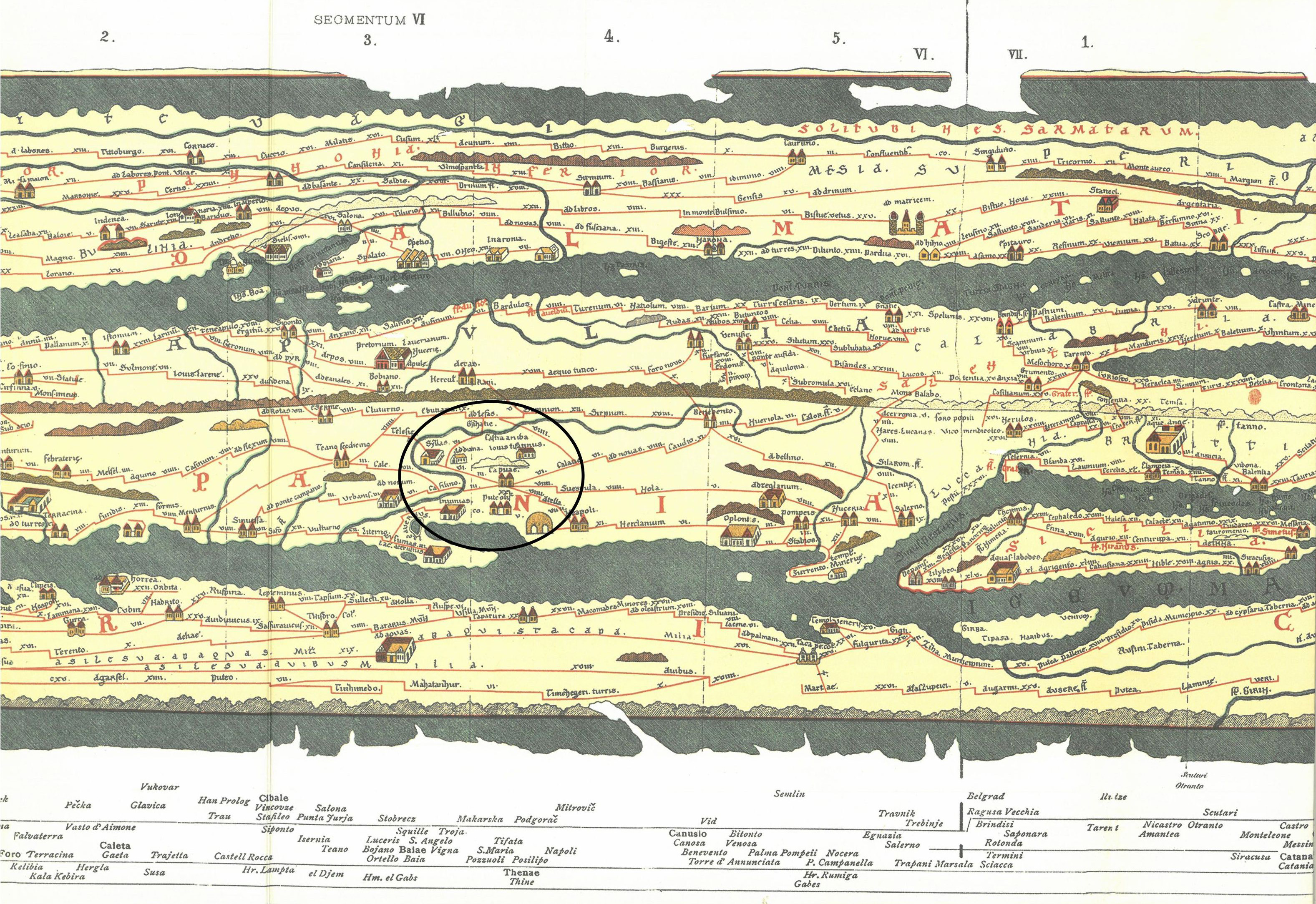
1 | The section of the Tabula Peutingeriana with the drawing of the possible healing building (Syllas) attributed to the springs of Monte Tifata and the Sanctuary of Diana Tifatina near Capua (Tab. Peut. segm. V, 3: ©www.omnesviae.org).
In order to contextualise Seneca’s thoughts on the characteristics of bathing facilities and the tendency of his contemporaries to spend a lot of time at the baths (whether for hygiene or healing purposes), it may be useful to briefly recall Seneca’s biography in the thirty years between 37 and 65 AD, the date of his death.
As is well known (Lana 1956), Seneca gained fame as a rhetorician and philosopher first under the principatus of Caligula and then under those of Claudius and Nero. Sources remember him as the lover of Iulia Livilla, Caligula’s sister, who was also the incestuous lover of her own brother (Svet. Cal. 24). Due to internal disputes, Iulia Livilla was sent into exile and then recalled in 41 upon Caligula's death at the behest of Claudius. For this reason, Seneca was overwhelmed by scandal, as he was accused of aiding and abetting Julia Livilla’s adultery. However, the philosopher managed to escape death thanks to the intercession of Claudius, who saved him by confining him to Corsica while confiscating half of his assets. Soon, however, he returned to Rome, where he served as tutor to Domitius, son of Agrippina (Claudius’ wife) and future Nero. From that moment until the last years of his life (62-65 AD), Seneca held positions of great importance thanks to the favour of Nero, who had meanwhile become emperor. The philosopher retired from public life in 62 and, until 65 AD, composed the volumes entitled Ad Lucilium epistularum moralium libri, containing 124 letters: these are a summa of moral precepts aimed at suggesting ways of living inspired by wisdom (see Traina 1984).
This brief reference to Seneca’s life story helps us understand why his Epistulae contain numerous references to a life inspired by moderation, with which the wise man can face difficulties of all kinds, such as those that affected him in his later years (remember that he was forced to commit suicide in 65 AD by Nero). Therefore, it is not surprising that in those pages he dwells, sometimes with significant details, on describing the decline in morals and the excessive waste of money in the construction of buildings that no longer served as dwellings or places from which to derive benefit, such as thermal baths, but as spaces in which to display wealth and power and where to carry out actions that were harmful to the body and, above all, to the spirit.
In the Epistulae, as in his treatises, Seneca often contrasts lifestyles inspired by simplicity with others characterised by excessive use of ars. For example, with regard to the power of nature unaltered by human works, he reminds that everyone, if inspired by wisdom, can find guidance in the god present in every natural resource: if a cave not dug by human hands but created by natural causes offers a sense of religious awe to a pious soul who enters it (liber IV, ep. 41, 3-4), so too are the hot mineral springs that gush from the subsoil objects of worship, because they emanate the power of the divinity that shows itself without intermediaries:
Magnorum fluminum capita veneramur: subita ex abdito vasti amnis eruptio aras habet; coluntur aquarum calentium fontes, et stagna quaedam vel opacitas vel immensa altitudo sacravit.
We worship the sources of big rivers: where water suddenly bursts forth from the depths, altars are erected; hot springs are objects of worship, and some lakes are considered sacred either because of their dark colour or their immense depth.
In this case, the direct relationship between man and the beneficial thermal spring is evident. Precisely because it springs spontaneously from the rock or the earth, it is venerated in the same way as dark and deep rivers or lakes, near which altars are erected. Conversely, an overly artificial and unnatural relationship with the same resource can, in his eyes, constitute a trap from which it is best to escape. In fact, the best places to stay for a wise man of his time were not the famous spa town of Baia, where he also had a villa: that land so conducive to human health had now become a place of vice at any time of day and especially at night (thus in liber V, ep. 51, 2-4). Indeed, Seneca draws attention to the deleterious effect that the practice of balneum with hot and mineral waters could have on a general such as Hannibal, who in a single winter had managed to become soft because he had been made lazy by the pleasures enjoyed during his stay at the thermal baths and in the lands of Campania (liber V, ep. 51, 5-6):
Id agere debemus ut inritamenta vitiorum quam longissime profugiamus; indurandus est animus et a blandimentis voluptatum procul abstrahendus. Una Hannibalem hiberna solverunt et indomitum illum nivibus atque Alpibus virum enervaverunt fomenta Campaniae: armis vicit, vitiis victus est.
Let us fortify our spirit and keep it away from the lure of pleasures. A single winter spent in idleness sapped Hannibal’s energy. This great leader, whom even the snow-capped Alps could not stop, allowed himself to be weakened by pleasures during his stay in Campania; victorious in battle, he was defeated by vice.
This is a negative example most likely taken from Livy’s unfair pages devoted to the African general (Liv. XXIII, 45), in which the Carthaginian army is portrayed as deprived of its ardour and strength for having lingered to bathe in the vicinity of Capua, where the men and the general himself indulged in the pleasures of wine and the flesh. In this regard, I have already pointed out (Bassani 2014a, in particular 155-160) that this is a completely distorted pro-Roman interpretation of the events that took place at the springs of Mount Tifata between 216 and 211 BC (victory of the Carthaginians over the Romans at Cannae, with the Carthaginians moving to Capua). There, I suggested instead that Hannibal’s decision to stop at Mount Tifata with his army should be attributed to the need to treat the wounds sustained during the battles by men and animals, including the famous elephants, thanks to those healing springs: which were not at all hot like those in Baia, but cold and sulphurous. The springs were part of the sanctuary of Diana Tifatina, and it was no coincidence that a healing facility was built there at the behest of Sylla during the 1st century BC, the shape of which can be recognised in the image in the Tabula Peutingeriana (segm. V, 3, already mentioned in Quilici Gigli 2012: [Fig. 1]). In short, Hannibal had brought his men and animals to the aquae of Diana Tifatina to ensure they received healing treatments with the cold sulphurous springs, and certainly not for entertainment: this practice has been attested for a long time and goes beyond ancient times, as demonstrated by the design of a treatment facility, also equipped with an area for horses, dating back to the late nineteenth century (Bassani 2014a, in particular 157).
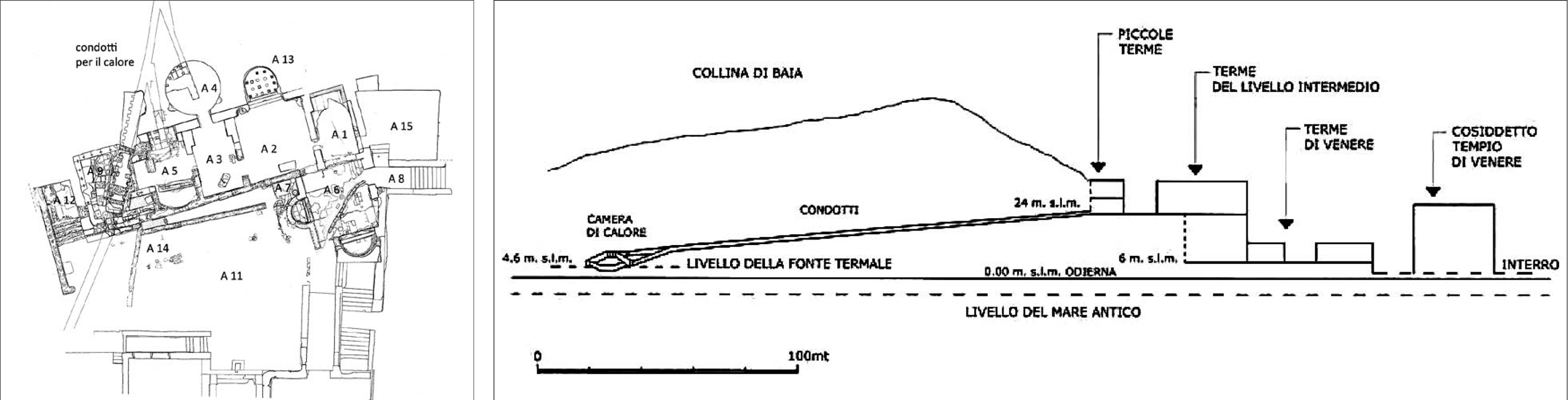
2 | Plan and section of the “Le Piccole Terme” bathing establishment, which exploited the healing springs at Baia (Medri 2013, 122, fig. 3).
3 | Section of the “Le Stufe di Nerone” bathing establishment, which exploited the healing springs at Baia (Medri 2013, 131, fig. 10).
It therefore seems reasonable to conclude that Seneca may have exaggerated his criticism of the Campania thermal baths in order to warn Lucilius, or any aspiring sage, against idleness at the aquae, because the latter would distract him from the activities of a simple life devoted to meditation. Thus, the overlap of places in Campania with different therapeutic characteristics (the hot springs of Baia and the cold springs of Tifata) does not seem to contradict Seneca’s reasoning, but rather seems to serve to emphasise that wisdom can only be achieved through moderation in one’s habits, unlike the relaxation that pervades everyone when taking a therapeutic bath: the feeling of tiredness and the need for rest that one experiences after undergoing treatment in mineral waters, caused by a drop in body pressure, is well known. And in fact, immediately afterwards (again in liber V, ep. 51, 6), Seneca states:
Quid mihi cum istis calentibus stagnis? quid cum sudatoriis, in quae siccus vapor corpora exhausurus includitur? Omnis sudor per laborem exeat.
What use are these hot pools or sweat baths to me, in which dry vapour develops that will exhaust the body? Sweat should only be caused by fatigue.
Thermal treatments using dry steam baths, which then as now induced profuse sweating and a consequent feeling of fatigue, were not considered by Seneca to be an effective remedy for the treatment of many diseases, but rather an obstacle to leading a simple life, free from luxury and ostentation, befitting a wise man. After all, those hot, sometimes very hot steam baths were typical of the Campi Flegrei: numerous facilities had already been built here in the late Republican era to exploit the geothermal potential, including the Piccole Terme di Baia and the Stufe di Nerone complexes [Fig. 2 and Fig. 3]. These complexes also included rooms where hot vapours were channelled through dug-out conduits, capturing them from the underground heat source and transferring them to designated rooms (Medri 2013). However, Seneca’s disappointment does not seem to be directed solely at public health resorts, since in another letter he appears to refer to private residences on the Phlegraean shores equipped with balnea, where thermal waters had been brought. In letter 122, he acknowledges that it is entirely inappropriate to build a thermal mineral facility directly in the sea (liber XX, ep. 122, 8):
Non vivunt contra naturam qui fundamenta thermarum in mari iaciunt et delicate natare ipsi sibi non videntur nisi calentia stagna fluctu ac tempestate feriantur?
Those who build thermal baths with foundations immersed in the sea do not live contrary to nature, perhaps convinced that they cannot swim voluptuously if their hot water pools are not beaten by waves and storms?
Now, it is impossible to identify the private dwelling that Seneca had in mind in his invective, but it is worth remembering that several villas, now largely submerged due to bradyseism (Davidde Petriaggi et al. 2024), have been investigated in the Phlegraean area, which had been built on the sea (cf. the results obtained by the Superintendency of the Sea for the conservation and enhancement of these submerged contexts are important). Among these was a residence known as the Villa dei Pisoni near Punta Epitaffio, which dates back to the 1st century BC but later passed into imperial ownership. Recent underwater investigations have clarified that it was equipped with a thermal baths system that used thermal mineral waters, and that it had a long terrace whose foundations consisted of numerous pilae resting directly on the seabed [Fig. 4]. This is therefore clear evidence of the building practice mentioned by Seneca in the passage examined, but on the other hand, it cannot be overlooked that it was in Baia that the conspirators led by Gaius Calpurnius Piso gathered with the aim of eliminating Nero. After being discovered, they were either executed or forced to commit suicide: in addition to Gaius Calpurnius Piso, Seneca was also included, although his involvement in the conspiracy had not been proven (Tac. ann. XV, 49-57).
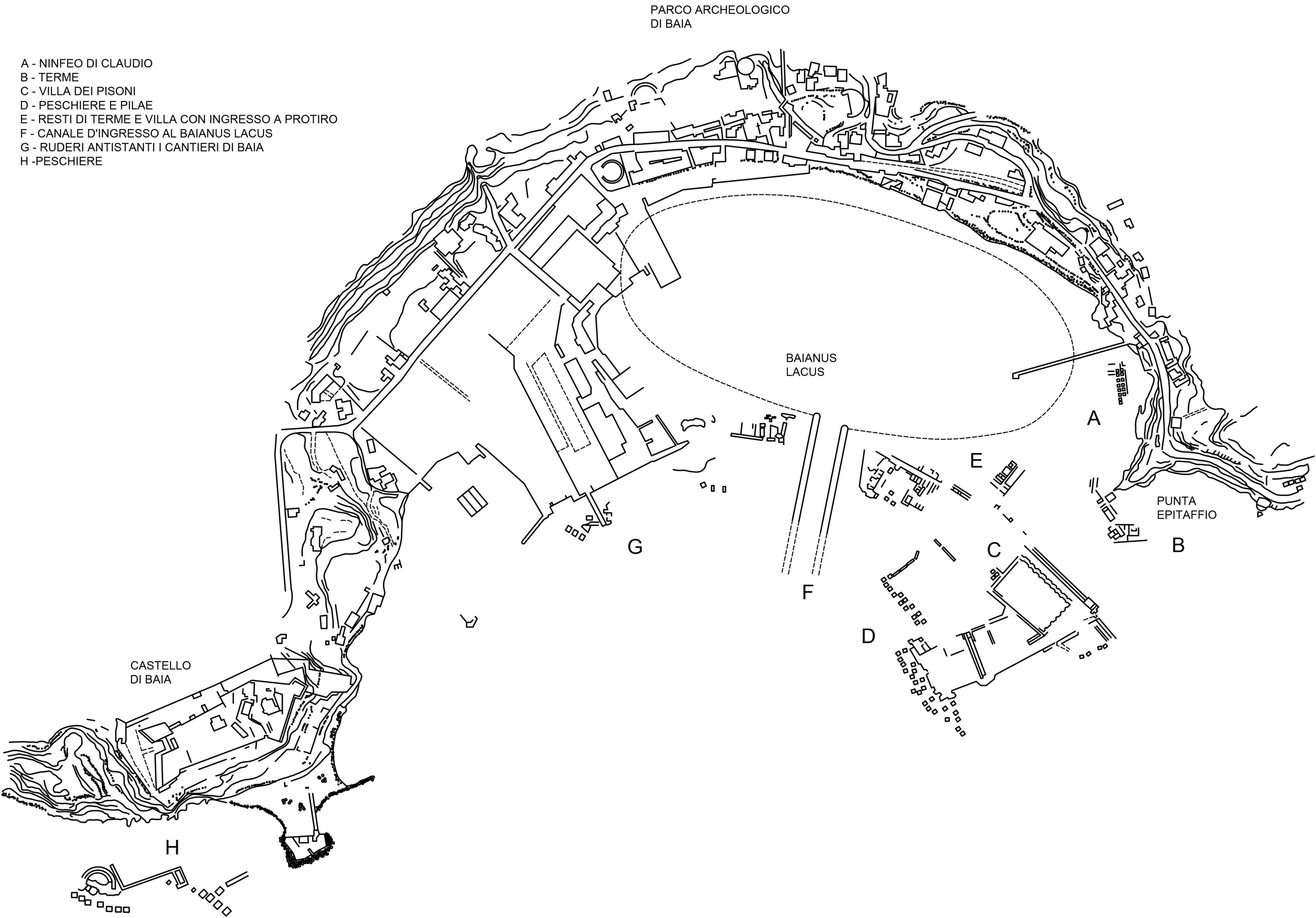
4 | Topographical map of the submerged remains in the Gulf of Baia, including the Villa di Punta Epitaffio (©www.progettomusas.eu/baia/).
Therefore, even in private homes, people sought the pleasures of a healthy bath, building villas on the seabed with rooms equipped with hot water baths. It should be noted that the calentia stagna mentioned in the passage are the same ones that Seneca had already mentioned in Epistula 51 of liber V mentioned above, in relation to dry steam bath therapies, which were very fashionable in his day and which he detested. For him, the foolish owner had spent a lot of money for the pure pleasure of swimming in tamed waters, such as the thermal waters brought into his home, alongside the untamed waters of the sea, whose waves broke on the perimeter of the seaside villa, believing that he would achieve complete enjoyment through ars. But in his opinion, it was pure illusion, since the man lost sight of the full meaning of life, which should be inspired by moderation and contemplation and not by the futile amusements of idleness at the aquae.
II. Baths compared
Seneca’s polemic against unbridled luxury has long been examined by scholars (Berno, De Finis 2004) and, in the context of this contribution, it may be useful to draw attention to some data contained in Epistula 86, the subject of two recent studies (Fucecchi 2019; De Maria 2021).
The context to which Seneca refers is the villa of Publius Cornelius Scipio Africanus on the coast of Literno, south of Naples, where the general who defeated Hannibal at Zama retired to private life between the end of the 3rd and the beginning of the 2nd century BC, devoting himself to rest and the care of his vegetable garden. Here he spent his time sweating with fatigue because he cultivated the land according to the mos maiorum, certainly not because he took dry steam baths (liber XI, ep. 86, 4-5):
Vidi villam extructam lapide quadrato, murum circumdatur, silvae, turres quoque in propugnaculum villae utrimque subrectas, cisternam aedificiis ac viridibus subditam, quae sufficere in usum vel exercitus posset, balneolum angustum, tenebricosum ex consuetudine antiqua; non videbatur maioribus nostris caldum nisi obscurum. Magna ergo me voluptas subiit contemplantem mores Scipionis ac nostros. In hoc angulo ille Carthaginis horror, cui Roma debet, quod tantum semel capta est, abluebat corpus laboribus rusticis fessum. Exercebat enim opere se terramque, ut mos fuit priscis, ipse subigebat. Sub hoc ille tecto tam sordido stetit, hoc illum pavimentum tam vile sustinuit. At nunc quis est, qui sic lavari sustineat?
I visited the villa, built of square stones, the park enclosed by a wall; the two towers that stand, one on one side, one on the other, defending the villa; the cistern hidden among the buildings and plants, which could suffice for the needs of an entire army; and a small, dark bathroom, according to ancient custom. It seemed to our ancestors that the room could not be heated unless it was dark. It gave me great pleasure to compare Scipio’s customs with our own. In this corner, the great man who was ‘the terror of Carthage’ [quoted from Lucretius, De rerum natura III, 1034], and to whom Rome owes the fact that it was only occupied by enemies once, rested his weary limbs from farm work in the bath. In fact, he practised working the land with his own hands, according to ancient custom. He stayed in this humble room and walked on this rough floor. In our times, who would be willing to bathe here?
Scipio, therefore, was content with a small and modest bath to restore his body and spirit, which appeared very different from the sumptuous baths in vogue in Seneca’s time and which perhaps used fresh water. This was not an anomaly: several studies (Yegül 1992; Lucore, Trümper 2013) have drawn attention to the presence of bathing facilities in Greek and Roman homes since archaic times, although the custom of providing a dedicated room seems to have become established only from the 2nd century BC onwards, driven by Roman culture. Initially, houses may have had a small room, often adjacent to the kitchen in order to make use of the same drain and heat, and equipped with a basin, or there may have been a mobile tub or basin filled with hot fresh water and placed in a private room of the dwelling as needed.
Scipio’s balneolum seems to be one such environment: Seneca describes it as a small, dark room with a floor of no decorative value. Later in the letter, he recalls that in the small bath Scipio washed himself with ‘unfiltered water, which was often cloudy and, if there had been a storm, even muddy’ (Non saccata aqua lavabatur, sed saepe turbida et, cum plueret vehementius, paene lutulenta: § 11): this indicates that the water supply system did not include a filtering system, and it cannot be ruled out that it drew from the large cistern mentioned at the beginning of the paragraph. Therefore, Scipio only cared about rinsing himself and washing away the sweat, without immersing himself in sumptuous baths filled with thermal waters and without then sprinkling his body with perfumed ointments.
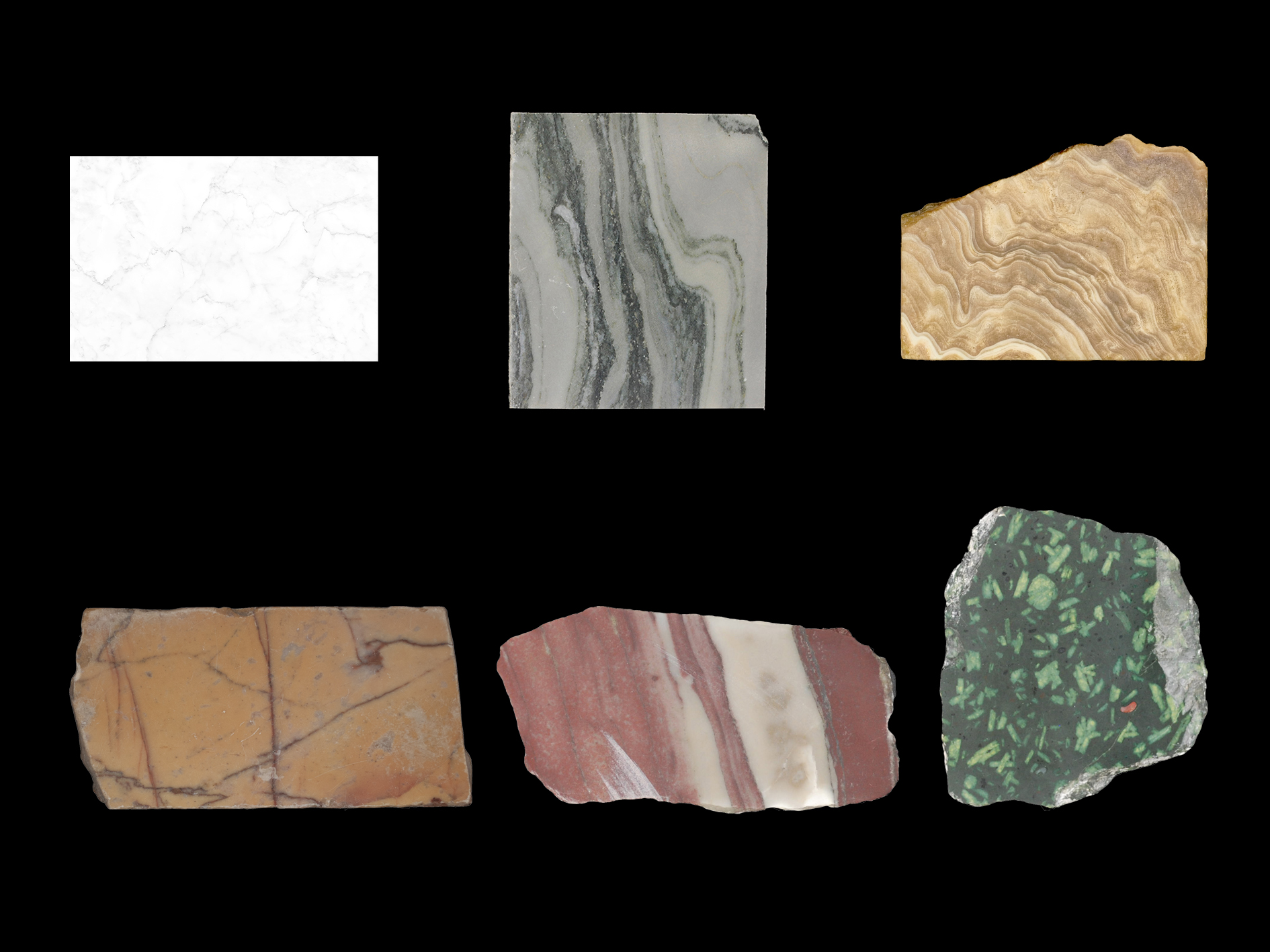
5 | Ancient marbles mentioned in the literary sources analysed: 1. Thasian marble; 2. Carystian marble or cipollino verde; 3. alabastro cotognino; 4. giallo antico; 5. cipollino rosso; 6. porfido verde (graphic design by the author, photos of the marble present in the Laboratorio di Analisi di Materiali Antichi, Iuav University of Venice).
The second part of the letter is dedicated to the rich thermal baths of the mid-1st century AD, in which Seneca draws attention to what the balnea looked like during the early imperial period. The latter had walls covered with circular mirrors, alabastro (Alexandrina marmora) combined with giallo antico marble (Numidicae crustae), in turn inlaid with mosaic decorations alternating with slabs of Thasian marble [Fig. 5]: they at one time would have been admired only in temples and not around the baths, now also equipped with silver taps (liber XI, ep. 86, 6-7):
At nunc quis est, qui sic lavari sustineat? Pauper sibi videtur ac sordidus, nisi parietes magnis et pretiosis orbibus refulserunt, nisi Alexandrina marmora Numidicis crustis distincta sunt, nisi illis undique operosa et in picturae modum variata circumlitio praetexitur, nisi vitro absconditur camera, nisi Thasius lapis, quondam rarum in aliquo spectaculum templo, piscinas nostras circumdedit, in quas multa sudatione corpora exinanita.
In our day, who would be willing to bathe there? They would feel poor and tasteless if the walls were not adorned with large circular mirrors; if Alexandrian marble were not combined with slabs of Numidian marble; if these marbles were not adorned on all sides with artistic decorations and various paintings; if the ceiling were not made of glass, if Thasian marble, which once could only be admired, and rarely, in temples, did not surround its pools, in which we abandon our bodies exhausted by abundant sweat.
Seneca goes on to point out that in those years it was inconceivable to have bathrooms without statues by famous sculptors, large windows, and precious inlays in the floors, all elements considered necessary to enliven the stay of the users, who would have considered the baths of Scipio, victor over Hannibal, a rat-infested hovel (blattaria: liber XI, ep. 86, 7-8):
Et adhuc plebeias fistulas loquor; quid, cum ad balnea libertinorum pervenero? Quantum statuarum, quantum columnarum est nihil sustinentium, sed in ornamentum positarum inpensae causa! Quantum aquarum per gradus cum fragore labentium! Eo deliciarum pervenimus ut nisi gemmas calcare nolimus.
In hoc balneo Scipionis minimae sunt rimae magis quam fenestrae muro lapideo exsectae, ut sine iniuria munimenti lumen admitterent; at nunc blattaria vocant balnea, si qua non ita aptata sunt, ut totius diei solem fenestris amplissimis recipiant, nisi et lavantur simul et colorantur, nisi ex solio agros ac maria prospiciunt.
But these are plebeian baths. What should I say when I move on to the bathrooms of the libertines? How many statues! How many columns that have no supporting function, but are placed there only for ornamental purposes and to flaunt wealth! What an abundance of water flowing down the steps with a roar! We are so demanding that we cannot set foot on anything but precious stones.
In this bath of Scipio, instead of windows, there are small slits in the stone wall; this allows light to enter without damaging the stability of the building. Nowadays, however, we call bathrooms ‘rat holes’ if they are not built in such a way that the sun shines through the windows all day long, if you cannot tan while bathing, if you cannot enjoy the view of the countryside and the sea from the bathtub.
Leaving aside for a moment the moralistic intentions behind the letter, it is worth noting here that Seneca’s account is of great interest not only for its list of the types of marble and decorative motifs used to cover the rooms, and perhaps, perhaps exaggerated, of precious metal fittings, but above all for its references to the construction methods used for the baths.
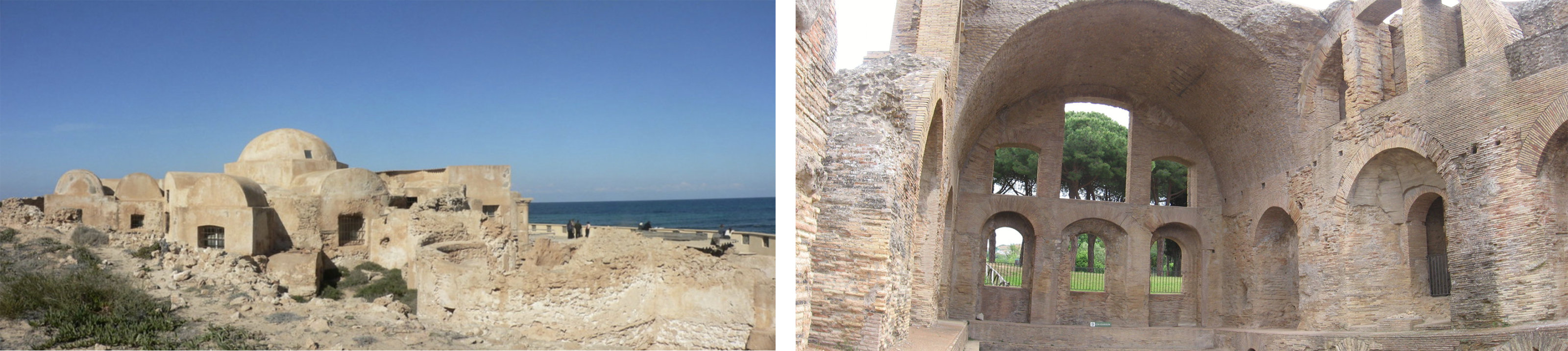
6 | View of the Roman villa of Silin near Leptis Magna and the bathing complex after restoration and roofing (Musso 2024, fig. 4).
7 | View of the windows of the so-called calidarium in the therapeutic baths of Terme Taurine near Civitavecchia (photo by the author, 2012).
On the one hand, there is a reference to the many statues, remembered because they embellished areas intended mainly for freedmen and people of high rank, and to the columns, which did not necessarily serve to support the ceilings, but were placed there to show off their splendour, like the floors decorated with precious stones. On the other hand, Seneca draws attention to the windows in the baths, which could have been a problem for the structural integrity of the buildings: this is a very well-documented building feature in hygienic constructions, as evidenced, for example, by the cases of Herculaneum (Guidobaldi et al. 2015) or, at a private level, the well-known example of the maritime villa of Silin in Leptis Magna (Rind 2009, 44-45; Musso 2024: [Fig. 6]). Windows were also present in mineral water spas, such as the Terme Taurine (Annibaletto 2014: [Fig. 7]) and the Terme di Santa Venera in Sicily (Branciforti 2006). The brightness of a room was not functional in ensuring a safe tan and a splendid view of the landscape, but provided constant air exchange, especially if several dozen people could stay in the room with the bath at the same time, or if the vapours from the mineral waters used could be harmful if inhaled for too long. However, on rereading the passages just quoted, it is impossible to overlook the fact that Seneca explicitly mentions the existence of a ‘glass ceiling’ among the many other manifestations of wealth lavishly displayed in the thermal baths. Given the peculiarity of this reference, it is worth dwelling on it.
III. Glass ceilings in thermal baths or simply glass mosaics?
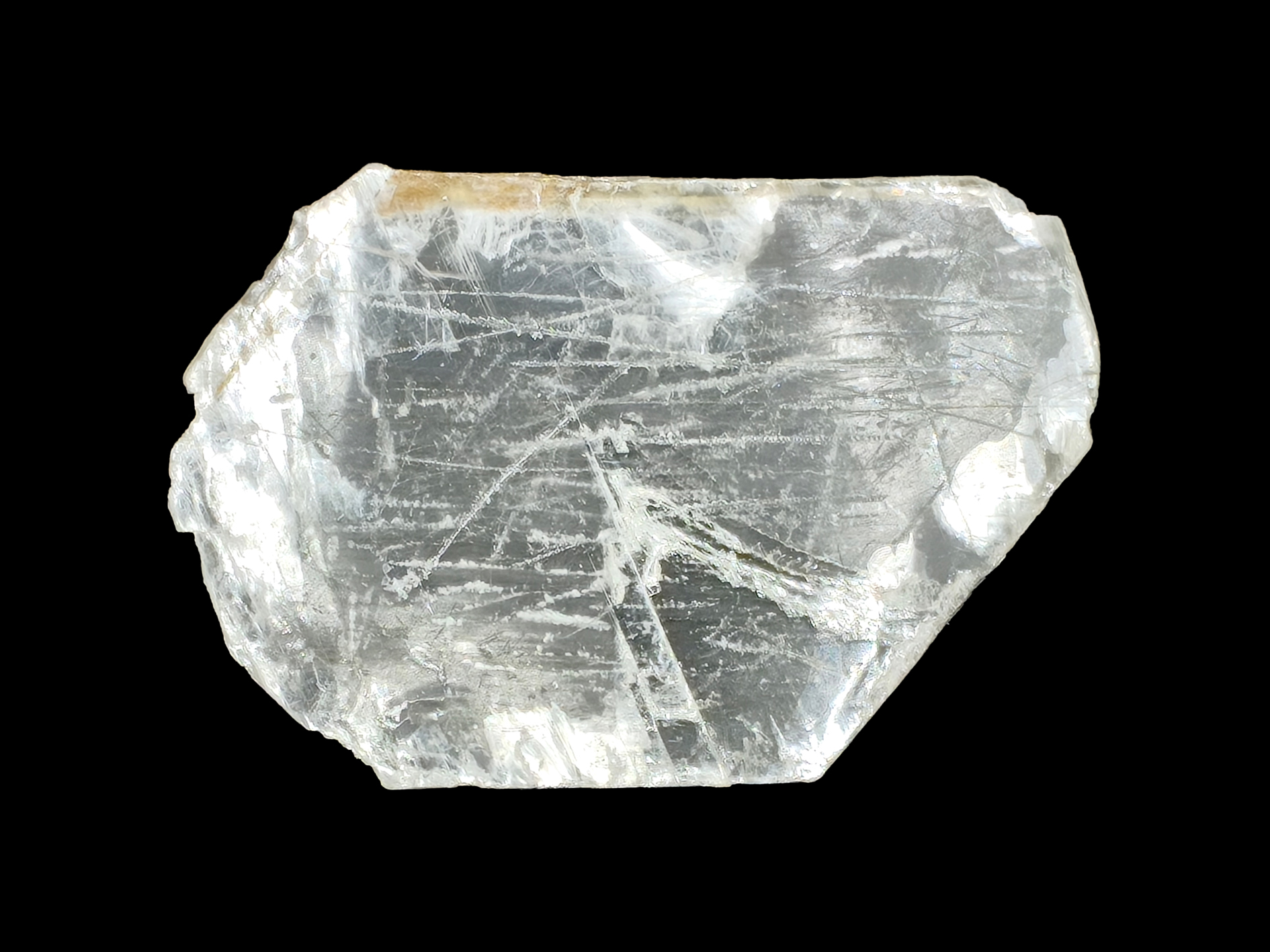
8 | Fragment of lapis specularis (courtesy of the Laboratorio di Analisi di Materiali Antichi LAMA, Università Iuav di Venezia).
In the letter 86, Seneca also mentioned the presence of glass ceilings among the indicators of extreme luxury in the baths: it may be useful to refer to the passage (liber XI, ep. 86, 6):
At nunc quis est, qui sic lavari sustineat? Pauper sibi videtur ac sordidus, nisi parietes magnis et pretiosis orbibus refulserunt, nisi Alexandrina marmora Numidicis crustis distincta sunt, nisi illis undique operosa et in picturae modum variata circumlitio praetexitur, nisi vitro absconditur camera (etc.).
In our day, who would be willing to bathe there? They would feel poor and tasteless, unless the walls were adorned with large circular mirrors; unless the Alexandrian marble was combined with Numidian marble encrustations; unless these marbles were adorned on all sides with artistic mosaics and various paintings; unless the ceiling were made of glass (etc.).
The text contains the phrase vitro absconditur camera, which can be literally translated as ‘the vaulted ceiling is covered by glass’, meaning ‘the ceiling is made of glass’. The word camara/camera is analysed in Latin dictionaries, particularly in the Thesaurus Linguae Latinae, which lists numerous occurrences where it refers to part of a building (ThLL vol. 3 col. 203-204). It is a noun that specifically indicates a vaulted ceiling, or the vault itself: it is found in Varro (rust. I, 59, 2) in reference to rooms used as warehouses, or in Propertius, who uses the term to indicate sumptuous halls (III, 2, 10). The word is also found in Vitruvius, who discusses it in relation to baths or basement facilities (V, 10, 3; VII, 2, 2; VIII, 6, 3). With regard to the latter, it should be noted that concameratio is properly a vaulted construction typical of cement substructures used to build cryptoporticoes and underground constructions (see Les cryptoportiques 1973; Callebat, Fleury 1995, s.v. camera, concameratio; Bassani 2003; Basso, Ghedini 2003). In later times, the word camera was used by Caelius Aurelianus in his treatise on medicine, particularly in the chapter dedicated to acute pain: here he uses this term in reference to baths with vaulted rooms, referring to therapies for various forms of acute ache (acut. III, 17, 151 f.: Cum autem declinare passio coeperit, etiam embasim adhibemus ex oleo vel calida et oleo aut decoctione laxativarum materiarum, non sine cautione. [152] declinanda est enim perfrictio, quapropter erit facienda in calido loco vel balnei fornice, quem appellant a
Then, the term does not refer to a flat ceiling: Latin used the word tectum, or lacunar, when referring to a coffered ceiling for this part of the building. The word camara/camera derives from the Greek καμάρα, a vaulted object, or a vaulted chamber (see, for example, Agatharch. 62; CIG 2241, Chios, where the term refers to the vault of a tomb). Finally, the verb abscondo seems to be used in Seneca’s passage more in the sense of covering than hiding, and its use in the passive voice properly conveys the action of covering performed by the glass on the room. Vitrum is in fact the neuter noun for glass as a material, while vitreum is the derived adjective that can also indicate, by metonymy, a glass vase or tessera. Some scholars believe that with this sentence, Seneca meant the covering of surfaces with glass tiles (Vlad Borrelli 2016, 64). But is this the only way to interpret this testimony?
The information provided by Seneca is therefore of great importance because it raises the issue of recognising vaulted structures made of materials other than brick and opus caementicium within thermal baths. Similar information can be found in Stace’s Silvae (silv. I, V, 31-44, see Fontaine, Foy 2008, 425), which mentions the thermal baths of a certain Claudius Etruscus. After invoking Apollo, the Muses and the Nymphs who were the patronesses of the springs, the poet lists the types of marble that could have been used to cover the walls of a balneum of the time: white Thasian marble, green cipollino from Carystus, alabaster (onyx), Numidian marble also known as giallo antico, marble ‘the colour of Tyre and Sidon red with white veins’, i.e. pavonazzetto, green Laconian also known as green porphyry or serpentine, etc. (see Lazzarini 2004; Lazzarini 2007: [cf. supra Fig. 5]). The thresholds of the rooms were also covered with marble, and the vaults were equally resplendent, perhaps covered with glass tiles, on which animal designs were chiselled (Stat. silv. I, V, 41-43):
[…] Non limina cessant,
effulgent camerae, vario fastigia vitro
in species animosque nitent.
The thresholds are no less impressive,
the vaults shine, their summits gleam
with the multicoloured glass of animated figures.
In this passage, Statius’s use of the word camerae (in the plural form) refers to vaulted ceilings, but the verb effulgeo seems to evoke the brilliance of the figurative compositions with coloured glass: the poet was describing decorative glass compositions that imitated marble by juxtaposing different polychrome slabs.
Pliny the Elder, on the other hand, seems to refer to glass vaults, recalling the vaulted ceilings in the Baths of Agrippa (Plin. nat. XXXVI, 189), but it cannot be ruled out that he was referring to the same mosaic technique, which also used glass tiles on the surfaces of public and private rooms. In fact, when discussing the technique of mosaic making, he states that
Agrippa certe in thermis quas Romae fecit figulinum opus encausto pinxit in calidis, reliqua albario adornavit, non dubie vitreas facturus camaras si prius inventum id fuisset aut a parietibus scanae, ut diximus, Scauri pervenisset in camaras […]
Agrippa, at least, in the Baths he built in Rome, had the brick walls of the hot rooms painted with the encaustic technique, and adorned the rest with stucco: while he would certainly have made glass vaults, if that technique had been discovered earlier, or if from the walls of Scauro’s scene, as we said (36, 114), it had already passed to the decoration of the vaults […].
These testimonies, together with that of Seneca, contain clear references to vaulted roofs with glass elements in some rooms of the baths dating from the middle of the 1st century AD, but one wonders whether, at least in Seneca’s case, he intended to draw Lucilius’ attention to a vaulted roof system made entirely or partially of glass, and, if so, what kind of glass it was.
The use of glass windows in public and private buildings is well known in Roman architecture from the 1st century AD. Recent studies have highlighted the Roman practice of making quadrangular window panels measuring between 40 and 60 cm, onto which moulded glass was fixed within wooden or metal frames, which were then attached to the walls of houses and public buildings (Allen 2002; Roffia 2008; Fontaine, Foy 2011). Archaeological remains of hemispherical window glass found in Spain, Portugal, Italy, France, Great Britain and Switzerland, mostly from thermal contexts, have also been examined. In particular, the recovery of a 3rd century AD ship known as the ‘West-Embiez’ wreck off the coast of Provence revealed a cargo consisting exclusively of glass: the quadrangular window panes measured approximately 30.5 x 23.5 cm, while the dome-shaped window panes had a diameter of 40-52 cm. It cannot be ruled out that this glass could also have been used for the oculi of the vaults, which were useful for air exchange and the escape of vapours (Fontaine, Foy 2011).
However, it should be noted that in addition to window glass, obtained by melting silica and soda compounds with the possible addition of other components to obtain a specific colour, another type of ‘glass’ material, lapis specularis, has also been analysed recently (Guarnieri 2015; Guarnieri 2015a; Tempesta 2015; for modern uses, see Alberti et al. 2018). This is a translucent stone mentioned by Strabo (XII, 2, 10) and later by other authors, including Pliny the Elder (nat. 36, 45-46), which is identified as selenitic gypsum (Lugli 2018). It is found both in the quarries of Spain, near Segobriga (Cuenca: Bernardez Gomez, Guisado Di Monti 2002), in the area of the Parco del Gesso in Emilia-Romagna (which also includes the Grotta del Re Tiberio, long frequented for its mineral springs: Bassani 2014b, 181), and finally in the Agrigento area (Gullì 2015). This material comes in wide transparent crystals, which even in ancient times could be cut into very large slabs that then thinned to achieve the desired thickness [Fig. 8]. Examples have been found in various contexts, but their chemical and physical characteristics have not always been recognised by archaeologists, who have confused them with simple glass (see Guarnieri 2015a).
IV. A research hypothesis for the Roman healing complex at Montegrotto Terme
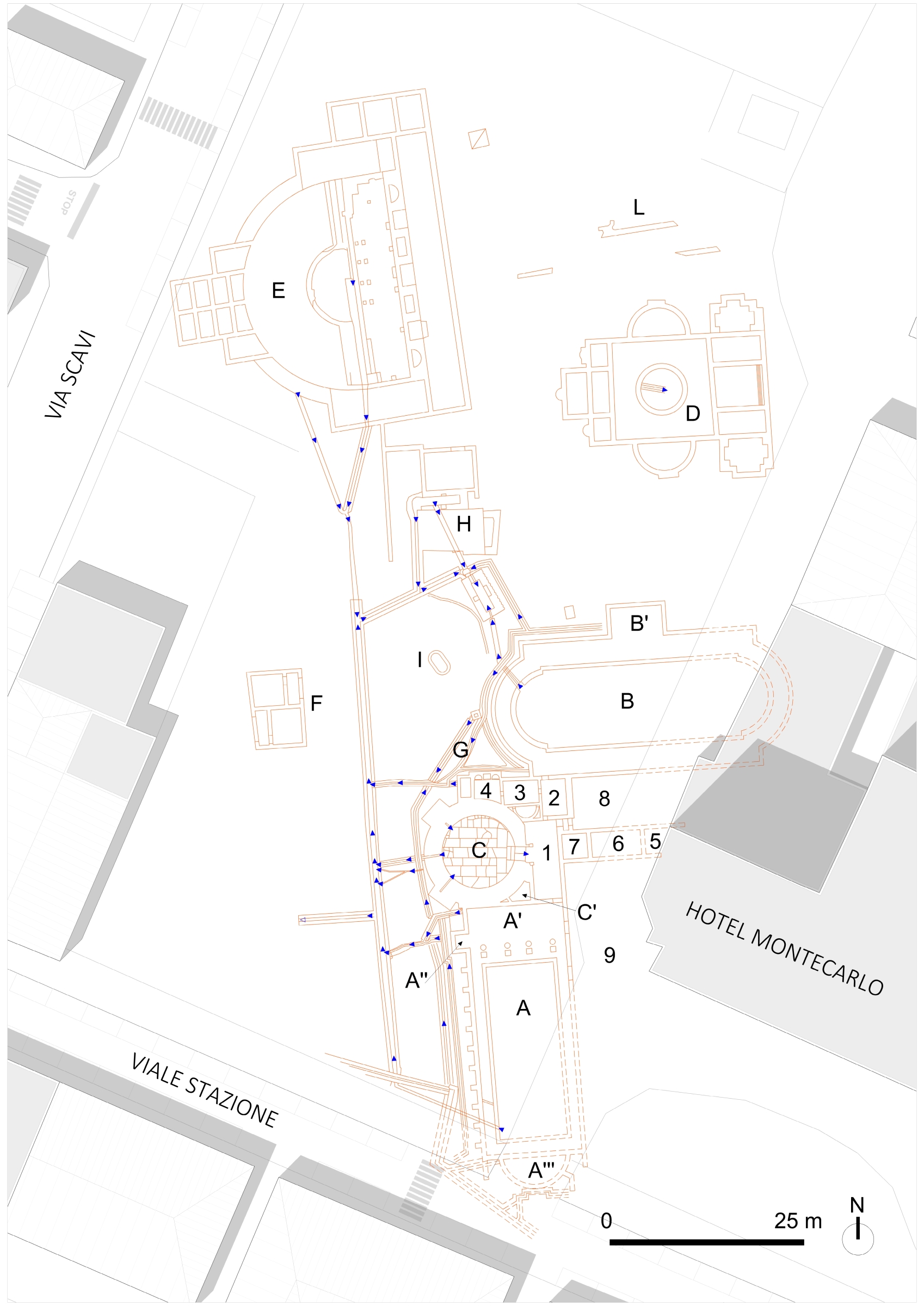
9 | Plan of the Roman healing context in Via Scavi at Montegrotto Terme (Bassani, De Venanzi 2024, fig. 3).
Returning to Seneca’s testimony and as we draw to a close, there is no evidence to say with certainty whether he was referring to vaulted ceilings with glass slabs or rather with lapis specularis slabs: in this case, it can be hypothesised that they were assembled together to cover all or part of the vaulted ceiling of a balneum, possibly combining them with curved glass parts, such as dome-shaped windows for the oculi.
Further research may perhaps attempt to provide an answer to these uncertainties, but for the moment it seems interesting to open up a line of research that could prove to be of great importance not only for understanding Seneca’s reference in greater detail, but above all for studying the glass remains found in ancient thermal mineral contexts through laboratory analysis.
The archaeological thermal mineral contexts of Montegrotto Terme can be a field of investigation. In particular, excavations in Via Scavi carried out first in the late 18th century and then in the second half of the 20th century brought to light a large area [Fig. 9] equipped with three interconnected pools, as well as several service rooms, a small theatre and a nymphaeum (on the Roman thermal area, see Bonomi, Malacrino 2012, with previous bibliography; on the nymphaeum, see Bassani 2022). The public thermal baths date back to the second half of the 1st century BC until the 3rd century AD. Here, several fragments of architectural glass have been found in the public baths in Via Scavi (as well as in the complex under the Hotel Terme Neroniane: Cipriano 2012): no archaeometric analyses have been carried out on them, and it might therefore be useful to dedicate investigations in order to ascertain their composition and reconstruct the production technique of those artefacts in the main structures. For this reason, specific research will be conducted to study the glass and its composition through laboratory tests, but also to reconstruct in detail the structures to which it belonged. In fact, the state of preservation of the rooms in which the ancient glass was recovered in the public healing context of Via Scavi is rather altered because it was severely compromised and underwent extensive restoration work at the end of the 20th century. The dimensions of the rooms are known (hall with the pool A: 12x30 m; the pool A measures 8,5x20 m; hall with the pool B: 37x16,7; the pool B measures 24,5x9,5 m; pool C: diam. 9,30 m), but the question of the possible roofing system remains unresolved. It is almost certain that the circular pool C, which had a continuous wall 2,15 m thick, was covered: this covering system ensured that the internal temperature of the pool, which was lined with marble slabs, was maintained. Conversely, it is not clear what the two large rooms A-B were like: covered or uncovered? Giovanna Tosi emphasised that, given the rather thin walls surrounding the halls (0,45 m), it would have been difficult for them to support the weight of a large vault (Tosi 2004, 882). Simonetta Bonomi and Carmelo Gianluca Malacrino also referred to this aspect when analysing the complex in Via Scavi (Bonomi, Malacrino 2012, 166) and proposed a roofing system made of wood and clay elements. In my opinion, and in light of the literary and archaeological evidence presented, a working hypothesis could be that of a mixed wood and glass roof, the latter to be correctly defined, specifying whether it is fused glass in sheets or lapis specularis sheets. The work may develop insights that take into account, on the one hand, the methods of construction of similar structures in an unstable geomorphological context such as that of the Euganean thermal area and in relation to the building techniques developed between the end of the 1st century BC and the early empire. On the other hand, the study may address issues related to the use of the various building materials available, not least lapis specularis.
The research to be conducted on a specific scale in Montegrotto Terme could then be extended to other thermal mineral contexts where the presence of glass has been confirmed: it would in fact be appropriate to review and reconsider the interpretations of materials defined as “glass” in therapeutic contexts, which could be examples of selenite gypsum slabs (from macrocrystalline rocks), or, conversely, glass melted and spread into special slabs. This analysis may also provide useful information for understanding whether, given the different qualities of mineral waters present in evaporated and/or liquid form, there was a preference in the use of materials for roofing and ventilation systems in bathing establishments.
In conclusion, a re-reading of the literary sources relating to natural thermalism and bathing practices may prove of some interest in focusing attention not only on socio-cultural dynamics such as those highlighted in the pages of Seneca, but above all on the ways in which these facilities were built in relation to the different materials used, as in the case of glass and lapis specularis. Useful clues may also be derived from the analysis of the initial design choices and any restoration work carried out during the ancient era, to adapt or renovate the facilities to the treatment practices in vogue at different periods. Finally, these areas of study may be accompanied by investigations into the trade in raw materials: in the case of lapis specularis, its origin from quarries known only in three areas of the empire may suggest possible research for the raw material or the places where it was processed and finished for use in the construction of thermal architecture.
Special thanks go to the staff of the Laboratory for the Analysis of Ancient Materials (LAMA) and Prof. Lorenzo Lazzarini.
Bibliography
Literary Sources
- Plinio il Vecchio, Storia delle arti antiche. Naturalis Historia (libri XXXIV-XXXVI), Introduzione di Maurizio Harari. Testo critico, traduzione e commento di Silvio Ferri, Milano 2000.
- Publio Papinio Stazio, Opere, a cura di A. Traglia, G. Aricò, Torino 1980.
- Lucio Anneo Seneca, Lettere a Lucilio, Introduzione di Luca Canali, traduzione e note di G. Monti, 2 voll., Milano 1997.
References
- Alberti et al. 2018
S.A. Alberti, M. Benfari, L. Lazzarini, F. Mannuccia, S. Tusa, “Figuri sculpiti d’alabastru”. Francesco Laurana a Partanna, in Gullì et al. 2018, 351-368. - Allen 2002
D. Allen, Roman Window Glass, in M. Aldhouse-Green, P. Webster (eds.), Artefacts and Archaeology. Aspects of the Celtic and Roman World, Cardiff 2002, 102-111. - Annibaletto 2014
M. Annibaletto, Le stazioni termominerali: tipologie architettoniche e sistemi infrastrutturali, in Annibaletto, Bassani, Ghedini 2014, 129-242. - Annibaletto, Bassani, Ghedini 2014
M. Annibaletto, M. Bassani, F. Ghedini (a cura di), Cura, preghiera e benessere. Le stazioni termominerali nell’Italia romana, Padova 2014. - Bassani A. 2014
A. Bassani, Note idrotermali: caratterizzazione, prodotti, usi diversi, in Annibaletto, Bassani, Ghedini 2014, 29-43. - Bassani 2003
M. Bassani, La percezione del vivere sotterraneo, in Basso, Ghedini 2003, 29-53. - Bassani 2014a
M. Bassani, I santuari e i luoghi di culto presso le sorgenti termominerali, in Annibaletto, Bassani, Ghedini 2014, 143-160. - Bassani 2014b
M. Bassani, Per una carta distributiva degli spazi sacri alle fonti curative, in Annibaletto, Bassani, Ghedini 2014, 161-188. - Bassani 2022
M. Bassani, L'edificio polilobato in Via Scavi a Montegrotto Terme. Ipotesi per una sua interpretazione, “Rivista di Archeologia” 46 (2022), 101-123. - Bassani 2025
M. Bassani, Adriatico salutifero, 1. Archeologia del termalismo al Fons Timavi e al Fons Aponi, Roma-Bristol 2025. - Bassani, Bressan, Ghedini 2012
M. Bassani, M. Bressan, F. Ghedini (a cura di), Aquae patavinae. Montegrotto e il termalismo in Italia. Aggiornamenti e nuove prospettive di valorizzazione. Atti del convegno (Padova 2011), Padova 2012. - Bassani, Bressan, Ghedini 2013
M. Bassani, M. Bressan, F. Ghedini (a cura di), Aquae salutiferae. Il termalismo fra antico e contemporaneo. Atti del Convegno Internazionale (Montegrotto Terme 2012), Padova 2013. - Bassani, De Venanzi 2024
M. Bassani, M.E. De Venanzi, Hotel Montecarlo nearby the archaeological area of Via Scavi in Montegrotto Terme: the archival sources, “La Rivista di Engramma” 214 (luglio 2024), 149-170. - Bassani, Tabolli 2024
M. Bassani, J. Tabolli (eds.), Archaeology of Thermalism. New studies on healing waters, monographic issue “La Rivista di Engramma” 214, (luglio 2024). - Basso, Ghedini 2003
P. Basso, F. Ghedini (a cura di), Subterraneae domus. Ambienti residenziali e di servizio nell'edilizia privata romana, Caselle di Sommacampagna 2003. - Bernárdez Gómez, Guisado Di Monti 2002
M.J. Bernárdez Gómez, J.C. Guisado Di Monti, Las explotaciones mineras de lapis specularis en Hispania. Catalogue de l’exposition Artifex: la ingeneria romana en España, Madrid 2002. - Berno, De Finis 2004
F.R. Berno, L. De Finis (a cura di), Colloquio su Seneca, Atti del Convegno di Studio, Trento, 28 ottobre 2004, Roncafort (Trento) 2004. - Bonomi, Malacrino 2012
S. Bonomi, C.G. Malacrino, Il complesso termale di viale Stazione / via degli Scavi a Montegrotto Terme, in Bassani, Bressan, Ghedini 2012, 155-172. - Branciforti 2006
M.G. Branciforti (a cura di), L’area archeologica di Santa Venera al Pozzo-Acium: antiquarium, Aci Catena 2006. - Caldara, Chiappetta, Scimemi 2024
F. Caldara, A. Chiappetta, P. Scimemi, Thermal scientific research and therapies in the Euganean area, “La Rivista di Engramma” 214 (luglio 2024), 205-218. - Callebat, Fleury 1995
L. Callebat, P. Fleury, Dictionnaire des termes techniques du De architectura de Vitruve, Hildesheim 1995. - Cipriano 2012
S. Cipriano, Il riordino e l’inventariazione del materiale archeologico di Montegrotto Terme, in Bassani, Bressan, Ghedini 2012, 237-246. - Ciucci et al. 2024
G. Ciucci, B. Davidde Petriaggi, C.Rousse (a cura di), Villae maritimae del Mediterraneo occidentale, Roma 2024. - Davidde Petriaggi et al. 2024
B. Davidde Petriaggi, M. Stefanile, S. Medaglia, R. Petriaggi, F. Lucci, G. Gomez de Ayala, S. Passaro, Nuovi dati sulle ville di Baia dalla ricerca archeologica subacquea, in Ciucci et al. 2024, 25-40. - De Maria 2021
S. De Maria, Seneca e il balneolum di Scipione, in Lucrezio, Seneca e noi. Studi per Ivano Dionigi, Bologna 2021, 309-319. - Fontaine, Foy 2008
D. Foy, S.D. Fontaine, Diversité et évolution des vitrages de l’Antiquité et du haut Moyen Âge, “Gallia” 65 (2008), 405-459. - Fontaine, Foy 2011
S.D. Fontaine, D. Foy, Sulla diversità delle vetrate antiche: vetri da finestra a calotta emisferica e vetrate di pietra speculare, in M.G. Diani, T. Medici, M. Uboldi (a cura di), Produzione e distribuzione del vetro nella storia: un fenomeno di globalizzazione, Atti delle XI Giornate nazionali di Studio in memoria di Gioia Meconcelli (Bologna 2005), Pasian di Prato 2011, 35-44. - Fucecchi 2019
M. Fucecchi, Seneca e la villa di Scipione a Literno: spunti per la (ri)costruzione di un personaggio carismatico, in M. Citroni, M. Labate, G. Rosati (a cura di), Luoghi dell’abitare, immaginazione letteraria e identità romana. Da Augusto ai Flavi, Pisa 2019, 247-264. - González Soutelo 2024
S. González Soutelo, Ancient Thermalism. Thermal spas and territory: the role of mineral-medicinal waters in the Roman provinces. Proceedings of the Third International Conference (Madrid 2023), Oxford 2024. - Guarnieri 2015
C. Guarnieri (a cura di), Il vetro di pietra: il lapis specularis nel mondo romano dall'estrazione all'uso, Faenza 2015. - Guarnieri 2015a
C. Guarnieri, Rinvenimenti di manufatti in lapis specularis in Italia e nelle Province Romane: distribuzione, utilizzi e datazione, in Guarnieri 2015, 169-177. - Guérin-Beauvois, Martin 2007
M. Guérin-Beauvois, J.M. Martin (éds.), Bains curatifs et bains hygiéniques en Italie de l’antiquité au Moyen Âge, Actes du colloque (Rome 2004), Roma 2007. - Guidobaldi et al. 2015
M.P. Guidobaldi, D. Camardo, A. Esposito, M. Notomista, La presenza di vetri alle finestre di edifici pubblici e privati nell’antica Ercolano, in L. Mandruzzato, T. Medici, M. Uboldi (a cura di), Il Vetro in Italia centrale dall’antichità al contemporaneo. Atti delle XVLII giornate nazionali di studio sul vetro (Massa Martana/Perugia 2013), Milano 2015, 139-143. - Gullì 2015
D. Gullì, La grotta Inferno presso Cattolica Eraclea (AG). Una cava di età romana di lapis specularis, in Guarnieri 2015, 77-84. - Gullì et al. 2018
D. Gullì, S. Lugli, R. Ruggieri, R. Ferlisi (a cura di), Geo ArcheoGypsum 2019. Geologia e Archeologia del Gesso. Dal lapis specularis alla scagliola, Palermo 2018. - Lana 1956
I. Lana, Lucio Anneo Seneca, Torino 1956. - Lazzarini 2004
L. Lazzarini (a cura di), Pietre e marmi antichi: natura, caratterizzazione, origine, storia d'uso, diffusione, collezionismo, Padova 2004. - Lazzarini 2007
L. Lazzarini, Poikiloi lithoi, Versiculores Maculae: i marmi colorati della Grecia antica: diffusione, cave, geologia, caratterizzazione scientifica, archeometria, deterioramento, Pisa 2007. - Les cryptoportiques 1973
Les cryptoportiques dans l'architecture romaine, Actes du colloque (Rome 1972), Rome 1973. - Lombardo 2009
N. Lombardo, Baia: le terme sommerse a Punta dell'Epitaffio. Ipotesi di ricostruzione volumetrica e creazione di un modello digitale, “Archeologia e Calcolatori” 20 (2009), 373-396. - Lucore, Trümper 2013
S. Lucore, M. Trümper (eds.), Greek Baths and Bathing Culture: New Discoveries and Approaches, “Babesch” Suppl. 23, Leuven 2013. - Lugli 2018
S. Lugli, Il gesso in natura e nell'arte, in D. Gullì, S. Lugli, R. Riggieri, R. Ferlisi (a cura di), GeoArcheoGypsum2019. Geologia e Archeologia del Gesso. Dal lapis specularis alla scagliola, Palermo 2018. - Mantovanelli 2014
L. Mantovanelli, Acque termali e cure mediche, in Annibaletto, Bassani, Ghedini 2014, 45-50. - Mariotti, Salvi, Tabolli 2025
E. Mariotti, A. Salvi, J. Tabolli (a cura di), Il Santuario Ritrovato 2. Oltre il bronzo. Rapporto preliminare di Scavo (2023-2024) al Bagno Grande di San Casciano dei Bagni, San Miniato (Pisa) 2025. - Matilla, González 2017
G. Matilla, S. González (eds.), Termalismo antiguo en Hispania: un análisis del tejido balneario en época romana y tardorromana en la Península Ibérica, Madrid 2017. - Medri 2013
M. Medri, In baiano sinu: il vapor, le aquae e le piccole terme di Baia, in Bassani, Bressan, Ghedini 2013, 119-144. - Musso 2024
L. Musso, La residenza costiera di Silin (uadi Yala, Leptis Magna) nel quadro della cultura della villa nella Tripolitania romana, in G. Ciucci et al. 2024, 235-252. - Pettenò 1998
E. Pettenò, Le aquae e le terme curative dell’Africa romana, “Antiquités africaines” 34/1 (1998), 133-148. - Quilici Gigli 2012
S. Quilici Gigli, Il santuario di Diana Tifatina e il contesto topografico, “Atlante Tematico di Topografia Antica” 19 (2012), 9-168. - Rind 2009
M. Rind, Römische Villen in Nordafrika, Oxford 2009. - Rizzi 2013
A. Rizzi, Canaque sulphureis albula fumat aquis. Il termalismo romano in Italia e le fonti letterarie: un quadro d’insieme, in Bassani, Bressan, Ghedini 2013, 219-230. - Roffia 2008
F. Roffia, I vetri, in G. Cavalieri Manasse (a cura di), L'area del Capitolium di Verona. Ricerche storiche e archeologiche, Verona 2008, 495-515. - Tempesta 2015
C. Tempesta, Quod vitri more transluceat. Il lapis specularis nella testimonianza delle fonti, in Guarnieri 2015, 45-55. - Tosi 2004
G. Tosi, Il complesso termale e teatrale delle Patavinorum aquae calidae nella tradizione letteraria antica e nelle testimonianze archeologiche, in M. Fano Santi (a cura di), Studi di archeologia in onore di Gustavo Traversari, Roma 2004, 871-894. - Traina [1974] 1984
A. Traina, Lo stile “drammatico” del filosofo Seneca, Bologna [1974] 19843. - Vlad Borrelli 2016
L. Vlad Borrelli, Musivaria. Mosaico e opus sectile in età antica: storia, tecniche, conservazione, Roma 2016. - Yegül 1992
F. Yegül, Bath and Bathing in Classical Antiquity, New York 1992. - Zanetti 2013
C. Zanetti, I siti termali d’Italia tra fonti letterarie e dati archeologici, in Bassani, Bressan, Ghedini 2013, 231-246. - Zanetti, Rizzi, Mantovanelli 2012
C. Zanetti, A. Rizzi, L. Mantovanelli, Acque e siti termali nell’Italia romana. Le testimonianze degli autori antichi, in Bassani, Bressan, Ghedini 2012, 365-378.
Abstract
The article offers a reflection based on the reading of several passages from the Epistulae ad Luciulium written by Seneca between 61 and 65 AD, which are of interest for investigating aspects relating to Roman healing and hygiene facilities, both in their articulation with respect to the former, modest private facilities, and in the decorative elements of the early imperial period, with particular regard to the possible presence of vaulted ceilings made of glass or lapis specularis. The prospect of further study highlights the need to carry out archaeometric analyses on fragments of building materials found in both public and private thermal and mineral contexts from the imperial period.
keywords | Seneca; Thermalism; Thermae; Aquae.
La Redazione di Engramma è grata ai colleghi – amici e studiosi – che, seguendo la procedura peer review a doppio cieco, hanno sottoposto a lettura, revisione e giudizio questo saggio
(v. Albo dei referee di Engramma)
Per citare questo articolo / To cite this article: Maddalena Bassani, Seneca and the thermal baths, between sobriety and splendour, “La Rivista di Engramma” n. 231, gennaio/febbraio 2026.