Defining Hybrid Spaces for a Medieval Thermal Spa
The Case of the ‘Caldanelle di Petriolo’ (Italy)
Edoardo Vanni
Abstract
Thermal Landscapes and Hybrid Architectures
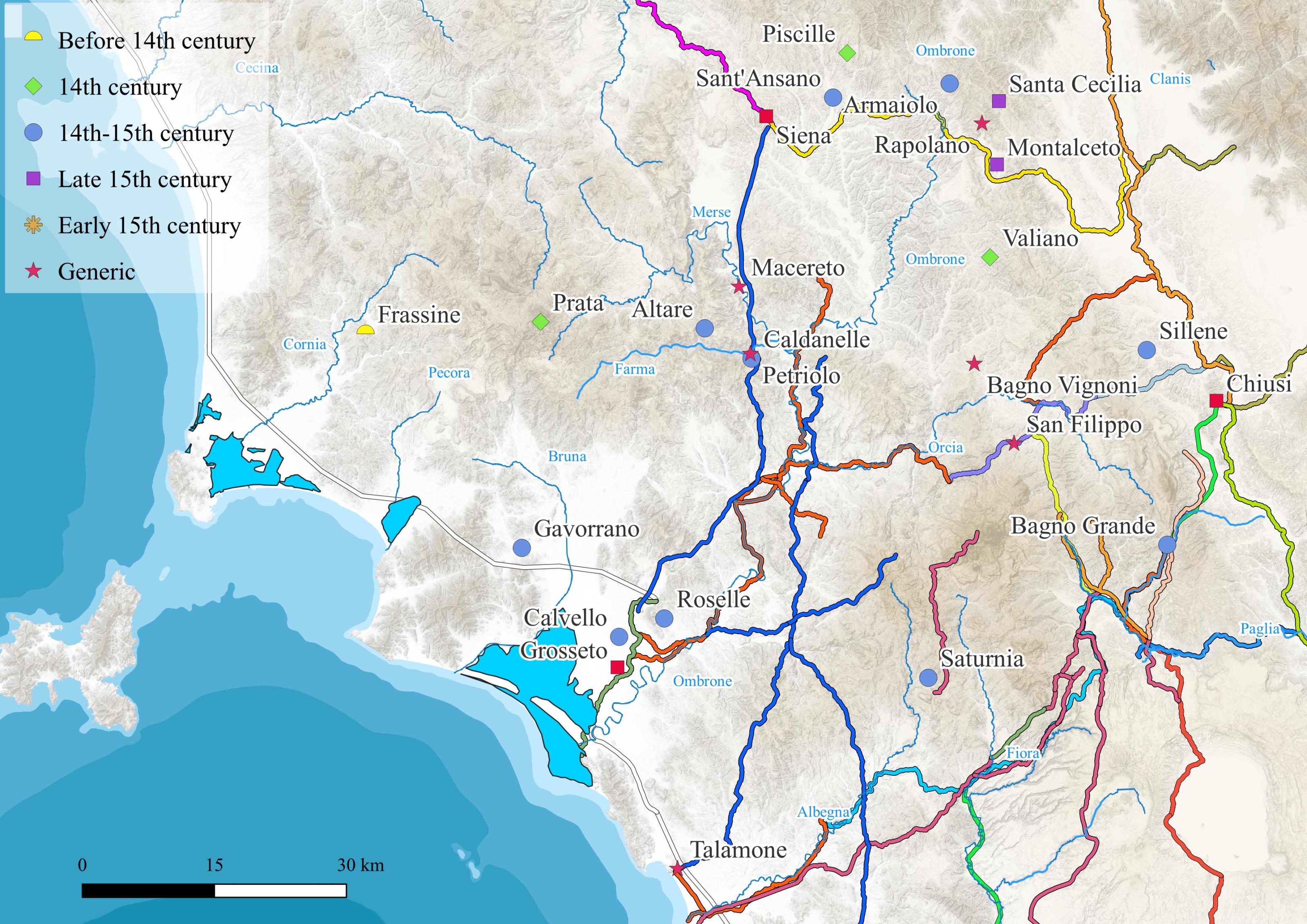
1 | Map showing the main medieval thermal sites of southern Tuscany (elab. E. Vanni).
From the balneum of Rome to the late-medieval public bath, thermal architecture can be approached as an interface of mediation between nature, technology and society – a laboratory of transformation in which the fluid matter of water becomes structure, and technique unfolds as a form of ecology. Water – hot and mineral – is not a passive substance but a generative principle: it orders dwelling, articulates space, and regulates the rhythms of collective life. Within it resides the thermal intelligence of the societies that harnessed it – a constructive and symbolic knowledge that translates natural flux into architectural order. Far from being simple curative enclosures, ancient and medieval baths may be described, in analytical terms, as hydraulic organisms – architectures of circulation where the domestication of water produced not only health but order, turning movement itself into a spatial and social grammar (Annibaletto, Bassani, Ghedini 2014; Bassani, Bolder-Boss, Fusco 2019; Bassani, Tabolli 2024; Becker, Turfa 2017; Chellini 2002; Gonzalez Soutelo 2024; Guérin-Beauvois, Martin 2007; Matilla Séiquer, González Soutelo 2017; Scheid et al. 2015; Routh et al. 1996; Yegül 1992).
In medieval settings, springs and rivers formed a political ecology – a medium where matter, ritual, and power converged. Their therapeutic and symbolic values were inseparable from economic and jurisdictional functions, turning the governance of thermal waters into a technology of place production. In Tuscany, the constellation of thermo-mineral waters along the Farma and Merse valleys produced not simply a geography of baths but an infrastructure of control: a stratified hydro-territory in which the modulation of water mirrored shifts in authority. Managing water here meant calibrating the landscape’s permeability and the circulation of bodies – human and non-human alike – within it. The spring, the conduit, and the bath thus formed a spatial configuration closely tied to jurisdictional practice, an early hydraulic governmentality in which bodily care and territorial administration became indistinguishable (Gelli, Guarducci 2023; Ascheri 1993, 62–66; Boisseuil 2002, 45-52; Farinelli 2007, 73-90).
Across this diffuse hydrographic field, the ‘Caldanelle di Petriolo’ may be regarded as a particularly instructive synthesis of form and function. Situated along the course of the Farma, on the shifting threshold between the Sienese contado and the Maremma, the site represents one tangible expression of the Republic of Siena’s efforts to stabilise and administer thermal resources within a wider territorial order [Fig. 1]. Rather than a mere bathhouse, it operated as a hospitium thermale – a composite layout equipped with pools, lodgings, and service areas. Here, the thermal water entered the very economy of the landscape, sustaining activities such as textile maceration and animal care – practices through which matter, labour, and healing converged (Bellotti et al. 2018, 11-15; Vanni et al. 2022; Vanni et al. 2023; Vanni, Quaglia 2024).
Archaeological and documentary evidence situates the Caldanelle within a broader Sienese hydro-territorial framework – a network of waters, infrastructures, and routes interweaving health, economy, and fiscal taxation (Guarducci 2021, 145–152; Cristoferi 2021, 111-130; Farinelli 2007, 85-88). Along the Farma valley, the relationship between Petriolo, the Caldanelle, and Macereto defines a coordinated thermal micro-system rather than a hierarchy of isolated sites. While Petriolo functioned as a fortified and fiscally controlled centre, and Macereto as a minor node connected to routes and rural activities (Campana 2001, 38, 121-122), the Caldanelle occupied an intermediate position, combining therapeutic, productive, and service-oriented functions. This complementarity suggests a differentiated but coordinated management of hydrothermal assets at regional scale (Arrighetti, Leporini 2023, 253; Arrighetti, Bianchi 2023, 275).
The Caldanelle therefore invites a reading of thermal architecture not as a fixed typology but as an ecological device: a built articulation that turns flow into structure, temperature into language, and pressure into spatial order. Here this logic is legible in the engineered gradients, basins, and drainage features that regulate circulation and sedimentation. In this sense, the bath compound belongs to a long hydraulic continuum in which water operates as a historical agent, shaping built form through routines of movement, maintenance, and mineral deposition.
Historical and Archaeological Framework
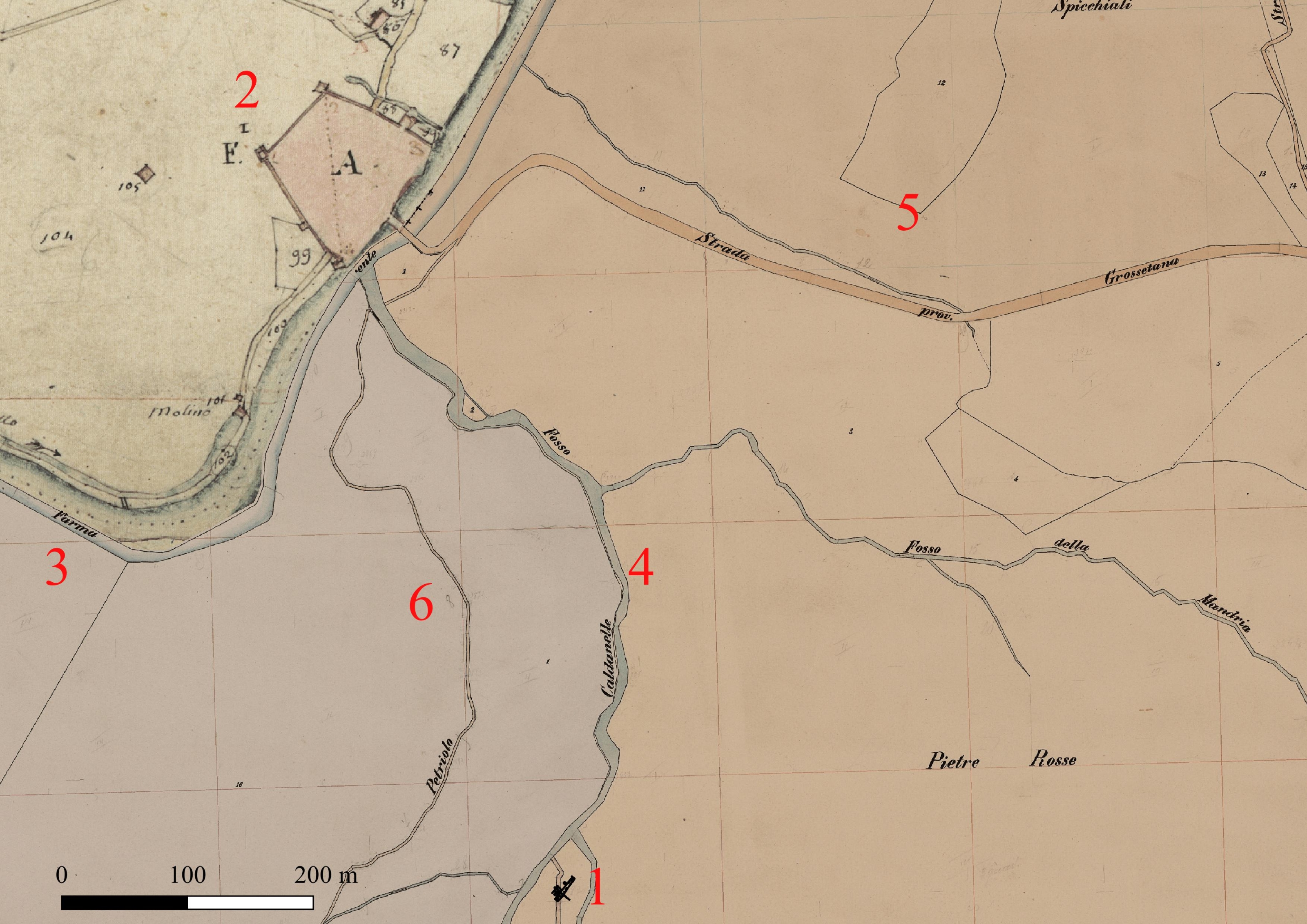
2 | Historical map showing the micro-territorial system centred on the Farma and Merse rivers: no. 1 Caldanelle; no. 2 Petriolo; no. 3 Farma River; no. 4 Caldanelle Stream; no. 5 Road to Grosseto; no. 6 Road to Petriolo (elab. E. Vanni).
The ‘Caldanelle di Petriolo’ lies in the territory of Civitella Paganico, near the medieval castle of Pari, on the fluctuating boundary between the Sienese contado and the Maremma plain. This border zone – traversed by rivers, routes of transhumance, and axes of exchange – formed a mobile landscape, continually reconfigured between the thirteenth and fifteenth centuries by the consolidation of Siena’s territorial state (Dani 2011).
Within this process of civic expansion and administrative rationalization, the control of water – both thermal and fluvial – emerged as a strategic component of policy: not merely for its therapeutic or productive value, but for its capacity to impose form upon the landscape according to fiscal and military logics (Boisseuil 2002, 45-49). Bridges, mills, baths, and springs composed an infrastructural syntax in which healing and profit converged within a single ecology of power.
The earliest record of the thermal spa complex dates to the early fourteenth century, when Donosdeo Malavolti, bishop of Siena, obtained from the Commune permission muris circumponere balnea – “to enclose the baths with walls” – provided that access remained public (Cecchini 1931-1940; Cecchini et al. 1984-1991; Ascheri 1993, 63-65). Behind this administrative clause stands a structural tension between private appropriation and civic regulation. As Boisseuil (2002, 50-54) observes, comparable ordinances were issued across Tuscany to supervise the use of baths and fountains, ensuring both maintenance and taxation.
The Malavolti intervention at the Caldanelle thus prefigures a hydraulic architecture of enclosure, in which construction and administration coincide: masonry becomes an instrument of governance, the wall a device of fiscal measurement. This pattern recurs from the Val di Merse to San Giuliano, where hydraulic protection and social regulation form a single territorial grammar (Boisseuil 2002, 78–82; Gelli, Guarducci 2023, 69-70).
During the fourteenth and fifteenth centuries, the foundation of the Dogana dei Paschi institutionalized this hydraulic rationality, integrating the management of pastures, transhumance, and thermal waters into a unified apparatus of environmental administration (Cristoferi 2021, 111-130; Vanni, Cristoferi 2015; Vanni 2019; Vanni 2025, 253). Situated along the route connecting Pari, Petriolo, and the Farma valley, the Caldanelle occupied a strategic hinge within this system – a thermal and fiscal station where the distribution of water overlapped with the movement of goods, animals, and people. The multiple use of the springs – for human therapy and for animal prophylaxis – situates the Caldanelle at the intersection of civic medicine and pastoral economy, a mixed hygienic–zootechnical regime characteristic of the Sienese hinterland (Cristoferi 2021, 120-123).
Archaeological evidence corroborates this administrative framework. Excavations reveal two principal phases: a fourteenth-century nucleus of service rooms in roughly coursed local limestone bound with lime mortar; and a late-fifteenth-century reconstruction of regular masonry, brick vaults, and a consistent system of drainage and distribution (Bellotti et al. 2018, 15-19). The proximity to the fortified baths of Petriolo, rebuilt after the Malavolti–Siena conflict, suggests a shared typology of thermal fortification (Boisseuil 2002, 78-84; Arrighetti, Leporini 2023, 257). At Petriolo, polygonal walls and guarded gates regulated access to the springs and secured republican revenues; at the Caldanelle, though lacking fortifications, the perimeter wall performed a similar administrative role – delimiting, ordering, and governing the use of water [Fig. 2].
Taken together, textual and material evidence cast the Caldanelle as a strategic node within a wider territorial framework shaped by water infrastructures, where economic, medical, and political logics coalesced into a single apparatus of control. Its architecture embodies the adaptive intelligence of Sienese hydraulic culture, an embodiment of governmentality in which function generates form and form reflects authority. The Caldanelle site is thus not a peripheral episode but a paradigm of the politics of flow: a built negotiation between architecture and power in the thermal ecologies of medieval central Italy.
The Ecology of Architecture
The architectural evolution of the ‘Caldanelle di Petriolo’ encapsulates the complex interaction between natural resources, building practices, and social functions within the landscape of southern Tuscany between the fourteenth and seventeenth centuries. Far from representing a secondary dependency of the nearby baths of Petriolo, the Caldanelle constituted an autonomous and functional organism, conceived to combine hydrothermal exploitation, hospitality, and productive activity.
Archaeological traces point to an even earlier phase preceding the fourteenth century: modest wall remains and primitive drainage alignments adapted to the natural slope of the hill. This proto-architectural nucleus – perhaps an open collecting basin – was later monumentalized through the walled enclosure granted to Donosdeo Malavolti, when the act of muris circumponere balnea translated hydraulic management into architectural form. The enclosure itself materialised a shift from open use to regulated access, turning the bath into an infrastructural mechanism of control and maintenance [Fig. 3].
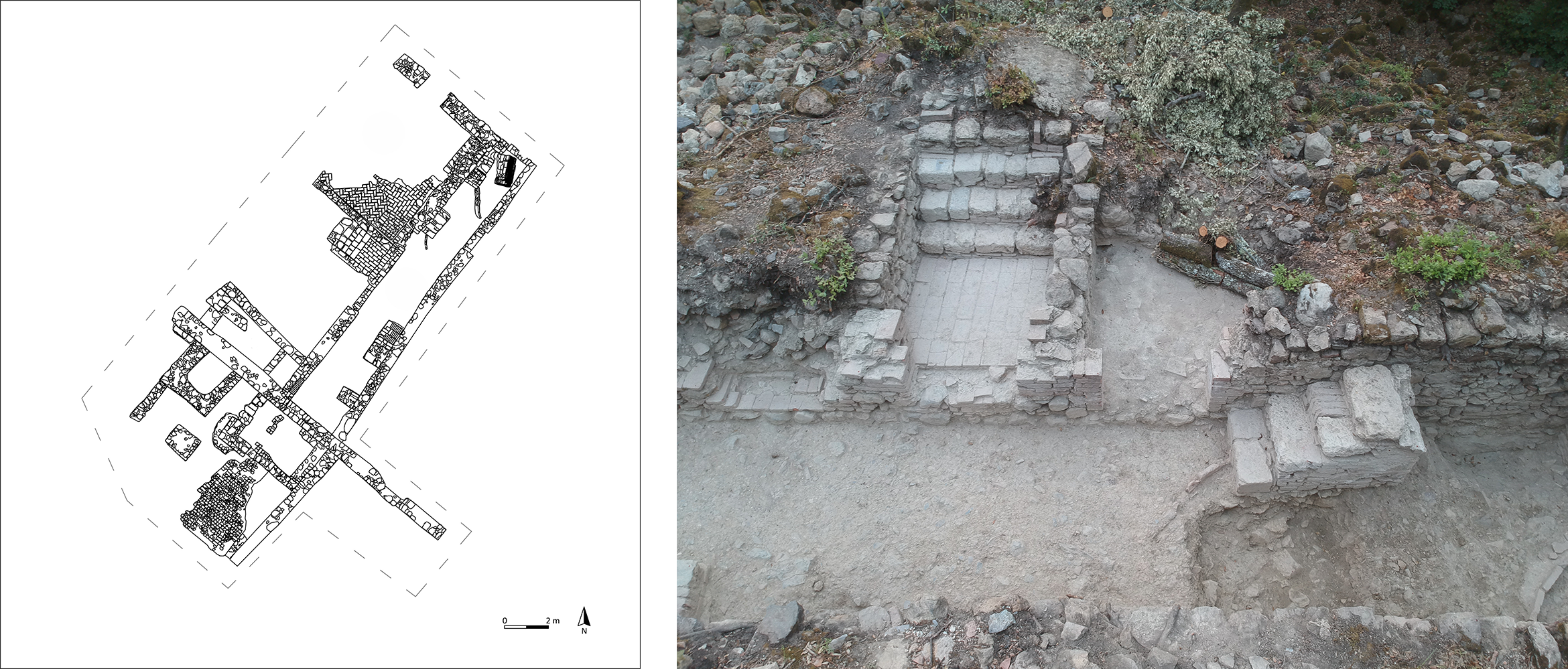
3 | Plan of the excavated area of the thermal site of the Caldanelle di Petriolo (elab. E. Vanni).
4 | View of the corridor with the staircase leading to the upper floors (drone photo by the author).
The early fourteenth-century structures were built in local limestone laid in irregular courses with lime mortar – a vernacular technology already hybridized by hydraulic intent. Inclined pavements sloped toward the stream, covered with waterproof plasters of lime, sand, and crushed pottery, reveal a deliberate grammar of flow control and mineral management, analogous to that observed at San Filippo and Radicondoli. Between the late fifteenth and early sixteenth centuries, the compound was restructured under the influence of the Malavolti family and of Pandolfo Petrucci’s Sienese renewal. The Caldanelle was reconceived as a compact structured ensemble – a hybrid assemblage of curative, domestic, and productive functions. The masonry of this phase, alternating squared limestone and brick ribs in opus latericium mixtum, echoes the syntax of Sienese urban palaces (Balestracci 2003; Arrighetti, Bianchi 2023, 280). The internal articulation of this phase further reveals a conscious reorganization of circulation and access. The presence of a corridor aligned along the longitudinal axis, together with the remains of a staircase leading to an upper level, indicates a deliberate attempt to structure the complex vertically, transforming the bath into a multi-level organism where water, heat, and movement were hierarchically distributed [Fig. 4]. The obliteration of the main entrance and the raising of the interior floors – perhaps following an unforeseen event such as an earthquake or a flood – suggest an adaptive response to environmental instability, in which repair and reconfiguration became part of the site’s ecological metabolism. In this sense, the complex of the Caldanelle does not merely endure natural perturbations; it can be interpreted as a self-correcting system, capable of absorbing instability and converting disturbance and crisis into spatial reconfiguration. The convergence of these domains within a unified constructive scheme confirms the thermal complex as a hybrid organism (Bellotti et al. 2018, 15-22; Vanni 2025, 256).
The seventeenth century marked a new phase of adaptation following the fall of the Republic of Siena and the establishment of Medicean administration. Structural repairs using spolia of stone, brick, and ceramic record a ruralization of the thermal space, its conversion from hospitium to storage and shelter. Analogous processes occurred at San Giovanni in Val d’Orcia and at minor baths in Languedoc and Provence, gradually reabsorbed into agrarian economies after the sixteenth century (Boisseuil 2002, 117-121; Perez Agorreta, Alaix i Miró 2017). Yet the Caldanelle preserved the integrity of its hydro-architectural system: vaults, plasters, and conduits endure as the anatomical traces of a resilient environmental design.
Ultimately, the ‘Caldanelle di Petriolo’ articulates a genuine ecology of architecture, where matter, energy, and human practice cohere within a continuous cycle of transformation. Across three centuries, the complex evolved from a utilitarian ensemble into a sophisticated spatial metabolism guided by environmental intelligence. The correspondence between hydraulic technique, architectural configuration, and social function reveals how medieval and Renaissance builders conceived the bath not as a monument but as a dynamic architectural apparatus – a spatial configuration emerges from the negotiation between geological energy, material resistance, and social function. In this sense, the Caldanelle offers a compelling case of adaptive thermal architecture, where the flow of water is not merely contained but converted into a generative principle of architectural thought itself [Fig. 5].
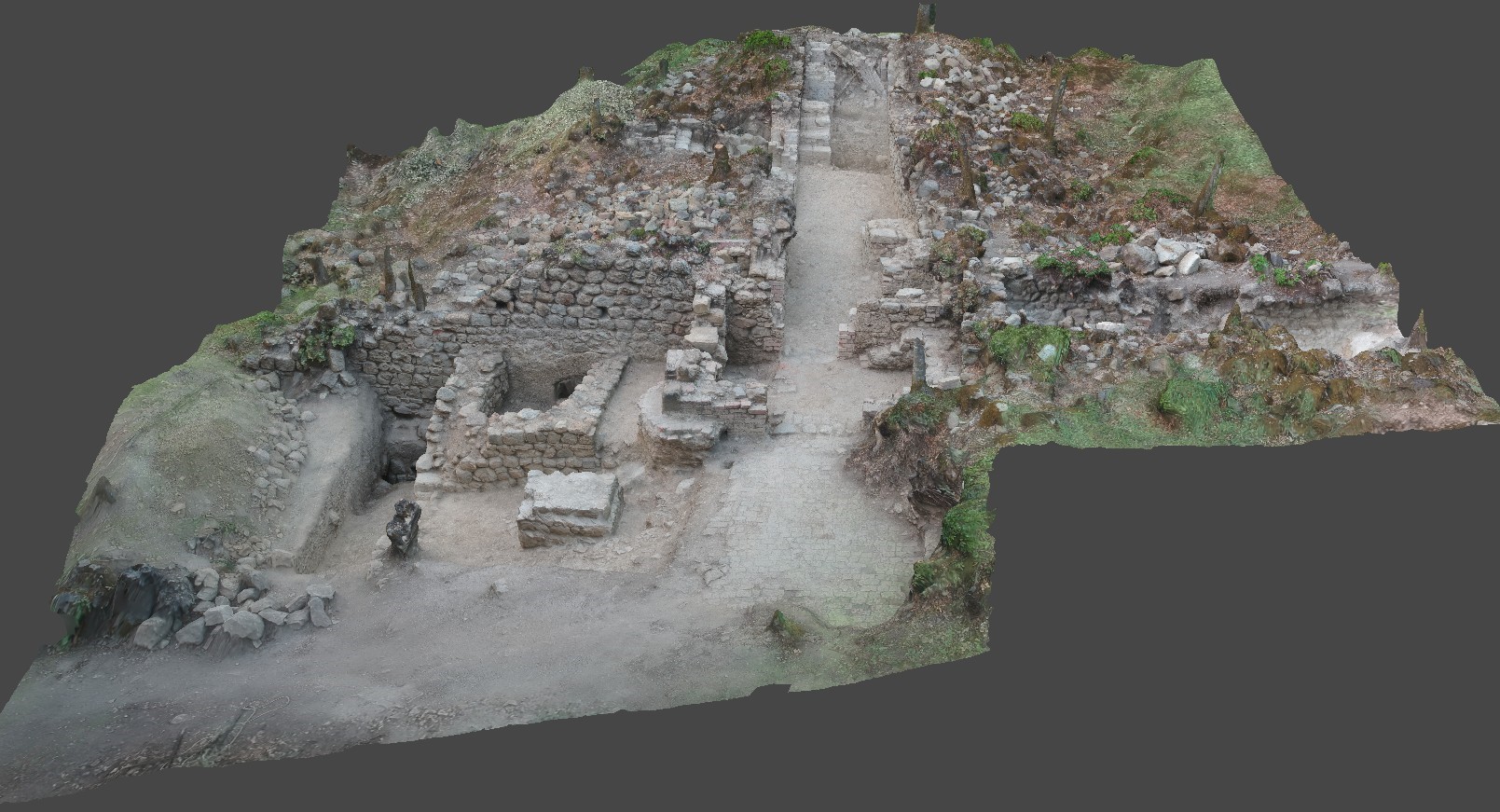
5 | View of the 3D model of the site from the south, showing the entrance and the multi-level layout adapting to the slope of the hillside (elab. E. Vanni).
Comparable adaptive strategies can be observed across a broader European horizon. Comparison is used as an interpretative device to isolate recurrent constraints – hydrothermal resources, mobility, governance, and patterns of use – and to assess how different sites translated them into spatial organisation, building solutions, and regimes of access. The Caldanelle is therefore brought into selective dialogue with contexts that either share close geo-historical conditions or foreground comparable functional problems, while longer-range parallels are invoked only to clarify specific architectural or technical choices.
Within central Italy, Bagno Vignoni offers a particularly useful reference for the spatial coupling of bathing and hospitality, whereas Viterbo provides a comparative lens for access regulation and the articulation of thermal infrastructures as part of a broader urban and territorial framework. San Casciano dei Bagni, in turn, highlights the persistence and reconfiguration of thermal practices over the longue durée, showing how bathing spaces could be reoccupied, redefined, and materially renegotiated from Antiquity through the medieval and early modern periods (Mariotti, Salvi, Tabolli 2023; Mariotti, Salvi, Tabolli 2025). Beyond Italy, the multilayered residential bath typologies of Buda (Pintér et al. 2011) and the progressive domestication of the springs at Bath (Borsay 2000, 17-25) are mobilised as functional points of comparison, rather than as genealogical models. Likewise, selected cases from Catalonia and Provence (Cifuentes, Carré 2007; Gordon 2012) help frame specific constructional and hydraulic solutions – mixed masonry, lime-lined conduits, and maintenance regimes – within a wider technical repertoire that remained available well beyond its Roman and Late Antique antecedents (Les thermes romains 1991; Adam 1994, 211-215; Ginouvès et al. 1994; Guérin-Beauvois 2015).
What emerges is not a typology of thermal sites, but a range of mixed-use configurations, in which bathing, hospitality, labour, and governance intersect in different proportions. Read against this range, the Caldanelle appears as a locally specific solution – shaped by the Farma valley setting and by Sienese territorial administration – rather than as an exceptional or marginal anomaly.
Material Culture and Hydraulic Habitus
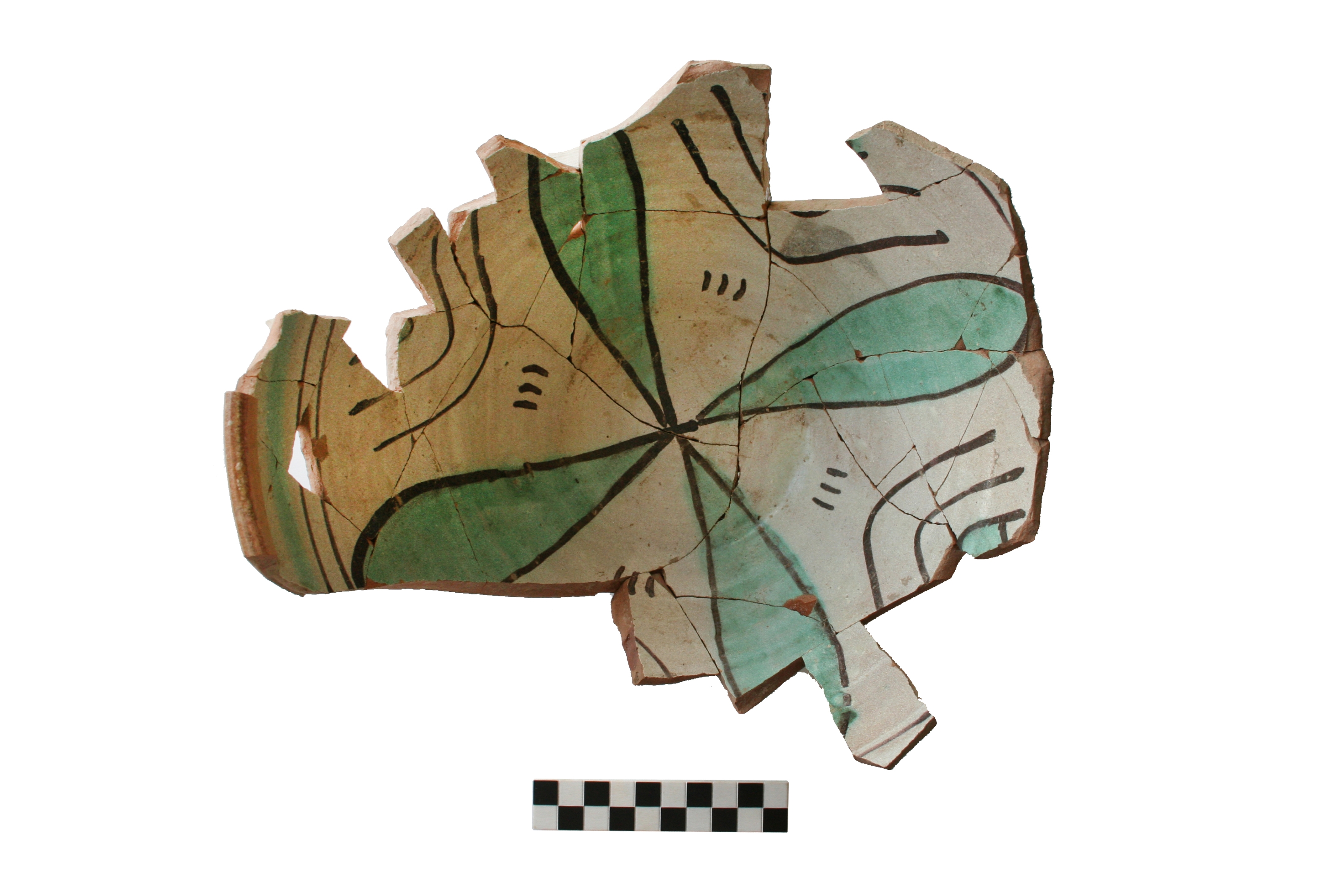
6 | Archaic maiolica: truncated conical bowl decorated with a pattern of lanceolate leaves alternating with stylised flowers (photo by C. Barbafiera, D. Quaglia).
The material culture unearthed at the ‘Caldanelle di Petriolo’ reveals the intricate weave binding architecture, function, and water use. The distribution of ceramics, glass, metal, and bioarchaeological remains mirrors the vertical articulation of the complex, allowing the Caldanelle to be reconstructed as a dynamic environment in which water, matter, and human practice were structurally entangled. Ceramics – abundant and functionally eloquent – span a chronological arc from the fourteenth to the seventeenth century. Their typology, manufacturing, and finishing techniques correspond precisely to the architectural zones in which they were found. In the lower rooms facing the watercourse, equipped with channels and plastered basins, utilitarian forms prevail: jugs, small amphorae, and bowls in local red clay, many encrusted with carbonates from prolonged contact with mineralized water. Within the same operational sphere appear small bowls, mortars, and unglazed cups – sometimes fire-altered – linked to the preparation of ointments, infusions, and medicinal clays. Comparative contexts from domestic and medical sites in central Italy confirm the coexistence of therapeutic and artisanal practices (Mariotti, Salvi, Tabolli 2023). In this sense, plastered surfaces, drains, and basins emerge not as mere constructive elements but as operative instruments through which the material culture of care was enacted and circulated.
In the upper, drier, and more monumental sectors, the assemblage shifts. Fine tableware appears – maiolica arcaica, graffita, ingobbiata wares, and later Montelupo productions – adorned with vegetal and geometric motifs in blue, markers of conviviality and refined hospitality aligned with the social practices of late medieval Tuscan thermal culture (Berti 1997, 117-124; Fig. 6).
Their association with hearths, heating systems, and paved courtyards confirms the existence of spaces dedicated to dining and reception: the Caldanelle thus materialises as a multi-functional hospitium thermale, where medical service and domestic refinement interpenetrated in a carefully calibrated balance already defined by the fifteenth century. To this material dimension may be added the hypothesis of a cenobitic or charitable presence tied to the site’s administration – perhaps small monastic or confraternal groups devoted to the care of travellers and the sick. The conjunction of table ceramics, ointment containers, and everyday utensils strengthens this reading of the Caldanelle as a micro-assistential organism, poised between devotion, healing, and labour, in continuity with the hospitalia aquarum that punctuated the thermal landscapes of central Italy (Boisseuil 2002, 78-84; Guèrin-Beauvois, Martin 2007).
Glass artefacts, though fewer, are equally revealing. Thin beakers, flasks, and small bottles in colourless or pale-green glass – sometimes with a milky translucence (lattimo) – attest to a material culture of refinement and hygiene. Their typology recalls Venetian and Tuscan productions of the fifteenth century (Guidotti 1991, 167-168). Found together with coins from the late fifteenth and early sixteenth centuries, they mark the apogee of the site’s occupation and evoke an urbane clientele embedded in Sienese mercantile networks. As at Bath and Aachen, fine glassware accompanied ritualized practices of water consumption, carrying symbolic connotations of purity and social distinction (Borsay 2000, 23–27).
Metal artefacts and hydraulic fittings attest to a technical sophistication consistent with the site’s environmental intelligence. Iron nails, hinges, and bronze fragments correspond to structural maintenance phases, while lead and copper-alloy pipes, recovered near conduits, reveal an advanced system of supply and drainage. Corrosion patinas and mineral deposits on their surfaces record prolonged exposure to sulphurous water, analogous to patterns observed in Roman and medieval baths across central Italy (Adam 1994, 211-215). This evidence speaks to continuous technical care: the regulation of circulation, temperature, and mineral sedimentation as architectural agents. The bioarchaeological record, in turn, restores the site’s living dimension. Faunal remains reveal a predominance of ovicaprines and cattle, with butchery marks indicating both consumption and craft uses such as tanning and bone-working; marine shells and burnt bones suggest food preparation for residents and travellers alike. Pollen and plant macro-remains attest to cereals, vines, and legumes – traces of a mixed agrarian economy typical of the Sienese contado (Salvadori 2003).
Read spatially, the stratigraphy of materials reproduces the architectural hierarchy: the damp lower sectors yield coarse ceramics, faunal debris, and iron tools linked to service and craft areas; the vaulted residential zones concentrate fine wares, glass, and coinage associated with sociability and consumption; the upper service spaces contain utilitarian ceramics tied to storage and processing. This is not a random layering of “strata,” but a functional order inscribed in climate – a logic of humidity, temperature, and access embedded in the architecture itself. Rather than a passive container, the Caldanelle operated as a hydraulic system whose spatial configuration and daily rhythms were continuously shaped by the management, maintenance, and failure of hydraulic circuits.
This co-productive relation between built form and material culture defines, in the fullest sense, a hydraulic habitus – a cultural adaptation to existence within a thermal ecosystem, where architecture does not merely host curative practice but modulates its duration, intensity, and thresholds according to the physics of water. The alternation of humid and dry, hot and temperate, public and secluded zones reproduces the rhythms of the spring itself. Matter – ceramic, glass, metal – does not simply record use; it participates in the production of hybrid space and meaning. The Caldanelle thus provides a particularly informative case for discussing medieval architectural ecology, where the boundaries between natural and artificial, functional and symbolic, dissolve into the daily negotiation of hydraulic dynamics.
The production of multiple places
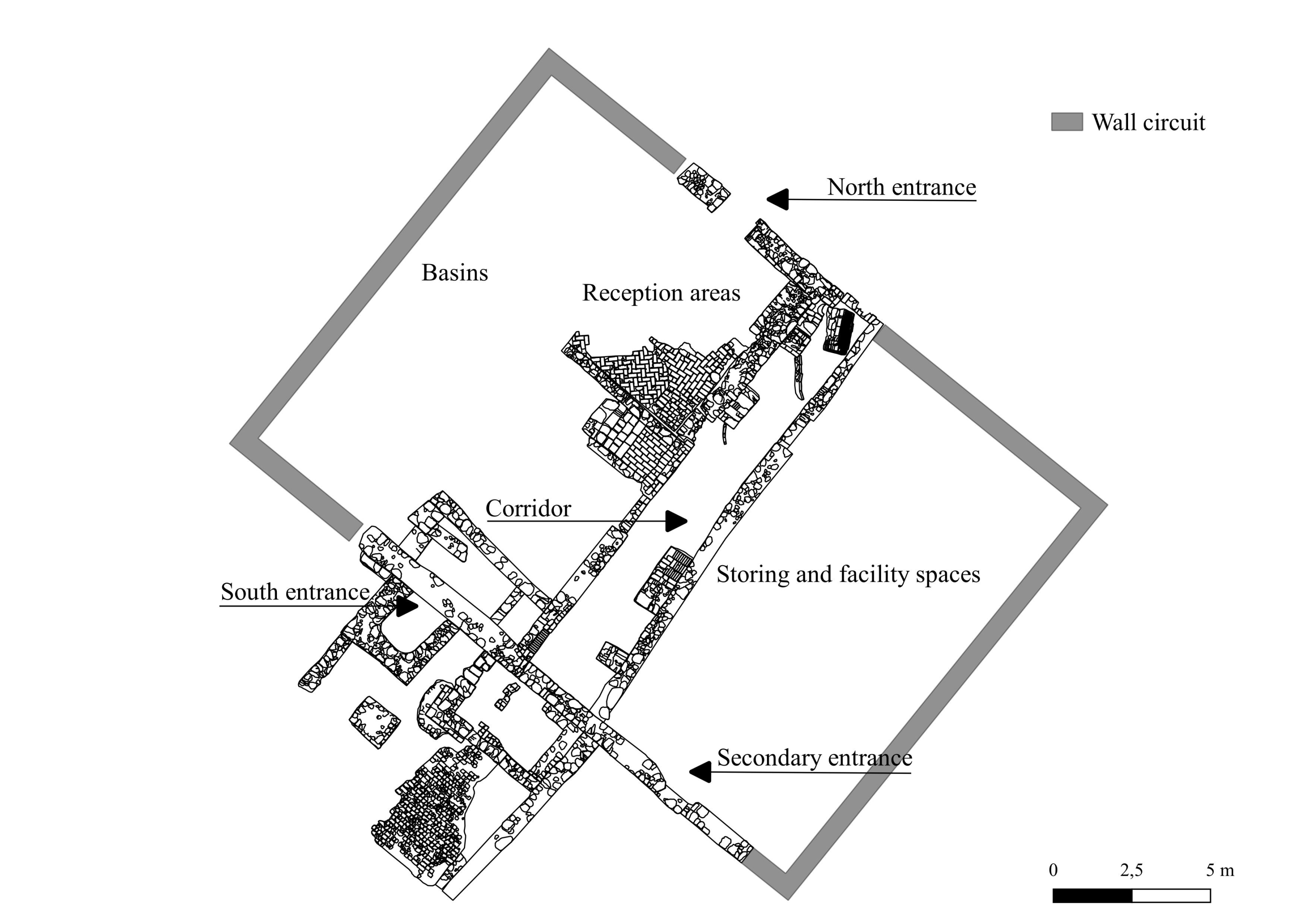
7 | Map showing the spatial organisation of the complex (elab. E. Vanni).
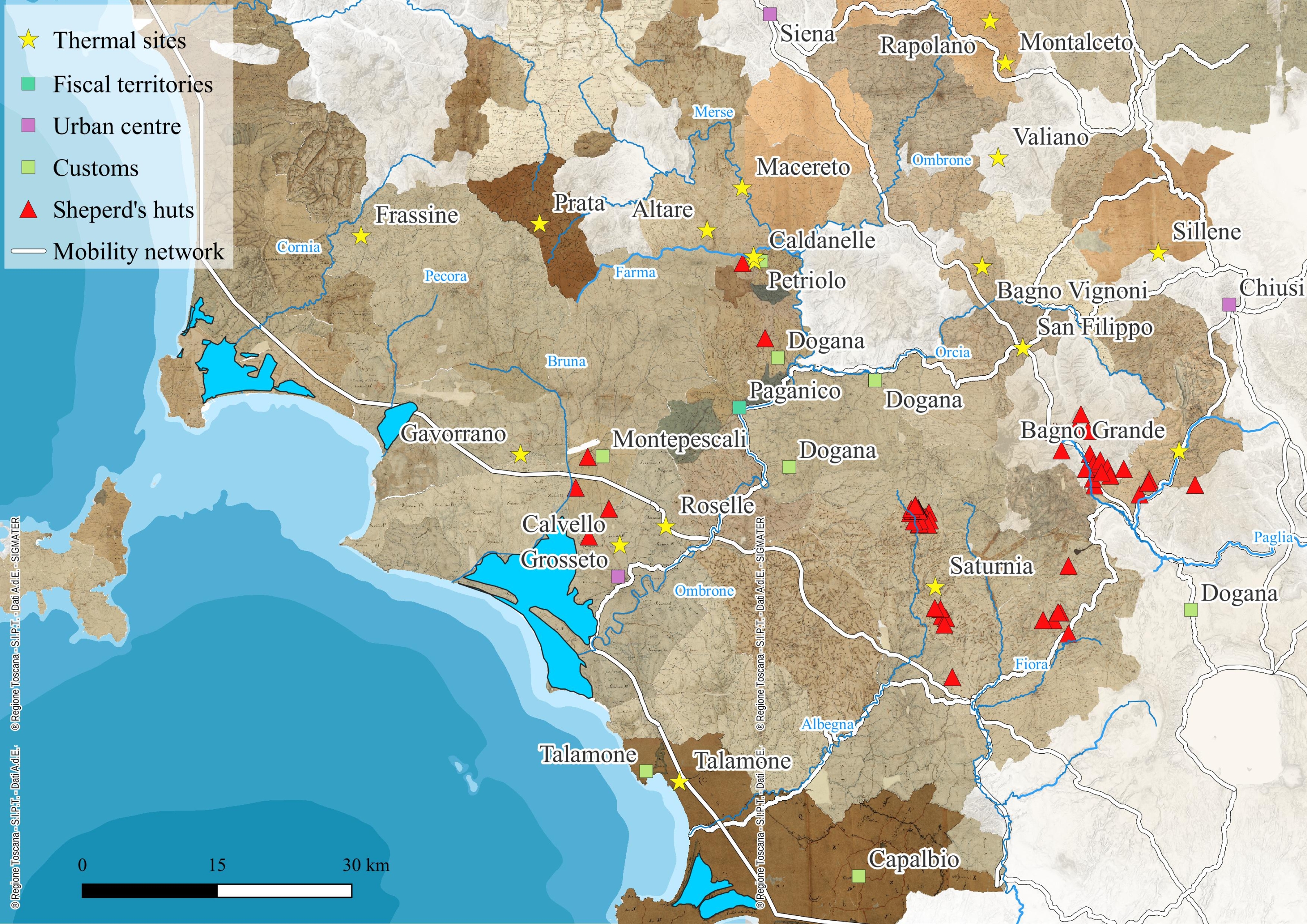
8 | Customs and fiscal organisation of the Sienese territory within the local micro-mobility network (elab. E. Vanni).
The ‘Caldanelle di Petriolo’ emerge as a genuine instance of environmental design ante litteram – an experiment in the coupling of geothermal energy, everyday life, and landscape, where thermal architecture becomes not merely a response to function but a medium of social, and ecological order (Guarducci 2014). Yet the making of the Caldanelle place is not solely vertical – organized by humidity, temperature, and access – but also horizontal, extending through the landscape and the topography of the Farma valley. The alignment of the buildings along the stream mirrors a wider hydrographic rhythm in which spring, river, and mobility converge into a single continuum of movement [Fig. 7].
Archaeological, documentary, and environmental evidence together depict the Caldanelle as a nodal point, connecting Siena to its Maremma coastal plain through a dynamic system of mobility, fiscal control, and public health. As has been already observed (Vanni 2024, 59), this network should be understood not merely as administrative apparatus but as a living geography – an ecological infrastructure in which the circulation of waters and the mobility of bodies, human and non-human alike, actively produced innovative space and layered forms of governance. The thermal setting thus functions as an expanded architecture, where the same hydraulic logic that organizes the distribution of rooms also regulates the courses of rivers and the mobility of flocks and travellers.
In this sense, the Caldanelle ecology operated simultaneously as architectural and territorial device: the gravitational descent of hot water within the building echoed the seasonal descent of herds and wayfarers along the transhumance routes – a hydraulic isomorphism between construction and landscape. Located along these pastoral corridors, the site was inscribed in the fiscal and ecological system of the Dogana dei Paschi, where thermal springs served as stations of rest and prophylaxis for livestock. Recent studies confirm the diffusion of animal bathing practices across Tuscan thermal contexts – from the Maremma to the Val di Merse and along the Paglia valley – where hot waters were harnessed for hygiene and veterinary care as well as economic purposes (Vanni 2024). This phenomenon, entwining animal mobility, empirical knowledge, and architectural adaptation, clarifies the dual vocation of the Caldanelle: a locus of healing and of labour, a node in a thermal economy uniting human medicine with agro-pastoral productivity (Vanni, Quaglia 2024).
Following the fall of the Republic of Siena and the site’s absorption into the Medicean agricultural order, the Caldanelle underwent a gradual ruralization. This was not abandonment but transformation – an architectural metabolism adapting to new economic ecologies (Vanni 2024, 59-62). The thermal buildings were repurposed for agrarian use, yet the traces of their hydraulic intelligence remained legible: enduring evidence of a resilient system capable of translating social and environmental change into form.
Unlike the monumental complexes of San Casciano dei Bagni or Bagno Vignoni, the Caldanelle articulate a model of ecological adaptation, where scale and typology respond precisely to the local conditions of the Farma valley and to the interweaving of domestic life with resource management (Tabolli 2023; Mariotti, Salvi, Tabolli 2025). Given their geo- and hydrographic configuration, the Caldanelle, together with Petriolo and Macereto, must have formed a system of management and administration within the hydro-territorial landscape [Fig. 8]. In a broader European context, from Viterbo to Buda to Bath, a shared architectural grammar of thermalism emerges: the governance of water, the ritual of cure, and the control of hybrid space as instruments of distinction and social order (Ditaranto, Scardozzi 2016, 115-120; Borsay 2000, 23-29).
The Caldanelle site, though more modest in scale, embodies the same conception of thermal architecture as a medium between care, sociability, and power – an interlinked system of public health, economy, and ecology.
Ultimately, the ‘Caldanelle di Petriolo’ stands as a paradigm of eco-architectural hybridity, where architecture, hydrology, and society form a continuous negotiation between nature and design. Their spatial logic – vertical in construction, horizontal in landscape – allows us to recognize an early form of environmental intelligence, where the management of water generates form, use, and meaning.
Bibliography
- Adam 1994
J.-P. Adam, Roman Building. Materials and Techniques, London-New York 1994. - Annibaletto, Bassani, Ghedini 2014
M. Annibaletto, M. Bassani, F. Ghedini (a cura di), Cura, preghiera e benessere. Le stazioni curative termominerali nell’Italia antica, Padova 2014. - Arrighetti, Bianchi 2023
A. Arrighetti, G. Bianchi, Evidenze archeologiche nell’area del piazzale antistante la chiesa di S. Maria, in A. Paolella (a cura di), Bagni di Petriolo. Restauro e valorizzazione, vol. 3, Firenze 2023, 273-288. - Arrighetti, Leporini 2023
A. Arrighetti, R. Leporini, La chiesa e le terme ‘antiche’ di Petriolo: nuovi dati dall’analisi archeologica delle architetture, in A. Paolella (a cura di), Bagni di Petriolo. Restauro e valorizzazione, vol. 3, Firenze 2023, 253-271. - Ascheri 1993
M. Ascheri, L’ultimo statuto della Repubblica di Siena (1545), Siena 1993. - Balestracci 2003
D. Balestracci, Il controllo delle acque nel territorio senese tra XIII e XV secolo, in E. Crouzet-Pavan (ed.), Pouvoir et édilité. Les grands chantiers dans l’Italie communale et seigneuriale, Rome 2003, 419-438. - Bassani, Bolder-Boss, Fusco 2019
M. Bassani, M. Bolder-Boss, M. Fusco (eds.), Rethinking the Concept of “Healing Settlements”. Cults, Constructions and Contexts close to Springs in the Ancient World, Oxford 2019. - Bassani, Tabolli 2024
M. Bassani, J. Tabolli (a cura di), Archaeology of Thermalism. New Studies on Healing Waters. Monographic issue, “La Rivista di Engramma” 214 (luglio 2024). - Becker, Turfa 2017
M.J. Becker, J.M. Turfa, The Etruscans and the History of Dentistry, London 2017. - Bellotti et al. 2018
A. Bellotti, A. Marcocci, E. Vanni, D. Quaglia, R. Farinelli, D. Boisseuil, M. De Benetti, L’albergo delle Caldanelle di Petriolo tra XIV e XVIII secolo. Contributo all’archeologia del termalismo in area senese, “Facta. A Journal of Roman Material Culture Studies” 12 (2018), 11-50. - Berti 1997
G. Berti, La maiolica arcaica toscana. Produzione e diffusione, Firenze 1997. - Boisseuil 2002
D. Boisseuil, Le thermalisme en Toscane à la fin du Moyen Âge. Les bains siennois de la fin du XIIIe siècle au début du XVIe siècle, Roma 2002. - Borsay 2000
P. Borsay, The Image of Georgian Bath, 1700-2000. Towns, Heritage, and History, Oxford–New York 2000. - Campana 2001
S. Campana, Carta Archeologica della provincia di Siena. Murlo. Vol. V, Siena 2001. - Carré, Cifuentes 2017
A. Carré, L. Cifuentes, Los Baños en la literatura catalana medieval durante los siglos XIV y XV, in A. López Castro, M. Luzdivina Cuesta Torre (eds.), Actas del XI Congreso internacional de la asociación Hispánica de literatura medieval, Universidad de León 2007, 395-403. - Cecchini 1931-1940
G. Cecchini (a cura di), Il Caleffo Vecchio del Comune di Siena, voll. 1-3, Siena 1931-1940. - Cecchini et al. 1984-1991
G. Cecchini, M. Ascheri, A. Forzini, C. Santini (a cura di), Il Caleffo Vecchio del Comune di Siena, voll. 4-5, Siena 1984-1991. - Chellini 2002
R. Chellini, Acque sorgive, salutari e sacre in Etruria (Italiae Regio VII). Ricerche archeologiche e di topografia antica, Oxford 2002. - Cristoferi 2021
D. Cristoferi, Statuti della Dogana dei Paschi di Siena del 1419 e del 1572, Siena 2021. - Dani 2011
A. Dani, Profili giuridici del sistema senese dei pascoli tra XV e XVIII secolo, in A Mattone, P. Simbula (a cura di), La pastorizia mediterranea. Storia e diritto (secoli XI-XX), Roma 2011, 254-275. - Ditaranto, Scardozzi 2016
I. Ditaranto, G. Scardozzi, Gli impianti termali lungo la via Cassia presso Viterbo: nuovi dati per la conoscenza dei singoli contesti e per la ricostruzione della topografia antica dell’area, “Journal of Ancient Topography” 26 (2016), 75–158. - Farinelli 2007
R. Farinelli, I castelli nella Toscana delle città ‘deboli’. Dinamiche del popolamento e del potere rurale nella Toscana meridionale (secoli VII–XIV), Firenze 2007. - Gelli, Guarducci 2023
B. Gelli, A. Guarducci, La Via Consolare Grossetana e i ponti di Macereto e di Petriolo tra Medioevo ed Età contemporanea, in A. Paolella (a cura di), Bagni di Petriolo. Restauro e valorizzazione, vol. 3, Firenze 2023, 69-110. - Ginouvès et al. 1994
R. Ginouvès, A.-M. Guimier-Sorbets, J. Jouanna, L. Villard (eds.), L’eau, la santé et la maladie dans le monde grec, Paris 1994. - Giontella 2012
C. Giontella, “…nullus enim fons non sacer…”. Culti idrici di epoca preromana e romana (Regiones VI–VII), Pisa-Roma 2012. - González Soutelo 2024
S. González Soutelo (ed.), Thermalism in the Roman Provinces. The Role of Medicinal Mineral Waters across the Empire, Oxford 2024. - Gordon 2012
B.M. Gordon, Reinventions of a spa town: the unique case of Vichy, “Journal of Tourism History” 4/1 (2012), 35-55. - Guarducci 2014
A. Guarducci, Per una geostoria del termalismo toscano: dagli abbandoni ai casi di recupero e valorizzazione tra fine Novecento e oggi, "Geotema" 60 (2014), 34-43. - Guarducci 2021
A. Guarducci, Le terme della Toscana dal medioevo ad oggi. Storia e beni culturali, Firenze 2021. - Guérin-Beauvois, Martin 2007
M. Guérin-Beauvois, J.-M. Martin (eds.), Bains curatifs et bains hygiéniques en Italie de l’Antiquité au Moyen Âge, Roma 2007. - Guidotti 1991
A. Guidotti, Appunti per una storia della produzione vetraria a Firenze e del suo territorio pre-cinquecentesca, in M. Mendera (a cura di), Archeologia e Storia della produzione del vetro preindustriale. Atti del Convegno Internazionale L’attività vetraria medievale in Valdelsa ed il problema della produzione preindustriale del vetro: esperienze a confronto (Colle Val d’Elsa-Gambassi 2-4 aprile 1990), Firenze 1991, 161-175. - Les thermes romains 1991
Les thermes romains. Actes de la table ronde organisée par l’École française de Rome (Rome, 11-12 novembre 1988), Roma 1991. - Mariotti, Salvi, Tabolli 2023
E. Mariotti, A. Salvi, J. Tabolli (a cura di), Il Santuario ritrovato 2. Dentro la vasca sacra. Rapporto preliminare di scavo al Bagno Grande di San Casciano dei Bagni, Livorno 2023. - Mariotti, Salvi, Tabolli 2025
E. Mariotti, A. Salvi, J. Tabolli (a cura di), Il Santuario ritrovato 3. Oltre il bronzo. Rapporto preliminare di scavo (2023-2024) al Bagno Grande di San Casciano dei Bagni, Livorno 2025. - Matilla Séiquer, González Soutelo 2017
G. Matilla Séiquer, S. González Soutelo (eds.), Termalismo antiguo en Hispania. Un análisis del tejido balneario en época romana y tardorromana en la Península Ibérica, Madrid 2017. - Perez Agorreta, Alaix i Miró 2017
M. J. Perez Agorreta, C. Alaix i Miró (eds.), Ubi aquae ibi salus. Aguas mineromedicinales, termas curativas y culto a las aguas en la Península Ibérica (desde la Protohistoria a la Tardoantigüedad), Madrid 2017. - Pintér et al. 2011
F. Pintér, J. Weber, B. Bajnóczi, M. Tóth, Brick-lime mortars and plasters of a sixteenth-century Ottoman bath from Budapest, Hungary, in I. Turbanti-Memmi (ed.), Proceedings of the 37th International Symposium on Archaeometry, Berlin-Heidelberg 2011, 293-298. - Routh et al. 1996
H.B. Routh, K.R. Bhowmik, L.C. Parish, J.A. Witkowski, Balneology, mineral water, and spas in historical perspective, “Clinics in Dermatology” 14/6 (1996), 551-554. - Salvadori 2003
F. Salvadori, Archeozoologia e Medioevo: lo stato degli studi, in R. Fiorillo, P. Peduto (a cura di), III Congresso Nazionale di Archeologia Medievale (Salerno, 2–5 ottobre 2003), Firenze 2003, 176-181. - Scheid et al. 2015
J. Scheid, M. Nicoud, D. Boisseuil, J. Coste (eds.), Le thermalisme. Approches historiques et archéologiques d’un phénomène culturel et médical, Paris 2015. - Tabolli 2023
J. Tabolli, The Etrusco-Roman thermo-mineral sanctuary of Bagno Grande at San Casciano dei Bagni (Siena): aims and perspectives ‘behind-the-scenes’ of ongoing multidisciplinary research project, “Folder-it” 556 (2023). - Vanni, Cristoferi 2019
E. Vanni, D. Cristoferi, The role of marginal landscapes for understanding transhumance in postmedieval Central Italy: integrating ethnoarchaeology and historical perspective, in E. Costello, E. Svensson (eds.), Historical Archaeologies of Transhumance across Europe, London 2019, 197-218. - Vanni 2019
E. Vanni, Sistemi agro-silvo-pastorali nella Toscana meridionale. Tra archeologia e trasformazioni, in S. Bertoldi, M. Putti, E. Vanni (a cura di), Archeologia e storia dei paesaggi senesi. Territorio, risorse, commerci tra età romana e medioevo, Firenze 2019, 87-112. - Vanni 2024
E. Vanni, Of souls and animals. Healing properties of hot springs and livestock economies, “La Rivista di Engramma” 214 (luglio 2024), 59-84. - Vanni 2025
E. Vanni, Nuove geografie termali. Quando il monopolio dell’acqua calda diventa ‘fonte’ di potere, in E. Mariotti, A. Salvi, J. Tabolli (a cura di), Il Santuario ritrovato 3. Oltre il bronzo. Rapporto preliminare di scavo (2023–2024) al Bagno Grande di San Casciano dei Bagni, Livorno 2025, 253-268. - Vanni et al. 2022
E. Vanni, B. Baleani, C. Barbafiera, M. Fronteddu, D. Quaglia, L’Espai Termal de les Caldanelle (Civitella Paganico – Grosseto). Noves perspectives per al termalisme medieval, “Rodis. Journal of Medieval and Post-Medieval Archaeology” 5 (2022), 231-248. - Vanni et al. 2023
E. Vanni, B. Baleani, C. Barbafiera, M. Fronteddu, D. Quaglia, Il Bagno delle Caldanelle, in A. Paolella (a cura di), Bagni di Petriolo. Restauro e valorizzazione, vol. 3, Pisa 2023, 211-232. - Vanni, Quaglia 2024
E. Vanni, D. Quaglia, “Il sito termale delle Caldanelle (Civitella Paganico, GR)”, in G. Baldini, A. Marcocci, V. Delsegato, M. Milletti (a cura di), Gli Etruschi di Casenovole. Passato remoto di una comunità, Pisa 2024, 295-301. - Yegül 1992
F. Yegül, Baths and Bathing in Classical Antiquity, New York-Cambridge (MA) 1992.
Abstract
The ‘Caldanelle di Petriolo’ is a medieval thermal site on the Farma River, part of the Mount Amiata hydrothermal district in southern Tuscany. It provides an exceptional archaeological context for examining “hybrid space” as the interplay of architectural design, hydrothermal technology, and social practice. Excavations document an articulated built ensemble whose layout and uses evolved between the fourteenth and seventeenth centuries. Rather than a marginal annex to the nearby baths of Petriolo, the Caldanelle appears as an integrated undertaking in which hot mineral water structured therapeutic practices, domestic and hospitality routines, as well as productive activities. Drawing together architectural analysis, material culture, and written evidence, the article reconstructs its development, spatial organisation, and position within a wider European repertoire of thermal architecture.
keywords | Medieval thermalism; Caldanelle di Petriolo; hydro-architecture; archaeology of water; hybrid spaces.
La Redazione di Engramma è grata ai colleghi – amici e studiosi – che, seguendo la procedura peer review a doppio cieco, hanno sottoposto a lettura, revisione e giudizio questo saggio
(v. Albo dei referee di Engramma)
Per citare questo articolo / To cite this article: Edoardo Vanni, Defining Hybrid Spaces for a Medieval Thermal Spa. The Case of the ‘Caldanelle di Petriolo’ (Italy), “La Rivista di Engramma” n. 231, gennaio/febbraio 2026.