Thermalism and Agriculture
An Unusual Use of Thermal-Mineral Water in the Euganean Area for Hemp Processing during the Time of the Serenissima
Paola Zanovello
I. Cultivation and use of hemp in Antiquity: a brief Introduction
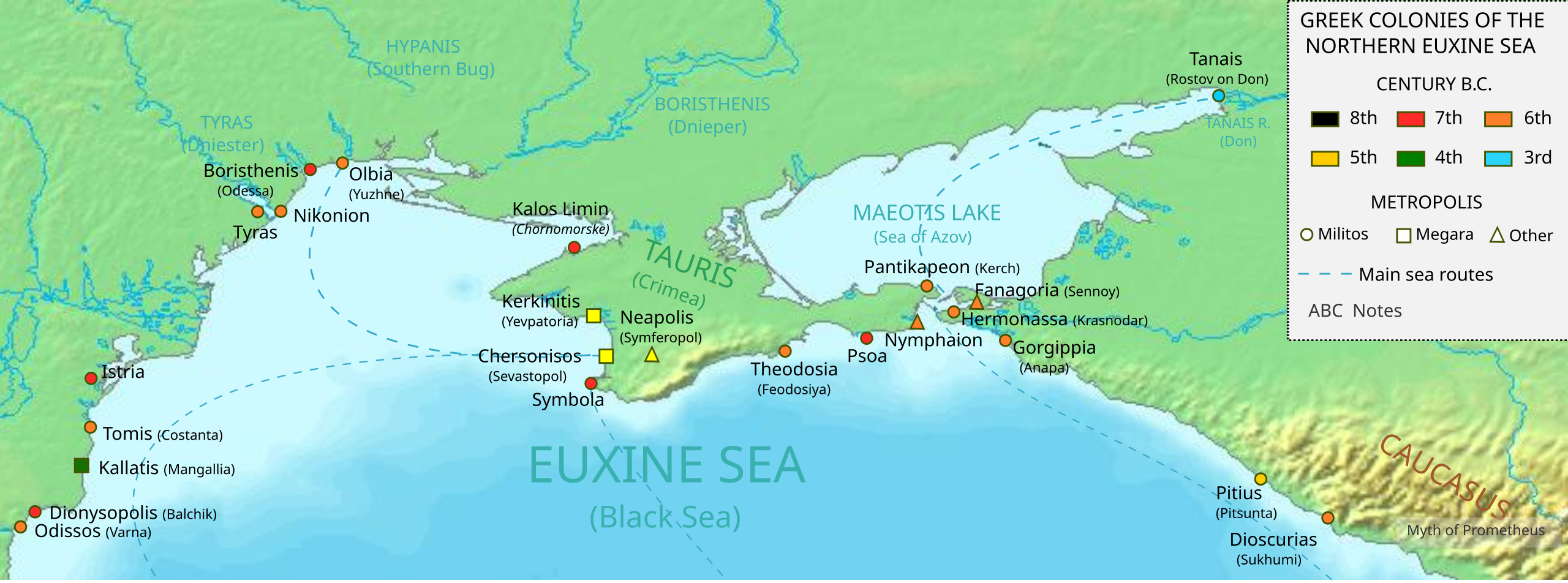
1 | Location of the Greek colony of Tanais on the Sea of Azov.
Cannabis sativa is an extremely versatile plant, known and cultivated since ancient times as a textile fiber, as a source of oil for lighting extracted from its seeds, and as a medicinal or psychoactive substance, as Herodotus recounts (Histories, IV, 73–75) when describing particular ceremonies practiced by the Scythian people in the 5th century BC (De Ruggiero 1900; Forbes 1964; Godwin 1967).
Around the Black Sea its cultivation spread and the port of Tanais, a Greek colony on the Sea of Azov at the mouth of the Don River, directly connected to the Black Sea [Fig. 1], became one of the main trading centers of the product as early as the Classical period. In the ancient literary sources, the area is known as Μαιώτις λίμνη (Aesch., Prom. 427) or Maeotis Lacus (Plin. nat. 4, 24; 6, 6). Strabo (11, 2.3) describes the city as follows:
ἐπὶ δὲ τῷ ποταμῷ καὶ τῇ λίμνῃ πόλις ὁμώνυμος οἰκεῖται Τάναϊς, κτίσμα τῶν τὸν Βόσπορον ἐχόντων Ἑλλήνων. νεωστὶ μὲν οὖν ἐξεπόρθησεν αὐτὴν Πολέμων ὁ βασιλεὺς ἀπειθοῦσαν, ἦν δ᾽ ἐμπόριον κοινὸν τῶν τε Ἀσιανῶν καὶ τῶν Εὐρωπαίων νομάδων καὶ τῶν ἐκ τοῦ Βοσπόρου τὴν λίμνην πλεόντων, τῶν μὲν ἀνδράποδα ἀγόντων καὶ δέρματα καὶ εἴ τι ἄλλο τῶν νομαδικῶν, τῶν δ᾽ ἐσθῆτα καὶ οἶνον καὶ τἆλλα ὅσα τῆς ἡμέρου διαίτης οἰκεῖα ἀντιφορτιζομένων.
On the river and on the lake is situated a city called Tanais, like the river; it was founded by Greeks who held the Bosporus… It was a commercial center used both by the nomads of Asia and Europe, and by the sailors who, departing from the Bosporus, traveled across the lake. The former brought slaves, furs, and other products of the nomads; the latter carried in exchange loads of clothing, wine, and other goods useful for daily life.
With the Greeks the cultivation spread throughout the Mediterranean, particularly in humid areas; among these, the French Camargue was a major production center and Marseille (ancient Massalia) was one of the main ports for the trade of the fiber. Evidence of this remains in the old toponym of the Canebière district, adjacent to the port area (Blès 1994). Many ancient authors, collected in an interesting work by Alfredo Buonopane (2012) on the Roman Veneto, recall the use of hemp, especially for the production of ropes and resistant fabrics; among these sources in particular Columella (De re rustica II, 7) recalls its diffusion among the main crops and the peculiar cultivation methods (2, 10):
Cannabis solum pingue stercoratumque et riguum vel planum atque humidum et alte subactum deposcit. In quadratum pedem seruntur grana sex eius seminis Arcturo exoriente, quod est ultimo mense Februario circa sextum aut quintum Kalend. Mart. Nec tamen usque in aequinoctium vernum, si sit pluvius caeli status, improbe seretur.
Hemp requires a soil that is rich and well-fertilized, and that is either level and moist and deeply tilled. Six grains of its seed are sown per square foot when the sun rises, which is in the last month of February, around the sixth or fifth of the Kalends of March. However, it should not be sown until the vernal equinox, if the weather is rainy.
However, it must not have been an easy crop, as Columella still states (2, 12):
Cannabis seritur, ut supra docuimus: sed incertum est, quantam impensam curamque desideret
Hemp is sown, as we have taught above: but it is uncertain how much effort and care it requires.
Even Pliny the Elder (nat. 19, 174) recalls the importance of this plant, listing three particularly fine varieties of hemp: those from Alabanda and Miletus, cities both located in Caria, and the one grown in Rosea, in the Sabine countryside of Italy near Rieti.
Definite palynological evidence has emerged from research carried out some years ago in the area of the volcanic lakes Albano and Nemi: the crops must have been distributed across the hilly areas, while the soaking of the fibers in the lake waters has been confirmed, with activities dated mainly between the 1st and 2nd centuries AD (Mercuri et al. 2002). Hemp was certainly widespread, together with flax, at least from the 2nd century BC in the Po Valley, as documented in the Bologna area (Marchesini, Marvelli 2009, 315), where during Roman times it was mainly used as a textile plant, especially for producing ropes, cords, mats, and nets. To the data concerning cultivation derived from archaeobotanical analyses, more strictly archaeological information from Roman Veneto can be added (Buonopane 2012). In addition to numerous literary sources gathered by Alfredo Buonopane, significant epigraphic evidence is also reported. The author analyzes in particular an inscription (CIL V, 3072 = ILS 8339), found most likely in the centuriated territory of Bovolenta, south of Padua, but now preserved, after various vicissitudes, in the Museo Nazionale Atestino. It is a funerary inscription that very precisely defines the boundaries established for the burial in an area adjacent to a hemp field (canabetum). The inscription is dated between the 2nd and 3rd centuries AD and demonstrates that even in this part of the Po Valley the cultivation of this plant was widespread, as it was in the nearby centuriated territory of Emilia.
Another epigraphic text, stamped on a small lead sheet from the territory of Altino and used as a “label” to indicate batches of goods intended for sale or processing, records a quantity of three and a half pounds of hemp (KANN). Based on the shape of the letters, Buonopane (2012, 539) dates it between the 1st century BC and the 1st century AD. The weight mentioned is modest, just over one kilogram, and therefore it could refer either to a small lot of fiber or, according to the scholar, to seeds intended for agricultural or medicinal use. Also interesting are the observations that the author dedicates to this agricultural practice in Roman Veneto, which, due to the scarcity of evidence, seems to have been aimed at local use and self-consumption. This would fit well within the general context described by Varro (De re rustica I, 22, 1):
De reliquo instrumento muto, in quo sunt corbulae, dolia, sic alia, haec praecipienda. Quae nasci in fundo ac fieri a domesticis potuerunt, eorum nequid ematur… sic quae fiunt de cannabi, lino, iunco, palmo, scirpo, ut funes, restes, tegete.
As for the remaining ‘mute instruments’, which include baskets, jars, and the like, these must be provided for. Those that can be produced on the estate and made by household workers should not be purchased… thus those made of hemp, flax, rush, palm, or bulrush, such as ropes, cords, and mats.
Moreover, the association with a quantity of six bales (vellera) of wool, found on the same lead sheet from Altino, may suggest a type of cultivation complementary to the wool industry, which was widespread in the Veneto area, perhaps intended to produce mixed fabrics that were tougher and more durable (Buonopane 2012, 540). To these findings can be added the important recent discovery at Aquileia, where an exceptional system of basins used in Roman times for hemp retting was found. These were in operation between the late 2nd and early 4th centuries AD, near the river port along the eastern bank of the Natisone River (cafoscariNEWS, 20/09/2018).
The plant must therefore have been widely cultivated in the Roman period and its fibers processed mainly in connection with agricultural and port areas.
II. The Spread of Hemp Cultivation and Trade between the Middle Ages and the Modern Age
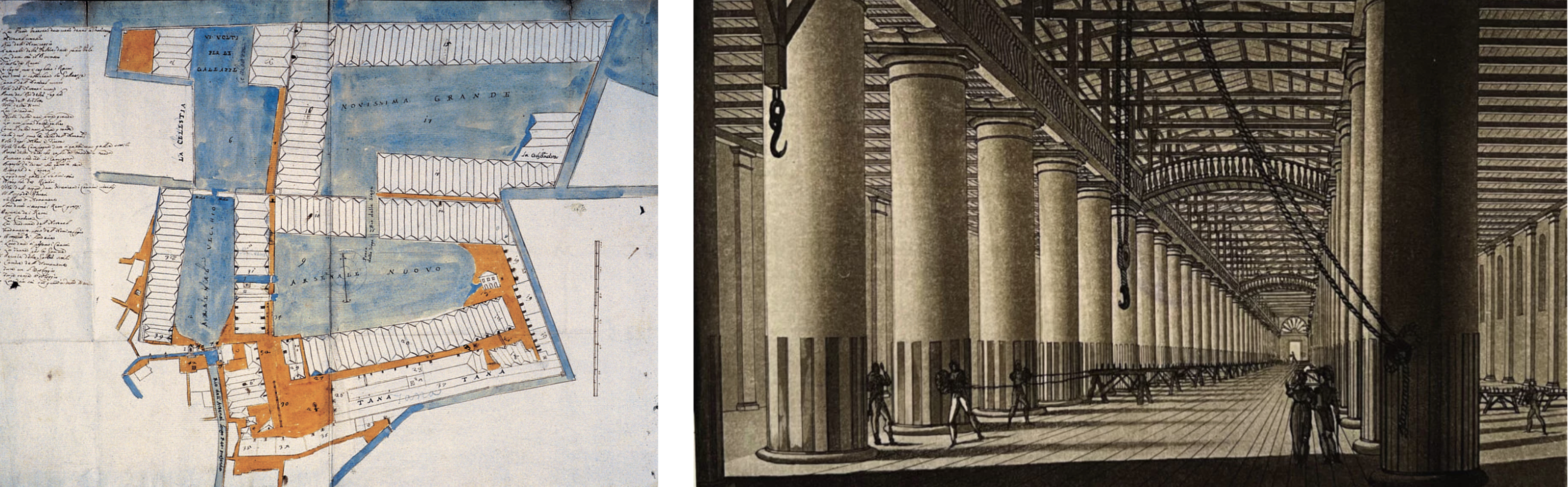
2 | The Arsenal of Venice, in a drawing by an unknown artist, second half of the 18th century
(ASV, Patroni e provveditori all’Arsenal, b. 546, dis. 1, in Celetti 2007, 173, fig. 8).
3 | Perspective view of the “Officina della Corderia”, commonly known as “Tana all'Arsenale”, in a drawing by Andrea Tosini (engraving by Antonio Lazzari), in Oggetti più interessanti della Città di Venezia 1833.
Due to its versatility, hemp continued to be cultivated and traded throughout the Mediterranean world even during the Middle Ages. It is precisely in the ancient territory of Tanais, on the Sea of Azov, that the Venetian term for hemp warehouses originated (Rampazzo 2024): the river port on the Don, directly connected to the Black Sea, became during the era of the maritime Republics in the second half of the 13th century first a Genoese and later a Venetian trading post known as Tana (Wasowicz 1966; Pubblici 2005). From there during the 14th and 15th centuries numerous shipments of hemp destined for the production of ropes, an essential material for the Venetian navy, arrived in Venice along with other valuable goods.
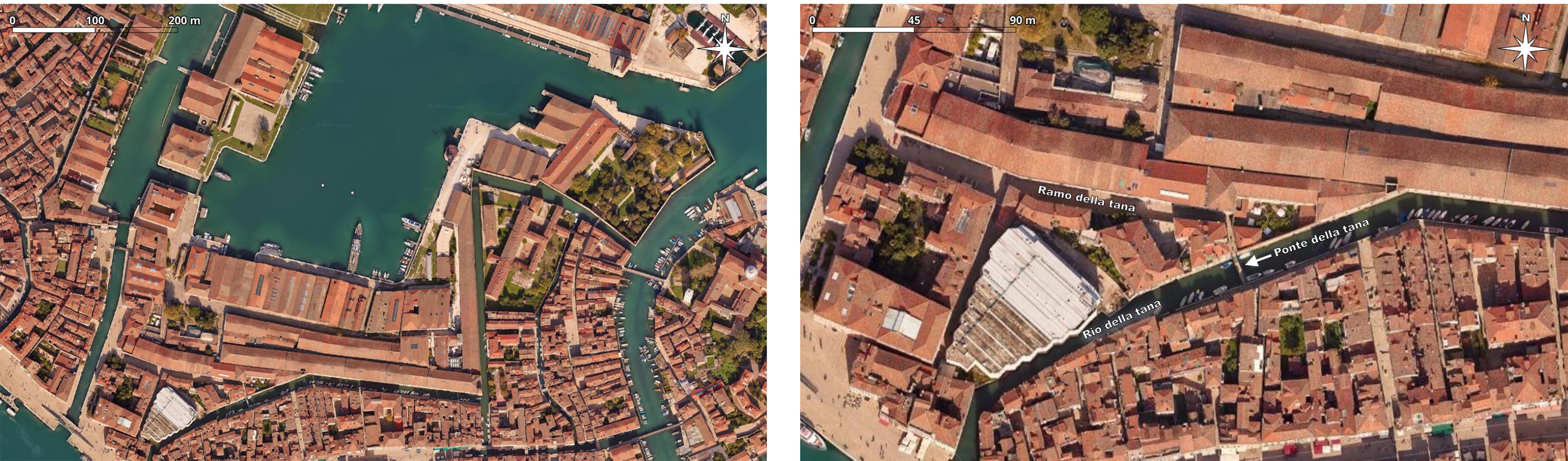
4 | The Arsenal area today (Google Earth, GIS elaboration by A. Meleri).
5 | Detail of the area with toponyms linked to the “Tana” (Google Earth, GIS elaboration by A. Meleri).
In the area of the Arsenale in the lagoon city, a special building was constructed for the carding and spinning of textile fibers needed to meet the growing naval demand. This building was variously known as the Caxa del Canevo, the Corderia, or more commonly the Tana [Figs. 2-3]. In this district many related toponyms still survive today, such as Campo de la Tana, Calle de la Tana, Ponte de la Tana, and Rio de la Tana [Figs. 4-5].

6 | Cover of Il Canapajo by Girolamo Baruffaldi, published in Bologna in 1741.
From the Early Middle Ages onward, Venice had become a key reference point for all maritime trade between Europe and the East and its fleet experienced a steady and massive expansion. During this phase the Republic of Venice undertook, among other major projects in the Venetian territory, the widespread cultivation of hemp (Baruffaldi 1741; Pastori Bassetto 1993; Cazzola 2002, 240-241; Poni 2002; Celetti 2007), intended for the great Venetian ropeworks (corderie). Numerous written documents, especially from the 18th and 19th centuries, confirm this (Celetti 2007; Danieli 2021).
Andrea Gloria, in his book Dell’Agricoltura nel Padovano (1855), collected a series of documents attesting to the presence of extensive cultivations that included hemp and flax, particularly in the areas between Este, Montagnana, and Cologna Veneta, since the time of Ezzelino (13th century). This is also suggested by the Atestine toponym Canevedo (Gloria 1855, CXX) and by the widespread presence of retting pits and storage facilities, known in Venetian dialect as tane.
Among the documents gathered by the Paduan historian are specific regulations for farmers and prohibitions, such as the ban on hunting in fields sown with hemp (no. 212), the prohibition of retting in public waters (no. 213), and strict anti-fraud controls (no. 214).
To these can be added specialized works, such as Il Canapajo by Girolamo Baruffaldi, a sort of handbook in eight books written in verse, as was common at the time, published in Bologna in 1741 [Fig. 6]. The cultivation of textile plants, such as hemp and flax, was widespread everywhere (Somma 1923; Poni, Fronzoni 2005; Andreozzi 2006; Ciotti 2007; Llinares 2020), often as a supplementary activity for peasant families, within which weaving was also organized for the self-production of materials needed for daily life such as sheets, towels, tablecloths, and dishcloths (canovacci), the latter deriving their very name from this fiber (Dalla Libera 2004, 27-29).
Salvatore Mandruzzato, author of an extensive three-volume work on the Baths of Abano (Mandruzzato 1789-1804), in his time denounced the widespread neglect in the maintenance of ditches and canals, and even “the filling in of the same for the retting of flax or hemp,” which caused the marshy stagnation of large areas in the lower part of the Euganean thermal region, between Montegrotto and the Catajo (Mandruzzato 1804, Book III, Section IX, 166).
III. Agriculture and Thermal Water between the 19th and 20th Centuries: Some Experiments
Particularly interesting is the use of thermal water in agriculture, not only because of its higher temperatures which undoubtedly accelerated certain vegetative processes, but also due to the chemical characteristics of the various springs. In the territories of Abano and Montegrotto there are reports of some experiments. Antonio Sette, author of a brief agricultural guide published in 1843, devoted considerable attention to the crops cultivated in the lands of the provinces of Padua, Rovigo, Venice, Vicenza, and Verona, including hemp and flax, which continued to be grown even after the fall of the Serenissima. Of particular interest is his note about the experiments of his nephew Alessandro, well known as an inventor and innovator in agriculture, who tested at San Pietro Montagnon the increased productivity of a small rice field through the use of very hot thermal water, partially cooled in special basins (Sette 1843, 82-83).
On the opposite Euganean hillside, there is also a long tradition of exploiting thermal waters for agricultural purposes: in the Calaona Valley, now in the municipality of Baone, a fertile and flat area at the foot of the Euganean Hills, inhabited since prehistoric times, the geothermal phenomenon was exploited at least since the 17th century, both for public use for medicinal purposes (remains of basins and of a building with a hospitality function) and for the establishment of naturally heated greenhouse cultivation facilities (Zanovello, Meleri 2023). The geothermal resource thus became even more important, enabling cutting-edge cultivation practices for the time, which reduced cultivation times and increased production profitability with completely natural and zero-cost methods.
IV. Agriculture and Thermal Water: a Particular Use for Hemp Processing
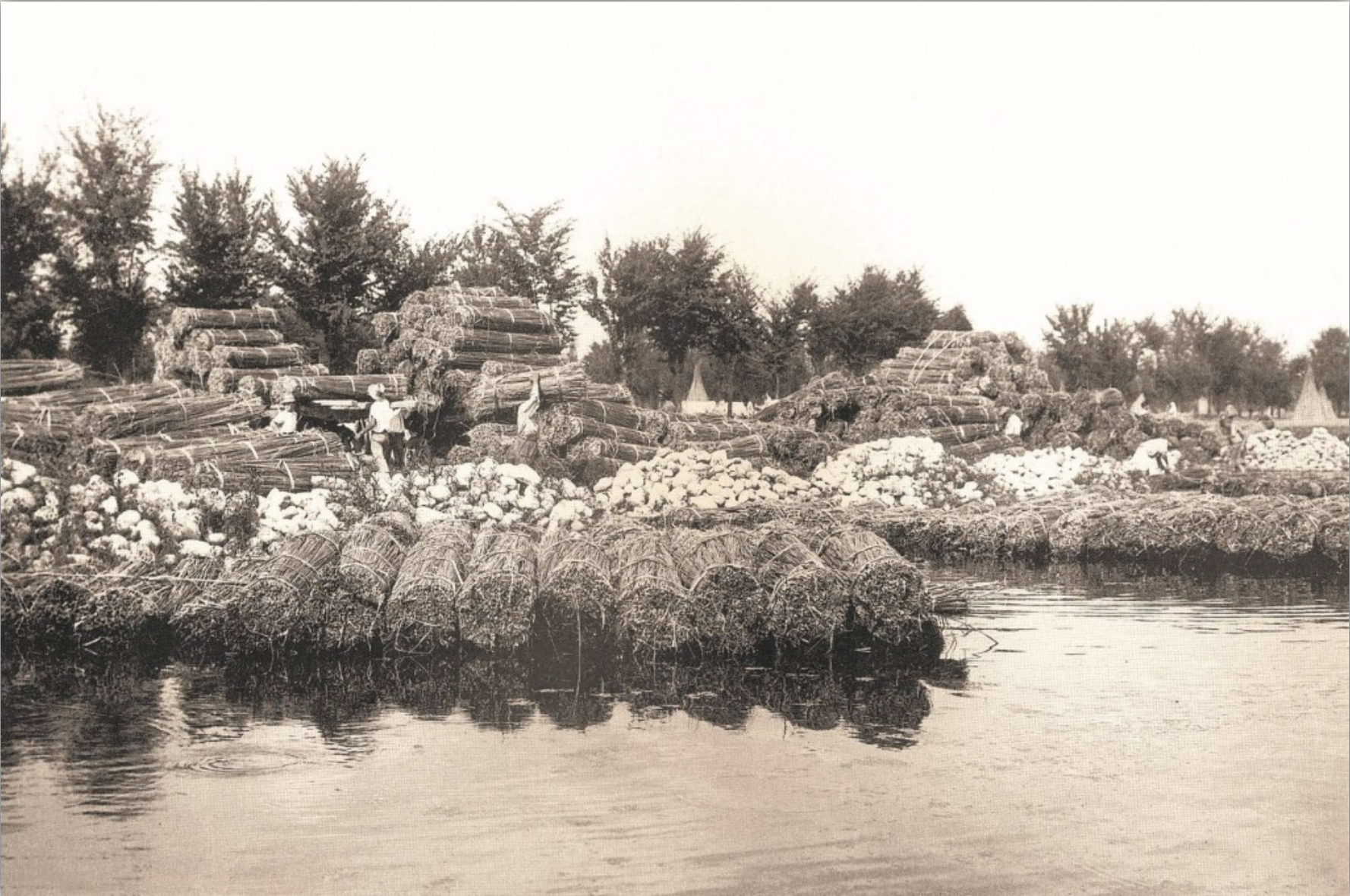
7 | Historical image of a hemp maceration basin in the Ferrara area (Archivio Centro Documentazione Storica, Comune di Ferrara).
Thanks to experiments conducted in the Euganean thermal area, the use of thermal water also proved useful for softening hemp fibers, since with water at about 30°C the retting time was cut in half: four days instead of the usual eight to ten (Rizzo et al. 1867; Zanetti 2002, 289) [Fig. 7]. Therefore, the practice of macerating hemp and textile fibres in general spread where this resource was naturally present. This recalls Mandruzzato’s “denunciation” of the poor hydrogeological management of the thermal territory, influenced by the needs of cultivators: he refers to “certain private abuses” (Mandruzzato 1804, 166), namely “on one hand, the neglected excavation of ditches and canals, their filling in for the retting of flax or hemp, small embankments to prevent the drainage of water that might harm some landowners; on the other hand, the silence and inactivity of municipal laws” (Mandruzzato 1804, 166, note 1). The situation was probably not much different in other areas of Italy, as evidenced by numerous but sporadic reports that have so far only been studied at a local level.
In Val d’Ossola, in Piedmont, in the locality of Premia where a thermal spa still exists today, there are records dating back at least to the 16th century of a hot spring that was freely used for various purposes: medical treatments, laundry and hemp retting (Negri, Mosello 1989). The same practice is believed to have taken place at the thermal baths of Comano, in Trentino, according to local tradition (Gorfer 1972), and possibly also in the thermal area of Fratta, in the municipality of Bertinoro in Romagna (Bassani M. 2016, 887). Other reports on the use of thermal water for retting hemp and flax (Bassani M. 2016, 887-888) are also found at the Bullicame springs near Viterbo, at least from the mid-13th century (Bassani A. 2014, 40), and in modern times at the Terme delle Zitelle (Termalismo antico e moderno nel Lazio 1999, 55) and at Casa Carletti (Chellini 2002, 120; De Felice 2009, 103), within the same thermal area.
Even more interesting within this context is the volcanic Phlegraean area, not far from Naples and Pozzuoli, where between Lake Agnano and Lake Fusaro [Fig. 8] an extensive tradition of cultivation and retting of hemp is documented, which must have benefited from the particular chemical and physical characteristics of the soil and water (Russo Spena 2024). In Agnano there was a Roman thermal complex which, between the 9th and 10th centuries, was submerged due to bradyseism: a lake [Fig. 9] formed in correspondence with the crater (Sgobbo 1929, 189-190; Amalfitano, Camodeca, Medri 1990, 62-67), which was later drained and reclaimed at the end of the 19th century (Annecchino 1931).
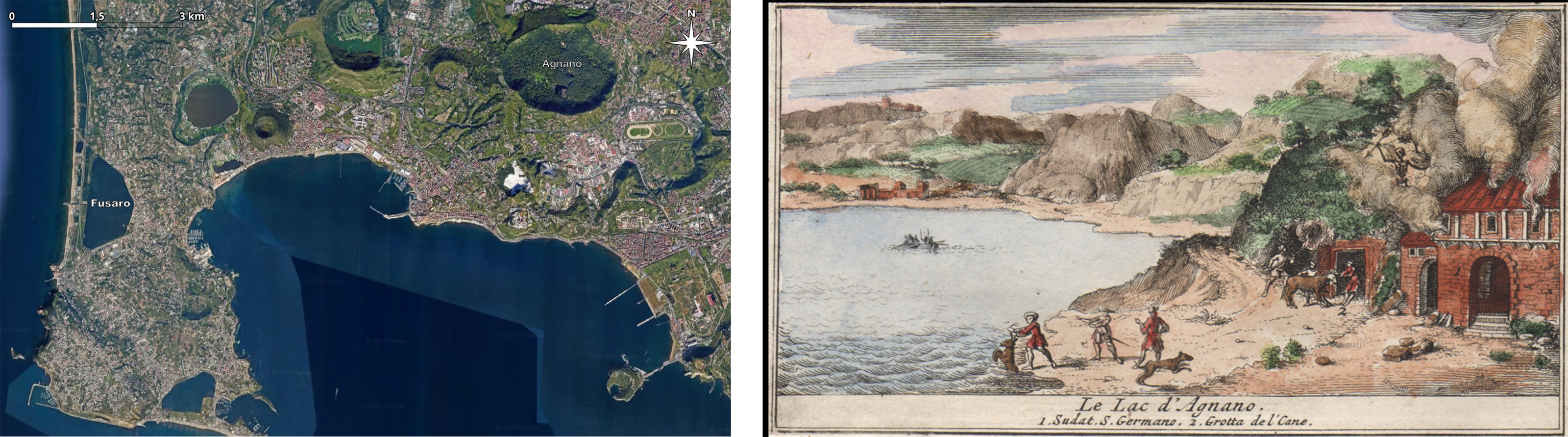
8 | Phlegraean Fields, with Lake Fusaro and the crater once occupied by Lake Agnano (reworked from Google Earth, GIS elaboration by A. Meleri).
9 | Lake Agnano in a 1706 watercolor engraving (Alexandre de Rogissard, Les délices de l’Italie, III, Leiden 1706).
At least since the mid-15th century, hemp cultivation has been documented here (Casoria, Scognamiglio 2006), and the lake basin, shallow and ideal for this type of process, was used for retting. Alfonso of Aragon promoted its use for this purpose, also because both Agnano and the nearby Lake Fusaro, located between Baia and the Tyrrhenian Sea, were peripheral to Naples. This helped solve a serious public health issue: in Naples several sites were used for hemp retting (Casoria, Scognamiglio 2006, 63-64), but the bad smells emanating from the processing waters heavily affected everyday life in the city.
It is worth recalling that the name of Lake Fusaro itself derives from the fusari, the basins where laborers gathered hemp stalks into bundles and submerged them for several days to carry out the necessary process of separating the fibers from the woody parts. The same policy of promoting this crop led to the identification of another area, slightly further north, suitable for retting: in the Caserta region lies the territory of the Regi Lagni, whose name derives from an important reclamation project carried out at the beginning of the 17th century at the mouth of the Clanio River (Capasso 1994). Here too, one of the most important areas for hemp cultivation and processing developed. Thus, even in the Phlegraean area, as in other regions of Italy, thermal phenomena were exploited to optimize the timing and methods of agricultural processing, albeit under complex hygienic and operational conditions, especially where production took place on an industrial scale, both in the Kingdom of Naples and in the territories of the Serenissima.
V. Hemp and Thermal Water: a Case Study at the Bagno della Crosara in the Euganean Hills
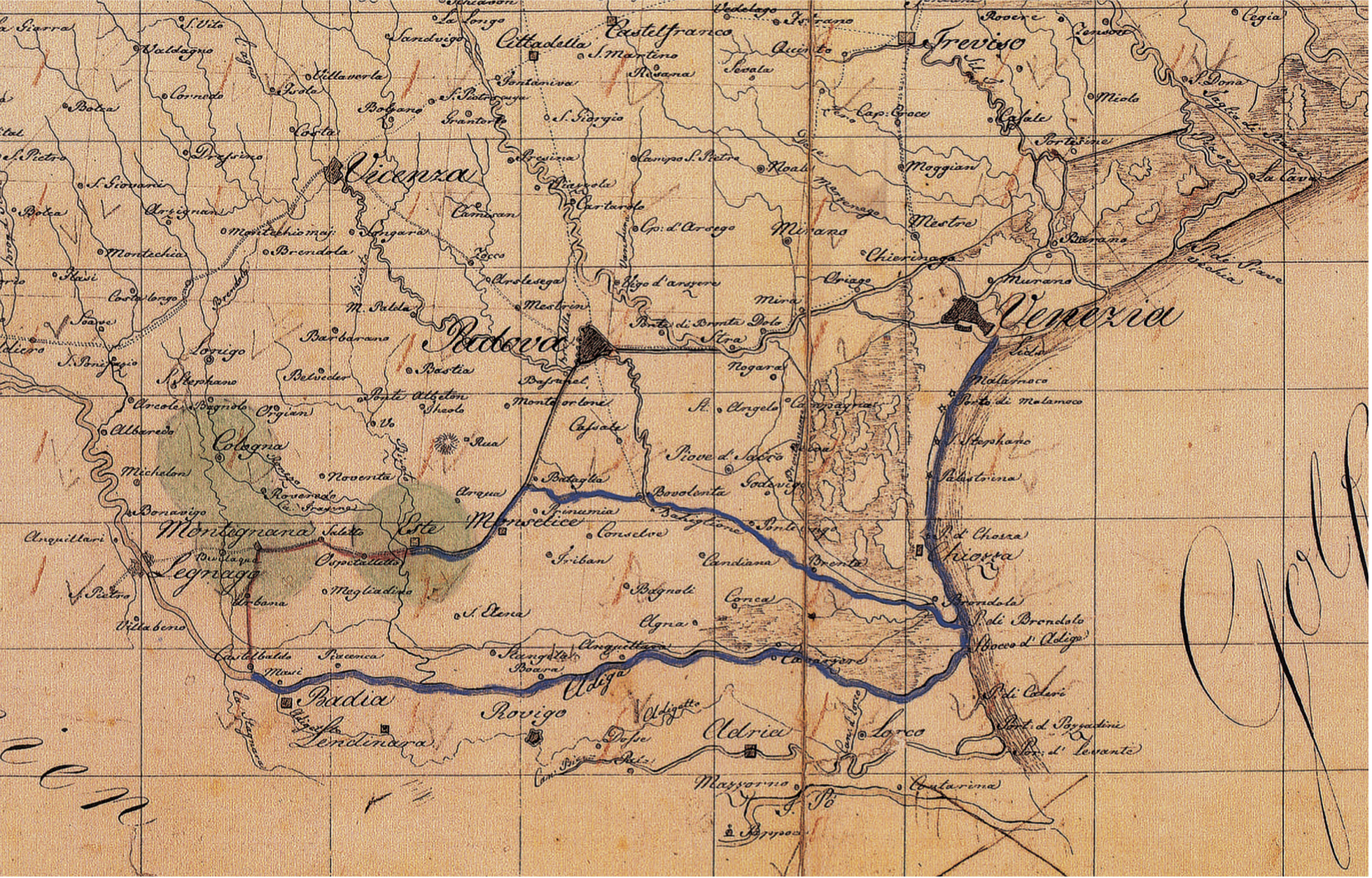
10 | Hemp cultivation in the Venetian Republic: a graphic reworking by David Celetti based on Anton von Zach’s cartography (from Celetti 2007, 174, fig. 9).
On the western side of the Euganean Hills, in the plain that extends toward Este, Montagnana, and Cologna Veneta where hemp cultivation was widespread during the time of the Serenissima (Celetti 2007) [Fig. 10] there remains evidence of the use of a thermal basin for hemp retting. In the locality of Crosara di Fontanafredda, in the municipality of Cinto Euganeo, a site still known today as “Bagno”, also reported in the Napoleonic and Austrian cadastral maps, there is an architectural complex with a basin fed by a thermal spring still flowing today; it was restored about ten years ago through a private initiative [Figs. 11-13].
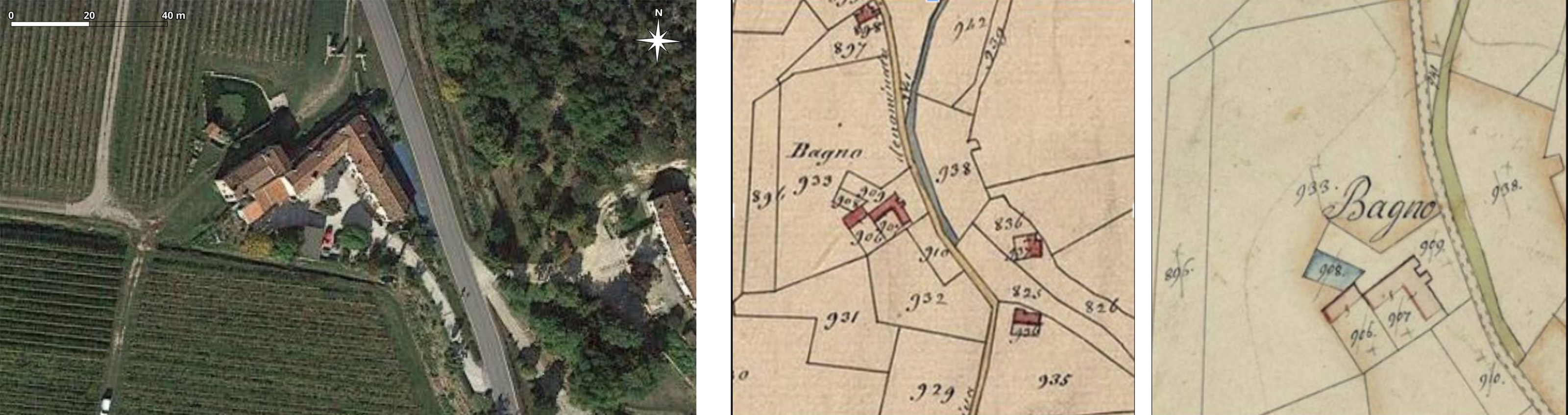
11 | The “Bagno della Crosara” ancient architectural complex in Fontanafredda, Cinto Euganeo (Padua) (GIS elaboration by A. Meleri).
12 | The “Bagno della Crosara” site in a detail of the Napoleonic Land Registry of 1811.
13 | The “Bagno della Crosara” site in a detail of the Austrian Land Registry of 1845.
The spring emerges at a temperature of 27°C, but according to local tradition, before the 1976 earthquake the moderately sulfurous water reached temperatures above 40°C and surfaced at several points in the plain. The existence of the spring is documented at least from the early 12th century when the Bishop of Padua, Sinibaldo, bathed there for its therapeutic properties (Casarin 1976, 191, 313-314). Later it was exploited for productive purposes: around 1300 a mill with a coppedello (vertical wheel) was built and is still preserved today (Grandis 2001; Grandis 2005, 237-239); in 1488 it was purchased by the Venetian Contarini family, who owned land and an imposing frescoed villa in nearby Valnogaredo, another hamlet of Cinto Euganeo.
The main activity was flour production, for which hydraulic energy was exploited to move the large mill wheel, but the thermal basin was also used for hemp retting, certainly benefiting from the temperature and the chemical-physical composition of the water [Figs. 14-15]. A short paved ramp, still preserved, descending to the basin was intended to facilitate the loading and unloading of the bundles of stems left to macerate. The basin is not large, but the water temperature accelerated the process, thus encouraging more frequent turnover of the raw materials. It should be noted that the practice of self-production must also have been widespread, with small facilities serving local communities and representing the entire production chain from cultivation to retting, breaking, carding, and finally weaving. In the Veneto region, as in other parts of Italy, several examples of this still remain; for instance, in the Vicenza area toward the end of the 18th century, there was one loom for every 15-20 families (Panciera 1999). Great attention is therefore also paid to basic training, tailored to family and community needs.
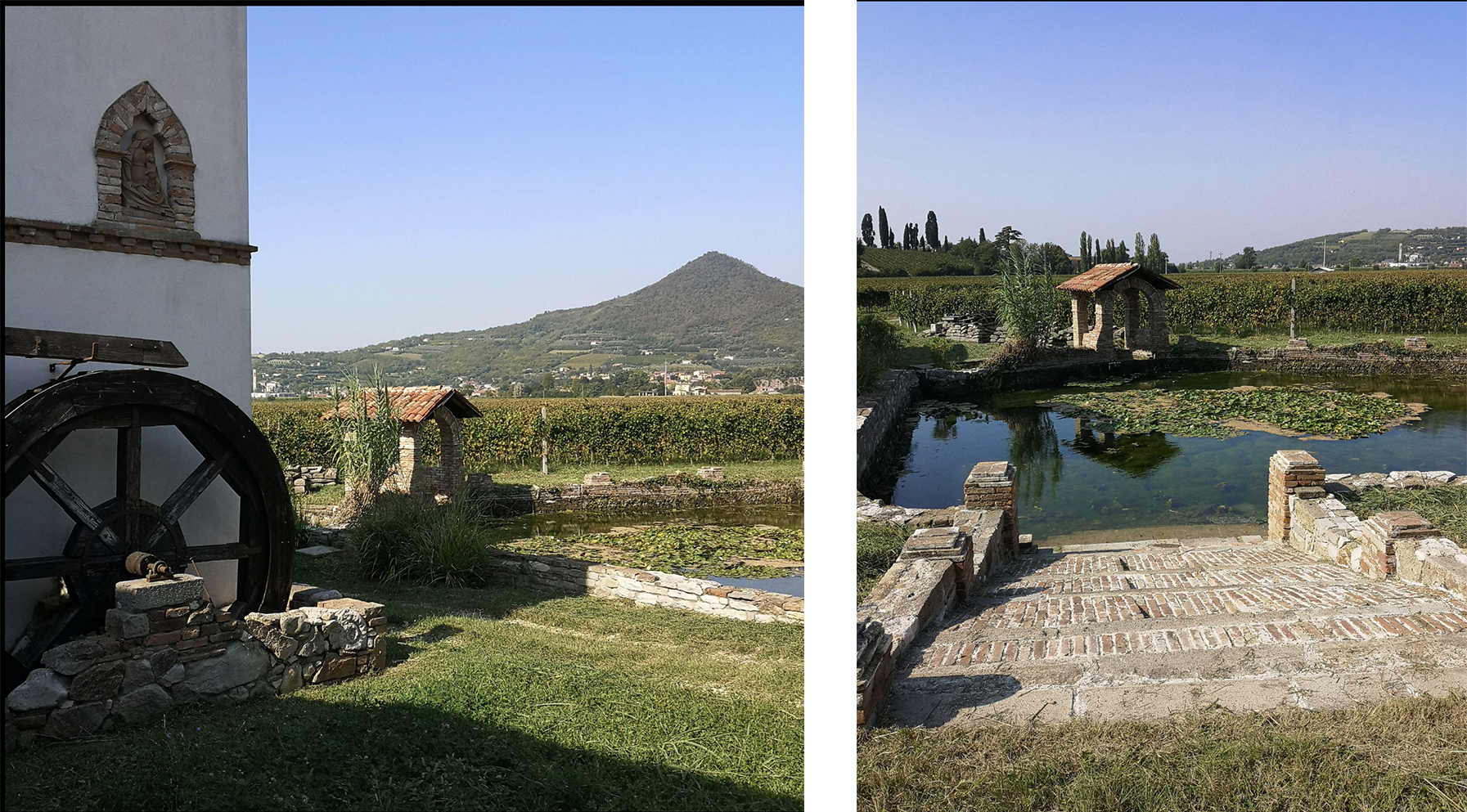
14 | Crosara di Fontanafredda: the “coppedello” mill and the thermal basin.
15 | Crosara di Fontanafredda: the thermal basin and the short paved ramp to the basin.
In the first half of the 19th century, numerous short practical texts, almost handbooks, addressed to farmers, began to appear (Scalco 2003). These included recommendations such as “make sure that every year there is a plot of land set aside for hemp and flax for family use,” as reported in the Catechismo agricolo ad uso dei contadini, compiled by a parish priest, Don Giovanni Rizzo, and published in Padua in 1869 (Rizzo 1869, 13, 87). This reflects the same agricultural context recorded by Andrea Gloria in his aforementioned Dell’agricoltura nel Padovano (1855).
Toward the end of the 19th century in the Padua area there were 3,426 hectares devoted to hemp cultivation, with a total production of 23,982 quintals, coming mainly from Montagnana, followed by Padua and Este (Celetti 2007, 312). Within this context fits the particular use of the thermal “Bagno” of Fontanafredda, an important example of how thermal water could facilitate certain production processes: water, therefore, not only with therapeutic value but also serving a profitable purpose in agriculture.
Bibliography
- Amalfitano, Camodeca, Medri 1990
P. Amalfitano, G. Camodeca, M. Medri (a cura di), I Campi Flegrei: un itinerario archeologico, Venezia 1990. - Andreozzi 2005
D. Andreozzi, Tra Trieste, Ancona, Venezia e Bologna. La canapa e il commercio nell’Adriatico del ’700, in D.Andreozzi, C.Gatti, Trieste e l’Adriatico. Uomini, merci, conflitti, Trieste 2005, 142-185. - Annecchino 1931
R. Annecchino, Agnano: l’origine del nome e del lago, Napoli 1931. - Baruffaldi 1741
G. Baruffaldi, Il canapajo. Libri 8, con le annotazioni, Bologna 1741. - Bassani A. 2014
A. Bassani, Note idrotermali: caratterizzazione, prodotti, usi diversi, in M. Annibaletto, M. Bassani, E.F. Ghedini (a cura di), Cura, preghiera e benessere. Le stazioni curative termominerali nell’Italia romana, Padova 2014, 29-43. - Bassani M. 2016
M. Bassani, Soltanto ‘salus per aquam’? Utilizzi non terapeutici delle acque termominerali nell’Italia romana, in J. Bonetto et al. (a cura di), I mille volti del passato. Studi in onore di Francesca Ghedini, Roma 2016, 879-891. - Blès 1994
A. Blès, La Canebière, dans le temps et dans l'espace, Marseille 1994. - Buonopane 2012
A. Buonopane, La canapa nel Veneto romano: testimonianze epigrafiche, in M.S. Busana, P. Basso (a cura di), La lana nella Cisalpina romana. Economia e società. Studi in onore di Stefania Pesavento Mattioli. Atti del Convegno (Padova-Verona, 18-20 maggio 2011), Padova 2012, 535-542. - Capasso 1994
S.Capasso, L'area canapicola campana e i lagni, “Rassegna storica dei Comuni” 17/61-63 (1991), 3-7. - Casarin 1976
O. Casarin, La storia di Cinto e del suo territorio, Galliera Veneta 1976. - Casoria, Scognamiglio 2006
P. Casoria, G. Scognamiglio, Implicazioni sociali della lavorazione della canapa tessile (Cannabis sativa L.) nel territorio di Napoli, “Delpinoa” 48 (2006), 61-70. - Cazzola 2002
F. Cazzola, Colture, lavori, tecniche, rendimenti, in G. Pinto, C. Poni, U. Tucci (a cura di), Storia dell’agricoltura italiana. II. Il Medioevo e l’età moderna, Firenze 2002, 223-253. - Celetti 2007
D. Celetti, La canapa nella Repubblica Veneta. Produzione nazionale e importazioni in età moderna, Venezia 2007. - Chellini 2002
R. Chellini, Acque sorgive salutari e sacre in Etruria (Italiae Regio VI). Ricerche Archeologiche e di Topografia Antica, BAR International Series 1067, Oxford 2002. - Ciotti 2007
M. Ciotti, La canapa nell’Ascolano tra agricoltura e marineria (secc. XVIII-XIX), “Proposte e ricerche” 59/2 (2007), 94-109. - Dalla Libera 2004
F. Dalla Libera, Attività agricole e tradizioni venete nelle collezioni di Carlo Etenli, Museo della Civiltà Contadina di Grancona, Vicenza 2004. - Danieli 2022
G. Danieli, La produzione ed il mercato della canapa di Montagnana in Età Carrarese: una prospettiva di indagine, “Archivio Veneto” 24 (2022), 7-45. - De Felice 2009
P.L. De Felice, Il termalismo nel Lazio tra persistenze culturali e valori ambientali. Un caso di studio: le Terme di Viterbo, “Geotema” 39 (2009), 101-107. - De Ruggiero 1900
E. De Ruggiero, Canabetum, in DE, Roma 1900, 63. - Forbes 1964
R.J. Forbes, Studies in Ancient Technology, Leiden19642. - Gloria 1855
A. Gloria, Della agricoltura nel Padovano. Leggi e cenni storici, I, Padova 1855. - Godwin 1967
H. Godwin, The ancient cultivation of hemp, “Antiquity” 41 (1967), 42-49. - Gorfer 1972
A. Gorfer, Le terme di Comano nelle giudicarie esteriori, Calliano 1972. - Grandis 2001
C. Grandis, I mulini ad acqua dei Colli Euganei, Este 2001. - Grandis 2005
C. Grandis, Fontane, rii, calti e gorghi: il patrimonio idrico e termale, in F. Selmin (a cura di), I Colli Euganei, Sommacampagna 2005, 209-239. - Llinares 2020
S. Llinares (èds), Le chanvre, histoire et techniques d'une fibre végétale, Rennes 2020. - Mandruzzato 1789-1804
S. Mandruzzato, Dei Bagni di Abano, I-III, Padova 1789-1804. - Marchesini, Marvelli 2009
M.Marchesini, S.Marvelli, Ricostruzione del paesaggio vegetale e antropico nelle aree centuriate dell’Emilia Romagna attraverso le indagini archeobotaniche, “Agri Centuriati. An International Journal of Landscape Archaeology” 6 (2009), 313-23. - Mercuri et al. 2002
A.M. Mercuri, C.A. Accorsi, M.Bandini Mazzanti, The long history of Cannabis and its cultivation by the Romans in Central Italy, shown by pollen records from Lago Albano and Lago di Nemi, “Vegetation History and Archaeobotany” 11 (2002), 263-276. - Negri, Mosello 1989
B. Negri, R. Mosello, Le acque termali ossolane: I. Il “Rivo dell’acqua calda” di Piedilago, “Oscellana” (1989), 2, 97-103. - Panciera 1999
W. Panciera, Filatura e tessitura domestiche: lana, lino e canapa, in U. Bernardi, G.L. Fontana, (a cura di), Cultura popolare vicentina. Mestieri e saperi fra città e territorio, Vicenza 1999, 103-122. - Pastori Bassetto 1993
I. Pastori Bassetto, La coltivazione ed il commercio della canapa nella Repubblica Veneta, “Archivio Veneto” s. 5/141 (1993), 5-65. - Poni 2002
C. Poni, Coltivare e lavorare la canapa, in G. Pinto, C. Poni, U. Tucci (a cura di), Storia dell’agricoltura italiana. II. Il Medioevo e l’età moderna, Firenze 2002, 515-529. - Poni, Fronzoni 2005
C. Poni, S. Fronzoni (a cura di), Una fibra versatile. La canapa in Italia dal Medioevo al Novecento, Bologna 2005. - Pubblici 2005
L. Pubblici, Venezia e il Mar d’Azov: alcune considerazioni sulla Tana nel XIV secolo, “Archivio Storico Italiano” 163 (2005), 435-483. - Rampazzo 2024
D. Rampazzo, I veneziani nel mar Nero: la colonia commerciale di Tana tra archeologia e storia, “La Pagina di Campalto” 21/232 (2024), 12-14. - Rizzo 1869
G. Rizzo, Catechismo agricolo ad uso dei contadini con due appendici su alcuni pregiudizi dei contadini e sulle misure e pesi metrici, Padova 1869. - Rizzo, et al. 1867
G. Rizzo, A. Sette, G. Magarotto, Catechismo agricolo ad uso delle scuole comunali di Padova, Padova 1867. - Russo Spena 2024
R. Russo Spena, Paludi, fusari e lagni nella città di Napoli, nei Campi Flegrei e in Terra di Lavoro. Politiche di gestione delle acque da Federico II a Ferdinando II di Borbone, “Storia urbana” 177, Suppl. (2024), 69-92. - Scalco 2003
L. Scalco, Don Giovanni Rizzo e il “Catechismo agricolo ad uso dei contadini”, “Rivista di Storia dell’agricoltura” 43/2 (2003), 61-81. - Sette 1843
A. Sette, L’agricoltura veneta, Padova 1843. - Sgobbo 1929
I. Sgobbo, Terme flegree ed origine delle terme romane. Atti del I Congresso di Studi romani, Roma 1929, 186-194. - Somma 1923
U. Somma, La canapa. Cultura, lavorazione, commercio, Bologna 1923. - Termalismo antico e moderno nel Lazio 1999
Termalismo antico e moderno nel Lazio, Regione Lazio, Assessorato Sviluppo Economico ed Attività Produttive, Roma 1999. - Wasowicz 1966
A.Wasowicz, À l’époque grecque : le peuplement des côtes de la mer Noire et de la Gaule méridionale, “Annales. Economies, sociétés, civilisations” 21, 3 (1966), 553-572. - Zanetti 2002
P.G. Zanetti, Andar per acque. Da Padova ai Colli Euganei lungo i navigli, Padova 2002. - Zanovello, Meleri 2023
P. Zanovello, A. Meleri, Water Landscapes. The phenomenon of Thermalism in the Euganean District between Antiquity and the Modern Age, “La Rivista di Engramma” 204 (luglio/agosto 2023), 35-49.
Reference websites
Abstract
This study explores the historical interplay between thermalism and agriculture in the Euganean area, focusing on the use of thermal-mineral waters for hemp processing during the time of the Venetian Republic. Cannabis sativa, a versatile plant cultivated since antiquity for fiber, oil and medicinal purposes, was widely grown in Roman and medieval northern Italy, particularly in the Po Valley and Veneto region. Archaeological, palynological and epigraphic evidence confirms its cultivation and local use, especially for ropes, textiles and mixed fabrics. During the time of the Serenissima hemp production expanded to meet the demands of Venice’s naval industry, with retting and fiber processing supported by natural water sources. In the Euganean Hills thermal springs were exploited to accelerate hemp retting, reducing processing time while benefiting from the chemical and thermal properties of the waters. Similar practices were recorded elsewhere in Italy, including Lazio, Piedmont, Trentino, Romagna and the Phlegraean area, demonstrating a broader historical pattern of using thermal waters to optimize fiber processing. The research highlights the multifaceted role of thermal water in agriculture, combining economic, technological and environmental functions, and documents the persistence of hemp cultivation and small-scale self-production in northern Italy up to the early 20th century.
keywords | Hemp (Cannabis sativa); Fiber processing; Thermal-mineral water; Euganean Hills; Venetian Republic.