The God among the Rivers
Mount Raffe (Mussomeli, Sicily) and the Cult of Achelous
Sofia Bulgarini, Andrea Luvaro*
Abstract
I. Territorial and archaeological context of Monte Raffe
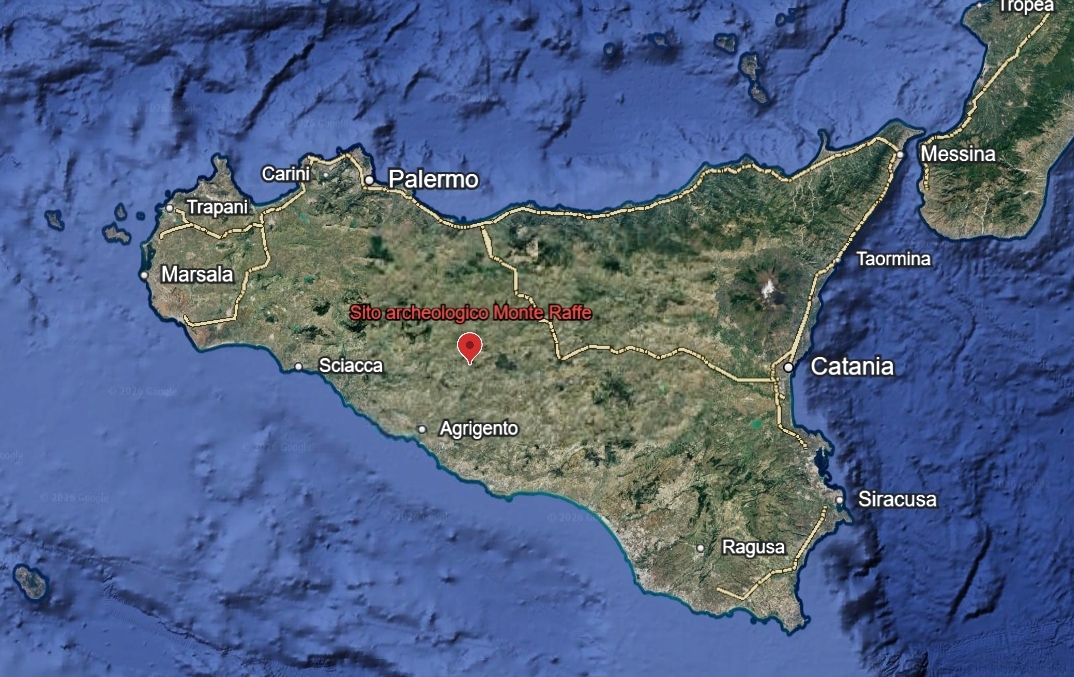
1 | Map of Sicily with the indication of Monte Raffe site (graphic design by the authors).
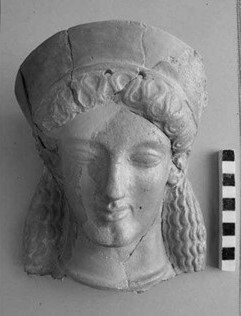
2 | Female protome in terracotta, first quarter of the 5th century BC, Monte Raffe (CL), Regional Archaeological Museum of Agrigento (Congiu-Chillemi 2015).
The hill of Monte Raffe rises in the territory of Mussomeli (CL), on the border with the municipalities of Sutera and Bompensiere, in the province of Caltanissetta [Fig. 1]. This area is dominated by the presence of water, as it was in ancient times. In fact, in the past, all the Sicilian hinterland must have been characterised by an abundance of water: the main rivers, which are currently torrential, were navigable for most of their course (Tramontana 2012, 272), and the landscape must have been characterised by a wealth of springs and sources, favouring considerable soil fertility and the presence of shrubs and tall trees. In this landscape, the hill of Raffe (423 m above sea level) occupied a strategic position controlling the courses of the Fiumicello, Salìto and Gallo d’Oro rivers, natural routes connecting the coast and the inland.
Monte Raffe is considered one of the centres of the Platani Valley that underwent the process of Hellenisation between the end of the 6th century BC and the first twenty-five years of the 5th century BC. In particular, the presence of stamped and painted pottery in Raffe suggests that Hellenisation began here in the last decades of the 6th century BC and took on characteristics typical of Agrigento (De Miro 1962, 150; Congiu, Chillemi 2015, 237). In fact, the site of Monte Raffe was founded in the shadow of Polizzello, whose acropolis was abandoned in the second half of the 6th century BC. Raffe, meanwhile, experienced a real demographic and cultural boom. Archaeological finds show a growing interest by the centre of Agrigento in Raffe as part of the new political strategies implemented by Falaride to control the territory (Congiu, Chillemi 2015, 237).
Furthermore, the materials found in the extramoenia sanctuary demonstrate an intense vitality of the centre between the last quarter of the 6th and the beginning of the 5th century BC, which seems to have remained constant until the 4th century BC (Congiu, Chillemi 2015, 240; Congiu, Chillemi 2009, 129). In the second half of the 4th century BC, there was also a demographic increase, perhaps due to the displacement of part of the population from Polizzello, following which Monte Raffe, like the rest of the territory of Mussomeli, came under Carthaginian influence (Belvedere 2000, 46).
Archaeological investigations, begun by Antonino Salinas (1883) and continued by Pietro Griffo (1956-57) (Griffo 1958, 28-29; Lagona 1997, 179-180; Lagona 2003, 235-236; Congiu, Chillemi 2015, 233), Sebastiana Lagona (1980s-1990s) and the Soprintendenza of Caltanissetta (2007-08) (see Congiu, Chillemi 2009, 117-147 and Congiu, Chillemi 2015, 233-264), have revealed the image of a long-time settlement from pre-protohistoric times to Middle Ages. The site, firstly occupied during the early Iron Age, was fortified by an impressive defensive wall maybe dated to the Late Archaic period; there are also necropolis areas and a small rock sanctuary outside the town, which can no longer be traced. The settlement, arranged on terraces on the eastern slope, includes rock dwellings and dry-stone structures (Congiu, Chillemi 2009, 121-127). Among the most significant materials found here, we note a bronze hoard containing a small ring, seven arrowheads with through-holes and thirteen bronze coins, nine of which can be traced back to the mint of Kainon (Sole 2017, 273), dating from between the 5th and 3rd centuries BC. Among these, the so-called ‘casa scaletta’ stands out, divided into two levels connected by a staircase carved into the rock.
The main necropolis extends along the south-western slope of the hill, with rock tombs and shaft burials (6th-4th century BC). The most recent investigations have identified nine burials dug into chalk outcrops, some of which have already been violated. According to Congiu (Congiu 2018, 423), the burial area extended well beyond the modern road, which has partially compromised the western ridge.
At the foot of the mountain, in an area near the Salìto river, an extramoenia sanctuary has been identified (Congiu, Chillemi 2009, 118), which was frequented between the 6th and 5th centuries BC and was probably abandoned following a natural event or war. Near the area identified as a space for cult practices, several ritual deposits were found, consisting of groups of fragments and votive objects (For further information on the materials found, see Congiu, Chillemi 2009, 119-120. For the coin finds, see Sole 2012, 151-184) that were partly burnt, in some cases stacked or overturned, evidence of a complex sequence of ritual actions. Particularly significant for the interpretation of the complex was the discovery of a small group of votive terracotta objects, the study of which provided essential elements for defining the cult context.
Based on the type of materials and their chronological classification, the collection of finds can be interpreted as pertaining to a Demeter sanctuary. The constant presence of the figure of Demeter in the votive deposit found could refer to the figure of Achelous, as Maria Raffaella Ciuccarelli points out with regard to the connection between the two figures and the underworld (Ciuccarelli 2006, 121-122). The relationship between Demeter, thermal waters and springs in general is also a recurring theme, as many shrines to the goddess include a natural spring or watercourse as a primary element, especially in relation to purification rites (see Portale 2009, 54, note 3), dating from the late 6th to early 5th century BC, in line with what has been documented in two of the sanctuaries dedicated to Demeter in the city of Gela. This attribution is further confirmed by typological and stylistic comparisons with contemporary votive productions from the same area. Among the materials found, two examples of female bust-protomes are particularly noteworthy and can be compared with models from Agrigento (Congiu, Chillemi 2015, 239) [Fig. 2].
Further tests have revealed traces of a protohistoric settlement, while illegal excavations carried out between the 1970s and 1990s have unfortunately compromised most of the structures and altered the orographic profile of the hill.
The site’s heyday was between the 6th and 4th centuries BC, as indicated by the materials found in the votive deposit identified at the rock sanctuary excavated by Griffo. The terracotta finds – over two hundred pieces including statuettes, ceramics, oil lamps and metal objects – also include fragments of Late Corinthian pottery, evidence of contact between the Greeks and the indigenous people of Monte Raffe (Congiu, Chillemi 2015, 234-235. Specifically, these are two fragments of Corinthian pottery dating from between 590 and 550 BC). The stylistic evolution of materials from the 6th century onwards reflects a period of recovery for the site, perhaps linked to Phalaris’ policy of controlling the hinterland between the Halykos and Himera rivers (Congiu, Chillemi 2015, 237).
II. Thermal springs near the site
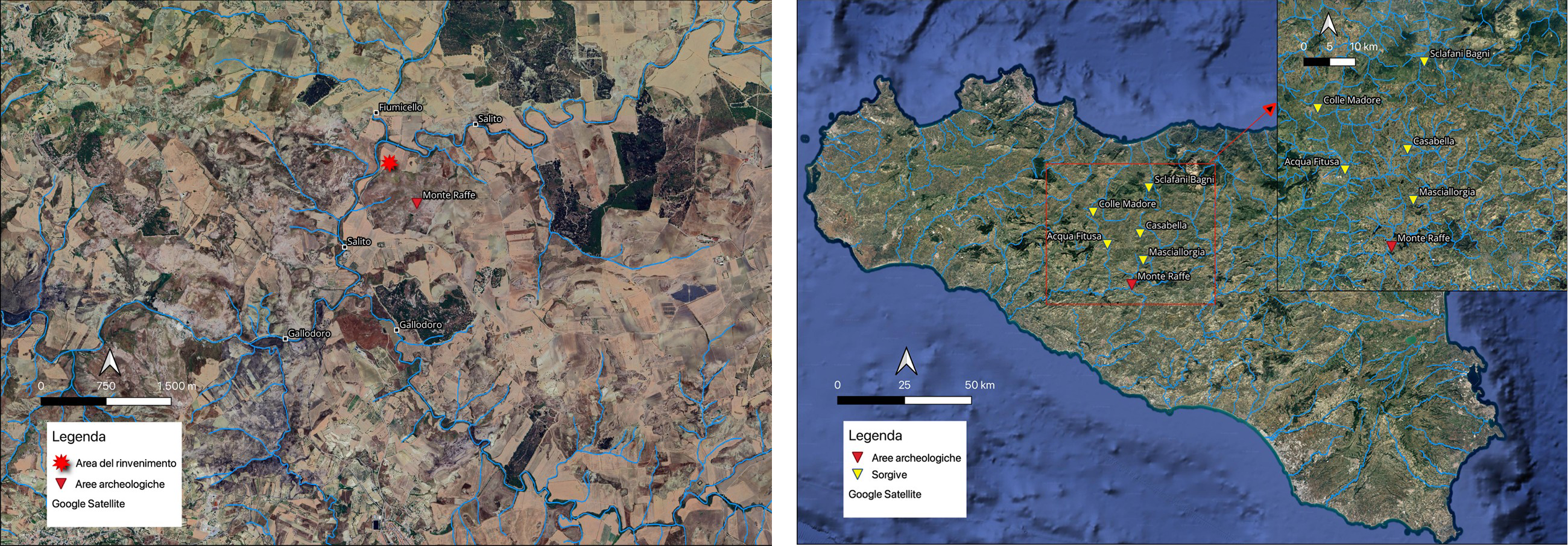
3 | Location of the discovery in relation to the main waterways in the area (graphic design by the authors).
4 | Mapping of the mail thermal water springs near Monte Raffe (graphic design by the authors).
As mentioned, the site of Monte Raffe is in a particularly strategic position from a landscape point of view, being at the confluence of three waterways, which were navigable in ancient times and used as communication routes [Fig. 3]. Furthermore, the location of the extramoenia sanctuary at the foot of the hill, right next to the river, appears unusual, an element that could be linked to the discovery of the head depicting Achelous. At the same time, the location of the Monte Raffe site corresponds precisely to the chalky-sulphurous basin that, as mentioned above, characterises this area (Bonica Santamaria 2001, 22); the richness of thermal springs in central-southern Sicily, which, together with the volcanic territories of the Etna area, has the largest number of springs on the island, is certainly linked to the characteristics of this subsoil.
Furthermore, the entire area between the Platani and Himera rivers is characterised by a concentration of chalky-solifery outcrops which, in many cases, are interspersed with deposits of pyroschist and naphthoschist from which bituminous mineral oil is extracted. This phenomenon, in central-southern Sicily, also affects some natural cavities, where the presence of thermal mineral and sulphurous waters can contribute to the formation of bituminous oils (Cultraro 2016, 129).
The most famous Sicilian thermal springs – namely those of Alì Terme, Terme Vigilatore, Lipari, Vulcano (Messina), Acireale (Catania), Sclafani Bagni and Termini Imerese (PA), Segesta and Gorga (TP) and, finally, Monte Kronio-Fazello cave in Sciacca and Montevago (AG) – have thermal manifestations ranging from 25°C to 58°C, with the exception of the Santa Venera spring in Acireale (22°C). There are also sub-thermal and hypothermal springs, especially in central and south-eastern Sicily, with temperatures around 20°C. Among these, we have chosen to mention those closest to the area under consideration.
Some are mentioned here because they are known exclusively through oral tradition and are often used as watering places for livestock, such as the La Bella spring in Villalba (CL), located in Contrada Casabella, immediately west of the village, or the so-called Pozzo della Mascellorgia, locally known as ‘u Ciurciu’ and located in the area between the centre of Mussomeli (CL) and the site of Polizzello, while others are well-known and studied through the years [Fig. 4].
The ‘Acqua Fitusa’ spring, on the other hand, is in the municipal area of San Giovanni Gemini (AG) at an altitude of 375 m above sea level [Fig. 5]; it emerges at the contact between Holocene limestone and sandy marl. The spring is located inside a cave, where no definite traces of activity related to permanent habitation have been found, except for the oldest phase documented to date, referring to the Epigravettian levels (Gullì 2013, 259). The cave takes its name from the presence of sulphurous water springs and has an internal development of almost 200 m along the main axis, with a series of sub-horizontal galleries of varying heights. In the northern branch of the cave, the remains of numerous burials have been found, disturbed by illegal excavations, which, based on the numerous ceramic fragments, date from the Middle Neolithic to the entire Eneolithic period.
Equally interesting is the site of Sclafani Bagni, located in a dominant position above the Salìto river valley in the northern basin of the Imera; the spring – from which “[…] sulphurous-salty-bromine-iodine thermal water […]” (Bonica Santamaria 2001, 50-51) flows is located at 430 m above sea level, on the left bank of the river, has a temperature of 33-35°C and is immediately conveyed to the pools of the establishment built in 1846, now abandoned. In addition, there are salt springs with lower temperatures in the vicinity.
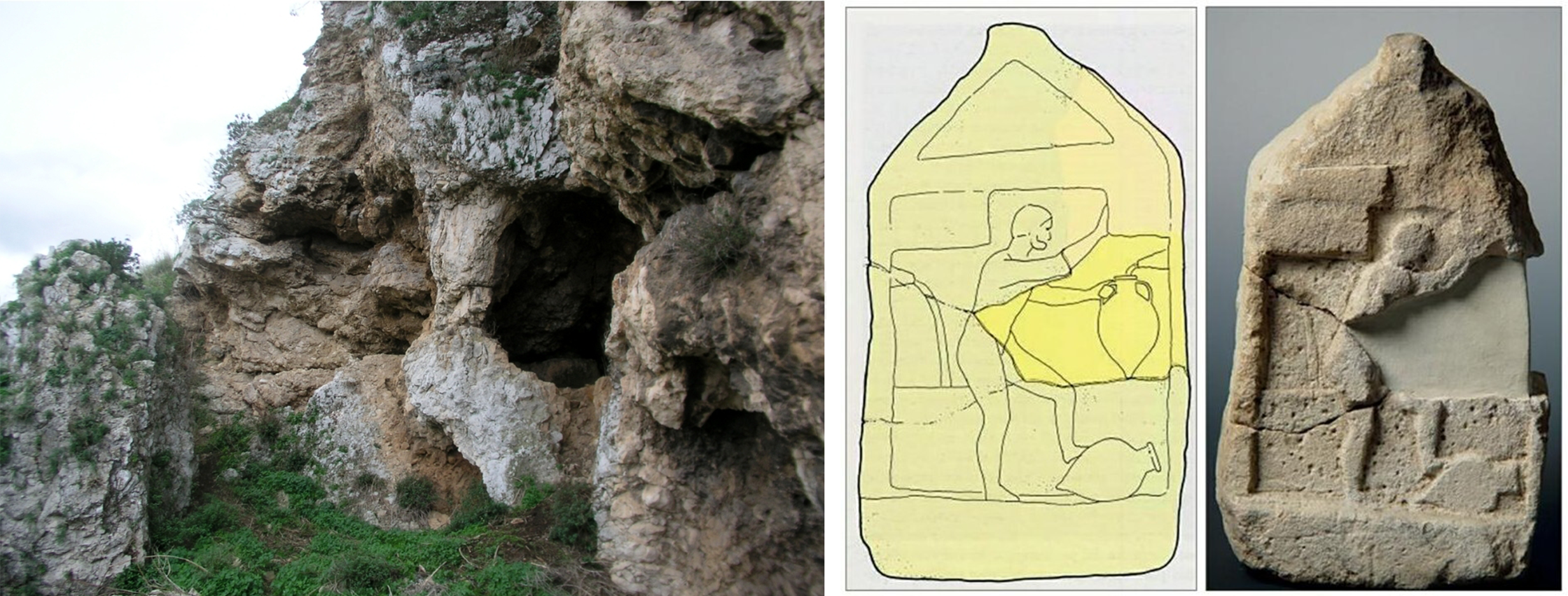
5 | Acqua Fitusa cave in San Giovanni Gemini (AG).
6 | Shrine with Heracles at the fountain in Colle Madore (PA) (Belvedere, Vassallo 2019).
Finally, we cannot fail to mention Colle Madore, located in the indigenous hinterland of Himera, about 1 km from the town of Lercara Friddi. This is an originally Sican settlement, whose origins date back to the 8th-7th century BC, but which, from the mid-6th century BC onwards, underwent a process of profound Hellenisation, favoured by its location along the routes of the Torto and Platani river valleys (Raimondi 2024, 398-399; Belvedere, Vassallo 2019; Vassallo 1999a; Vassallo 1999b; Vassallo 1999c; Chiovaro, Vassallo 2014; Allegro et al. 1993; Allegro 1996; Allegro 1999; Allegro 2008). On the northern side of the hill, there is a sulphurous spring; not far away, in Contrada Savochetta, there are the so-called maccalube, “[…] mud volcanoes with intermittent activity determined by the pressure exerted by gases contained in pockets within the plastic clay-marl complex” (Favarò 1999, 249-250; see also Cultraro 2016, 130). From the sacred area of Colle Madore comes an archaic sandstone shrine depicting Heracles drawing water from a fountain [Fig. 6] (Belvedere, Vassallo 2019; De Bernardin 2012, 306; Raimondi 2024, 398). The figure of Heracles is frequently associated, in sources and cult testimonies, with the presence of thermal waters or hot springs; in this perspective, it seems likely that the presence of a sulphurous spring at the foot of Colle Madore was a determining factor in promoting the spread and acceptance of the cult of the hero in the indigenous environment.
III. Achelous at Monte Raffe: analysis of the discovery
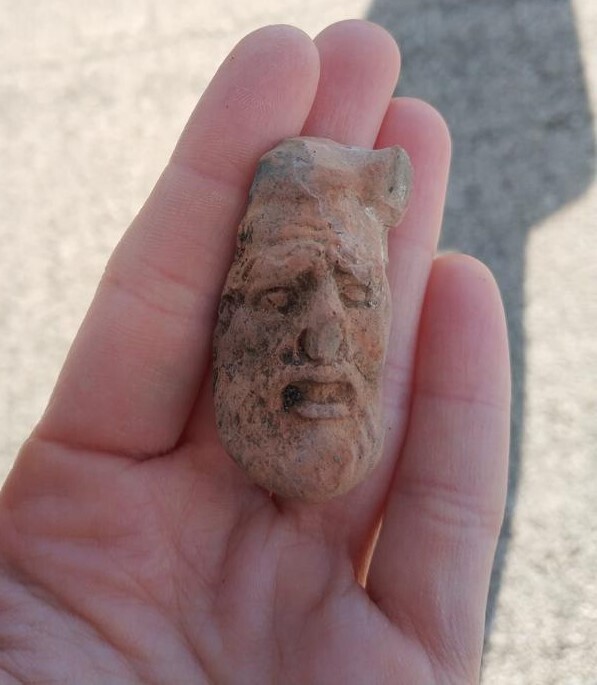
7 | Protome of Achelous found at Monte Raffe (CL), terracotta, second half of the 4th century BC (photo by the authors).
In January 2021, during an inspection carried out by the authors[1] around the Monte Raffe site, a clay protome depicting Achelous was found [Fig. 7]. The head was found in an area overlooking the northern necropolis of the site, just outside the archaeological area, near the road connecting Mussomeli to Bompensiere. The head measures 4.5 cm in height and 2.5 cm in width. The quality of the workmanship is quite refined and, even though it is partially damaged, the details of the face are clear and easily distinguishable. On the front, there is a rather elongated male face, seen from the front, with a thick beard and moustache, a furrowed brow and an expression of intense suffering in the eyes, which are close together and slightly asymmetrical. The arched and well-defined brow creates a shadow over the eye; the full, slightly parted lips are turned downwards. The nose is partially preserved, as is the upper part of the head, where the left horn is recognisable, albeit truncated; the right horn is missing due to the poor state of preservation. The crease of the eyes, the expressiveness of the face, the wrinkles on the forehead and the half-open mouth give the representation an evident pathos, which is also emphasised by the strong chiaroscuro effect. At the back, the artefact is concave, with a well-smoothed surface and a fracture in the lower part, at the neck. From a technical point of view, the protome was made using a single flat matrix technique[2] on orange clay with no traces of engobe or color.
During excavations carried out over the years at the two main archaeological sites in the area, Polizzello and Monte Raffe itself[3], no other depictions of the god Achelous have been found in the territory of Mussomeli, with the exception of a second example unearthed at Girafi, a district located north-east of the municipality of Mussomeli. During some surface surveys, Gianluca Calà discovered an archaic antefix with the protome of Achelous, with bull-like attributes, in association with a clay slab with a palmette in relief [Fig. 8]. The site of the discovery is located within the district of Girafi, on the southern slopes of the so-called ‘Pizzo della Bandiera’, at 882 m above sea level, on a hill overlooking a large part of central Sicily. The district is characterised by a remarkable wealth of springs, probably exploited since ancient times, and the presence of an Achelous in these territories could be justified by the need to divert a spring for agricultural purposes (Calà 2015, 155). These are, as is evident, two very different types of representation: the antefix from Girafi, as far as can be understood from the considerable erosion of the surface, is of the archaic type and probably of local production[4], characterised by geometric features, little chiaroscuro and a lack of expressiveness; it depicts a youthful, beardless Achelous with an oval-shaped face, well-defined eyes and nose, and small bull-like horns.
The protome from Monte Raffe, on the other hand, is closer to the iconographic types common in the Hellenistic period[5], characterised by skilful chiaroscuro, strongly contracted forehead muscles and an expressive face. The discovery of the protome depicting Achelous, a river god rarely attested in inland Sicily – with only one known comparison, represented by the antefix of Girafi – is of particular interest due to its location at the confluence of the Fiumicello and Salìto rivers. This location could suggest the existence of a votive offering of thanksgiving, perhaps connected to the construction or completion of hydraulic works, in keeping with the tradition widespread in the ancient world, of entrusting the regulation of water to divine protection. From this perspective, the presence of the river god could take on an apotropaic value, linked to the canalisation or diversion of the course of the Salìto, aimed at preventing swamping and, consequently, promoting greater fertility of the surrounding soil.
An alternative interpretation could consider the protome to be a decorative element, given its small size and concave rear surface, characteristics that would suggest its use as an applique on a wooden or architectural support. An equally interesting hypothesis could be that the fragment is part of one of those focula widespread in Magna Graecia and Sicily between the 5th and 4th centuries BC, often decorated with appliqués. In this case, a possible functional comparison could be made with a terracotta artefact in the Pietro Griffo Regional Archaeological Museum in Agrigento, which represents a naked male figure interpreted as the Egyptian god Bes. Regarding the interpretation of this artefact, other hypotheses link it more closely to the theatrical masks of Lipari, depicting the servant or a Silenus. Furthermore, the ceramic form in question, which can be classified as a perfume burner, deserves further consideration. This allows us to link the artefact to the theme of fertility: “The fragments of focula with Silenus-shaped appliqués distributed between Magna Graecia and Sicily between the 5th and 4th centuries BC seem to confirm this private significance of the cult of female fertility, especially during childbirth, when the use of hot water was necessary” (Fariselli, Lepore, Mangione 2024; Costanzo 2018).
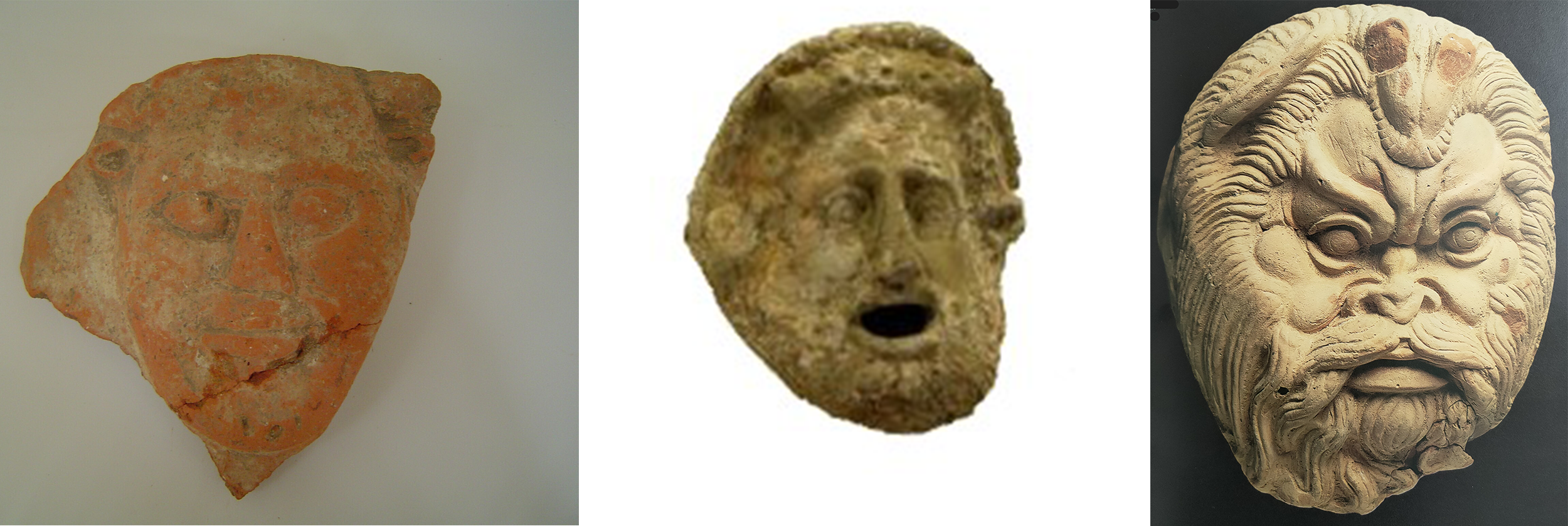
8 | Clay antefix with protome of Achelous found in Contrada Girafi (CL) (Calà 2015).
9 | Polychrome tragic mask with the head of Achelous, from Lipari, tomb 890, first half of the 4th century BC.
10 | Antefix with protome of Achelous, terracotta, late 5th century BC, Regional Archaeological Museum of Agrigento (Sikanie 1985).
However, the absence of reliable stratigraphic data and of a defined context of discovery limits the possibility of formulating conclusive hypotheses about its original function. From a stylistic point of view, the protome is distinguished by its intense chiaroscuro modelling, the asymmetry of the gaze, the furrowed brow and the slightly parted lips: features that refer to the pathetic rendering of the face of Achelous typical of the 4th century BC, subsequently taken up and reworked in the Hellenistic figurative language.
In any case, beyond the Sicilian hinterland, which reveals a very small number of representations of the god, the rest of the island shows many examples that can be used for comparison. This is not the place to review iconographic types and comparisons (already done in Bulgarini, Luvaro 2024), but it is worth mentioning at least the balsamari from the Fusco necropolis in Syracuse (Ciuccarelli 2007, 126; Mussini 2002, 107; Pelagatti, Voza 1972, 94; Isler 1970, 19 n. 106), or from sanctuary contexts in Selinunte (Ciuccarelli 2007, 126; Isler 1970, 141 n. 104, 143 n. 114). Isler, in his monograph dedicated to the god Achelous, even states that all depictions of the androprosopic bull should be interpreted as images of Achelous, thus including those on the main Sicilian coinage (Isler 1970, 80-91). In fact, there are numerous representations of rivers in the form of bulls (Martorana et al. 1993, 89), such as the river Gelas, depicted as a bull with a human face (Ciaceri 1910, 255), or the Amenanos in Catania, depicted with a head adorned with horns and a diadem, surrounded by fish or, on some tetradrachms, in the form of a bull with a beard (Ciaceri 1910, 255).
Expressive solutions that can be put in comparison with the one in Monte Raffe can be found, for example, in a clay theatre mask from Lipari (first half of the 4th century BC) [Fig. 9] and in an antefix from Agrigento (late 5th century BC) (For a more in-depth analysis of the subject of the god Achelous and his significance, particularly in the Sicilian and Magna Graecia contexts, with a list of some possible comparisons, see Bulgarini, Luvaro 2024) [Fig. 10], both characterised by the same emotional tension and the intention to convey a sense of inner suffering.
Based on the iconographic evidence and the chronology of the site, the head of Achelous can be dated to the second half of the 4th century BC, a period that coincides with the final phase of occupation of Monte Raffe. It therefore represents significant evidence of the persistence, in this area of the Sicilian hinterland, of a syncretic religious culture, in which elements of Greek tradition intertwine with local components, giving rise to artistic production of remarkable expressive intensity and symbolic value.
*The topic of this paper has already been presented in “Cronache di Archeologia” 43, 2024, see Bulgarini, Luvaro 2024, where it is possible to find a more in-depth analysis of the subject of the god Achelous and his significance, with a list of iconographic types and possible comparisons; in this paper we would like to present a further investigation into the presence of thermal springs in the vicinity of the site.
Notes
[1] The inspection of the Monte Raffe area, carried out exclusively outside the archaeological site, was carried out as part of a five-week internship at the Municipal Antiquarium of Mussomeli, in conjunction with the authors’ participation in the Advanced Training Course “ArcheoUp: knowing the past to plan the future”, a training and support programme for the launch of cultural and creative enterprises to be established in public spaces, which the Department of Archaeology of the Università Cattolica di Milano has designed within the POR-FSE resources of the Lombardia Region.
[2] As is well known, coroplastic manufacture from Greece, Magna Graecia or other areas of the Mediterranean, especially in the Hellenistic period, was produced exclusively using the matrix technique, in this case unique. For a technical analysis of the preparation of the matrices and the production of the relief works, see Cuomo di Caprio 2007, 225-230.
[3] See the following bibliography for further information: for the Polizzello site, De Miro 1988; Panvini et al. 2009; for the Monte Raffe site, Lagona 1997; Lagona 2003; Congiu 2018; Congiu, Chillemi 2015; Congiu, Chillemi 2009.
[4] According to Calà, this could be an artistic and religious event organised by locals but in a typically Greek manner, with the aim of appeasing the violated source and the god of rivers (Calà 2015, 155).
[5] This chronological horizon can also be hypothesised thanks to the comparisons made by Elena Mussini in Mussini 1998 in the Slovenian context, also considering the revival of the Hellenistic model in the subsequent Roman imperial age.
Bibliography
- Allegro et al. 1993
N. Allegro et al., Il santuario di Athena sul Piano di Imera, in A. Marotta, C.A. Di Stefano (a cura di), Di terra in terra. Nuove scoperte archeologiche nella provincia di Palermo, Palermo 1993, 65-72. - Allegro 1996
N. Allegro, Le fasi dell’abitato di Himera, in AA.VV., Sicilia occidentale e centro-meridionale: ricerche archeologiche nell’abitato. Atti giornate studio Zurigo 1996, 65-80. - Allegro 1999
N. Allegro, Imera, in E. Greco (a cura di), La città greca antica. Istituzioni, società e forme urbane, Roma 1999, 269-301. - Allegro 2008
N. Allegro, L’abitato di Himera, in N. Allegro (ed.), Himera V, Università di Palermo – Dipartimento di Beni Culturali, Palermo 2008, 7-16. - Belvedere, Vassallo 2019
O. Belvedere, S. Vassallo, I thermà loutrà di Termini Imerese dalla presenza mitica di Eracle alle terme romane, in I. Fumadò Ortega, S. Bouffier, B.A. Robinson (eds.), Ancient Waterlands, Aix-en-Provence 2019, 183-194. - Belvedere 2000
O. Belvedere, Carta archeologica del territorio del Comune di Mussomeli, Istituto di Archeologia dell’Università di Palermo, 2000. - Bonica Santamaria 2001
M.L. Bonica Santamaria, Il termalismo in Sicilia, “Archivio storico messinese” 82 (2001), 17-103. - Bulgarini, Luvaro 2024
S. Bulgarini, A. Luvaro, Acheloo e il culto delle acque in Sicilia: il caso di Monte Raffe, “Cronache di Archeologia” 43 (2024), 35-58. - Calà 2015
G. Calà, Una dorsale montuosa che unisce l’Halykos al Belici: risultati delle ricognizioni, in R. Panvini, M. Congiu (a cura di), Indigeni e Greci tra le valli dell’Himera e dell’Halykos, Caltanissetta 2015, 150-165. - Chiovaro, Vassallo 2014
M. Chiovaro, S. Vassallo (a cura di), Colle Madore: guida breve, Palermo: Regione siciliana, Assessorato dei beni culturali e identità siciliana, Dipartimento dei beni culturali e identità siciliana, 2014. - Ciaceri 1910
E. Ciaceri, Culti e miti nella storia dell’antica Sicilia, Catania 1910. - Ciuccarelli 2007
M.R. Ciuccarelli, Acheloo ctonio dalla Magna Grecia all’Etruria, Mediterranea, “Quaderni Annuali dell’Istituto di Studi sulle civiltà italiche e del Mediterraneo antico del Consiglio Nazionale delle Ricerche” 3 (2006), 121-140. - Congiu 2018
M. Congiu, Alcuni corredi inediti dalle necropoli di Monte Raffe di Mussomeli, in C. Malacrino, S. Bonomi (a cura di), Ollus leto datus est. Architettura, topografia e rituali funerari nelle necropoli dell’Italia meridionale e della Sicilia tra antichità e medioevo, Reggio Calabria 2018, 419-426. - Congiu, Chillemi 2009
M. Congiu, V. Chillemi, Monte Raffe di Mussomeli. considerazioni topografiche dalle nuove indagini, in M. Congiu, C. Miccichè, S. Modeo (a cura di), Eis Akra. Insediamenti d’altura in Sicilia dalla Preistoria al III sec. a.C., Caltanissetta-Roma 2009, 117-147. - Congiu, Chillemi 2015
M. Congiu, V. Chillemi, Vecchie e nuove acquisizioni da Monte Raffe, in R. Panvini, M. Congiu (a cura di), Indigeni e Greci tra le valli dell’Himera e dell’Halykos, Caltanissetta 2015, 233-264. - Costanzo 2018
D. Costanzo, Spazi e rituali negli abitati di Magna Grecia e Sicilia, in C. Malacrino, M. Cannatà (a cura di), Oikos. La casa in Magna Grecia e Sicilia, Reggio Calabria 2018, 149-160. - Cultraro 2016
M. Cultraro, Elementi di interesse paletnologico nei depositi di olio bituminoso della Sicilia centro-occidentale, in E. Mangani, A. Pellegrino (a cura di), Ghia To Philo Mas. Scritti in ricordo di Gaetano Messineo, Roma 2016, 129-136. - Cuomo di Caprio 2007
N. Cuomo di Caprio, Ceramica in archeologia 2. Antiche tecniche di lavorazione e moderni metodi di indagine, Roma 2007. - De Bernardin 2012
M. De Bernardin, Per un’analisi della figura di Eracle in Sicilia: dal VII sec. a.C. all’età romana, in C. Ampolo (a cura di), Sicilia occidentale. Studi, rassegne, ricerche, Pisa 2012, 305-312. - De Miro 1962
E. De Miro, La fondazione di Agrigento e l'ellenizzazione del territorio fra il Salso e il Platani, “Kokalos” (1962), 122-152. - De Miro 1988
E. De Miro, Polizzello, centro della Sicania, “Quaderni di Messina” (1988), 25-41. - Fariselli et al. 2024
A.C. Fariselli, G. Lepore, D. Mangione, A proposito del cosiddetto ‘Bes’ di Agrigento, “OTIVM. Archeologia e Cultura del Mondo Antico” 17, (2024), 1-30. - Favarò 1999
B. Favarò, Colle Madore visto dal geologo, in S. Vassallo (a cura di), Colle Madore. Un caso di ellenizzazione in terra sicana, Palermo 1999, 249-254. - Griffo 1958
P. Griffo, Sulle orme della civiltà gelese, Agrigento 1958. - Gullì 2013
D. Gullì, L’occupazione delle grotte in età preistorica nel territorio agrigentino, F. Cucchi, P. Guidi (a cura di), Atti del XXI Congresso Nazionale di Speleologia “Diffusione delle conoscenze”, Trieste 2013, 258-266. - Isler 1970
H.P. Isler, Acheloos. Eine Monographie, Bern 1970. - Lagona 1997
S. Lagona, Note sul centro a terrazze a Raffe di Mussomeli, “Sicilia Antiqua – An International Journal of Archaeology” (1997), 179-180. - Lagona 2003
S. Lagona, Monte Raffe, in R. Panvini (a cura di), Caltanissetta. Il Museo archeologico. Catalogo, Caltanissetta 2003, 235-236. - Malacrino, Bonomi 2018
C. Malacrino, S. Bonomi (a cura di), Ollus leto datus est. Architettura, topografia e rituali funerari nelle necropoli dell’Italia meridionale e della Sicilia tra antichità e medioevo, Reggio Calabria 2018. - Martorana et al. 1993
G. Martorana, F. Angelini, N. Cusumano, R. Greco, Dizionario dei culti e miti nella Sicilia antica, Palermo 1993. - Mussini 1998
E. Mussini, La rappresentazione del dio fluviale Acheloo in area slovena, “Arheološki vestnik” (1998), 261-270. - Mussini 2002
E. Mussini, La diffusione dell’iconografia di Acheloo in Magna Grecia e Sicilia. Tracce per l’individuazione di un culto, “Studi Etruschi” 65-68 (2002), 91-120. - Panvini et al. 2009
R. Panvini, C. Guzzone, D. Palermo (a cura di), Polizzello. Scavi del 2004 nell’area del santuario arcaico dell’acropoli. Regione Siciliana – Assessorato dei Beni Culturali, Ambientali e della Pubblica Istruzione, Viterbo 2009. - Pelagatti, Voza 1973
P. Pelagatti, G. Voza, Archeologia nella Sicilia Sud Orientale. Catalogo della mostra, Siracusa 1973. - Portale 2009
E.C. Portale, Coroplastica votiva nella Sicilia di V-III secolo a.C.: la stipe di Fontana Calda a Butera, “Sicilia Antiqua” (2009), 9-58. - Raimondi 2024
G. Raimondi, I Santuari delle Ninfe. Il paesaggio dell’acqua in Sicilia e la sua storia, Tesi di Dottorato, Università degli Studi di Catania (a.a. 2022-2023), Catania 2024. - Sole 2012
L. Sole, Gli Indigeni e la moneta. Rinvenimenti monetali e associazioni contestuali dai centri dell’entroterra siciliano, Caltanissetta-Roma 2012. - Sole 2017
L. Sole, Interazioni tra migranti e popolazioni locali nella Sicilia centrale del IV sec. a.C., in R. Panvini (a cura di), Migrazioni e commerci in Sicilia. Modelli del passato come paradigma del presente, Palermo 2017, 263-276. - Tramontana 2012
E. Tramontana, Fiumi e sorgenti. L’importanza dell’acqua nel sistema insediativo nella Sicilia centro-meridionale indigena, in A. Calderone (a cura di), Cultura e religione delle acque, Roma 2012, 271-299. - Vassallo 1999a
S. Vassallo (a cura di), Colle Madore. Un caso di ellenizzazione in terra sicana 1. Il sito, lo scavo, Palermo 1999. - Vassallo 1999b
S. Vassallo (a cura di), Colle Madore. Un caso di ellenizzazione in terra sicana 2. Catalogo, Palermo 1999. - Vassallo 1999c
S. Vassallo (a cura di), Colle Madore. Un caso di ellenizzazione in terra sicana 3. Contributi vari, Palermo 1999.
Abstract
This paper aims to illustrate a previously unseen depiction of the river god Achelous, in the form of a protome, which was discovered by chance in January 2021 during an inspection carried out by the authors near the site of Monte Raffe, located in the municipality of Mussomeli, in the province of Caltanissetta. The finding is of considerable interest not only for its iconographic and formal characteristics, but also for the territorial context in which it was identified, which is still unknown and only partially explored. We intend to provide an overview of the Monte Raffe site, outlining its main topographical and archaeological characteristics, even though its stratigraphic legibility has been compromised by numerous illegal excavations. The analysis aims to understand the possible relationship that existed in ancient times between the cult or symbolism of Achelous and the specific territory of the Raffe mountain. In addition, it was deemed appropriate to map the thermal and hypothermal springs located in the immediate vicinity of the site to outline the geo-environmental picture of the area more precisely.
keywords | Acheloos; Monte Raffe; rivers; Thermal waters.
La Redazione di Engramma è grata ai colleghi – amici e studiosi – che, seguendo la procedura peer review a doppio cieco, hanno sottoposto a lettura, revisione e giudizio questo saggio
(v. Albo dei referee di Engramma)
Per citare questo articolo / To cite this article: Sofia Bulgarini, Andrea Luvaro, The god among the rivers. Mount Raffe (Mussomeli, Sicily) and the cult of Achelous, “La Rivista di Engramma” n. 231, gennaio/febbraio 2026.