Introduction
.jpg)
1 | Map of aquae calidae, baths and ancient towns (A. Younès)
Water played a crucial role in the cities of Africa Proconsularis. Local authorities captured both sources and groundwater, and collected rainwater to meet various water needs in a province characterized by a Mediterranean climate. A considerable proportion of this water was allocated to the baths, as each city was equipped with one or more thermal complexes.
In addition to baths intended for regular bathing, the inhabitants of Africa Proconsularis also frequented hot springs (aquae calidae) where they built facilities designed to exploit their therapeutic and healing properties. Although the study of these thermal complexes is essential for understanding an aspect of Roman society in Africa Proconsularis, this topic has received far less scholarly attention than that devoted to the urban baths of the province. The few publications dealing with hot springs and thermal complexes are based mainly on literary and epigraphic sources.
Beyond the valuable information provided by these classical sources, archaeological, physicochemical, mineral, and therapeutic data now offer new insights that enrich our understanding of thermalism in Africa Proconsularis.
For several reasons – including the large number of aquae calidae and bathing complexes, as well as the constraints of this paper’s length etc. – this study focuses exclusively on the hot springs (aquae calidae) and thermal installations of ancient Tunisia. The number of identified hot springs with simple constructions (such as pipes or basins) or with preserved thermal complexes in ancient Tunisia now exceeds those recorded in ancient texts and inscriptions (Jouffroy 1992, 87-99; Pettenὸ 1998, 133-148; Aounallah 2018, 267-272) [Fig. 1]. Indeed, sixteen (16) aquae calidae and thermal constructions have been registered: Aqua calida of Utica, Aquae Persianae, Aquae calidae of Capsa, Aquae Tacapitanae, Aquae, Aquae calidae of Theudalis (!), Ad Aquas, Aquae Aptuccensium, Aquae Traianae, Aquae Carpitanae, Aqua calida of Wadi Mellègue, Aqua calida of Jebel Oust, Aqua calida of Zriba, Aqua calida of Jedidi, Aqua calida of Maamar, Vaporium of Jebel Trozza [Fig. 1].
These sites are located within Roman cities or their territories, and the exploitation of certain thermal springs may date back to the Punic period.
This paper examines the hot springs located both within Roman cities and in their surrounding territories, providing a synthesis of their geographical distribution, the thermal structures built around them, and the relationship between the springs, therapeutic treatments, and water cults.
Aquae calidae and thermal facilities in the ancient cities
Among the sixteen (16) currently identified aquae calidae and thermal structures, five (5) are located in urbes Romanae: Aqua calida of Utica, Aquae Persianae, Aquae calidae of Capsa, Aquae Tacapitanae, and Aquae.
I. Aqua calida of Utica
The hot spring known as Ain el-Hammam is located at the site of the ancient city of Utica. Recent archaeological excavations have revealed that the spring was associated with an early temple dating from the second half of the 7th to the mid-4th century BC. This structure was later replaced by a second temple, built directly over the earlier one in the mid-4th century BC and destroyed around the end of the 2nd or the beginning of the 1st century BC (Ben Jerbaia et al. 2021, 61-90). The spring supplied a quadrangular basin within the second temple, and it is likely that it had also provided hot water to the earlier temple. According to the physicochemical and mineral analyses conducted by the Thermal Office, the spring’s flow rate is 1 L/s, and the water temperature does not exceed 38.5°C. The major elements identified – calcium (54 mg/L), magnesium (25 mg/L), sodium (215 mg/L), potassium (16.7 mg/L), bicarbonates (348 mg/L), sulphates (60 mg/L), and chlorides (270 mg/L) indicate that the water is low-sodium chloride in composition (Office du Thermalisme 2000, 24). Archaeological evidence suggests that the spring was connected to the Phoenician-Punic temple, allowing worshippers to honour a deity – currently unidentified – while benefiting from the therapeutic properties of the sodium chloride hot water. Today, local inhabitants continue to use the spring water both to relieve rheumatological pain and to irrigate their crops.
II. Aquae Persianae, Ad Aquas, Naro (Hammam-Lif) Aqua calida of Utica
Two hot springs are attested in the present-day city of Hammam-Lif, the successor of the Roman city of Naro: Ain Dar el-Bey and Ain el-Aryan. Located close to one another, both were already known in Roman times, as attested by Latin literary sources. In Florida XVI, Apuleius reports that he visited the Aquae Persianae to treat a sprain with the waters of the hot springs: Contulerim me ad persianas aquas, gratissima prorsus et sanis natabula et aegris medicabula (Apuleius, Florida, XVI). In 1854, an inscription dedicated to the God of medicine, Aesculapius, was discovered during the excavation of a probable Roman thermal complex at Hammam-Lif. The inscription reads: Aesculapio /T(itus) Iulius Perseus cond(uctor) IIII p(ublicorum) Africae (CIL, VIII, 997; Guyon 1864, 4 et seq.; Toutain 1912, 335; Jouffroy 1992, 87-99; Pettenὸ 1998, 133-148; Ben Seddik 2010, t. 2, 27). The dedication, carved on the architrave of the building, dates from the early Roman Empire (2nd-early 3rd century AD) and was commissioned by Titus Iulius Perseus. During the construction of the Dar el-Bey hammam in the mid-18th century, archaeological remains very likely belonging to Roman baths were unearthed (Abidi-Belhaj 2016). Today, the spring of Ain Dar el-Bey supplies water to Hammam Sidi Bourigua, formerly known as Dar el-Bey hammam, and later as Hammam En-Nsa [Fig. 2]. The spring has a flow rate of 2 L/s and a temperature of 43 °C. Its mineral composition indicates a highly chlorinated, sodium-rich, and sulphated water, with major element concentrations exceeding those of the Utica spring: calcium (960 mg/L), magnesium (162.94 mg/L), sodium (3776.60 mg/L), potassium (124.02 mg/L), bicarbonates (622 mg/L), sulphates (1056 mg/L), chlorides (7268 mg/L), fluorides (2.80 mg/L), and nitrates (7.17 mg/L). Trace elements are quite abundant: SiO₂, Sr, Rb, B, Mn, Li, Fe, Zn, Cu, Ni, Pb (Office du Thermalisme 2000, 64). The spring of Ain el Aryan supplies thermal water to the Assouri hammam, also known as Hammam Sidi al Aryan, which is currently closed. Its flow rate is 2.5 L/s and its temperature reaches 46°C. Its mineral composition is close to that of the previous spring. The concentrations of major elements are as follow: calcium (960 mg/L), magnesium (182.40 mg/L), sodium (3776.60 mg/L), potassium (124.02 mg/L), bicarbonates (597 mg/L), sulphates (1116 mg/L), chlorides (7963 mg/L), fluorides (2.70 mg/L), and nitrates (1.94 mg/L). The trace elements include SiO₂, Sr, Ba, B, Rb, Mn, Li, Fe, Zn, Cu, Co (Office du Thermalisme 2000, 67).
III. Aquae calidae of Capsa
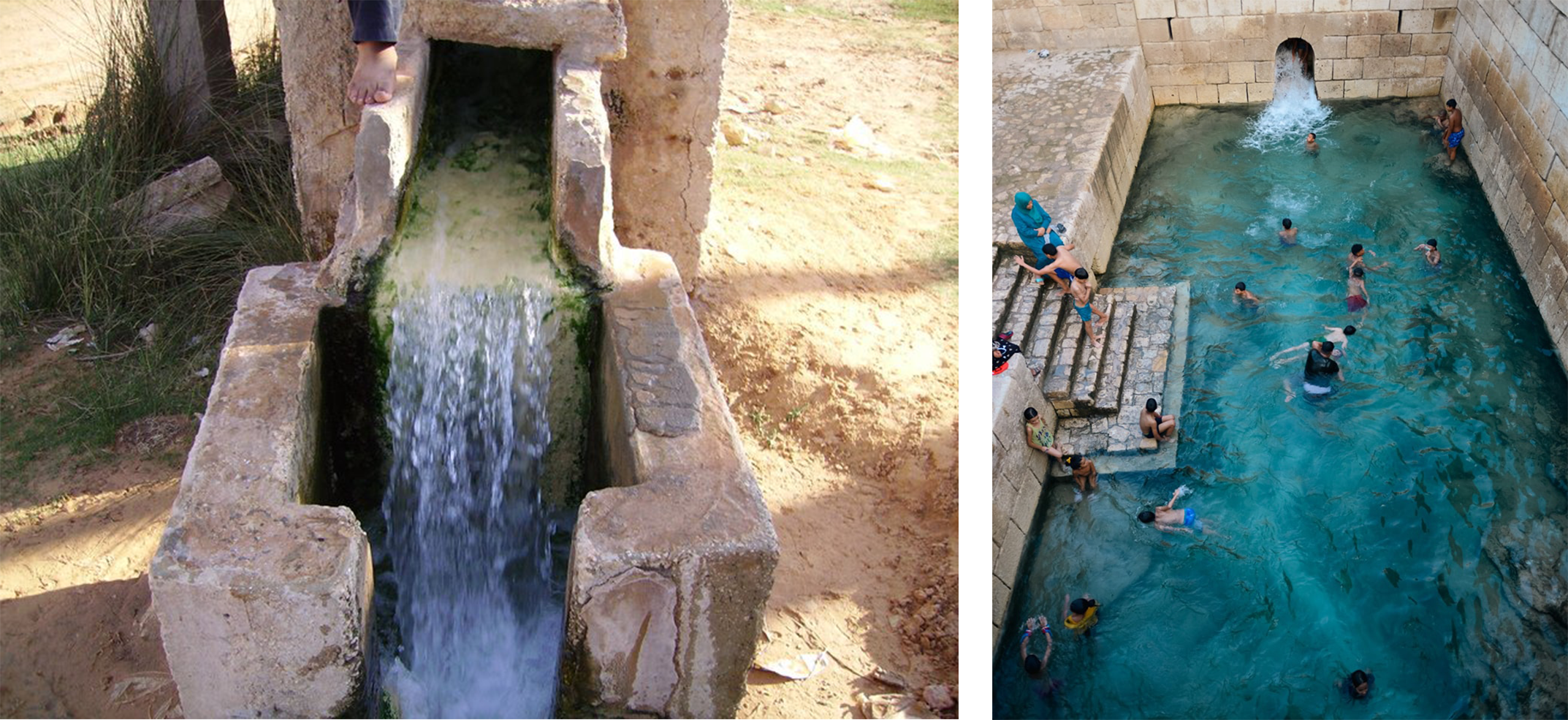
3a-b | Ain Dar el Bey channel and Roman basin (Termil errjel).
The baths were built in the ancient city of Capsa (modern-day Gafsa). Their existence is attested by an inscription dedicated by Cnaeus Iunius to Neptune and the Nymphs, as well as by archaeological remains (CIL VIII, 120; Shaw 1743, 271; El Bekri 1913, 100-102; Saumagne 1962, 520-523; Trousset 1993, 1758-1759). Today, only two quadrangular basins (known as Roman pools) remain. They were built in opus quadratum and are connected by an underground channel. The larger pool, called Termil Errjel/Hammam Errjel, measures 19 meters in length and 16 meters in width [Fig. 3]. The smaller pool, called Termil Ennsâ/Hammam Ennsâ, measures 15 meters in length and 6.5 meters in width. The Tunisian term Termil is derived from a distortion of the Latin word thermes. Accordingly, Termil Errjel can be interpreted as the “Baths for Men” (Errjel means “men” in Arabic), while Termil Ennsâ refers to the “Baths for Women” (Ennsâ means “women” in Arabic). The two basins are supplied by a hot sodium-chloride spring (called Ain Dar el Bey) located beneath the Hafsid Kasbah (citadel) [Fig. 3]. Physicochemical and mineral analyses confirm that the spring water is sodium-chloride and sulphurous. Its flow rate is 26 L/s (pumped) and its temperature is moderately warm, at 28 °C. The concentrations of both major and trace elements are slightly lower than those recorded in the Aquae Calidae Persianae. Major elements include calcium (760 mg/L), magnesium (170.24 mg/L), sodium (3460 mg/L), potassium (170 mg/L), bicarbonates (390.40 mg/L), sulphates (1817 mg/L), chlorides (6514.25 mg/L), fluorides (1.14 mg/L), and no nitrates. Trace elements are: SiO₂, Sr, Ba, B, Rb, Mn, Li, Fe, Zn (Office du Thermalisme 2000, 158). In addition to the thermal spring that once supplied the Roman baths in the city, another thermal spring is located at Sidi Ahmed Zarrouk, about 5 km northwest of Gafsa. A modern thermal facility has recently been constructed there, and the spring has been replaced by a deep borehole to ensure an adequate flow of hot water.
IV. Aquae Tacapitanae / Hammat Gabès
Aquae Tacapitanae is located approximately 31 km west of the ancient city of Tacape (modern-day Gabès). It was mentioned both in the Antonine Itinerary, 74,1 and 78,2-3 (Cuntz 1929), and in the Peutinger Table, segment VI, 3-4 (Weber 1976). Today, the site of the ancient Roman town is occupied by the modern city of El Hamma, which, like its predecessor, owes its name to the abundance of hot water (Shaw 1743, 277; Guerin 1862, t. 1, 235; Tissot 1888, t. 2, 645 and 699). According to archaeological remains uncovered during development and construction work in the modern town, as well as interviews with local residents, three thermal springs are located in the centre: Ain el Borj, Ain Sidi Abdelkader, and Ain Ezzairi. These three springs currently supply three modern hammams: Hammam el Borj, Hammam Ezzairi, and Hammam Sidi Abdelkader. During the construction work of the municipality and Hammam el Borj, the ruins of a significant ancient thermal complex were uncovered [Fig. 4]. Physicochemical and mineral analyses of Ain el Borj attest that the spring water is sulphated-calcium and sodium-chloride rich. Its temperature is 40 °C, and the concentrations of major elements are lower than those of the previously two springs: calcium (424.65 mg/L), magnesium (74.20 mg/L), sodium (506.57 mg/L), potassium (99.13 mg/L), bicarbonates (183 mg/L), sulphates (1187.05 mg/L), chlorides (883.83 mg/L), fluorides (0.55 mg/L), and nitrates (2.64 mg/L). Trace elements are comparable to those found in the Capsa baths spring: SiO₂, Sr, B, Rb, Mn, Li, Fe, Zn, Cu (Office du Thermalisme 2000, 161). Outside the town of El Hamma, in the village of El Kasr, there is another thermal spring mentioned by V. Guérin (Guerin 1862, t. 1, 235). A small modern thermal facility has been constructed on the site of an older one, of which only compartments built in opus quadratum remain. The hypothesis that these structures belonged to a Roman thermal complex is plausible. An archaeological investigation of the site would not only uncover additional ancient remains but also provide further insight into the architecture, operation, and dating of the complex.
V. Aquae / Hammet el Jerid
Aquae, corresponding to the present-day town of Hammat Gabès, is located approximately 10 km north of the Roman city of Tusuros (modern-day Tozeur). The ancient name Aquae reflects the abundance of springs in the area, including hot springs. It was mentioned in the Acts of the Conference of Carthage in 411 (Lancel 1991, 1308). Authors from the Medieval period such as Al-Marrakchi (Chtioui, Sila 2021, 32) and Ibn Chabbat (Chtioui, Sila 2021, 32), as well as visitors and travellers from the 18th and 19th centuries, such as Al-Sijilmassi (Chtioui, Sila 2021, 32-33), Al-Warthilani (Chtioui, Sila 2021, 33), De Florac (Chtioui, Sila 2021, 34), V. Guérin (Guerin 1862, t. 1, 269), and Ch. Tissot (Tissot 1888, t. 2, 683), all noted the hot springs and praised their therapeutic virtues. One of the ancient and still-known thermal springs is Ain Sidi Haraket [Fig. 5]. According to accounts by 18th and 19th centuries’ visitors and travellers, this spring – whose temperature exceeds 50 °C – flows into two adjacent ancient basins built with finely cut stone (Guerin 1862, t. 1, 269; Tissot 1888, t. 2, 683). The first basin is oblong, and the second is square. It is very likely that both basins were part of an ancient thermal complex dating from the Roman period (Chtioui, Sila 2021, 73). Today, the two basins are connected to the small structure of the Marabout of Sidi Haraket. An archaeological investigation around the marabout would likely uncover remains of the Roman baths.
Aquae calidae and thermal facilities in the territories of ancient cities
Eleven hot springs with associated thermal installations have been identified within the territories of Roman cities: Aquae Calidae of Theudalis, Ad Aquas, Aquae Aptuccensium, Aquae Traianae, Aquae Carpitanae, Aqua Calida of Wadi Mellègue, Aqua Calida of Jebel Oust, Aqua Calida of Zriba, Aqua Calida of Jedidi, Aqua Calida of Maamar, and Vaporium of Jebel Trozza.
VI. Aquae calidae of Theudalis (Hr Aouan) (!)
Three hot springs are located about 5 km west of the Roman city of Theudalis and only a few hundred meters from Jebel Ichkeul: Ain Sidi Ben Abbès, Ain Sidi Abdelkader, and Ain Djerab (or Ain Ennegrez). These springs lie at a low elevation, not exceeding one meter. According to the Archaeological Atlas of Tunisia (AAT) 1892, sheet n°6, Jebel Ichkeul, site 6, the remains of an ancient thermal complex are still visible at Ain Sidi Abdelkader. In modern times, three small hammams were constructed around the hot springs – Hammam Sidi Abdelkader, Hammam Sidi Ben Abbès, and Hammam Djerab (also known as Hammam Ennegrez) – all of which are currently closed. Archaeological investigation, particularly around Hammam Sidi Abdelkader, could reveal further remains of the ancient bathing complex. Hydrochemical analyses show that the three springs are highly mineralized, characterized by sodium-chloride, sulphated-calcium, and magnesium-rich waters.
• Sidi Abdelkader Spring
Temperature 43 °C. The concentrations of major elements are higher than those recorded at Hammat Gabès spring and comparable to those of Hammam Lif: calcium (1120 mg/L), magnesium (182.40 mg/L), sodium (3000 mg/L), potassium (78 mg/L), bicarbonates (353 mg/L), sulphates (2253.36 mg/L), chlorides (5502.50 mg/L), fluorides (1 mg/L), and traces of nitrates. Trace elements differ slightly from those observed at Capsa and Hammat Gabès, with the presence of Sr, Si, B, Ba, Mo, Li, Fe, Zn, Cu (Office du Thermalisme 2000, 16).
• Sidi Ben Abbès Spring
Temperature 42 °C. The concentrations of major elements are similar to those of the previous spring: calcium (1240 mg/L), magnesium (121.60 mg/L), sodium (3160 mg/L), potassium (74 mg/L), bicarbonates (366 mg/L), sulphates (2200.50 mg/L), chlorides (5573.50 mg/L), fluorides (1 mg/L), with traces of nitrates. Trace elements have not been determined (Office du Thermalisme 2000, 14).
• Hammam Djerab Spring
Temperature 45 °C and a flow rate of 0.3 L/s. The concentrations of major elements differ from those of the other two springs: calcium (900 mg/L), magnesium (668.80 mg/L), sodium (2600 mg/L), potassium (69 mg/L), bicarbonates (353.80 mg/L), sulphates (952.50 mg/L), chlorides (4686 mg/L), fluorides (1.55 mg/L), and traces of nitrates. Trace elements have not been determined (Office du Thermalisme 2000, 20).
The archaeological remains belong to an ancient thermal complex that very likely depended on the nearby Roman city of Theudalis. Further excavation would provide valuable information concerning the size, architectural features, and chronology of the structure.
VII. Ad Aquas / Hammam Ali Daoua / Argoub Assaboun
The hot spring is located about 1.5 km west of the Roman city of Thuburnica and 11 km north of the modern town of Ghardimaou. It represents the most significant spring outlet emerging from the bed of the wadi el-Hammam. This main outlet was tapped and channelled to supply the baths since Antiquity. Archaeological remains – including small masonry blocks, limestone rubble, and large stone blocks – are still visible on the surface near the modern Hammam Sidi Ali Daoua. It is very likely that these remains belong to the Roman thermal complex associated with Thuburnica, over which the modest modern hammam was later constructed [Fig. 6]. Excavations in the vicinity of the hammam would likely uncover additional remains of the Roman thermal complex. The physicochemical and mineral analyses indicate that the spring water is sulphated, highly mineralized, characterized by a typical sodium–chloride hydro-chemical facies, and enriched in manganese. Its flow rate is 0.5 L/s and the temperature reaches 40 °C. The concentrations of major elements are generally higher than those of the previously described springs: calcium (986 mg/L), magnesium (249.28 mg/L), sodium (17128 mg/L), potassium (3.90 mg/L), bicarbonates (707.60 mg/L), sulphates (3456 mg/L), chlorides (25915 mg/L), and fluorides (1.90 mg/L). Trace element concentrations (Sr, Mn) are lower than those in the preceding sources (Office du Thermalisme 2000, 49-50).
VIII. Aquae Aptuccensium / Hammam Biadha
Aquae Aptuccensium is located approximately 4 km north-northwest of the Roman city of Aptucca (Henchir Semmech, also known as Henchir Oudeka), and about 24 km west-southwest of the modern town of Teboursouk. The existence of a thermal complex at this site is confirmed by an inscription dedicated to the healing god Aesculapius, similar to the one found at Aquae Persianae. The inscription reads:
Aesculapium arg(enteum) / libris quinque et sen(is) /Aquis Aptuccensium, /Aemilia Tertulla Marciana /Cornelia Rufina Africania/na, clarissima f(emina), consecrauit eadem/que Marciana signum mar/moreum Aesculapi(i) d(onum) d(edit) (Ben Seddik 2010, t. 2, 26).
The archaeological remains of the Roman thermal complex are partially visible today, as the modern hammam (Hammam Biadha) was constructed over part of the ancient structure. Among the preserved elements are large rock-cut rooms coated with hydraulic mortar, hot-water conduits, and cisterns [Fig. 7]. It is very likely that this Roman bath complex dates to a period after the reign of Emperor Hadrian (117–138 AD) (Diez De Velasco 1998, 109). Given its proximity to the Roman city of Aptucca, this Roman bath complex was most probably dependent upon that ancient city. At present, the spring feeding Hammam Biadha is captured through a rock-cut well (or grotto), approximately 20 meters deep and 5 meters wide. It has a flow rate of 3 L/s and a temperature of 45 °C. Its mineral composition indicates a sodium-chloride spring rich in CO₂. The concentrations of both major and trace elements are higher than those recorded at Ad Aquas. Major elements include calcium (1540 mg/L), magnesium (644.50 mg/L), sodium (19056 mg/L), potassium (248.68 mg/L), bicarbonates (1647 mg/L), sulphates (3778 mg/L), chlorides (33015 mg/L), fluorides (0.84 mg/L), with traces of nitrates. The trace elements are comparable to those of Aquae Persianae: SiO₂, Sr, Ba, B, Mn, Li, Fe, Zn, Cu, Ni, Rb (Office du Thermalisme 2000, 109).
IX. Aquae Traianae / Hammam Saiala
Aquae Traianae is located approximately 5 km south-southwest of Beja (ancient Vaga). The existence of the spring is attested by a dedication made by the imperial freedman, Marcus Ulpius Menophoon to the Genius Aquarium Traianarum – Genio Aquar(um) Traian(arum) (ILAfr. 440; Jouffroy 1992, pp. 87-99; Pettenὸ 1998, 133-148) – as well as by a fragmentary inscription referring to the restoration of the bath complex (CIL, VIII, 14457; Jouffroy 1992, 94), and by the archaeological remains of the Roman baths themselves (AAT 1892, Sheet n°26, Wadi Zerga, site 2; Vincent 1884, 38; Monchicourt 1913, 131-134). Today, the site is partially covered by the modern Hammam Saiala. The remains of the Roman thermal complex are still visible, consisting of masonry blocks, rubble and block stones [Fig. 8]. According to H. Jouffroy (1992, 94), “this was most likely a small thermal station located on an imperial estate”, administratively linked to the city of Vaga. A preventive archaeological investigation would likely reveal additional buried remains of the ancient baths – a particularly urgent task given the ongoing construction in the vicinity of the modern hammam. At present, the spring supplying Hammam Saiala is captured through a well of 8 meters deep. It has a flow rate of 1 L/s and a temperature of 46 °C. Its mineral composition indicates a a sodium-chloride-rich thermal spring. The concentrations of both major and trace elements are lower than those recorded at Aquae Aptuccensium. Major elements include calcium (280 mg/L), magnesium (121.60 mg/L), sodium (4300 mg/L), potassium (28 mg/L), bicarbonates (355 mg/L), sulphates (903 mg/L), chlorides (7455 mg/L), fluorides (4.4 mg/L), with traces of nitrates. The trace elements identified include SiO₂, Sr, B, Mn, Li, Fe, Rb (Office du Thermalisme 2000, 39).
X. Aquae Carpitanae / Korbous
The hot springs of Korbous are well known from both ancient literary sources and archaeological as well as epigraphic evidence. Titus Livius (History, XXX, 24) mentions the presence of Aquae Calidae, situated opposite Carthage, near which part of the transport fleet of Cn. Octavius was lost. Strabo (Geography, XVII, 3, 16) also refers to Thermae located along the Cap Bon coast, between the town of Tunis and the Latomiae. The Stadiasmus Maris Magni (Stadiasmus 1855, 120, 1) places Thermae between Karpis and a northern city, probably Missua. An inscription dating from 44–43 BC, discovered during construction work near the thermal hotel in 1907 (Belhadj Aissa 1982, 27), reveals that the quaestor and pro-praetor Decimus Laelius Balbus financed the construction of a thermal complex comprising steam rooms, an area for cleansing and massage with the strigil, and an open solarium. The inscription reads:
D(ecimus) Laelius D(ecimi) F(ilius)/Balbus q(uaestor) pro/pr(aetore), assa destrictar(ium) solariumque / facieundu(m) coerav(it) (CIL VIII, 24106).
Archaeological excavations conducted by J. Renault between 1906 and 1908 uncovered the remains of the Roman thermal complex, including elongated basins with rounded ends, water conduits, statues, artifacts, and fragments of Roman ceramic (Renault 1908, t. 1,12-34). At present, seven hot springs are known in the Korbous area, four of which are the most significant: Ain el-Atrous, Ain Echifa, Ain Kalassira, and Ain Sbia [Fig. 9]. Their flow rates range from 0.70 L/s to 39 L/s, with temperatures between 44 °C and 59 °C. The waters are classified as sodium-chloride type (Office du Thermalisme 2000, 75-83; Belhadj Aissa 1982, 36-45). Currently, the most frequented spring is Ain el-Atrous, owing to both its favourable location and mineral composition. It has a flow rate of 39 L/s and a temperature of 58.6 °C. Its mineral characteristics indicate a highly sodium-chloride composition. The concentrations of both major and trace elements are comparable to those of Aquae Persianae. Major elements include calcium (800 mg/L), magnesium (240.76 mg/L), sodium (2953.20 mg/L), potassium (89.70 mg/L), bicarbonates (536.80 mg/L), sulphates (2110.13 mg/L), chlorides (4970 mg/L), fluorides (3.20 mg/L), and no nitrates. Trace elements identified are SiO₂, Sr, Rb, B, Mn, Li, Fe, Zn, Cu, and Pb (Office du Thermalisme 2000, 82).
XI. Aqua calida of Wadi Mellègue / Thermal spring of Wadi Mellègue / Hammam Wadi Mellègue
The thermal spring is located near Wadi Mellègue, approximately 12 km west of the town of Le Kef (ancient Sicca Veneria). The spring is indicated in the Topographic Map 1956, Sheet Le Kef n° 44, as “Roman Ruins” (RR) and in the Archaeological Atlas of Tunisia (AAT)1892, Sheet n°62, the surroundings of Le Kef, at site 18. However, the site was not mentioned in the accounts of travellers and archaeologists from the 18th to 20th centuries. During the Roman period, the spring water was exploited for bathing properties. Today, although these baths are threatened by the expansion of the Wadi Mellègue dam, they remain relatively well preserved [Fig. 10]. The complex covers an approximate area of 875 m². Local inhabitants still frequent the site for bathing. A small Roman settlement developed around the thermal complex, covering about 3.4 hectares. In addition to the baths, visible remains include portions of structures, pavements, elements of ancient olive presses, and sherds of ancient ceramic. Future surveys and archaeological surveys should provide further data on the occupation of the site, which was most likely connected to the Roman town of Sicca Veneria. The spring that supplies the modern hammam has a flow rate of 2.5 L/s and a temperature of 42 °C. Its mineral composition indicates a strongly sodium-chloride type water. The concentrations of both major and trace elements differ from those of the previous spring. The major elements are: calcium (327.50 mg/L), magnesium (91 mg/L), sodium (2783 mg/L), potassium (48.80 mg/L), bicarbonates (639.28 mg/L), sulphates (363.50 mg/L), chlorides (4527.50 mg/L), and fluorides (2.05 mg/L). Trace elements include SiO2, Ni, Rb, B, Sc, Li, Fe, Zn, Cu, Se, As (Office du Thermalisme 2000, 129).
XII. Aqua calida of Jebel el Oust / The thermal spring of Jebel el Oust
The Roman thermal station of Jebel el Oust is situated approximately 15 km north of Zaghouan (Ziqua) and 14 km southwest of Oudhna (Uthina), encompassing an area of about 7 hectares. The Roman name of this notable thermal station remains unknown. Excavations conducted during the 20th and 21st centuries have revealed several structures, including a temple, a thermal complex, a residence, and other monuments such as a large door, terracotta kilns, and a small necropolis (Carton 1914, 247-263; Fendri 1965, 157-171; Ben Abed, Scheid 2005, 321-349; Broise et al. 2011, 328-336; Ben Abed et al. 2011, 10-14). The three major monuments are summarized below: the temple was initially erected in the 1st century AD, and subsequently expanded during the early Empire period and the Antonine era. From the 4th century onwards, it was reused by Christians, who introduced structural and functional modifications. Statues of Aesculapius and Hygieia were discovered in the central cella, indicating its original cultic purpose. The thermal complex [Fig. 11] consists of two primary sections: one dedicated to bathing and associated hygienic practices, and the other serving as a lodging, rest, and healing area. The complex is believed to have been constructed in the mid-2nd century AD and remained in use until the Byzantine period. Over this long period (approximately four centuries), the complex underwent multiple architectural modifications. The residence dating to Late Antiquity, covers an area of approximately 1700 m² and is connected to the thermal complex via a long central corridor. Currently, the hot water spring is captured in a natural cave at the end of a gallery and supplies the modern thermal station of Jebel el Oust. Its flow rate is 3 L/s under gravity and 15 L/s when pumped, with a temperature of 54°C. Its mineral composition indicates a strongly sodium-chloride type water. The concentrations of both major and trace elements differ from those of the Hammam Wadi Mellègue spring. The major elements are: calcium (992 mg/L), magnesium (167.80 mg/L), sodium (4991 mg/L), potassium (167.70 mg/L), bicarbonates (536.80 mg/L), sulphates (2814 mg/L)), chlorides (8094 mg/L), and fluorides (2.30 mg/L). Trace elements include SiO₂, Sr, Rb, Ba, B, Li, Fe, Zn, Ag, Mn (Office du Thermalisme 2000, 95-96). This is a significant Roman thermal station that operated from the 2nd century AD until the Byzantine period, and it likely depended on the Roman city of Ziqua or that of Uthina.
XIII. Aqua calida of Zriba / Zriba thermal spring / Hammam Zriba
The thermal spring, emerging in Wadi el-Hammam, is located approximately 8 km east-southeast of the Roman city of Ziqua (Zaghouan) and 23 km west-southwest of Segermes (Henchir el Harrat). It is marked on the Topographic Map 1951, Sheet Bou Ficha n° 36, as Hammam Zriba, as well as in the Archaeological Atlas of Tunisia (AAT) 1892, Sheet n°36, Sheet Bou Ficha, as site 181. The ancient spring is known from 19th-century travellers and archaeological documentation. Victor Guerin (1862, t. 4, ch. VI) identified visible remains of the baths, including a square basin in opus quadratum, a structure adorned with arcades, and a large vaulted building subdivided into several parallel compartments. P. Gauckler (1902, t. 2, pp. 144-145) provided a more complete and detailed description of the large cisterns and the thermal complex: an important Roman rainwater cistern divided into 12 compartments, an aqueduct carrying water from the cistern to the baths (?), a hot-water pool (!), two rectangular cisterns, and remains of the substructures of the complex. G.-Ch. Picard (1941, 321) identified a statuette of Aesculapius found near the baths. The thermal complex most likely depended on the Roman city of Ziqua. Future archaeological investigations are expected to reveal additional remains of the Roman thermal complex, thereby enriching the available data concerning this monument. Today, the spring supplies the modern Hammam Zriba. Its flow rate ranges from 8 to 60 L/s, and its temperature is 44 °C. Its mineral compositions confirm a strongly sodium-chloride type water. The concentrations of most major elements are lower than those found in the Jebel Oust thermal spring: calcium (640 mg/L), magnesium (145.92 mg/L), sodium (1132.74 mg/L), potassium (24.40 mg/L), bicarbonates (256.20 mg/L), sulphates (1770.09 mg/L), chlorides (1924.57 mg/L), fluorides (2.30 mg/L), and nitrates (1.41 mg/L). Trace elements include SiO₂, Sr, B, Li, Fe, Zn, Mn, Pb, Co, Rb, Ag, Ni, As, Cu (Office du Thermalisme 2000, 93).
XIV. Aqua calida of Jedidi / The thermal spring of Jedidi / Hammam Jedidi
The spring is located approximately 6 km west of the Roman town of Segermes (Henchir el Harrat) and 22 km east of Ziqua (Zaghouan). Its Latin name remains unknown. It is indicated on the Topographic Map 1951, Sheet Bou Ficha n° 36, as “Roman Ruins” (RR), and in the Archaeological Atlas of Tunisia (AAT) 1892, Sheet n°36, Sheet Bou Ficha, as site 94. The ancient thermal spring is known through archaeological remains. Excavations of a Roman cistern near the spring revealed a collection of statuettes, some representing Aesculapius and Hygieia (Merlin 1913, 215- 234). These are likely ex-votos offered by bathers to the healing deities Aesculapius and Hygieia (Ben Seddik 2010, t. 2, 47). The thermal spring is very likely associated with the Roman city of Segermes. Today, the hot water is conducted to the modern baths of Hammam Jedidi [Fig. 12]. Electrical system and magnetic surveys, along with excavations around the modern hammam will help enrich the currently scarce data concerning the Roman baths. The spring has a flow rate of 15 L/s (pumped) and a temperature of 60 °C. Its mineral characteristics reveal a strongly sodium-chloride type water. The concentrations of both major and trace elements differ only slightly from those of the Jebel Oust spring. The major elements are: calcium (829.46 mg/L), magnesium (120.40 mg/L), sodium (5520 mg/L), potassium (179.40 mg/L), bicarbonates (414.80 mg/L), sulphates (1700 mg/L), chlorides (9585 mg/L), fluorides (1.50 mg/L), and nitrates (1.77 mg/L). Trace elements include SiO2, Sr, Sb, Ba, B, Li, Fe, Zn, Mn, Pb, Se, Ni, As, Cu (Office du Thermalisme 2000, 86-87).
XV. Aqua calida of Maamar / Ain Maamar / Hammam Salhine / Hammam sidi Maamar
The hot spring is located near Wadi Zroud, approximately 26 km south-southeast of the town of Haffouz (Aquae Regiae). It is indicated on the Topographic Map 1957, Sheet Hadjeb el-Aioun, n° 78, as “Sulphurous Springs”, along with the presence of constructions. The spring was unknown to travellers and archaeologists of the 18th–20th centuries. Today, the spring water is conducted into a circular basin associated with the marabout Sidi Maamar, where visitors bathe [Fig. 13]. It is likely that the spring was connected to the Roman town of Aquae Regiae. Archaeological surveys and excavations would help determine whether an ancient thermal structure once existed at the site where the marabout was later built, as has been observed at other sites such as Hammams sidi Abdelkader, Hammam sidi Ali Daoua, Hammam sidi Haraket, etc. The spring of Hammam Sidi Maamar has a low flow rate of 0.5 L/s and a moderately warm temperature of 34°C. Its water is strongly sodium-chloride in character. The concentrations of both major and trace elements are higher than those of the Jebel el Oust thermal spring. The major elements are: calcium (1440 mg/L), magnesium (364.80 mg/L), sodium (7360 mg/L), potassium (351 mg/L), bicarbonates (500 mg/L), sulphates (1607.60 mg/L), chlorides (15549 mg/L), and fluorides (2.10 mg/L). Trace elements include SiO₂, Sr, Ba, B, Li, Fe, Zn, Cu, Mo (Office du Thermalisme 2000, 116).
XVI. Vaporium of Jebel Trozza / The thermal spring of Jebel Trozza / Hammam Jebel Trozza
The thermal spring is located approximately 6.5 km south-southwest of the town of Haffouz (Aquae Regiae) and 21 km north of Ain Maamar spring. It is identified on the Topographic Map 1957, Sheet Jebel Trozza n° 70, as “Roman Ruins” (RR) and “thermal spring”. The spring is a natural sulphurous vaporium, emitting hot water vapor. Steam escapes through fissures in the flank of Jebel Trozza and spreads into a small, partially arranged cave, where bathers sit to enjoy hot sulphurous steam baths. A few dozen meters from the vaporium, a hot spring allows visitors to wash after their steam bath. Several archaeological sites are located in the vicinity of the thermal springs, marked as “Roman Ruins” (RR) on the Topographic map 1957, Sheet Jebel Trozza n° 70. Further archaeological surveys are expected to provide additional information regarding their occupation during Antiquity.
Archaeological and mineral characteristics, religious and curative functions of the thermal springs
A total of sixteen (16) thermal springs have been recorded in Tunisia to date. They are unevenly distributed, with approximately two-thirds (2/3) located in the northern regions. This figure remains provisional and may increase with further field surveys in areas where hot springs occur, particularly in central and southern Tunisia. The springs exhibit diverse archaeological, mineralogical, and functional characteristics, reflecting both cultic and therapeutic uses over time.
I. Archaeological and mineral characteristics
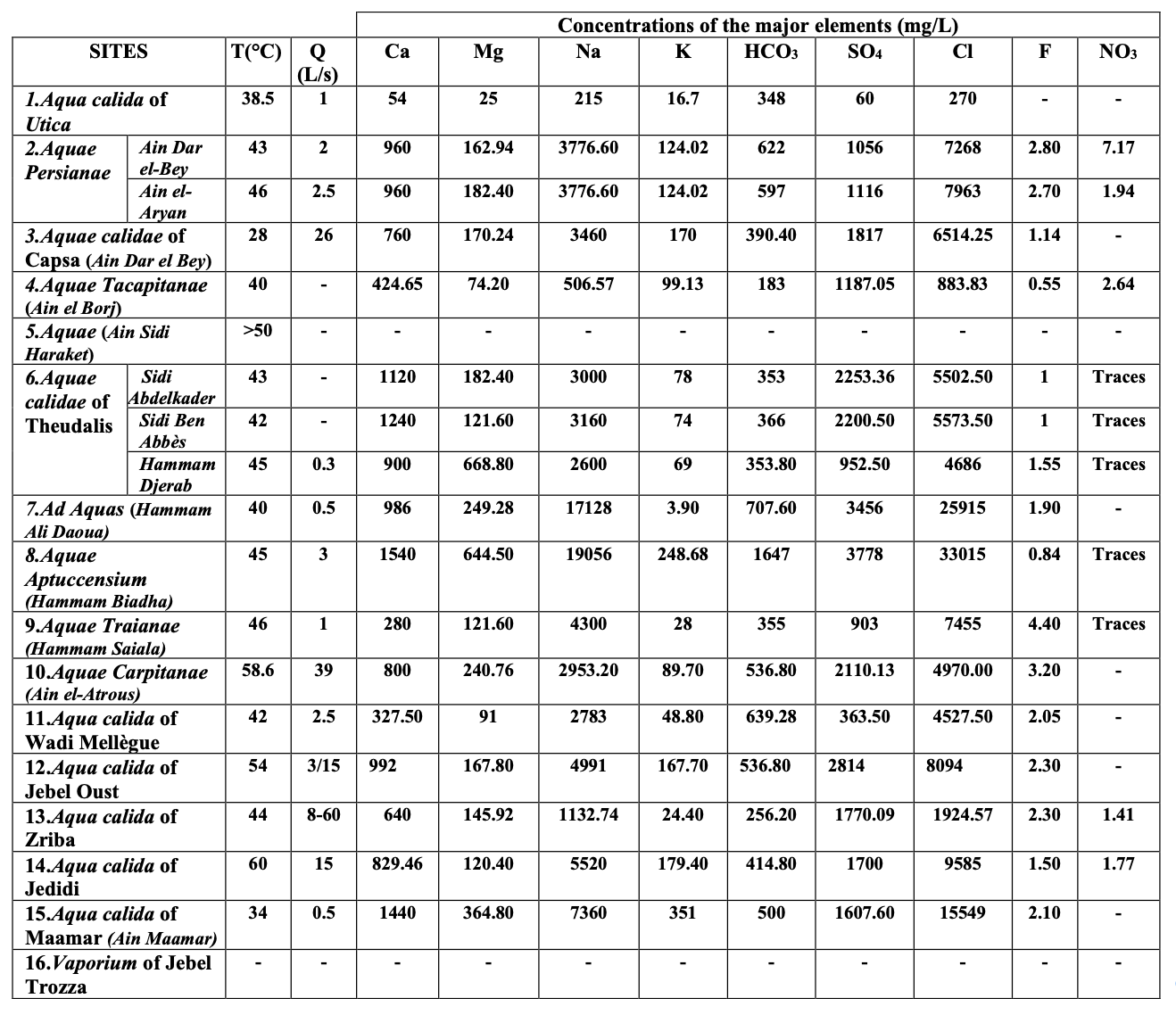
Table | Concentration of the major elements in the studied aquae calidae and thermal constructions.
The identified hot springs and associated thermal structures allow for the development of a typology that, while incomplete, is informative. Thermal springs are found either within Roman towns or in their surrounding territories. Springs located within towns are relatively few, including the Aqua calida of Utica, Aquae Persianae, Aquae calidae of Capsa, Aquae Tacapitanae, and Aquae. It is highly plausible that towns such as Aquae Persianae, Aquae Tacapitanae, and Aquae developed around these springs.
In contrast, thermal springs in the surrounding territories are more numerous. These include Aquae calidae of Theudalis, Ad Aquas, Aquae Aptuccensium, Aquae Traianae, Aquae Carpitanae, Aqua calida of Wadi Mellègue, Aqua calida of Jebel el Oust, Aqua calida of Zriba, Aqua calida of Jedidi, Aqua calida of Maamar and the Vaporium of Jebel Trozza.
The preserved Roman thermal constructions range from modest-sized baths (e.g., Ad Aquas, Aquae Traianae, Hammam Wadi Mellègue, Aqua calida of Maamar and the Vaporium of Jebel Trozza) to more elaborate thermal complexes (e.g., the Thermal Station of Jebel el Oust). Future archaeological surveys and excavations at these sites will undoubtedly enrich the existing data, and thereby help refine their typology. Physicochemical and mineral analyses indicate that spring waters are generally strongly sodium-chloride or calcium-sulphate in types, sometimes enriched in manganese. Their temperatures typically exceed 40 °C, while their flow rates vary considerably from 0.5 to 29 L/s. [Table].
II. Religious and curative functions
Thermal waters in Tunisia have been associated with both cultic and therapeutic uses since the Punic period. Archaeological evidence of such practices during this period is currently known only at Utica, where the hot spring was directed into a basin within a temple of Phoenician-Punic tradition, dating from the 7th century BC to the end of the 2nd/early 1st century BC. The deity associated with the temple, who blessed the thermal spring, remains unknown. Visitors to the temple would immerse themselves in the hot, sodium chloride-rich waters, blessed by the temple’s deity, in hopes of treating certain rheumatological diseases. During the Roman period, evidence of cultic and therapeutic practices becomes more abundant through archaeological, epigraphic, and literary sources. Roman thermal complexes often included temples or dedicated rooms for the healing deities Aesculapius and Hygieia, as observed at Jebel el Oust, Aquae Persianae, Aquae Aptuccensium, Hammam Jedidi, and Hammam Zriba (Ben Seddik 2010, 25, 26, 37, 47, 49, 50). Visitors used the strongly sodium-chloride-rich waters, blessed by these Roman-African healing deities, in the hope of curing rheumatological diseases. Notably, Apuleius (Florides, XVI) travelled to the town of Aquae Persianae to treat a sprain using the thermal waters of the spring at Ain Dar el Bey. In addition to therapeutic baths with hot spring waters, the vaporium provided curative steam baths, in which visitors benefited from hot water vapor.
Conclusions
Sixteen (16) Aquae calidae antiquae have so far been identified in Tunisia, although this number should be regarded as provisional. Ongoing and future archaeological field surveys are likely to reveal additional sites. The known thermal springs are unevenly distributed across the Tunisian territory, with the highest concentration found in the northern regions. Approximately one-third (1/3) of these springs are located within ancient cities, while the remaining two-thirds (2/3) lie in their surrounding territories. Since the Punic period, hot spring waters have been continuously exploited by local populations for therapeutic properties. They were often integrated into temples and/or bathing facilities, reflecting a dual cultic and medicinal purpose. The plans of most Roman thermal complexes identified to date remain only partially known, owing to the limited extent of archaeological investigation. Nevertheless, the available evidence indicates that most of these baths were of modest dimensions. These sites were frequented by visitors seeking healing under the protection of the deities Aesculapius and Hygieia, particularly for rheumatological diseases. Apuleius provides unambiguous testimony to the curative role of the Aquae calidae Persianae, blessed by Aesculapius and Hygieia, during the 2nd century AD. Today, some of these ancient thermal complexes continue to welcome visitors, while others have been architecturally modified and are now associated with marabouts (Muslim saints) or have been abandoned due to the drying of their hot springs. Contemporary users, much like those in Antiquity, bathe in strongly sodium-chloride-rich hot waters blessed by a marabout, seeking relief from rheumatological, dermatological, and occasionally respiratory illnesses. These therapeutic uses are corroborated by the results of modern physicochemical and mineral analyses confirming the curative properties of these waters. These enduring practices illustrate the remarkable continuity of hydrothermal traditions in Tunisia from Antiquity to the present-day, highlighting their lasting cultural, therapeutic, and archaeological significance.
.png)
Figures in order | 2a-b: Ain and Hammam Dar el-Bey (photo by the author); 4: Vestiges of the ancient baths incorporated into hammam el Borj / Hammet Gabès; 5a: The baths of the Marabout Sidi Haraket built over Roman thermal structures (Chtioui and Sila 2021, 69); 5b: The baths of the Marabout Sidi Haraket built over Roman thermal structures (photo by the author); 6: Hammam Ali Daoua (Office du Thermalisme 2000, 49); 7: Hammam Biadha (photo by the author); 8: Hammam Saiala (photo by the author); 9: Ain el-Atrous (Korbous) (photo by the author); 10: Hammam Wadi Mellègue; 11: Thermal complex of Jebel el Oust; 12: Hammam Jedidi; 13: Ain Maamar basin (photo by the author).
Bibliography
Literary Sources
- Apuleius
Apuleius, Florides, XVI, Les Belles Lettres, Paris 1924. - Stadiasmus Maris Magni
K. Müller (ed.), Geographi Graeci Minores, 120, 1, Paris 1855. - Strabon
Strabon, Géographie, XVII, Loeb Classical Library edition, London 1932. - Tite Live
Tite Live, Histoire romaine, XXX, Les Belles Lettres, Paris 1994.
References
- AAT 1892-1913
E. Babelon, R. Cagnat, S. Reinach, A. Merlin (eds.), Atlas Archéologique de la Tunisie au 1/50 000 (AAT), Paris 1892-1913. - Abidi-Belhaj 2016
B. Abidi-Belhaj, Dar el-Bey d’Hammam-Lif aux XVIIe-XIXe siècles : prémices de l’architecture thermale à Tunis, “Al-Sabil : Revue d’Histoire, d’Archéologie et d’Architecture Maghrébines” 2 (2016), 1-13. - Aounallah 2018
S. Aounallah, Réflexions sur les Aquae impériales d’Afrique romaine, in V. Brouquier-Redde, F. Hurlet (eds.), L’Eau dans les villes du Maghreb et leur territoire à l’époque romaine, Mémoires 54, Bordeaux 2018, 267-272. - Belhadj Aissa 1982
K. Belhadj Aissa, Korbous, Station thermale (in Arabic), Tunis 1982. - Ben Abed-Ben Khader, Scheid 2005
A. Ben Abed-Ben Khader, J. Scheid, Nouvelles recherches archéologiques à Jebel Oust (Tunisie), “Comptes rendus des séances de l’Académie des Inscriptions et Belles-Lettres” 1 (2005), 321-349. - Ben Abed-Ben Khader et al. 2011
A. Ben Abed-Ben Khader, J. Scheid, H. Broise, C. Balmelle, Le sanctuaire de source de Jebel Oust (Tunisie), “Les nouvelles de l’archéologie” 124 (2011), 10-14. - Ben Jerbania et al. 2021
I. Ben Jerbania, J. Luis López Castro, Ah. Ferjaoui, Ed. Ferrer Albelda, C. A. Pardo Barrionuevo, V. Peña Romo, K. Jendoubi, W. Khalfalli, Architecture Phénico-punique dans le secteur des temples à Utique, in L. Ben Abid, F. Prados Martínez, M. Grira (eds.), De Carthage à Carthagène, Bâtir en Afrique et en Ibérie durant l’Antiquité, España 2021, 61-87. - Ben Seddik 2010
N. Ben Seddik, Esculape et Hygie en Afrique, Paris 2010. - Broise et al. 2011
H. Broise, J.-L. Paillet, J. Scheid, E. Rosso, Ah. Larbi, A. Ben Abed, N. André, C. Balmelle, R. Durost, Ch. Guellela, Jebel Oust (Tunisie), “Mélanges de l’Ecole Française de Rome, Antiquité” 123-1 (2011), 328-336. - Cagnat et al. 1923
R. Cagnat, A. Merlin, L. Chatelain, Inscriptions Latines d’Afrique (ILAfr), Paris 1923. - Carte Topographique 1956-1957
Carte Topographique au 1/50 000, Institut Géographique National de Paris / Office de Topographie et de Cartographie de Tunis (1956-1957). - Carton 1914
Dr. Carton, Onzième chronique archéologique Nord-Africaine (1912-1913), “Revue tunisienne” (1914), 247-263. - Chtioui, Sila 2021
M. Chtioui, D. Sila, Ville et patrimoine d’Hamma Djérid. Publication réalisée avec la contribution de l’Agence Italienne pour la Coopération au Développement. Traduction Anglais/Français : Arbi Aloui et Slimen Zougari, 2021, Copyright © Association Persone Come Noi. - Cuntz 1929
O. Cuntz (éd.), Itineraria romana, Itineraria Antonini Augusti et Burdigalense, Leipzig 1929. - Diez De Velasco 1998
F. Diez De Velasco, Termalismo y religión : La sacralización del agua termal en la Península Ibérica y el norte de Africa en el mundo antiguo, “Revista de Ciencias de las Religiones”, Monographies, 1, Madrid 1998. - El Bekri 1913
A. El Bekri, Kitab al-masalik w’al-mamalik, Paris 1913 (translated into French by M.-G. de Slane, Description de l’Afrique septentrionale). - Fendri 1965
M. Fendri, Evolution chronologique et stylistique d’un ensemble de mosaïques dans une station thermale à Jbel Oust (Tunisie), in Ch.-G. Picard, M.-H. Stern, La mosaïque gréco-romaine. Colloque international du CNRS, Paris 1965, 157-171. - Gauckler 1902
P. Gauckler (dir.), Enquêtes sur les installations hydrauliques romaines en Tunisie, tome II, Tunis 1902. - Guérin 1862
V. Guérin, Voyage archéologique dans la Régence de Tunis, tomes I and II, Paris 1862. - Guyon 1864
Dr. Guyon, Études sur les eaux thermales de la Tunisie, Paris 1864. - Jouffroy 1992
H. Jouffroy, Les Aquae Africanae, in A. Chevallier, Les eaux thermales et les cultes des eaux en Gaules et dans les provinces voisines. Actes du colloque (Aix-Les-Bains, 28-30 septembre 1990), “Caesarodunum” 26 (1992), 87-99. - Lancel 1991
S. Lancel, Actes de la conférence de Carthage en 411, IV, Paris 1991. - Merlin 1913
A. Merlin, Séance de la commission de l’Afrique du Nord, “Bulletin du Comité des Travaux Historiques” (1913), 215-216. - Monchicourt 1913
Ch. Monchicourt, La région du Haut Tell en Tunisie, Paris 1913. - Office du Thermalisme 2000
Office du Thermalism, Principales manifestations thermominérales en Tunisie : Données utiles, Tunis 2000. - Pettenὸ 1998
E. Pettenὸ, Le Aquae e le terme curative dell’Africa romana, “Antiquités Africaines” 34 (1998), 133-148. - Picard 1941-1942
G.-Ch. Picard, Statuaire de la région de Zaghouan, “Bulletin du Comité des Travaux Historiques” (1941-1942), 319-321. - Renault 1908
J. Renault, Korbous, “Les cahiers d’archéologie tunisienne” 1 (1908), 12-34. - Saumagne 1962
Ch. Saumagne, Capsa, les vestiges de la cité latine de Gafsa, “Cahiers de Tunisie” 10/37-40 (1962), 519-531. - Shaw 1743
Th. Shaw, Voyages dans plusieurs provinces de la Barbarie et du Levant, Gand 1743. - Tissot 1888
Ch. Tissot, Exploration scientifique de la Tunisie : Géographie comparée de la province romaine d’Afrique, II, Paris 1888. - Toutain 1912
J. Toutain, Les cultes païens dans l’Empire romain, Paris 1912. - Trousset 1993
P. Trousset, Capsa, in Encyclopédie berbère XII, Aix-en-Provence 1993, 1758-1759. - Vincent 1884
Capitaine Vincent, Hammam-Seïala. Etablissement thermal, “Bulletin de l’Académie d’Hippone” (1884), 38. - Weber 1976
E. Weber, Tabula Peutingeriana. Codex Vindobonensis 324. Facsimile Ausgabe mit Kommentar, Graz 1976.
Abstract
Water management was a central concern of cities in Africa Proconsularis, where a significant proportion of water resources was devoted to bathing facilities. Alongside urban baths, hot springs (aquae calidae) played an important role, valued for their therapeutic properties and often equipped with dedicated thermal installations. Despite their significance, these sites have received far less scholarly attention than monumental urban baths, and previous studies have relied mainly on literary and epigraphic evidence. Focusing exclusively on ancient Tunisia, this paper examines sixteen identified hot springs and associated thermal structures, many of which exceed those recorded in ancient texts. Drawing on archaeological remains as well as physicochemical, mineral, and therapeutic data, the study offers a synthesis of their geographical distribution, architectural characteristics, and modes of exploitation. Particular attention is paid to the relationship between hot springs, healing practices, and water cults, contributing to a more comprehensive understanding of thermalism in Roman Africa Proconsularis.
keywords | Africa Proconsularis; water management; aquae calidae; thermal constructions; water cults; Aesculapius; Hygieia; physicochemical data; mineral; therapeutic.
La Redazione di Engramma è grata ai colleghi – amici e studiosi – che, seguendo la procedura peer review a doppio cieco, hanno sottoposto a lettura, revisione e giudizio questo saggio
(v. Albo dei referee di Engramma)
Per citare questo articolo / To cite this article: Ameur Younès, Aquae calidae and thermal constructions in Tunisia during Antiquity, “La Rivista di Engramma” n. 231, gennaio/febbraio 2026.