3NÓS3. Interversão Between Urban Space and Media Circulation
Notes on Profanation
Simone Rossi
Abstract
I.
In May 1982, the Brazilian collective 3NÓS3 was invited to exhibit at the Pinacoteca do Estado de São Paulo (hereafter Pinacoteca), one of the city’s earliest and most established public art museums. Composed of Hudinilson Jr. (1957-2013), Mario Ramiro (1957), and Rafael França (1957-1991), the collective had, until that moment, operated almost exclusively outside institutional frameworks. The exhibition 3NÓS3/3ANOS marked a return to the art world’s most codified institutional enclosures. It seemingly disavowed — or at least attenuated — a three-year practice that had sought “an autonomy in relation to the traditional circuit of visual arts” (Ramiro 2004, 41). That practice had unfolded through urban actions and clandestine interventions in the streets, sustained by an attitude of open ideological confrontation. It emerged within a broader countercultural climate, shaped by the dissemination of punk rock, the rise of graffiti art, and the consolidation of institutional critique and guerrilla strategies as shared modes of artistic opposition[1].
Yet the occasion also marked an extraordinary opportunity. The invitation to exhibit at the Pinacoteca formalized the institutional recognition of a practice developed through a sustained effort to establish a principle of transitivity with the urban fabric and its media circuits. This moment did not entail a voluntary change of direction on the part of the collective; rather, it crystallized a condition of critical tension in which the institution itself sought to engage with — and partially absorb — a sabotaging language forged outside its own boundaries. The exhibition thus unfolded within a broader moment of acute social and political intensity. Brazil had entered the so-called process of abertura [political opening process]; the military dictatorship was no longer as firmly entrenched as before. The street once again became central to workers’ and students’ protests — an antagonistic site of collective gathering and a space artists increasingly inhabited with renewed force and critical articulation.
These were also the years in Brazil that the psychoanalyst and philosopher Félix Guattari and the psychoanalyst and cultural critic Suely Rolnik would later describe as a “molecular revolution”: a phase marked by a diffuse yet palpable sense of imminent transformation, in which new forms of becoming and insurgency emerged across multiple fronts. Feminist and gay movements flourished, marked by milestones such as the founding, in 1978, of Somos: Grupo de Afirmação Homossexual, Brazil’s first LGBT rights advocacy group. At the same time, desire began to be reclaimed outside the confines of the capitalist logic of subjectification, opening onto other modes of relationality — what Guattari and Rolnik described as a form of desire grounded “in a positive affirmation of creativity, in a willingness to love, in a willingness simply to live or survive” ([1986] 2008, 63).
The experience within the museum marked the collective indelibly, ultimately sanctioning its dissolution. As if to underscore that a cycle had come to an end, 3NÓS3 (“Three Knots” and “We Three” in Portuguese) disbanded later that same year, following a final public farewell — mock-performative in tone and tellingly titled Acabou [It’s Over]. The action took place during the first edition of 14 Noites de Performance, held at the newly inaugurated SESC Pompeia cultural center, renovated by Italian-born Brazilian architect Lina Bo Bardi[2].
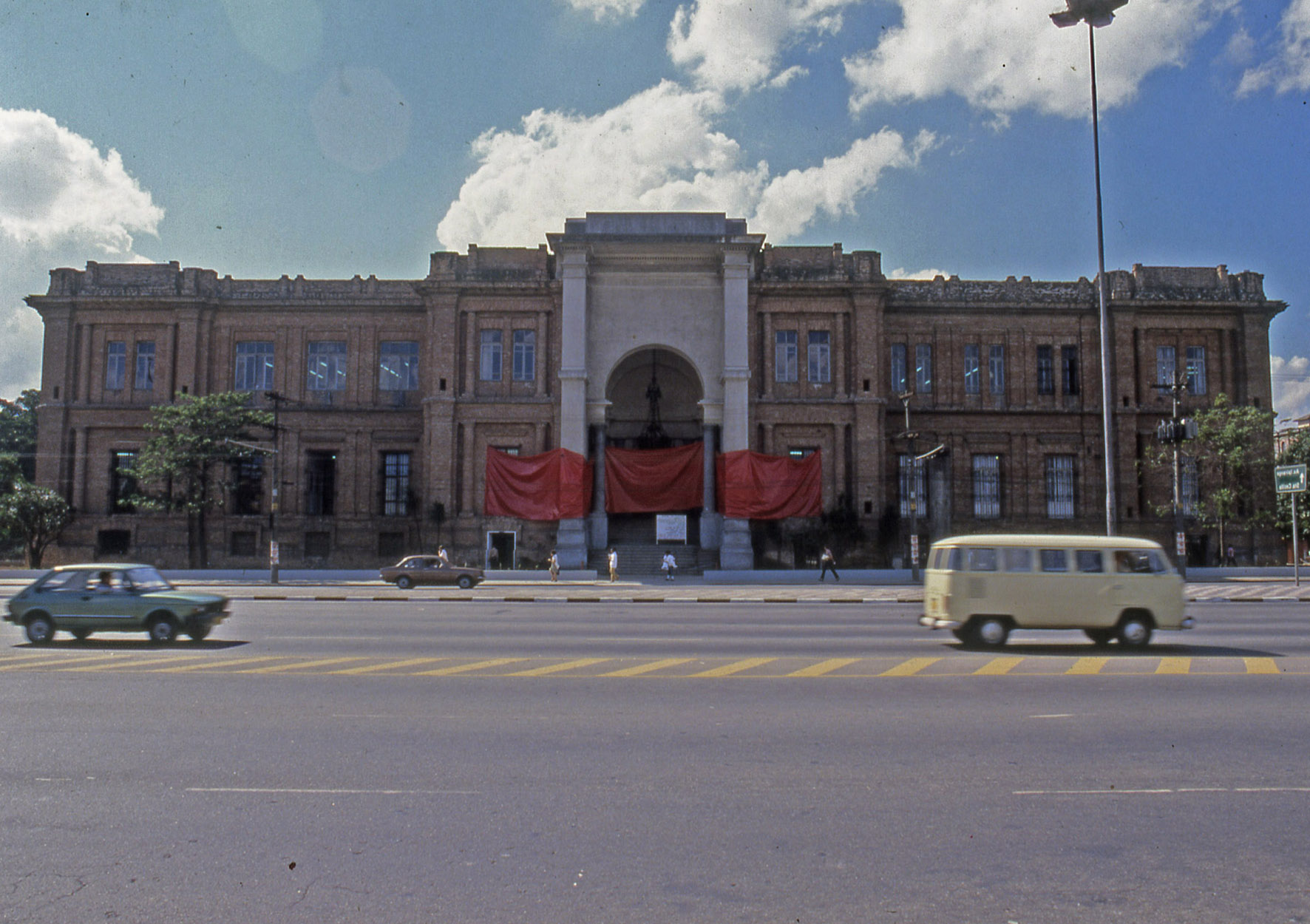
1 | 3NÓS3, 27.4/3 – II, urban intervention with red polyethylene bands, façade of the Pinacoteca do Estado, São Paulo 1982.
For the Pinacoteca exhibition (19 May-6 June 1982), the collective effectively operated through disaggregation. Inside the museum, each member presented an individual work articulated through a distinct medium: an installation in two cases — Hudinilson Jr.’s Posição amorosa, which formalized a relational and affective aporia, and Ramiro’s Estruturas de Especulação, a series of geometric flat sculptures engaging an intramuseal synchronization of neoplasticism and land art, and a video in another case, with França’s Carta 23. This disaggregation, however, was accompanied by one last communal gesture. On the museum’s main façade, the collective installed a horizontal band of red plastic stretching from window to window [Fig. 1]. Positioned at a height that allowed entry while nonetheless compelling visitors to lower their bodies, the intervention subtly inscribed a corporeal negotiation into the very act of access.
The juxtaposition of the glossy plastic strip with the monumentally eclectic façade of Pinacoteca produced an effect reminiscent of squatting practices — markedly different from that generated by the group’s earlier urban interventions, in which plastic had been interwoven with the concrete fabric of the city itself. This final museum-based gesture, minimal and anonymous in appearance, functioned as a kind of signature. Red, along with the rolls of cellophane or polyethylene, had been among the most distinctive markers of their actions, as evidenced by slightly earlier interventions such as Corte AA, B.81, and Outdoor/Art–Door. More broadly, red — together with yellow, blue, and brown, the other plastic colors deployed by the collective across its various interventions – offered an exemplary counterpoint to the pervasive greyness emitted by the city’s concrete arteries.
It is in this sense not coincidental that the nearby, iconic suspended volume of the Museu de Arte de São Paulo (MASP), designed by Lina Bo Bardi and inaugurated in 1968, is today perceived as resting upon four bright red pillars. While the structure remained exposed concrete for over two decades, the later application of red — introduced in the late 1980s during restoration works — retroactively reshaped the building’s visual identity, to the point of becoming inseparable from its image. Here, the red does not simply belong to the building’s material history but to its mediated visibility (Miyoshi 2007). Introduced later, it nonetheless came to define how the architecture is perceived, remembered, and circulated. Located along Avenida Paulista — São Paulo’s primary axis of commercial exchange and political mobilization — the museum has come to stand as one of the city’s most symbolically charged architectural presences.
Against this urban and architectural backdrop, the intervention at the Pinacoteca might at first glance suggest — purely on a formal level — affinities with certain strands of American land art[3] or with the wrappings executed by Christo and Jeanne-Claude. A notable example is Wrapped Kunsthalle (1968), when the Kunsthalle in Bern, then curated by Harald Szeemann, was entirely covered for a week with a mantle of translucent polyethylene and nylon ropes. In both cases, the action was carried out with institutional consent and neither produced a genuine deactivation of the museum apparatus — access to the internal exhibitions remained fully possible — nor suspended its symbolic function, which in fact was further emphasized and made conspicuously visible. In Christo and Jeanne-Claude’s wrapping, this operation explicitly enacted a relocation of the aura: no longer residing solely in the works displayed inside, it extended to the container itself, rendering the building hyper-iconic and auratic. While such precedents offer a point of comparison in terms of gesture, materiality, and surface engagement, they ultimately fail to account for the situated, profanatory logic of 3NÓS3’s actions.
The Pinacoteca building is neither isolated nor “wrapped”; the covering is partial, suggestive rather than total, almost graphic in its effect. The gesture does not close but opens a threshold: it marks the architecture, symbolically incises it, and situates it within a trajectory that both precedes and surpasses it. Titled 27.4/3 – II, the intervention should be understood as the second act of an action initiated just a few days earlier, on 27 April of that year, when the group laid out two long red plastic bands on the lawns adjacent to Avenida 23 de Maio, an imposing urban artery and emblem of the city’s modernizing rationality, designed for continuous automobile flow and inherently hostile to pedestrians [Fig. 2]. The two parallel bands neither blocked traffic nor disrupted the street’s infrastructural function, but introduced a symbolic crossing where crossing was otherwise denied. The roadway was not rendered unusable; rather, it was reopened to a mode of use that did not belong to it. Two improper lines cut through space without organizing it, marking without regulating, inscribing without producing a new order. These improper lines functioned as lines of flight from urban discipline. They created trajectories of deterritorialization, tracing a potential movement across a space designed exclusively for transit. The polyethylene bands did not propose an alternative function; instead, they revealed the possibility of a different relationship with the urban environment — one based on interference and symbolic reappropriation rather than prescribed use.
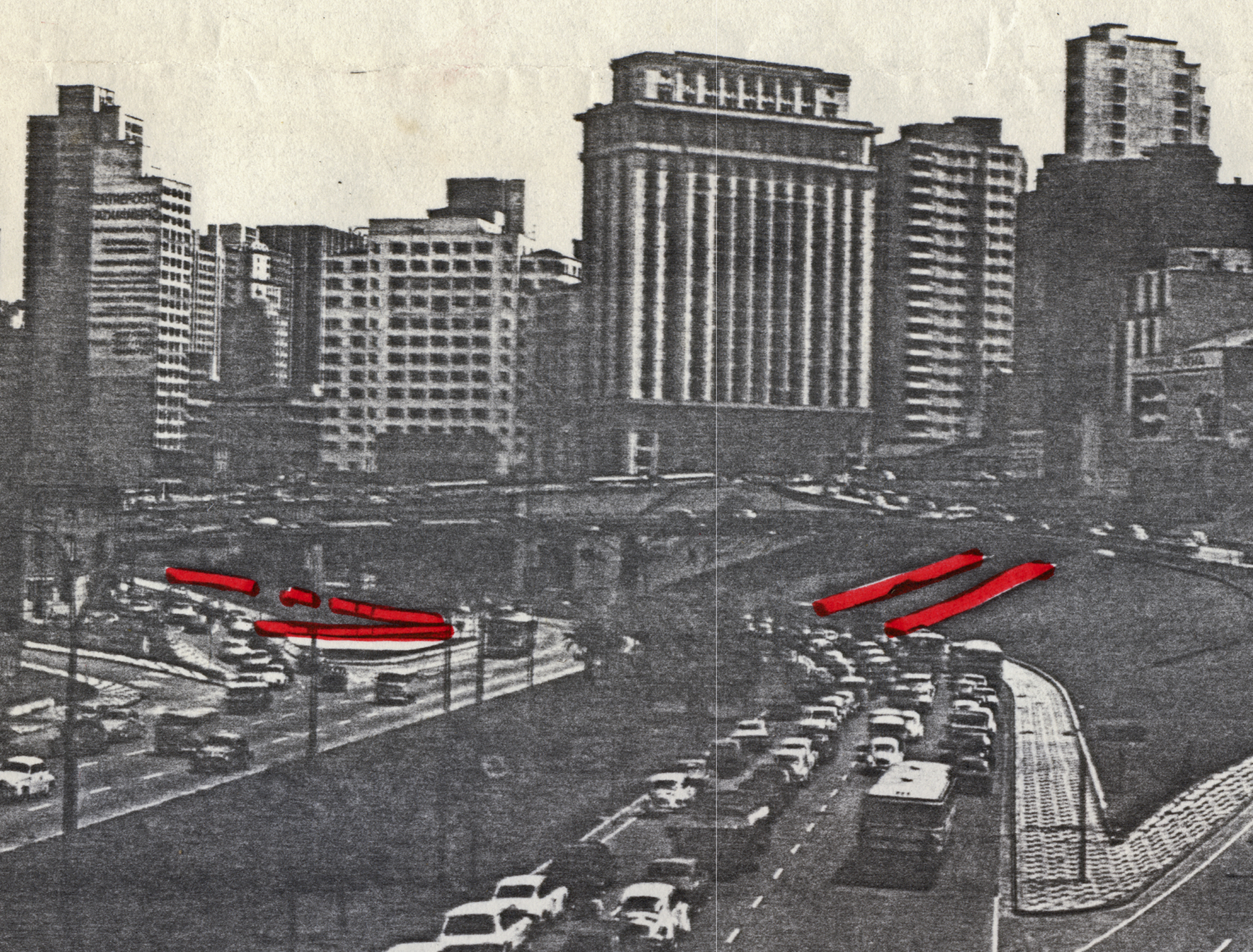
2 | 3NÓS3, 27.4/3, urban intervention with red polyethylene bands, Avenida 23 de Maio, São Paulo 1982.
By titling the museum intervention as a “second act,” the collective underscored a fundamental equivalence: the institutional space was to be treated as merely another segment of the urban continuum — not as a qualitatively separate, auratic, or exceptional realm, but as belonging to the same spatial and economic logic as the street. For Giorgio Agamben, the museum represents the space that most dramatically manifests, in the contemporary stage of spectacle-capitalism, the impossibility of profanation — that is, the impossibility of suspending the separation that prevents the free use of both objects and spaces. In this light, 3NÓS3’s action at Pinacoteca can be read as a minimal, yet extreme, attempt to enact precisely this form of profanation. It aligns with what Agamben identified as the core political task: “to wrest from the apparatuses — from all — the possibility of use that they have captured” (Agamben [2005] 2007, 92). The red plastic band, in its stark simplicity, sought to momentarily suspend the museum’s ‘arrested’ status, wresting its threshold back into a space of bodily negotiation and potential use. As such, the intervention was not merely a formal gesture but a concrete attempt at what Agamben would call the “profanation of the unprofanable” (Agamben [2005] 2007, 92).
Given the profound symbolic charge the museum held for the collective, it is hardly surprising that it was also central to one of their earliest interventions, X-Galeria. On the night of 2 June 1979, the entrances of twenty-seven commercial art galleries — institutions that radicalize, even pornographize, the separation produced by the interplay of spectacle and consumption — along with that of a museum, specifically that MASP on Avenida Paulista — were sealed with a large ‘X’ of masking tape. The gesture was accompanied by mimeographed leaflets stating: “O que está dentro fica / O que está fora se expande” [What is inside stays / What is outside expands]. That the museum functioned as both the starting point and the endpoint of 3NÓS3’s brief trajectory reveals a paradigmatic hostility toward the aridity of institutional containers. Yet these two episodes gain their fullest generative power when mapped cartographically — when seen in proximity and tangency to the other urban actions that unfolded between them. Between 1979 and 1982, the collective produced at least seventeen further interventions, employing the city in its full semantic breadth as their medium — its monuments, arterial roads, viaducts, buildings, plazas, and the myriad forms of its expansion. With a single exception — the work ARTE, executed in Porto Alegre, the hometown of França and seat of the kindred artistic group Nervo Óptico[4] — their canvas was São Paulo. The metropolis thus became a surface upon which to inscribe lines that traversed heterogeneous spaces, manifesting a continuity only in fragments: a relational and desecrating diagram that existed solely in its state of dissemination.
The true significance of the museum within 3NÓS3’s work — its role as a structure so pervasive that it comes to permeate the city itself — only comes into focus when viewed in the context of their seventeen other interventions. These works collectively form a far more expansive and polyphonic project, one that lays bare a core dialectic: to equate the museum with the common urban fabric is to diminish its privileged aura, yet the converse holds with equal force. Indeed, an expanding domain of public space is itself being reconfigured through a process of intense musealization. This is precisely what Agamben underscores: “everything can become a museum, because this term simply designates the exhibition of an impossibility of using, of dwelling, of experiencing” (Agamben [2005] 2007, 84). Moving in reverse chronological order, from 1982 back to 1979, I will therefore attempt to demonstrate how the group’s entire practice was driven by a profound impulse toward operative profanation. Whereas this impulse found a primarily graphic resolution in their final museum intervention, over the preceding three years it fueled a varied experimentation with multiple expressive modes. In each, disorientation, play, and critique emerge as the persistent markers of a trajectory that is both rhizomatic in its structure and convex in its orientation — outwardly expansive rather than inwardly focused.
II.
The action on Avenida 23 de Maio was the final instance in a series of large-scale urban interventions executed by the collective across São Paulo’s major highway complexes, employing monumental rolls of red or yellow plastic. Although these actions have often been retrospectively described as ‘interventions,’ the group itself began, from 1980 onward, to define them more precisely as interversões: a neologism fusing ‘intervention’ and ‘inversion.’ Attentive to language and etymology, the collective defined the term as follows:
INTERVERSÃO [interversion] (from the Latin intervertio), noun. The act of inverting; changing the natural or habitual order.
INTERVERT [intervertir] (from the Latin intervertere), verb. To invert; to turn upside down. (Hudinilson, Ramiro, França 1981)
Interversão VI, the first action to bear this name, took place on the night of June 15, 1980. Without any form of authorization, the collective deployed a massive roll of red plastic — one hundred meters long, four meters wide — to draw a line across the two large oval cavities (buracos) that connect — at least visually and aerially — Avenida Paulista with Avenida Consolação. In the volume documenting the group’s activities, Ramiro notes that the site was selected because of its relation to the Nova Paulista project: a set of urban redevelopment plans initiated in the 1970s for Avenida Paulista and its system of infrastructural links, including underpasses, pedestrian crossings, and subterranean circulation flows (Ramiro 2017, 74).
This contextual choice clarifies that the intervention was conceived to operate within a specific urban rationality, one that treats the city as an eminently functional organism. Its target was not the underpass as such, but the logic that had generated it: a planning dispositif that materially connects two parallel arteries running side by side, facing one another, yet never intersecting. Thus the underpass — dark, oppressive, and saturated with traffic — was symbolically sutured to the surface above, a space that today also functions as a refuge for many homeless and crack users. And not to just any surface, but to Avenida Paulista: the infrastructural ridge of the city, where corporate headquarters, media institutions, and political demonstrations converge.
The enormous roll of red plastic descended from Paulista into Consolação only to return to the surface, connecting the city’s pulsating heart with the avenue that runs beneath it — like a hidden vein suddenly irradiated with new blood. Maria A. Pontes, a curator and researcher who devoted her master’s thesis to the collective, has described the action as “similar to sewing” (Pontes 2017, 212). One might add that it enacted a form of precise suturing between two dimensions: a slow stitch binding together two sides of a membrane. Like a provisional basting, this stitching signaled a potential weave — an hypothesis of passage between two spaces; a temporary and ephemeral sketch for a new form of spatial projectuality. Interversão VI was made possible through the patronage of a private company, Plastic Five, and its entrepreneur, Guacira Quinto Malatesta, a key supporter of the collective from its earliest stages. Malatesta produced, exclusively for 3NÓS3, the plastic materials employed in these large-scale interventions — monumental in scale yet conceived as radically ephemeral. Interversão VI itself lasted only a few hours: the graphic and symbolic order of the site was rapidly reinstated by the military police, the fire brigade, and the transport department.
A similar institutional response met the intervention entitled Conecção, another neologism coined by the group through the crasis of conexão (connection) and ação (action). On May 13, 1981 — this time in broad daylight — 3NÓS3 chose to operate through a ventilation shaft located at the junction of Avenida Rebouças and Avenida Dr. Arnaldo [Fig. 3]. The shaft was treated as a kind of eruptive crater, from which a twenty-five-meter roll of glossy red polyethylene spread outward into the surrounding grassy area. Once again, the collective selected an open infrastructural element — a portal between worlds. The intersection of Rebouças and Dr. Arnaldo is a node of intense vehicular and pedestrian traffic, a crucial confluence within the city’s flow. The ventilation shaft thus functions as a metaphor for ‘connection,’ its technical purpose of linking airflows mirroring both the title and the poetics of the action itself: to connect bodies and cityscapes. In the third major urban intervention, Arco 10, which was realized on the night of December 7, 1981, the chosen site was the viaduct along Avenida Doutor Arnaldo. From it, the collective suspended a one-hundred-meter roll of yellow cellophane over the Avenida Sumaré below. The plastic arc hovered above the street, precarious, tracing a line that linked vertical and horizontal space, bridging separation without touching the ground.
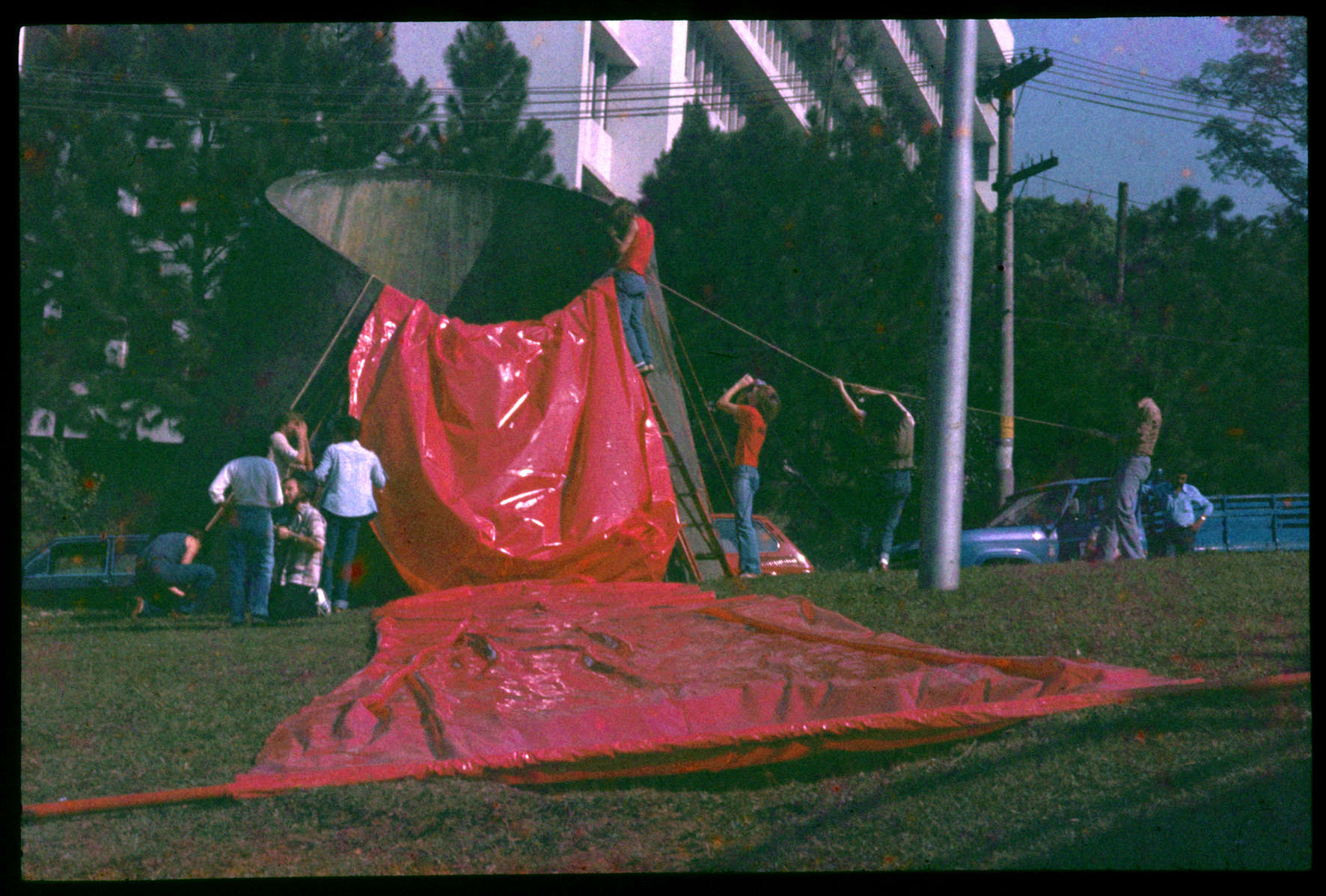
3 | 3NÓS3, Conecção, urban intervention with red polyethylene roll, intersection of Avenida Rebouças and Avenida Dr. Arnaldo, São Paulo 1981.
All three actions unfolded within road infrastructures designed to accommodate the city’s explosive growth in automobile traffic. As curator and art historian Erin Aldana has noted, starting in the 1970s São Paulo experienced “by far the most extensive renovations of any city in South America” (Aldana 2017, 219). These transformations altered not only the city’s physical geography but its affective one, progressively tailoring the urban environment to the scale of vehicles rather than pedestrians. The result was a widespread sense of alienation and discomfort: time spent in traffic became passive, anxiety-inducing, and increasingly perilous, with thefts and robberies occurring even while stopped at lights. This ambient sense of danger, ingrained in everyday urban experience, at times generated more disruption than the interventions themselves. During Arco 10, for example, concern among drivers and local residents that the colored arc over Sumaré Avenue might obstruct traffic or reduce visibility prompted a swift police response. The authorities chaotically closed the road, thereby causing far greater obstruction than the installation had posed. Although operating without permits, the collective’s statements never expressed an intent to provoke danger. Their works were conceived, instead, as “visual marks imposed on and in dialogue with the architecture” (Ramiro 2004, 46).
Emerging from a visual arts rather than performance background[5], all three members deliberately avoided “spaces of public concentration” (Ramiro 2004, 43) — theaters, buses, and restaurants — in favor of “spaces of public circulation” (Ramiro 2004, 44). Here, with a subversive yet peaceful, playful, and communal sensibility, they placed visual elements in sites where bodies and flows intersect. Crucially, these interventions were not solely designed to be experienced live, but functioned as a form of media art meant to be encountered secondhand — through newspapers, television, mail art networks, and other modes of reproduction and distribution. The goal was to foster conscious, active — rather than automatic — engagement with urban spaces and media spaces, insisting on the transitivity of these two realms: how each influences and fundamentally conditions the experience of the other. As Brazilian art historian Annateresa Fabris, the first scholar to recognize the depth of the collective’s work, observed that 3NÓS3 sought to cultivate “an awareness of the new status of the city in contemporary society, the substantial transformation that makes it no longer a carrier of values, but rather of news; no longer a historical construction, but also a system of information” (Fabris [1984] 2017, 207).
The profanatory dimension at work in these interversões resides in their ephemeral attempt to foster what Agamben terms “a special form of negligence, which ignores separation or, rather, puts it to a particular use” (Agamben [2005] 2007, 75). The functional purpose of those viaducts, the traffic on those roads, and the rhythm of those arteries was never fully suspended — except by the authorities. The inherent separation governing those spaces remained intact; they could still be consumed, used, and crossed according to convention. Yet a supplementary register was introduced, one that inscribed itself within the existing order and, by proposing an alternative, generated a fissure. Now, that street need not be traversed solely to reach a destination; it could even become an object of unproductive, aesthetic regard. The yellow cellophane tracing a vast arc above the roadway, the red lines cutting orthogonally across the grassy verges to redefine the connectivity between stretches of grey concrete — these gestures rendered the habitual use of that space inoperative, if only momentarily. They produced what Agamben would call “pure means [...] the possibility of a new use, a new experience of the world” (Agamben [2005] 2007, 88).
It is therefore significant that these large-scale urban works — notably Conecção and 27.4/3, executed in daylight, a departure signaling the collective’s increased audacity — began to draw considerable media attention and increasingly large crowds. A public that did not necessarily comprehend the logic of the actions nonetheless began to perceive their spirit, as captured in one contemporary response:
The two men interviewed for the Jornal Hoje segment provide rare insight into audience interpretation of the interventions. Both men admit they do not understand every aspect of Conecção but that they find it beautiful anyway, the simple gesture of bringing a temporary swath of color to the streets of São Paulo suggesting a sort of poetic beauty with or without the military regime as a framing reference. (Aldana 2017, 221).
This shift from clandestine night actions to daytime engagements marked a transformation in the very conditions of reception. With Conecção and 27.4/3, the relationship to the public pivoted decisively, a change made especially evident in the latter, where police intervention was no longer required to restore order. The public moved from being passive — or altogether absent — bystanders to becoming active participants in the work’s unfolding. In earlier actions, the possibility of a chance encounter was itself central, given that most interventions took place between midnight and dawn; recognizing an event as an artistic gesture was already part of the experience. As its neologism suggests, interversão carries within it the seed of reversal: a disorienting inversion that problematizes actions and sites otherwise traversed through the automatisms of routine.
Seen from this perspective, interversão resonates with key Situationist tactics — most notably the dérive, and, in a different register, détournement — while rearticulating them within a local and historically specific framework (Knabb 1995; Wark 2011). If détournement names the reversal of meaning through the reuse and recombination of existing elements in order to undermine the logic of the spectacle, the dérive operates as an embodied and spatial practice: a mode of moving through the city that suspends functional trajectories and destabilizes habitual perceptions of urban space. As Tom McDonough observes: “The city and its quarters are no longer conceived of as ‘spontaneously visible objects’ but are posited as social constructions through which the dérive negotiates while simultaneously fragmenting and disrupting them” (McDonough 1994, 74). It is precisely at this intersection between traversal and inversion that the interversões operate, acting upon the urban fabric while simultaneously engaging artistic and mass-media circuits in Brazil during this period. Before turning to the collective’s strategies of détournement and the relocation of aura enacted through media circulation, however, this backward panoramic movement must be brought to a close. Its purpose has been to foreground the group’s embodied practice as it developed prior to — and in preparation for — the very coinage of the term interversão.
III.
Before producing what Ramiro termed “drawings on the city map” (Ramiro 1998, 247), or “drawings on the city blueprint” (Ramiro 2004, 46), the collective operated at a fundamentally different scale and tempo. Their earliest actions were minor, rapid, and elusive, privileging immediacy over duration and trace over permanence. These initial actions were closer in spirit and method to the burgeoning graffiti art scene in São Paulo — exemplified by figures such as Alex Vallauri (Spinelli 2010) — in their emphasis on speed, nocturnality, and elusiveness. They were not meant to be witnessed live but to leave behind traces, signs destined for belated discovery or outright oblivion. They required minimal material, no complex logistics, and none of the extended collaborative networks that would later support their large-scale interversões[6]. The documentation of these acts was accordingly precarious and immediate: hurried photographs, often blurred, poorly framed, or captured in low light. These images register the urgency and contingency of the acts themselves, rather than aspiring to visual clarity or spectacle. Crucially, the fragility of these early interventions should not be mistaken for a lack of force. Conceived in full awareness of their imminent removal, denunciation and erasure were not accidental outcomes but structural conditions of the work.
Among these early, small-scale works — not yet explicitly named interversões, though already animated by a closely related spirit — three stand out: Ensacamento, Tríptico, and Interdição, all carried out in 1979. Interdição marked the first time 3NÓS3 worked with sheets of colored cellophane, draping them around architectural and infrastructural features across the city. On 21 September 1979, beginning at 4 p.m., the group temporarily closed a section of Avenida Paulista near MASP and adjacent streets by stretching bands of blue, yellow, brown, and red plastic across the roadway [Figs. 4, 5]. Mimicking the gestures of street vendors, they remained motionless when the traffic light turned green, allowing the situation to unfold and leaving it to motorists to decide how — or whether — to proceed. As Ramiro recalled in a contemporary newspaper account: “Many of them [the motorists] stayed there, looking at me, asking what they should do, whether they should cross the strip or not. And I replied, ‘You, sir, are the one who knows the answer’” (Aldana 2008, 176).
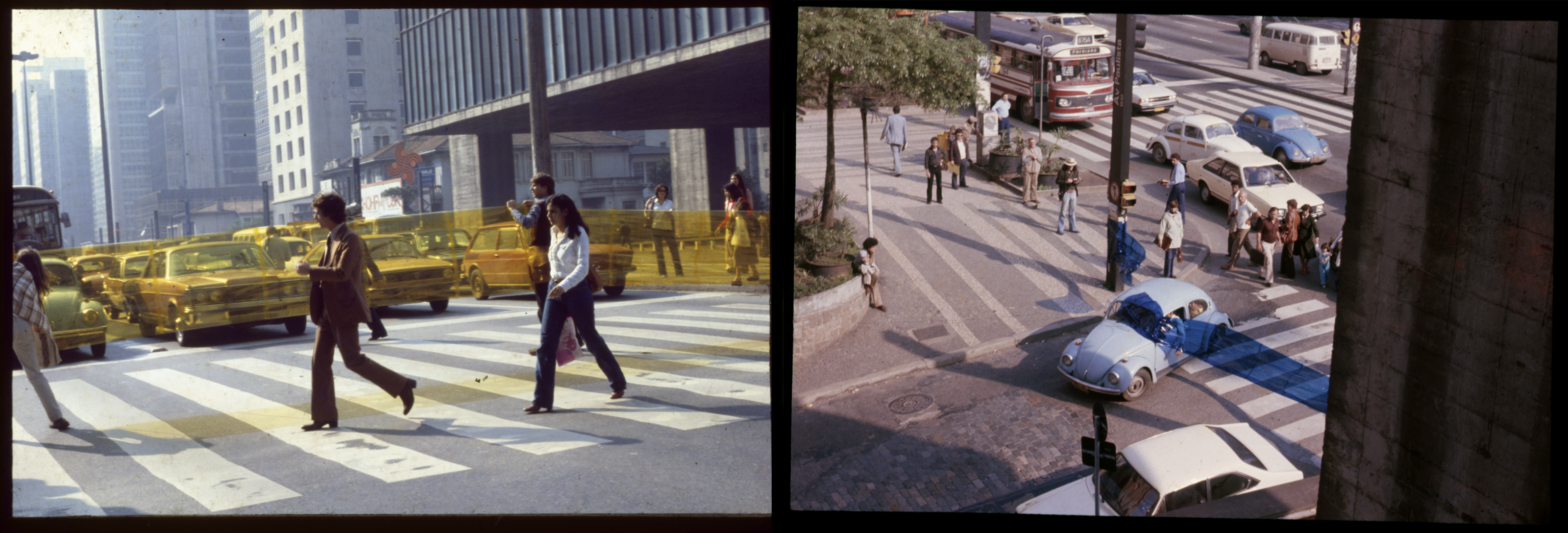
3-4 | 3NÓS3, Interdição, urban intervention with colored cellophane bands, Avenida Paulista, São Paulo 1979.
This intervention, whose title translates as ‘closure’ or ‘injunction,’ closely resembled another action performed a few years earlier — though unknown to the collective at the time — by another key experimental and conceptualist artist of that generation, Paulo Bruscky, in Recife, Pernambuco (Northeast Brazil). Entitled Arte/pare (Art/Stop), Bruscky’s 1973 piece involved closing the historic Boa Vista Bridge (the first major bridge in the Americas, built by Maurício de Nassau in 1633) with a red ribbon, filming the scene in Super 8. Pedestrians and cars stopped before this unusual obstruction, which lasted about forty minutes until a driver finally approached and untied the ribbon. This parallel should not be read as a claim of direct influence, but as evidence of a shared operational sensibility emerging under comparable political and cultural constraints.
This very constellation of practices was later mapped by the research collective Red Conceptualismos del Sur in their pivotal 2012 exhibition Perder la forma humana (Losing Human Form) at the Museo Reina Sofía. The exhibition assembled diverse expressive modes from across Latin America during the dictatorships, framing them through conceptual trajectories such as “Artistic Activism” (Red Conceptualismos del Sur [2012] 2014, 279-283); “Flash Action” (315-318); “Guerrillas” (328-338); “Intervention / Interversion / Interposition” (345-350); and “Overgoze” (365-370).
In contrast, Ensacamento and Tríptico — together with X-Galeria — addressed what Fabris identifies as a distinct sphere of action. Here, the primary subject shifts from the city to the art circuit itself. Yet the fundamental context, spirit, and methodology of interference remained unchanged, for, as Fabris notes, “what 3NÓS3 calls into question, ever since the first actions of 1979, is the relationship of art with the city” (Fabris [1984] 2017, 206). For Tríptico [Figs. 6, 7], three rectangular panels — 2.20 x 1.40m each — were arranged to form a triangular sculptural ensemble on the sidewalk in front of the Theatro Municipal de São Paulo on Rua Xavier de Toledo — the iconic site of the 1922 Modern Art Week that launched Brazilian modernism (Tarsila do Amaral, Anita Malfatti, Mário de Andrade, among others). Each artist claimed one panel: Ramiro and França worked pictorially, while Hudinilson Jr. employed assemblage. It became the collective’s longest intervention, lasting three days, from 24 to 26 August 1979. The group meticulously documented the public’s reaction and the piece’s gradual transformation until, as Ramiro notes, “the screens were finally removed by the Sanitation Department” (1998, 247). Significantly, the photographic record shows that the piece was largely ignored as an artistic intervention. Instead, it was read as advertising for theatre events, used as a bulletin board for flyers, and ultimately treated as “an ephemeral piece of garbage” (Aldana 2008, 218), ripped apart and nearly destroyed. In its ambiguous public reception — oscillating between overlooked artwork, appropriated advertising space, and urban detritus — Tríptico engaged an already emerging condition in late-1970s São Paulo: the saturation of the urban visual field and the unstable boundary between artistic gesture and communicative noise.
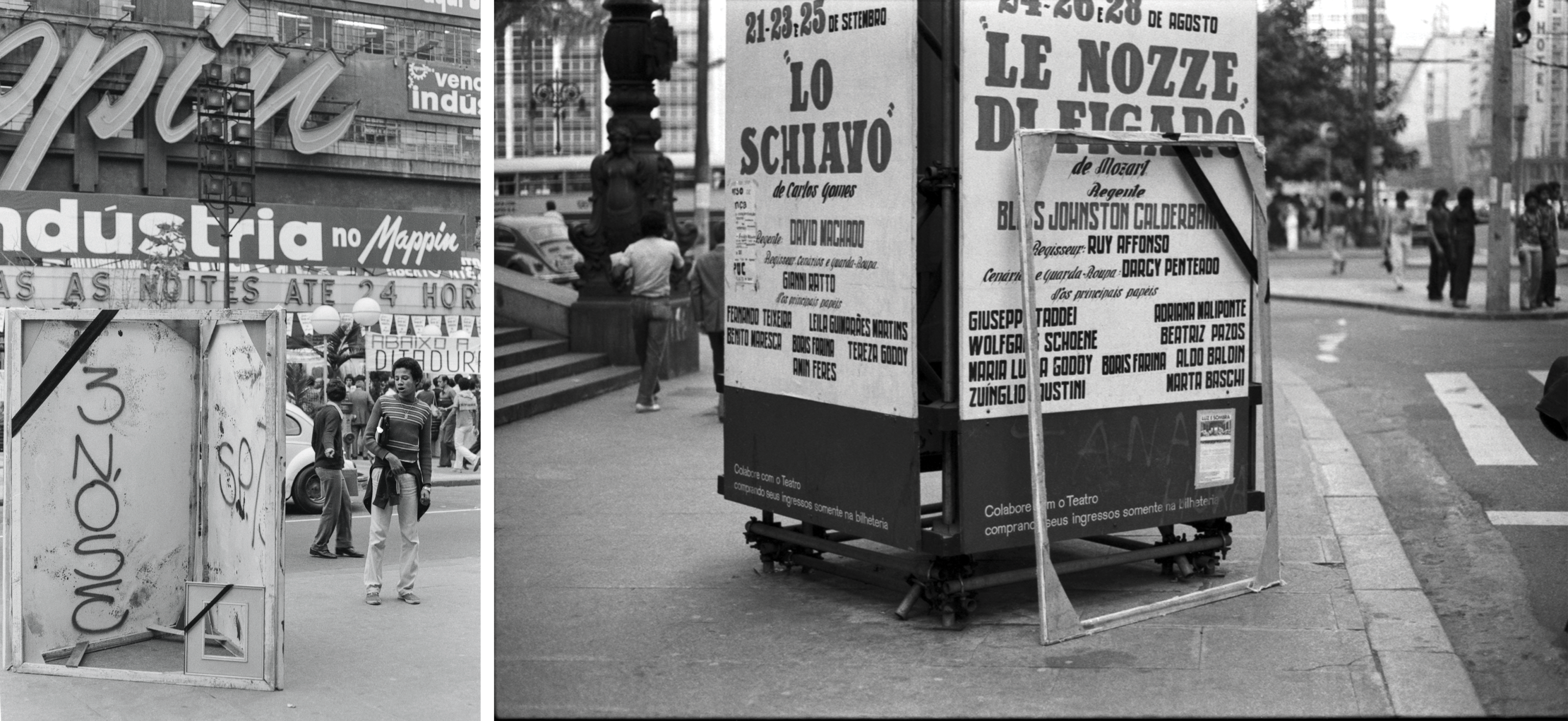
6-7 | 3NÓS3, Tríptico, urban intervention with painted panels and assemblage, Rua Xavier de Toledo (Theatro Municipal), São Paulo 1979.
If Tríptico explored the blurred line between art and urban debris, the collective's inaugural action, Ensacamento took a more directly confrontational approach to public symbolism. The latter remains the group’s most famous action, their very first, and, retrospectively, the one that most clearly condenses the operative logic of their early practice. It unfolded between midnight and five in the morning on 27 April 1979. Hudinilson Jr., Ramiro, and França moved furtively through the city, hooding the heads of public monuments and historical sculptures with black or blue trash bags tied closed with a rope — like a noose, simulating strangulation. They began, not by chance, at the Monument to the Independence of Brazil, erected on the banks of the Ipiranga Brook where Dom Pedro I declared the country’s independence from Portugal in 1822. From there, they proceeded through a constellation of civic and historical markers: Praça Marechal Deodoro; the Monumento às Bandeiras at the entrance to Ibirapuera Park, celebrating the bandeirantes (colonial-era Portuguese explorers and slave raiders) and their territorial conquests; the busts of John Kennedy in Largo do Arouche and Giuseppe Verdi in the Vale do Anhangabaú; the Monument to Carlos Gomes in Praça Ramos de Azevedo, inaugurated in 1922 for the centennial of independence; and finally the Monument to Anhanguera, another bandeirante, situated opposite Trianon Park on Avenida Paulista, among many others. In total, some sixty public sculptures were bagged, their heads shadowed, their moral gaze upon the city effectively blinded.
Ensacamento has recently been taken up as a paradigmatic case by Claire Bishop, who uses it to introduce a particular ‘mode of working’; “a crucial category of art making (and culture more broadly) that [...] has never been historicized or theorized”: the intervention. She defines the latter as “self-initiated actions that address the polis through the use of public space, employing an everyday visual language, and harnessing the media to force an issue into public consciousness and spark debate” (Bishop 2024, 115). Within a broader discourse on the types of attention that govern how we view art and performance today, Bishop observes that interventions — which she traces historically from the Italian Futurists through to Parisian Dada and Russian Futurism — “are predicated on the peak-and-decay model of viral attention” (Bishop 2024, 116). Most easily performed by groups, interventions found extremely fertile ground in South America during the second half of the twentieth century, of which Ensacamento represents but one exemplary, late instance. For Bishop, it reveals “a way of working that is urgent, nimble, low-budget, inventive, polemical, and reaches a broad audience” (Bishop 2024, 124). The practice of 3NÓS3 further refined this very notion, infusing the act of intervention with the connotations of inversion and subversion that became its hallmark. Bishop’s analysis provides a framework for understanding how Ensacamento operates.
The intervention is fundamentally defined by its occupation of public space, targeting civic symbols like statues to engage the unsuspecting passerby and question the ownership of the urban narrative. This is possible because such acts are unauthorized, self-initiated gestures that bypass institutional channels, allowing them to respond with urgency from a position of exteriority. To communicate within this sphere, they employ a vernacular visual language — using commonplace materials like garbage bags and ropes to create an immediately legible, yet potent, image. This visual strategy leads to a core strength: polysemy. The intervention’s power often resides in its semantic openness, forcing a public debate over its meaning — is it a political critique, a poetic act, or a surreal mockery? This debate is catalyzed by a keen sense of timing, an attunement to the kairotic moment in which historical conditions amplify the gesture’s resonance, as seen in Brazil’s late-1970s abertura. Finally, the intervention is conceived in symbiosis with the media, not as a secondary record but as a parallel site in which the work is extended and contested. This dual existence — in space and in circulation — defines the hybrid identity of the intervention Bishop describes.
IV.
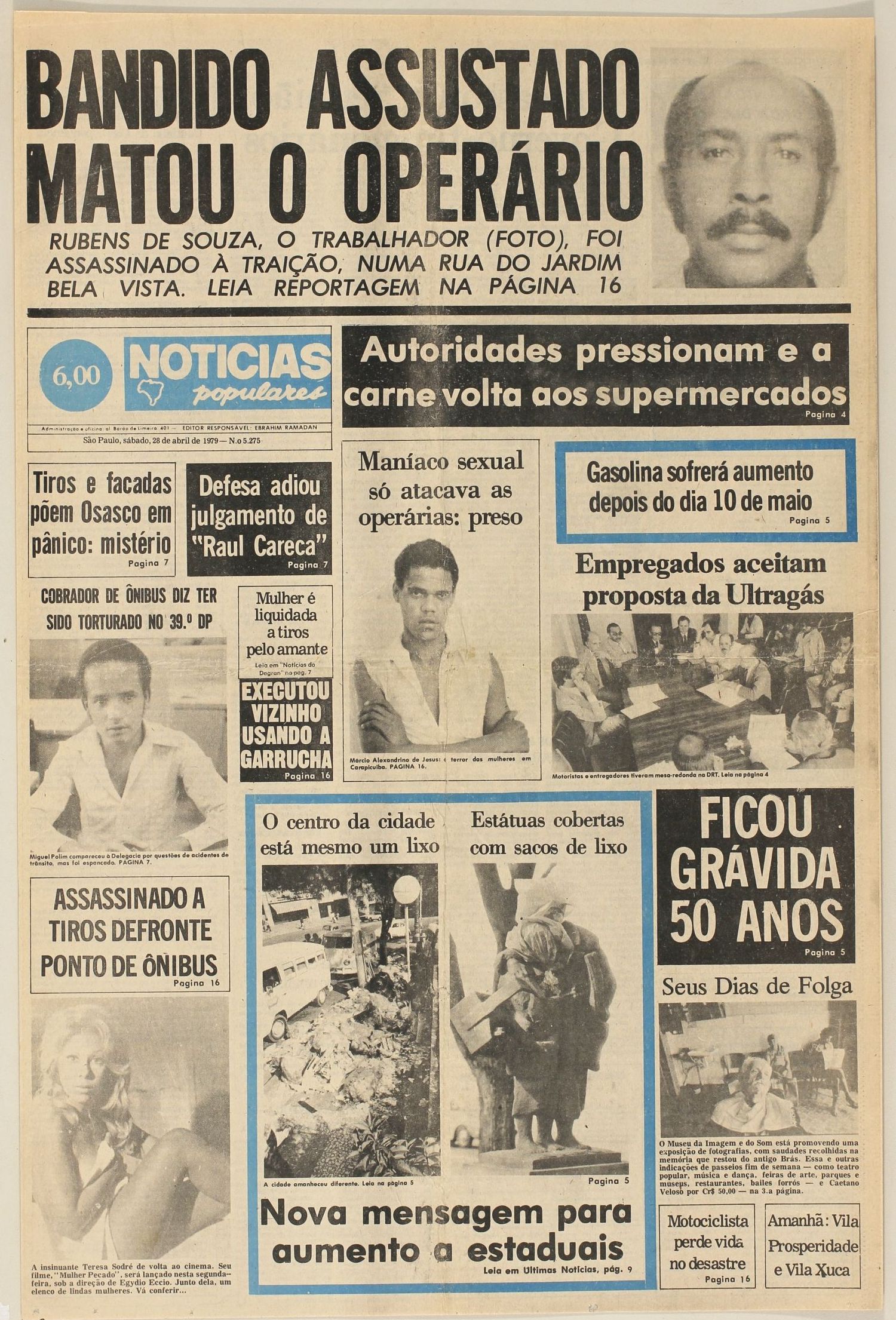
8 | 3NÓS3, Ensacamento, press coverage published in Notícias Populares, 28 April 1979.
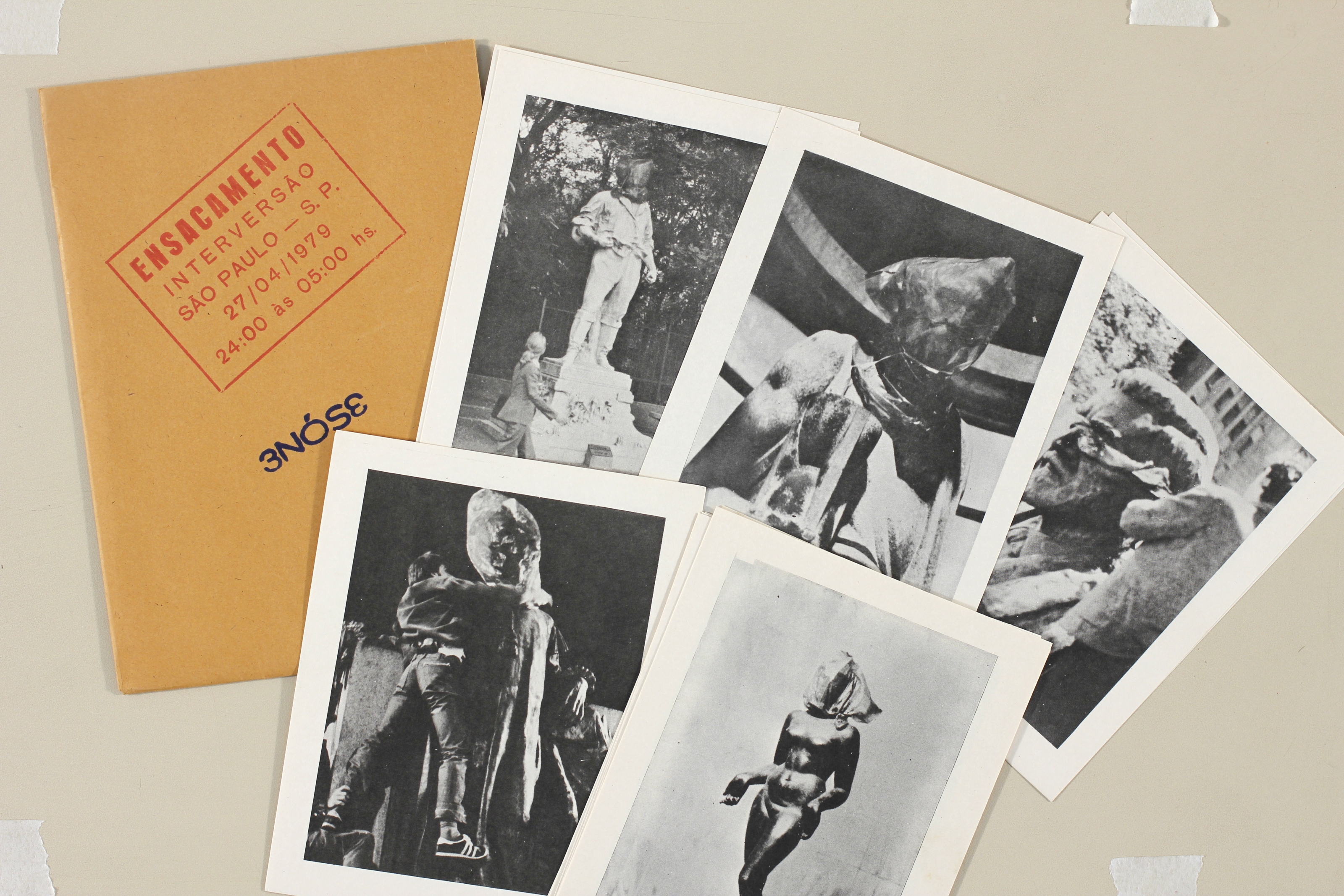
9 | 3NÓS3, Encarte-Ensacamento, printed multiple (offset print), edition of 500 copies, distributed through mail art networks, São Paulo 1979.
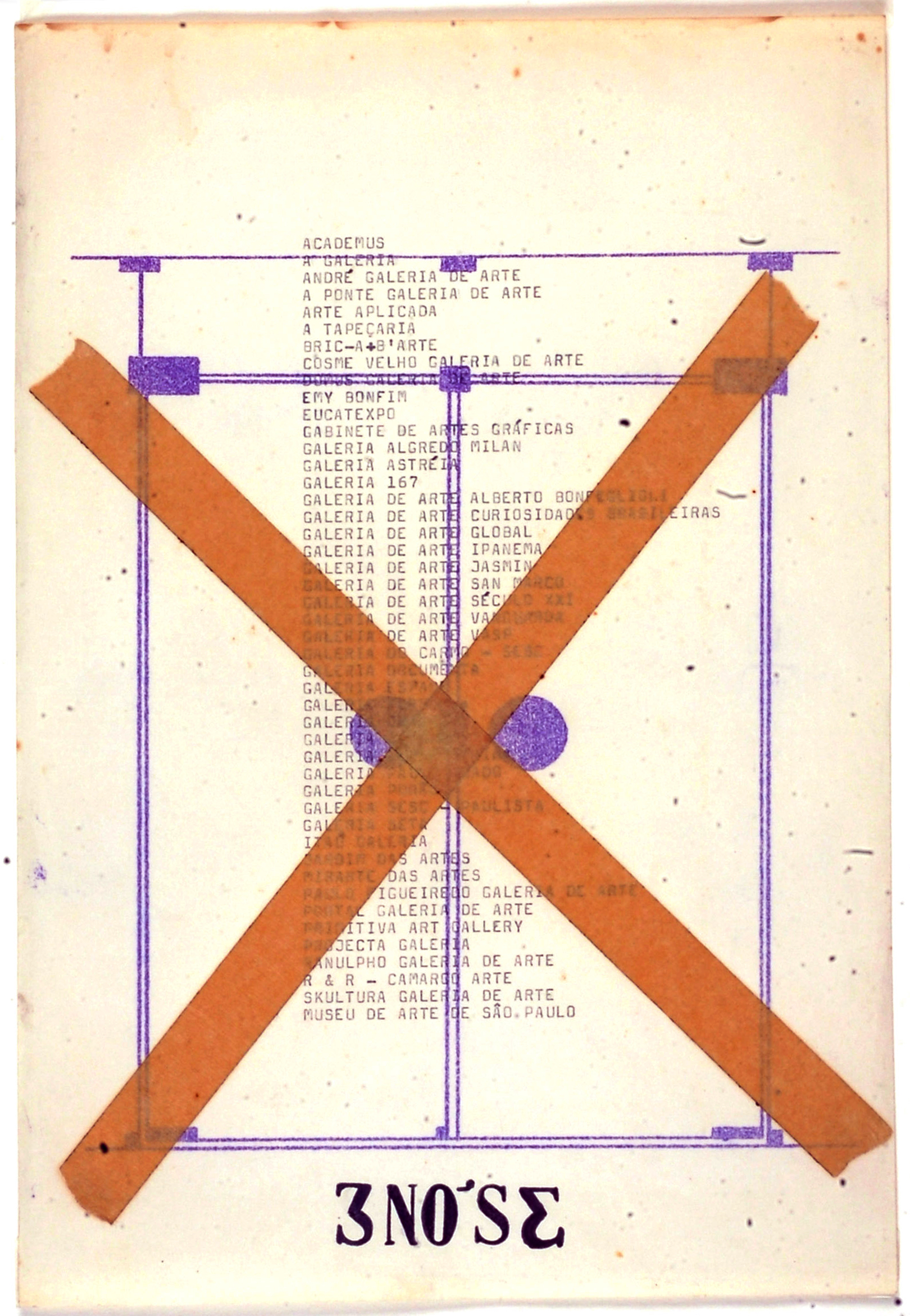
10 | 3NÓS3, X-Galeria, poster derived from the urban intervention, offset print, São Paulo 1979.
Ensacamento did not unfold solely within the streets of São Paulo, nor did it remain confined to the space of direct experience. From its inception, the intervention was conceived to operate simultaneously within the city and within circuits of mediated visibility. The collective themselves contacted newspaper editorial offices, alerting them that something unusual was taking place across the city’s monuments. The following day, the event was widely reported in major newspapers such as Folha da Tarde, Última Hora, Diário da Noite, and Notícias Populares [Fig. 8]. Significantly, these reports appeared predominantly in sections devoted to urban chronicle rather than cultural commentary, allowing the intervention to enter public discourse not as an art event, but as an anomalous disruption of the city’s ordinary functioning.
This articulation between urban action and media visibility was consolidated already in the collective’s second intervention. In X-Galeria, the operation unfolded in near simultaneity with its media registration, as it was accompanied and photographed by a reporter from Jornal da Tarde throughout its execution. The presence of the press thus became not merely a mechanism of subsequent amplification, but an integral component of the intervention itself. From this point onward, media coverage was no longer episodic or reactive, but increasingly anticipated, incorporated, and mobilized as part of the group’s actions. As Mario Ramiro would later recall:
In hindsight, I see Urban Interventions as an early form of media art, resulting in a temporal existence more significant than its physical existence by means of achieving a presence in the mass media. Much more than an installation or the product of a performance, the Urban Interventions existed as television or print media stories. (Ramiro 1998, 249)
Newspapers, television reports, and photographic reproductions were therefore not secondary documentation but integral components of the intervention’s afterlife. This dynamic became particularly evident in later actions such as Conecção and Arco 10, which were broadcast on channels of the Globo Network, further amplifying their reach and transforming ephemeral urban gestures into widely shared visual events.
Alongside mainstream media, 3NÓS3 actively mobilized alternative circuits of dissemination, particularly through mail art, which in the late 1970s had expanded among artists seeking to operate beyond institutional frameworks (Gifalli 2018). From photographic records and press materials, the collective produced a series of multiples — booklets, posters, and xeroxed inserts — distributed in specially marked envelopes. Among these were Encarte-Ensacamento, an offset-printed edition of five hundred copies circulated through mail art networks [Fig. 9]; the X-Galeria poster accompanied by a booklet of newspaper clippings [Fig.10]; the photocopied edition of Conecção; and Intervenção IV, published in 1981 with the support of São Paulo’s Department of Culture. Through these channels, the interventions migrated across geographies and contexts, acquiring new layers of visibility while preserving their unstable, processual character.
The collective’s engagement with mediated circulation also took the form of a deliberate détournement of mass communication itself. On 18 November 1979, within the visual arts section of Folha de São Paulo, in a column ceded by artist Fernando Cerqueira Lemos, 3NÓS3 published A Categoria Básica da Comunicação. Rather than offering commentary or documentation, the page was filled with a collage of disconnected phrases extracted from texts on aesthetics, semiotics, and politics — an assemblage deliberately devoid of coherent meaning. As Pontes has observed, it functioned as “an assault on blank space that, in saying nothing, became expressive” (Pontes 2017, 211). By interrupting the newspaper’s expected communicative function, the collective introduced noise into a system structured around clarity, legibility, and consumption.
This gesture did not emerge in isolation. Rather, it aligned 3NÓS3 with a broader Brazilian and international lineage of artistic occupations of mass media. From Nelson Leirner’s interventions in newspapers to the classified advertisements conceived by Paulo Bruscky and Daniel Santiago, and Fred Forest’s blank spaces in Le Monde, these practices sought to destabilize communication systems from within (Pontes 2012, 84). As Fabris has argued, détournement in that context pointed to the necessity of acting from within the very structures one seeks to disrupt, through the appropriation and reworking of preexisting and established artistic forms, which in this very process reveal their underlying functions (Fabris 2017, 225). The intervention by 3NÓS3 produced a comparable effect, foregrounding the newspaper not as a neutral vehicle of information but as a regulated space of meaning subject to disruption.
In parallel, the collective carefully maintained an ephemeral presence within the art world. This dialogue with artistic institutions was established well before the Pinacoteca ‘gran finale,’ through exhibitions, publications, and editorial interventions. In January 1980, following the intervention in Porto Alegre, the group organized Intervenção Urbana, a one-week exhibition at Espaço N.O., presenting documentation of their actions. Two months later, in March 1980, they staged Interversões Urbanas: A fotografia como documento at the Museu Lasar Segall in São Paulo, assembling a visual archive of their interventions realized up to that point. These exhibitions translated the fleeting urban gestures into a structured narrative form, allowing them to persist beyond their immediate occurrence in the city. This strategy of translation and persistence was further reinforced through print culture. In October 1981, the influential art magazine Arte em São Paulo, edited by Luiz Paulo Baravelli, featured a photograph of Ensacamento on the cover of its second issue, accompanied by a substantial article authored by the collective. The text traced the group’s formative experience at São Bento subway station — an informal ‘open atelier’ involving the three members alongside the artist Marília Grünwaldt — and emphasized the multiplicity of media formats generated by subsequent interventions, including video recordings, audiovisual works, and xeroxed inserts. Across these platforms, urban action and mediated reproduction were consistently articulated as inseparable dimensions of the same practice. Taken together, these exhibitions and publications indicate that 3NÓS3 did not treat documentation as a secondary or retrospective gesture. Rather, they actively constructed an ecology of transmission in which interventions unfolded across heterogeneous supports, temporalities, and publics. The city, the exhibition space, and the printed page functioned as interconnected sites within a broader system of circulation, each contributing to the work’s visibility and intelligibility.
It is within this framework that questions surrounding aura, reproducibility, and profanation become unavoidable. The collective’s reliance on photographic records, press coverage, and printed multiples resonates with contemporaneous artistic reflections on reproduction, particularly within Brazilian experimental practices such as Paulo Bruscky’s xerox art, which foregrounded the notion of an “art without original” (Aldana, Maynes 2017, 23). More broadly, these strategies align with a critical rethinking of originality and mediation characteristic of the late 1970s and early 1980s. Within this context, reproduction did not simply threaten the work of art but became one of its operative conditions. As theorists such as Boris Groys and Douglas Crimp have noted, postmodern artistic practices increasingly operated within open and anonymous circuits of circulation, where meaning and value were generated not through singular objects but through processes of displacement, repetition, and contextual relocation (Groys 2008; Crimp 1979; 1980).
Against this backdrop, the apparent ephemerality of 3NÓS3’s interventions does not signal the disappearance of aura but its transformation. As Walter Benjamin famously observed, aura is bound to “the unique phenomenon of a distance, however close it may be” (Benjamin [1935] 1969, 5). In the case of 3NÓS3, this distance was no longer anchored in the singularity of an art object but neither was it simply dissolved by reproduction. Rather, it was reconfigured through forms of mediated circulation that did not eliminate distance, but displaced it. The brief physical gesture — fragile and destined for rapid removal — was rarely encountered in its immediate presence; instead, it emerged belatedly, through newspapers, television broadcasts, photographs, and multiples.
In this sense, mediation does not automatically produce aura — indeed, in most cases it neutralizes it. Yet here, the temporal delay, fragmentation, and dispersal introduced by circulation generate a different regime of distance, no longer tied to the uniqueness of the object, but to the conditions under which it circulates. As Groys has argued, in contemporary art the auratic function is no longer grounded in the singular work, but emerges through its inscription within specific contexts of presentation and circulation (Groys 2008, 72-75). The intensity of the work thus resides not in its immediate presence, but in its deferred and distributed appearance.
The sudden appearance of hooded monuments, colored plastic lines slicing through urban arteries, or meaningless collages occupying newspaper columns functioned as condensed visual shocks whose resonance expanded as they moved across communicative networks. Aura, rather than dissipating, migrated into circuits of circulation, where repetition, displacement, and contextual re-inscription generated new forms of symbolic force. From this perspective, 3NÓS3’s practice complicates any straightforward opposition between presence and reproduction. Urban interference and media dissemination operated as complementary dimensions of a single strategy, unfolding simultaneously within the material fabric of the city and the immaterial flows of information.
This dynamic also complicates Agamben’s understanding of profanation. If, for Agamben, what is profaned “loses its aura and is returned to use” (Agamben [2005] 2007, 77), the interventions of 3NÓS3 suggest a more ambivalent economy. Their actions clearly deactivate monuments, infrastructures, and media spaces as dispositifs of separation; yet their mediated afterlife does not simply neutralize symbolic charge. Rather, it redistributes it. Aura is neither preserved intact nor fully dissolved, but transformed into a processual effect — inseparable from circulation itself. If the interversões sought to wrest urban spaces from their prescribed functions, the media interventions pursued a parallel task within systems of communication, rendering them momentarily noisy, inoperative, and open to other modes of experience. Profanation thus extends beyond physical occupation to encompass the infrastructures of visibility and circulation that structure contemporary urban life. The work of 3NÓS3 can therefore be read as a prescient exploration of artistic action within an increasingly mediatized condition, in which the city is continuously translated into images, information, and flows, and where resistance operates as much through circulation as through presence.
Notes
[1]In Brazil, during the late 1960s and 1970s, the notion of guerrilla circulated as a shared conceptual framework of opposition, informing both political militancy and cultural practices. Within artistic discourse, this vocabulary was articulated most explicitly in Pignatari (1967), while Marighella (1969) contributed to shaping a broader countercultural imaginary.
[2]SESC Pompeia is a landmark cultural center in São Paulo developed through the adaptive reuse of a former industrial complex by Bo Bardi, who preserved the site’s material roughness while reconfiguring it into an open, non-hierarchical space for collective life (Ferraz 2019). More broadly, SESC is a nationwide Brazilian institution dedicated to cultural, educational, and social activities, and has played a key role in shaping experimental forms of public culture in Brazil (Mairink 2014).
[3]On a purely formal level, such affinities may recall large-scale works associated with American land art of the late 1960s and 1970s, in which industrial materials and minimal gestures were deployed to mark or inscribe space. Canonical examples include Michael Heizer’s City (begun in the early 1970s), a monumental complex of earth and concrete structures in the Nevada desert, and Nancy Holt’s Sun Tunnels (1973-76), composed of four concrete cylinders aligned with solar events and the surrounding landscape.
[4]Nervo Óptico (1976-1978) was an experimental art collective based in Porto Alegre, whose core participants included Clovis Dariano, Telmo Lanes, and Vera Chaves Barcellos. Beyond operating as a collective, the group maintained an independent exhibition space (Espaço N.O.) and produced a self-published periodical, functioning as a platform for exchange within Brazil’s alternative art networks of the late 1970s.
[5]The collective’s formation was rooted in the academic environment of the Escola de Comunicações e Artes of the Universidade de São Paulo, where Ramiro and França were enrolled as students, while Hudinilson Jr. participated informally in courses and activities. All three were also frequent attendees of ASTER, an experimental art school and workshop founded in São Paulo in 1978, specializing in printmaking and engraving techniques (Sayão 2021).
[6]The collective’s larger-scale interventions involved a broader network of artists and groups who shared an independent artistic ethos and complementary practices. These included: Viajou Sem Passaporte, Tupinãodá, Manga Rosa, Gextu, Nervo Óptico, D’magrelas, Sanguinovo, Centro de Livre Expressão, TVDO, and the Argentine group Taller de Investigaciones Teatrales.
Bibliographical references
- 3NÓS3 1981
3NÓS3, VI Interversão, São Paulo 1981. - Agamben [2005] 2007
G. Agamben, Profanations [Profanazioni, Roma 2005], New York 2007. - Aldana 2008
E. D. Aldana, Interventions into Urban and Art Historical Spaces: The Work of the Artist Group 3NÓS3 in Context, 1979-1982, PhD dissertation, The University of Texas at Austin, 2008. - Aldana 2017
E. Aldana, “Drawings on the City Map,” in M. Ramiro (ed.), 3NÓS3: Intervenções Urbanas 1979-1982, São Paulo 2017, 217-223. - Aldana, Maynes 2017
E. Aldana, E. Sullivan Maynes (eds.), Xerografia: Copyart in Brazil, 1970-1990, San Diego 2017. - Benjamin [1935] 1969
W. Benjamin, “The Work of Art in the Age of Mechanical Reproduction”, in H. Arendt (ed.) Illuminations, New York 1969. - Bishop 2024
C. Bishop, Disordered Attention: How We Look at Art and Performance Today, New York 2024. - Crimp 1979
D. Crimp, Pictures, “October” 8 (1979), 75-88. - Crimp 1980
D. Crimp, The Photographic Activity of Postmodernism, “October” 15 (1980), 91-101. - Fabris [1984] 2017
A. Fabris, “Pretext for an Intervention” [“Pretexto para uma intervencao”, São Paulo 1984], in M. Ramiro (ed.), 3NÓS3: Intervenções Urbanas 1979-1982, São Paulo 2017, 206-207. - Fabris 2017
A. Fabris, “Revisiting the Actions of 3NÓS3”, in M. Ramiro (ed.), 3NÓS3: Intervenções Urbanas 1979-1982, São Paulo 2017, 224-227. - Ferraz 2019
M. C. Ferraz (ed.), Coleção Lina Bo Bardi, São Paulo 2019. - Gifalli 2018
R. Gifalli, Arte postal no Brasil: comunicação criativa e sua atualização nas redes sociais, “Revista Multiplicidade” 1, no. 1 (2018). - Groys 2008
B. Groys, “The Topology of Contemporary Art,” in Antinomies of Art and Culture. Modernity, Postmodernity, Contemporaneity, Durham 2008, 71-80. - Guattari, Rolnik [1986] 2008
F. Guattari, S. Rolnik, Molecular Revolution in Brazil [Micropolítica: Cartografias do desejo, São Paulo 1986], Los Angeles 2008. - Hudinilson Jr., Ramiro, França 1981
Hudinilson Jr., M. Ramiro, R. França, 3NÓS3 / Interversão Urbana, “Arte em São Paulo” 2 (1981). - Knabb 1995
K. Knabb (ed.), Situationist International Anthology, Berkeley 1995. - Mairink 2014
R. Mairink, SESC – o livre acesso à cultura na cidade de São Paulo, “Cidades, Comunidades e Territórios” 28 (2014), 88-102. - Marighella 1969
C. Marighella, Minimanual do Guerrilheiro Urbano, São Paulo 1969. - McDonough 1994
T.F. McDonough, Situationist Space, “October” 67 (1994), 58-77. - Miyoshi 2007
A. Miyoshi, O edifício do MASP como sujeito de estudo, “Arquitextos” 84 (2007). - Pignatari 1967
D. Pignatari, Teoria da Guerrilha Artística, “Correio da Manhã” (7 july 1967). - Pontes 2012
M. A. Pontes, A documentação nas práticas artísticas dos grupos Arte/Ação e 3NÓS3, MA thesis, Universidade Estadual Paulista, São Paulo 2012. - Pontes 2017
M. A. Pontes, “Urban Intervention as System,” in M. Ramiro (ed.), 3NÓS3: Intervenções Urbanas 1979-1982, São Paulo 2017, 208-216. - Ramiro 1998
M. Ramiro, Between Form and Force: Connecting Architectonic, Telematic and Thermal Spaces, “Leonardo” 31, no. 4 (1998), 247-60. - Ramiro 2004
M. Ramiro, Grupo 3Nós3: The Outside Expands, “Parachute” 116 (2004), 41-53. - Ramiro 2017
M. Ramiro (ed.), 3NÓS3: intervenções urbanas 1979-1982, São Paulo 2017. - Red Conceptualismos del Sur [2012] 2014
Red Conceptualismos del Sur (ed.), Losing Human Form: A Seismic Image of the 1980s in Latin America [Perder la forma humana, Madrid 2012], Buenos Aires 2014. - Sayão 2021
B. Sayão, Constelação ASTER: histórias de um centro de estudos de arte em São Paulo (1978-1981), PhD dissertation, Universidade de São Paulo (PPGEHA-USP), 2021. - Spinelli 2010
J. Spinelli, Alex Vallauri: graffiti. fundamentos estéticos do pioneiro do grafite no brasil, São Paulo 2010. - Wark 2011
M. Wark, The Beach Beneath the Street: The Everyday Life and Glorious Times of the Situationist International, London–New York 2011.
Abstract
This essay examines the Brazilian collective 3NÓS3 (1979-1982) through the conceptual lens of profanation, understood as an operative strategy enacted across urban space and media circulation. Starting from the group’s final institutional intervention at the Pinacoteca do Estado in São Paulo (1982), the article reads this moment not as a rupture but as the crystallization of a practice developed outside traditional art circuits through clandestine urban actions, infrastructural interferences, and deliberate engagements with mass media. Moving backwards from the museum to the street, the essay reconstructs the logic of the collective’s interversões – ephemeral interventions employing plastic bands, cellophane rolls, and minimal graphic gestures within highways, underpasses, monuments, and galleries. These actions sought to suspend the functional and symbolic separation governing both urban infrastructures and cultural institutions, without fully neutralizing their use. Drawing on Giorgio Agamben’s notion of profanation while testing its conceptual limits, the essay argues that 3NÓS3’s practice does not simply abolish aura but reconfigures it within circuits of mediation, where meaning and intensity emerge through repetition, displacement, and circulation. Special attention is given to newspapers, television, mail art, and printed multiples as constitutive elements of the works rather than secondary documentation. By operating simultaneously within the city and its media representations, 3NÓS3 articulated a form of artistic action that treated the museum, the street, and the press as contiguous segments of the same spatial and communicative continuum. The essay ultimately positions the collective’s work as a prescient exploration of artistic profanation within an increasingly mediatized urban condition, where resistance unfolds as much through circulation as through physical presence.
keywords | 3NÓS3; Artistic intervention; Profanation; Mediatization; Urban Infrastructure.
La Redazione di Engramma è grata ai colleghi – amici e studiosi – che, seguendo la procedura peer review a doppio cieco, hanno sottoposto a lettura, revisione e giudizio questo saggio
(v. Albo dei referee di Engramma)
Per citare questo articolo / To cite this article: Simone Rossi, 3NÓS3. Interversão Between Urban Space and Media Circulation. Notes on Profanation, “La Rivista di Engramma” n. 232, marzo 2026.
Per citare questo articolo / To cite this article: Simone Rossi, 3NÓS3. Interversão Between Urban Space and Media Circulation. Notes on Profanation, “La Rivista di Engramma” n. 232, marzo 2026, pp. xx-yy | PDF dell’articolo