The Practice of Play
On the Profane Gesture and the Architecture of Use
Enrico Miglietta, Liselotte Vroman
Abstract
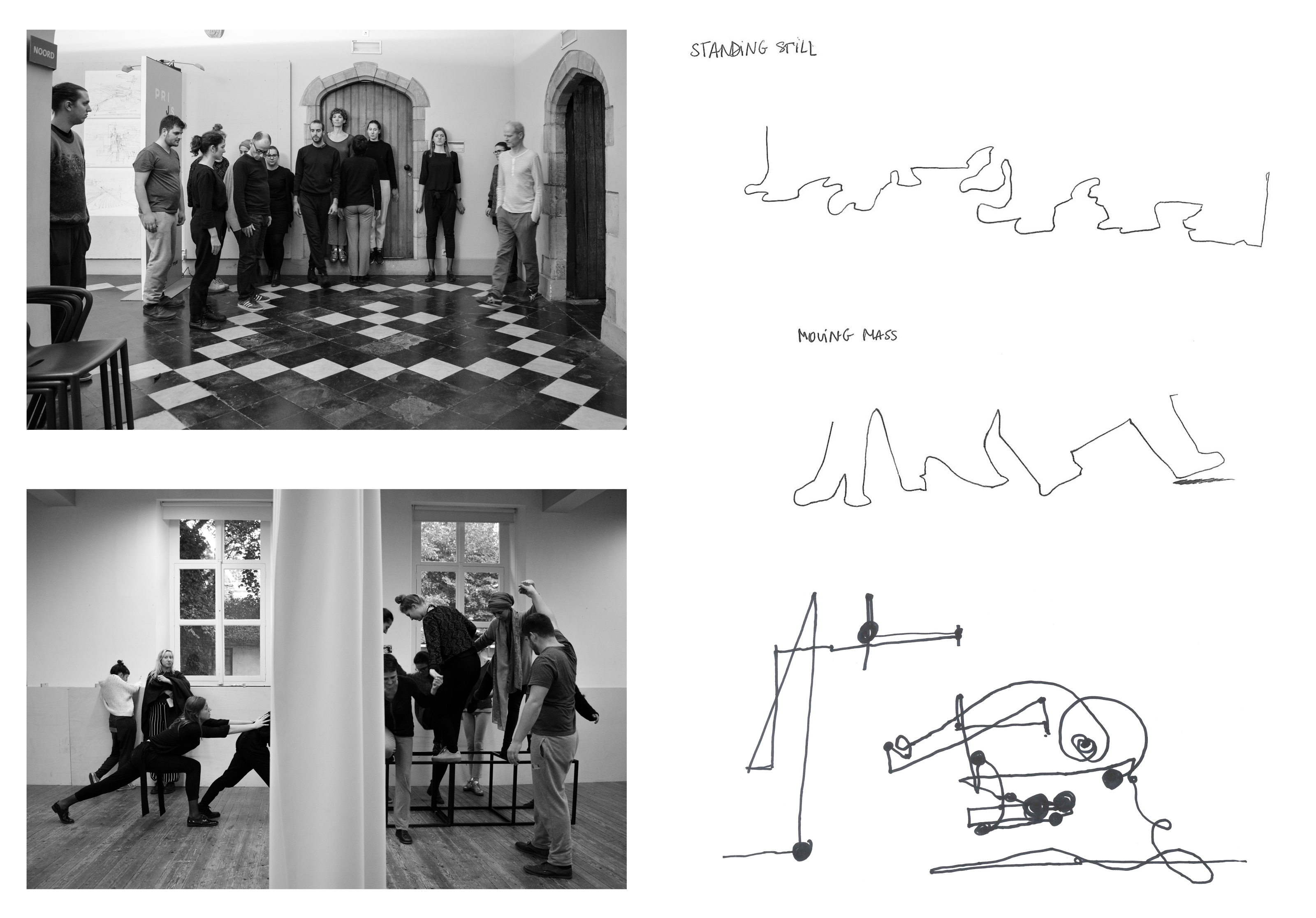
1 | Performing Space and Objects, doctoral workshop organised by T. Lagrange, D. Vangrunderbeek and G. Belpaeme with students of the MSc in Architecture. Participants explore space through body movement — guided by dramaturgist G. Belpaeme and researcher L. Vroman — while others simultaneously draw movement notations. Left: performance photographs; right: movement notations. KU Leuven, Faculty of Architecture, Campus Sint-Lucas Ghent. Photos: Liselotte Vroman, 2017.
I. Introduction
Friedrich Schiller describes the ‘Play Drive’ (Spieltrieb) as the impulse to hold together, through contradiction, the human experience of the finite and the infinite, of sense and reason, of matter and form. For the philosopher, it is precisely the pursuit of a ‘living form’, and thus the contemplation of the beautiful, that allows human beings to become more fully human (Schiller 1993). Play often emerges where function is momentarily suspended, or more precisely, where the ordinary conditions of use are held in abeyance. It appears at those moments when space and function fall slightly out of alignment, when rules begin to lose their grip, and when gestures drift away from what is expected without yet becoming oppositional. In such moments, play does not escape reality, but abstracts it from within, operating inside its frameworks while temporarily loosening their necessity. One might think, for instance, of a child who suddenly breaks into running, jumping, or singing inside a museum. Such behaviour is not necessarily disruptive. Rather, it exposes the latent tensions embedded in the space itself: the delicate choreography through which silence, slowness, and controlled movement are ordinarily produced and maintained. What becomes visible is not disorder, but the fragility of the construction of order. Through play, architecture may momentarily reveal itself not as a stable framework of forms and programmes, but as a carefully articulated field of distances, thresholds, and separations that must be continuously upheld.
While Schiller’s notion of Spieltrieb provides an important philosophical point of departure, play cannot be understood as a singular or stable concept across disciplines. Its meaning shifts according to context and practice. In the performing arts, for instance, play may refer to a written, choreographed, or improvised work staged within a defined spatial and temporal frame. In everyday language, it may denote a game or activity pursued for enjoyment, distraction, or imaginative displacement. Despite their differences, these meanings share a common trait: a partial withdrawal from regimes of purpose and efficiency, allowing actions, gestures, and roles to unfold without being fully subordinated to prescribed ends. Rather than fixing its definition, this essay approaches play as a relational practice that operates across such fields, remaining attentive to the ways in which it suspends necessity without abolishing structure.
Architecture organises use by establishing margins, between seeing and touching, moving and staying, approaching and keeping one’s distance. These margins are rarely neutral. They are embedded in spatial arrangements, in the disposition of surfaces and objects, in the way bodies are invited in, guided out, or restrained. Certain spaces are designed to be crossed without pause, others to be contemplated without contact; certain elements demand reverence, others familiarity. Use, in this sense, is never simply given. It is shaped, withheld, delayed, or redirected through architectural gestures. It is through this continuous work of distancing—by which proximity is modulated, contact deferred, and attention regulated—that the notion of profanation acquires its relevance. As such, to ‘profane’ does not mean to negate a spatial order, nor to oppose it through overt transgression. Rather, it describes a subtle operation, the return of what has been set apart to a shared field of use. In architecture, profanation acts through minor displacements, through gestures that do not abolish rules but suspend their necessity. A boundary remains in place, yet becomes permeable [Fig. 02]; a device continues to function, yet no longer commands a single mode of behaviour. What is at stake is not the destruction of form, but its temporary disarming. Play constitutes one of the most precise modalities through which such disarming can occur. Far from being a realm of pure freedom, play unfolds within constraints. Yet these constraints no longer serve a final purpose. Rules are present, but they do not compel; they can be repeated differently, stretched, or momentarily set aside. In this sense, and following Benveniste’s understanding of play as a ‘structural operation’, play does not suspend action itself but the obligation attached to it: gestures remain recognisable, procedures intact, while their necessity is loosened (Benveniste 1947). Action continues to take place, but without having to fulfil a prescribed end. It is in this suspension of the means–ends relation that play operates as a form of use without destination: a practice that renders function inoperative without rejecting it. Through play, space is no longer occupied according to a single plan, but tested, reinterpreted, and reopened to other possibilities of inhabitation.
Building on this understanding, the essay approaches architecture not as closed, resolved forms, but as spatial conditions that can be activated, misused, or reinhabited through gesture. Through selected situations, read alongside artistic and performative practices, it traces how play can operate as a profanatory gesture in architectural space—moving from the suspended gesture of the individual body in relation to aura and distance, through the roles and tools by which space is conceived and inhabited, to the political question of how such gestures can sustain common use. What emerges is not a catalogue of examples, but a field of relations in which space appears as an offering: a constellation of thresholds, surfaces, and devices that may be returned, however briefly, to shared inhabitation. Written in two converging voices—one grounded in the minute negotiations of architectural detail, the other in movement and embodied spatial exploration—writing itself becomes a form of offering: an open, iterative practice that mirrors the logic of play and profanation it seeks to articulate, remaining attentive to the gestures through which space may be offered anew.
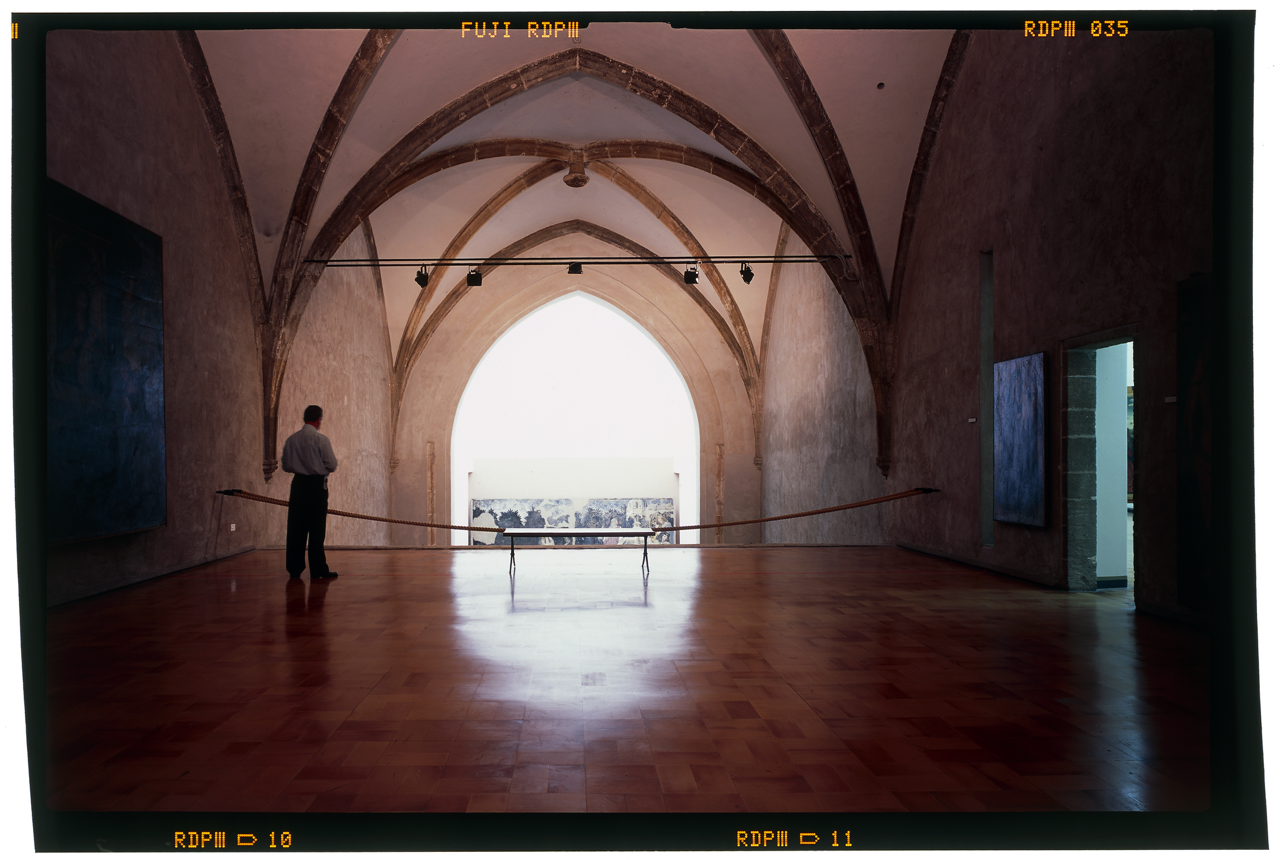
2 | Carlo Scarpa, Palazzo Abatellis – Galleria Regionale della Sicilia. View of the Chapel and suspended rope, a minimal device that maintains distance while remaining permeable, exposing separation as a constructed and reversible condition of use. Photo: Vaclav Sedy, 2004. © CISA-A. Palladio.
II. Aura, Distance and Play as Profanatory Suspension
Before organising form or programme, architecture works by establishing distances between bodies and objects, between what may be looked at and what may be touched, between movement and rest. These distances are materially and spatially constructed through thresholds, surfaces, devices, and details that regulate behaviour and stabilise expectations. In this sense, architecture does not simply ‘host’ use; it actively produces ‘regimes of use’. Within this material and spatial economy, aura can be understood not as an ineffable quality but as an operative condition of distance. Aura resides in the experience of separation itself, persisting even when physical proximity is possible, as “the unique appearance of a distance, no matter how close it may be” (Benjamin 2008, 285). Separation preserves objects and spaces by withdrawing them from use, fixing them in a state of untouchability that transforms engagement into contemplation. Architectural space participates in this logic whenever it produces attitudes of reverence, restraint, or passive observation. This condition is not limited to religious or exceptional domains. Modernity generalises separation across everyday life. Benjamin already identifies this logic in the nineteenth-century World Exhibitions, where the regime of display anticipates a condition in which visibility replaces use. The imperative governing spaces of exhibition and consumption is explicit: look at everything; use nothing (Benjamin 2008, 101). From this perspective, the canonical museum emerges as an allegory of the unusable, a space in which objects are made universally visible and preserved while being collectively withdrawn from common use. When separation operates in this way, through the simultaneous exposure and withdrawal of objects, it produces a condition that is inherently unstable. Distance is no longer secured by inaccessibility but must be continuously maintained in the very moment of visibility. Objects are brought close, rendered legible, and yet withheld from use. It is within this tension—between proximity and interdiction—that the possibility of profanation emerges.
Profanation does not aim to abolish distance or to negate the arrangements that sustain it; rather, it intervenes in their mode of operation. As Agamben formulates it, “to profane means not simply to abolish and erase separations, but learn to put them to a new use, to play with them” (Agamben 2007, 87, emphasis added). Separation remains in place, but its necessity is suspended. This condition of suspension does not imply the disappearance of rules or boundaries, but their transformation into a more permeable regime. Thus, play operates within a regulated separation that functions less as a rigid border than as a porous membrane, capable of filtering reality rather than excluding it altogether (Maestri 2020). It is precisely this regulated permeability that allows gestures to be displaced without collapsing the spatial order they inhabit. What is returned is not an original immediacy, but the possibility of use itself. Play constitutes a privileged mode of this suspension. Far from opposing rules, play inhabits them. It accepts the presence of constraints while disengaging them from their prescribed ends. Gestures are repeated, but their obligation is lifted; actions are performed without fulfilling their function. Agamben insists on this point with deliberate clarity when he describes play as a form of use “in vain”, in which gestures are enacted without finality (Agamben 2007, 85). The gesture remains recognisable, yet its end is neutralised.
Children’s play again offers the clearest image of this operation. Children never play outside history or culture; they inherit a world already structured by adult tools, objects, and expectations. As Benjamin observes, “the perceptual world of the child is influenced at every point by traces of the older generation, and has to take issue with them” (Benjamin 2005, 118). Objects and toys are already saturated with functions and intentions imposed from elsewhere. Yet play does not consist in reproducing these models. Through repetition without obedience, children expose the contingency of function and meaning. For Benjamin, the core of play lies in repetition, governed by what he calls the “great law that presides over the rules and rhythms of the entire world of play” (Benjamin 2005, 120). This repetition is not mechanical. In children’s play, repetition does not stabilise form; it keeps it open. “A child creates the entire event anew and starts again right from the beginning” (Idem). What is repeated is not a model to be followed, but a gesture performed again, differently, without closure. Repetition here suspends the linear logic of means and ends, preventing action from congealing into habit. Against the tendency of repetition to harden into automatism, Benjamin insists that play always leaves behind a residue. Even where gestures have congealed into convention, “a small remainder of play survives to the end” (Idem). This remainder persists at the margins of use, in minor deviations and quiet reorientations. Play, in this sense, does not oppose order from the outside; it inhabits it from within, keeping open the possibility that what appears fixed might be used otherwise. Understood as a practice of suspension rather than negation, play returns to what has been withdrawn without claiming ownership or mastery. It neither destroys distance nor dissolves form, but transforms separation into a field of possible gestures. Crucially, this transformation does not occur at the level of representation alone. It unfolds through moving bodies that enact play as a situated practice: through gestures repeated without obligation and movements that explore space without fulfilling its prescribed ends. Movement here is not simply what happens within space, but how spatial roles, distances, and permissions are negotiated and rehearsed. In this sense, play operates as a profanatory force capable of reactivating architectural space not by overturning its order, but by inhabiting it otherwise, through movement, experimentation, and embodied rehearsal.
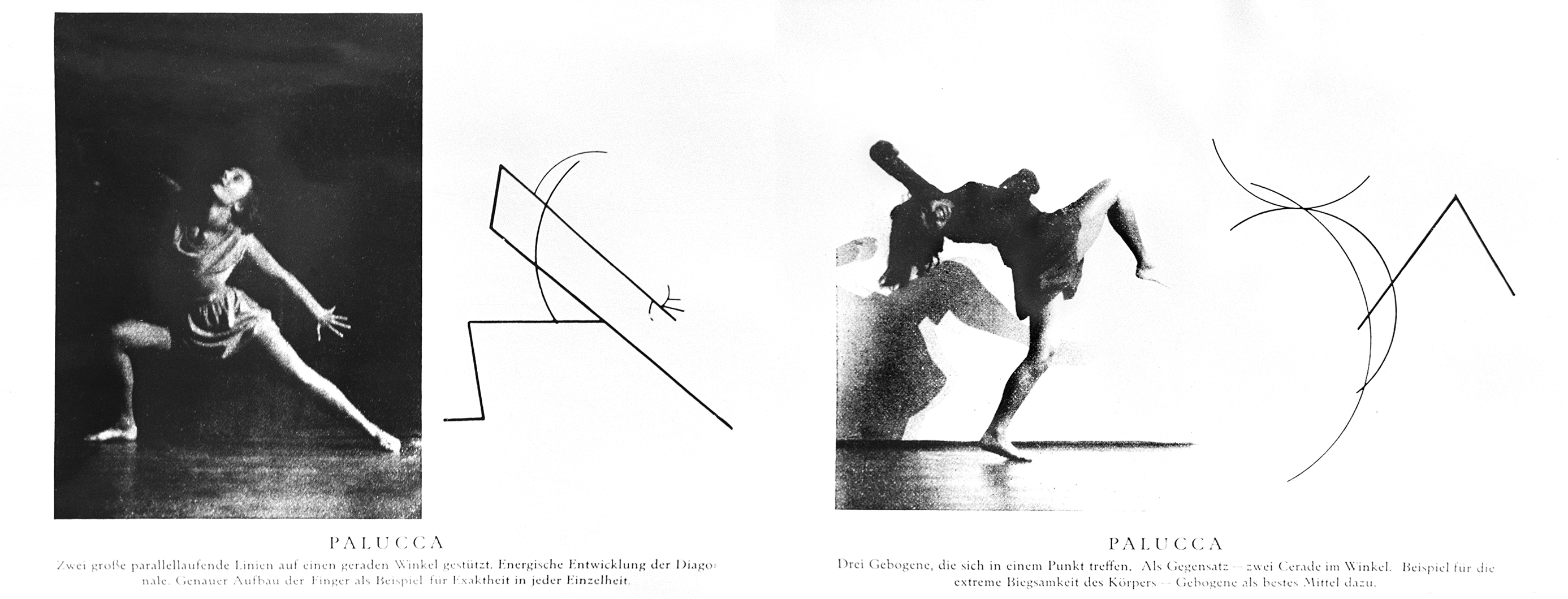
3a-b | Two of the four drawings that were included in Wassily Kandinsky’s essay, Dance Curves: On the Dances of Palucca (original title: ‘Tanzkurven: Zu den Tänzen der Palucca’), 1926. Abstraction of the human body and its movement on the basis of photos by Charlotte Rudolph (source: “Das Kunstblatt”, Potsdam, vol. 10, no. 3 [1926], 120-21). © Deutsche Fotothek / Erich Höhne.
III. Movement, Roles and the Learning Body
Movement precedes knowledge—not in a chronological sense, but in an experiential one. Before language and representation, before meaning stabilises into concepts or formal structures, bodies learn by moving. As Merleau-Ponty suggests, it is through bodily engagement with space that understanding first takes shape, as a form of practical orientation rather than reflective thought (Merleau-Ponty 2012). Long before space can be described, measured, or named, it is encountered through action, through approaching and withdrawing, touching and avoiding, falling and standing up again, repeating gestures until they become familiar. Knowledge, in this sense, is not initially symbolic but corporeal; it emerges through the ongoing negotiation between body and environment. As phenomenological accounts of embodiment suggest, movement constitutes a primary mode of sense-making, a kind of ‘mother tongue’ through which spatial, temporal, and bodily understanding take shape prior to abstraction (Sheets-Johnstone 2011, 419–49). From this perspective, learning cannot be reduced to the transmission of information or the internalisation of abstract rules. It unfolds instead as a situated process in which perception is inherently multisensory and relational. Vision alone is insufficient to grasp space as lived experience; it must be integrated with touch, proprioception, and kinaesthetic awareness. Spatial understanding arises through what Rodaway describes as a ‘haptic mode of perception’, in which the body actively negotiates its position in relation to surfaces, distances, and forces, rather than observing them from a detached standpoint (Rodaway 1994, 41-59). Space is thus not apprehended as a static container, but as a dynamic field continuously reconfigured through movement. What is learned is not simply where things are, but how they can be reached, avoided, leaned against, circled, or crossed.
Play occupies a crucial position within this process of learning. In Homo Ludens, Johan Huizinga situates play as a foundational condition of human culture, introducing the figure of the ‘playing human’ alongside, and even prior to, homo sapiens. For Huizinga, play is not a derivative or utilitarian activity, but an impulse that precedes rational order and instrumental purpose, grounded in human (and animal) life itself (Huizinga 1949). Play, in this sense, does not serve an external goal, nor does it operate according to the logic of efficiency or optimisation. It unfolds as an activity that is “not ‘ordinary’ or ‘real’ life” (Huizinga 1949, 8), interrupting the chain of needs and ends that normally govern action and sustaining itself as a meaningful practice in its own right. Within play, gestures are thus allowed to unfold without being strictly subordinated to fixed outcomes. Movement is repeated, but not in order to perfect performance or achieve mastery—repetition instead becomes a way of testing variation, rhythm, and difference. Actions may be exaggerated, slowed down, or carried out in vain, detached from their usual consequences. Through this temporary suspension of purpose, play opens a space in which learning can occur without being absorbed into predefined results, allowing bodily experience to remain exploratory, open-ended, and generative (Ibid). Children’s play offers a paradigmatic image of this process, not because it is innocent or spontaneous, but because it reveals how learning is always entangled with inherited structures. Roles are tried on, displaced, or exchanged; objects are used against their intended functions; spaces are crossed in unexpected ways. Learning takes place precisely in this interval between prescription and use, where gestures expose the contingency of what appears given and open it to reinterpretation.
Architecture participates directly in shaping this interval. Space does not merely host movement; it conditions and invites it. Architectural environments often prescribe behaviour through programmatic clarity, circulation schemes, and functional hierarchies. Paths suggest speed or slowness, thresholds demand pause or permission, and surfaces discourage or encourage contact. In such contexts, movement risks becoming purely instrumental, reduced to circulation between fixed points. Yet architecture can also operate otherwise, not by abandoning structure altogether, but by offering situations that invite interpretation rather than compliance. Performance practices make this invitation particularly explicit. In performance, space does not precede action as a stable frame; it emerges through use, as meaning is produced through trajectories, pauses, repetitions, and encounters between bodies over time. A floor becomes a field of negotiation; a wall becomes something to lean against, slide along, or resist. Lawrence Halprin’s work is instructive in this regard, precisely because it exposes the difficulty architecture has traditionally had in accounting for movement, despite movement being central to spatial experience. As he observes, “since we have no techniques for describing the activity that occurs within spaces or within buildings, we cannot adequately plan for it, and the activity comes, in a sense, as a by-product after the fact” (Halprin 1965, 126). By bridging choreography and architectural thinking, Halprin thus foregrounds space not as a fixed designation, but as something that is realised through bodily action, unfolding in time and through use.
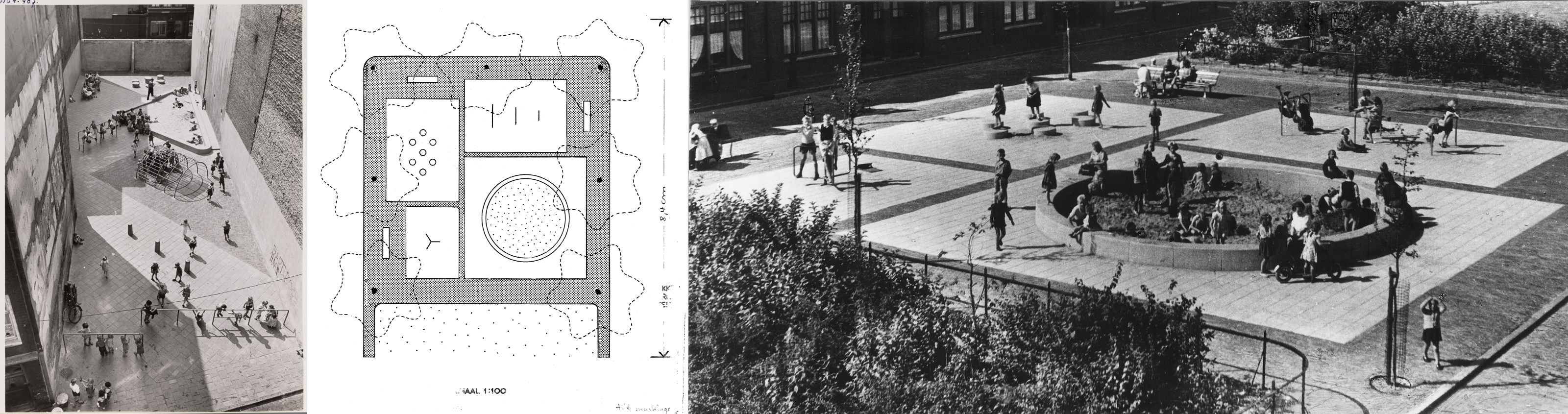
4a | Aldo van Eyck, Amsterdam playgrounds, Dijkstraat 6-12. Stadsarchief Amsterdam.
4b-c | Aldo van Eyck, Amsterdam playgrounds, Zaanhof 28-34, Design plan and photograph of the realised work. Collection Nieuwe Instituut, Aldo and Hannie van Eyck archive.
A similar logic can be found in Aldo van Eyck’s rejection of strict functional determinism, where space is conceived not as a container for predefined activities, but as a relational field that supports bodily adjustment, encounter, and learning through use. Rather than assigning a single, correct use to space, van Eyck’s architecture allows users to negotiate meaning through action, inhabiting space in ways that remain open and reversible (van Eyck 2008). In such contexts, a distinction becomes necessary. When a project deliberately resists behavioural prescription—as in van Eyck’s playgrounds—the profanatory potential does not disappear, but shifts register. It is no longer the body that acts against the space, but the space that has already internalised the gesture of suspension. What remains available to profanation is not the spatial order itself, but the social and institutional frameworks that surround it: the expectations of correct use, the surveillance of adult behaviour, the silent norms that govern what a playground is for. Profanation here operates at the boundary between architectural intention and lived practice, in the gap between what the project offers and what the body actually does with that offer. Learning, in this sense, is never purely individual. It unfolds through shared situations in which roles remain fluid and reversible. The distinction between observer and performer, teacher and learner, designer and user is temporarily suspended without being erased. One watches, then imitates; one acts, then reflects; one leads, then follows. These shifts do not abolish authority or expertise, but render them situational rather than fixed. Profanation operates here not as an act of rebellion, but as a redistribution of positions, in which roles remain legible while losing their rigidity. Such collective learning processes cultivate a heightened sensitivity to difference, variation, and contingency. Through shared movement and observation, bodies attune themselves to the nuances of space and to one another, gradually refining “an education of attention” (Gibson 1979, 254), a situated capacity to perceive, adjust, and respond within a shared environment (Ingold 2000). What is learned is not a correct way of using space, but an awareness that use itself is negotiable. Architecture, when engaged through embodied practices of play and movement, reveals its capacity to support this negotiation from within. It becomes a field in which gestures precede knowledge, and where learning takes place not through instruction alone, but through the lived experience of space as something that can always be used otherwise.
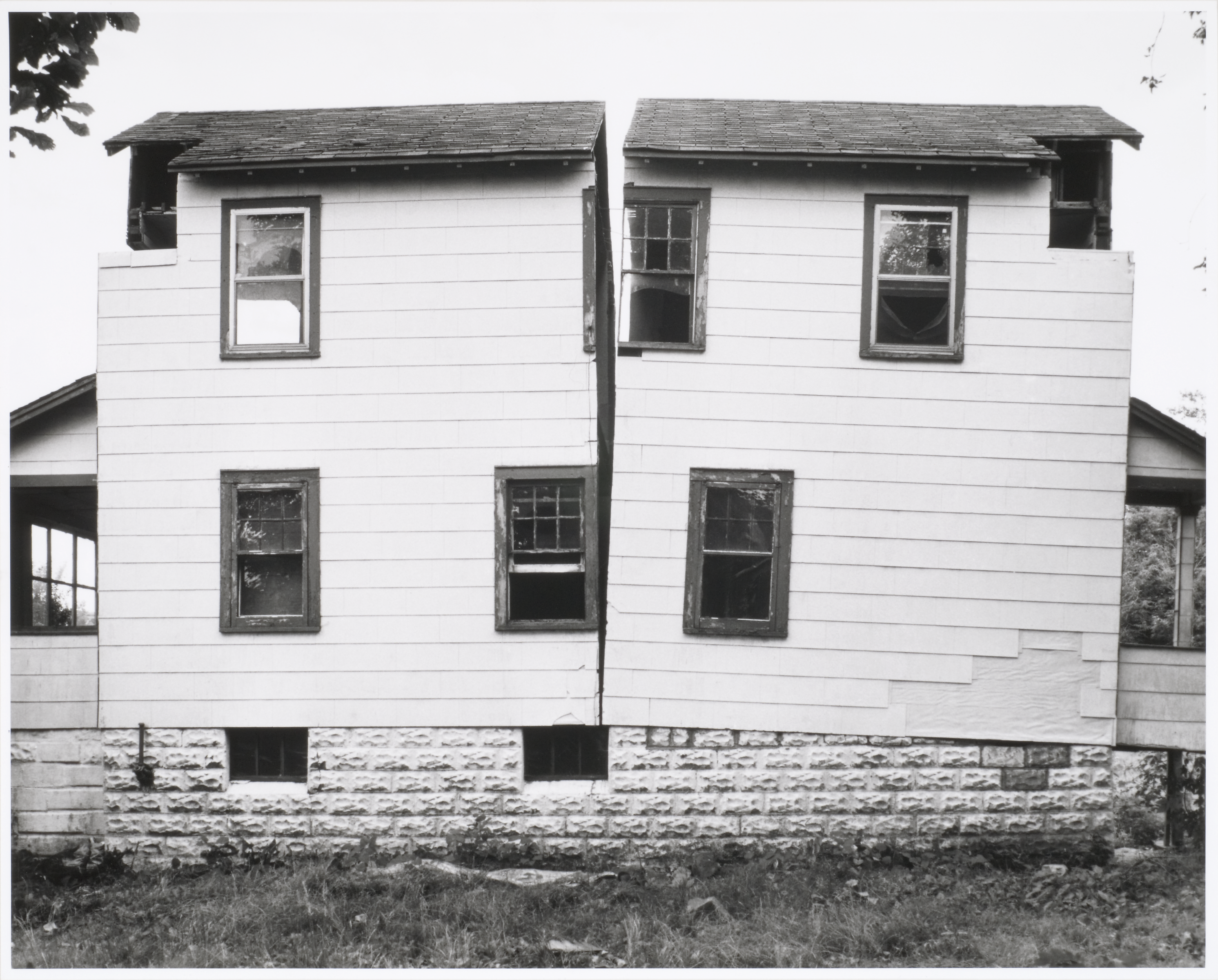
5 | Gordon Matta-Clark, Splitting, 1974, probably printed in 2001. Later gelatin silver print made from Gordon Matta-Clark’s negative, 40,6x50,5 cm. PHCON2002:0016:088:004, Canadian Centre for Architecture, Gift of Estate of Gordon Matta-Clark. © Estate of Gordon Matta-Clark/A R S/by SIAE.
IV. Gestures of Profanation
In Splitting (1974), Gordon Matta-Clark cuts a suburban house in half, opening a vertical fissure that runs through walls, floors, roof, and foundations. The gesture is neither destructive nor purely symbolic. The house remains standing; its domestic order is not erased but rendered unstable. What is exposed is not an alternative form of habitation, but the latent structure of separation upon which the house already relied. By cutting through it, Matta-Clark does not abolish the building’s rules; he suspends their self-evidence, returning the house to a condition in which use becomes uncertain, negotiated, and newly perceptible.
This gesture offers a useful point of entry for thinking about profanation in architecture. Profanation does not operate by negating form, function, or discipline, but by intervening in their internal logics. It acts through precise displacements that render established separations inoperative without dissolving them. In architecture, such separations are embedded not only in spatial organisation, but also in the procedures through which space is conceived, designed, and inhabited. Architectural tools are often understood as neutral mediators between intention and construction, as instruments meant to stabilise form and translate ideas into buildable instructions. Yet drawing and modelling operate less as representations of a finished object than as procedures through which architecture is analytically disassembled and synthetically recomposed. Plans, sections, and models do not merely describe space; they actively decompose it into units, fragments, and components, subjecting form to a process of controlled reduction before it can be reassembled into a coherent whole (Miglietta 2024). This logic of decomposition and recomposition situates architectural tools closer to practices of assembly than to acts of depiction. The project emerges through a sequence of operations—taking apart, isolating, recombining—rather than through the linear refinement of a pre-existing image. In this sense, drawing and modelling function as devices that hold together rule and variation, norm and freedom: they prescribe relations between parts while leaving open the possibility of alternative configurations. What is fixed is not the outcome, but the framework within which transformation can occur. Such a logic is structurally analogous to play. Like the child who disassembles an inherited object not to destroy it but to reinvent it, the architect who treats drawing and modelling as open procedures enters a condition of suspension in which rules remain operative but outcomes remain undetermined.
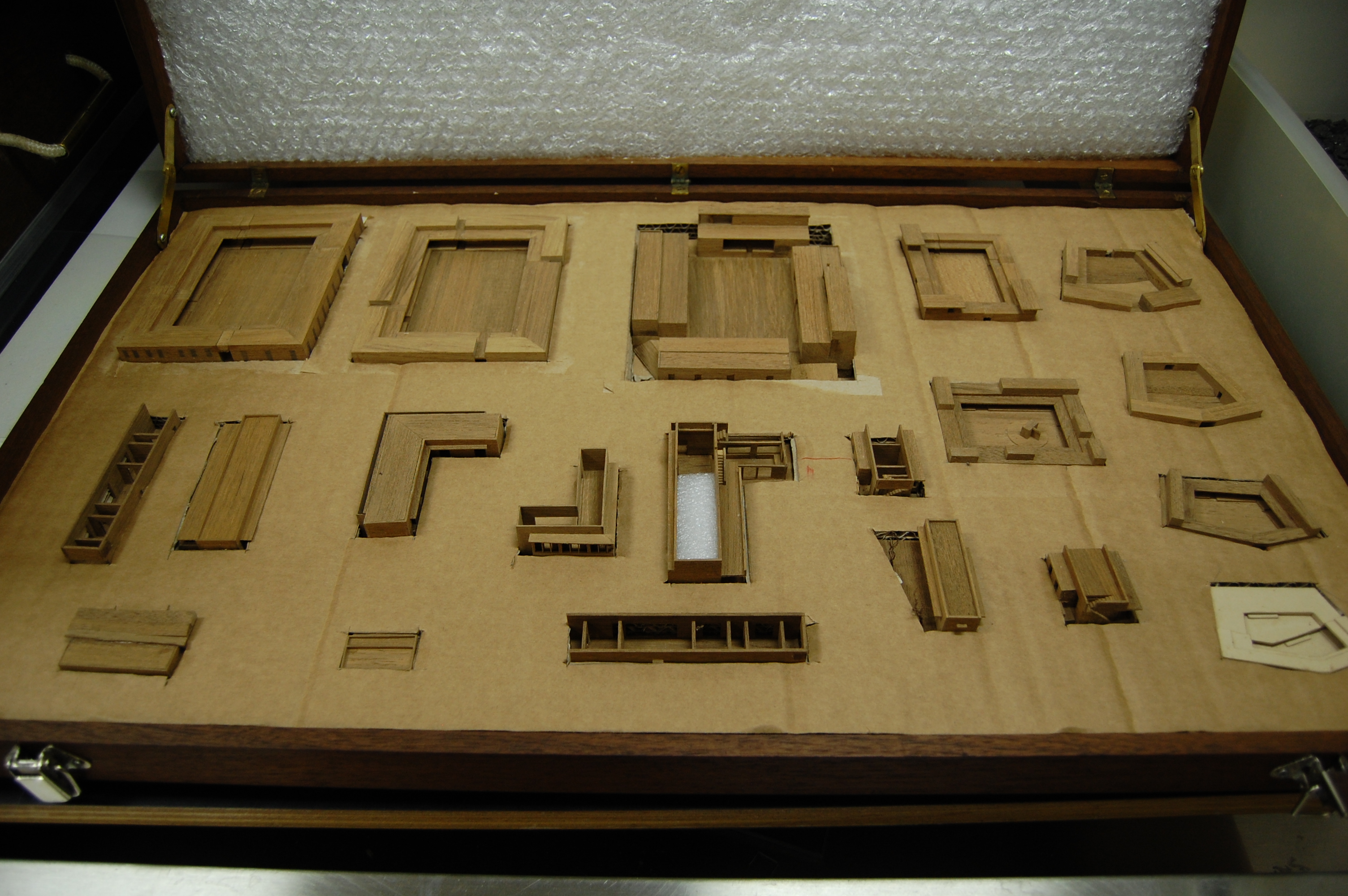
6 | Studio Mumbai, Weavers’ Studio: study model, 2013. Wood, model: 2x11x2,5 cm. ARCH272805, Bijoy Jain fonds, Canadian Centre for Architecture. Gift of Bijoy Jain.
It is precisely here that the architectural model acquires a specific operative status. Rather than anticipating a final form, the model functions as a synthetic device of assembly, a spatial apparatus in which elements are provisionally held together while remaining available for disjunction and reconfiguration—something akin to an “assembly box” rather than a representational miniature (Morpurgo 2024). Profanation operates precisely within this procedural space. When architectural tools are treated not as authoritative representations but as provisional assemblages, their function shifts from prescribing use to enabling it. The model, in particular, becomes a site where form can be tested, interrupted, and reconfigured, suspending the closure that representation typically demands. Rather than anticipating a final state, it sustains a condition of reversibility, allowing construction to be thought as an ongoing process rather than a resolved result. This condition of reversibility is precisely what aligns the architectural model with play: both sustain a space of operations in which form can be tested without being fixed, and in which the gesture of assembly carries meaning independently of its final result.
The model produced for the Weavers’ Studio by Studio Mumbai exemplifies this condition with particular clarity. Presented as a collection of discrete elements arranged within a case, it resists any totalising view of the project. Its logic is neither illustrative nor explanatory. Instead, it foregrounds the act of assembly itself, keeping visible the tension between parts and whole. In doing so, the model does not negate architectural order, but suspends its authority, transforming representation into a field of possible operations and returning the project to use. Such a displacement inevitably reverberates onto roles. Architecture has long relied on the stabilisation of positions—architect and user, designer and builder, performer and audience—through which authority, responsibility, and authorship are distributed. These roles do not merely organise labour; they regulate behaviour and expectation, establishing who is entitled to act and who is expected to receive. Profanation intervenes here not by abolishing these distinctions, but by loosening their necessity. When tools cease to function as commands and begin to operate as open assemblages, roles lose their fixity. Authorship becomes provisional, agency circulates, and knowledge is no longer produced from a single, privileged position, but emerges through movement between roles, through forms of learning that are situated, shared, and reversible. In this sense, architecture does not determine meaning in advance, but provides a framework within which it can be interpreted and appropriated in different ways (Hertzberger 1991). The consequences of this redistribution become most tangible in space itself. Functionalist space anticipates use by prescribing circulation, programme, and efficiency in advance, seeking to eliminate ambiguity, hesitation, and deviation. In such environments, behaviour is foreseen and normalised before it can occur. Profanation does not destroy function, but suspends its inevitability, allowing space to be inhabited otherwise. In this sense, form does not operate as an end in itself, nor as a prescriptive instruction, but as a structured condition that invites use while leaving room for interpretation and appropriation (Ibid).
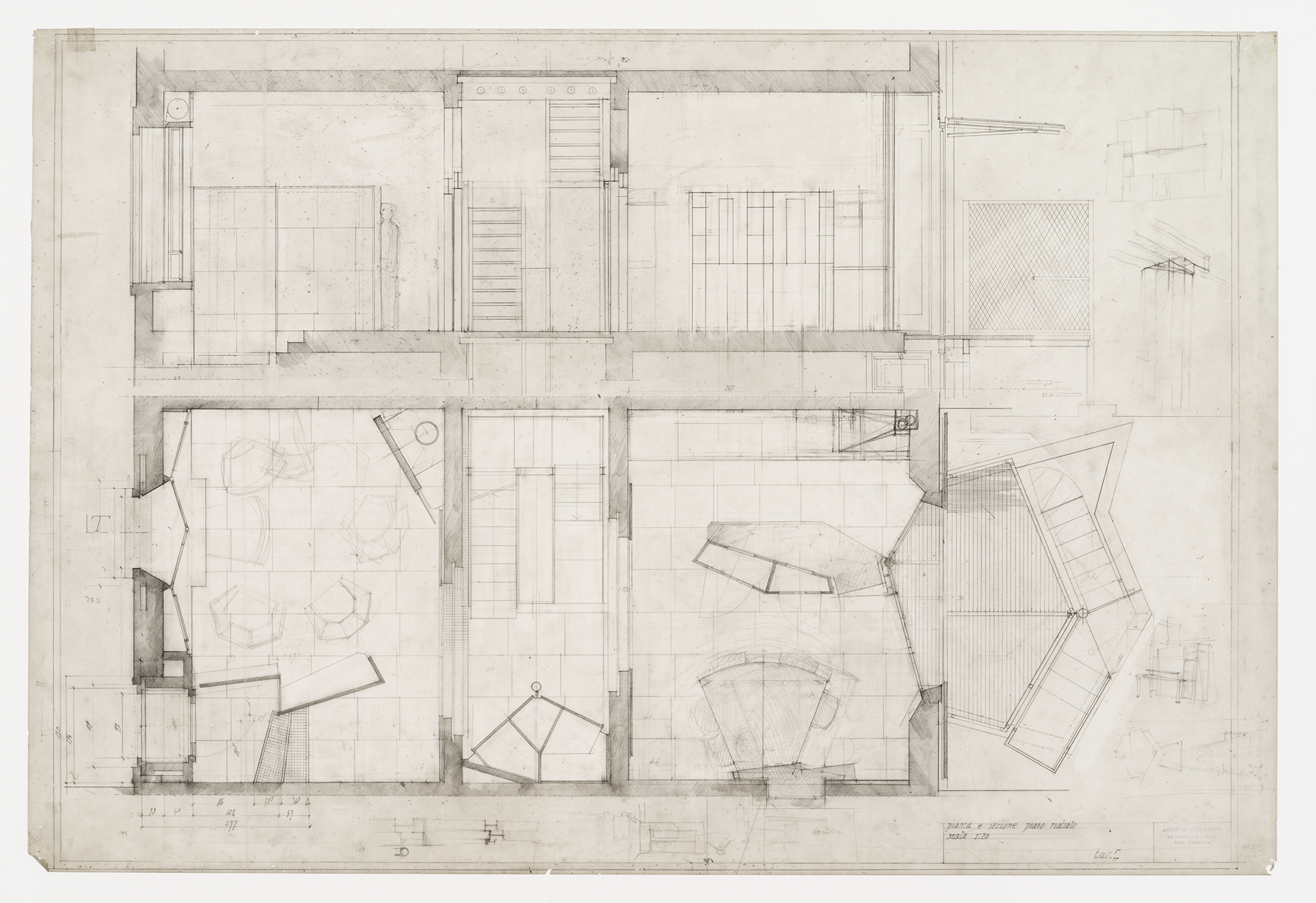
7 | Umberto Riva, plan and section of raised ground floor showing entrance, living room, closet, kitchen, dining room and loggia for Casa Frea, Milan, Italy, circa 1982. Graphite on drafting film with ink stamp and traces of transfer lettering, 60x87,8 cm. ARCH271180, Umberto Riva fonds, Canadian Centre for Architecture. Gift of Umberto Riva. © Estate of Umberto Riva.
This suspension can be observed, in a different register, in the work of Umberto Riva, where plan and section cease to function as distributive diagrams and instead operate as instruments for modulating movement. In Casa Frea, for instance, the organisation of space does not rely on the clear separation of rooms or on linear circulation, but unfolds through a sequence of ‘internal margins’ (de Curtis 2015) produced by fixed furnishings, thresholds, and subtle misalignments. The distributive path at ground level is articulated around elements such as the entrance screen, windows, built-in storage, and the veranda leading towards the garden, each of which redirects movement without prescribing it. Space is not divided once and for all, but continuously negotiated through proximity, obstruction, and deviation, so that what appears as ‘furniture’ simultaneously acts as architectural structure and spatial boundary. What emerges is a spatial condition in which use is neither free nor predetermined. Precision does not result in closure; rather, it sustains a field of possible gestures. Movement is slowed, redirected, or momentarily interrupted, inviting the body to adjust its rhythm and orientation. In this sense, architecture prepares use instead of dictating it. The experience of space unfolds through bodily negotiation—by passing alongside a wall-armadio, leaning against a surface, adjusting one’s pace in response to light, depth, or resistance. Here, profanation does not take the form of a transgressive act, but of a continuous, minor displacement of the relation between rule and use. Ultimately, it is through the body that such a suspension becomes effective. Abstract separations between prescription and experience are quietly displaced by small, situated gestures: slowing down, deviating from an expected path, touching a surface that is neither purely structural nor purely decorative. Thinking does not precede action but unfolds within it; understanding is grounded in bodily engagement rather than detached observation. In Riva’s work, architecture is not opposed by these gestures, nor overridden by them. It is reactivated from within, as a precise yet open system that remains receptive to use as an ongoing practice rather than a resolved outcome.
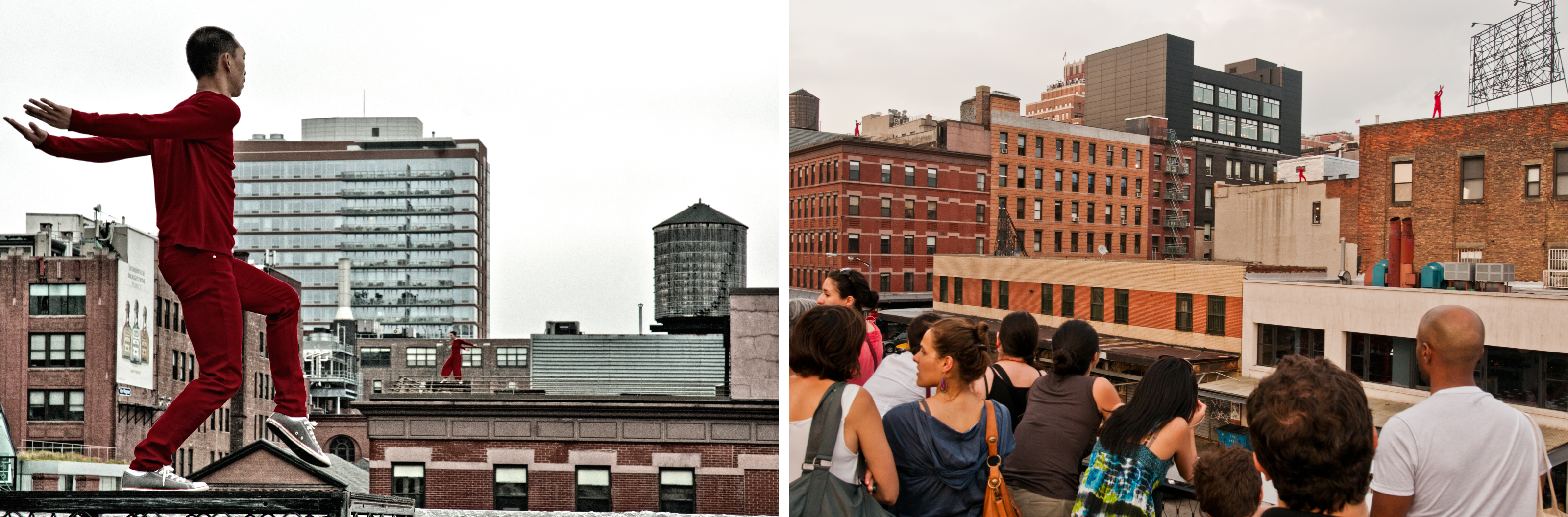
8a-b | Trisha Brown, Roof Piece (1971), Photo: Kevin Vast (@kevinvast). Courtesy Kevin Vast and Trisha Brown Dance Company.
This condition becomes particularly legible in the choreographic practices of Trisha Brown, where bodies engage architectural space without treating it as a stable frame or neutral support. Rather than opposing architecture through acts of transgression, Brown’s work operates through precise shifts in orientation, balance, and alignment that place spatial order under a different kind of pressure. In Roof Piece (1971), the city unfolds as a distributed gravitational field rather than as a unified spatial container. Bodies are positioned on separate rooftops, connected only through delayed imitation and fragile lines of sight. There is no shared ground, no central stage, and no stable point of reference. What holds the piece together is not spatial continuity but the transmission of gesture across distance. Roofs, parapets, and edges are not obstacles to be crossed nor symbols to be subverted; they function as operative conditions that structure movement while remaining open to reinterpretation. In this sense, gravity, orientation, and verticality are not abolished, but continuously renegotiated through bodily effort and balance. Space is experienced not as an abstract geometry, but as a condition sensed through weight, tension, and the constant risk of loss of equilibrium—an understanding of space that aligns closely with Paul Virilio’s notion of spatial experience as fundamentally gravitational rather than purely visual or metric (Virilio 1994). The dancers do not claim mastery over architecture; they test its limits through repetition, delay, and minor deviation, exposing the contingency of what ordinarily appears fixed. What emerges is not a new spatial order, but a temporary suspension of the given one. The separation between performer and spectator, between private roof and public city, between architecture and choreography, is neither erased nor dramatised. It is rendered permeable. Architecture remains fully itself, yet becomes available to use otherwise. Through these gestures, the city is not transformed into a scenography, but reactivated as a field of bodily negotiation rather than a framework of control.
Seen in this light, profanation is neither an exceptional act nor a strategy of rupture. It is a situated practice that unfolds through tools that remain open, roles that remain reversible, and spaces that remain negotiable. What it returns is not an original immediacy, but the possibility of use—maintained in tension with form, rather than resolved by it.
V. Common Use: The Politics of Shared Offering
If profanation restores what was separated to use, the question that follows is not merely who may use space, but how such use can remain common. Common use does not coincide with access, availability, or collective ownership; it names a fragile condition in which space remains usable by many without being fully appropriable by any single subject. What profanation returns, in this sense, is not a right guaranteed in advance, but a shared possibility, always exposed to closure, capture, or exhaustion. The distinction becomes clearer when contrasted with architectural projects that sought to install play as a permanent condition. From Cedric Price’s Fun Palace to Constant’s New Babylon, play was elevated to a totalising principle, envisioned as a new social order capable of replacing work, programme, and fixed use altogether. While these projects remain crucial for understanding the political ambitions of play within architecture, they also reveal a critical limit: when play becomes continuous and prescribed, it risks losing precisely its profanatory force. Rather than suspending the necessity of rules, it establishes a new norm, one that absorbs indeterminacy into a programmed horizon. In this sense, play ceases to operate as a gesture of use without destination and instead becomes a destination in itself.
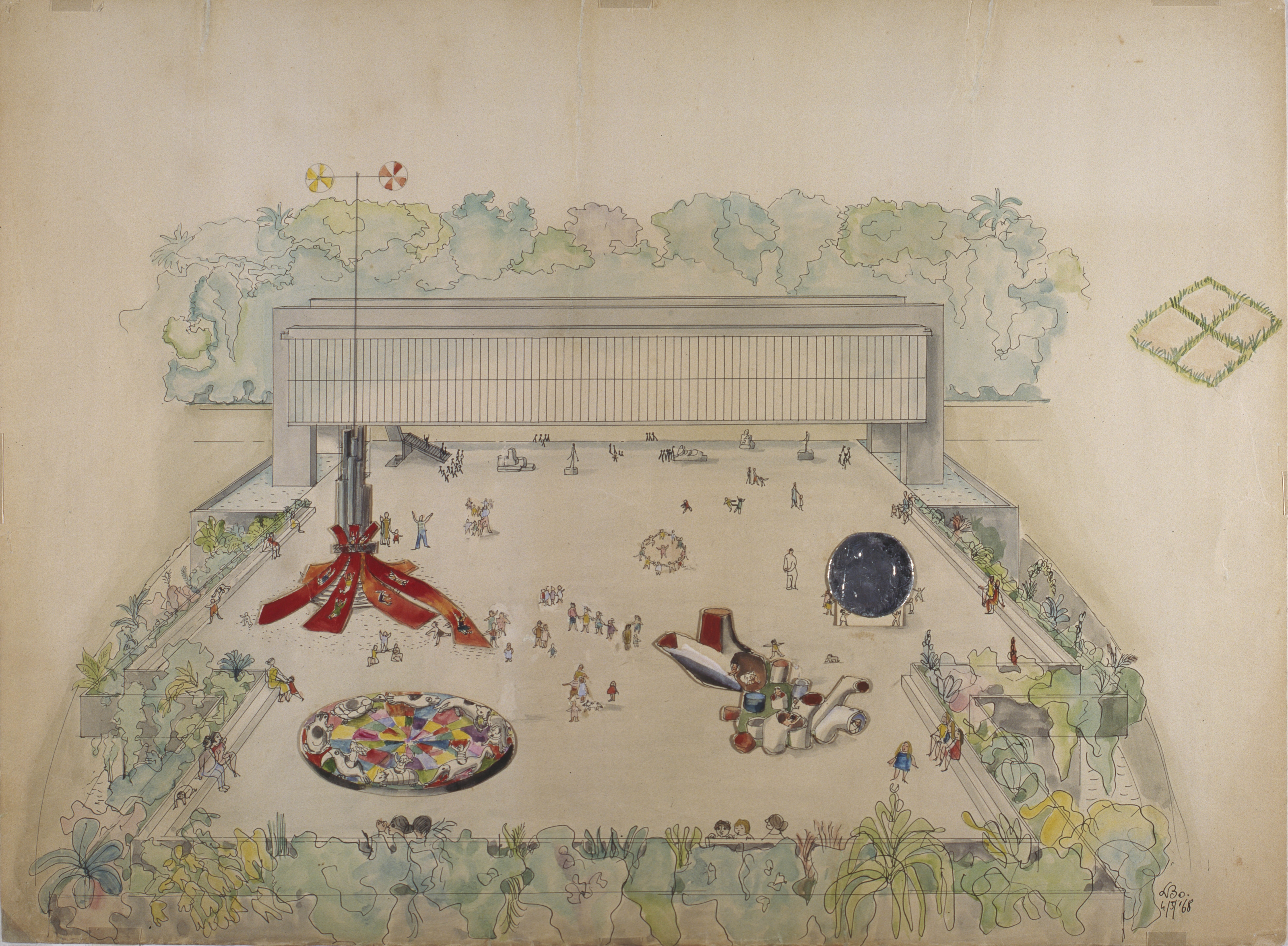
9 | Lina Bo Bardi, Preliminary Study – Practicable Sculptures for the Belvedere at Museu de Arte de São Paulo, 1968. Indian ink and watercolour on paper, 56,2x76,5 cm. MASP Collection, donation, Instituto Lina Bo e P.M. Bardi, 2006.
From this perspective, offering emerges as a specific political gesture. To offer space is not simply to open it or to provide it with a function, but to suspend regimes of possession and authority that seek to fix its meaning and outcome. Offering entails a partial renunciation of control: the project does not withdraw, but accepts that use will exceed intention. Architecture, when it offers rather than prescribes, exposes itself to practices it cannot fully anticipate. This exposure is political precisely because it redistributes agency without guaranteeing results. As research on play and spatial conditions has shown, ‘making room’ for use does not mean designing activities, but articulating conditions—margins, degrees of openness, moments of indeterminacy—within which use may emerge and persist (Vroman 2021). Play operates within this offered condition as a quiet form of redistribution. Rather than overturning order, play subtly reconfigures how space may be used together. It suspends the necessity of rules without abolishing them, allowing gestures to unfold without being absorbed into predefined ends (Huizinga 1949). In this sense, play does not oppose structure; it inhabits it otherwise. Minor, repeatable practices—often ordinary and unspectacular—can maintain shared use precisely by resisting closure and spectacle, working instead through duration, attention, and care.
A paradigmatic architectural articulation of this condition can be found in Lina Bo Bardi’s Museu de Arte de São Paulo (MASP). Here, common use is not produced through dedicated programmes or zones, but through a radical act of suspension. By lifting the museum above the ground, Bo Bardi returns the site to the city as an open civic ground—neither fully interior nor exterior, neither monumental nor domestic. The plaza beneath the suspended volume is not designed as a space of play, yet it persistently becomes one: a place for gathering, protest, rest, informal sport, waiting, and lingering. What is offered is not a scripted activity, but a condition of shared availability, maintained through the precise articulation of structure, distance, and openness. This logic is already legible in Bo Bardi’s drawings for the project, where the museum is conceived less as an object to be contemplated than as a spatial apparatus that frames use while withholding instruction. The Preliminary Study [Fig. 09] makes this especially clear: the vast empty ground plane, the suspended mass, and the structural span articulate a field in which bodies are free to circulate, stop, appropriate, and reorient themselves without being assigned a role in advance. Space remains exact and constructed, yet deliberately unfinished in its relation to use; it invites occupation without prescribing behaviour, allowing multiple and often conflicting practices to coexist within the same architectural frame.
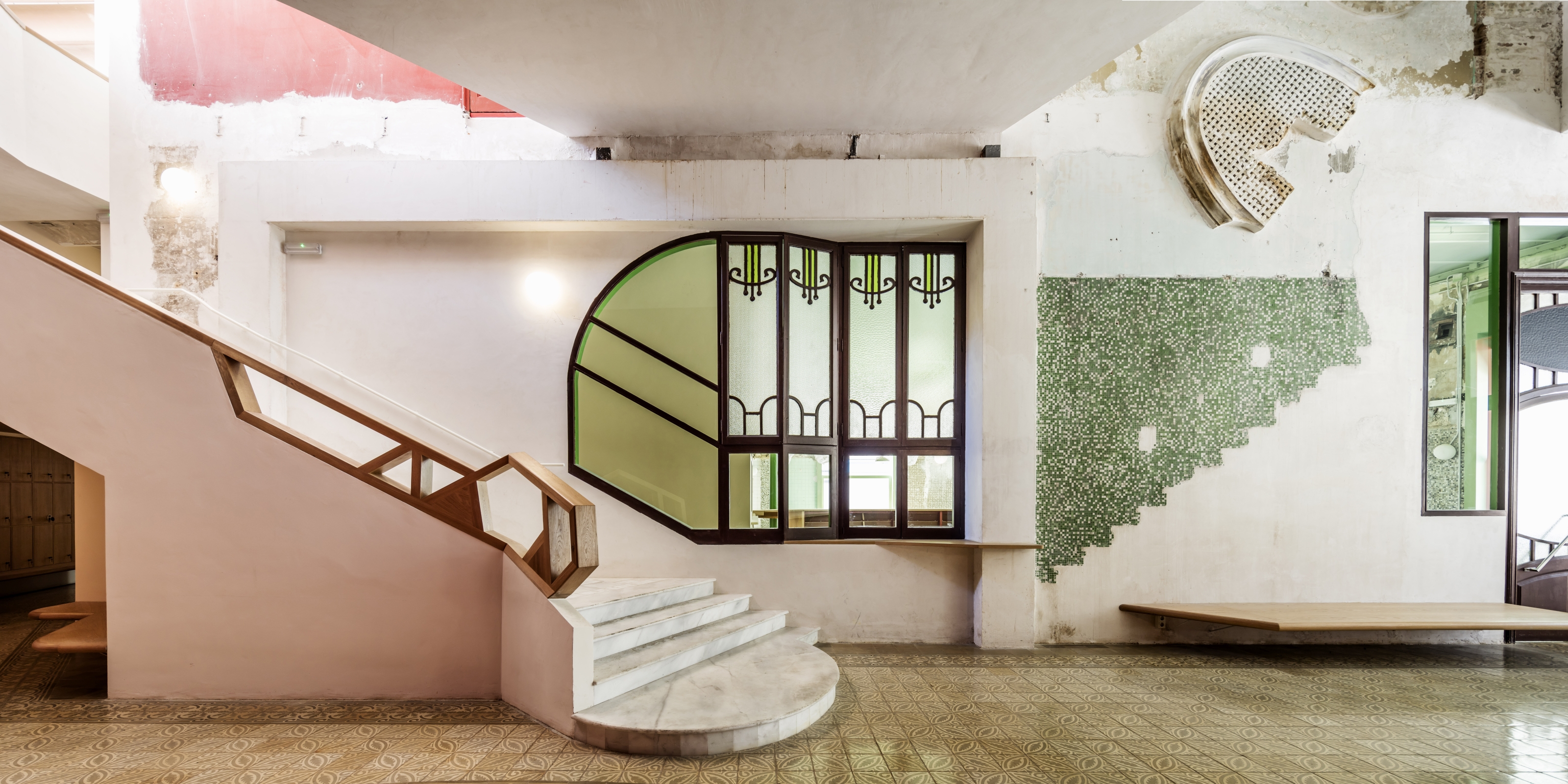
10 | Flores y Prats, Sala Beckett, Barcelona. Photo: Adrià Goula (2016).
A comparable condition can be observed, in a more recent and deliberately non-spectacular register, in the Sala Beckett by Flores y Prats in Barcelona—though here the profanatory logic operates through a different mechanism. Housed within a former workers’ cooperative, the project enacts a double act of profanation: it displaces the building’s previous social function without erasing it, and it unsettles the theatrical conventions through which performance space typically distributes roles and distances. What remains—residual rooms, passages, staircases, thresholds—is neither museified nor neutralised, but held in suspension between what it was and what it has become. This indeterminate condition is not incidental; it is precisely what enables play. Like the child who inherits an adult object and reinvents its use without abandoning its form, Flores y Prats inhabit an existing spatial grammar and displace it from within. Circulation areas, foyers, rehearsal rooms, and technical spaces bleed into one another, resisting the categorical separation between preparation and performance, between actor and witness. The roles the building offers are legible but not fixed; they remain reversible, available to reinterpretation through bodily presence. What is offered is not openness as such, but a structured ambiguity, an architectural condition that sustains play precisely by refusing to resolve the tension between form and use, between the building’s memory and its present occupation.
In this sense, common use must be understood as a condition that requires care. Care here does not imply preservation or protection from change, but the ongoing effort to keep space responsive, permeable, and shared. To care for such a space is to resist its sacralisation—whether cultural, institutional, or economic—and its reduction to image or value, allowing it instead to remain exposed to wear, misuse, and transformation. These possibilities are easily lost when space becomes overdetermined; they survive only where openness is actively maintained rather than declared once and for all. Seen in this light, profanation unfolds as a situated practice sustained over time through tools that remain open, roles that remain reversible, and spaces that remain negotiable. Architecture cannot guarantee common use, but it can refuse to foreclose it, preserving, within its separations, the conditions under which use may remain shared. What profanation ultimately returns is not an original state of things, but the ongoing capacity to use space in common, not despite its separations, but by learning to inhabit them otherwise.
VI. Coda / Notes for a Possible Play
Pause at a threshold. Not only at the door, but where levels change, where materials shift, where inside and outside hesitate. Remain there longer than required by passage.
Lean against a surface designed to be seen, not touched. Test its depth, its temperature, its resistance. Allow contact to undo distance.
Sit where circulation is expected. Stand where rest was anticipated. Let use interrupt programme without cancelling it.
Reverse a role embedded in space. Become a spectator where a performer was assumed, a performer where observation was implied. Accept the position as temporary, reversible.
Repeat a movement along a stair, a ramp, a corridor. Change its rhythm. Slow it down, accelerate it, interrupt it. Let the section become legible through the body.
Begin again. Not to optimise, but to explore variation. Let repetition reveal what the plan could not prescribe.
Play may begin here: not in a designated place, but in the misalignment between space and use, in the interval where architecture remains precise, yet available, in a shared suspension that allows space to be used without being exhausted.
Bibliographic references
- Agamben [2005] 2007
G. Agamben, Profanations [2005], New York 2007. - Benveniste 1947
É. Benveniste, Le Jeu comme Structure, “Deucalion. Cahiers de Philosophie” n. 2 (1947), 161-167. - Benjamin [1928] 2005
W. Benjamin, Toys and Play [1928], in Selected Writings, Volume 2, part 1: 1927–1930, M.J. Jennings, H. Eiland, G. Smith (eds.), Cambridge (MA) 2005, 117-121. - Benjamin [1935] 2008
W. Benjamin, The Work of Art in the Age of Its Technological Reproducibility, and Other Writings on Media [1935], Cambridge (MA) 2008. - de Curtis 2015
A. de Curtis, Figurazione. Alla Ricerca della Forma. Dialoghi con Umberto Riva, Milano 2015. - Gibson 1979
J.J. Gibson, The Ecological Approach to Visual Perception, Boston 1979. - Halprin 1965
L. Halprin, Motation, “Progressive Architecture” n. 46 (7) (July 1965), pp. 126-133. - Hertzberger 1991
H. Hertzberger, Lessons for Students in Architecture, Rotterdam 1991. - Huizinga 1949
J. Huizinga, Homo Ludens: A Study of the Play-Element in Culture, London 1949. - Ingold 2000
T. Ingold, The Perception of the Environment: Essays on Livelihood, Dwelling and Skill, London 2000. - Maestri 2020
G. Maestri, Notes on the Semantics of Play, “FAM” n. 51 (January-March 2020), 23-32. - Merleau-Ponty [1945] 2012
M. Merleau-Ponty, Phenomenology of Perception [1945], London 2012. - Miglietta 2024
E. Miglietta, Re-reading Form through the Agency of the Joint. The Archaeological Attitude of Design Driven Research, PhD diss., Politecnico di Milano—KU Leuven 2024. - Morpurgo 2024
G. Morpurgo, Architectus Ludens. Giochi di Costruzioni/Scatole di Montaggio, “La Rivista di Engramma” n. 213 (June 2024), pp. 41-49. - Rodaway 1994
P. Rodaway, Sensuous Geographies: Body, Sense and Place, London 1994. - Sheets-Johnstone 2011
M. Sheets-Johnstone, The Primacy of Movement, Amsterdam 2011. - Schiller [1795] 1993
F. Schiller, Letters on the Aesthetic Education of Man [1795], in Essays, W. Hinderer and D.O. Dahlstrom (eds.), London 1993, 86-178. - Van Eyck [1962] 2008
A. Van Eyck, The Child, the City and the Artist. An Essay on Architecture: The In-Between Realm [1962] V. Ligtelijn, F. Strauven (eds.), Amsterdam 2008. - Virilio 1994
P. Virilio, Gravitational Space. Interview with Laurence Louppe, Daniel Dobbels, in L. Louppe (ed.), Traces of Dance: Drawings and Notations of Choreographers, Paris 1994, 35-60. - Vroman 2021
L. Vroman, Make Room for Play. Questioning the Role of the Moving Body between Thinking and Making, PhD diss., KU Leuven 2021.
Abstract
This essay approaches Play as a situated practice that unsettles the separations through which architecture organises use, distance, and behaviour. Rather than opposing order, play operates from within architectural regimes of prescription, making visible how space is stabilised through margins, thresholds, and devices that regulate proximity, movement, and access. In doing so, play exposes how these regimes may be quietly loosened, rendered permeable without being overturned. Emerging from the distinct yet converging practices of the two authors of this essay—one grounded in the minute negotiations of architectural detailing, the other in movement and embodied spatial exploration—the text itself unfolds as a profanatory practice. Writing is treated not as a neutral commentary but as an operative field, where thinking and making remain intertwined, and where concepts are tested through spatial, bodily, and procedural displacement.
Through close readings of architectural situations, set in resonance with artistic and performative practices, the essay traces how profanation arises when bodies inhabit the margins of use: lingering where circulation prescribes speed, touching what is meant to remain at a distance, or repeating gestures without fulfilling their expected ends. Architecture is thus approached as a field of offerings—thresholds, surfaces, and spatial devices whose separation sustains distance, yet remains open to reinterpretation through play. To profane, in this sense, is not to negate architectural order but to suspend its necessity, expanding the affordances of familiar spatial arrangements. The Practice of Play reveals architecture as a precise yet open system, capable of sustaining common use without fixing meaning in advance, and of offering space anew through minor, repeatable gestures of inhabitation.
keywords | Play; Profanation; Spatial affordance; Common use; Architectural gesture.
La Redazione di Engramma è grata ai colleghi – amici e studiosi – che, seguendo la procedura peer review a doppio cieco, hanno sottoposto a lettura, revisione e giudizio questo saggio
(v. Albo dei referee di Engramma)
Per citare questo articolo / To cite this article: Enrico Miglietta, Liselotte Vroman, The Practice of Play. On the Profane Gesture and the Architecture of Use, “La Rivista di Engramma” n. 232, marzo 2026.
Per citare questo articolo / To cite this article: Enrico Miglietta, Liselotte Vroman, The Practice of Play. On the Profane Gesture and the Architecture of Use, “La Rivista di Engramma” n. 232, marzo 2026, pp. xx-yy | PDF dell’articolo