The Intersecting Models
Saint Casimir and the Construction of the Image of the Polish King John Casimir Vasa in 17th Century Art
Agnieszka Skrodzka
Abstract
Saint Casimir Jagiellon (1458-1484) is a popular saint whose cult is concentrated in Lithuania and Poland. He hailed from the Lithuanian dynasty of the Jagiellons. A pious and virtuous youth, he was being groomed to rule the later Polish-Lithuanian Commonwealth but died aged twenty-five, regarded as a saint. Among his devotees was King John II Casimir Vasa (1609-1672), who considered the young Jagiellon to be his patron and role model. The two Casimirs shared not just the first name but also family ties and deep piety. These connections have been acknowledged and emphasized in various works of art. At the same time, some of these pieces have contributed to misinterpretations in important compendiums devoted to the iconography of saints. This text aims to indicate and clarify these links.

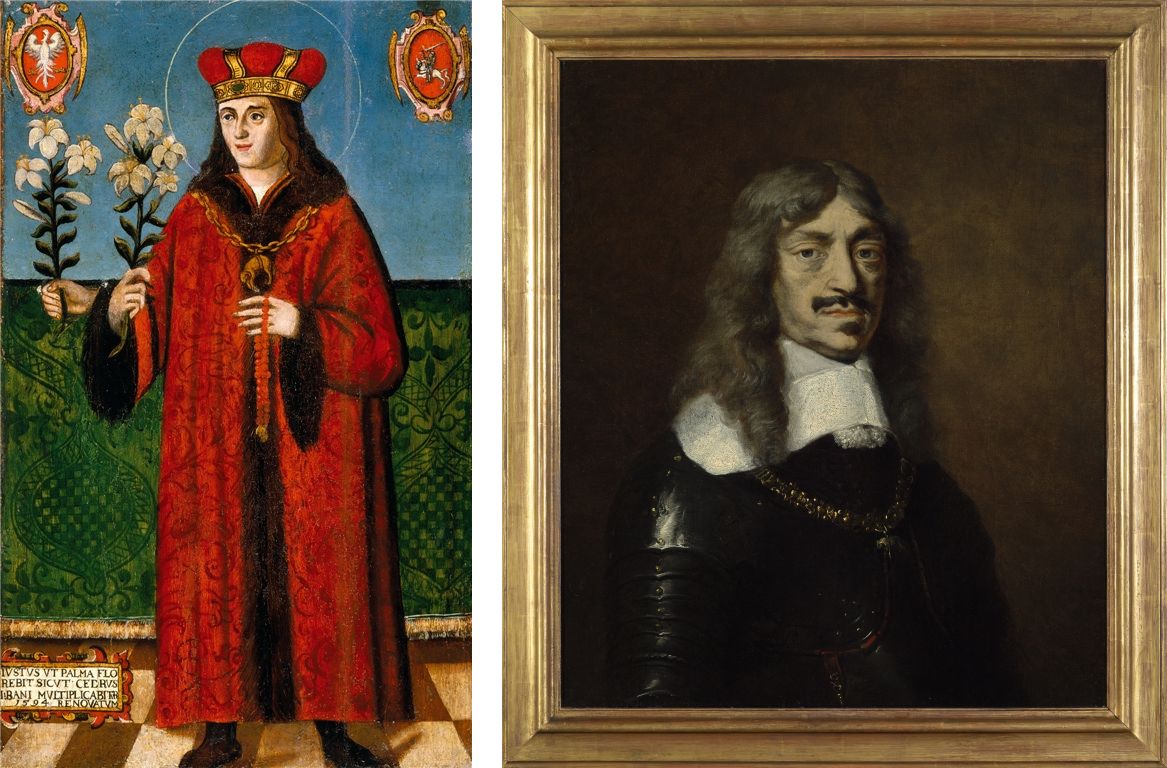
1 | Anonymous painter, Three-Handed Saint Casimir, tempera on panel, ca. 1550, Vilnius Cathedral, Chapel of Saint Casimir, originally in the Royal Chapel.
2 | Daniel Schultz, Portrait of John Casimir in armour, ca. 1649, Warsaw, Royal Castle Museum.
Saint Casimir [Fig. 1] was born on 3 October 1458 as the son of Polish King Casimir IV Jagiellon, who hailed from a Lithuanian princely house that entered personal union with the Polish Crown in 1385, forming what was to later become the Polish-Lithuanian Commonwealth (Swastek 2000, 1275). Prince Casimir was the elder brother of future Polish kings John I Albert, Alexander Jagiellon, and Sigismund I the Old. From an early age, the heir was groomed to become a monarch. In the years 1481-1483 he was his father’s viceroy and gained recognition for being just and seeking peace. However, in this period he also began to suffer from tuberculosis and ultimately had to step down from his function. After returning to Lithuania in 1483, he survived only several months and died on 4 March 1484 at the age of twenty-five, regarded as a saint. During his lifetime, he distinguished himself with sensitivity and deep piousness, especially in terms of reverence for the Virgin Mary. His premature death as a bachelor further contributed to his image of an innocent and virtuous young man (Swastek 2000, 1275).
Soon after the prince’s death, King Sigismund launched a campaign to canonize his brother, which succeeded in 1521 when the Pope issued the appropriate bulla. Still, Casimir was officially recognized as a saint only in 1602 (Swastek 2000, 1276). Among his advocates was also the next Polish King, Sigismund III Vasa, who was a relative of the saintly prince through his mother’s family (Catherine Jagiellon). Owing to these connections, the Vasas considered themselves to be continuators of the Jagiellon dynasty, which only intensified the prince’s cult in the royal family (Wdowiszewski 2005, 232-233; Skowron 2019, 61). For this reason, devotees of the young Jagiellon also included Sigismund’s two sons, who were later both crowned: Władysław IV Vasa and John II Casimir Vasa [Fig. 2] (Rożek 1984, 117). The latter was born a few years after Casimir Jagiellon was canonized, in 1609. Soon after the birth of John Casimir, his parents took him on a pilgrimage to Vilnius, where he was commended to God and Saint Casimir (Wójcik 1997, 14).
During baptism, John Casimir was given names carrying important symbolic connotations. The first one commemorates the grandfather, John III of Sweden, while the second was supposed to emphasize the Jagiellonian tradition and devotion to the cult of Saint Casimir, with hope for his special consideration (Borkowska 1994, 84-85). During childhood, John Casimir was raised in an atmosphere of deep piousness, which certainly shaped his spiritual life (Wójcik 1997, 14-16). He had particular reverence for Mary, Mother of God, similarly to his saintly namesake (Wassenberg [1644] 1858, 4-5, 23). Further, he was a devotee of other saints, including Polish ones (Czapliński 1963) such as John Cantius, John of Dukla, and Stanislaus of Szczepanów, the patron saint of Poland. John Casimir was in possession of relics of Saint Placidus and, naturally, of Saint Casimir (Wasilewski 1984, 13, 61, 70). Sources also contain information about vows and votive offerings made by John Casimir to the Saint, as well as note the former’s participation in commemorative celebrations. It has been established, for example, that John Casimir was present in Vilnius at the ceremonial transfer of the Jagiellon’s relics to a newly-built chapel – the most important artistic initiative of Sigismund III and his son Władysław IV – on 14 August 1637 (Niewierko 1970, 92-93).
The saintly Jagiellon was not only John Casimir’s patron but also his role model. Historian Ludwik Kubala remarks that John Casimir had a saintly namesake in the Jagiellon family, who was constantly being held up to the future king as an example (Kubala 1896, 5). John Casimir was a highly complex historical figure who must be viewed against the backdrop of the turbulent political landscape of seventeenth-century Europe, marked by wars of conquest and revolts by the nobility, which resulted in John Casimir losing many territories of the Polish-Lithuanian Commonwealth. He died in exile, having abdicated and become unpopular, far from his people. Despite this, John Casimir was a great patron of the arts, possessed a vast art collection and founded the University of Lviv (Lwów-Leopoli). His spiritual life, marked precisely by his relationship with the eponymous Saint Casimir Jagiellon, was also highly conflicted.
One particularly important event in John Casimir’s religious life was his entry into the Jesuit novitiate in 1643 (Paszenda 2001, 2159). The decision may be interpreted as being imitative of the saint’s virtues and may also have been inspired by the example of other famous European rulers and heirs who abandoned earthly offices and entered monasteries. Among them were numerous emperors, kings as well as many pious and God-fearing young princes (Skarga [1606] 2016, 222-224). Prince John Casimir had been considering entering the monastic state ever since his unfortunate adventure in France, where he was arrested in 1638 under the accusation of being a spy and spent twenty-one months in prison (Wassenberg [1644] 1858). While in captivity, he vowed to abandon lay life upon regaining freedom and become a monk. He pondered the idea since then, seeking advice from his Jesuit confessor, Father Jerzy Lejer. Finally, in late May 1643, the prince secretly left Poland and entered the Jesuit novitiate in Loreto (Wasilewski 1984, 30, 39, 41-54). Pope Urban VIII was very content with this decision because a young man from an eminent family taking up the habit was a compelling example of contempt for worldly matters. Having donned the habit of the Jesuit novice and received the tonsure, he immediately began to observe the rules of the novitiate strictly, renouncing all privileges attached to his noble status. Declaring that “there is no prince Casimir anymore, just brother Casimir” (L’extrait 1643, 1049; Czermak 1888, 5), he had the makings of a devout and fervent novice, according to the Jesuits.

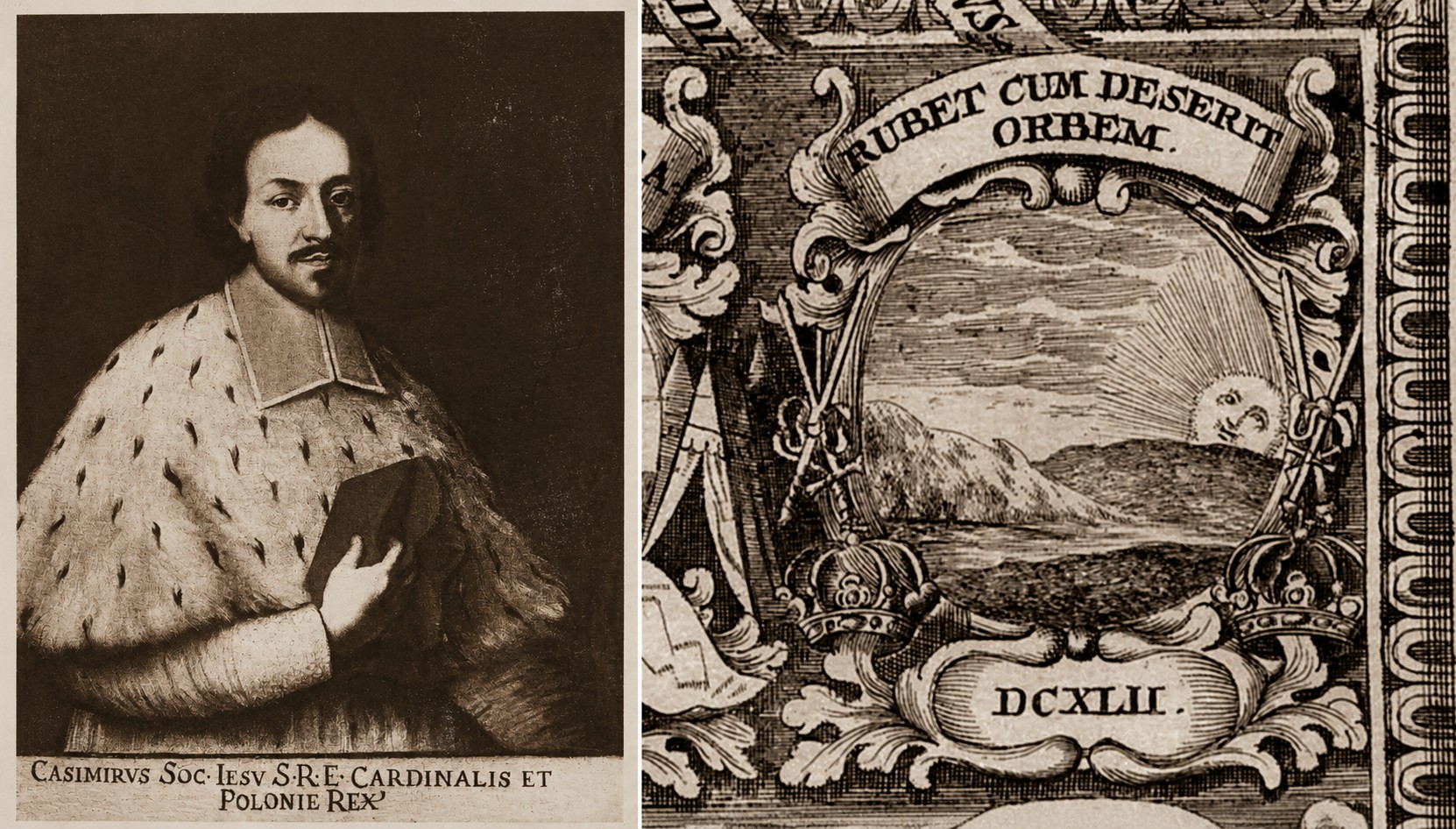
3 | Anonymous painter, Portrait of prince John Casimir as cardinal, 1646, Rome, Pontifical Gregorian University.
4 | Johann Georg Wolffgang and Jacob Müller after designs by J.C. Schalck, Emblem Rubet cum deserit orbem, copper engraving, in Jacob Boschius, Symbolographia, sive De arte symbolica: sermones septem, Augsburg 1702.
The prince received minor orders soon after, on 6 December 1643, in the upper chapel at the Jesuit novitiate house Sant’Andrea al Quirinale. He was entered into ordination records as Joannes Casimirus Jagellonidi (Jujeczka 2018, 22). John Casimir insistently sought to be granted dispensation necessary to receive holy orders before canonical term. However, after merely one year in the novitiate, the prince had a change of heart and decided to abandon plans for an ecclesiastical career. On 28 May 1646, Pope Innocent X elevated John Casimir to the cardinalate while he remained in minor orders, allowing him to leave the Societas Iesu with honour [Fig. 3]. In September, John Casimir left Rome and returned to Poland, ultimately stepping down from the office of cardinal in July 1648 (Wasilewski 1984, 42-44, 51-53). Subsequently, he ascended to the throne and continued his troubled and ultimately unsuccessful reign.
The prince’s entry into an austere religious order resonated widely in Europe and manifested in iconography. An iconographical theme from the Jesuit period in the life of John Casimir is his official scarlet dress of a cardinal. Jesuits announced his elevation to this office in an emblem by Claude-François Ménestrier and Jacob Boschius, with the lemma RUBET CUM DESERIT ORBEM [He glows in red upon leaving the world] (Ménestrier 1682, 25; Boschius 1702, 47). The pictura shows a sun with a human face, setting over a mountainous horizon [Fig. 4]. The star naturally stands for prince John Casimir, while his exit from the world represents his rejection of worldly splendour and the choice to lead a life in service of the Church.

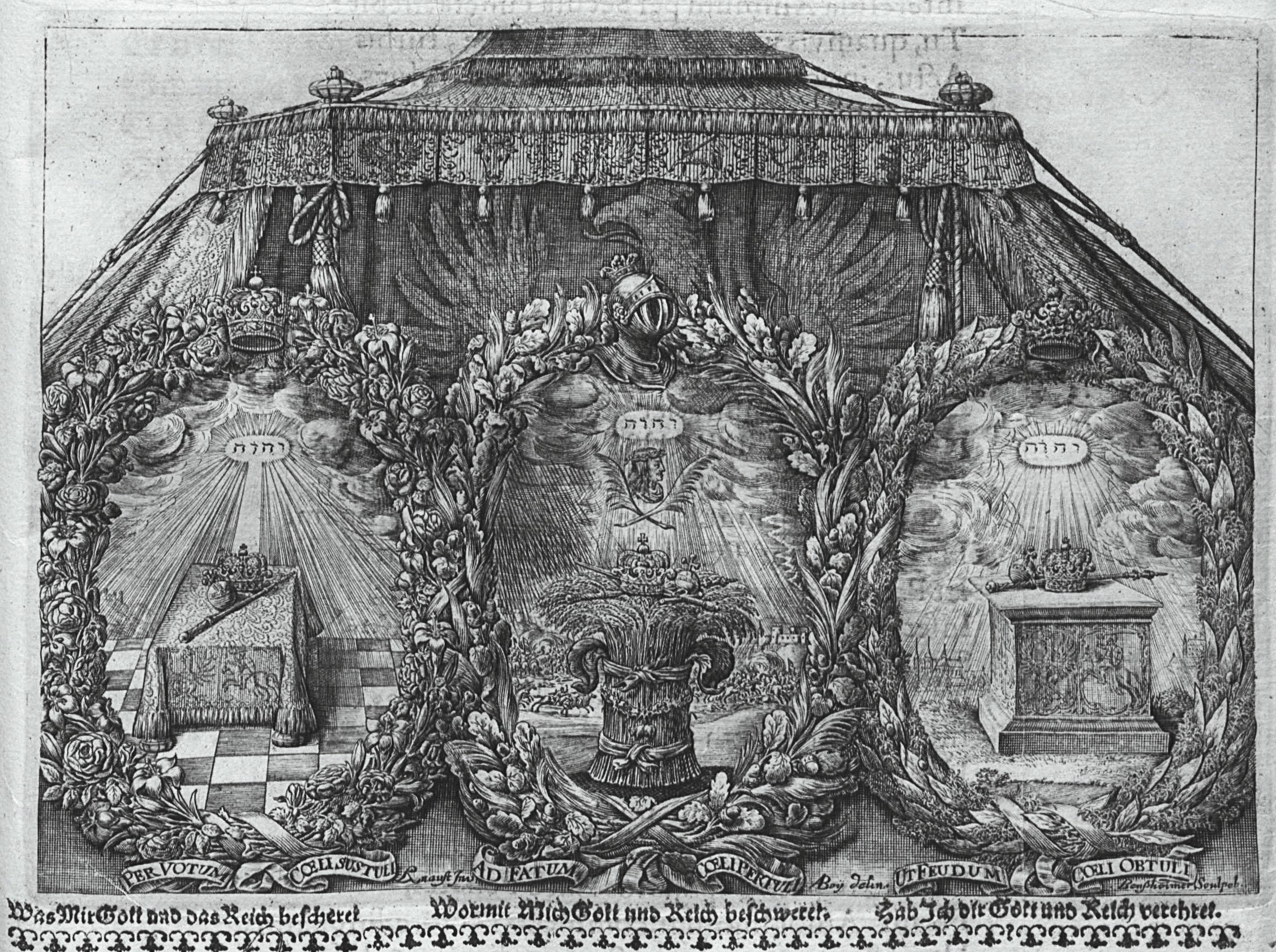
5 | Ludwig Knausten, Johann Bensheimer, Adolf Boy, Denk- und Dankaltar, copper engraving and etching, Danzig 1668.
Another reference to this event had already appeared in an illustration published after 1668, which offers a symbolic depiction of John Casimir’s three stages of life [Fig. 5]. His youth is represented by an altar table with regalia, surrounded by a wreath of roses and lilies (Skrodzka 2016, 440-441). Trappings of royal authority foreshadow his later ascension to the throne, while the flowers refer to princely virtues, purity, and Marian piousness. The lilies are a particularly expressive symbol that links the figure of prince John Casimir with his patron saint (Maslauskaitė-Mažylienė [2010] 2013). This is because, in iconography, the white lily is an indispensable attribute of the young Jagiellon, communicating virginity, virtue, devotion to the Mother of God, and premature death (Picinelli 1681, 657-663, 664-674).
Admission of an eminent prince as well as a relative of some of the most powerful European rulers into the Societas Iesu was an immense gratification to the order (L’extrait 1643, 1050). The new member was not only the brother and son of the Polish King but also kin to the great saint Casimir Jagiellon, whom the Jesuits fervently worshipped. Since their arrival in the Polish–Lithuanian Commonwealth in 1564, the Society of Jesus promoted his cult throughout the seventeenth century and at the beginning of the eighteenth. These activities included the foundation of the Church of Saint Casimir in Vilnius (1604), numerous dedications of altars in Jesuit churches, and the publication of prints commemorating the pious youth (Maslauskaitė-Mažylienė [2010] 2013, 172). Some of these publications contain particularly interesting illustrations, namely etchings depicting Saint Jagiellon, clearly stylized to resemble prince John Casimir by way of similar hairstyle and beard (e.g. Rossi 1653, 326; Hymnus 1640, 22) [Figg. 6-8].

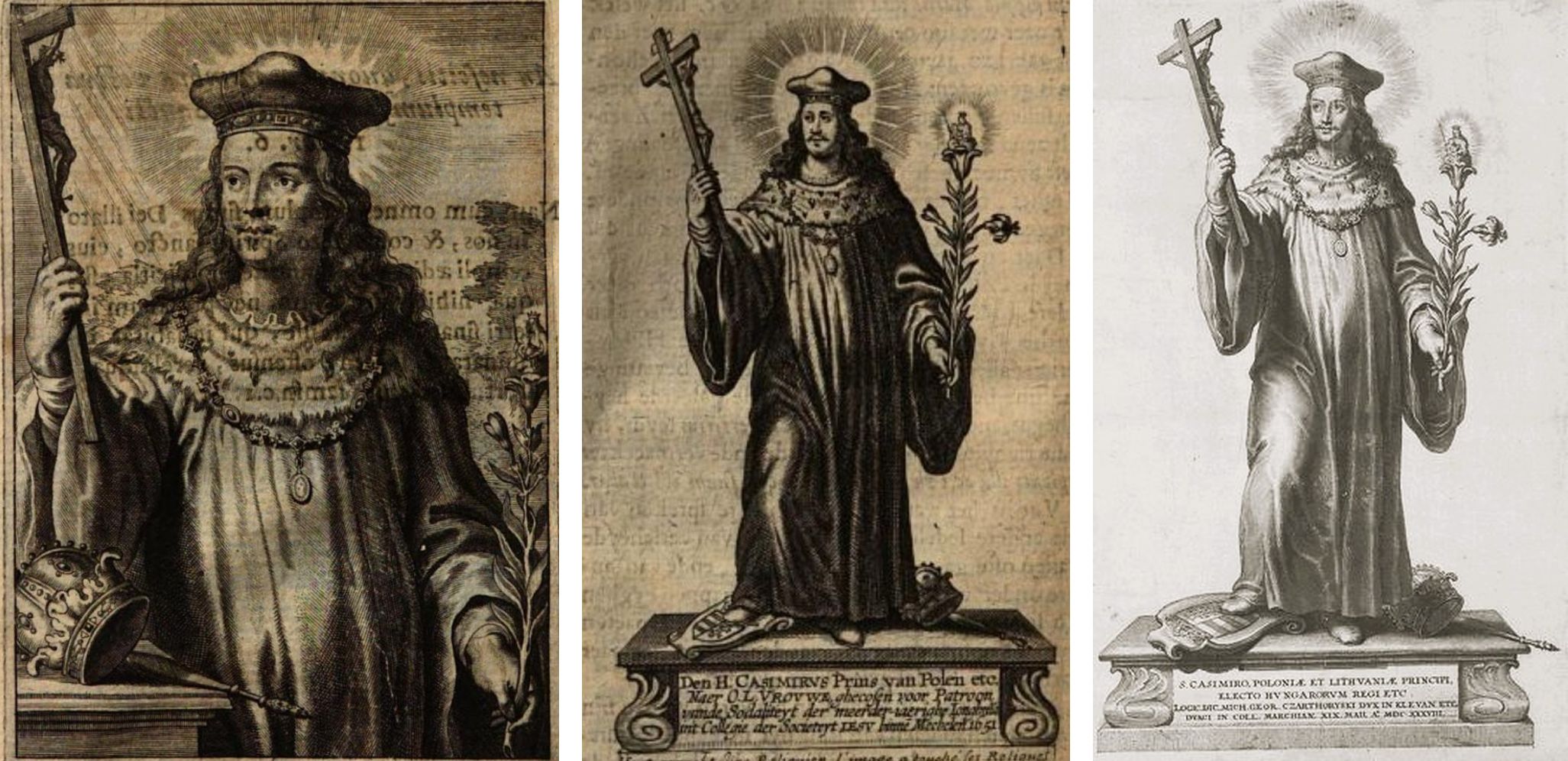
6 | Anonymous engraver, Saint Casimir, copper engraving, in Giovanni Battista Rossi, Clypeus castitatis ex armamentario virginitatis promptus, Romae 1653.
7 | Matthäus Küssel, Saint Casimir, copper engraving, second half of the 17th century, Krakow, National Museum, Princes Czartoryski Collection.
8 | Gaspar Bouttats, Saint Casimir, copper engraving, in Franciscus Nerrincq, Voor-beeldt der waere deught, namentlijck van de maeghdelijcke reynigheydt […], Mechelen 1692.
Physical similarity was probably meant to underscore their shared spirituality and the special status of Saint Jagiellon as a role model for John Casimir. Perhaps these depictions can also be related to the portrait of John as a young man wearing a fur kalpak hat and Renaissance attire [Fig. 9], made in the final years of his life (Steinborn 2004, 24-25, 100-101). It remains unclear why the monarch would be depicted at that time as a youth dressed in accordance with fashion rules from a bygone era. However, the above context could suggest that it was a portrait historié, or the kind of representation where the portrayed figure is shown in the costume of a different person, along with their attributes.
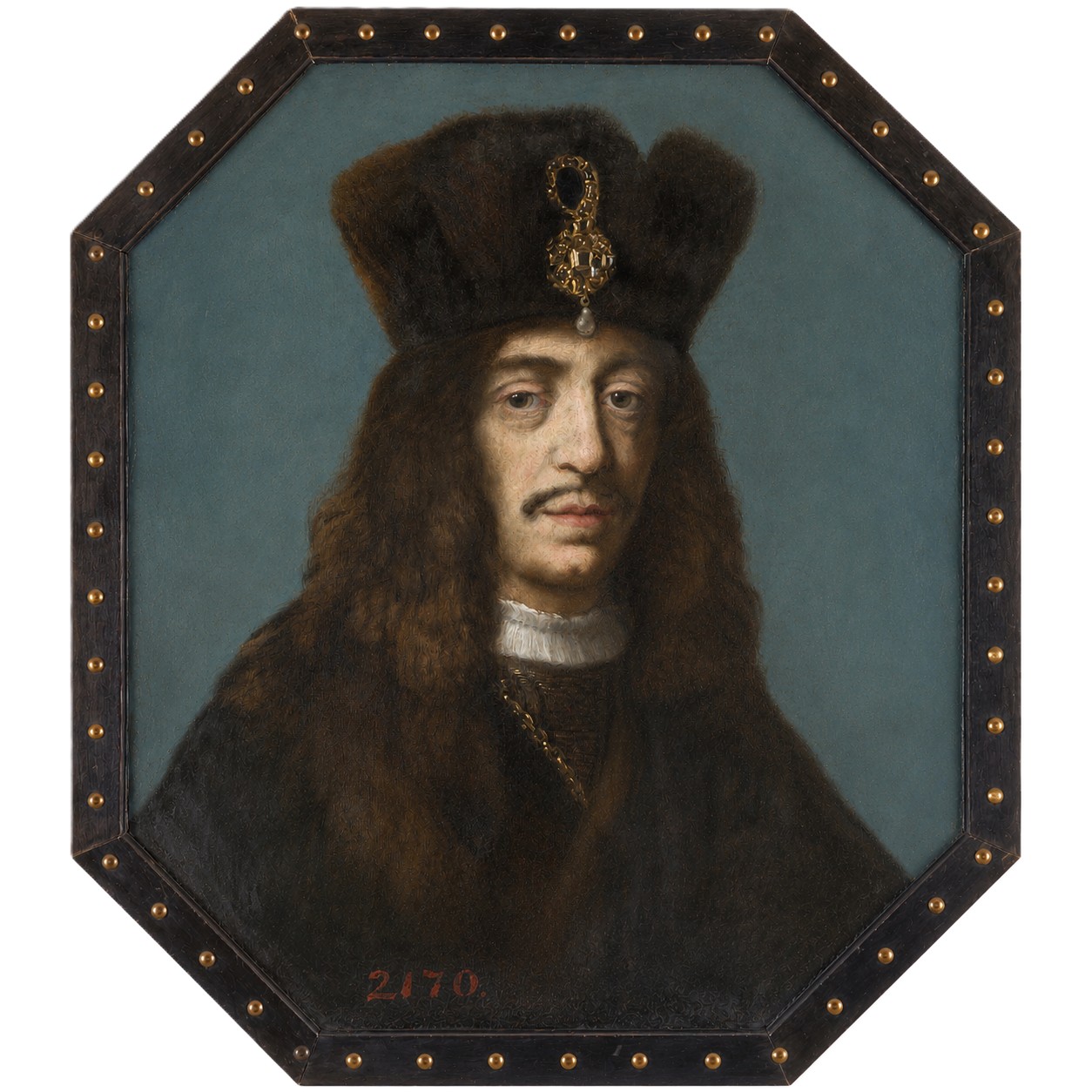
9 | Daniel Schultz, Portrait of John Casimir, oil on panel, 1660, Warsaw, Royal Castle National Museum.
As Polish King since 1648, John II Casimir continued to venerate his holy namesake, imploring the Saint to grant him support, for example in the fierce struggle for the Polish throne (Wasilewski 1984, 61). The King also made efforts to preserve the chapel in Vilnius, where the Saint’s relics were held, and attended masses in his honour (Niewierko 1970, 94-95, 98-99). Under the reign of John II Casimir, the cult of the saintly prince acquired the character of a state matter since the latter was regarded as the defender of the motherland. One artistic manifestation of this cult was the chasuble commissioned by Ludwika Maria, the King’s wife, for Warsaw’s Nuns of the Visitation. It was made from satin, richly embroidered, and decorated with a medallion depicting Saint Jagiellon. According to tradition, this liturgical attire was made in 1660 as a votive offering for the victory in war against Sweden (Piwocka 1999, 145).
The demand for a patron saint defending the Commonwealth rose along with numerous unfortunate wars waged under John II Casimir. He was not popular among his subjects, especially after having declared early in his reign to “prefer seeing a dog rather than a Polish person”, which made the Polish gentry dislike him (Wójcik 1997, 50-60). In the 1660s, John II Casimir seriously considered abdication, which was influenced by increasingly anti-royalist sentiments and the country’s complex political situation. He decided to leave Poland after stepping down and settle in one of the Jesuit monasteries in Switzerland (Kłaczewski 1993, 84). Moreover, he intended to return to the clergy because he felt attracted to a secluded life, one focused on prayer and removed far from worldly concerns. The spiritual aspirations stirred in his youth found fulfilment during annual retreats among Camaldolese monks. It was for this purpose that he built a wooden manor house next to their monastery in Warsaw (Skrodzka 2015, 104). Increasingly sick, tired and frustrated, the King abdicated in 1668 at a special parliamentary gathering. In the end, King Louis XIV made him abbot in the Parisian monastery of Saint-Germain-des-Prés, where he was installed on 24 November 1669 (Bouillart 1724, 263).
The ostentatious piousness of the new abbot met with the admiration of his fellow brothers (Ultee 1981, 64). Even in the Commonwealth, where his reign was very unpopular, people would still appreciate his deep religiousness. Bazyli Rudomicz, professor and long-time rector of the Zamoyski Academy, noted in his diary that:
Father Felicjan Dąbrowski, a Jesuit, recalled that the king would often be found at nighttime praying alone in the church, that he would minister to the Jesuits, and that he would spend the Shrovetide among them, deep in reflection. He would spend the last days of Lent among the hermits in Bielany, as was widely known. Having discussed his virtues and abdication, Father Felicjan Dąbrowski said that ‘there would be a second Saint Casimir’ (Rudomicz [1656-1672] 2002, 198).
When he was leaving Poland after abdication, John II Casimir took with him the relics of his patron saint in a reliquary made from gold-plated silver (Bouillart 1724, 278, 280). He also kept the image of Saint Casimir painted by Daniel Schultz, now lost (Steinborn 2004, 196), which was placed in one of the chapels at the Church of Saint-Germain-des-Prés in Paris. After the monarch’s death, the picture was moved to the Chapel of Saint Placidus, where sculptors Gaspard and Balthazar Marsy made an impressive tombstone for the king’s heart in 1674 (Skrodzka 2018, 153-170; Migasiewicz 2019). It is adorned with the kneeling figure of John II Casimir, who is turned towards the altar [Fig. 10].

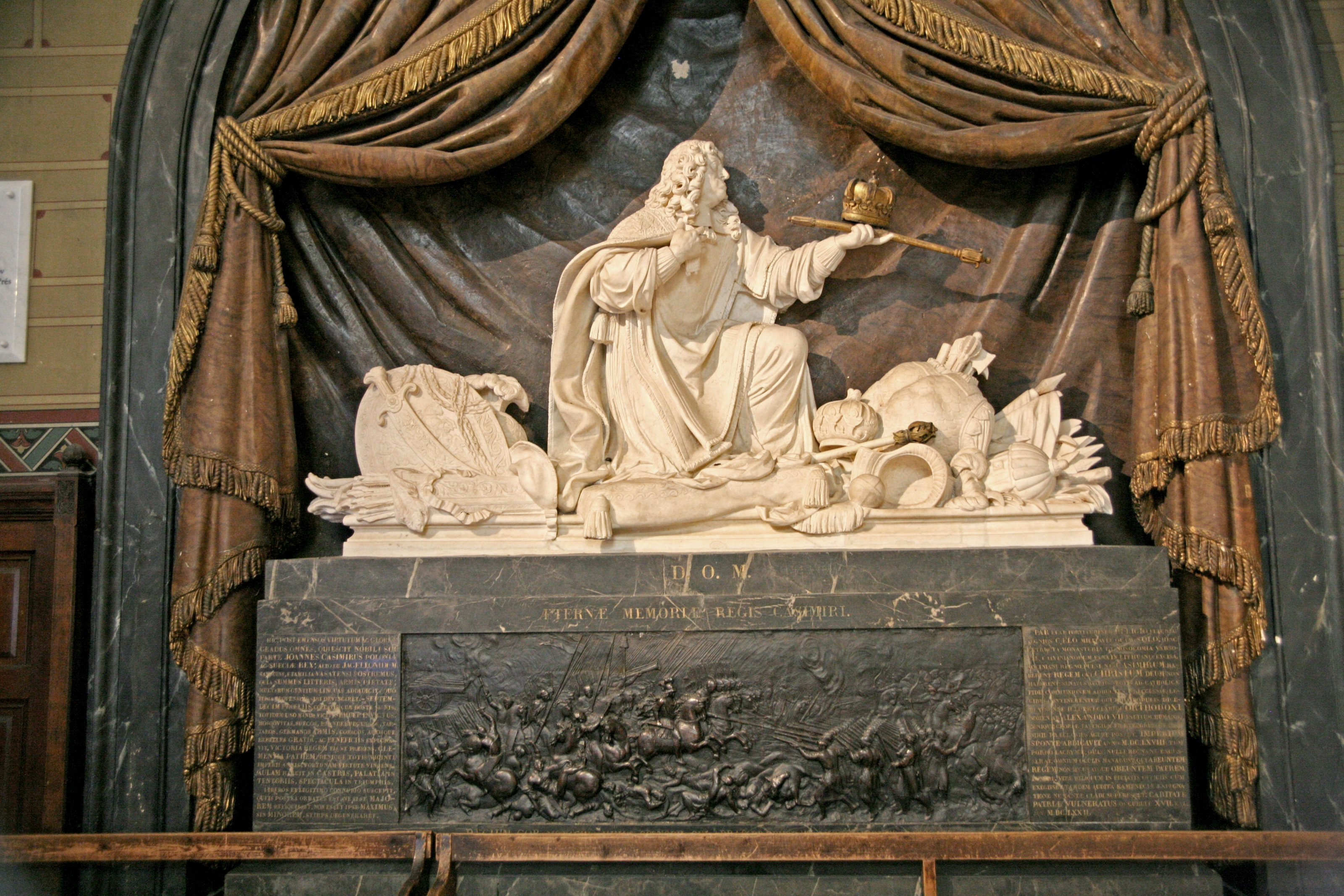
10 | Gaspard and Balthazar Marsy, The tomb of John Casimir, 1674, Paris, Saint-Germain-des-Prés.
The king is wearing his coronation attire as well as a cope, an alba, and a dalmatic. His hand is lifted and his fingers are reaching out to the ornamental clasp that holds the lapels. The gesture of taking off the cloak symbolizes in this case the act of abdication. A similar kind of movement can be discerned in the image of Saint Casimir painted by Carlo Dolci [Fig. 12] (Fondazione Zeri 2026), which was probably inspired by the discussed tomb [Fig. 11]. Dolci’s painting was made in the wake of growing interest in the fate of the Polish monarch after abdication. His decision was regarded almost throughout Europe as a great spiritual victory, celebrating the former king as sui ipsius triumphator (Bulifon 1697, 97-105). A similar opinion was held of Saint Casimir, who was regarded as a “bloodless martyr” and able to renounce all temptation, including that of power (Okoń 2013).
The similarity of the fates and virtues of the two Casimirs, as well as the fact that they shared the same name, caused them to be sometimes conflated in Western literature and art. One example of this is the famous ca. 1550 icon of Three-Handed Saint Casimir from the Vilnius cathedral, which was later supplemented with the collar of the Order of the Golden Fleece [Fig. 13]. However, Saint Casimir was never awarded this recognition. Instead, it was John II Casimir who became a member of the order in 1637 (Wasilewski 1984, 17). In the iconography of Saint Casimir, the Order of the Golden Fleece became his attribute and element of attire in the second half of the seventeenth century (Maslauskaitė-Mažylienė [2010] 2013, 63), which could indicate that the theme was tied to the image of John Casimir and may have been inspired by his figure.

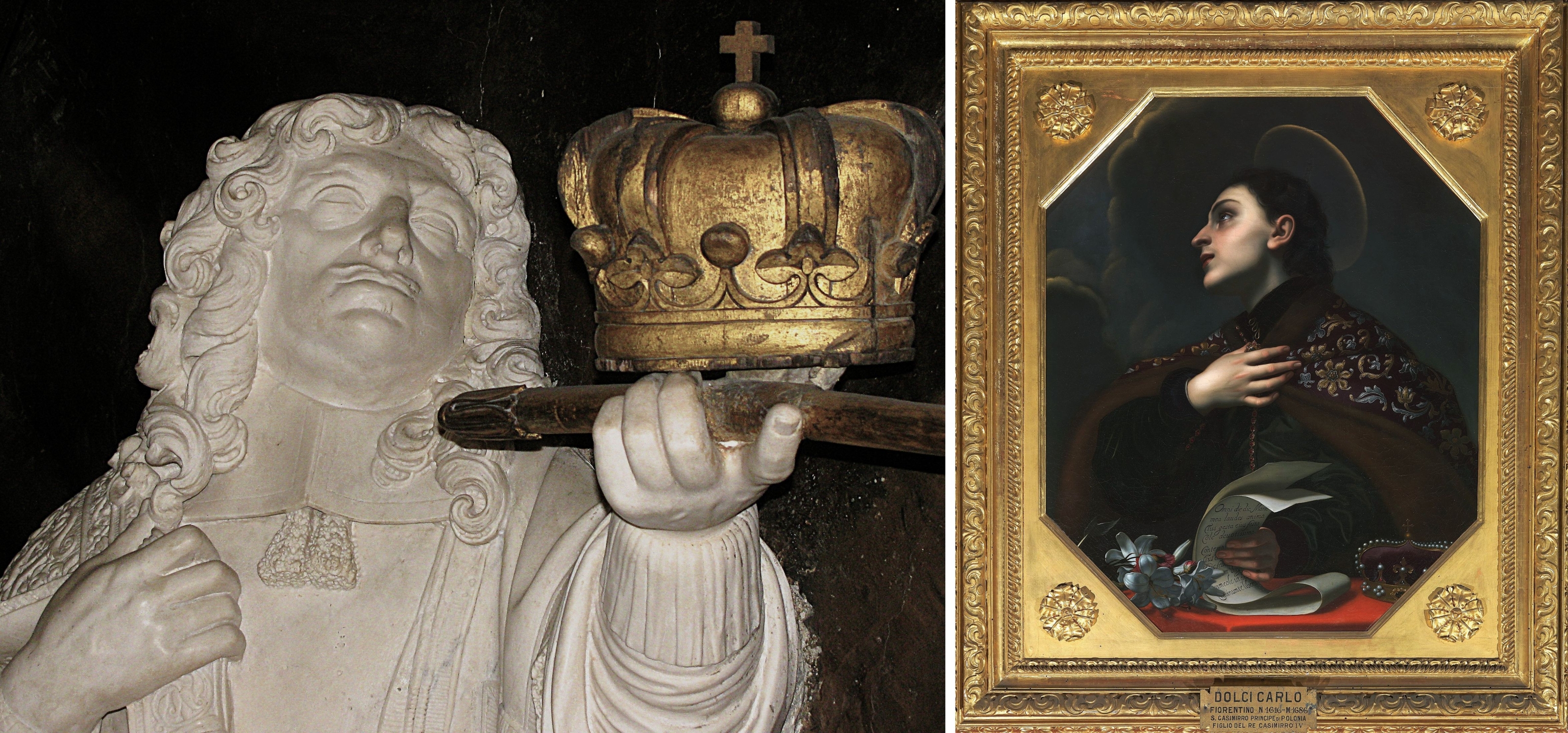
11 | Gaspard and Balthazar Marsy, The tomb of John Casimir, 1674, Paris, Saint-Germain-des-Prés.
12 | Carlo Dolci, Saint Casimir, oil on canvas, ca. 1674, Moscow, Pushkin State Museum of Fine Arts.
The conflation of the two men, firstly intentional and later inadvertent, proved to have long-lasting and far-reaching consequences. Louis-Jean Guénebault’s 1830 iconographic dictionary claims that the Parisian Church of Saint-Germain-des-Prés contains the tombstone of Saint Jagiellon, adorned with his kneeling figure (Guénebault 1830, 119). This absurd mistake was then repeated by Louis Réau in one of the most famous iconographic dictionaries (Réau 1958, 260). He even ascribed to Saint Casimir the biographical note of King John II Casimir, considering the tombstone holding his heart to be a monument to Saint Jagiellon (Pasierb 1984, 75).
Saint Casimir played an important role in the spiritual development of King John II Casimir as the latter’s patron and role model, at the same time acquiring the function of the patron saint of the Commonwealth and the defender of the motherland. The Polish monarch and his contemporaries discerned multiple similarities between the king and his patron saint, specifically in relation to their attitudes, fates and family connections. These analogies clearly impacted works of art connected with the cult of this saint. Nevertheless, the Polish King never won the name and status of the second Saint Casimir. In his homeland, he was regarded as controversial and at variance with the nobility – a capricious and indolent ruler who abandoned the country. At the same time, his private and public reverence for Saint Casimir clearly cemented and popularized the cult of the Lithuanian prince in Western and Southern Europe.
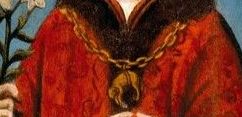
13 | Detail of the anachronistic collar of the Order of Golden Fleece, in Anonymous painter, Three-Handed Saint Casimir, tempera on panel, ca. 1550, Chapel of Saint Casimir, Vilnius Cathedral.
Bibliographical References
- Borkowska 1994
U. Borkowska, Królewskie zaślubiny, narodziny i chrzest, in J. Banaszkiewicz (ed.), Imagines Potestatis. Rytuały, symbole i konteksty fabularne władzy zwierzchniej. Polska X–XV w., Warszawa 1994, 75-92. - Boschius 1702
J. Boschius, Symbolographia, sive De arte symbolica: sermones septem, Augsburg 1702. - Bouillart 1724
J. Bouillart, Histoire de l’abbaye royale de Saint-Germain-des-Prés, contenant la vie des abbés qui l’ont gouvernée depuis sa fondation: les hommes illustres qu'elle a donnés à l’Église & à l’État; les privilèges accordés par les souverains pontifes & par les évêques; les dons des rois, des princes & des autres bienfaiteurs; avec la description de l’église, des tombeaux & de tout ce qu’elle contient de plus remarquable. Le tout justifié par des titres authentiques, & enrichi de plans & de figures, Paris 1724. - Bulifon 1697
A. Bulifon, Lettere memorabili, istoriche, politiche, ed erudite scritte. Raccolta seconda, Napoli 1697. - Czapliński 1963
W. Czapliński, Jan II Kazimierz, in K. Lepszy (ed.), Polski słownik biograficzny, T. X, Wrocław-Warszawa-Kraków 1963, 410-413. - Czermak 1888
W. Czermak, Jan Kazimierz. Próba charakterystyki, Lwów 1888. - Guénebault 1830
L.-J. Guénebault, Dictionnaire iconographique des figures, légendes et actes des saints, tant de l’Ancienne que de la Nouvelle Loi, et répertoire alphabétique des attributs qui sont donnés le plus ordinairement aux saints par les artistes, peintres, sculpteurs, graveurs, etc., du Moyen Âge et des temps postérieurs, avec l’indication des ouvrages et collections où sont conservées et publiées les représentations de ces divers attributs, Paris 1830. - Hymnus 1640
Hymnus quem in B. Virginis honorem composuit, et secum sepeliri curavit Sanctus Casimirus, Casimiri Poloniae regis et Elisabethiae Austriacae filius, rex Hungariae electus. Repertus est sancti principis pectori superpositus dum eius sepulchrum aperiretur anno MDCIX, Douai 1640. - Jujeczka 2018
S. Jujeczka (red.), Klerycy z ziem polskich, litewskich i pruskich święceni w Rzymie (XVI - pocz. XX w.), Wrocław 2018. - Kłaczewski 1993
W. Kłaczewski, Abdykacja Jana Kazimierza. Społeczeństwo szlacheckie wobec kryzysu politycznego lat 1667-1668, Lublin 1993. - Kubala 1896
L. Kubala, Szkice historyczne, Kraków 1896. - L’extrait 1643
L’extrait d’une lettre escrite de Rome touchant le noviciat du prince Casimir aux Jésuites, “Gazette” 154 (1643), 1049-1050. - Maslauskaitė-Mažylienė [2010] 2013
S. Maslauskaitė-Mažylienė, Dzieje wizerunku św. Kazimierza od XVI do XVIII wieku. Między ikonografią a tekstem [Šventojo Kazimiero atvaizdo istorija XVI–XVIII a., Vilnius 2010], przeł. K. Korzeniewska, Vilnius 2013. - Ménestrier 1682
C.-F. Ménestrier, La philosophie des images, composée d’un ample recueil de devises et du jugement de tous les ouvrages qui ont été faits sur cette matière, Paris 1682. - Migasiewicz 2019
P. Migasiewicz, Nagrobek serca króla Jana Kazimierza w kościele Saint-Germain-des-Prés w Paryżu. Aeternae memoriae Regis Orthodoxi, Warszawa 2019. - Niewierko 1970
F. Niewierko, Dzieje kultu św. Kazimierza w kraju i za granicą, “Nasza Przeszłość” 33 (1970), 92-93. - Okoń 2013
J.Okoń, Ks. Piotr Skarga jako promotor kultu św. Kazimierza, “Senoji Lietuvos literatūra” 35-36 (2013), 239-268. - Pasierb 1984
J.S. Pasierb, Wartości duchowe, kulturowe i pastoralne postaci św. Kazimierza dla dzisiejszego katolicyzmu polskiego, “Analecta Cracoviensia” 16 (1984), 71-77. - Paszenda 2001
J. Paszenda, Juan Casimir Vasa, in Ch.E. O’Neill, J.M. Domínguez (eds.), Diccionario histórico de la Compañía de Jesús, t. III, Madrid 2001, 2159. - Picinelli 1681
P. Picinelli, Mundus symbolicus, in emblematum universitate formatus, explicatus, et tam sacris, quam profanis eruditionibus ac sententiis illustratus: subministrans oratoribus, praedicatoribus, academicis, poetis etc. innumera conceptuum argumenta, t. I, Coloniae Agrippinae 1681. - Piwocka 1999
M. Piwocka, Ornat z kompletu tzw. królewskiego, in A. Badach, P. Mrozowski (eds.), Ornamenta Ecclesiae Poloniae. Skarby sztuki sakralnej. Wiek X–XVIII, Warszawa 1999, 145. - Réau 1958
L. Réau, Iconographie de l’art chrétien, t. III : Iconographie des saints, vol. I : A-F, Paris 1958. - Rossi 1653
J.B. Rossi, Clypeus castitatis ex armamentario virginitatis promptus, Romae 1653. - Rożek 1984
M. Rożek, Święty Kazimierz – patron Rzeczypospolitej Obojga Narodów. Szkic historyczno-ikonograficzny, “Analecta Cracoviensia” 16 (1984), 113-137. - Rudomicz [1656-1672] 2002
B. Rudomicz, Efemeros czyli Diariusz prywatny pisany w Zamościu w latach 1656–1672 [Ephemeros seu diarium privatum A.D. 1656 (ad 1672), rkps], t. II: 1665-1672, Lublin 2002. - Skarga [1606] 2016
P. Skarga, Żywot świętego Kazimierza królewicza polskiego i książęcia litewskiego w Wilnie roku 1606 przez Mateusza Chryzostoma Włodkiewicza przełożony. Przydane są modlitwy nabożne i hymny do św. Kazimierza, Warszawa [1606] 2016. - Skowron 2019
R. Skowron, Budowanie prestiżu królewskiego rodu. Związki rodzinne Wazów z dynastiami europejskimi, “Studia Europea Gnesnensia” 20 (2019), 61-81. - Skrodzka 2015
A. Skrodzka, Tablica kommemoracyjna Jana Kazimierza z pokamedulskiego kościoła na warszawskich Bielanach – pamiątka dewocji ostatniego Wazy na polskim tronie, in A.S. Czyż, K. Moisan-Jabłońska (ed.), Pióro na wodzie. Eseje o ks. Januszu St. Pasierbie i studia z ikonografii dedykowane jego pamięci, Warszawa 2015, 100-109. - Skrodzka 2016
A. Skrodzka, Królewicz jezuitą, król opatem. Wątek zakonny w ikonografii Jana Kazimierza, “Folia Historica Cracoviensia” 22 (2016), 437-450. - Skrodzka 2018
A. Skrodzka, Udręki majestatu. Polscy “królowie nieszczęśliwi” w ikonografii nowożytnej, Warszawa 2018. - Steinborn 2004
B. Steinborn, Malarz Daniel Schultz, gdańszczanin w służbie królów polskich, Warszawa 2004. - Swastek 2000
J. Swastek, Kazimierz, in A. Szostek et al. (eds.), Encyklopedia katolicka, t. VIII, Lublin 2000, 1275-1276. - Ultee 1981
M. Ultee, The Abbey of Saint-Germain-des-Prés in the Seventeenth Century, West Hanover 1981. - Wasilewski 1984
T. Wasilewski, Ostatni Waza na polskim tronie, Katowice 1984. - Wassenberg [1644] 1858
E. Wassenberg, Więzienie we Francji Jana Kazimierza polskiego i szwedzkiego królewicza [Serenissimi Johannis Casimiri Poloniarum Sveciaeque principis carcer gallicus, Dantisci 1644], przeł. i oprac. M. Baliński, Petersburg 1858. - Wdowiszewski 2005
Z. Wdowiszewski, Genealogia Jagiellonów i domu Wazów w Polsce, Kraków 2005. - Wójcik 1997
Z. Wójcik, Jan Kazimierz Waza, Wrocław 1997.
Abstract
Saint Casimir Jagiellon (1458-1484), a prince of the Jagiellonian dynasty and son of King Casimir IV Jagiellon, was venerated for his piety, devotion to the Virgin Mary, and virtuous life. Although prepared for kingship, he died at the age of twenty-five and was canonized in the early seventeenth century. His cult was particularly promoted by the Vasa dynasty, which regarded itself as the heir to the Jagiellonian tradition. Among his most devoted admirers was King John II Casimir Vasa (1609-1672), who was named after the saint and entrusted to his protection shortly after birth. This article examines the role of Saint Casimir as both patron saint and personal model for John II Casimir, focusing on artistic representations that reveal the perceived parallels between the two figures. Shared characteristics – including dynastic connections, Marian devotion, ascetic inclinations, and a willingness to renounce worldly ambitions – encouraged contemporaries to view the king through the lens of his saintly namesake. These connections influenced the iconography of Saint Casimir and, in some cases, led to misunderstandings in later iconography, where the identities of the saint and the king became partially conflated. The article demonstrates how the cult of Saint Casimir shaped both the personal spirituality of John Casimir and the artistic representation of kingship, sanctity, and dynastic memory in seventeenth-century Europe.
keywords | Saint Casimir; John II Casimir; Jagiellons; Cult of Polish saints; Iconography.
La Redazione di Engramma è grata ai colleghi – amici e studiosi – che, seguendo la procedura peer review a doppio cieco, hanno sottoposto a lettura, revisione e giudizio questo saggio (v. Albo dei referee di Engramma)
Per citare questo articolo / To cite this article: Agnieszka Skrodzka, The Intersecting Models. Saint Casimir and the Construction of the Image of the Polish King John Casimir Vasa in 17th Century Art, “La Rivista di Engramma” n. 238, agosto 2026.