Throughout history, architecture has periodically oscillated between a pragmatic discipline concerned with function and utility, and a more reflective medium through which broader cultural conditions and the role of the individual are articulated. For the Chicago-based architect Stanley Tigerman, architecture operated primarily in this latter capacity. His work reveals an existentialist sensibility shaped by several intersecting forces: his position as an individual within American culture, the geopolitical role of the United States as a global hegemonic power, and his own understanding of himself as an American Jew.
Within this framework, architecture became for Tigerman a critical instrument through which to expose and interrogate tensions embedded within culture itself. His designs foregrounded contradictions – between essence and appearance, high and vulgar culture, genteel refinement and Jewish marginality, creed and logic – thereby challenging assumptions of coherence and harmony in the built environment. Rather than pursuing synthesis, his work embraced fragmentation and dissonance as intrinsic conditions of modern life.
In this sense, Tigerman’s architectural practice can be understood as emblematic of postmodernism. From the 1960s through the 1990s in particular, the movement frequently employed irony as a central strategy, invoking humor alongside a sense of tragedy in order to expose and amplify the cultural incongruities embedded within the United States and, more broadly, Western society. Tigerman’s work was deeply rooted in its historical and geographic context – the American Midwest during the Vietnam War, the oil crisis, and the sexual revolution – and stands as a compelling example of how architecture both emerges from and actively shapes its cultural milieu. His Janus-faced mode of expression continually oscillated between humor, wit, and irony on the one hand, and a deeper sense of cultural gravitas on the other.
For a discipline that had long defined itself through seriousness, monumentality, and synthetic coherence, this moment marked a profound shift. Architecture became infused with self-doubt, reflexivity, and an awareness of individual fragility – qualities that would come to define American postmodernism in the work of a generation of architects that included Philip Johnson, Helmut Jahn, Michael Graves, Charles Moore, Hans Hollein, and Arata Isozaki, among others. Yet Tigerman stands out for embracing the tension between profound metaphysical insight and ironic self-deprecation.
Tigerman wouldn’t mind to be portrayed as a sort of freethinker and even “libertine” of the architectural discipline while, paradoxically, constructing himself as the defender of ethics in architecture. He is somebody who insisted that what architects do with physical architecture is important, but that ultimately, the architecture of the “here and now” is a mere scaffold to support ideas that exceed the sphere of art and that lie beyond the expressive possibilities of architecture.
The study field of philosophy has institutionalized a series of major figures – the “great” philosophers – who constitute the foundation of the discipline as we have come to define it: Plato, Kant, Hegel, and the like; but it also drew its vitality from their dialectic counterparts, the anti-philosophers: Socrates, Kierkegaard, Bataille; those are the thinkers, who don’t play by the rules, and who some would claim have no business being counted as a part of the discipline of philosophy. However, they appeared so indispensable in making philosophy move. If given the choice, Tigerman would certainly side with the anti-philosophers, constructing himself as a sort of anti-architect, who cannot leave the discipline because it is what fuels his resistance; his is a resistance to all these fantasies of perfection, synthesis and performance, which have propelled architecture since its beginnings as a discipline, and which modernism has reactivated.
DUI – Design Under the Influence
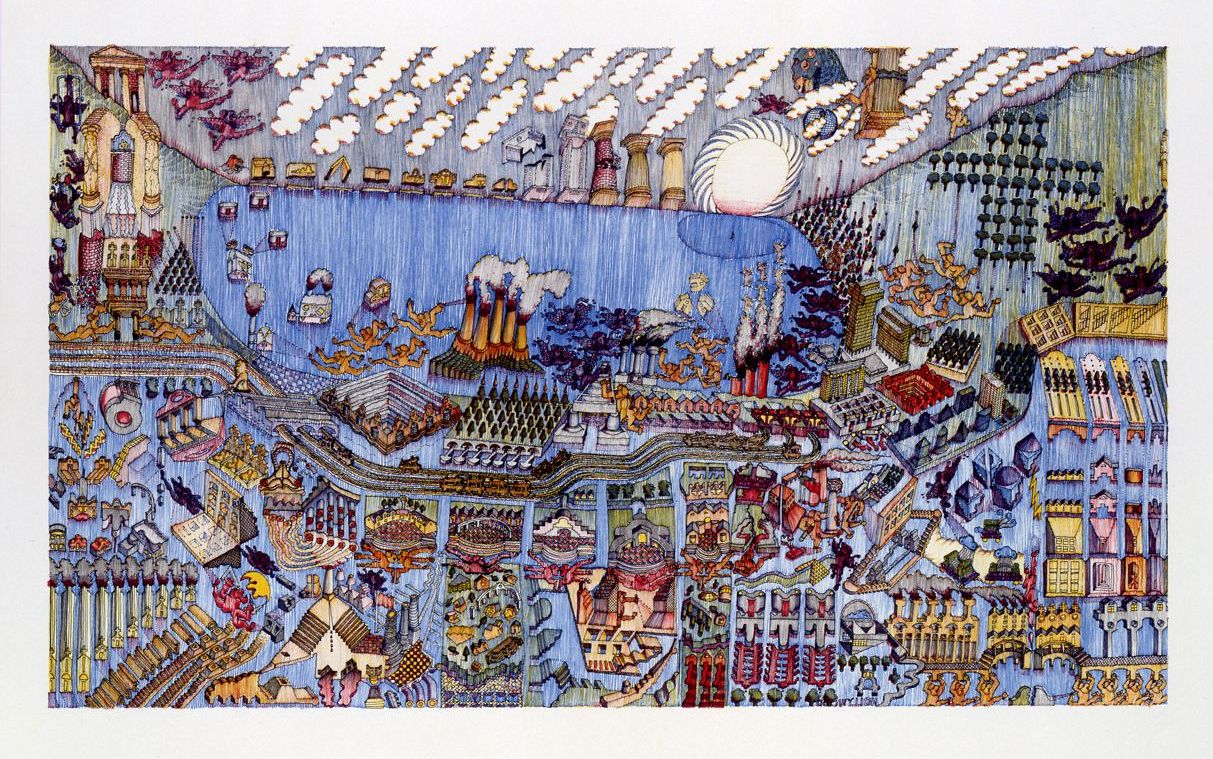
1 | Stanley Tigerman, Career Collage, 1983. From “Architoons”. Lithograph on bond paper.
Tigerman’s largest Architoon drawing, Career Collage (1983), brings together many of his central ideas. This lithograph can be situated within the tradition of Surrealism, recalling works such as The Garden of Earthly Delights by Hieronymus Bosch. Much like Bosch’s painting, Tigerman’s drawing presents an imaginary world animated by strange objects and grotesque figures engaged in scenes of excess and desire. Built upon visual metaphors and puns, Bosch’s work is saturated with sexual connotations, linking mythical and religious narratives to the customs and taboos of social life in his own time. It offers a vision of paradise on earth – or rather, of what becomes of paradise once it is grounded in worldly reality. The painting’s meticulous realism produces a comic effect, exposing both the ethical traditions and the moral failings of society.
Tigerman’s collage shares a similar narrative and compositional logic. It too unfolds within a natural, earthly setting – beneath clouds and sun, across land and water, and among rolling hills. Yet in Tigerman’s version, the dreamscape becomes autobiographical. Through the drawing, he reflects on his self-fashioned place within the history of architectural ideas, his relationship to historical precedents, and his own first-person narrative as a Jewish architect practicing in Chicago.
At the time Tigerman entered the architectural scene, the invocation of historical precedents was precisely what could “get you in”. Indeed, did not Philip Johnson himself publish – with a characteristic sense of irony – his essay Seven Crutches of Modern Architecture in 1954, in which he argued:
We have very fortunately the work of our spiritual fathers to build on. We hate them, of course, as all spiritual sons hate spiritual fathers, but we can’t ignore them, nor can we deny their greatness. The men, of course, that I refer to: Walter Gropius, Le Corbusier and Mies van der Rohe. Frank Lloyd Wright I should include – the greatest architect of the nineteenth (sic!) century.
In Career Collage, Tigerman frames his own architectural history between two poles: on one side, the legacy of Greek architecture; on the other, the most contemporary work of the moment, represented by César Pelli’s design for the World Financial Center – a project that would not begin construction until two years after Tigerman completed the drawing. The scene is thus staged between antiquity and an unfinished present, between inherited origins and architecture still in the making.
For Tigerman, history is inseparable from the lifecycle of the individual, who moves through a succession of experiences, encounters, and discoveries at a uniquely personal pace. Yet this understanding of history is never entirely liberating. Rather, it underscores the difficulty of escaping the influence of canonical precedents and the weight of architectural tradition. Such a self-reflective conception of history recalls The Anxiety of Influence (1973), in which Harold Bloom argues that the young poet achieves creative freedom precisely through the deliberate – and often ironic – misreading of his predecessors.
As such it is Tigerman, himself, who likes to point out the unmistakable influences to be found in his work: among these, one will find in the decade following his graduation from Yale in 1961, the influence of Paul Rudolph. Right after graduation, Tigerman designed the Chapman House (1963) with its exposed brick and concrete, brutalist appearance; the play with the multiple levels of floors and ceilings, the expressive spouts and chimney, were things that Rudolph put to use himself, as he did for example in the project for the Christian Science Student Center at the University of Illinois (1962-1967). The early influence of Rudolph is also obvious in Tigerman’s designs for the Polytechnic Institutes, which were commissioned by the World Bank trying to develop the technological know-how in (what was then) West Pakistan, and what would become Bangladesh in the Liberation War in 1971. For these five institutes throughout Bangladesh, Tigerman collaborated with a former Yale classmate, Muzharul Islam; it was Islam who brought Tigerman, but also Rudolph and Louis Kahn to Bangladesh as part of the so-called American Trio.
Kahn sure is another acknowledged influence on Tigerman: the early studies for the Polytechnic Institutes show Kahn’s characteristic round openings in the heavy masonry walls very reminiscent of the latter’s Assembly Building in Dhaka. But also a homeless shelter Tigerman designed in 1966, “Bum’s Housing” in Chicago and the Kelmer Arlington Industrial Building (Arlington Heights, Illinois 1972-74) evokes Kahnian tropes. Interestingly, the use of precedent starts to shift with these projects: these buildings convert the archetypal primitiveness of Kahn’s circular openings into a “language” – a witty game of fragmentary forms – half-circles, quarter-circles, circles that are sliced in two by columns – that change their meaning depending on the compositional context they get inserted in. Unlike Kahn, the circular openings produce a graphic effect and establish a self-referential formal language. No doubt, by the time of this building, Robert Venturi had an impact on Tigerman’s thinking here, and also Charles Moore’s supergraphics. These projects began to comment on precedent rather than simply replicate them.
There are also those influences that Tigerman does not mention or does not like to mention because he doesn't have the same appreciation for them: among them Jim Stirling, who had just built the Leicester engineering building and started his 24-year-long teaching career at Yale just before Tigerman graduated. Tigerman’s St. Benedict’s Abbey Church in Wisconsin (1969-73) borrows from the spatial pin-wheel typology which Stirling and Gowan had used for their Camberwell Assembly Hall. Tigerman's interest in the structuralist architecture would become very important for his work: in the 1960s, he developed bold steel-and-glass structures at a very big scale, some of them floating on the water. They also appear in the Career Collage: Instant City (1965-66), Urban Matrix (1967-68), Instant Football, The Kingdom of Atlantis were the architectural expression of optimism and of the confidence in the power of architecture to impinge on the socio-political relationships of the real world, and inspired by Kenzo Tange, Yona Friedman, Justus Dahinden, and Bucky Fuller. Yet only a few years after these projects, Tigerman would revise his faith in this optimistic attitude around the disasters the United States had participated in engaging in the Vietnam war. While these might very well be some of his spatially most powerful projects, he could never reconcile their utopian ideals with his own skeptical attitude. In that sense, they were “mannerist” in that they mimicked an attitude of his contemporaries while he, himself, did not subscribe to their underlying ethics of confidence.
For these antecedents, the scientific findings of “System Analysis Theory”, “Network Theory”, “cybernetics”, and “Field Theory” largely contributed to their interest in devising large structural frameworks at the intersection of the architectural and urban scales. Yet for Tigerman, the primordial question remained one of artistic composition: as such, he references György Kepes, Robert Slutzky, Colin Rowe, Mondrian and, of course, Josef Albers, who headed Yale’s Department of Design until 1958. He became fascinated with Albers’s compositional experiments that evoked spatial constructions: both Tigerman’s “Kingdom of Atlantis” and Albers’s canvas “Shrine” deal in similar ways with the “transparency” of overlapping figures in space, and they both play with the paradox of “transparent lines”. Albers’s geometrical play with the diagonal and the lozenge, which can be found in the “Kinetic” series from 1945, found their way into Tigerman’s “Formal Generators of Structure” as well as in a series of oil-on-wood paintings with the lengthy title: ”I Pledge Allegiance to The Lozenge and to the Implications for Which it Stands”. The play with ambiguity, both cultural and formal, feeds into Tigerman’s ironic stance towards the strict rules and the aesthetic straitjacket of his late-modernist training.
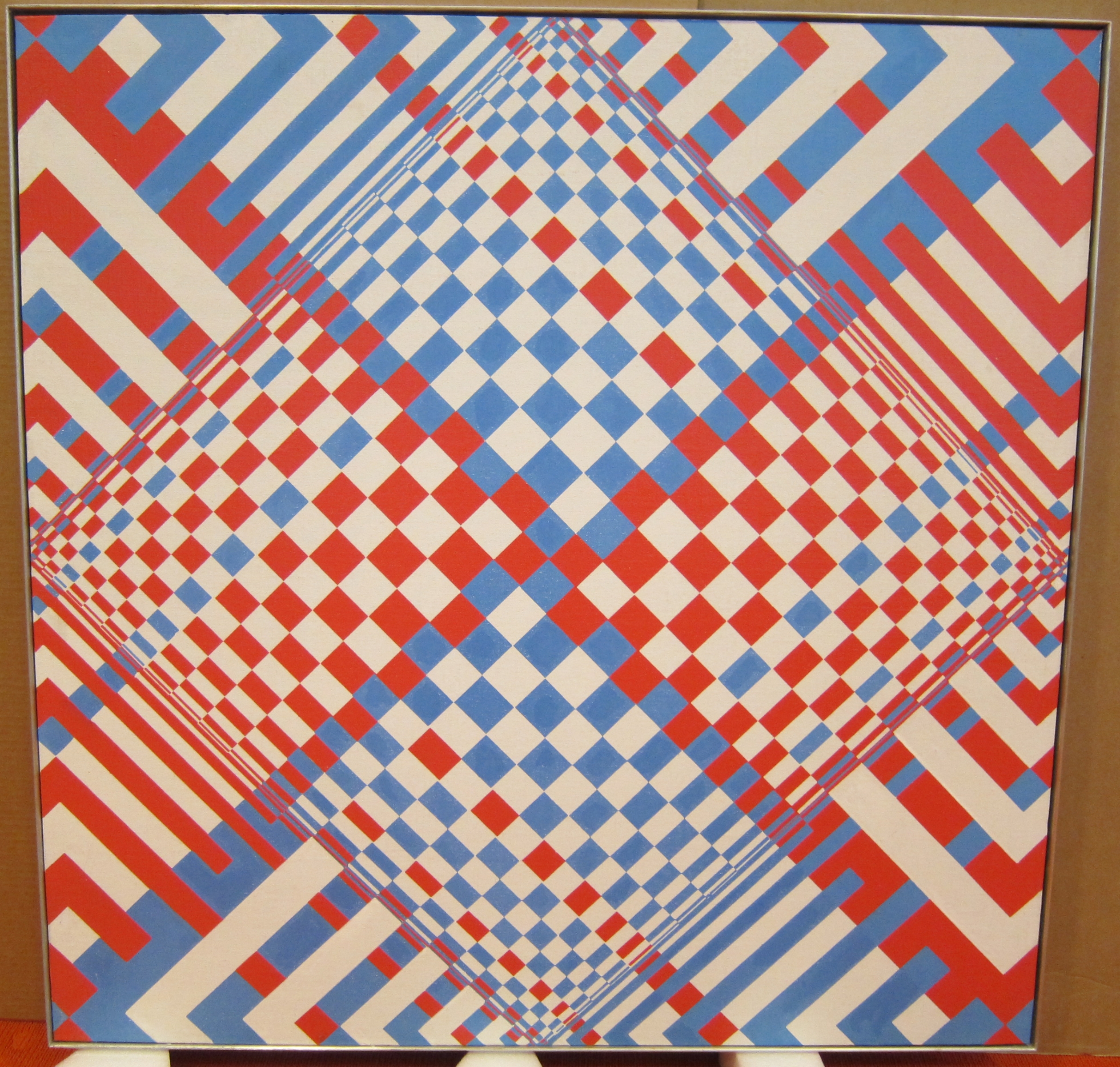
2 | Stanley Tigerman, from I Pledge Allegiance to the Lozenge and to the Implications for Which It Stands, 1964. Oil on wood.
One of the acknowledged influences is given a particularly vital and dramatic role: Ludwig Mies van der Rohe. Tigerman admired Mies, but he also made him into a sort of vodoo doll that had to take the blame for all the things Tigerman objected to in late-modern architectural culture. In the drawing of the Career Collage, Tigerman drew Mies’s Federal Center in Chicago, which Mies started working on in 1959 and which was only completed posthumously, in 1974. It is one of Mies’s abstract and monumental downtown projects with the homogenizing tinted glass curtain-wall facades for which he was, by that time, so well-known. Tigerman turns the abstract buildings figural by representing them as giant, extruded crosses, and thus converts Mies’s forms with no apparent architectural rhetoric into “symbols” – the symbols of Mies’s death (in 1969), but also symbols of the disturbing fact that, while the man had died, his acolytes continued to perpetuate an aesthetic that they turned into a cliché for the global export: Mies had turned into the dominant corporate architectural paradigm.
In a posthumous “Letter to Mies”, Tigerman wrote in 1978:
[…] you’ll be interested to know that lots of “Mies Buildings” are now being designed for Arabs. […] The Illinois Institute of Technology is the same as it was ten years ago. The architecture school is still the same old Jesuit Seminary ( – Mies was a German catholic, Tigerman a Jew – ) it was when you were here and they still import seminarians from the Black Forest for graduate school who still believe in your credo: “Build, don’t talk” (Stanley Tigerman (Versus), 30).
Against Miesian abstraction, Tigerman insisted that buildings have narratives; that they do “talk” and that they do carry the memory of the architectural discipline, the history of a place, and the stories their architect wants to convey.
In the Career Collage, Tigerman thus puts one of his own buildings right next to Mies’s; the Pensacola building is an attempt to bring back all that Miesianism had suppressed in order to restate the identity of Chicago: Pensacola redeploys the architectural iconography of the “courtyard”, the “townhouse facade”, columns, capitals, cornices and ornamentation. Pensacola was to reintroduce memory into a pragmatic city without memory. With this in mind, he reinterpreted the site plan for the Graceland Cemetery in Chicago by adjusting the geometry of the city to align his and his office partner and wife Margaret McCurry’s common future tomb with an axis connecting Mies’s gravestone (and also Louis Sullivan’s) with Lake Michigan, and with Tigerman’s Pensacola and Boardwalk buildings (1978-81). Just as is the case with his understanding of history, Tigerman’s interpretation of Chicago turns autobiographical; indeed, how much more graphic can one get about tracing one’s lineage (both in historical time, and also in a city plan) than to align one’s own future tomb with Mies’s, and bending the geography of the hometown to fit this scenario!
After the death of Mies, architecture had to be reanimated in new ways; for Tigerman, this meant that the formal system of orthogonal grids and precise and rigid alignments of axes had to be supplemented with something else – a new energy, another geometry, and another ethics. This is the process and the moment whereby Tigerman finds his role as an architect.
Setting Architecture Afloat and Letting It Speak
Around the mid- to late 1970s, Tigerman starts to move away from these precedents, and explicitly relativizes the centrality of Miesian abstraction. In 1978, Tigerman created the now famous collage entitled “The Titanic”, where he makes Crown Hall at IIT float in a precarious position in Lake Michigan. Both the semi-transparent water with its waves, and the perpetually changing forms of clouds in the background are leitmotifs of psychoanalysis. In this collage, Mies’s architecture is set in dialogue with all the things Mies had to suppress to maintain the crystalline appearance of his structures, i.e. to make the structure ‘universal’ as opposed to ‘individual’, or even ‘personal’. But Tigerman wanted to show that something was lurking under the surface of Mies’s rational superstructure and his positivist certainties that could now, after Mies’s death, crop up from their repressed state: a new power structure existed in the architectural culture of Chicago, and therefore Tigerman also wanted to see a new aesthetic emerge. By the time of the Titanic collage, the turn to psychoanalysis to re-energize the discourse of late-modernism was not completely novel in architecture, and the fluid shapes of water and clouds take on the role of geometry’s dialectic ‘other’: Madelon Vriesendorp, in particular, had painted a series of canvases since the early-1970s, which had addressed the hidden subconscious layers of pragmatic Manhattan – amongst them, “Freud Unlimited”, which shows the rational Manhattan grid as a mere (soft) blanket that covers a potentially exciting and delirious urban underworld or infrastructure. In Vriesendorp’s case, the iconic Empire State building floats in the water in much the same way as Tigerman’s Titanic.
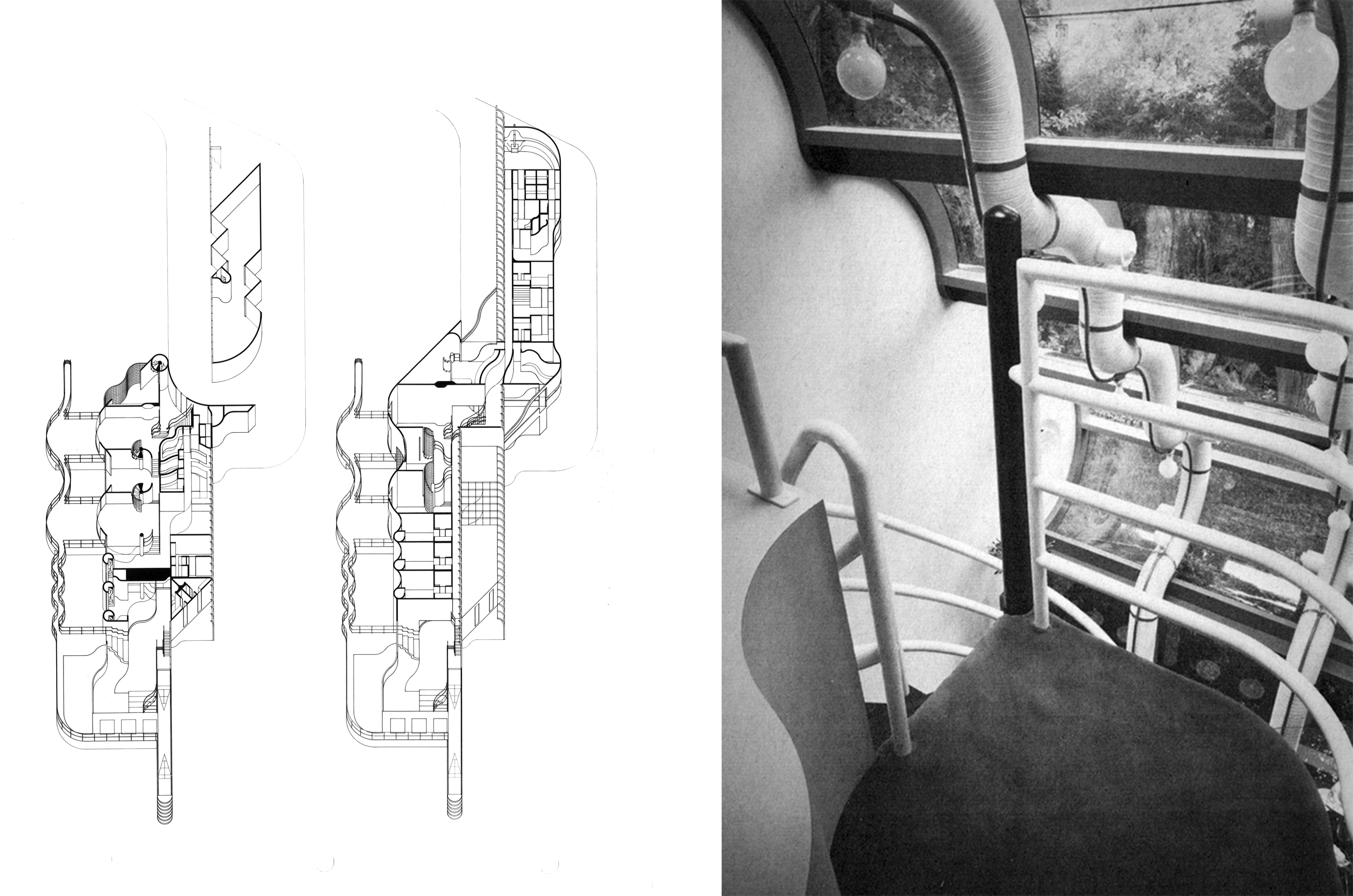
3 | Stanley Tigerman, Labadie House, 1976-77. Plan, ink on Mylar, 32 × 80 in. (81.2 × 200 cm). Oakbrook, Illinois.
4 | Stanley Tigerman, Tigerman takes a bite out of Keck (Harvey L Walner Residence Addition), Highland Park, Illinois, USA, 1977-79.
Tigerman’s architectural projects also started to make use of a fluid kind of geometry. In the Labadie House from 1976-77, the architect set the straight, orthogonal lines in dialogue with a undulating geometry : it is as if Mies’s grids were supplemented with the curvilinearity of waves and clouds, to produce the convoluted plan of this house, which also sits on the shores along the rushing water of a river in Oakbrook, IL. The notion of concept is supplemented with the dynamic phenomenology of natural shapes. The house’s formal resemblances with the work of Tigerman’s friend John Hejduk, in particular the latter’s Wall Houses, is no coincidence; Hejduk had also transitioned from an abstract and geometric phase to a lyrical one. However, the similarities between their work notwithstanding, one will continue to feel the Miesian precedent in Tigerman, while with Hejduk, Le Corbusier’s lyricism continues to be apparent. As such the waves of the Labadie house are always based on an series of arcs of a circle, which are indeed derivative of Mies’s half-circles in the Tugendhat house, whereas Hejduk’s curves derive from Corbu’s use of the cubist guitar, the piano shape and other lyrical curves as exemplified in the Carpenter center in Cambridge, MA.
Similarly, for an addition for a house designed by George Fred Keck, Tigerman devised a wavy geometry for the glass roof, the electric cables, light fixtures, and air ducts. Keck had made a name as the pioneer of passive solar houses; he was, for example, the architect of the “House of Tomorrow” for the Century of Progress exhibition in 1933, as well as of the Crystal House from 1934. The positivist modernist Keck saw in technology the innovative force for architecture. In response to this context, Tigerman did not reproduce Keck’s attitude, but made his structure into a witty commentary on this precedent’s technological vision. As such he created his own ironic version of a passive solar house, rejecting the idea that form should follow function and instead “making air-conditioning ducts to follow form”, so-to-speak. Tigerman turned Keck’s technical utopianism into formal mannerism: while the building addition looks like a machine, it is not clear what this machine has been built to do. For sure its mechanism is more linguistic than it is pragmatic.
Returning to the Career Collage. Many of the buildings in Tigerman’s drawing appear like elongated silhouettes. Some of the outlines of the front facades are simply extruded into deep space without any articulation. Tigerman also does this with graphic and typographic signs, which are extruded into spatial objects. “Form” is here directly derived from two-dimensional graphic outlines; the result is not really three-dimensional, but two-dimensions turned thick. And importantly, form is simplified to the point where it becomes immediately legible: architecture becomes a vignette of (simple) messages. This technique borrow from the world of cartoons – an artistic medium geared towards direct and clear communication. Tigerman himself is an extremely prolific cartoonist, and aligns himself with a whole series of postmodern architects, for whom cartoons represented a rich source of inspiration and communication. Among them, John Hejduk, Robert Venturi, Charles Moore, Robert A.M. Stern, Michael Graves, in the States, and, in Europe, Ettore Sottsass, Hans Hollein, Gustav Peichl (alias Ironimus), among others.
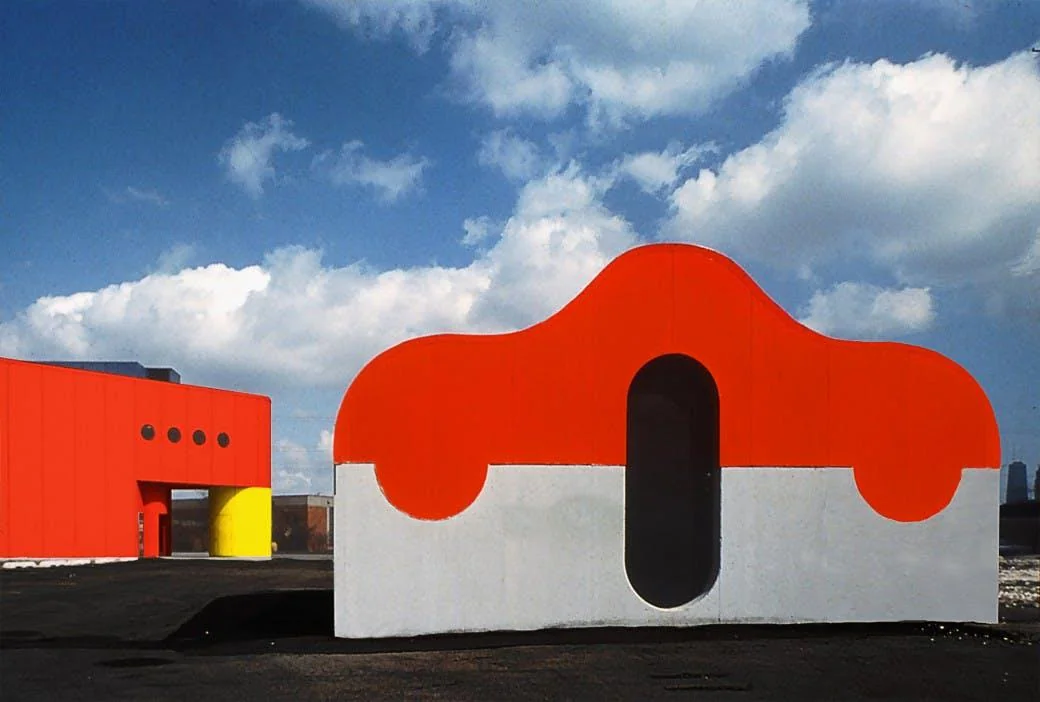
5 | Stanley Tigerman, Illinois Regional Library for the Blind and Physically Handicapped, Chicago 1976.
The car garage in Tigerman’s project of the Illinois Regional Library for the Blind and Physically Handicapped in Chicago is itself the built silhouette of a car shape; it allows near blind people to understand the form. In a sense, the building fits its content like a glove fits the hand, and becomes a parody of the “form follows function” paradigm – a modern architecture parlante. The architect here plays with the dichotomy of architecture’s gravitas and the lightness of the messages he wants to convey. He also reactivates a historic period of architecture around the French Revolution, with a nod to Claude-Nicolas Ledoux, and, to Ledoux’s “cheekier” contemporary, Jean-Jacques Lequeu. Ledoux had famously designed the phallus-shaped Oikema building for the initiation of young men, and the Maison de plaisir in Montmartre; Lequeu found the same shape intriguing, and had used it in elevation and in section to devise a monument to celebrate the omnipotence of God.
Referencing these precedents, Tigerman built the Daisy House from 1975-78. The project combines tragedy and comedy in form and narrative, as the client was a terminally ill cancer patient and the owner of strip bars in Chicago. Tigerman decided to base the house’s plan on the Hermaphrodite double iconography of male and female genitalia. In the face of the approaching death of the client, Tigerman reports that he wanted to make his client laugh. The Janus-faced scheme has a dividing wall: on one side of the wall, the plan is phallus-shaped, while the beach-side of the wall relates to the female anatomy. This double structure provides for a male and a female elevation with the addition of a Spanish Missionary bell on top of the female elevation. The vertical planks of the facade do not only make the smooth curvature of the form possible, but references a particular precedent by Claes Oldenburg: Oldenburg had put on display a Mouse Museum at the Museum of Contemporary Art in Chicago in 1977. The entrance to Oldenburg’s pavilion borrowed its form from a curvilinear extension, similar to the one in the Daisy House, but in Oldenburg’s case, the shape was Mickey Mouse’s tongue stuck out.
Orgy, Rebellion, Infantilism
What to make of Tigerman’s references to the iconography of the lower stratum of the body? Sigmund Freud helps in these situations, as according to him, sexual jokes like the Daisy House are a way of letting out sexual repressions. When humor and sexuality merge, the genre of burlesque is at play. So the Daisy House is architectural burlesque. But Freud also describes these jokes as a way to express a critique against an overpowering authority. And indeed we are faced with Tigerman’s attempt to liberate himself from a bureaucratic, positivist, overly regulated and pragmatic socio-cultural context, from which he wanted to distance himself as a sort of cultural libertine. In this context, he often mentions the problematic moral stance that got the United States involved in the Vietnam war, which he saw as an expression of a broken ethical orientation underlying the American society as a whole. And surely he was sensitive to the thematic as a Jew, who was well aware of what was going on in Germany when he was a teenager.
Interestingly, that the same year Tigerman drew the Career Collage, in 1983, Peter Sloterdijk published his book Critique of Cynical Reason. In the book, the philosopher establishes a list of what he calls “The Psychosomatics of the (cynical) Zeitgeist”, where he also enlists the physiognomic instruments of this type of satirical critique:
Tongue, stuck out;
Mouth, crooked, bitter, laughing maliciously;
Breasts, Arses, Fart, Shit, Genitalia
Sloterdijk’s table of content reads like a taxonomy of the very graphic elements Tigerman likes to use in his architectural cartoons with the intention to animate them. Sloterdijk explains: “The truth often speaks against conventions, and the (satirist) plays the role of a moralist who makes it clear that one has to violate morality in order to save it” (Peter Sloterdijk, Critique of Cynical Reason, 142) and that “it is necessary to rethink the usefulness of the unuseful, the productivity of the unproductive, philosophically speaking: to unlock the positivity of the negative …” (ibidem, 151). Sloterdijk’s comments resonate well with Tigerman, as the latter insists that the different expressions of idealism in architecture – the value of permanence, of synthesis, of perfection – have limited architecture to a very narrow and abstract medium of expression. And while the genre of burlesque might not be the solution to address the need for architecture to “speak out”, it sure can point out the problem.
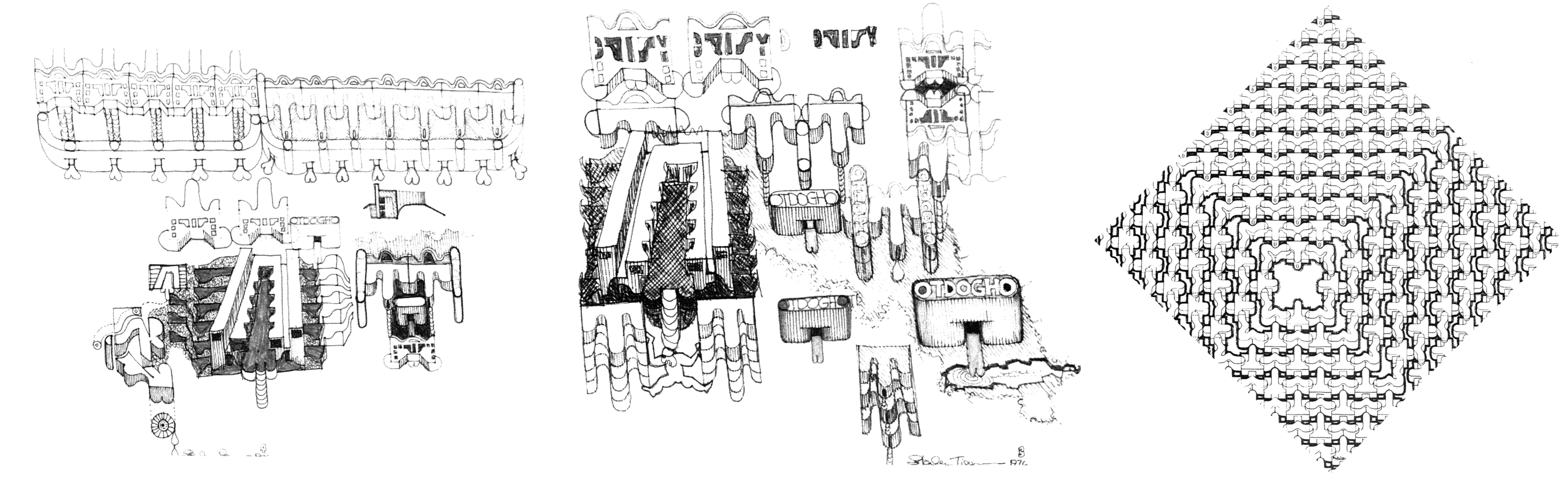
6 | Stanley Tigerman, Dirty Postcards, Venice Biennale, 1976.
In one of the Architoons and in the “Dirty Postcards” which Tigerman printed to distribute at the 1976 Venice Biennale, Tigerman’s Hotdog House and the Daisy House are being animated and turned “alive” with added tongues, mouths and genitalia when they go about their business of being involved in a postmodern orgy. Again, herein he was joined by other architects, who mobilized the same genre of satiric criticism, as Hejduk did in his sketchbook “Architectures in Love”, or Hollein with his phallic sketch of Chicago skyscapers, and no doubt, also Ettore Sottsass. All of these expressions were directed against “obedience” and against being part of the hegemony, against belonging to a “program” or “manifesto” in the way the modern avant-garde had it. In its place came the idea of freedom and of individualism, of breaking out of the chains of all ‘discipline’ and the ‘System’.
In 1976, Tigerman created the group of the “Chicago 7” as the architectural homologue of the political “Chicago Seven” around Abbie Hoffman, Jerry Rubin, Lee Weiner and the others, who rioted in Chicago in 1968 in protest of President Johnson’s Vietnam war policies. Tigerman created the group to affirm an alternative to the officially sanctioned traditions of Chicago architecture, meaning the well rehearsed histories out of Louis Sullivan, Frank Lloyd Wright, Daniel Burnham. But the lose constellation of people in there Chicago Seven was also meant to put Chicago on the map, after the East Coast had seen the so-called White Architects and the Grays appear, while a group of L.A. architects emerged as the Silvers. The East and West Coast groups had teamed up around common agendas: the Whites were interested in autonomy of form, the Grays saw themselves as inclusivists, and the Silvers gathered around specific concerns of technology and urban mobility. Nevertheless Tigerman claims that the Chicago 7 had no such program; if anything, they had a negative program. They knew what they did not want to do; in fact, Tigerman claims:
The Chicago Seven have nothing to do with each other – formally, and now, personally. I don’t even see them. […] It was the only way we could get seven desperate people who had nothing in common, including respect for the other; but one thing we had in common: we needed to penetrate a city that was monolithic, that was Miesian.
One can claim that the program of the Chicago Seven was less artistic but more existentialist in character: it was about survival and a sort of free-masonry in a context where the big forces were in place, and were not up to letting any new-comers in. In 1980, the group invited a series of individuals to submit “late entries” to the 1922 Chicago Tribune competition. Six decades after Walter Gropius’s and Adolf Loos’s iconic proposals, many of the late entries commented on these modern icons with a sense of infantilist humour. Fred Koetter bent Gropius’s building as if the building had been hit in the stomach. Borrowing from Claes Oldenburg, Livesey / Rosenstein turned Loos’s column-building into a giant baby bottle, claiming to bring back the lost innocence of Chicago architecture after it has been taken over by “big business”. These were attempts to signal the desire to rebel and escape from the aesthetic straightjacket of modern architecture.
Architecture and Persistent Dialectics
Also in the Career Collage, there is a group of buildings set along the shore, with train tracks entering the buildings, and with chimneys from which little dogs fly vertically up into the sky. The reference to the Nazi concentration camps is obvious. It is in the context of Tigerman’s self-understanding as a Jew that he declared, in his book VERSUS in 1982, that “Postmodernism is a Jewish Movement”. The book cover shows a stone tablet that is cracked in two halves; the rift separates the profane world of reason and analysis from the spiritual and sacred sphere of faith and the search for synthesis. Despite the attempt of angels and soldiers on either side of the stone to bring these opposites together, the crack persists and the stone resists unifying synthesis. Analogously, on the cover of the 1988 book Architecture of Exile, a cube appears as a double object: as a physical object, on the one hand, and as a displaced dotted analog, on the other. The sketch exemplifies that the realm of ideas and metaphysics always escorts the physical object of architecture. In other words, architecture is not simply present, but its ideas are set adrift, “in exile”, and moving freely and unstoppably through the labyrinthian dynamism of architectural discourse. No doubt, Tigerman writes up simultaneously a theory of architecture and a self-reflection on the Jewish condition, implying that while architects can plan the geometry of a building, they have to resist the conceit of determining how buildings are interpreted once inserted into real space and time. After conception, buildings like humans drift into exile.
This is precisely the existential condition of all architecture: ideas about perfection are changing with the dialectics of history, and so the notion of perfection is dynamic. This realization is also fundamental to any ethical philosophy – Emmanuel Levinas and Martin Buber being two of Tigerman’s favorites; if the voice of the ‘other’ gets suppressed by glossing over all “difference” with an aesthetic of perfection, where nothing seems out of place, and where nothing can be added or subtracted – as Alberti had once fantasized – then architecture gets disconnected from the human condition. Tigerman is not willing to do that.
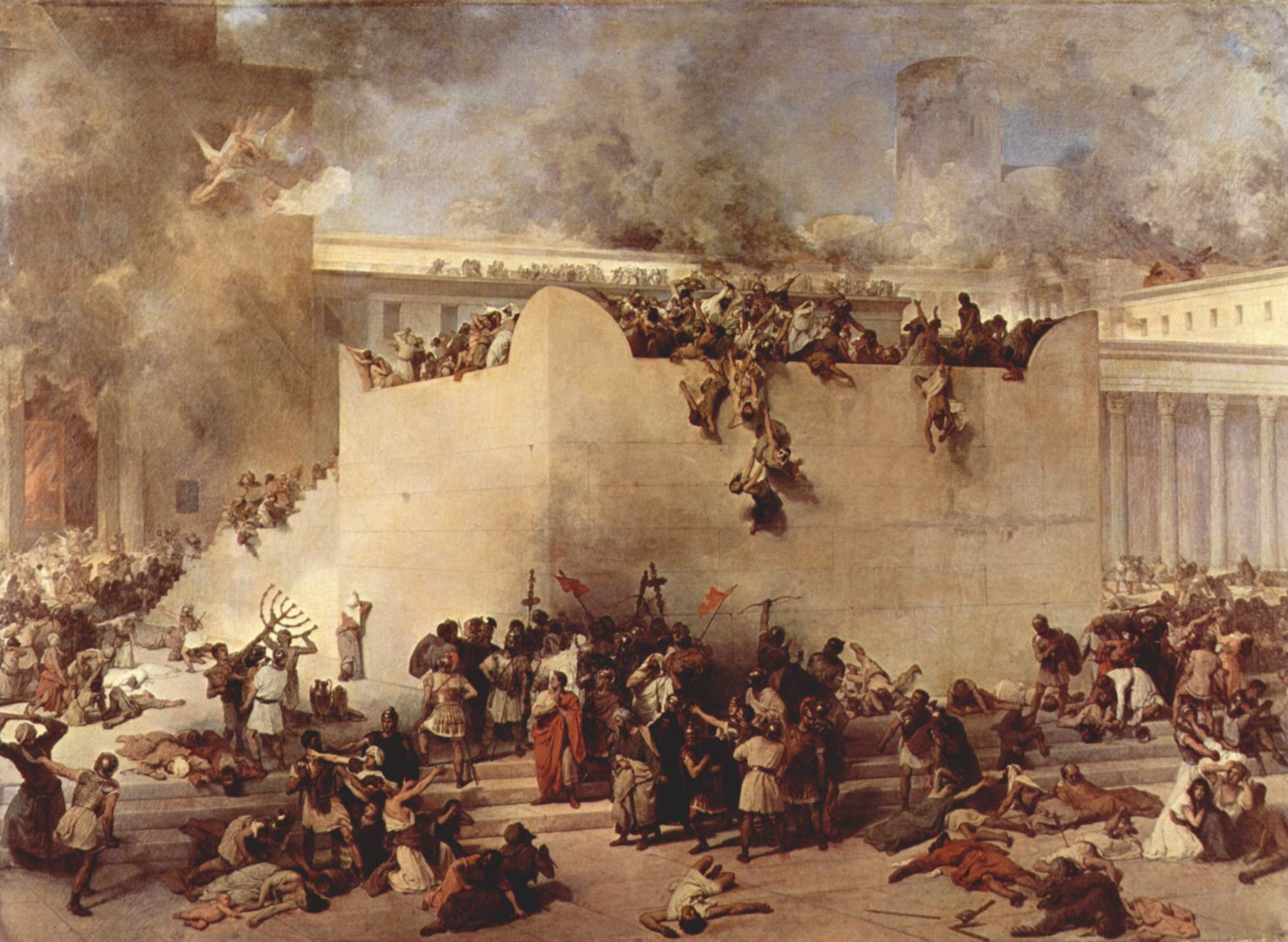
7 | Francesco Hayez, The Destruction of Solomon’s Temple, 1867. Oil on canvas, 7 1/4 × 9 3/4 ft. (183 × 252 cm).
In the book Greek versus Hebrew by theologist Thorleif Boman, Tigerman finds his view of dialectics articulated in a most convincing way: Boman attributes the search for presence and clarity to Greek culture; Hebrew culture, in contradistinction, builds its metaphysics on the notions of absence and memory, and on the cycle of reading and interpreting the text. The translation into architecture was most direct: the Greek Acropolis is the paradigm for all architecture as it builds on presence and clear form, and as it even still exists today to be visited. But there has always existed another Ur-model that has been more peripheral for architecture: it is the Hebrew temple, the Temple of Solomon, which was destroyed, and so its existence is not physical, but narrative and speculative: it only exists as a memory. Tigerman proposes that architecture can be enriched if we accept that physical buildings are mere place-holders of a whole universe of ideas, which we can think, but never fully build.
Bibliographical references
- Bloom 1973
H. Bloom, The Anxiety of Influence: A Theory of Poetry, New York 1973. - Boman 1960
T. Boman, Hebrew Thought Compared with Greek, Philadelphia 1960. - Tigerman 1982
S. Tigerman, Versus: An American Architect’s Alternatives, New York 1982. - Tigerman 1988
S. Tigerman, Architecture of Exile, New York 1988. - Buber 1970
M. Buber, I and Thou, New York 1970. - Levinas 1969
E. Levinas, Totality and Infinity: An Essay on Exteriority, Pittsburgh 1969. - Jencks 1977
C. Jencks, The Language of Post-Modern Architecture, London 1977. - Petit 2025
E. Petit, “Yours Sincerely”, in G. Papamattheakis (ed.), Stanley Tigerman: Drawing on the Ineffable, New Haven 2025. - Petit 2013
E. Petit, Irony; or, The Self-Critical Opacity of Postmodern Architecture, New Haven 2013. - Petit 2011
E. Petit, Schlepping Through Ambivalence: Essays by Stanley Tigerman, New Haven 2011. - Venturi 1966
R. Venturi, Complexity and Contradiction in Architecture, New York 1966. - Venturi, Scott Brown, Izenour 1972
R. Venturi, D. Scott Brown, S. Izenour, Learning from Las Vegas, Cambridge MA 1972. - Johnson 1954
P. Johnson, “Seven Crutches of Modern Architecture”, in Writings, New York 1954. - Sloterdijk [1983] 1987
P. Sloterdijk, Critique of Cynical Reason [Kritik der zynischen Vernunft, Frankfurt Am Main 1983], Minneapolis 1987. - Tafuri 1976
M. Tafuri, Architecture and Utopia, Cambridge MA 1976.
English abstract
Stanley Tigerman occupies a distinctive position within American postmodern architecture by treating architecture not simply as the design of buildings, but as a medium for ethical, cultural, and existential reflection. Rejecting the modernist pursuit of unity, permanence, and abstraction, he embraced irony, humour, contradiction, and narrative as ways of exposing the tensions embedded within American society. Situated in the context of postwar Chicago, the Vietnam War, and his identity as an American Jew, Tigerman developed an architectural language that challenged the dominance of Miesian modernism while questioning architecture’s own disciplinary assumptions.
Focusing on Tigerman’s Career Collage (1983), the essay traces how he constructed an autobiographical history of architectural influence, simultaneously acknowledging and subverting predecessors such as Paul Rudolph, Louis Kahn, Robert Venturi, and Ludwig Mies van der Rohe. Drawing on Harold Bloom’s concept of the “anxiety of influence”, the essay argues that Tigerman transformed architectural precedent into an ironic and critical dialogue rather than a model for imitation. His cartoons, collages, and projects – including The Titanic, the Daisy House, and the Illinois Regional Library for the Blind – demonstrate how humour, visual puns, and burlesque became instruments for criticizing the ethical and cultural limitations of late modernism. The essay concludes that Tigerman argues that his work is ultimately grounded in a Jewish philosophical understanding of architecture, informed by thinkers such as Emmanuel Levinas, Martin Buber, and Thorleif Boman. Rather than viewing buildings as autonomous objects, Tigerman conceived architecture as an open-ended field of interpretation in which memory, absence, and dialogue continually challenge ideals of permanence and formal perfection. Through this perspective, his work redefines postmodern architecture as an ethical and cultural practice rather than merely a stylistic movement.
keywords | Stanley Tigerman; American Postmodernism; Collage; Anxiety of Influence; Miesian Modernism; Jewish Thought and Architecture; Chicago Seven.
La Redazione di Engramma è grata ai colleghi – amici e studiosi – che, seguendo la procedura peer review a doppio cieco, hanno sottoposto a lettura, revisione e giudizio questo saggio
(v. Albo dei referee di Engramma)
Per citare questo articolo / To cite this article: Emmanuel Petit, Ironic, Tragic, Funny. Stanley Tigerman and American Architecture, “La Rivista di Engramma” n. 237, luglio 2026.
Per citare questo articolo / To cite this article: Emmanuel Petit, Ironic, Tragic, Funny. Stanley Tigerman and American Architecture, “La Rivista di Engramma” n. 237, luglio 2026, pp. xx-yy | PDF dell’articolo