The Phenomenology of Seeing: Guardini’s Welt-Anschauung
Seeing the Sense, Spirit and Being of Iconography
Yvonne Dohna Schlobitten
Abstract
I. Introduction
The iconographic method, much more than the technical one, is an obstacle to the understanding of a work of art, because the types and compositions of mythological and sacred scenes can remain more or less the same, across the most profound differences in artistic civilizations and individual fantasies. Since creating in art does not mean inventing, the repetition of popularly accepted motifs remains distinct from the artist’s imprint and the taste of an era and a school. It is precisely iconography that is responsible for one of the greatest prejudices in the history of art, that of the immobility of certain artistic periods. Where the iconographic method best shows its weakness is when it turns to Romanesque and Gothic art, or the Renaissance, because the abundance of monuments allows us to better understand it in its individual aspects: and Male’s books on religious art in France are a typical example of this weakness. When, on the other hand, all the elements of the works of art, not only those relating to the subject treated but also the technical and generally formal ones, are placed in relation to the history of civilization, the results are much better (Venturi 1964, 239) [Author’s translation].
Venturi, known for the critique of art, outlines the danger that can arise in dealing with iconography. On the one hand, one should take seriously the difference between artistic creation and invention, as they are not synonymous. On the other, decoupling iconography from life, humanity, and civilization can lead to banal thinking. Hans Belting in his book The End of Art History (Belting 2001) clearly demonstrated the limit of the method of iconography. This discourse aims to show how, on the one hand, the method of iconography can restrict the comparison of two works of art, and, on the other, how, with the help of the Welt-Anschauung (the contemplative seeing of the world), we can get closer to the sense, being, and spirit of iconography and thus compare images on other levels.
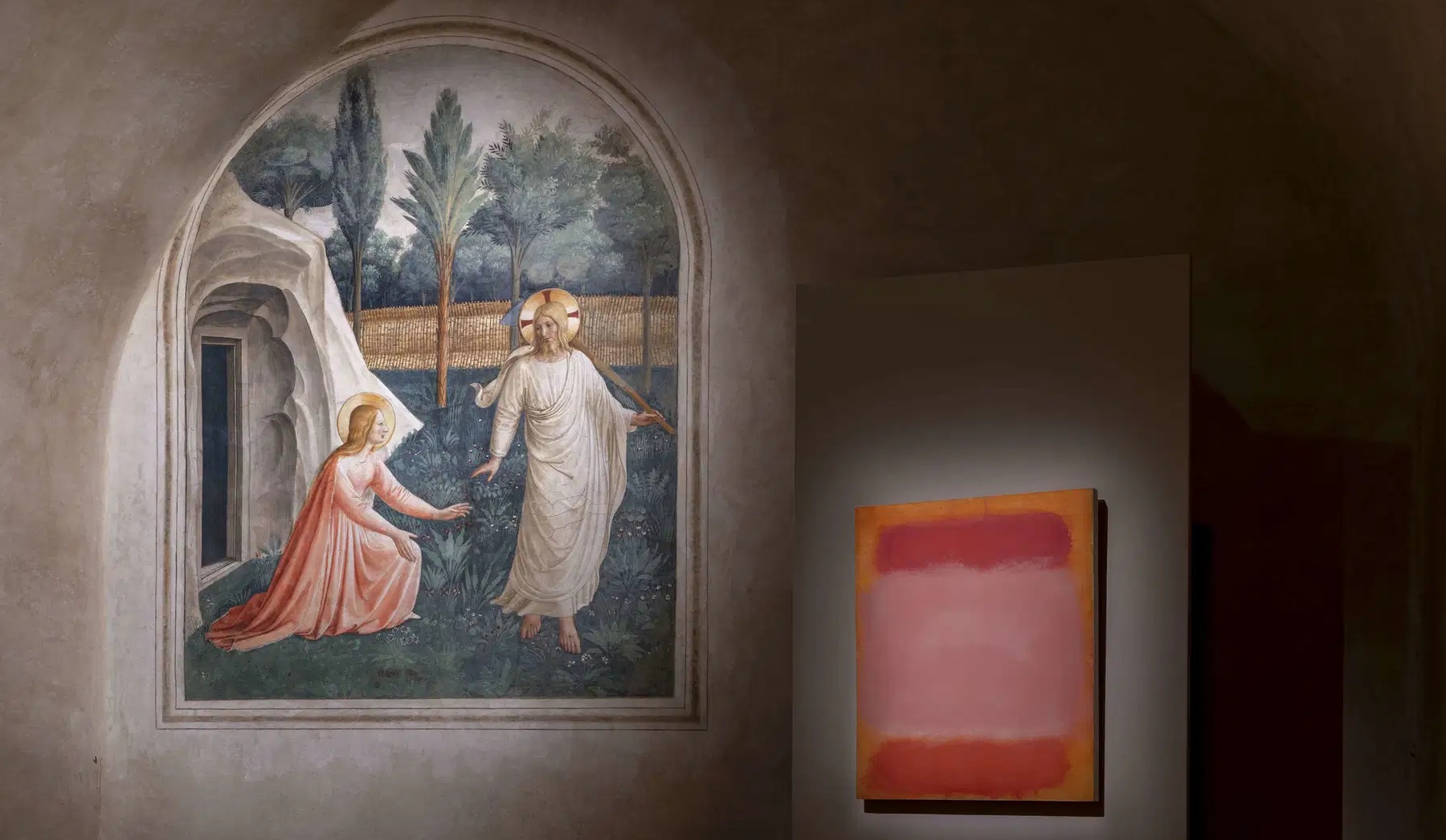
1 | Mark Rothko’s work exhibited in a cell of San Marco Museum in Florence in 2026
II. The comparison of art
To reveal the limits of iconography, it could be helpful to compare works of art from different eras, even though they do not obviously contain the same iconographic symbols (Dohna Schlobitten 2012). The comparison between ancient and contemporary art needs a methodological reflection because, at the same time, a dialogue takes place, and the past and the present are ready to prepare for the future. The contemporary world features a number of different comparisons, all of which are internal to the sacred space, though not to profane architecture. In Germany, at the Bavarian National Museum, a major work by Christoph Brech comes to life in a dialogue between the artistic creations of a contemporary artist and the works of medieval art (Brech 2016). In 1997 in Graz, Austria, Msgr. Hermann Glettler set up a space for an internal dialogue within the Gothic church of St. Andrä. The event, in which various contemporary artists participated, was created as a project to celebrate the Andrä Kunst logo. The figure of Bishop Glettler is also very peculiar: he works mostly with socially disadvantaged people and refugees, but since his studies, he has been involved in the debate on contemporary art, working not only as a curator and art mediator, but also as an independent artist.
This state initiative is analogous to those in other European countries. In France, thanks to the impetus of Professor Jérôme Cottin, the great Parisian churches have welcomed numerous exhibitions of contemporary Christian art into their sacred spaces (Cottin 2017; Cottin 2017b). In Italy, on the occasion of the major exhibition Rinascimento elettronico at Palazzo Strozzi dedicated to Bill Viola (Galansino Perov 2017), two of the artist’s works were placed in dialogue with the masterpieces of the new Museum – the video art by Bill Viola Acceptance (2008) was exhibited close to the Maddalena penitente by Donatello, and his Observance (2002) next to the Pietà Bandini by Michelangelo. And most recently, during the Mark Rothko’s exhibition at Palazzo Strozzi in Florence (opened on 14 March 2026), some of Rothko’s works were displayed in the cells at the San Marco Museum (a satellite location of the exhibition) in dialogue with frescoes of Fra Angelico [Fig. 1].
The examples listed above are just a few models of comparison that have enriched liturgical spaces in Europe. Similar initiatives exist in America, Mexico, or Korea, as well as in the Vatican Museum in Rome (11 September–17 November, 2017) at the exhibition Come in cielo così in terra. Seul e i 230 anni della Chiesa cattolica in Corea (Come in cielo 2017). This comparison has unique, distant, and deep roots which goes beyond iconographic explanation. Cardinal Meissner had already shown the need for a comparison between the past and the present, making the Kolumba Museum in Cologne a complex situated entirely within a church destroyed during World War II where it has hosted major exhibitions of contemporary religious art, such as Paul Thek’s Shrine in 2012. We should also mention a recent example of the comparison of the Annunciation of Fra Angelico and Marina Abramovic’s work The artist is present (Dohna Schlobitten, in print).
In his book Image and Time, Johannes Grave first expressed concerns about the scientific validity of a comparison of images from two different eras: It is therefore rather irritating and requires explanation when an art historian makes very similar observations about artifacts from widely separated periods. If objects created under entirely different conditions are said to exhibit surprising similarities, the suspicion arises that the supposed finding is merely due to an anachronistic projection or even a personal idiosyncrasy” (Grave 2022, 11). On the other hand, the author himself has observed that this inherent contradiction within the image, according to his basic premise, could be at the same time the reason, that works of art from different eras can be perceived or received in a similar way. The image’s composition stimulates certain impressions that the beholder can only take in “successively or alternately, thus in a temporal process” and Graves continues: “To better understand the ‘power’ of images, it is necessary to clarify how images entangle their beholders in perceptual processes that partly escape the sovereign control of the recipient, especially through iconographically strict and regulating codes. It is precisely the tensions within the image itself that are of considerable importance. For it is a specific latent conflict structure that distinguishes images from other objects in our world. This arises from the fact that images, by means of their own physical presence, present something else – something non-present – to the viewer” (Grave 2022, 13). Probably referring to Lorenz Dittmann, he argues that in order to explore the resulting processes of reception and the temporality of viewing images, it is necessary to “go beyond the boundaries of art history” and “seek dialogue with other disciplines [...]” (Dittmann 1969 in Graves 2022, 35).
From Georg Simmel’s “Contemplative Seeing of Life” (Lebensanschauung) and “teaching of opposition” (Lehre des Gegensatzes) (Simmel 1910), influenced by Wilhelm Dilthey’s distinction between “metaphysics and empirical science” and “types of world-comprehension”, and by Heinrich Rickert’s heterothetic principle of thought of “intuition and thinking”, Romano Guardini – together with his friend Karl Neundörfer – developed various typologies from 1906s, which are divided into the areas of character theory, theory of opposition, and theory of a world contemplation. He developed his theory of worldviews, for which various approaches existed even before 1923, particularly from 1921/1922 onwards in Bonn and Berlin. He conceived it specifically for mental-rational knowledge within the university setting as a “theory of world contemplation”, understanding metaphysical, theoretical, conceptual-abstract, and deductive sciences on the one hand, and empirical, experiential, typological-concrete, and inductive sciences on the other, as rational-mental modes of knowledge – as two types of thought within the sciences that stand in polar-complementary opposition. They only approach the ‘whole’, the ‘truth’, and ‘complete’ knowledge if they do not mutually exclude each other, but rather, maintain a tension between them. According to Guardini, this unity of tension can only be achieved if it is an independent, non-scientific, yet mentally rational path to knowledge that incorporates and integrates the results of all sciences, without synthesizing them (Dohna Schlobitten 2021; Dohna Schlobitten 2021b).
III. Methods for the ‘seeing’
Religious iconography is characterized by seeing. We can distinguish three different ‘seeings’ in, for example, the iconography of the Annunciation:
1. Annunciation as an icon becomes a door. Contemplating the icon, the door opens and the scene becomes present. It reveals the look between God and humanity in the icon (Kessler 2012);
2. The seeing between the figures in the painting. We have the look between the angel and Mary in the Annunciation;
3. The ‘seeing’ of the work of art, which is between the work and the beholder.
Guardini says, that the work of art is a ‘being’ and thus we can allow to let ourselves to be looked at by the work of art. Here the question is not: can I see the content of theology, philosophy or other disciplines? It would be: How to look with love at the work of art? (Dohna Schlobitten, 2016; Dohna Schlobitten 2023). But, also, in this case there is a danger. One could reduce the iconography of the look of love within the work of art to visible codes that express intimacy, desire, veneration, or a sense of connection through symbols, figures, or the way eyes are painted. There are various ways of using the eyes as a means of expression (gazing heavenward, weeping, staring into the void, yearning with tears, etc.). Here we are again in classical iconography, which defines the longing, erotic, or yearning look within the context of the depicted story, or employs pathos formulas of the look – that is, sets of rules that conventionalize glances to express emotions (pain, ecstasy, shame) or danger. One could practice and recognize these codes. However, there is a danger that seeing becomes reduced to a functional iconographic understanding, instead to ‘exercise’ to be looked at by a work of art. Which disciplines could help us to understand the deeper sense of Iconography?
IV. With the Eyes of the Theory of Art – Iconosophy
In the study Iconosophy. The Relationship between Color Theory and Iconography (Dohna Schlobitten, Piňero Moral 2011) it was attempted to define a new field that goes beyond iconography without negating it. The coined term ‘iconosophy’ was intended to highlight the philosophical and theoretical dimension of iconography. The concern was to consider iconography as the central feature of artistic analysis, pivotal in its objective quality for any discussion about a work of art. Raphael Rosenberg states that the methods of art historians are already determined by their intellectual and spiritual backgrounds, their personal visions of the world, and their ideologies. Their specific comprehension of the world influences their interest in a single dimension of the reality of art and determines their questioning and methodological procedures. The same findings in an artwork – a formal characteristic – can yield different interpretations because all interpretations are based on different circumstances (Rosenberg 1989, 8). The critic who interprets a work of art using the iconographic method already assumes that the work is a document of a specific nature, defined by texts and independent from the artwork itself. This implies that the image follows a specific aesthetic style: that of illustration. This, also, means analyzing the work of art within an already fixed and defined parameter, as if art was only a historical document. We see the work of art in a specific moment in history (Belting 1990, Panofsky 1978, Wölfflin 1915), within a specific theology, philosophy, and well-defined social and technical circumstances. In this way, art becomes a mere representation of iconographic, socio-historical, or national, popular facts.
By focusing on color in our studies, we might discover that iconography is not as objective and unchanging as usually believed. Color indeed might modify form, but it also moves beyond classical symbolism and expression, influencing the very relationship between the artwork’s content and the emotions and perceptions. Scale, touch, physicality, true color, surface, and depth are all absent, along with any of the ‘authority’ or ‘presence’ which characterize great works of art. Reproductions throw more weight on certain limited aspects of the paintings. They promote the mistaken idea that ‘content’ regards only what we call the ‘iconographic’ aspects of the work. Reproductions also promote the false identification or confusion of a ‘work’ (which has cultural and historical context) with an ‘image’, which is divorced from context. If we posit that art reveals meanings and leads us to experience that which we would not have without it, then we accept that this leads us to the limits of art history. The richness of the results and the never-ending new discoveries make it clear that it would be absurd to consider only one method as the correct one. It is important to know as many methods as possible to arrive at a critical approach and find one’s own way. If we integrate the beholder, we get into other questions about psychology, perception, and reception. As already emphasized in the methodological debates that reshaped art history internationally during the 1980s, particularly in Germany, Gottfried Boehm’ states that this is not a critique of iconography, but a plea for recognizing the complexity of the artwork and, thus, the necessity to go beyond iconography (Boehm 1989, 14). And, as Raphael Rosenberg observes in his methodological reflections on art history, we have to go beyond the relation of ends and means to grasp the ‘unseen’ in the artwork: namely, those latent dimensions of visual meaning that cannot be reduced to iconographic content, function, or verbal explanation, but emerge through the internal logic of the image itself and through the phenomenological experience of vision (Rosenberg 1989, 7). Returning, then, to the subject of color, a question naturally arises: is it possible to analyse color in its own right? Max Imdahl invented a method for the interpretation of abstract art (Imdahl 1996; Imdahl 1983; Imdahl 1986, 65).
The independent power and language of color were shown through a concrete example formed by a relationship: on the one hand, the Goethe’s theory of color – a splendid synthesis of the uses of color by the masters and an influential turning point in the study of the aesthetic, philosophical, and artistic dimensions of color – and on the other, Turner’s painting Light and Colour (Goethe’s Theory) – The Morning after the Deluge – Moses Writing the Book of Genesis. [Fig. 2]
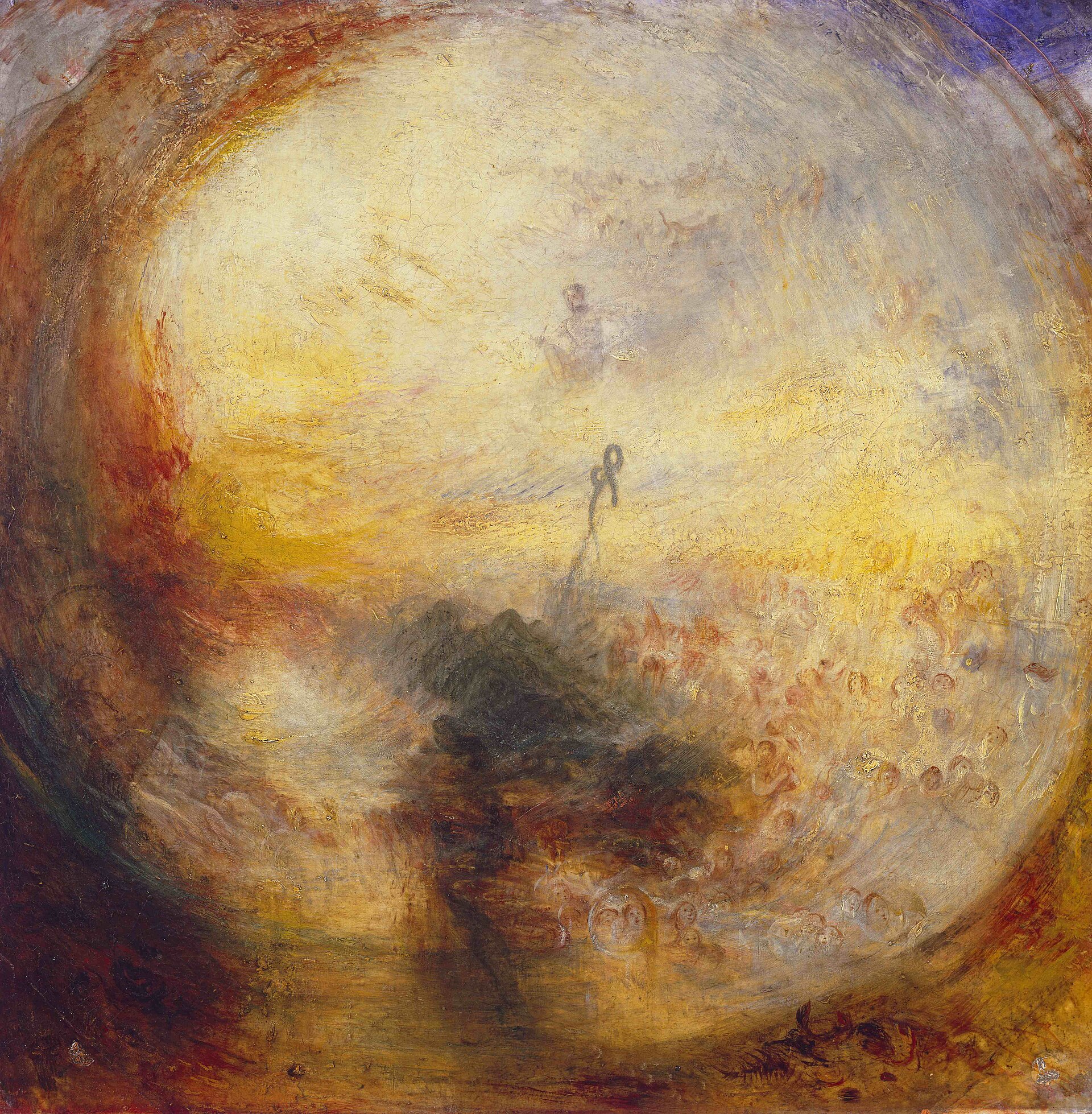
2 | J.M.W. Turner, Light and Colour (Goethe’sTheory) – The Morning after the Deluge – Moses Writing the Book of Genesis, 1843, London, Tate Gallery.
There has been important research on Goethe and Turner in art history, which can be divided into three main streams. The first is the theoretical aspect of color and line in Goethe’s theory analyzed by Rosenberg (Turner, Hugo, Moreau, 2007). He discusses the beginning of abstraction and the role of color and line. Through the analysis of his paintings and sketches, the author attempts to show the evolution of abstraction in Turner’s oeuvre. He goes beyond the profound theoretical analysis of Goethe’s color theory and its role in abstraction, focusing his analysis on the theoretical role of the line. The second approach was placed at the centre of the famous exhibition in Paris organized by Lemoine who attempted to understand how abstraction came to be invented (Lemoine, Rousseau, Jollet, Roque 2003). His approach centred on the relation between science and art, trying to grasp how scientific discoveries influence art. The third line of analysis developed around Maurice Tuchman’s groundbreaking exhibition The Spiritual in Art. Abstract Painting 1890-1985 organised in Los Angeles County Museum of Art in 1986 that was heavily influenced by Kandinsky’s The Spiritual in Art. The exhibition, among others, reevaluated Goethe’s theory of color and the role of pantheism, developing the spiritual sphere of abstract art and exploring the different artistic expressions of different religions (The Spiritual in Art, 1986). The idea was to enrich the spiritual, scientific, and theoretical discussions on Goethe’s theory and Turner with an analysis of the rhetoric of color. Is the theory of color incarnated in the iconography? In Turner, we could talk about ‘emotional rhetoric’, which means that Turner’s aesthetics becomes iconographic – a kind of ‘Iconosophy of color’ – meaning that iconography becomes philosophical when aesthetics or theories transform the level of perception of iconographic symbols. Thus, the character of the painting changes through the understanding of color theory.
V. With the eyes of Phenomenology
We can go even further. Today, at the intersection of epistemology, philosophical aesthetics, visual studies, art history, and spiritual theology, a desire and an idea have recently emerged to develop something akin to a history of looking or a history of seeing. Seeing is knowledge.
In Camera Lucida, Roland Barthes expresses a wish for a history of the ‘gaze’ (Roland Barthes 2016). He grounds this in the birth of photography, describing it as “the appearance of myself as someone else” – “a subtle dissociation of the consciousness of identity”. Gottfried Boehm, too, frequently writes about the process of seeing and its history (Boehm, 2011). He speaks of “successful” seeing – which is, paradoxically, also a form of “Versehen” (an oversight or mis-seeing). In doing so, he addresses both what is seen and the shadow of the invisible. Drawing on the writings of Georges Didi-Huberman, Wiebke-Marie Stock contributes to this “history of the gaze” (Wiebke-Stock 2011) rather than presenting a theory, she seeks a more precise understanding of what the history of seeing actually entails.
The concept primarily stems from the work of thinkers like Martin Heidegger, Karl Jaspers, and Edmund Husserl, who explored how our background assumptions dictate our relationship with the world. He called it epoché. In the ancient Greek philosophy there are two central concepts – the terms epoché (restraint/no judgment) and techné (art/craft/knowledge). One describes the conscious abandonment of thought and the other the creative, productive Gestaltung (shaping) of the world. The ‘phenomenology of seeing’ does not examine how religious or symbolic images (iconography) are experienced and perceived by the human consciousness (phenomenology), but it examines the being and the spirit and sense of iconography. It means seeing the image phenomenon as such, before interpreting its cultural or historical contexts. It is about the meaning, the being, and the spirit of the iconography, which can only be recognized in dialogue with the artwork
In this context Romano Guardini developed his Welt-Anschauung. Through an analysis of Michelangelo’s poems, Guardini identifies seeing as knowledge and ultimately contributing to the process of “becoming human”. The experience of seeing – precisely as an experience – cannot be reduced to anything else; it is a primordial phenomenon that touches upon the mystery of existence. Heidegger writes that a phenomenon always presupposes a task. Seeing, he suggests, is “the response to the fact that something to-be-seen exists”. Thing and eye, figure and its comprehension form is one of the fundamental relationships in which existence is situated: “That-which-is-to-be-seen bestows the capacity to see”. Life and its sense – linked to the experience of an ‘encounter’ – respond to certain laws: “The radiance must be understood precisely as the most explicit expression of that ‘aliveness’ and that ‘encountering’ which belong to the deepest depths of appearing”. The “look meeting the look” of the other is aptly described in a passage from the Phaedo that Guardini takes up and interprets in a very particular sense: “Then Socrates gazed composedly ahead, as was his wont, and said with a faint smile […]: he sat there, ‘looking through’ – through the near into the far, or more precisely, into the inner, the being ...” (Guardini, 1987).
Seeing is to be understood as a bodily experience, alongside the purely process of rational knowledge. Seeing becomes the “creative expression” of appearances, revealing the sense of things. The look thus grasps not only the iconographic meaning, but it is about the sense of iconography. In this case, the space of iconography becomes a space of love. We speak of a new space of narrative (Bible, myth, story, etc.) that transcends words. This is when, in the encounter, a new sense beyond that of iconography is capable of giving birth to something new. It is not only about beauty, symbols of the iconography, nor is it solely about spatial and temporal transformation processes that take place within the beholder, it is about the being and the sense of iconography itself. Rather, in the artwork, the world itself becomes the stage. The world in the image becomes the creation of the iconographic narrative itself. This means that the world is transformed within our seeing. This cannot be grasped through iconography alone, but can only be experienced through the act of seeing.
VI. With the eyes of the Welt-Anschauung (Contemplative seeing of the world)
With Guardini, we could even go a step further and ask about the ‘being’, the ‘meaning’, and the ‘spirit’ of iconography, which cannot be recognized by deconstructing the iconographic elements but requires seeing. With the Welt-Anschauung, the contemplative seeing of the world attends to the meaning of the whole encounter: what the work asks of its maker and beholder, how it changes their relation to a problem or another person, and whether usefulness has become the only criterion. It accompanies analysis and evidence. The aim is to understand an AI system as a human-made reality with its own operations, situated within human purposes, relationships and responsibilities.
Guardini writes:
“We have recognized specialized science and philosophy – in contrast to Weltanschauung (Contemplative seeing of the world) – as being more vital and closer to life. Yet, Weltanschauung must also be distinguished from life itself – from creative and active deeds. Its concern is with vision and contemplation, not with action or doing. To be sure, it implies insight into the world as a task – a call to create – but in itself, it remains insight rather than the work itself; it is the foundation of action, not an act in its own right. A comprehension of the world is an encounter between the world and the human being – standing face-to-face – yet it is a confrontation that takes place within the eye. It is a look, an act of knowledge, even if that knowledge is imbued with content far weightier and closer to life than the vision of science and philosophy. The very being of the world-view-perspective lies in the sincerity of this look. Certainly, this look may – indeed should – be borne by a certain fervor, yet it is the fervor of vision, not of action. The former broadens and deepens the look, for love is endowed with sight; the latter, by contrast, would cloud it. A world-seeing does not create; it beholds. Admittedly, a formative process is at work within it – a profound creative power – but it is a shaping that arises from vision. Here, the human being sees things as they are in themselves; he does not transform them into what he wills them to be – even if that were of a ‘transcendental’ nature. What the world-view beholds is already there. It is, indeed, an attitude of the whole person, yet one that culminates in seeing, in cognition. Its activity rises to the highest intensity and inwardness, yet it remains ever a matter of beholding, not of acting” (Guardini 1987).
Welt-Anschauung is about cultivating a “contemplative seeing of the whole”, which is always the perspective of a respective faith, within science. A change of mind and heart becomes a steadier attitude toward things. Knowing, creating and personal transformation belong together to a process that cannot be fully controlled.
So, what does it mean for the iconography? How should we look at the iconography? Guardini proposes that rational cold knowledge will be accompanied by this contemplative knowledge. Iconography is much more than the sum of facts, but has a deeper sense. Guardinis’ Welt-Anschauung is a matter of a more accurate understanding of the world, from which a shaping of the world, that is truer to its being and to the truth, can emerge – above all through this shift in mindset (metanoia) that gives rise to a new, steadfast attitude toward things. Metanoia links the process of knowledge (thinking) and the following creative act (as for example writing a paper). This process, leading from understanding to creating, is bound up with the transformation of one’s own self. This should be a part of the process of knowledge: being honest in the way we look at things. A change of mind and heart becomes a steadier attitude toward things. Knowing, creating and personal transformation belong together to a process that cannot be fully controlled.
As Antoine de Saint-Exupéry writes in his book The Little Prince: “One can only see well with the heart. The essential is invisible to the eye” (de Saint-Exupéry 1943).
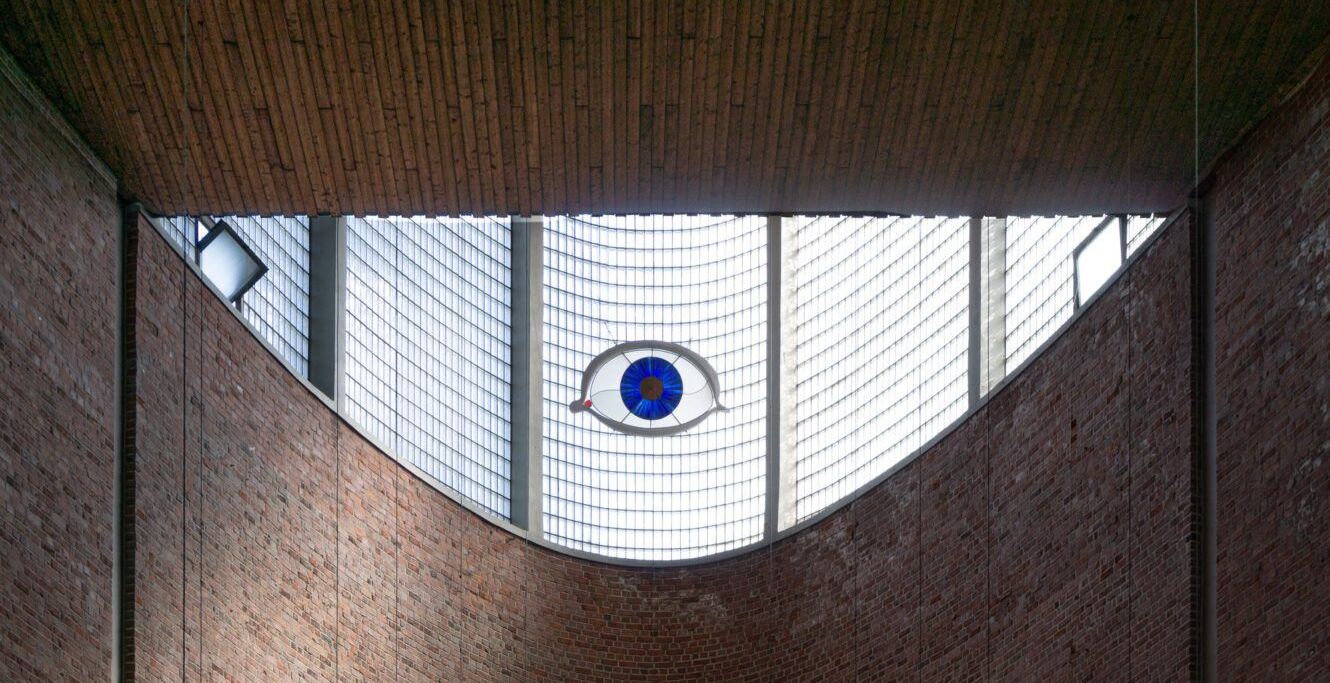
3 | Stained-glass apse of the Holy Cross Church, work of glassmaster Georg Meistermann on project of architect Rudolph Schwarz, 1953-1957, Bottorp, Essen.
Bibliographical References
- Belting 1990
H. Belting, Bild und Kult. Eine Geschichte des Bildes vor dem Zeitalter der Kunst, München 1990. - Belting 2001
H. Belting, Das Ende der Kunstgeschichte. Eine Revision nach 10 Jahren, München 2001. - Boehm 1989
G. Boehm, Was heißt Interpretation?, in C. Fruh, R Rosenberg, H.-P. Rosinski (eds.) Kunstgeschichte - aber wie? Zehn Themen und Beispiele, Berlin 1989, 13-27. - Come in cielo 2017
Come in cielo così in terra. Seul e i 230 anni della Chiesa cattolica in Corea, Arcidiocesi di Seul e Seoul Museum of History (ed.), Città del Vaticano 2017. - Cottin 2017
J. Cottin, Die pädagogische und katechetische Dringlichkeit, in U. Hauser, S. Hermann (eds.), Bildung. Europäische Perspektiven. Der Religionsunterricht. Perspektiven und Probleme, Stuttgart, 2017, 86-104. - Cottin 2017b
J. Cottin, Pour une théologie catéchétique de l’art et des images, “Lumen Vitae”, LXXII, n. 1, (2017), 47-61. - Dittmann 1969
L. Dittmann, Raum und Zeit als Darstellungsformen bildender Kunst. Ein Beitrag zur Erörterung des kunsthistorischen Raum-und Zeitbegriffes in: Alfred C. Boettger u.a. (ed.) Stadt und Landschaft Raum und Zeit, Festschrift für Erich Kuehn zur Vollendung seines 65. Lebensjahres, Köln, 1969, 43-55. - Dohna Schlobitten, Piňero Moral 2011
Y. Dohna Schlobitten, R. Piňero Moral, Iconosophy. The Relationship between Color Theory and Iconography (Goethe and Turner. The Labyrinth of Word and Light), “ARS” (Journal of the Institute of Art History of Slovak Academy of Sciences), 44, vol. 2 (2011), 82-111 - Dohna Schlobitten 2012
Y. Dohna Schlobitten, La bellezza e la seduzione e il peccato. Riflessi antropologici in alcune opere di Michelangelo, Raffaello e Stuck, in F. Brancaccio, D. Concolino (eds.) Progetto Universus, La persona crocevia dei Saperi, Todi 2012, 81-113. - Dohna Schlobitten 2016
Y. Dohna Schlobitten, Lasciarsi guardare. Antropologia filosofica e teologica dell’arte come preghiera. A partire da Romano Guardini, “Ignaziana” 21 (2016), 87-108. - Dohna Schlobitten 2021
Y. Dohna Schlobitten, Romano Guardini. La vita come opera d’arte. Scritti di Estetica (1907-1960), Brescia, 2021. - Dohna Schlobitten 2021b
Y. Dohna Schlobitten, Das schauende Denken auf das Ganze: Romano Guardini und die Didaktik des Blicks auf die Wirklichkeit im Gebet, in: O. Dürr, R. Kunz, A. Steingruber (eds.) Wachet und betet. Mystik, Spiritualität und Gebet in Zeiten politischer und gesellschaftlicher Unruhe, vol. 10, Studia Oecumenica Friburgensia 105, Münster, 2021, 331-345. - Dohna Schlobitten 2022
Y. Dohna Schlobitten (ed.), Pope Art. Tra esperienza religiosa, Estetica e Spiritualità. Verso una teologia della teoria e critica dell’arte contemporanea, Roma 2022. - Dohna Schlobitten 2023
Y. Dohna Schlobitten, Verso nuovi occhi. L’arte dello sguardo sul tutto, Assisi, 2023. - Dohna Schlobitten, in print
Y. Dohna Schlobitten, Die Bibel von Marina Abramović – Künstlerin, Frau, (feministische) Rebellin Inkarnation der Liebe in der Kunst (in print). - Galansino Perov 2017
A. Galansino, P. Perov (eds.), Bill Viola. Rinascimento elettronico, Firenze 2017. - Grave 2022
J. Grave, Bild und Zeit. Eine Theorie des Bildbetrachtens, München, 2022. - Gerl Falkovitz
H.-B. Gerl Falkovitz, Auge und Licht. Annäherung an Romano Guardinis Wahrnehmung von Welt, Trigon. Kunst, Wissenschaft und Glaube im Dialog, “Taschenbuch” 9 (2011). - Guardini
Romano Guardini, Der Tod des Sokrates, 5th edition, Main 1987. - Imdahl 1983
M. Imdahl, Moderne Kunst und Medien. Ein Vortrag, “Das Kunstwerk” 36, no. 1 (1983), 18-21. - Imdahl 1986
M. Imdahl, Moderne Kunst und visuelle Erfahrung, “Neue Ziircher Zeitung” (15.-16.2.1986.) - Imdahl [1971] 1996
M. Imdahl, Who’s Afraid of Red, Yellow and Blue IE [Werkmonographien zur Bildenden Kunst, 147, Stuttgart 1971], in A. Janhsen- Vukicevic (ed.) Zur Kunst der Moderne. Gesammelte Schriften, vol. 1, Frankfurt 1996, 244-273. - Lemoine, Rousseau, Jollet, Roque 2003
S. Lemoine, P. Rousseau, E. Jollet, G. Roque (eds.), Aux origines de I’abstraction, 1800- 1914. [Exhib. Cat. Musee d’Orsay], Paris 2003. - Papa Francesco 2015
Pope Francis, La mia idea di arte, Città del Vaticano, Milano 2015. - Papa Francesco 2020
Pope Francis, Let Us Dream: The Path to a Better Future, New York 2003. - Panofsky 1978
E. Panofsky, Ikonographie und Ikonologie. Einführung in die Kunst der Renaissance [1939], in Sinn und Deutung in der bildenden Kunst, Köln 1978, 33-65. - Rosenberg 1989
R. Rosenberg, Einleitung, in C. Fruh, R. Rosenberg, H.-P. Rosinski (eds.) Kunstgeschichte - aber wie? Zehn Themen und Beispiele, Berlin 1989. - de Saint-Exupéry 1943
Antoine de Saint-Exupéry, The Little Prince, New York 1943. - Simmel 1910
G. Simmel, Michelangelo. Ein Kapitel zur Metaphysik der Kultur, “Logos” 1 (1910/1911), 207-227. - The Spiritual in Art, 1986
The Spiritual in Art: Abstract Painting 1890-1985, M. Tuchman, J. Freeman (eds.), Los Angeles County Museum of Art/Abbeville Press, New York 1986. - Turner, Hugo, Moreau, 2007
Turner, Hugo, Moreau. Entdeckung der Abstraktion. R. Rosenberg, M. Hollein (eds.). Frankfurt, Schirn Kunsthalle. München 2007. - Brech 2016
C. Brech (ed.), Überleben. Installationen im Dialog mit dem Mittelalter, München 2016. - Venturi 1964
L. Venturi, Storia della critica d’arte, Torino, 1964. - Wiebke-Stock
Wiebke-Stock, Geschichte des Blicks. Zu Texten von Georges Didi-Huberman, Berlin 2011. - Wölfflin 1915
H. Wölfflin, Kunstgeschichtliche Grundbegriffe. Das Problem der Stilentwicklung in der neueren Kunst, München 1915.
Abstract
Venturi’s claims that there is an inherent danger in the iconographic method is responsible for the prejudice that developed against the iconographic method in art history. In phenomenology, Husserl called the knowledge of art (Kunsterkenntnis) epoché and Belting examines the limits of iconography in a short excerpt “The End of Art History”. The iconographic discourses are often detached from the concrete way of life and thought of the artist and from the time because they only abstractly examine the history of iconographic symbols through the centuries and do not inquire into the deeper sense, being and spirit of the respective iconography. On one hand, it means, that iconography alone cannot fully explain the meaning of artworks and that a phenomenology can offer a complementary way of understanding the work of art. However, the phenomenology of seeing, with Romano Guardini’s Welt-Anschauung (contemplative seeing of the world), could reveal the sense and spirit of iconography. Here we go one step further and open up a thought-provoking reflection on the understanding of iconography with a phenomenological argument grounded in an Anschauung. The main contribution of this text lies in the attempt to move beyond conventional iconographic analysis and explore the ‘spirit’ and ‘being’ of iconography. This is an approach that brings together contemporary debates in art history, phenomenology, theology, and aesthetics and provides a rich interdisciplinary foundation, but it also asks for a new kind of knowledge.
keywords: spiritual iconography; epoché; phenomenology; World-contemplation; Weltanschauung; Romano Guardini
La Redazione di Engramma è grata ai colleghi – amici e studiosi – che, seguendo la procedura peer review a doppio cieco, hanno sottoposto a lettura, revisione e giudizio questo saggio (v. Albo dei referee di Engramma)
Per citare questo articolo / To cite this article: Yvonne Dohna Schlobitten, The Phenomenology of Seeing: Guardini’s Welt-Anschauung, “La Rivista di Engramma” n. 238, agosto 2026.